Cascara: The Coffee Cherry Tea Most Farms Throw Away
Quick Answer
Cascara is the dried skin and pulp of the coffee cherry, brewed like tea rather than roasted like a bean. A review published in PubMed Central reports that roughly 90% of the edible parts of the coffee cherry are discarded or become by-products during conventional coffee production, which is why most farms never sell the fruit at all. The infusion tastes fruity and sweet, closer to hibiscus or raisin than to coffee, and its caffeine content sits well below a cup of brewed coffee. Brew it at about 1:15 to 1:18 by weight for 4 to 5 minutes.
Key Takeaways
- The bean is a seed inside a fruit. The dried coffee husk left over after the seed is removed is what gets sold as coffee cherry tea.
- About 90% of the edible coffee cherry becomes a by-product in conventional production, according to a review in PubMed Central (2020).
- Dry-processed husk can represent around 45% of coffee-cherry mass, and Colombian figures cited in that same review show about 39 kg of skin and pulp per 100 kg of fresh cherries.
- Caffeine is modest, typically reported by sellers as a fraction of brewed coffee. EFSA's general caffeine guidance for healthy adults is up to 200 mg in a single dose and up to 400 mg per day, with lower advice during pregnancy.
- The EU authorized dried coffee cherry pulp and its infusion as a traditional food under Commission Implementing Regulation (EU) 2022/47, adopted January 13, 2022, with limits for mycotoxins, heavy metals, and microbial contamination .
- Royal Coffee's February 2026 report called coffee upcycling "scale-limited," naming drying capacity, spoilage, and export difficulty as the real bottlenecks.
- Brew ratio to start: 8 g of husks to roughly 125 ml water, 4 to 5 minutes, then taste and adjust.
Cascara: What It Is and Where It Comes From
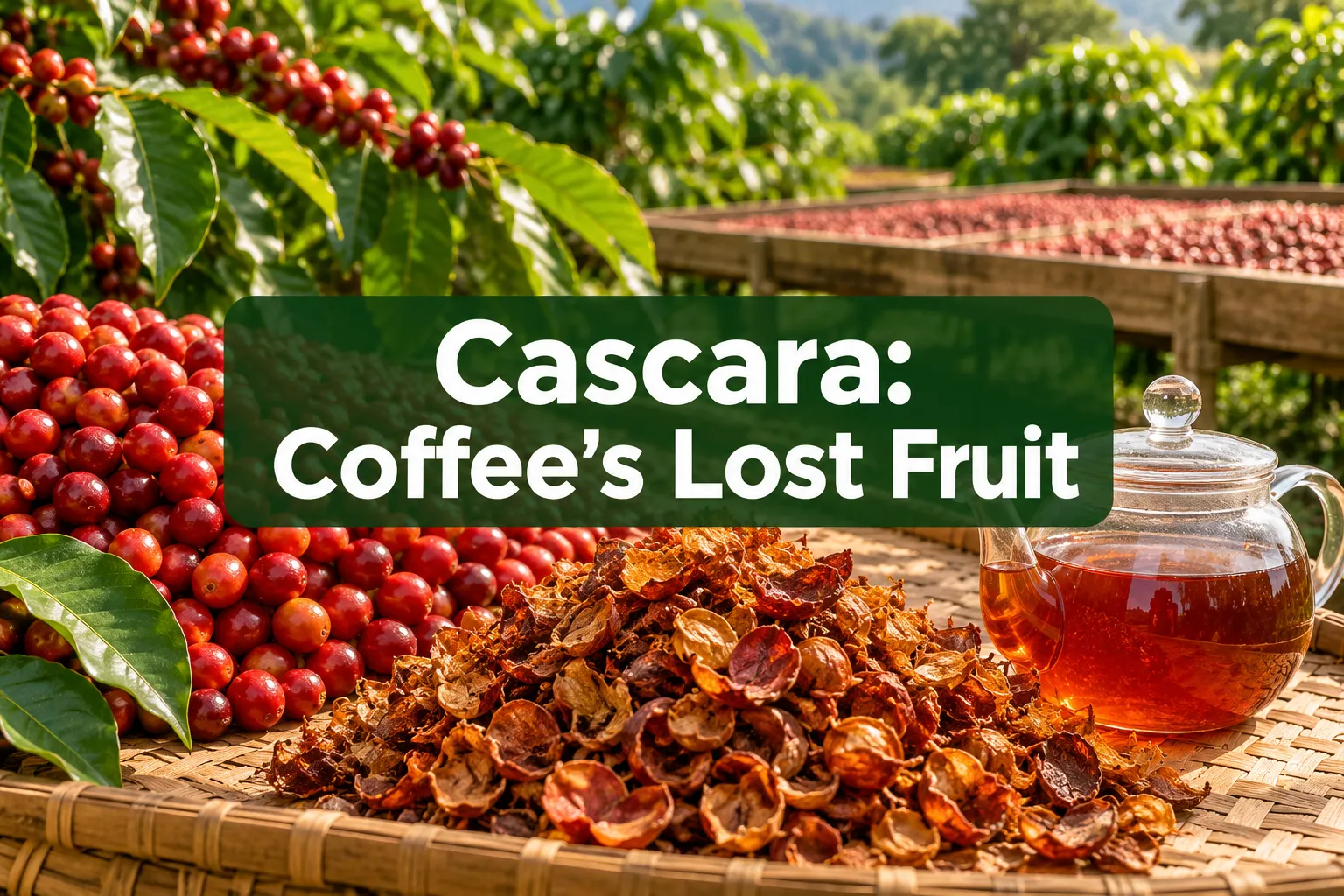
Cascara is the dried fruit skin and pulp of the coffee cherry, sold loose and steeped in hot water like tea. The Spanish word means husk or peel. It is a by-product of coffee processing, not a separate plant.

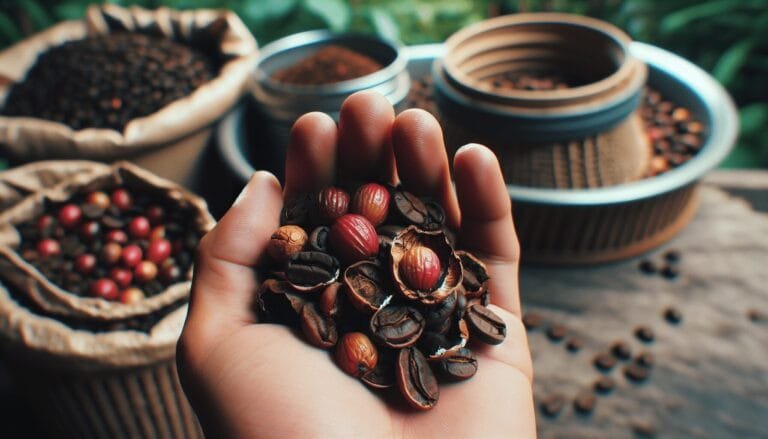
Every coffee bean you have ever ground started life as a seed, usually two of them, inside a small fruit about the size of a cranberry. Ripe cherries on Coffea arabica turn deep red or sometimes yellow. The layers run skin, then sticky sweet mucilage and pulp, then a papery parchment, then the green seed.
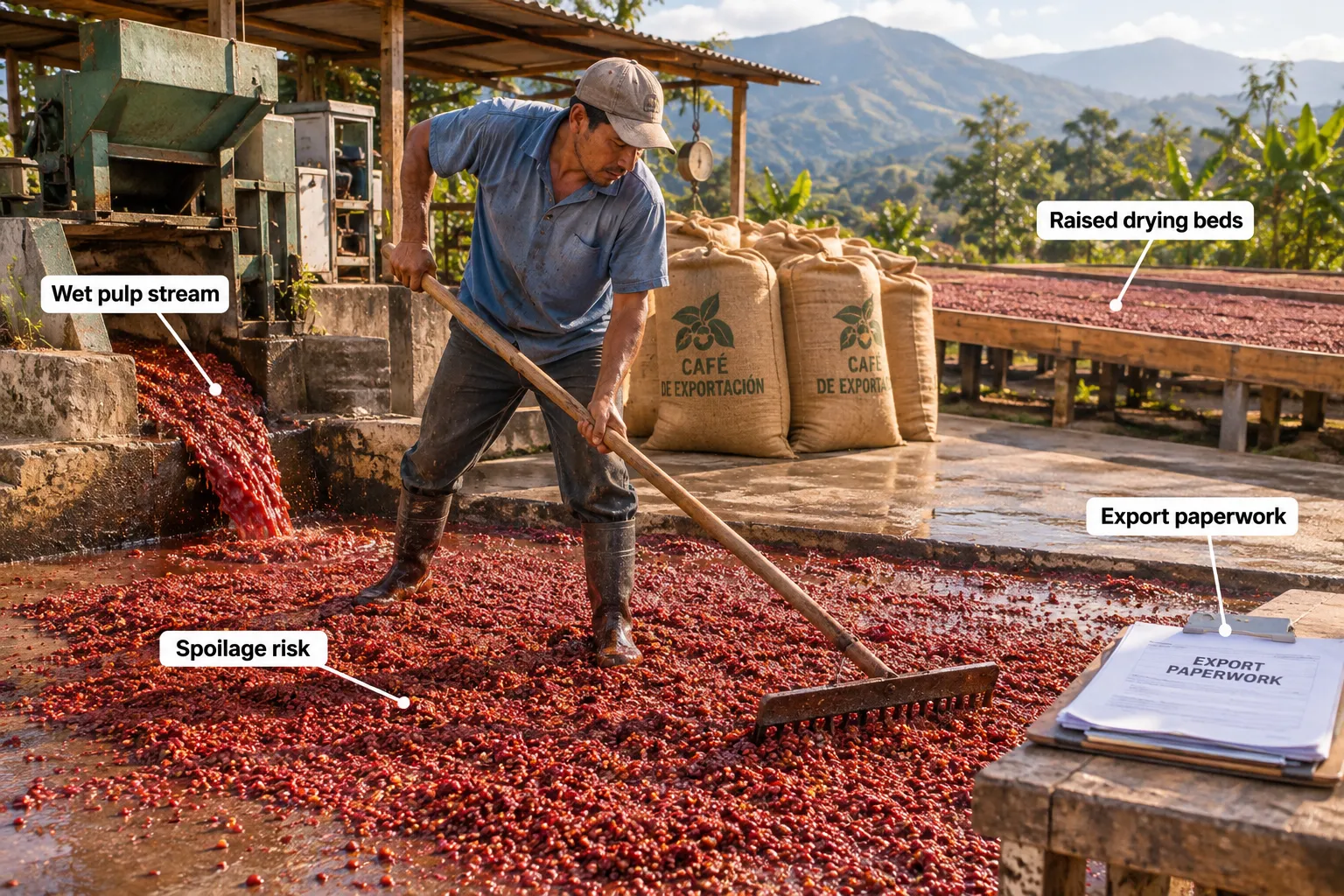
Coffee processing exists to remove everything that is not the seed. In dry (natural) processing, whole cherries dry in the sun and the brittle husk is hulled off later. That husk, containing skin, pulp, and sometimes parchment, is the classic source material. In wet (washed) processing, machines strip the skin and pulp off fresh, producing a wet, fast-fermenting pulp stream with completely different moisture and microbial behavior.
Researchers writing in PubMed Central's Coffee By-Products as Sustainable Novel Foods (2021) stress that these streams are not interchangeable. Dry husk and wet pulp differ in composition, drying difficulty, and spoilage risk. Treating them as the same product creates both quality and regulatory headaches.
)
Names vary by origin. Yemen has qishr, a spiced coffee husk drink historically consumed long before the roasted bean became the global default. Ethiopia has hashara and related preparations. Bolivian producers helped popularize the modern specialty version in the 2010s. The documented history and the marketing story are not the same thing: husk drinks are old, but the current export trade in bagged coffee cherry tea is recent.
Why do coffee farmers throw cascara away?
Most farms discard the fruit because turning it into food costs money, space, and risk that the coffee market does not pay them for. Pulp comes off wet, ferments fast in warm climates, and needs clean drying space that is usually already full of coffee.
The economics are blunt. A washing station processing several tonnes of cherry a day produces a mountain of pulp within hours. Leaving it to rot creates a waterway pollution problem. Drying it properly for human consumption means raised beds, sorting, moisture control, and storage, all competing for the same resources used to dry the coffee itself, during the same busy weeks.
)
Royal Coffee's February 2026 report on coffee upcycling landed on a conclusion worth repeating: the practice is technically feasible but scale-limited. The report named three obstacles directly.
- Drying. Food-grade husk needs controlled drying, not a tarp.
- Spoilage. Mold and off-flavors develop quickly in wet pulp.
- Export difficulty. Customs classification, food-safety documentation, and small lot sizes make shipping awkward.
Royal Coffee recommended practical on-farm processing and cooperative infrastructure rather than rushing to mass-market expansion. That is a more honest read of the situation than the usual "waste into gold" framing.
The misconception this article corrects: people often assume coffee cherry tea is leftover material a farm can bag up for free. It is not free. It is a second crop with its own drying, food-safety, and shipping costs, which is exactly why the price per ounce sometimes surprises buyers.
There is movement on the money side. ofi reports that its Upcycled Certified KOFEFRUT soluble coffee-fruit ingredient is sourced across six origins and delivers an average 25% additional revenue for participating coffee farmers, along with a 10% reduction in greenhouse-gas emissions from diverting the fruit out of the waste stream. Those are company-reported figures, not independently audited in the source, so treat them as a producer's claim rather than a verified benchmark.
How much caffeine is in cascara, and how does it compare to coffee?
Coffee cherry tea contains caffeine, but considerably less per cup than brewed coffee. Published figures vary widely because caffeine in the dried husk depends on variety, processing, how much parchment is included, and your brew ratio. The seed holds most of the caffeine; the fruit holds a smaller share.
Sellers commonly describe the infusion as somewhere between green tea and black tea in strength, and clearly below drip coffee. Treat any single number you see online with suspicion unless the seller states the serving size and the testing method. Market analysts tracking the category describe natural caffeine content and antioxidant claims as the main commercial selling points , which is also why serving-level data matters.
For context on what counts as a lot, EFSA's caffeine guidance states that single doses up to 200 mg generally raise no safety concern for healthy adults, and habitual intake up to 400 mg per day is generally acceptable for healthy adults, with lower advice for pregnancy and other sensitive groups.
| Drink | Typical serving | Caffeine level | Flavor family |
|---|---|---|---|
| Coffee cherry tea (husk infusion) | 8 oz steeped 4-5 min | Low; reported well below drip coffee | Tart red fruit, dried stone fruit |
| Drip coffee | 8 oz | Highest of these four | Roast, cocoa, acidity |
| Green tea | 8 oz | Low to moderate | Grassy, vegetal, umami |
| Hibiscus tisane | 8 oz | None | Sharp tart berry |
Decision rule: if you want an afternoon drink that still tastes like something grown on a coffee farm but will not rearrange your sleep the way a second espresso does, the husk infusion is a sensible swap. If you need a real caffeine hit, drink coffee.
What does the coffee cherry tea taste like?
Roasters who sell it publish remarkably consistent tasting notes: hibiscus, raisin, cherry, rosehip, honey, and brown sugar. Those are the sellers' published descriptors, not a tasting panel result from this publication.
The liquid brews a clear reddish amber, closer to rooibos than to coffee. Body is light. Acidity reads as tart and fruity rather than the citric brightness you get from a washed Ethiopian pour over. Sweetness is the part that surprises first-time drinkers, since nothing has been added.
What it does not taste like is coffee. There is no roast character, no bitterness from pyrolysis, no cocoa. A comparative taste write-up from Jayarr Coffee describes the coffee-fruit infusion as sitting in a distinctly different sensory category from the brewed bean .
Variation comes from the same variables that move any crop: cherry variety, ripeness at picking, drying method, and age. Older stock loses aromatic lift and starts tasting flat and papery, in the same way stale leaf tea does. Check the harvest or packing date the way you would check a roast date on beans.
How do you brew cascara tea at home?
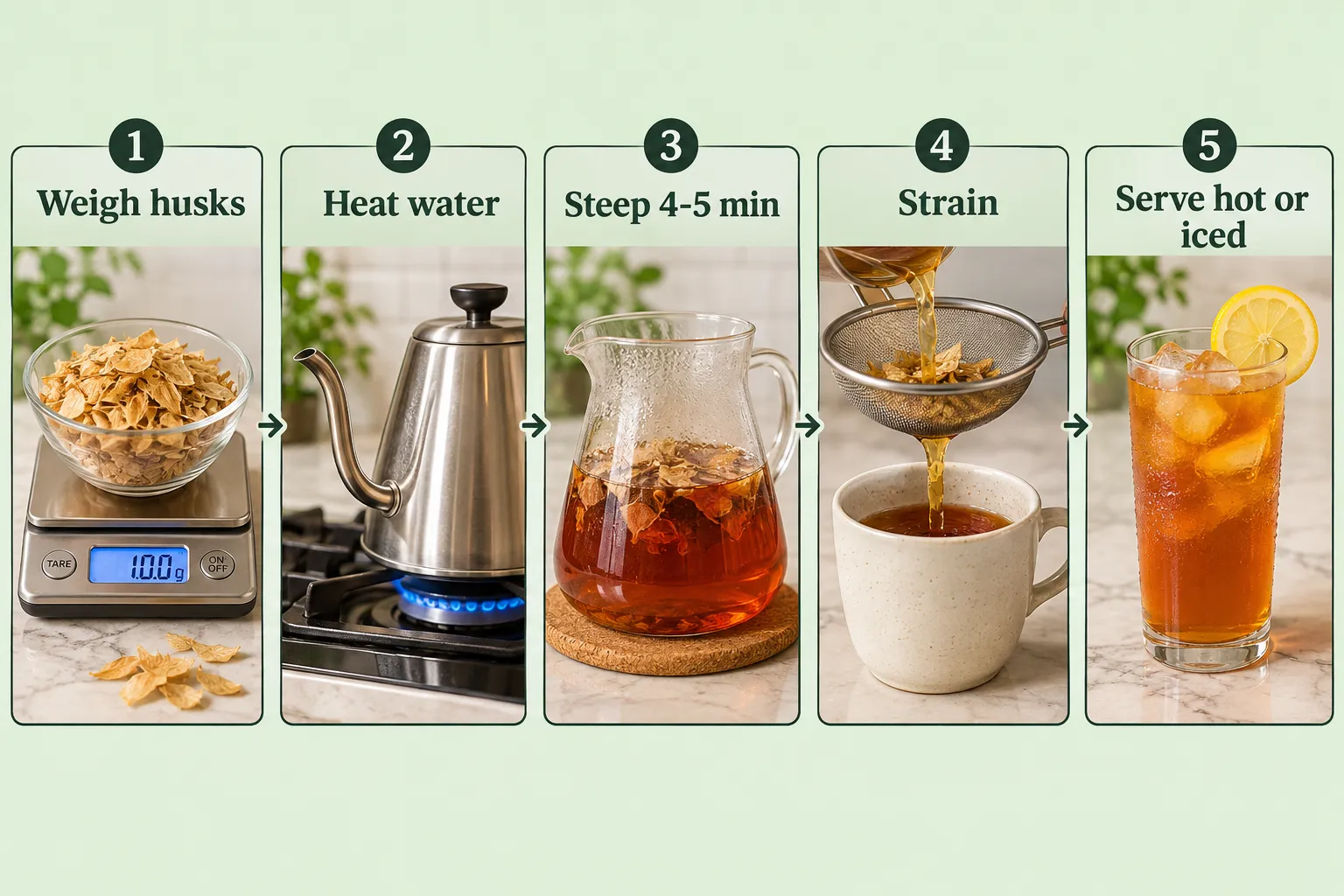
Steep 8 g of dried husks in roughly 125 ml of water just off the boil for 4 to 5 minutes, then strain. That lands you near a 1:15 brew ratio, which is a reliable starting point before you adjust to taste.
Equipment
- A scale. Husks are light and bulky, so volume measurements are unreliable. If you do not have one, compare the models before buying.
- A French press, teapot with an infuser, or any vessel plus a fine mesh strainer.
- A kettle. A thermometer helps but is not required.
Method
- Weigh. 8 g husks for a single large mug, 16 g for a small pot.
- Heat water to about 200 to 205°F (93 to 96°C). Boiling water is acceptable here; the fruit is more forgiving than ground coffee, where water temperature swings change extraction noticeably.
- Combine and steep 4 to 5 minutes. Stir once at the start so everything is wetted. No bloom is needed, since there is no trapped carbon dioxide the way there is in freshly roasted beans.
- Strain completely. Leaving husks in the pot keeps pulling tannin and turns the cup drying.
- Taste and adjust. Thin and watery means go to 1:12. Astringent and puckering means go to 1:18 or cut the steep to 3 minutes.
)
Three variations worth trying
- Iced. Brew at 1:10, strain over a glass full of ice. Tart, bright, excellent in July.
- Cold brew. 1:15 in the fridge for 12 to 16 hours. Rounder and sweeter, less tannic. Similar logic to any cold brew setup.
- Qishr style. Add crushed ginger and a crack of cinnamon during the steep, a nod to the Yemeni preparation.
Common mistakes when brewing coffee cherry tea
- Over-steeping. Past about 7 minutes the cup turns tannic and flat. This is the single most frequent complaint.
- Guessing the dose by eye. Dried husk is feather light. A heaping spoon might be 2 g.
- Grinding it. Do not. Whole husk is the point; grinding produces sediment and harsh extraction.
- Reusing the husks. A second steep gives you tinted water.
- Storing it loose in a warm cupboard. It is a dried fruit and it stales. Airtight, cool, dark.
Is cascara good for your health, and what are the risks?
The fruit contains caffeine, polyphenols, and dietary fiber, and research interest is real, but human clinical evidence specific to the infusion is limited. Nothing here should be read as treatment, prevention, or a health claim.
Most of the published work is compositional or laboratory analysis: measuring chlorogenic acids, caffeine, and antioxidant capacity in by-product material. A 2026 review in Beverages (MDPI) examining coffee by-products as food emphasizes that authorization and evidence for one preparation do not automatically transfer to other derivatives such as extracts or concentrates . A systematic review protocol on coffee cherry products has also been registered with PROSPERO, the international prospective register of systematic reviews, which signals that the evidence base is still being assembled rather than settled .
EFSA's botanicals guidance makes the same point from the safety side: the presence of a plant or a compound of interest does not by itself make a product unsafe or beneficial. Safety and effect depend on the plant part, the preparation, the concentration, and how it is used. A gentle infusion and a concentrated powder are different products.
How does it compare to green tea?
Honest answer: there is far more human research on green tea than on coffee cherry infusions, so a head-to-head health comparison is not supportable yet. Green tea has decades of epidemiological and interventional studies behind it. Coffee fruit has mostly compositional work and early trials on extracts. If you want a drink with a deeper research record, green tea wins on evidence volume. If you want a lower-caffeine fruit-forward cup with a story attached, the coffee husk delivers that.
Side effects and who should be careful
- Caffeine sensitivity. Lower than coffee, but not zero. People who react badly to caffeine late in the day should treat it like tea, not like a herbal tisane.
- Contaminant risk from poorly dried material. The EU authorization sets limits for mycotoxins, heavy metals, polycyclic aromatic hydrocarbons, and microbial contamination precisely because badly dried fruit can carry them . Buy from sellers who handle food-grade drying, not from improvised sources.
- Name confusion. "Cascara sagrada" is a completely different botanical, a bark used as a laxative. The coffee by-product is not related and does not act the same way. Check labels.
Can pregnant women drink it?
Pregnant and breastfeeding people should treat it as a caffeinated drink and count it toward their daily caffeine limit, following their own clinician's advice. EFSA advises lower caffeine intake during pregnancy than the general adult figure. Because serving-level caffeine data is inconsistent across brands, the safer route during pregnancy is to ask your healthcare provider and choose a product that states its caffeine per serving.
Is coffee cherry tea actually sustainable?
The waste-reduction logic is genuine, but the environmental benefit depends entirely on how the fruit is handled. Drying the pulp and selling it is better than dumping it in a river. Trucking poorly dried husk across the world to be thrown out at a port is not.
The scale of the opportunity is well documented. The PubMed Central review cited earlier reports that around 90% of the edible parts of the coffee cherry are discarded during conventional production, that dry-processed husk can account for roughly 45% of cherry mass, and that Colombian figures show about 39 kg of skin and pulp per 100 kg of fresh cherries. That is a large material stream currently doing little useful work.
Three things have to go right for the sustainability case to hold:
- The fruit is dried promptly to a food-safe moisture level, which prevents both spoilage and the methane produced by rotting heaps.
- The farmer is actually paid for it, otherwise there is no reason to do the extra labor.
- Demand is steady enough to justify the infrastructure, which is the part Royal Coffee's 2026 report flagged as weakest.
Market trackers continue to project growth for the category , and interest among roasters and beverage brands is real. Projections are forecasts, not measured outcomes, so read them as expectations rather than facts.
Where can you buy coffee cherry tea, and what does it cost?
Specialty roasters are the most reliable source, usually in 3 to 8 oz bags, often listed seasonally alongside their single origin coffees. Direct trade importers and a handful of dedicated tea retailers also stock it.
Pricing varies by origin and lot size, and it is frequently higher per ounce than people expect given that it is a by-product. That premium reflects the drying labor, low volumes, sorting, and export paperwork discussed earlier, not a markup for novelty alone. Check the current price at the roaster rather than relying on any figure quoted in an article, since these lots are small and move in and out of stock.
What to look for on the label:
- Origin and producer or cooperative name
- Harvest or packing date
- Processing type (dry husk versus pulp)
- Whether caffeine content per serving is stated
- Food-grade handling or an upcycled certification mark
Availability depends on where you live. In the EU, dried coffee cherry pulp and its infusion are authorized as a traditional food from a third country under Commission Implementing Regulation (EU) 2022/47 and appear in the Union list of novel foods . That authorization is product-specific and does not cover every coffee-fruit derivative, so extracts and fermented products face their own review .
The commercial center of gravity has also been drifting away from loose husks. Zurich-based CAZ Cascara reported on August 6, 2026 that its coffee-cherry-pulp drink was listed in roughly 50 Swiss bars and restaurants, including venues in Bern and Zurich, and that it added a sugar-free version, CAZ Zero, in June 2026 after customer feedback. BeGOAT launched a zero-sugar Watermelon Dragonfruit beverage in March 2026 using caffeine from its Cascara+ coffee-fruit ingredient . ofi sells KOFEFRUT as a soluble powder for reduced-sugar ready-to-drink formats including Honey Plum and Lemon, as covered by SupplySide Food & Beverage Journal. If you want to taste the fruit itself, buy the loose husk before the industry finishes converting it into ingredient powder.
FAQ

Conclusion
Coffee cherry tea gives home brewers something genuinely new that still belongs on a coffee shelf: a light, tart, naturally sweet infusion made from the part of the crop the industry spent a century treating as trash. The research case for the by-product's volume is solid, the sustainability case holds only when drying and payment are handled properly, and the health evidence is early enough that nobody should buy it as medicine.
Your next step is small. Order a 4 oz bag of single-origin loose husks from a roaster that lists the producer and the packing date, weigh out 8 g, and steep it for 4 minutes at roughly 1:15. Write down what you taste. Then brew it again at 1:18 and decide which one you would make again on a Tuesday afternoon. Better Coffee Starts With Better Answers, and this one starts with the fruit you have never tasted.
Cascara brew ratio calculator
Enter your cup size, pick a strength, get the husk dose and steep time.
Starting points only. Taste, then move the ratio one step if the cup is thin or astringent.