
Who Invented Espresso? The 1884 to 1948 Timeline
Who Invented Espresso: The Short Documented Answer
No single person invented espresso, and the question of who invented espresso has four documented answers spread across 64 years: Angelo Moriondo (Turin, 1884), Luigi Bezzera (Milan, 1901), Desiderio Pavoni (Milan, 1905), and Achille Gaggia (Milan, 1948). Each solved a different problem, and the drink you order today only exists because all four stages happened.
Key Takeaways
- Angelo Moriondo patented a steam-and-water coffee apparatus in Turin in 1884, shown at the Turin General Exposition. It was a bulk brewer, not a shot machine .
- Luigi Bezzera filed patents from 1901 for a machine with a group head and portafilter that brewed one cup to order .
- Desiderio Pavoni bought Bezzera's patent rights and began commercial production of the Ideale around 1905, putting the machine into cafés .
- Achille Gaggia patented a spring-piston lever design and launched it commercially in 1948. The higher pressure produced crema, the hazelnut foam on top .
- Early machines ran on steam pressure of roughly 1.5 to 2 bar. Gaggia's lever pushed water at around 8 to 10 bar, which is the modern standard .
- The word espresso originally signalled coffee made expressly for one customer, on the spot, not "fast" in the American sense .
- Historian Jonathan Morris argues Moriondo's machine was never a single-shot brewer, which is why crediting him alone with inventing espresso is inaccurate.
Who Invented Espresso
Four Italians, in sequence, between 1884 and 1948. Asking who invented espresso is a little like asking who invented the car: there is a first patent, a first usable product, a first commercial success, and a first version that resembles what you drink now.
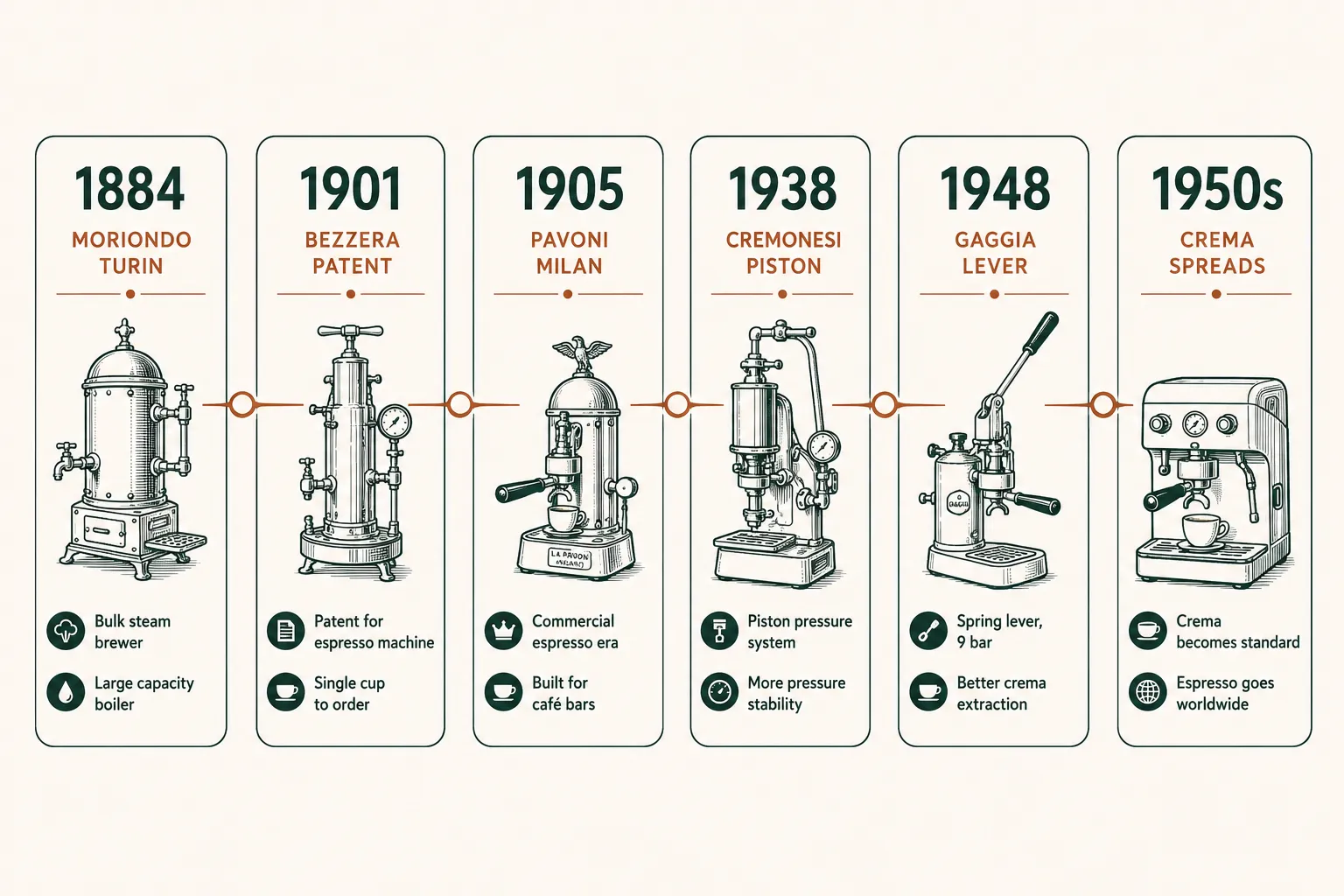
Here is the division of labour, in plain terms.
Angelo Moriondo built the pressure idea. His 1884 Turin patent covered a boiler that forced hot water and steam through a bed of coffee, brewing a batch far faster than a pot on a stove . He made machines for his own hotel and café businesses and never mass-produced them.
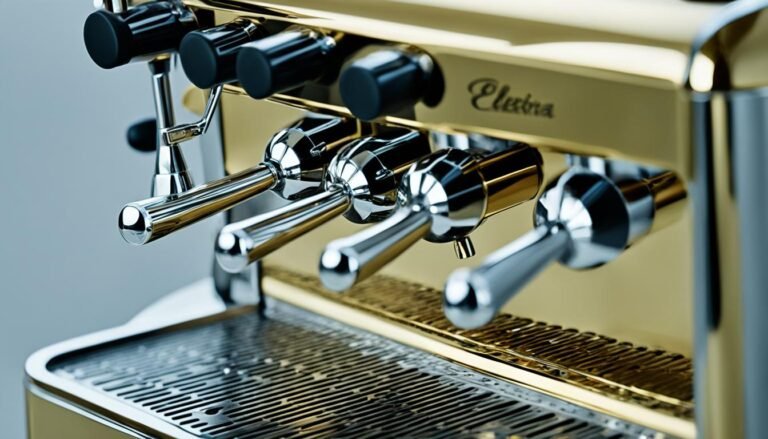
Luigi Bezzera built the cup. His patent work beginning in 1901 introduced the group head, a brewing unit with a filter holder (the portafilter, the handled basket you lock into a machine) and one or more spouts, so a barista could brew a single serving at the moment a customer asked for it . The Cimbali Group's MUMAC museum in Binasco treats that group head as the decisive step.
Desiderio Pavoni built the business. He acquired Bezzera's rights and, from around 1905, manufactured the Ideale in Milan, adding practical fixes such as a pressure release valve so baristas stopped scalding their wrists, and a steam wand for milk . Pavoni is the reason the machine ended up on café counters rather than in a patent drawer.
Achille Gaggia built the taste. In 1948 he brought out a lever machine in which a spring-loaded piston, not steam, pushed water through the coffee . Pressure jumped, extraction changed chemically, and a layer of emulsified oils and gas appeared on the surface. Baristas called it caffè crema. Customers assumed it was a quality signal. They were not wrong.
So when someone asks who invented espresso and expects one name, the honest answer is that the drink was assembled by a relay team.
The 1884 to 1948 Timeline, Event by Event
Seven documented milestones. Where a date is contested, that is flagged.
1884: Angelo Moriondo patents a steam coffee machine in Turin
Moriondo, who owned the Grand-Hotel Ligure and a café in the Galleria Nazionale, registered a patent for "new steam machinery for the economic and instantaneous confection of coffee beverage" and displayed it at the 1884 Turin General Exposition, where it took a bronze medal . Two boilers: one pushed hot water through a bed of grounds, the other sent steam across the surface to finish the brew. It made coffee in bulk for a crowd. One lever, one batch, no individual shots.
1901: Luigi Bezzera files the single-serving patent
Bezzera, a Milanese mechanic and manufacturer, filed patents from 1901 covering a vertical boiler with multiple brewing groups attached . The practical change was enormous. A café could now serve four customers from one machine, each cup brewed in roughly 45 seconds from fresh grounds. This is the first espresso machine patent that produced something recognizable as a shot.
1903 to 1905: Pavoni acquires the rights and starts production
Bezzera had engineering talent and little capital. Desiderio Pavoni bought the patent rights and began manufacturing La Pavoni's Ideale in Milan around 1905, reportedly at about one machine per day at first . The machines were tall brass columns, often topped with an eagle, and they became café furniture.
1920s: Espresso bars spread through Italian cities
Through the 1920s, bar counters in Milan, Turin and Rome standardized around the stand-up espresso service model: order, drink in two minutes, leave . This is the period when espresso stopped being novelty equipment and became a civic habit.
1938: Cremonesi's piston pump
Francesco Illy's work on automatic machines and, separately, Milanese engineer Rosetta Scorza's and Achille Gaggia's circle, were all chasing the same problem: steam at 100°C makes coffee taste burnt. In 1938 Cremonesi designed a piston pump that pushed hot but not boiling water through the puck, installed in the Achilles Gaggia café . World War II stalled commercialization.
1948: Achille Gaggia launches the lever espresso machine
Gaggia's Classica, commercialized in 1948, used a hand-operated spring-piston lever. The barista pulled the lever to load the spring, which then drove water through the coffee at roughly 8 to 10 bar . Crema arrived. The phrase "pulling a shot" is a literal description of this machine, and it survives in cafés that have not had a lever on the counter in 50 years.
1961: The Faema E61 replaces the lever with a motor
Just past the timeline window, but it closes the loop. Faema's E61, designed by Ernesto Valente, used an electric rotary pump and drew water through a heat exchanger, giving continuous 9-bar pressure without muscle . Almost every commercial machine since descends from it.
Documented Record vs Popular Legend
Three claims circulate constantly. Two are myths.
Legend: Luigi Bezzera invented espresso because his wife took too long over coffee breaks. This story appears in dozens of café menus and blog posts. There is no primary documentation for it. It is a good anecdote with no patent office behind it. Treat it as folklore.
Legend: espresso means "fast." The Italian caffè espresso carries the sense of made expressly for you, pressed out, on request . Speed came along for the ride. The drink was named for being personal before it was celebrated for being quick.
Legend: Moriondo invented the espresso machine, full stop. Coffee historian Jonathan Morris, interviewed by Johns Hopkins, describes the 1884 machine as a large steam-powered bulk brewer that cut brewing time sharply but did not brew single servings. Calling Moriondo the inventor of espresso skips the group head, the portafilter and the pressure jump. He invented a fast bulk coffee apparatus. That matters, and it is not the same thing.
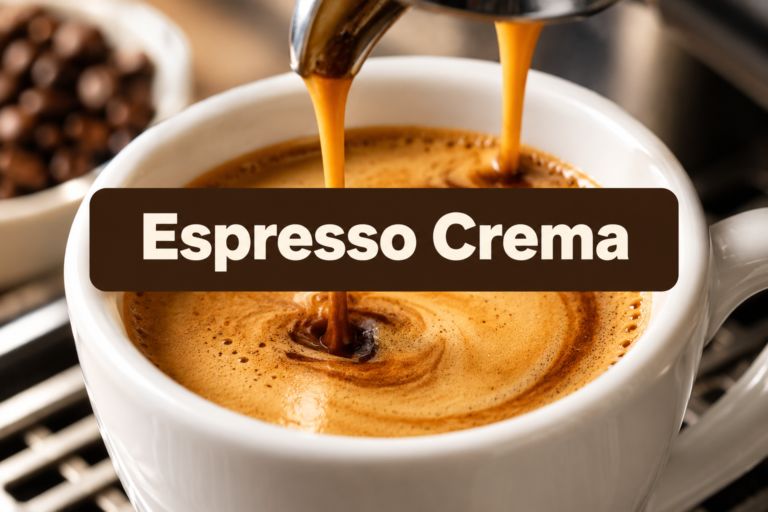
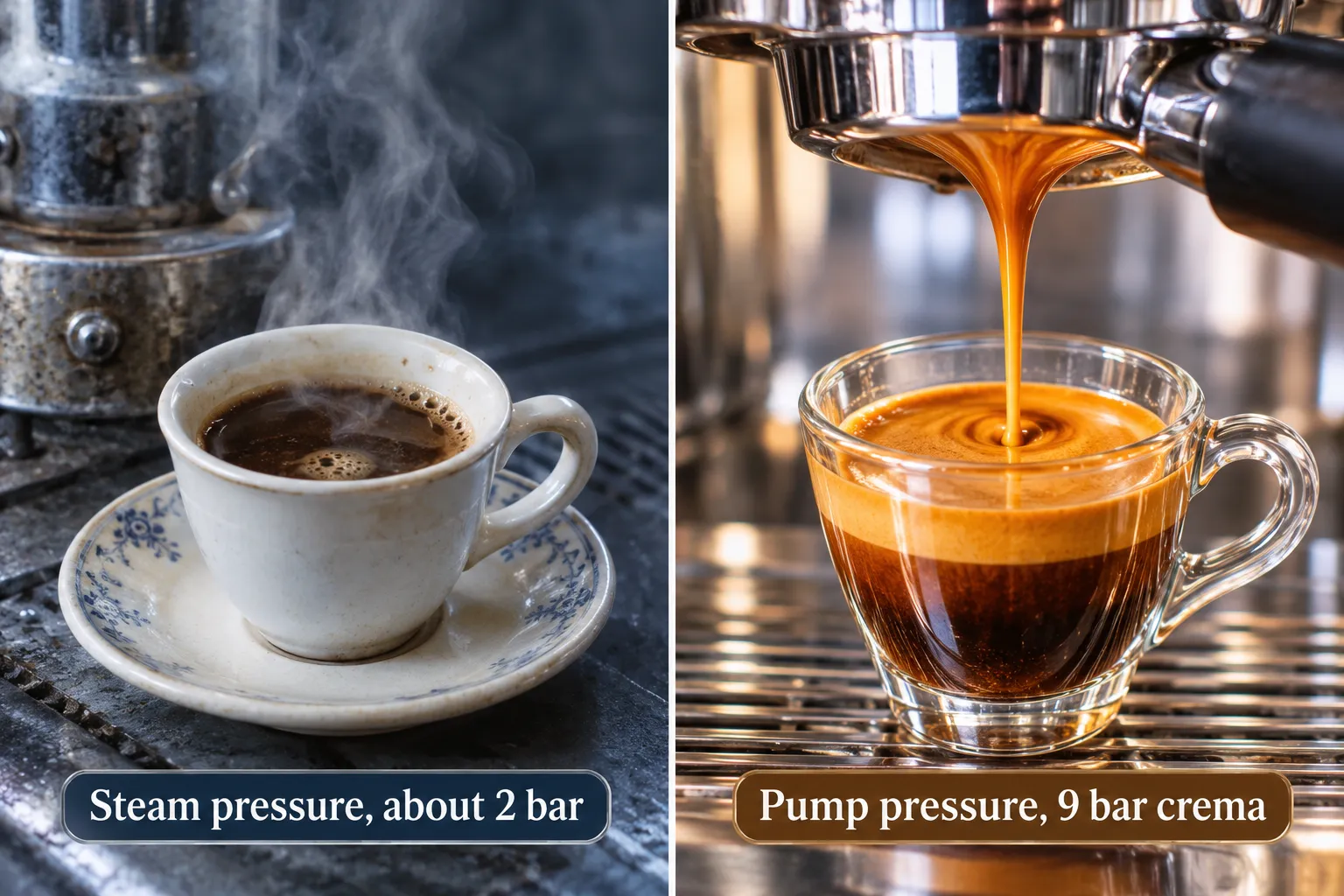
Documented: crema arrived with pressure, not with a bean. The foam on a modern shot is an emulsion of coffee oils and dissolved carbon dioxide released when water at high pressure meets freshly roasted grounds . Steam machines running near 2 bar could not produce it in any meaningful quantity. Gaggia's lever could. If you want the chemistry rather than the history, our guide to what espresso crema actually is goes deeper.
Separate the patent from the parable. Moriondo has a date and a drawing. Bezzera's wife has neither.
What's the Difference Between Espresso and Regular Coffee?
Pressure and ratio. Espresso forces water through finely ground coffee at around 9 bar, roughly nine times atmospheric pressure, using a brew ratio near 1:2 (for example 18g of coffee yielding 36g of liquid) in 25 to 30 seconds . Drip coffee uses gravity, a coarser grind size, and a ratio closer to 1:16.

That changes three things you can taste:
- Concentration. Espresso holds roughly 8 to 12% dissolved solids. Drip sits near 1.2 to 1.5%. Same beans, very different density.
- Texture. Pressure emulsifies oils that a paper filter would trap, which is why espresso coats the tongue.
- Aroma intensity. Crema traps volatile compounds briefly, which is part of why a shot smells strongest in its first 30 seconds.
Caffeine per cup is usually lower in a single espresso than in a 12oz drip coffee, because the serving is 30ml. Per millilitre it is far higher. If you want the side-by-side, read our drip coffee vs espresso comparison.
Did One Person Invent Espresso, or Did It Evolve Gradually?
It evolved, and the gaps between steps were long. Moriondo to Bezzera is 17 years. Bezzera to Gaggia is 47. Anyone answering who invented espresso with a single surname is choosing which problem they consider the real one.
A useful decision rule for how to credit it:
- If you define espresso as pressurized hot-water brewing, credit Moriondo, 1884.
- If you define it as a single serving brewed to order through a portafilter, credit Bezzera, 1901.
- If you define it as a commercial café product, credit Pavoni, 1905.
- If you define it as a 9-bar shot with crema, credit Gaggia, 1948.
The fourth definition is the one most drinkers mean. That is why 1948 keeps appearing in articles about who invented espresso, even though the first patent predates it by 64 years.
How Did Espresso Spread Beyond Italy?
Through emigration first, then through a 1950s equipment export boom. Italian families carried the café-bar model to the United States, Australia, Argentina and the United Kingdom. London's Moka Bar on Frith Street opened in 1953 with a Gaggia machine and is widely credited with starting Britain's coffee bar wave .
American adoption ran on a different clock. Espresso stayed a neighbourhood and ethnic-enclave drink in US cities until the 1980s and 1990s, when Seattle chains built a national habit around milk-based espresso drinks. The result is a market where most Americans met espresso as the base of a latte rather than as a standalone 30ml shot. If that describes your café order, our breakdown of cappuccino vs latte explains how the same shot ends up tasting so different in each cup.
Common mistake: assuming American "espresso roast" labelling reflects Italian tradition. A dark espresso roast is a style choice, not a requirement. Plenty of Italian bars pull medium-roast blends, and many third-wave cafés pull single origin shots that would have been unthinkable in 1948.
Can You Make Espresso Without a Machine?
Not true espresso, but you can get close enough to enjoy it. Real espresso requires sustained pressure near 9 bar, which a stovetop pot cannot produce. A Moka pot runs at roughly 1.5 to 2 bar, about the same as a 1905 Pavoni, which is a nice historical irony.
Workable options, ranked by how close they get:
- Manual lever devices (Flair, Cafelat Robot style). Hand pressure can reach 9 bar with practice. Closest result, including crema.
- AeroPress with a fine grind. Concentrated and pleasant, roughly 1 to 2 bar. No real crema.
- Moka pot. Strong, syrupy, slightly bitter if overheated. Historically legitimate, technically not espresso.
The practical limits are grind and freshness. You need a burr grinder capable of espresso-fine settings and beans within about three weeks of roast date, because the carbon dioxide that builds crema fades fast. Full method here: how to make espresso without a machine.
Sourced Dates and Figures
Six verifiable numbers from this history, with what each one actually measures.
| Date or figure | What it refers to | Source |
|---|---|---|
| 1884 | Angelo Moriondo's steam coffee machine patent, Turin; shown at the Turin General Exposition | |
| 1901 | Luigi Bezzera's espresso machine patent introducing group head and portafilter brewing | |
| 1905 | Desiderio Pavoni begins commercial production of the Ideale in Milan after acquiring Bezzera's rights | |
| 1938 | Cremonesi's piston pump pushes non-boiling water through the coffee bed | |
| 1948 | Achille Gaggia commercializes the spring-piston lever espresso machine; crema becomes standard | |
| 8 to 10 bar | Pressure range the lever design produced, versus roughly 1.5 to 2 bar from steam-only machines | |
| 1961 | Faema E61 introduces the electric pump and heat exchanger, the template for modern machines |
One caution on the numbers: patent filing dates, grant dates and first-sale dates often differ by a year or two in secondary sources. Where you see "1901 or 1903" for Bezzera, that is usually a filing-versus-grant discrepancy, not a disagreement about who did the work.
FAQ
Why This History Still Matters at Your Counter
Every argument in this timeline is an argument you still have each morning. Moriondo wanted speed. Bezzera wanted one good cup instead of a compromised batch. Pavoni wanted equipment a working barista could survive. Gaggia wanted pressure. Those are the same four trade-offs on the spec sheet of any machine you compare today, whether it is a $200 pump unit or a lever machine that costs more than a used car.
Two practical moves follow from knowing who invented espresso and why.
First, treat pressure and temperature as solved, and spend your attention on grind. Gaggia fixed the 9-bar problem in 1948 and Faema automated it in 1961. The variable modern home brewers still get wrong is particle size, which is why a decent grinder usually improves a shot more than a more expensive machine does. Compare options in our guide to the best espresso grinder.
Second, judge crema honestly. It signals fresh coffee and adequate pressure. It does not guarantee a sweet shot, and robusta-heavy blends produce more of it regardless of quality. Taste the drink, not the foam.
If you are starting out, the practical next step is a dialling-in routine: fixed dose, fixed yield, adjust grind only. Our beginners guide to barista-quality espresso drinks walks through that process, and the what is espresso explainer covers the definitions behind the numbers. Better Coffee Starts With Better Answers, and in this case the answer took four men and 64 years.
Who Invented Espresso: Tap Each Step
Four Italians, 64 years, one drink.
Sources: Wikipedia “Espresso machine”; Gaggia company history; MUMAC museum.