Coffeehouse History: Penny Universities to Lloyd’s
Punchline: one sentence stating what a penny bought in a 1600s coffeehouse, seed keyword inside first 8 words
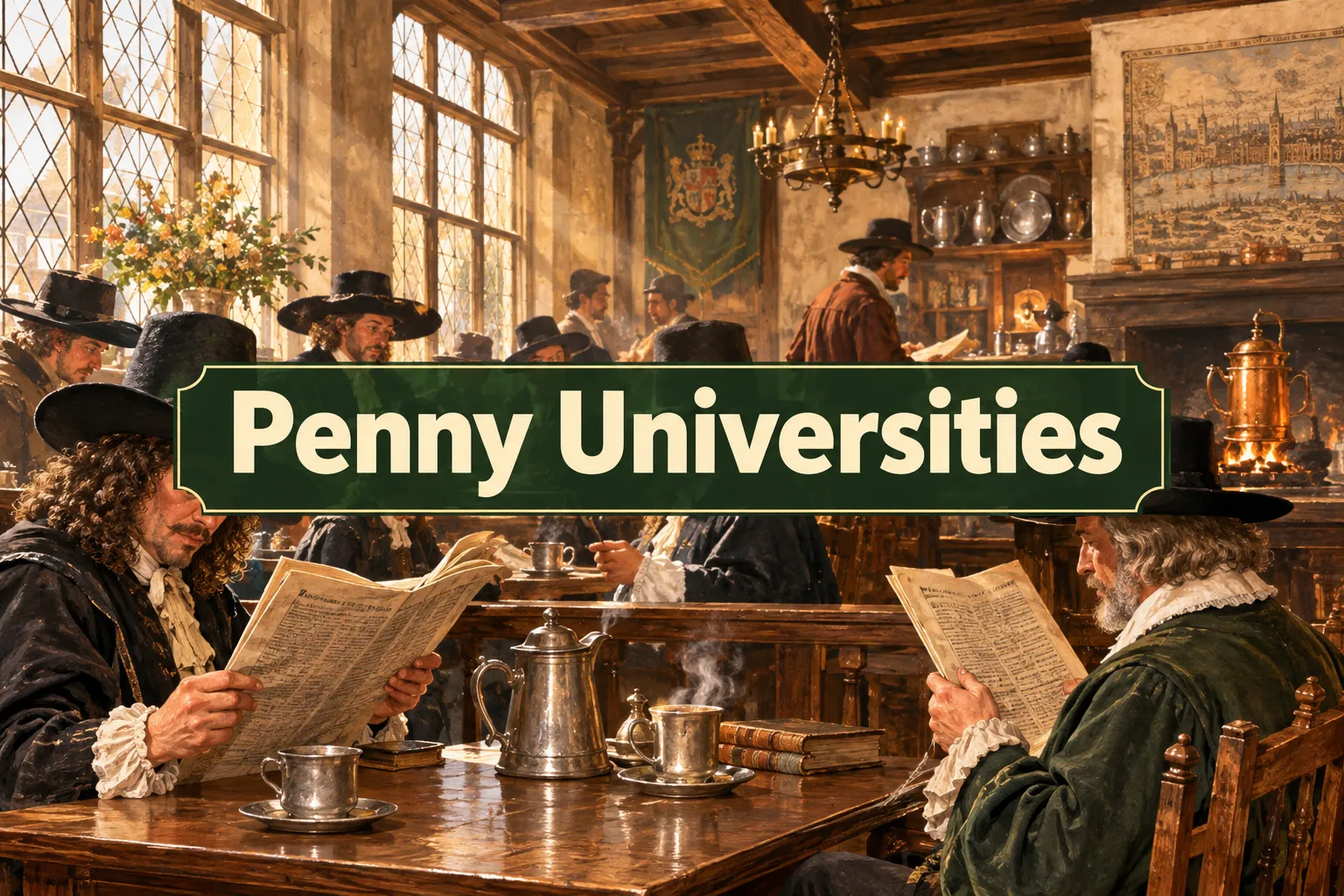
In coffeehouse history, one penny bought admission, a dish of coffee, the day's newspapers, and the right to argue with any stranger in the room. That last item was the real product. English writers nicknamed these rooms penny universities because a labourer's coin bought access to conversation that otherwise cost a university education . The drink was bitter, usually boiled, and by modern standards badly made. Nobody cared. People came for the information.
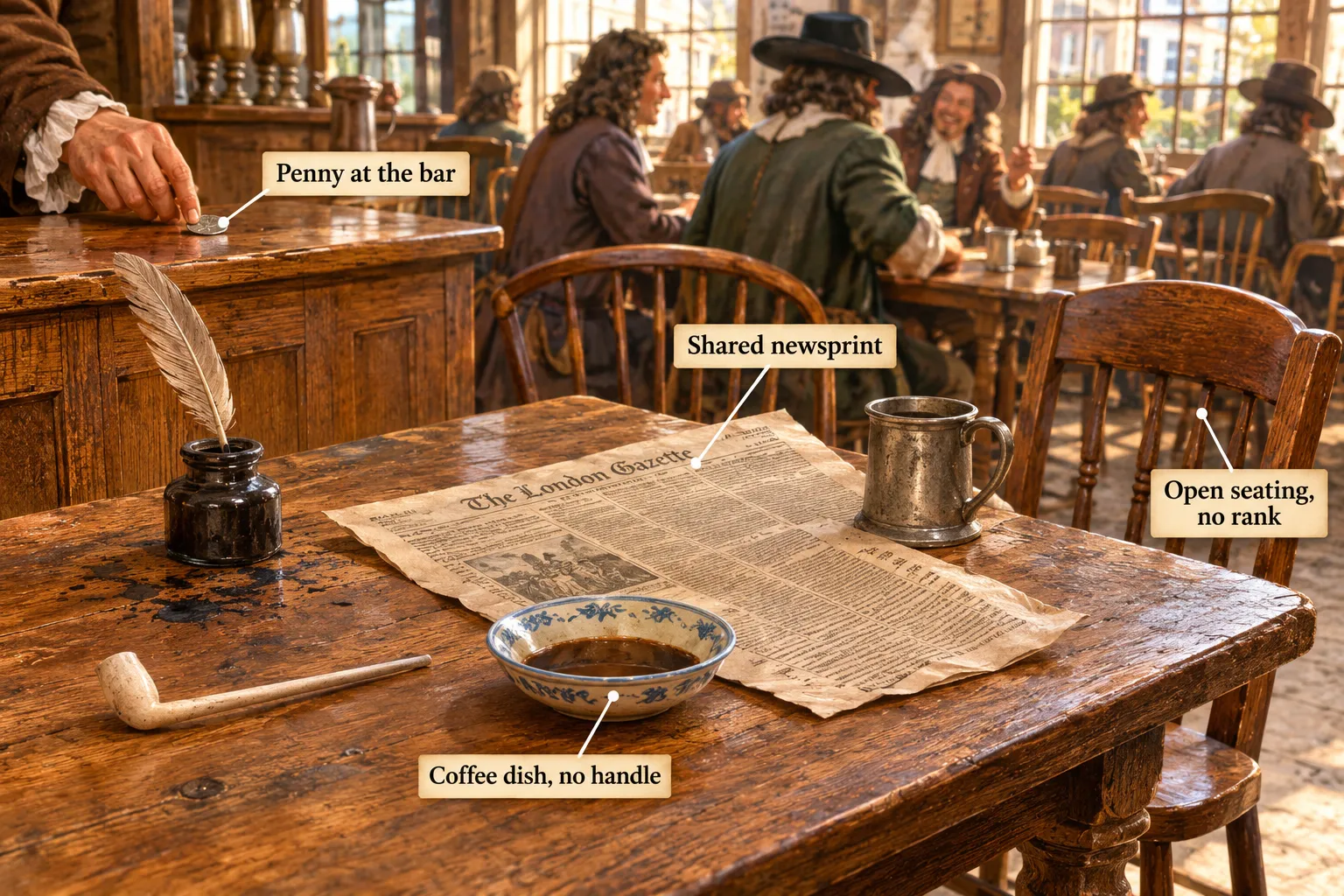
The pattern repeats across the whole history of coffee shops: a room sells a cheap drink, attracts a specific crowd, and accidentally becomes an institution. Edward Lloyd's coffee house turned into an insurance market. Jonathan's Coffee House turned into the London Stock Exchange. The coffee was the cover charge.
Key Takeaways: 5 to 7 bullets with dates and named places
- 1650, Oxford. The first recorded English coffeehouse opened at the Angel, run by a man recorded as Jacob, a Jewish immigrant .
- 1652, London. Pasqua Rosée opened a coffee stall in St Michael's Alley, Cornhill, widely cited as London's first coffeehouse .
- The penny. Entry cost roughly a penny, which included coffee and the newspapers. Hence the term penny universities .
- 1675. Charles II issued a proclamation to suppress coffeehouses as seedbeds of sedition. It collapsed within weeks under public pressure .
- 1680s, Exchange Alley. Jonathan's Coffee House hosted stockjobbers excluded from the Royal Exchange, seeding what became the London Stock Exchange .
- 1688. Lloyd's Coffee House in Tower Street appears in the London Gazette, serving shipowners and captains who arranged marine insurance at rented tables .
- 1734. The first official edition of Lloyd's List appeared, publishing shipping intelligence by subscription .
Coffeehouse history
Coffeehouse history is the story of how a Middle Eastern drinking custom became European civic infrastructure in about fifty years. Coffeehouses reached Venice in the early 1600s and England by 1650, arriving from Ottoman trade routes where the kahvehane had served the same social function for a century already .
What made the English version distinct was the entrance fee model. A penny at the bar bought you a seat, a dish of coffee, and whatever print lay on the tables: newsletters, pamphlets, ship arrival lists, foreign gazettes. You paid for access, not volume. Refills were cheap or free in many houses. So the economics rewarded staying and talking.
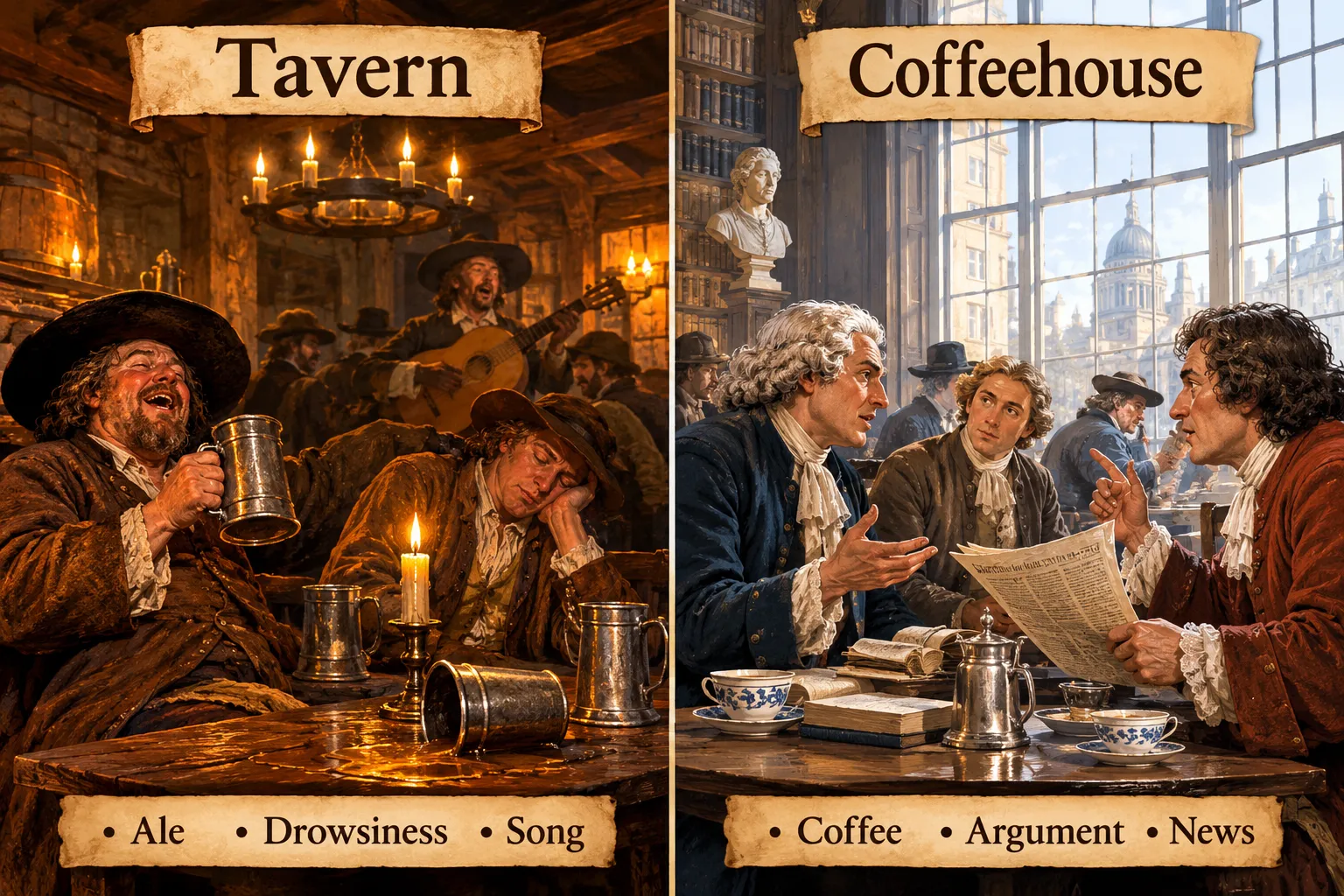
A tavern sold you ale and sent you home slower. A coffeehouse sold you a penny's attention and sent you home with an argument.
That difference matters for understanding coffeehouse culture. Beer and small ale were the default safe drinks in 17th century England, and the working day ran on mild intoxication. Coffee reversed the effect. Contemporary observers described coffeehouses as sober counterparts to taverns, where clerks and merchants went to sharpen up rather than wind down .
Three structural features defined a 17th century coffeehouse:
- Flat seating. Long communal tables, no private booths, no reserved places by rank.
- Print on the table. Newspapers and handwritten newsletters were part of the price.
- Specialisation by trade. Each house grew its own clientele, and that is where the institutions came from.
By the late 1600s, London held more than 80 coffeehouses, each tending to attract a particular occupational crowd . That clustering is the hinge of the whole story. Generic conversation produces gossip. Specialised conversation produces markets.
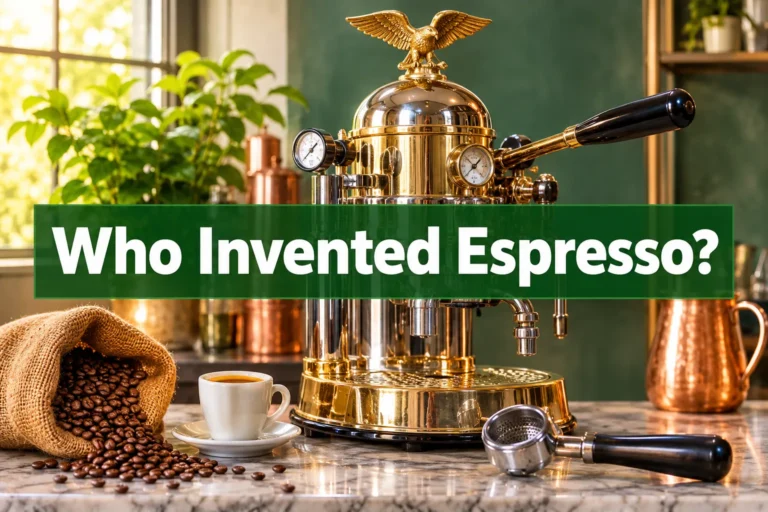
The drink itself bore little resemblance to anything you would brew now. Grounds were boiled, often repeatedly, and served in handleless dishes. Nobody was tracking grind size, water temperature, or brew ratio. If you want the opposite experience, the modern essential guide to coffee brewing covers the variables those drinkers had no words for.
Dated timeline: 5 to 8 events with named coffeehouses, people and what each became
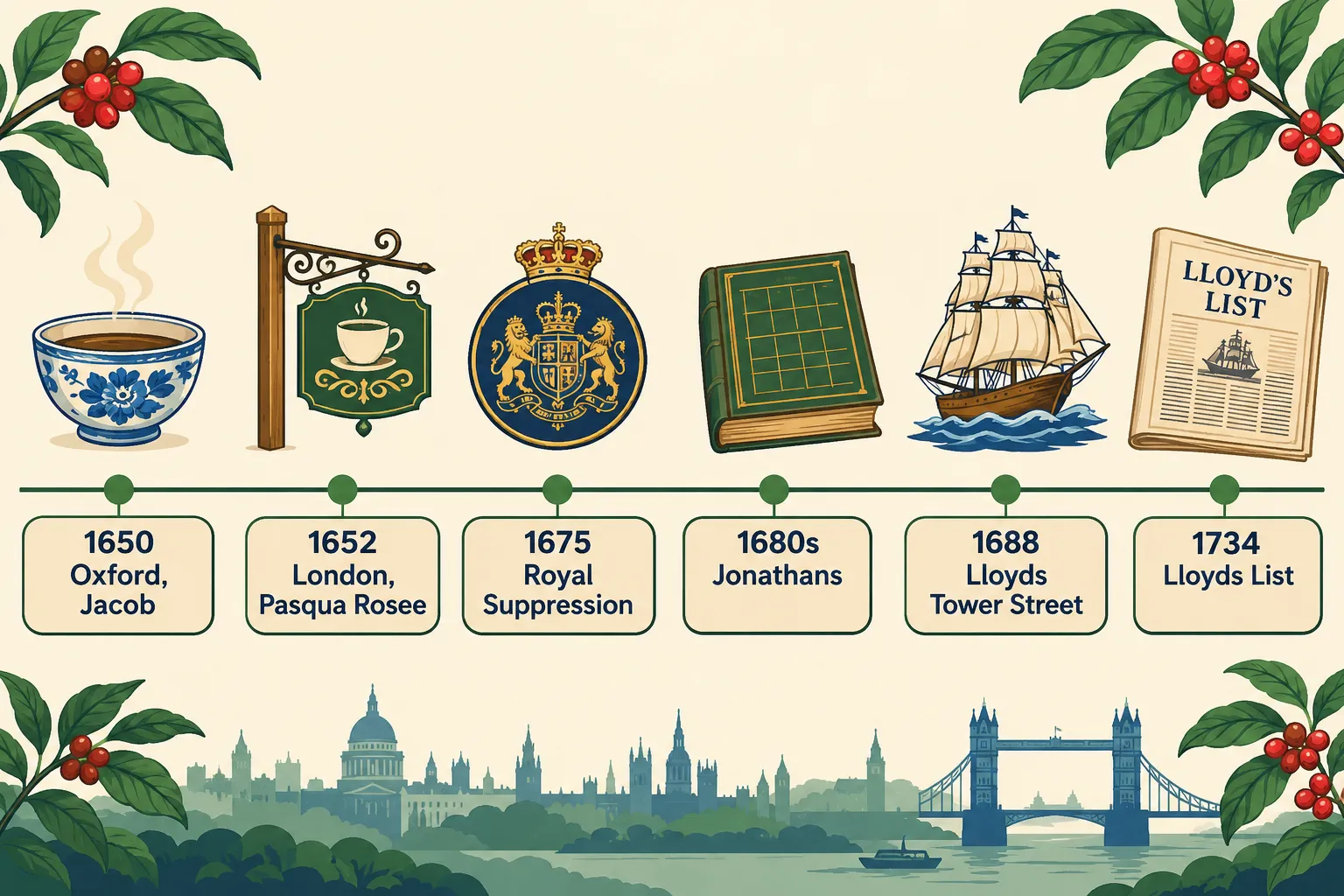
Each entry below pairs a date with a named place and what it eventually turned into.
1650: The Angel, Oxford
A man recorded in Oxford sources as Jacob opened the first English coffeehouse at the Angel in the parish of St Peter in the East . Oxford's academic crowd adopted it quickly. Students discovered they could buy the conversational half of a university education without matriculating, which is precisely how the nickname penny universities took hold.
1652: Pasqua Rosée's stall, St Michael's Alley
Rosée, servant to a Levant Company merchant, set up in Cornhill and is widely credited with London's first coffeehouse . His handbill advertised coffee as a cure for a long and implausible list of ailments. Early coffee marketing was not burdened by evidence standards.
1660s: Garraway's, Exchange Alley
Garraway's became an auction room. Ships, cargoes, property, and commodities changed hands there by the "sale by candle" method: bidding ran until an inch of candle burned out.
1675: The royal proclamation
Charles II moved to shut coffeehouses, calling them places where idle persons spread false news against the government . Merchants and the public objected hard enough that the ban was effectively abandoned within about a fortnight. A government learning that it cannot close the rooms where its critics meet is one of the more quietly important episodes in London coffeehouses.
1680s: Jonathan's Coffee House, Change Alley
Stockjobbers thrown out of the Royal Exchange for rowdy behaviour reassembled at Jonathans Coffee House . John Castaing began posting prices of stocks and commodities there under the title The Course of the Exchange and Other Things. That price list is an ancestor of the London Stock Exchange.
1688: Lloyd's Coffee House, Tower Street
Lloyds Coffee House appears in the London Gazette in 1688 . Edward Lloyd gathered shipowners, captains, and merchants, rented out tables and boxes, and supplied maritime news. Insurance deals were struck on the spot.
1760 and 1764: Lloyd's Register
Underwriters, brokers and shipowners from the same coffeehouse network formed the Society for the Registry of Shipping in 1760, publishing its first Register Book in 1764. It classified ships by condition and seaworthiness. Keep it separate from Lloyd's of London: same room, different institution, different job.
1771 and 1774: The Society of Lloyd's
Seventy-nine subscribers formed a committee in 1771, and in 1774 the Society moved into the Royal Exchange . The coffee business was over. The underwriting market had outgrown the shop.
Documented record vs legend, clearly separated
Coffeehouse history attracts tidy stories, and several of the tidiest are not well supported. Here is a clean split.
| Claim | Status | What the record supports |
|---|---|---|
| Entry cost about a penny and included newspapers | Documented | Widely attested in period accounts and the origin of the penny universities nickname |
| Charles II tried to suppress coffeehouses in 1675 | Documented | The proclamation was issued and then abandoned under pressure |
| Lloyd's Coffee House served maritime insurance brokers from the 1680s | Documented | Lloyd's own institutional history, Tower Street, London Gazette 1688 |
| Jonathan's housed the stockjobbers who became the Stock Exchange | Documented | Change Alley, price lists posted from the late 1600s |
| Every man was welcome regardless of class | Partly legend | Rules of civility existed, but houses sorted hard by trade and purse |
| Coffeehouses "caused" the Enlightenment | Legend as stated | They hosted and circulated ideas. Attributing causation to one venue type overstates the evidence |
| A goatherd named Kaldi discovered coffee | Legend | A late, unverified origin tale, usually dated to 9th century Ethiopia but first written down centuries afterwards |
Note the pattern. The business history is strong because institutions kept records. The social history is softer because it survives mostly through satire, pamphlets, and complaint. Satirists exaggerate for a living.
One more correction worth making: coffeehouses did not invent public discussion. They concentrated it, priced it cheaply, and attached it to printed news. That is a real contribution and it does not need inflating.
At least 4 H2s phrased as questions
Could women actually go to coffeehouses in the 1700s?
Mostly no, with real exceptions. English coffeehouses developed as male commercial spaces, and by the 1700s respectable women were largely absent as customers. The 1674 pamphlet The Women's Petition Against Coffee complained that the drink made husbands useless and kept them out of the house all day. It was satire, probably written by men, but it documents the exclusion it jokes about.
Women did run coffeehouses. Widows inherited and operated them, and women worked behind the bar serving. Continental practice differed, and Vienna's and Paris's café traditions admitted women earlier and more fully . So the rule is narrower than usually stated: English coffeehouses excluded women as patrons, not as proprietors.
How were early coffeehouses different from pubs and taverns?
Four differences, all practical:
- Pricing. Taverns charged per drink. Coffeehouses charged for entry, which encouraged long stays.
- Effect. Ale made customers slower. Coffee made them talkative and alert, which changed what the room was useful for .
- Print. Newspapers were standard furniture in a coffeehouse and rare in an alehouse.
- Purpose. Business was transacted openly in coffeehouses. Contracts, auctions, insurance, share dealing.
Decision rule for anyone reading period sources: if the venue sorted its customers by trade and kept news sheets on the table, you are reading about a coffeehouse, whatever the sign said.
Did ordinary people really go to penny universities, or just wealthy folks?
Ordinary working men did attend, and that is the point of the penny. A penny was affordable to a clerk, apprentice, shopkeeper, or tradesman, which is why contemporaries found the rooms notable . A gentleman and a joiner could share a bench.
The qualification matters though. Some houses charged more, and the elite houses in St James's functioned as proto-clubs with memberships and vetting. White's, founded as a chocolate house in 1693, became exactly that. So the penny universities label fits the City trading houses and the Oxford originals better than it fits the West End. Access was broad, not universal, and sorted by neighbourhood and trade.
What kind of conversations and debates happened in these places?
Business intelligence first, then politics, science, literature, and gossip, roughly in that order of commercial value. At Lloyd's: ship arrivals, departures, cargo conditions, foreign fleet movements, piracy reports . At Jonathan's: share prices and rumours that moved them. At Garraway's: auction lots and tea prices.
Scientific discussion was genuine. Members of the Royal Society used coffeehouses near Gresham College for informal meetings and demonstrations between formal sessions, and houses like the Grecian became associated with natural philosophy . Isaac Newton, Edmond Halley, Samuel Pepys, Christopher Wren, Jonathan Swift, Joseph Addison and Richard Steele all appear in accounts of London coffeehouses. The Spectator and The Tatler were written partly for and about this crowd.
As for etiquette, surviving house rules asked patrons to take any free seat rather than claim status, barred swearing and card games, and required anyone who started a quarrel to buy coffee for the room. Whether those rules were obeyed is a different question.
Why did coffeehouses become so popular in 1600s England?
Timing. The Restoration in 1660 loosened press controls, the postal system improved, printed news multiplied, and London's merchant economy expanded fast. A cheap room with newspapers and a stimulant solved a real problem: merchants needed current information and had nowhere affordable to get it . Coffeehouses supplied the venue, the news, and the sobriety at a penny.
Sourced stat cards: 3 to 6 cited dates and figures
By the late seventeenth century, London had more than 80 coffeehouses, each tending to draw a specific occupational clientele. Source: Lloyd’s institutional history .
Lloyd’s Coffee House on Tower Street is recorded in the London Gazette in 1688, already known as a meeting point for shipping men .
Published by Thomas Jemson under the Lloyd’s name, it became one of the world’s longest continuously running journals, built from the coffeehouse’s shipping-news function .
Maritime customers formed a subscription market in 1771 and moved to the Royal Exchange in 1774, completing the shift from coffee shop to underwriting institution .
The Society for the Registry of Shipping formed in 1760; the first Register Book appeared in 1764, classifying ships by condition. A separate institution from Lloyd’s of London.
The Bank of England Museum’s “After the Fire: Insurance, Finance & a Rebuilt City” runs to November 27, 2026, with displays modelled partly on Edward Lloyd’s coffee shop. The London Archives hosts “Coffee on Ice: London’s Frost Fairs & 375 Years of Coffee” on November 9, 2026 .
Below, a compact chart of the sequence from penny room to formal institution.
From penny room to institution
FAQ

Conclusion: the modern echo in today's cafes plus next step
The useful lesson from coffeehouse history is that the room, not the drink, created the value. Lloyd's survived because Edward Lloyd sold trusted shipping information and repeat contact between people who needed to trust each other . Jonathan's survived because John Castaing posted prices. Your local café runs a milder version of the same model: the espresso funds the seating, the wifi, and the two hours of thinking.
Two 2026 exhibitions are treating this seriously rather than as beverage trivia. The Bank of England Museum's "After the Fire" show, open until November 27, 2026, traces insurance and finance out of post-fire London, including displays modelled on Edward Lloyd's shop. The London Archives runs a lunchtime talk on November 9, 2026 covering 375 years of coffee through news, finance, science and entrepreneurship .
What you can do with any of this:
- Brew something the 1670s could not. Those drinkers boiled grounds. You can control water temperature, grind size and brew ratio. Start with the beginner's guide to pour over coffee and a measured pour over coffee ratio.
- Buy for freshness, not legend. Check the roast date on the bag and keep beans sealed. Compare options in our guide to coffee storage containers.
- Explore origin the way those merchants tracked cargo. A single origin rotation with clear processing method notes is the modern equivalent of a shipping list. Compare the models of brewing first, then pick beans to suit.
- Host your own penny university. Invite three people who do different work, make a full pot, and put your phones face down. That was the whole technology.
Better Coffee Starts With Better Answers, and the oldest answer in coffeehouse history is that a good cup is mostly an excuse to sit down with people who know things you do not.