Pour Over Coffee Ratio: The Number Baristas Start With
Quick Answer: The standard pour over coffee ratio most baristas start with is 1:16 by weight, meaning 1 gram of coffee for every 16 grams of water. For a typical 12 ounce mug that works out to about 20 to 22 grams of coffee brewed with 320 to 350 grams of water. From that starting point, baristas nudge toward 1:15 for a stronger cup or 1:17 for a lighter one, depending on the bean and roast.
Key takeaways
- The pour over coffee ratio baristas memorize first is 1:16, or 1 gram of coffee to 16 grams of water.
- The practical working range is 1:15 to 1:17, with 1:14 on the strong end and 1:18 on the light end.
- A 12 ounce cup needs roughly 20 to 23 grams of coffee, and a single cup recipe often lands near 15 grams of coffee to 250 grams of water.
- The Specialty Coffee Association's filter brewing guideline works out to about 55 grams of coffee per liter of water, which is close to 1:16 to 1:18.
- Bloom time (a 30 to 45 second pre-soak before the main pour) matters more for flavor than most people expect, even though it does not change the ratio itself.
- Water temperature between 195°F and 205°F affects how fast extraction happens, but it does not replace the need for an accurate coffee to water ratio.
- Coffee to water ratio and grind size work together. Change one and the other usually needs a small adjustment too.
- A kitchen scale gives the most reliable pour over coffee ratio, but tablespoon and cup conversions can get you close in a pinch.
What is the standard pour over coffee ratio
The standard pour over coffee ratio is 1:16 by weight, and most specialty cafes use it as the default before adjusting for taste. That means for every gram of ground coffee, you use 16 grams (roughly 16 milliliters) of water.
This isn't a guess pulled from nowhere. Multiple 2026 brewing guides point to the same number as the starting recipe baristas teach new hires, often citing something close to 22 grams of coffee to 350 grams of water with a total brew time around 3 minutes 30 seconds. A separate barista-focused explainer calls it the "simple math" of pour over: 1 gram of coffee to 16 grams of water, or 20 grams of coffee to 320 grams of water for a standard mug.
The working range sits between 1:15 and 1:17. Go stronger (1:15, sometimes 1:14) for a bolder, heavier cup. Go lighter (1:17, sometimes 1:18) for a cleaner, more tea-like cup. The pour over coffee ratio you land on depends on your beans, your roast level, and your own taste, but 1:16 is where nearly everyone starts.
Pour over coffee ratio: how much coffee to water for pour over
For most pour over brewing, use 1 gram of coffee for every 16 grams of water, which means roughly 20 grams of coffee for a 12 ounce cup. Scale up proportionally for bigger batches, and scale down for a single small mug.
Here's what that looks like in real numbers, based on current brewing references:
- Single mug (about 12 oz / 340 ml): 20 to 23 grams coffee, 320 to 350 grams water
- Smaller cup (about 10 oz / 300 ml): roughly 19 grams coffee
- Larger carafe (about 17 oz / 500 ml): roughly 31 grams coffee
- Single-serving V60 recipe: 15 grams coffee to 250 grams water
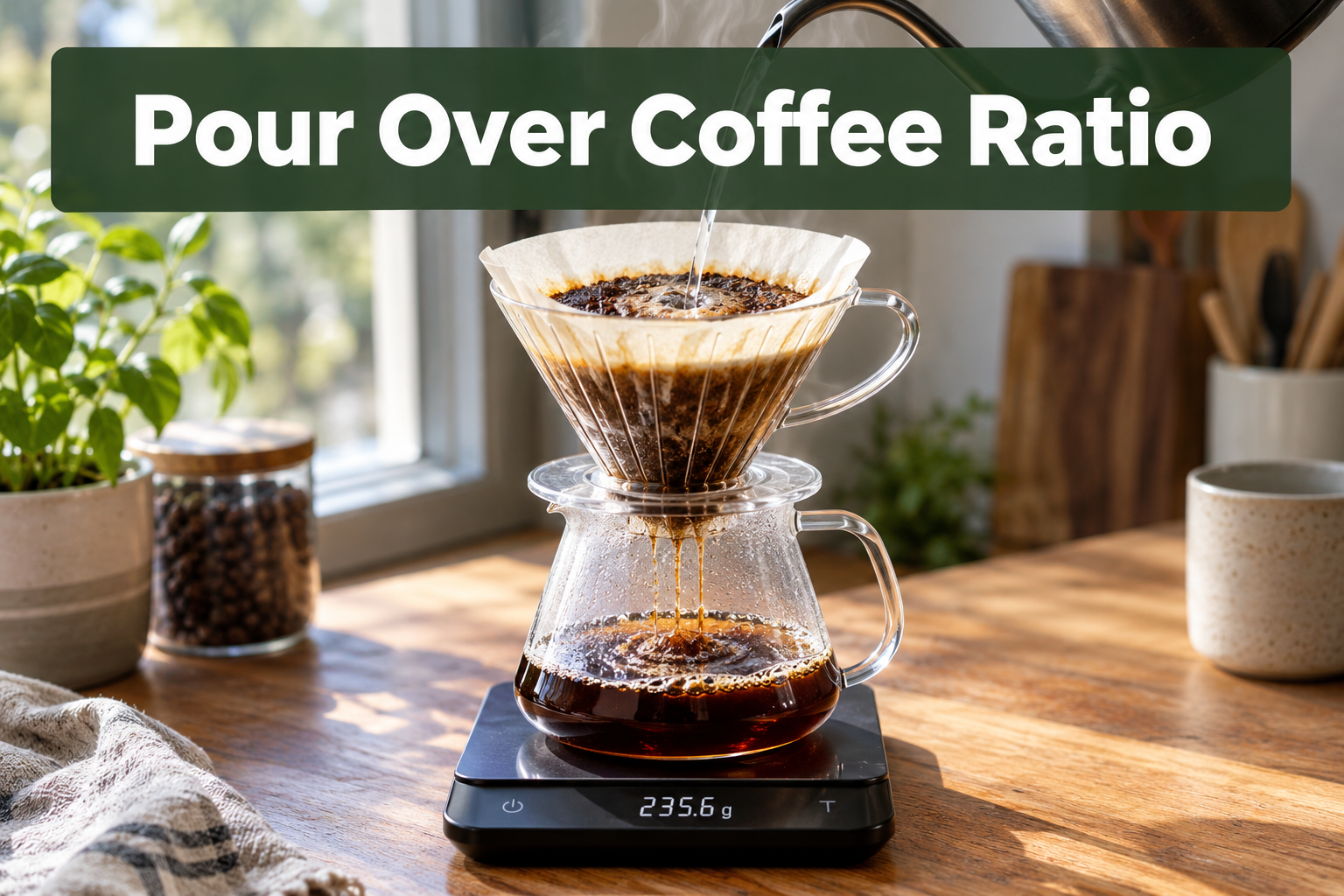
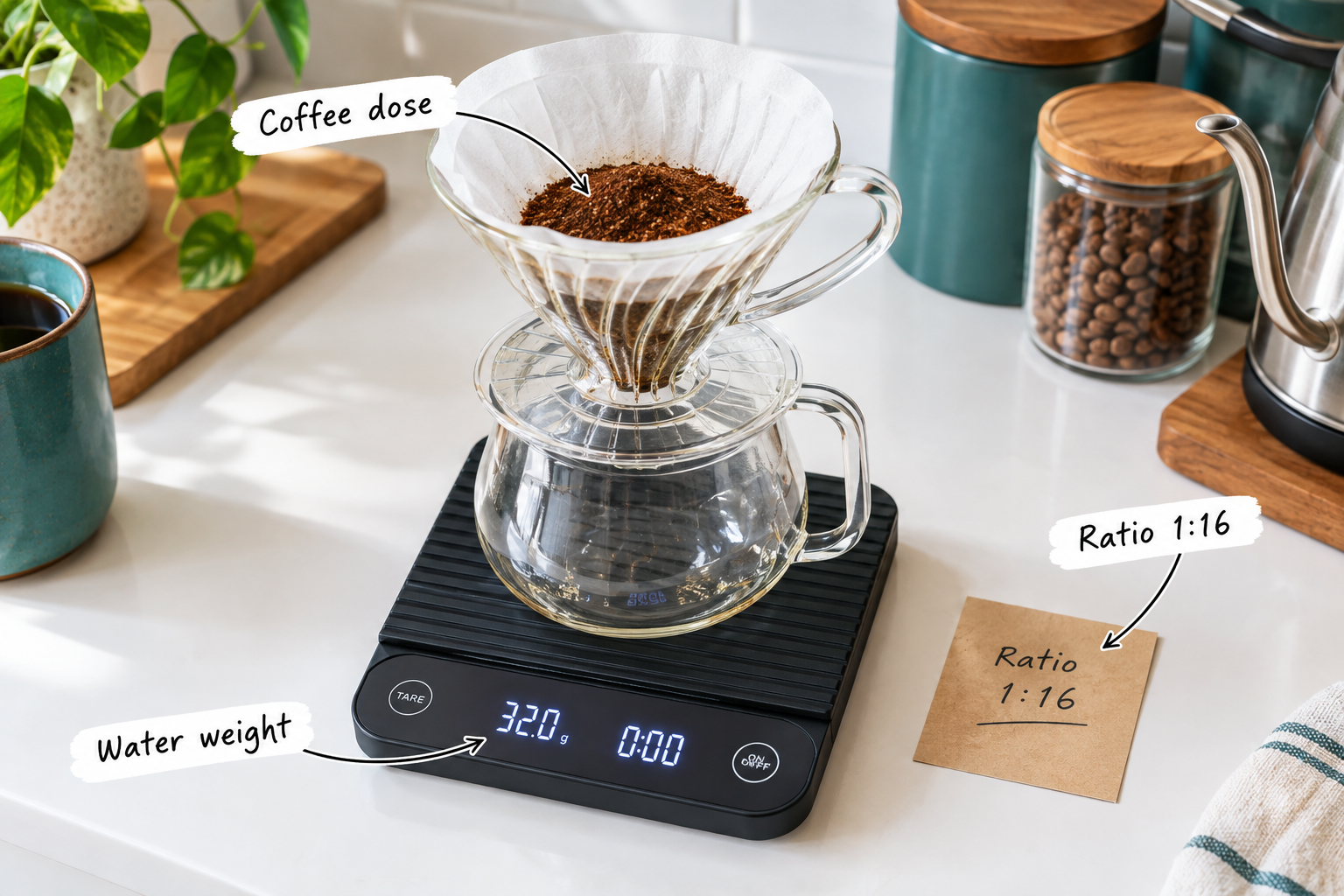
If you're using a kitchen scale (and you should, if you own one), zero it out with your dripper and filter in place, add your ground coffee, then pour water until you hit your target weight. This is the most accurate way to hold your coffee to water ratio steady from one brew to the next, which matters more than people assume, because a shift of even 20 grams of water can nudge a cup from balanced to watery.
For readers just getting comfortable with the beginner's guide to using a pour over coffee maker, this is the number to write on a sticky note and put on the coffee canister.
1:16 coffee to water ratio explained
The 1:16 coffee ratio means 1 unit of coffee weight to 16 units of water weight, and it lines up closely with the Specialty Coffee Association's filter coffee brewing standard. That standard calls for about 55 grams of coffee per liter of water, which works out to somewhere between 1:16 and 1:18 depending on how you round it.
Why 16 specifically, and not 10 or 20? At ratios stronger than about 1:14, coffee tends to taste heavy and can mute the brighter, more delicate flavors. At ratios weaker than about 1:18, coffee often tastes thin, even if the extraction itself is technically fine. The 1:16 coffee to water ratio sits in the middle of that range, which is why it works as a default rather than a rule carved in stone.
Decision rule: if you're brewing an unfamiliar bean for the first time, start at 1:16. Taste it before you touch anything else. Then adjust from there.
Does pour over ratio differ by coffee bean type
Yes, in practice. Light roasts, dense beans, and naturally processed coffees often taste better closer to 1:15, while darker roasts and coffees already carrying heavier body can taste cleaner at 1:17 or 1:18.
This isn't about one bean type needing a "correct" ratio. It's about how much soluble flavor a given coffee releases into water. Lighter roasts are denser and slower to extract, so a slightly stronger pour over coffee ratio (more coffee relative to water) can pull out more sweetness without tipping into sourness. Darker roasts break down faster and release bitterness sooner, so backing off toward 1:17 or 1:18 can keep the cup from turning ashy.
Processing method plays a role too. Naturally processed coffees, dried in the fruit before the seed is separated, tend to carry more fruit-forward intensity, and some drinkers prefer to dial the ratio slightly weaker to let that character show without becoming overwhelming. If you're building out your own rotation, our advanced coffee bean selection tips and guide to understanding different coffee roasts both go deeper into how roast level changes what a cup needs.
Best pour over ratio for different brewing times
Longer brew times generally call for a slightly weaker pour over coffee ratio, and shorter brew times can handle a slightly stronger one, because extraction time and coffee concentration both affect the final strength of the cup.
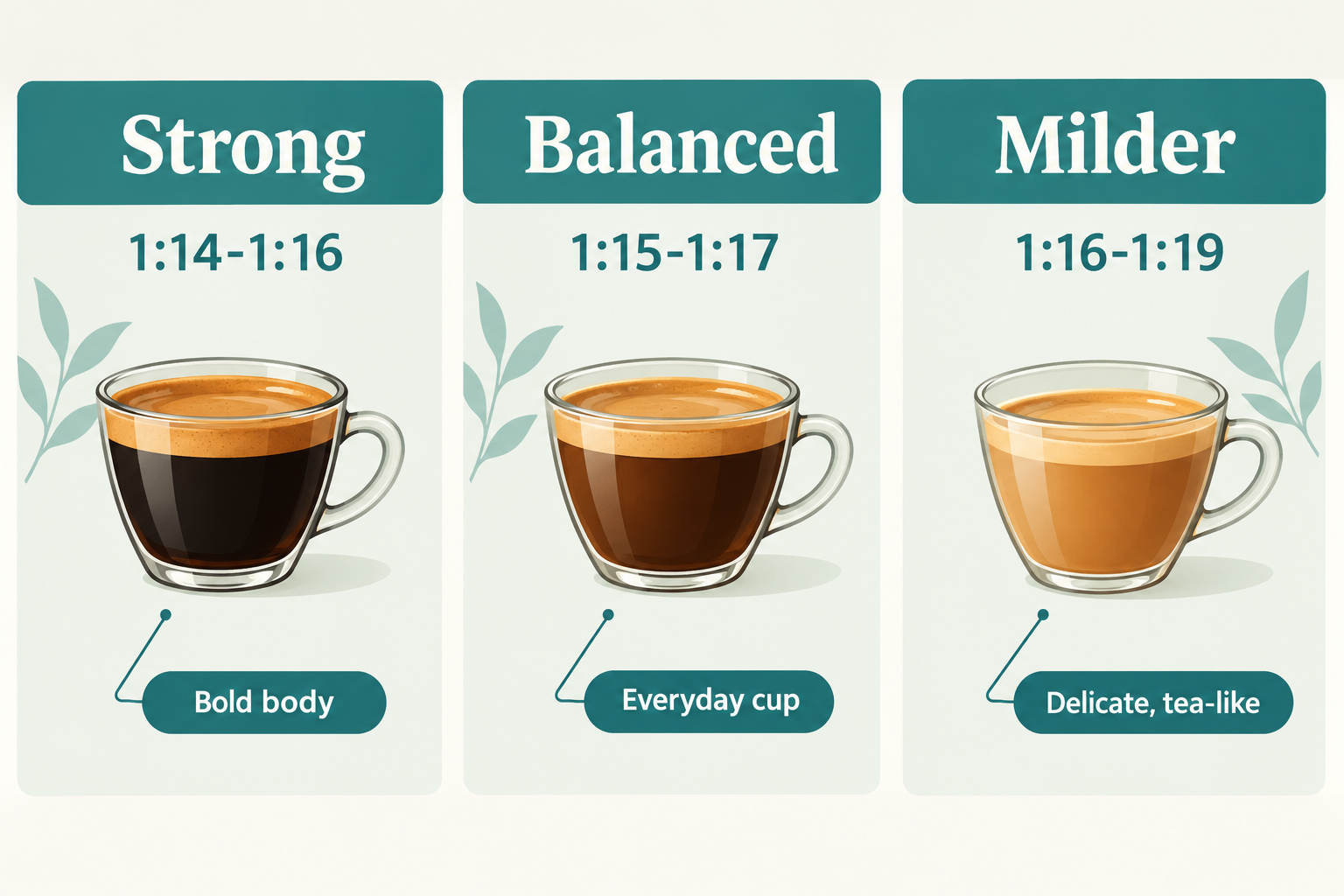
A widely used ratio chart breaks it down into three practical bands:
| Ratio range | Result | Typical use case |
|---|---|---|
| 1:14 to 1:16 | Strong | Dark roasts, smaller cups, drinkers who want bold body |
| 1:15 to 1:17 | Balanced | Everyday cup, most beans, most drinkers |
| 1:16 to 1:19 | Milder | Light roasts, delicate origins, longer steep or bloom |
Most standard pour over recipes finish in about 3 to 3.5 minutes total, including the bloom. If your brew is running much faster than that, your grind is probably too coarse. If it's running much slower, it's probably too fine, and that alone can make a correctly measured pour over coffee ratio taste off, because time and grind size both change how much flavor actually makes it into the cup.
How to measure pour over coffee without a scale
You can estimate a pour over coffee ratio using tablespoons and cups if you don't own a scale, though the result will be less precise than weighing your coffee and water.
Rough conversions to keep in your head:
- 1 level tablespoon of ground coffee weighs approximately 5 to 7 grams, depending on grind size and roast.
- A pour over coffee ratio in tablespoons, using 1:16 as the target: about 3 tablespoons of coffee (roughly 18 to 20 grams) to 1 cup (240 ml) of water gets you close to a 1:12 to 1:13 ratio, which is stronger than standard, so most people use closer to 2 tablespoons per cup for a more balanced result.
- A pour over coffee ratio for 1 cup of water (240 ml): aim for 15 to 16 grams of coffee, which is about 2 slightly heaped tablespoons.
The tablespoon method works fine for a quick weekday cup. It's not the method to use if you're trying to fine-tune a new bag of beans, because scoop size varies more than most people expect between grinders and coffee brands. A $15 to $25 digital kitchen scale removes that guesswork completely and is one of the cheapest upgrades in the beginner's guide to pour over coffee.
Why does coffee ratio matter for taste
The coffee to water ratio directly controls extraction, which is the process of water pulling soluble compounds like acids, sugars, and oils out of ground coffee. Too little water relative to coffee leaves flavor trapped in the grounds. Too much water pulls out compounds you don't want, including excess bitterness.
Coffee professionals talk about this in two connected terms: strength (how much dissolved coffee is in the cup, sometimes measured as total dissolved solids) and extraction yield (what percentage of the coffee's soluble material actually made it into the water). A pour over coffee ratio that's too strong and under-extracted often tastes sour or salty. One that's too weak and over-extracted often tastes bitter, hollow, or papery.
Grind size, water temperature, and brew time all interact with the ratio. Change the grind coarser and you extract less at the same ratio. Pour hotter water and you extract faster. That's why a single fixed pour over coffee ratio can taste different from one grinder to the next, and why dialing in always involves more than one variable at a time.
Pour over ratio vs french press ratio
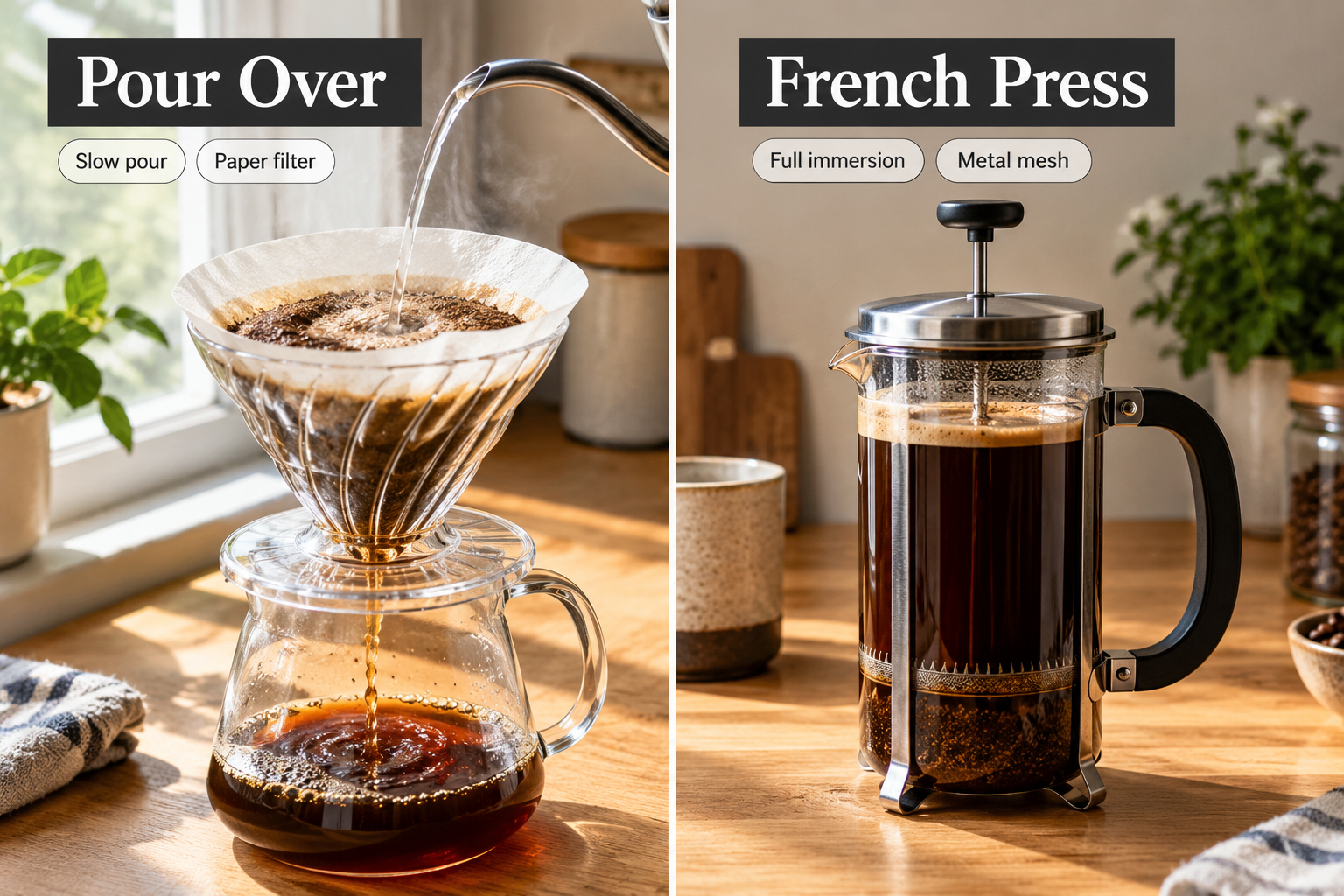
Pour over and french press use similar ratio math, but french press typically runs slightly stronger, often somewhere in the 1:12 to 1:15 range, because full immersion brewing extracts differently than a filtered pour.
The core difference is contact method. Pour over sends water through the grounds once (or in a few staged pours) and out through a paper or metal filter. French press submerges the grounds in water for several minutes, then separates them with a metal mesh plunger. That mesh lets more fine particles and oils stay in the cup, which is part of why french press coffee tastes heavier and fuller-bodied even at a comparable ratio.
Choose pour over if you want a cleaner cup with more clarity between individual flavor notes. Choose french press if you want heavier body and don't mind some sediment in the bottom of the cup. Either way, the same underlying principle applies: start near a documented ratio, then adjust based on the cup in front of you.
Common mistakes people make with coffee ratios
The most common mistake is eyeballing the coffee to water ratio pour over recipe instead of weighing it, which leads to inconsistent cups even when using the same bag of beans every day.
Other frequent problems worth checking before you blame the beans:
- Skipping the bloom. Pouring a small amount of water first and letting it sit for 30 to 45 seconds releases trapped carbon dioxide from the grounds, which helps water extract evenly during the main pour.
- Using stale coffee. A ratio can't fix flavor lost to a bag that's been open too long. Roast date matters more than most people realize.
- Ignoring grind size. The right pour over coffee ratio with the wrong grind still produces a bad cup. Medium-fine is the standard starting point for most pour over methods.
- Changing more than one variable at a time. If you adjust ratio, grind, and temperature all at once, you won't know which change actually fixed (or broke) the cup.
- Forgetting the scale's tare function. Weighing coffee and water without zeroing the dripper's weight first throws off every measurement that follows.
If your beans have been sitting around for a while, our advanced coffee storage and preservation guide covers how roast date and storage affect what you're actually tasting.
How to adjust pour over ratio if coffee tastes bitter
If your pour over coffee ratio tastes bitter, move it slightly weaker, from around 1:16 toward 1:17 or 1:18, and check whether your grind is too fine for your brew time.
Bitterness usually points to over-extraction, meaning too much soluble material came out of the grounds relative to how much water is in the cup. A few fixes, in order of what to try first:
- Weaken the ratio slightly. Move from 1:16 to 1:17, using a bit more water for the same amount of coffee.
- Grind coarser. A finer grind exposes more surface area, which speeds up extraction and can tip a cup toward bitter even at a normal ratio.
- Shorten the brew time. If your pour over is taking much longer than 3.5 minutes, something (usually grind size) is slowing the flow.
- Lower the water temperature slightly, especially if you're brewing right off a rolling boil. A few degrees can matter more than expected.
Make one change, brew again, and taste before making another. That's the actual dial-in process, and it's slower than people expect the first few times.
Pour over ratio for single cup vs large batch
The pour over coffee ratio itself doesn't change between a single cup and a large batch. What changes is the total amount of coffee and water, scaled proportionally to keep the same ratio.
- Single cup: 15 grams coffee to 250 grams water is a common starting recipe for one serving.
- Standard mug: 20 grams coffee to 320 grams water, following the 1:16 baseline.
- Large batch (multiple cups from a Chemex or similar carafe brewer): multiply both numbers by the same factor. For four mugs' worth, that's roughly 80 grams coffee to 1,280 grams water.
Common mistake: brewing a large batch by guessing "a bit more coffee" instead of doing the math. A ratio that tastes right at one cup can taste noticeably different at four cups if the proportion drifts even slightly, because larger volumes are more forgiving of small pouring inconsistencies but less forgiving of an actual measurement error.
Does water temperature affect the coffee ratio
Water temperature doesn't change the coffee to water ratio itself, but it does change how quickly that ratio extracts flavor, which is why temperature and ratio need to be considered together rather than separately.
The generally recommended range for pour over brewing is 195°F to 205°F (just off a full boil). Hotter water inside that range extracts faster, meaning a correctly measured 1:16 ratio can taste slightly different brewed at 195°F versus 205°F. If your water is cooler than that range, expect a flatter, less sweet cup even with a perfect ratio. If it's hotter, expect more bitterness to show up sooner.
Practical takeaway: if you've dialed in your pour over coffee ratio and grind size but the cup still tastes off, check your water temperature before changing anything else. An electric kettle with a built-in temperature display removes most of the guesswork.
What ratio do professional baristas use for pour over
Professional baristas generally start pour over recipes at 1:16, then adjust in small increments (usually no more than one point in either direction) based on how a specific coffee tastes during cupping or tasting.
This shows up consistently across current brewing references: a 2026 barista guide frames 1:16 as the "simple math" baseline before dialing in, a pour over ratio guide calls it the number to keep in mind above all others for V60, Kalita, and Chemex brewers, and cafe education material describes 16:1 water to coffee as the standard starting point baristas tweak for different origins, processing methods, and roast profiles. The pattern holds across sources because the number isn't arbitrary. It's close to the SCA's own filter coffee benchmark, which makes it a reasonable default rather than a house-specific trick.
Decision rule for home brewers: if you don't know where to start with a new bag of coffee, start exactly where baristas start. 1:16, taste it, then adjust.
How to dial in your pour over coffee ratio at home
Dialing in your pour over coffee ratio at home means brewing at 1:16 first, tasting honestly, then changing one variable at a time until the cup matches what you actually want to drink.
What you need:
- A pour over dripper (V60, Kalita Wave, or Chemex)
- A burr grinder set to medium-fine
- A digital scale
- A kettle that can hold 195°F to 205°F
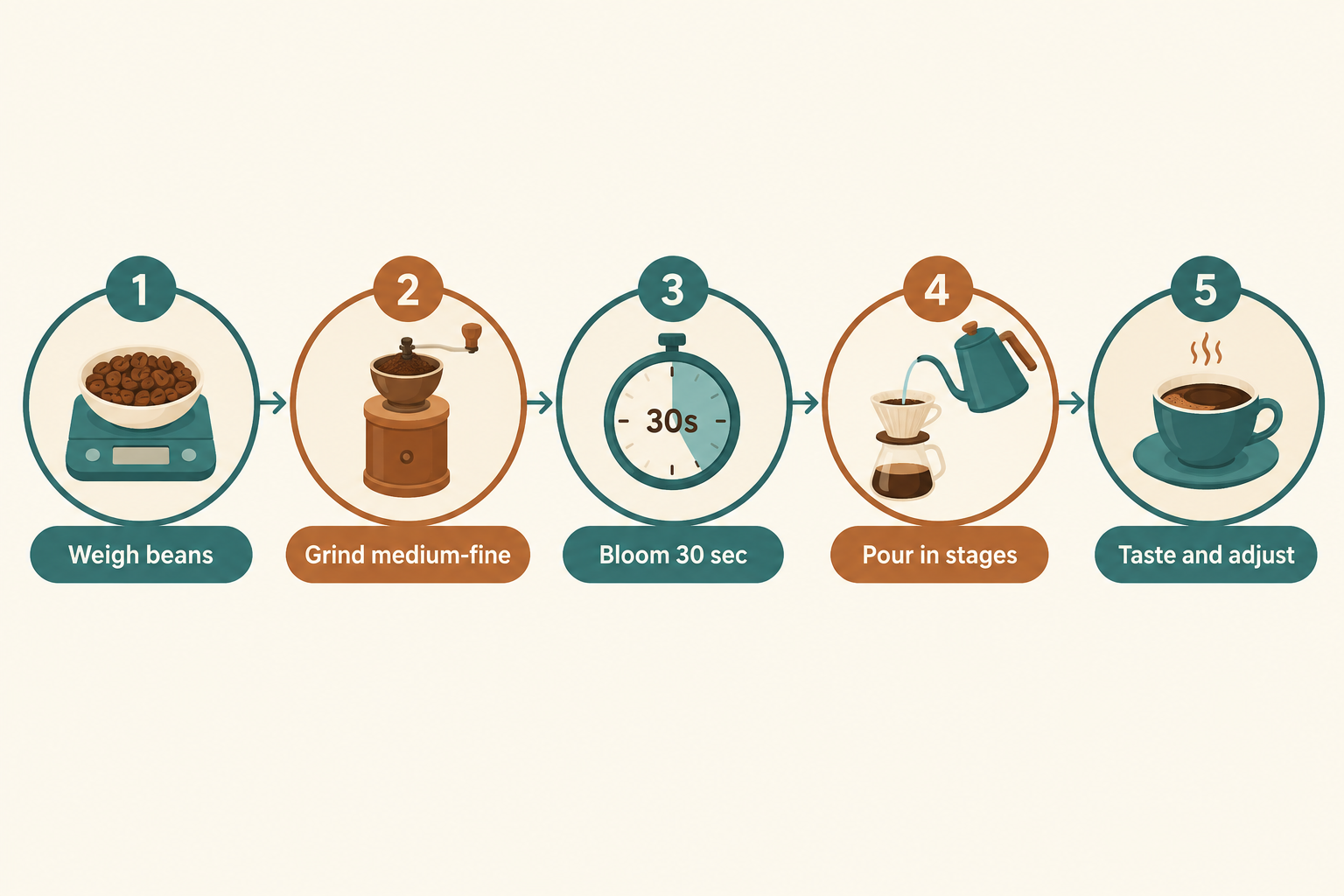
Method (basic Chemex recipe as an example):
- Weigh 30 grams of coffee for a 480 gram batch (a 1:16 ratio) and grind medium-fine.
- Place the filter in the Chemex, rinse it, and add the grounds.
- Start your timer, pour about 60 grams of water to saturate the grounds, and let it bloom for 30 to 45 seconds.
- Pour the remaining water in two or three slow, controlled stages, keeping the grounds evenly wet.
- Total brew time should land around 3 to 4 minutes, finishing near 480 grams of water.
That's how to make pour over coffee using the same ratio math baristas rely on, just scaled to a full carafe. Taste it. If it's bitter, move toward 1:17 next time. If it's sour or thin, move toward 1:15. Write the recipe down once you find it, because the version of you brewing coffee tomorrow morning will not keep in mind today's adjustments.
If you're still choosing equipment, the Chemex bonded coffee filter guide and the Cafellissimo paperless pour over dripper guide both cover how filter material changes the cup, which is a variable worth knowing about before you start troubleshooting ratio problems that might actually be filter problems.
Pour over coffee ratio calculator
Use the tool below to check your numbers before you brew. Pick a ratio, enter one value, and see what the other should be.
Pour over ratio calculator
Enter coffee above
FAQ
What is the best pour over coffee ratio for beginners? Start at 1:16 by weight (about 20 grams of coffee to 320 grams of water for a 12 ounce cup). It's the most commonly recommended baseline and easy to adjust from once you taste the result.
How much coffee do I need for 2 cups of pour over? For roughly 24 ounces (about 680 ml) of water, use about 42 to 43 grams of coffee at a 1:16 ratio. Scale the same math up or down for any batch size.
Is 1:16 the same as a standard scoop of coffee? Not exactly. A standard coffee scoop holds roughly 10 grams, so two scoops per cup gets close to a 1:16 to 1:20 range depending on grind and roast, but a scale is more accurate than scoops.
Does grind size change the pour over coffee ratio I should use? Grind size doesn't change the ratio number itself, but it changes how that ratio tastes. A finer grind extracts faster, so if your grind changes, taste the cup again before adjusting the ratio.
Why does my pour over coffee taste weak even at 1:16? Weak-tasting coffee at a correct ratio is usually a grind or temperature problem, not a ratio problem. Try grinding slightly finer or checking that your water is at least 195°F.
Can I use the same pour over coffee ratio for every bean I buy? You can start there, but not every bean will taste best at exactly 1:16. Light roasts and naturally processed coffees often do well closer to 1:15, while darker roasts sometimes taste cleaner near 1:17 or 1:18.
Conclusion
The pour over coffee ratio isn't a secret formula, it's a starting point: 1 gram of coffee to 16 grams of water, adjusted within a 1:15 to 1:17 range based on the bean in front of you. Weigh your coffee and water once with an actual scale, taste the result honestly, and change one thing at a time from there. That's genuinely the whole method, and it's the same one professional baristas use before they ever touch anything fancier. Start at 1:16 tomorrow morning, write down what you changed, and you'll know more about your own coffee in a week than most people learn in a year of eyeballing it.
Keep Exploring Coffee Rank IQ
- Coffee Rank IQ home: reviews, brewing guides, and coffee science
- Best Pour Over Coffee Maker: Drippers vs Machines Compared
- French Press vs Pour Over: Which Cup Fits Your Morning?
- French Press Coffee Ratio: The Grams, Cups, and Scoops That Work
- Best Cold Brew Coffee Maker: 6 Picks for Smooth Batches at Home
References
- masteringcoffee.com/how-to-make-pour-over-coffee
- baristabench.com/guides/pour-over-coffee-ratio
- www.day9.coffee/field-notes/pour-over-ratio-guide
- myhomebarista.com/guides/pour-over-ratio
- thecoffeeratio.com/blog/pour-over-coffee-guide
- coffeefile.com/pour-over-coffee-ratio
- baristalife.co/blogs/blog/pour-over-ratio
- completehomebarista.com/faqs/brewing-methods/pour-over/optimal-coffee-to-water-ratio
- coffeefile.com/pour-over-recipe-chart
- 40thievescoffee.com/blogs/thieves-blog/coffee-to-water-ratio-2026-guide-for-every-brewing-method