Best Cold Brew Coffee Maker: 6 Picks for Smooth Batches at Home
Quick Answer
The best cold brew coffee maker for most home brewers is the OXO Good Grips Cold Brew Coffee Maker, which testing panels at Wirecutter and Good Housekeeping rank at the top for clean extraction and simple cleanup. If you want a lower price and a glass carafe you can set on the counter, the Takeya Cold Brew Coffee Maker is the pick CNN Underscored names as its favorite. If you need coffee in minutes instead of hours, a rapid cold brew coffee maker like the OXO Rapid Brewer solves that without giving up much flavor.
Key Takeaways
- The OXO Good Grips Cold Brew Coffee Maker is the most-cited best cold brew coffee maker across 2026 testing roundups, prized for its stainless mesh filter and auto-draining valve.
- The Takeya Cold Brew Coffee Maker is CNN Underscored's named pick for value and simplicity, and it doubles as a best glass cold brew coffee maker for anyone who wants to see the brew steep.
- Traditional immersion brewing takes 12 to 24 hours, while a rapid cold brew coffee maker can produce a drinkable batch in 5 to 25 minutes.
- A standard cold brew concentrate ratio is 1 part coffee to 5 parts water; ready-to-drink cold brew runs closer to 1:7.
- Coarse grind, roughly the texture of raw sugar, is non-negotiable. Fine grounds turn cold brew bitter and cloudy.
- Cold brew makers with a built-in stainless filter skip paper filters entirely, which cuts long-term cost and waste.
- Budget pickers like the Mueller Cold Brew Coffee Maker trade some polish for big capacity at a low price.
- Weekly cleaning keeps every cold brew maker from developing rancid oil buildup, no matter which model you own.
What Is Cold Brew Coffee and How Is It Different From Iced Coffee
Cold brew coffee is steeped in room-temperature or cold water for hours, never touching heat. Iced coffee is brewed hot, the normal way, then cooled or poured over ice. That single difference in water temperature changes the chemistry, the acidity, and the shelf life of the finished drink.
Hot water pulls oils, acids, and aromatic compounds out of ground coffee fast. Cold water pulls them out slowly, and it extracts fewer of the acidic compounds that give hot coffee its sharper bite. That is why cold brew tastes rounder and less acidic, a point repeated across cold brew coverage from Business Insider to Food Network.
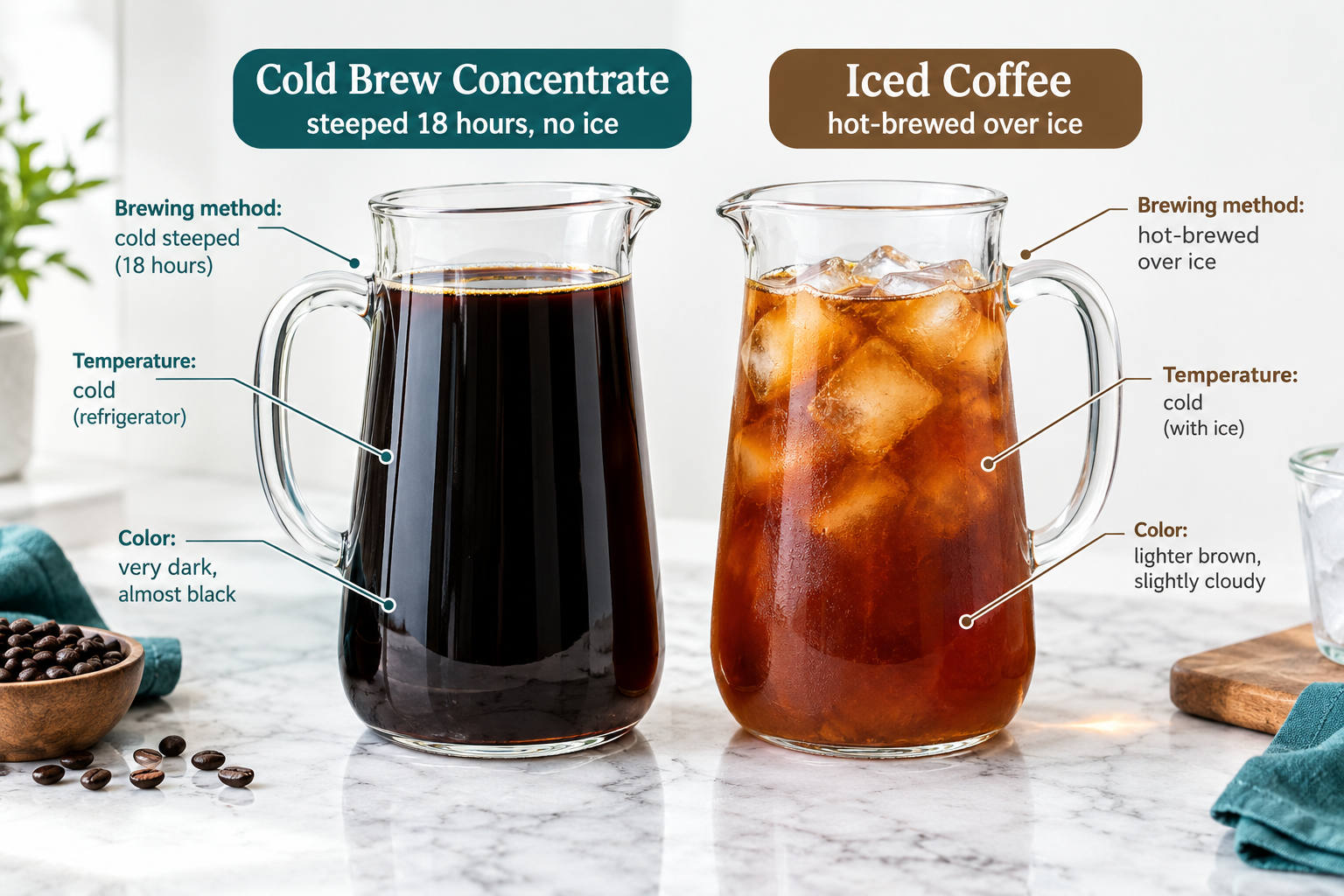
Iced coffee still carries the brightness of a hot brew, just chilled. Cold brew tastes closer to chocolate and low-acid fruit, with a heavier body. Neither is objectively better. Choose iced coffee if you like a livelier cup fast. Choose a cold brew coffee maker if you want a smoother, less acidic glass and don't mind planning ahead.
Common mistake: assuming cold brew is automatically weaker than iced coffee. Cold brew concentrate is often stronger than a normal cup of coffee before you dilute it. The smoothness comes from lower acid, not lower strength.
Best Cold Brew Coffee Maker: Quick Verdict for 6 Buyer Types
The best cold brew coffee maker depends on your kitchen, your batch size, and how long you're willing to wait. Here is the short version before the full breakdown.
| Buyer type | Best pick | Why it fits |
|---|---|---|
| First-time buyer who wants the safest choice | OXO Good Grips Cold Brew Coffee Maker | Consistent extraction, minimal guesswork |
| Budget shopper who wants a glass carafe | Takeya Cold Brew Coffee Maker | Affordable, filter-free cleanup, named top pick by CNN |
| Someone who wants coffee today, not tomorrow | OXO Rapid Brewer | Concentrate in about 5 minutes |
| Renter with limited fridge space | Dash Rapid Cold Brew Maker | Fast brew with noticeably less sediment |
| Household that drinks a lot of cold brew | Mueller Cold Brew Coffee Maker | Large 64-ounce capacity at a low price |
| Dorm room or tiny kitchen | Brewjar | Small footprint, one-jar simplicity |
This is not a case where one machine suits everyone. A student living out of a mini fridge has a different problem than a parent making a week's worth of concentrate on Sunday. Match the pick to the problem, not the other way around.
How Long Does It Take to Make Cold Brew
A traditional immersion cold brew maker needs 12 to 24 hours in the refrigerator, with most home brewers landing around 18 hours for balanced flavor. A rapid cold brew coffee maker shortens that to somewhere between 5 and 25 minutes, using pressure or agitation instead of a long soak.
The tradeoff is real. Reviewed.com's 2026 testing found a rapid machine could deliver a light-bodied iced coffee in about 5 minutes, or a bolder batch by running the cycle up to 25 minutes. That is remarkable speed, and it makes cold brew possible on a weekday morning instead of only after weekend planning.
Slow immersion still wins on smoothness in most published taste comparisons, because the long soak extracts flavor gently and leaves more acids behind. Decision rule: if you can plan a batch the night before, choose immersion. If you need a cup in the next half hour, choose a rapid cold brew coffee maker and accept a slightly brighter, less mellow result.
The 6 Best Cold Brew Coffee Makers for Smooth Batches at Home
These six models cover the price range, the counter space, and the patience level of nearly every home brewer. The picks below draw on published testing from Forbes Vetted, Wirecutter, Good Housekeeping, Consumer Reports, Food Network, Reviewed, and CNN Underscored, not hands-on testing by Coffee Rank IQ. Affiliate links may earn this site a commission at no extra cost to you.
| Model | Brew style | Capacity | Brew time | Best for |
|---|---|---|---|---|
| OXO Good Grips Cold Brew Coffee Maker | Immersion | 32 oz / 5 cups | 12-24 hrs | Best overall |
| Takeya Cold Brew Coffee Maker | Immersion, glass | 64 oz | 12-24 hrs | Beginners, value |
| OXO Rapid Brewer | Rapid | 24 oz concentrate | ~5 min | Speed |
| Dash Rapid Cold Brew Maker | Rapid | 32 oz | Under 30 min | Low sediment |
| Mueller Cold Brew Coffee Maker | Immersion | 64 oz | 12-24 hrs | Large batches, budget |
| Brewjar | Immersion, single jar | 32 oz | 12-24 hrs | Small spaces |
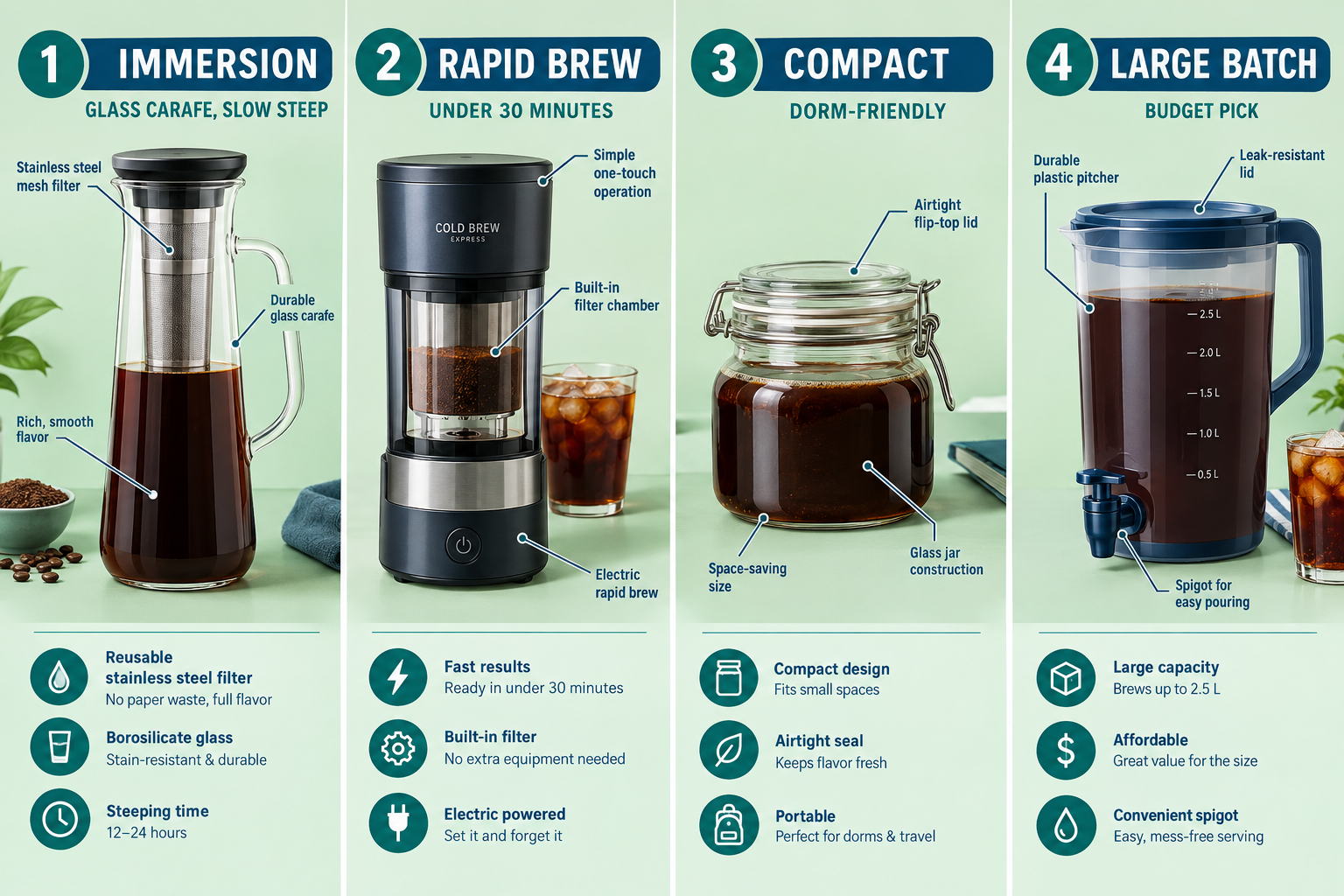
OXO Good Grips Cold Brew Coffee Maker
Verdict: the best cold brew coffee maker for anyone who wants a clean, consistent result without babysitting the process.
Who it suits: first-time buyers and anyone who has been burned by muddy, sediment-heavy cold brew from a DIY jar setup.
Evidence: Forbes Vetted's 2026 testing describes the OXO as "straightforward, mess-free and makes bold concentrate," with a 9.5 x 9.5 x 14.7 inch footprint, 5-cup capacity, and a 12 to 24 hour brew window. It uses a "Rainmaker" water distributor that saturates the grounds evenly, an auto-draining release valve, a borosilicate glass carafe with a stopper, and an ultra-fine stainless mesh filter. Good Housekeeping's lab test of more than a dozen models picked the OXO as best overall, and Wirecutter's dedicated cold brew review agrees on its balanced acidity and clean finish.
Strengths: even saturation, no paper filters to buy, a filter fine enough to leave minimal grit at the bottom of the glass.
Drawbacks: at roughly $60 as of this check, it costs more than a jar-and-cheesecloth setup, and the release valve needs a firm surface under the carafe to drain cleanly.
Who should skip it: anyone who only drinks cold brew occasionally and doesn't want a dedicated appliance taking up shelf space.
Compare the models or check the current price.
Takeya Cold Brew Coffee Maker
Verdict: the best glass cold brew coffee maker for a beginner who wants an all-in-one pitcher without buying separate filters.
Who it suits: first apartments, small households, and anyone who wants to watch the brew steep in the fridge door.
Evidence: CNN Underscored's 2026 review names the Takeya Cold Brew Coffee Maker its top cold brew pick, pointing to its affordable price, one-piece design, and filter-free cleanup. The pitcher holds a full 64 ounces, enough for most households to skip brewing every other day.
Strengths: simple immersion brewing, dishwasher-safe parts, a shape that fits most refrigerator doors.
Drawbacks: the built-in filter is coarser than the OXO's stainless mesh, so expect slightly more fine sediment at the bottom of the pitcher.
Who should skip it: anyone chasing the cleanest possible cup with zero grit; the OXO handles that better.
OXO Rapid Brewer
Verdict: the best rapid cold brew coffee maker for a household that wants concentrate today, not tomorrow.
Who it suits: people who forget to start a batch the night before, or anyone testing cold brew for the first time without a 24-hour commitment.
Evidence: a 2026 Consumer Reports roundup lists the OXO Rapid Brewer at about $37.90 and reports it can produce cold brew concentrate in roughly 5 minutes, compared with the 12 to 24 hour traditional window.
Strengths: near-instant concentrate, small footprint, easier for apartment dwellers without much fridge space to spare.
Drawbacks: rapid extraction trades some of the mellow, low-acid character that a long steep produces. It is good, not identical to a slow immersion brew.
Who should skip it: anyone who has already built a Sunday cold brew ritual and doesn't mind the wait.
Dash Rapid Cold Brew Maker
Verdict: a strong rapid cold brew coffee maker pick for anyone bothered by gritty sediment in fast-brewed coffee.
Who it suits: buyers who tried a rapid machine before and disliked the sludge at the bottom of the glass.
Evidence: Good Housekeeping's 2026 lab evaluation found the Dash produces noticeably less sediment than many competing rapid machines, resulting in what testers called a nicer mouthfeel.
Strengths: fast turnaround under 30 minutes, cleaner cup than most rapid alternatives.
Drawbacks: capacity runs smaller than the immersion pitchers on this list, so it suits singles and couples better than a family batch.
Who should skip it: large households that need a full week's supply from one brew.
Mueller Cold Brew Coffee Maker
Verdict: the budget answer to "what's the best cold brew coffee maker for making large batches without spending much."
Who it suits: coffee-heavy households, offices, or anyone who wants a full 64-ounce pitcher ready for the week.
Evidence: Mueller's cold brew pitcher appears in 2026 buying guides as a large-capacity, low-price option, positioned well below the OXO and Takeya on shelf price while matching their 64-ounce capacity range.
Strengths: big batch size, low upfront cost, straightforward immersion brewing that needs no special technique.
Drawbacks: build quality and filter fineness trail the pricier picks. Expect a bit more sediment and a less polished feel on the lid and spigot.
Who should skip it: anyone who cares more about a refined pour and clean finish than about stretching a dollar.
Brewjar
Verdict: the best cold brew coffee maker for a dorm room, a studio kitchen, or a first apartment with almost no counter space.
Who it suits: students, small households, and anyone who wants one glass jar that does the steeping and the storing.
Evidence: Coffee Circle's 2026 testing recommends the Brewjar as a minimal-effort immersion brewer, built around a single jar rather than a two-piece carafe and filter system.
Strengths: compact size, one item to wash, easy to tuck into a mini fridge.
Drawbacks: smaller batch size than the Takeya or Mueller, so it needs more frequent refills for a heavy drinker.
Who should skip it: anyone brewing for more than two people regularly.
Best Cold Brew Maker for Beginners
The best cold brew coffee maker for a beginner is one that removes decisions, not one with the most features. That means a fixed filter, a clear fill line, and instructions you can follow without a scale.
The OXO Good Grips Cold Brew Coffee Maker and the Takeya Cold Brew Coffee Maker both fit that description. Both use a coarse grind, a set amount of water, and a long soak with no monitoring required. Neither asks you to weigh anything or adjust pressure settings.
Decision rule: choose the OXO if you want the cleanest possible cup and don't mind the higher price. Choose the Takeya if you want a lower price point and a glass pitcher that also works as a fridge-door water alternative.
If you're brand new to the method entirely, our guide on how to make the best cold brew coffee walks through ratios and timing step by step.
Best Cold Brew Maker for Small Spaces or Dorms
The best cold brew maker for a dorm room or a tiny kitchen is a single-jar immersion brewer like the Brewjar, since it skips the two-part carafe-and-filter design that eats more shelf space.
Look for a model under 8 inches wide that fits on a narrow refrigerator shelf. Mini fridges have shallow doors, so a squat jar beats a tall pitcher every time. A flip-lid or screw-top jar also means you're not managing a separate filter basket in a shared kitchen sink.
Edge case: if your dorm fridge has no room at all, steep on a closet shelf instead. Cold brew works fine at cool room temperature for 12 to 16 hours; it just finishes a little faster than a refrigerated batch and should be strained and chilled once it's done.
Best Cold Brew Maker for Making Large Batches
The best cold brew coffee maker for large batches is one with at least a 64-ounce capacity, which points to the Takeya Cold Brew Coffee Maker or the Mueller Cold Brew Coffee Maker.
A 64-ounce batch of cold brew concentrate, diluted at the standard ratios, can produce well over a week's worth of drinks for one or two people. That cuts the number of steeping cycles you need to manage, which matters if you only have one shelf of fridge space to give up at a time.
Common mistake: brewing a huge batch and then forgetting about it. Cold brew concentrate keeps well for about 1 to 2 weeks refrigerated, but it does not last indefinitely. Label the jar with a date.
Cold Brew Maker vs French Press for Cold Coffee
A dedicated cold brew maker and a French press can both produce cold brew, but the cold brew maker's built-in filter handles a long steep better and leaves less sediment at the bottom of your cup.
A French press works fine for a single serving. Add coarse grounds and cold water, let it sit 12 to 18 hours in the fridge, then press down slowly. The mesh plunger on most French presses is coarser than a dedicated cold brew filter, so expect more grit unless you strain the coffee again through a paper filter or cheesecloth.
Decision rule: use a French press if you already own one and only want an occasional glass. Buy a dedicated cold brew coffee maker if you drink it often enough that cleanup time and sediment start to bother you.
Cold Brew Maker With a Built-In Filter vs a Separate Strainer
A cold brew maker with a built-in stainless mesh filter, like the OXO or Takeya, needs no paper filters at all and rinses clean in seconds. A separate strainer setup, like a jar with cheesecloth, costs less upfront but adds a step every single batch.
Built-in filters win on convenience over the long run. You never run out of paper filters, and the mesh doesn't tear. Separate strainer methods win on flexibility. A mason jar with a nut-milk bag or cheesecloth costs almost nothing and works with equipment you may already own.
Edge case: if you want zero grit at all, some brewers double-filter, straining once through the built-in mesh and again through a paper filter before storing the concentrate. It's an extra five minutes for a noticeably cleaner glass.
How Much Does a Good Cold Brew Maker Cost
A good cold brew coffee maker runs anywhere from about $17 for a basic large-capacity pitcher to around $60 for a premium immersion model with a fine stainless filter, based on prices checked across major 2026 retailer listings.
Here's the general breakdown by tier:
- Budget ($15-$25): Mueller and similar large plastic pitchers. Good capacity, basic build quality.
- Mid-range ($25-$40): Takeya glass pitchers and most rapid cold brew coffee maker models like the Dash.
- Premium ($40-$65): OXO Good Grips Cold Brew Coffee Maker and the OXO Rapid Brewer, both built around finer filtration and sturdier materials.
Decision rule: spend more if you drink cold brew daily and care about a clean finish. Spend less if you're testing the habit or replacing a jar-and-cheesecloth setup that already works fine.
What Grind of Coffee Is Best for Cold Brew
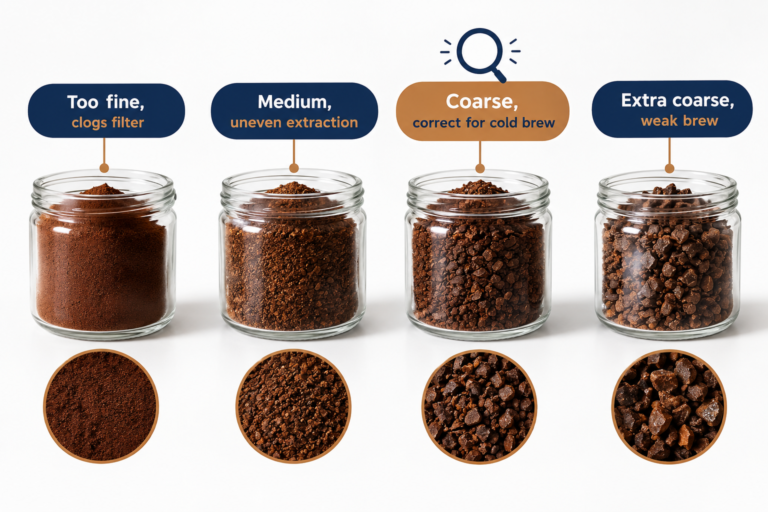
Coarse grind, roughly the texture of raw sugar or coarse sea salt, is the correct grind for cold brew. Fine grind clogs filters, over-extracts, and turns the finished coffee bitter and muddy.
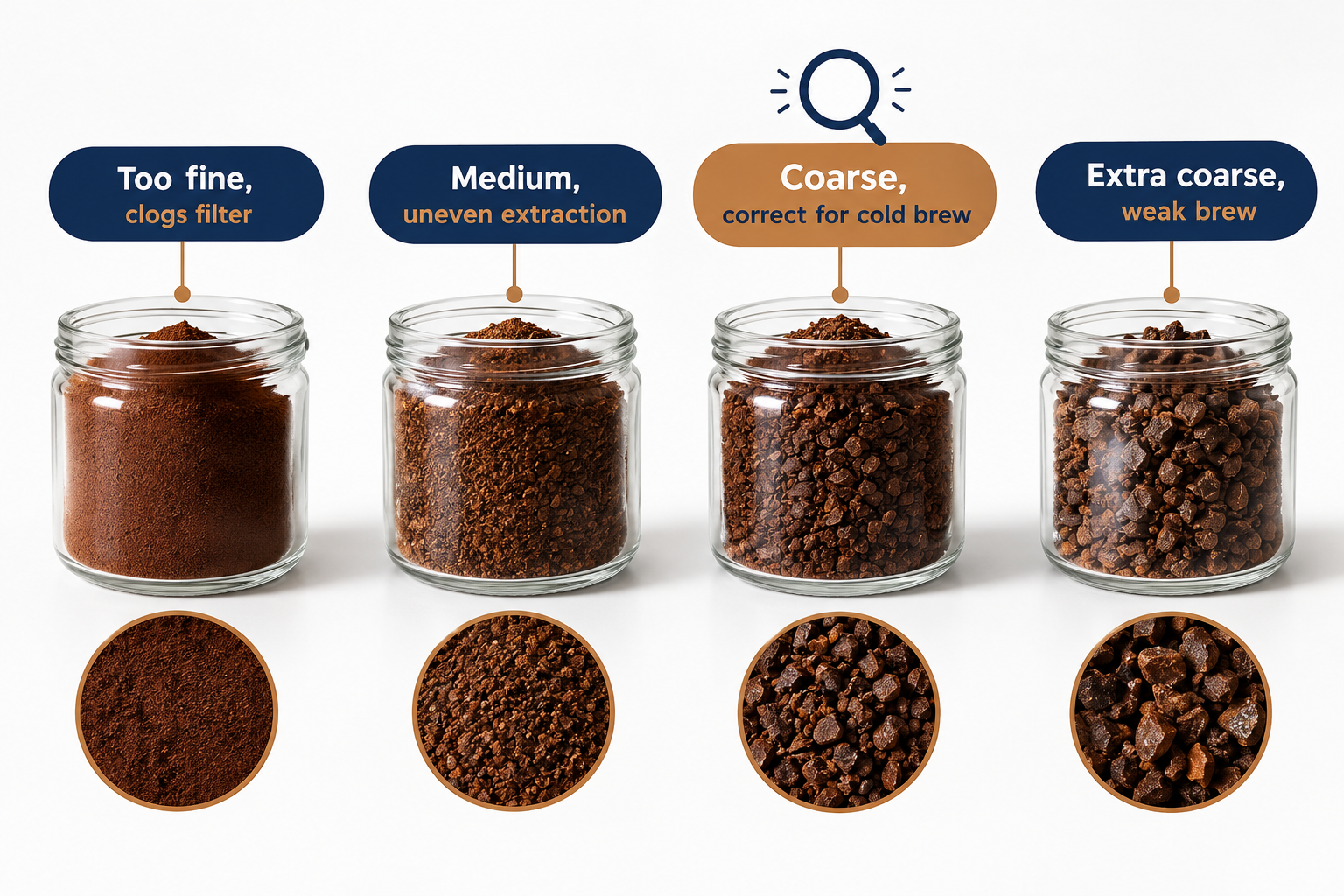
Yes, you can use regular pre-ground coffee bags labeled "medium" in a pinch, but the result usually runs cloudier and slightly harsher than a purpose-ground coarse batch. If your grocery store coffee only comes pre-ground medium, run it through a French press once before adding water. The larger holes in most standard drip filters won't fix a grind that's too fine for a 12-hour soak.
Common mistake: using espresso grind or standard drip grind in a cold brew maker. Both are far too fine for a long steep and will produce a bitter, silty batch no matter how good the beans are. If you want to dial in grind size with more control, a burr grinder beats a blade grinder for consistent coarse particles.
Why Is Your Cold Brew Bitter or Too Strong
Bitter or overpowering cold brew almost always comes down to one of three things: too fine a grind, too much coffee for the water, or a steep that ran too long.
- Grind too fine: switch to coarse and re-test the next batch.
- Ratio too strong: dilute the finished concentrate more before drinking. A 1:5 concentrate should be cut with water or milk before you drink it, not sipped straight.
- Steeped too long: pull the batch at 18 hours instead of pushing past 24. Extraction keeps happening the whole time the grounds sit in water.
Edge case: water quality matters too. Heavily chlorinated tap water can add a flat, chemical edge. Filtered water produces a cleaner-tasting batch in almost every side-by-side comparison home brewers report.
Can You Use Regular Coffee Grounds in a Cold Brew Maker
Yes, you can use regular coffee grounds in a cold brew maker as long as the grind is coarse enough, but a medium or fine grind sold for drip machines will produce a cloudier, more bitter result than a batch ground specifically for cold brew.
If coarse pre-ground coffee isn't available, buying whole beans and grinding them coarse at home gives you control over particle size, which matters more for cold brew than for almost any other brewing method because the grounds sit in water for so long.
Can You Make Cold Brew in a Mason Jar Instead
Yes, a mason jar works fine for cold brew and costs far less than a dedicated cold brew coffee maker, though you'll need a separate straining step that a built-in filter skips.
To do it: combine coarse grounds and cold or room-temperature water at a 1:5 ratio for concentrate, stir to make sure every ground is wet, cover, and refrigerate for 12 to 24 hours. Strain through a fine mesh sieve lined with a paper filter or through a nut-milk bag, twice if you want a cleaner result.
Decision rule: a mason jar is the right call if you brew cold brew occasionally and already own straining tools. A dedicated cold brew coffee maker earns its price if you brew weekly and want to skip the straining step every single time. For a full walkthrough with exact ratios, see our guide on advanced cold brew coffee methods.
How Often Should You Clean a Cold Brew Maker
Clean a cold brew maker after every batch, and give it a deeper scrub with dish soap and warm water at least once a week if you brew often.
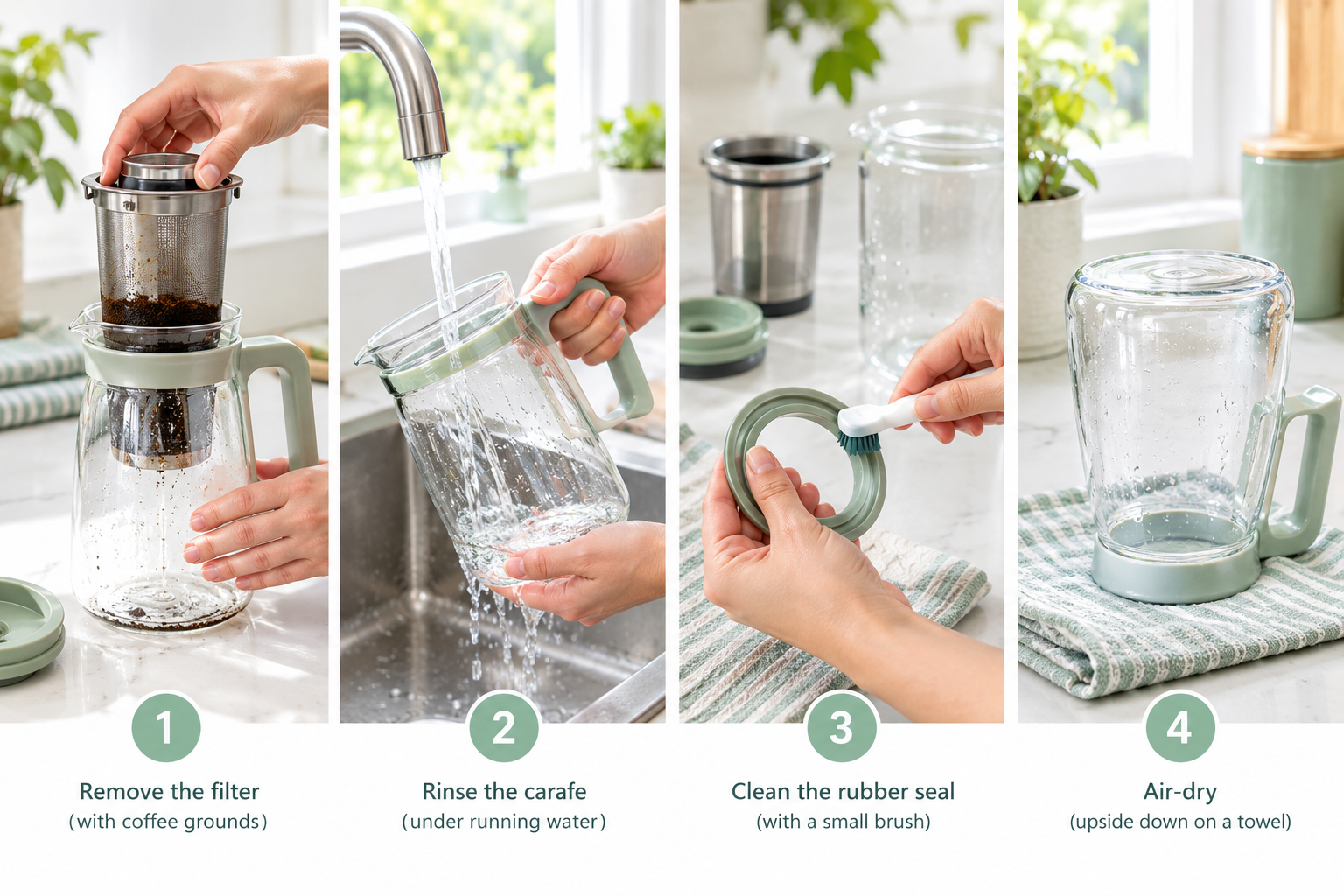
Coffee oils go rancid faster than most people expect, and a cold brew maker holds grounds in contact with water far longer than a drip machine does. A quick rinse between batches keeps oils from building up on the stainless filter or the rubber gasket.
Weekly routine:
- Remove the filter and rinse grounds down the drain, not the sink trap.
- Wash the carafe, filter, and any seals with warm soapy water.
- Check the release valve or spigot for trapped grounds; a small brush helps.
- Air-dry fully before the next batch to avoid mildew smell.
Common mistake: letting a used filter sit wet in the fridge overnight. That's the fastest way to a sour smell that transfers into your next batch. If you want a wider routine for every brewer in the house, our guide on best ways to clean a coffee maker for beginners covers descaling and deep cleaning too.
Try the Cold Brew Ratio Calculator
Cold Brew Ratio Calculator
Enter a batch size and pick a ratio.
Ratios follow common cold brew practice: 1:5 for concentrate, 1:7 for ready-to-drink cold brew.
FAQ
What is the best cold brew coffee maker for beginners? The OXO Good Grips Cold Brew Coffee Maker and the Takeya Cold Brew Coffee Maker are the easiest starting points. Both use fixed ratios and a set steep time, so there's little to get wrong on your first batch.
Is a rapid cold brew coffee maker as good as a traditional one? It comes close but not identical. Rapid machines like the OXO Rapid Brewer produce concentrate in about 5 minutes, while traditional immersion brewing over 12 to 24 hours generally produces a smoother, lower-acid cup in published taste tests.
What about the Toddy cold brew coffee maker or a KitchenAid cold brew coffee maker? Both are solid alternatives to the picks above. The Toddy Cold Brew System is one of the original immersion brewers and still shows up in many kitchens for its simple felt-filter design. A KitchenAid cold brew coffee maker suits buyers who want their brewer to match existing KitchenAid stand mixers and kettles on the counter. Neither beats the OXO on filtration fineness in published lab tests, but both are reasonable choices if design consistency matters to you.
Can I use my regular drip coffee grounds for cold brew? You can, but coarse grind works far better than the medium grind most bags are sold as. Fine or medium grounds over-extract during a long soak and turn the batch bitter and cloudy.
How long does cold brew concentrate last in the fridge? Most cold brew concentrate stays good for 1 to 2 weeks refrigerated in a sealed container. Ready-to-drink cold brew, already diluted, is best within about a week.
Do I need paper filters for a cold brew maker? Not with models like the OXO or Takeya, which use a built-in stainless mesh filter. Mason jar methods and some budget pitchers still rely on cheesecloth or a paper filter for straining.
Conclusion
The best cold brew coffee maker for you comes down to two questions: how much are you willing to spend, and how long are you willing to wait. If the answer is "spend a bit more, wait overnight," the OXO Good Grips Cold Brew Coffee Maker earns its reputation across nearly every 2026 testing panel. If the answer is "keep it cheap and simple," the Takeya Cold Brew Coffee Maker delivers most of that same smoothness in a glass pitcher for less money. And if patience isn't on the table this week, a rapid cold brew coffee maker like the OXO Rapid Brewer gets you a drinkable batch before your commute starts.
Pick the one that matches your actual morning, not the one with the most features on the box. Then read the brewing method that comes with it, use a coarse grind, and give the filter a real rinse after every batch. That's most of what separates a smooth glass of cold brew from a muddy one.
Keep Exploring Coffee Rank IQ
- Coffee Rank IQ home: reviews, brewing guides, and coffee science
- Best Cold Brew Coffee Brands: Concentrates, Cans, and Beans
- Best Pour Over Coffee Maker: Drippers vs Machines Compared
- Best Iced Coffee Maker: Brew-Over-Ice and Cold Brew Picks Compared
- Best Drip Coffee Maker: 7 Brewers Worth the Counter Space
References
- www.businessinsider.com/guides/kitchen/best-cold-brew-coffee-maker
- www.nytimes.com/wirecutter/reviews/best-coffee-maker
- www.forbes.com/sites/forbes-personal-shopper/article/best-coffee-makers
- www.theconsumers.guide/reviews/best-cold-brew-coffee-makers-2026
- www.consumerreports.org/appliances/coffee-makers/best-cold-brew-coffee-makers-of-the-year-a1383130199
- www.nytimes.com/wirecutter/reviews/best-cold-brew-coffee-maker
- www.foodnetwork.com/how-to/packages/shopping/product-reviews/best-cold-brew-makers
- www.goodhousekeeping.com/what-to-buy/kitchen-products/g71506488/cold-brew-coffee-makers
- www.reviewed.com/cooking/best-right-now/best-cold-brew-coffee-makers
- www.cnn.com/cnn-underscored/reviews/best-coffee-makers