Best Cold Brew Coffee Brands: Concentrates, Cans, and Beans
Quick Answer
Stumptown holds the top overall spot among cold brew brands in a seven-brand 2026 comparison, scoring 90 out of 100, and its concentrate is also singled out by Food Network as the strongest all-around choice for flavor and versatility. If you want the boldest, most caffeinated pour, Java House wins on strong taste among tested concentrates. If you want grab-and-go convenience, Starbucks Nitro Cold Brew leads canned rankings for texture and consistency. The best cold brew coffee for you depends on whether you value a ready-made can, a concentrate you dilute yourself, or whole beans you steep from scratch.
Key Takeaways
- Stumptown ranks as the top overall cold brew brand in a 2026 seven-brand comparison, with an SR Score of 90, and its concentrate is Food Network's top pick for store-bought cold brew.
- Java House concentrate is rated best for strong taste among coffee concentrates tested by NBC Select in 2026.
- Starbucks Nitro Cold Brew leads multiple 2026 canned rankings for smooth texture, though some tasters note a faint metal-can note.
- Cold brew concentrate and ready-to-drink cans solve different problems: concentrate is cheaper per serving and customizable, cans are faster but pricier per ounce.
- Coarse ground coffee for cold brew matters because fine grounds over-extract during a 12 to 24 hour steep and turn bitter or muddy.
- Cold brew is not automatically lower in caffeine than espresso. Ounce for ounce, espresso is far more concentrated, but a typical cold brew serving is larger, so total caffeine per cup can land close.
- Grocery store shelves now carry SToK, La Colombe, Chameleon, Bizzy, Stone Street, Califia Farms, and High Brew alongside Starbucks, giving buyers real choice at nearly every price point.
- Home brewing with coarse ground coffee for cold brew, a jar, and a filter costs less per cup than any canned or bottled option once you own basic gear.
What Is Cold Brew Coffee and How Is It Different From Iced Coffee?
Cold brew coffee is made by steeping coarsely ground coffee in cold or room-temperature water for 12 to 24 hours, then filtering out the grounds. Iced coffee is hot-brewed coffee that gets cooled and poured over ice. The two drinks start from the same bean but end up tasting different because of the water temperature used during extraction.
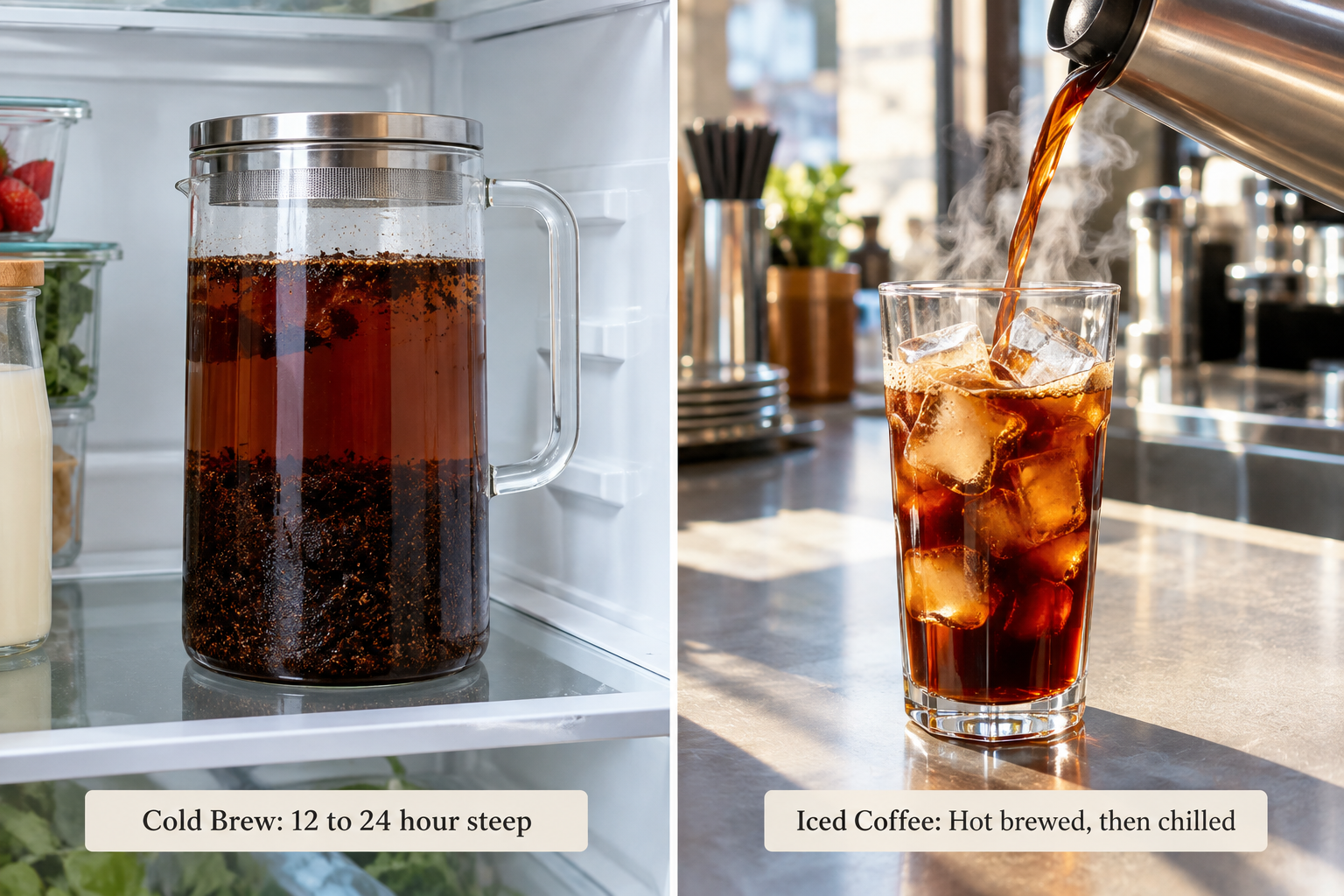
Heat pulls certain acids and aromatic oils out of coffee grounds quickly. Cold water pulls them out slowly and less completely. That's the reason cold brew tends to taste smoother and less sharp than iced coffee made from hot-brewed coffee, even when the beans are identical. A June 2026 buying guide on mold-free cold brew coffee recommends steeping in the refrigerator for 12 to 24 hours specifically to control extraction and reduce the risk of mold growth during a long steep at room temperature.
Iced coffee brews in minutes. Cold brew takes a full day. If you're short on patience, iced coffee wins. If you want a mellower, chocolate-forward cup with less acidity, cold brew is worth the wait. For a full walkthrough of the faster method, read our guide to making iced coffee for beginners.
Decision rule: choose cold brew if you drink coffee over ice daily and want to make a batch once for the week. Choose iced coffee if you want a single cold cup today with equipment you already have.
Best Cold Brew Coffee Brands 2026: Quick Verdict by Buyer Type
The best cold brew coffee brand changes depending on what you're buying it for: a bottle to dilute at home, a can to grab on the way out the door, or beans to brew yourself. Here is the short version before the detail.
- Best overall cold brew brand: Stumptown, with an SR Score of 90 across a seven-brand 2026 comparison.
- Best cold brew concentrate for flavor: Stumptown Cold Brew Concentrate, named "Best Concentrate" by Food Network.
- Best cold brew concentrate for strong, bold taste: Java House Cold Brew Coffee, rated "Best strong taste" by NBC Select in its September 2026 concentrate roundup.
- Best canned cold brew: Starbucks Nitro Cold Brew, which appears at the top of several 2026 canned coffee tests for texture and consistency.
- Best for a no-added-sugar pantry staple: Starbucks Signature Black Cold Brew Coffee Concentrate, made from Latin American arabica beans and sold as a no-added-sugar option through major retailers.
- Best for foodservice or high-volume brewing: DaVinci Gourmet Classic Iced Coffee Concentrate, built for cafes and restaurants that need a fast, consistent base.
- Best for home brewers who want control: whole bean coffee ground coarse for a DIY steep, paired with a dedicated cold brew maker.
No single brand wins every category, which is normal. A concentrate built for bold flavor and a canned drink built for portability are solving different problems, not competing head to head.
Cold Brew Concentrate vs Ready-to-Drink Cans: Which Is Better?
Concentrate is better if you want control over strength and lower cost per serving. Ready-to-drink cans are better if you want zero prep and a drink that's finished the moment you open it. Neither format is objectively superior; they trade convenience for customization in opposite directions.
Concentrate ships in a bottle at roughly two to three times normal coffee strength. You dilute it yourself with water, milk, or a milk alternative like Califia Farms oat or almond milk, which means you control the final strength and can stretch one bottle into many servings. Cans arrive ready to drink at full strength, with no dilution needed and no cleanup, but you pay for that convenience in price per ounce and you can't adjust the ratio once it's sealed.
| Format | Example brands | Prep needed | Best for |
|---|---|---|---|
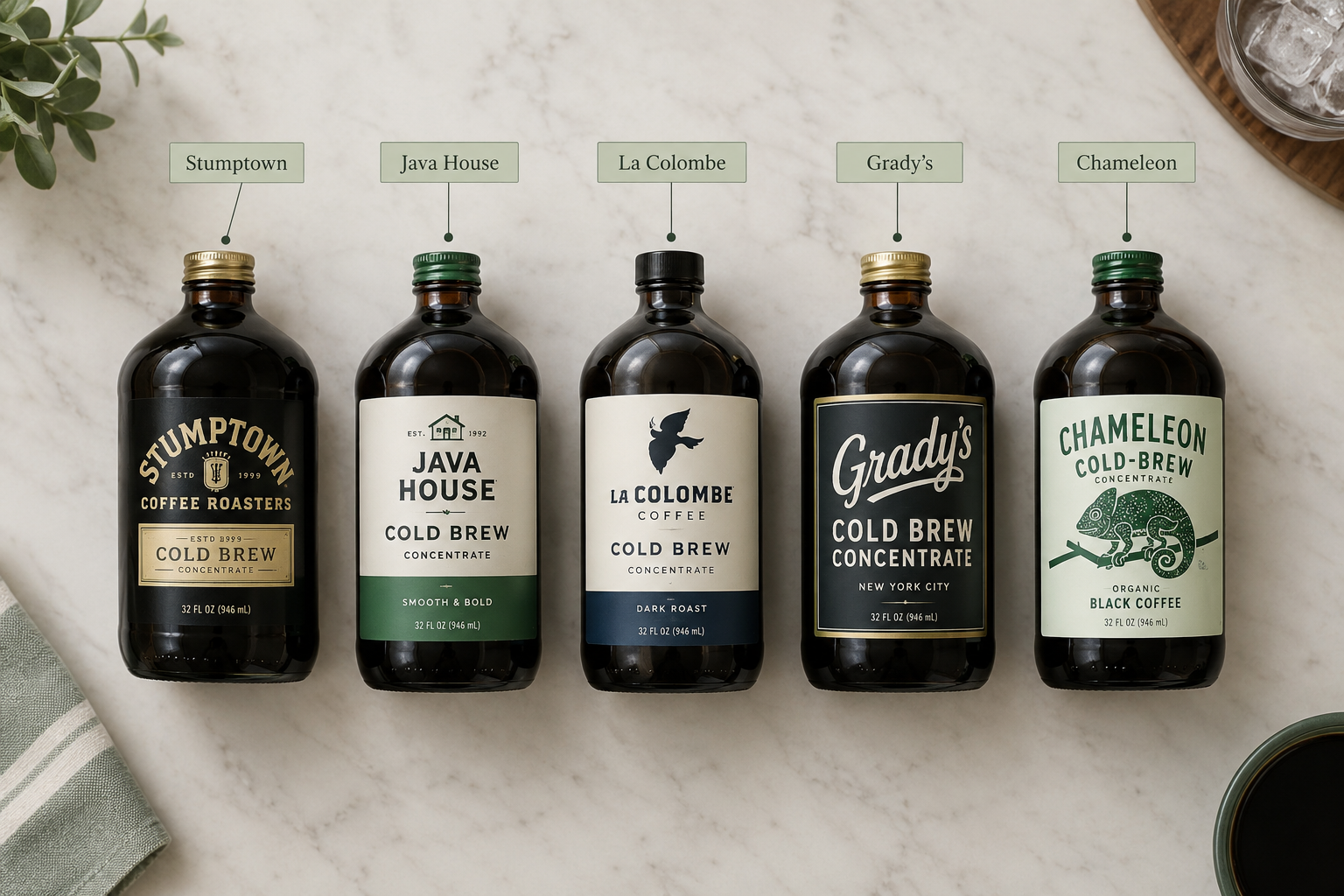
| Concentrate | Stumptown, Java House, La Colombe, Grady's, Chameleon, Bizzy, Stone Street | Dilute with water or milk | Daily drinkers who want lower cost per cup |
| Ready-to-drink cans | Starbucks Nitro, High Brew, illy, Califia Farms | None, drink as is | Commuters, travel, grab-and-go mornings |
| Whole bean, home steeped | Any roaster, ground coarse | 12 to 24 hour steep, plus straining | Home brewers who want full control over beans and strength |
Common mistake: pouring cold brew concentrate over ice without diluting it. Most concentrates are built to be cut with one to two parts water or milk. Skipping that step gives you a cup that's far more bitter and caffeinated than intended.
Best Cold Brew Concentrate Brands Worth Buying
The best cold brew concentrate brands in 2026 split into two camps: specialty roasters chasing flavor and grocery staples chasing convenience and value. Both camps have real winners.
Stumptown Cold Brew Concentrate sits at the top of Food Network's store-bought cold brew rankings, described as a benchmark for flavor and versatility when diluted at home. It also anchors Stumptown's position as the number one overall cold brew brand in a 2026 seven-brand comparison with an SR Score of 90. If you want one bottle that performs well both black and with milk, this is the safe pick.
Java House Cold Brew Coffee earned "Best strong taste" in NBC Select's September 2026 concentrate testing, aimed at drinkers who want an intense, high-caffeine base rather than a delicate one. Skip it if you prefer a milder, rounder cup, since Java House is built for people who like their coffee assertive.
Grady's NOLA Cold Brew Concentrate is a New Orleans-style concentrate made with chicory, giving it a slightly earthy, less acidic character than a straight arabica concentrate. It's a good pick for readers who want a distinct regional flavor rather than a neutral base.
La Colombe Cold Brew is widely available in grocery stores and shows up repeatedly in concentrate comparisons alongside Stumptown for its balanced, chocolate-forward flavor. It's a solid middle-ground pick between grocery-store convenience and specialty-roaster quality.
Chameleon Cold Brew focuses on organic, single-origin sourcing and tends to appeal to buyers who already care about bean origin and processing method the way they would when choosing coffee beans for home brewing.
Bizzy Cold Brew started as a small-batch concentrate maker and still markets itself on cold-brew-specific sourcing, which matters because not every roaster grinds or roasts beans with a long cold steep in mind.
Stone Street Coffee Cold Brew Reserve is aimed at buyers who want a darker, more full-bodied concentrate with noticeable body, closer to what you'd expect from a French press than a lighter pour-over.
Starbucks Signature Black Cold Brew Coffee Concentrate is positioned by Target as a no-added-sugar option made from Latin American arabica beans, giving it a straightforward, additive-free profile for shoppers who want a familiar name without flavored syrups mixed in.
DaVinci Gourmet Classic Iced Coffee Concentrate is built for foodservice, showing up in bulk-supply catalogs aimed at cafes that need a fast, consistent base for high-volume iced drinks rather than a small-batch specialty pour.
Who should skip concentrate entirely: anyone who wants a single-serve drink with zero measuring. Concentrate rewards people willing to dilute and taste-adjust. If that sounds like a chore, a can solves the problem faster.
Best Canned and Ready-to-Drink Cold Brew Brands
Starbucks Nitro Cold Brew is the most consistently top-rated canned cold brew across 2026 testing, praised for its smooth, almost creamy texture from the nitrogen infusion process. If you want the closest thing to a cafe nitro pour from a can, this is the pick to start with.
Food Network's broader cold brew roundup names illy Ready to Drink Cold Brew Cappuccino as its top overall ready-to-drink pick and calls Starbucks Nitro Cold Brew Splash of Sweet Cream the best nitro variety with dairy included, which tells you dairy-inclusive and nitro formats are now the strongest performers in the premium canned category. LexaveBrew's September 2026 expert ranking of 15 canned coffees gives Starbucks Nitro Cold Brew Black Unsweetened, sold in 9.6 fl oz cans, a 4.4 out of 5 rating.
Sporked's taste test, cited by CoffeeScan, calls Starbucks Nitro Cold Brew "Best Canned" for its smooth texture, though some tasters picked up a faint metallic note tied to the can itself rather than the coffee. DigitalNPQ's 2026 testing pushed further, sampling 144 cans across 12 brands over 90 days to find canned coffees that balance flavor, convenience, and caffeine without major compromises, which is a useful reminder that can-to-can variation within a single brand's lineup is real.
High Brew built its reputation on shelf-stable cans that don't need refrigeration until opened, which makes it a practical pick for road trips, gym bags, and desk drawers where a fridge isn't guaranteed. Califia Farms leans into plant-based cold brew drinks with oat milk blended in, aimed at buyers who want a finished, creamy drink without adding their own milk. SToK is a grocery-aisle staple known for widely available bottled cold brew, often flavored, that sits in the refrigerated section next to creamers rather than the shelf-stable aisle.
Decision rule: choose canned cold brew if refrigeration or steeping time isn't practical for your routine. Choose bottled or concentrate formats if you already keep coffee in the fridge and want more servings per dollar.
Cheapest Cold Brew Coffee Brands and Where to Find Them at the Grocery Store
The cheapest way to drink cold brew is a concentrate bottle diluted at home, not a can. A bottle of concentrate typically makes multiple servings once cut with water, which brings the per-cup cost well below any single-serve can.
Grocery store cold brew brands worth checking for value:
- La Colombe and SToK are widely stocked in mainstream grocery chains and tend to run cheaper per ounce than specialty roaster concentrates.
- Chameleon and Bizzy show up in the natural foods aisle of many grocery chains and price closer to mid-range specialty coffee.
- Store-brand and private-label concentrates sold alongside name brands often use 100% arabica beans and undercut branded concentrate on price per fluid ounce, since retailers can skip some of the marketing cost baked into a name brand.
- Starbucks Signature Black Cold Brew Coffee Concentrate sits in the middle of the price range for a no-added-sugar option and is easy to find at big-box retailers.
Common mistake: comparing sticker prices without checking dilution ratio. A $9 concentrate that makes six servings is cheaper per cup than a $3 can that makes one serving, even though the can looks like the smaller number on the shelf.
If you're building a home setup instead of buying pre-made, whole beans ground coarse for cold brew and a basic steeping jar will beat every bottled option on long-term cost, especially once you already own a burr grinder for consistent grind size.
How to Make the Best Cold Brew Coffee at Home
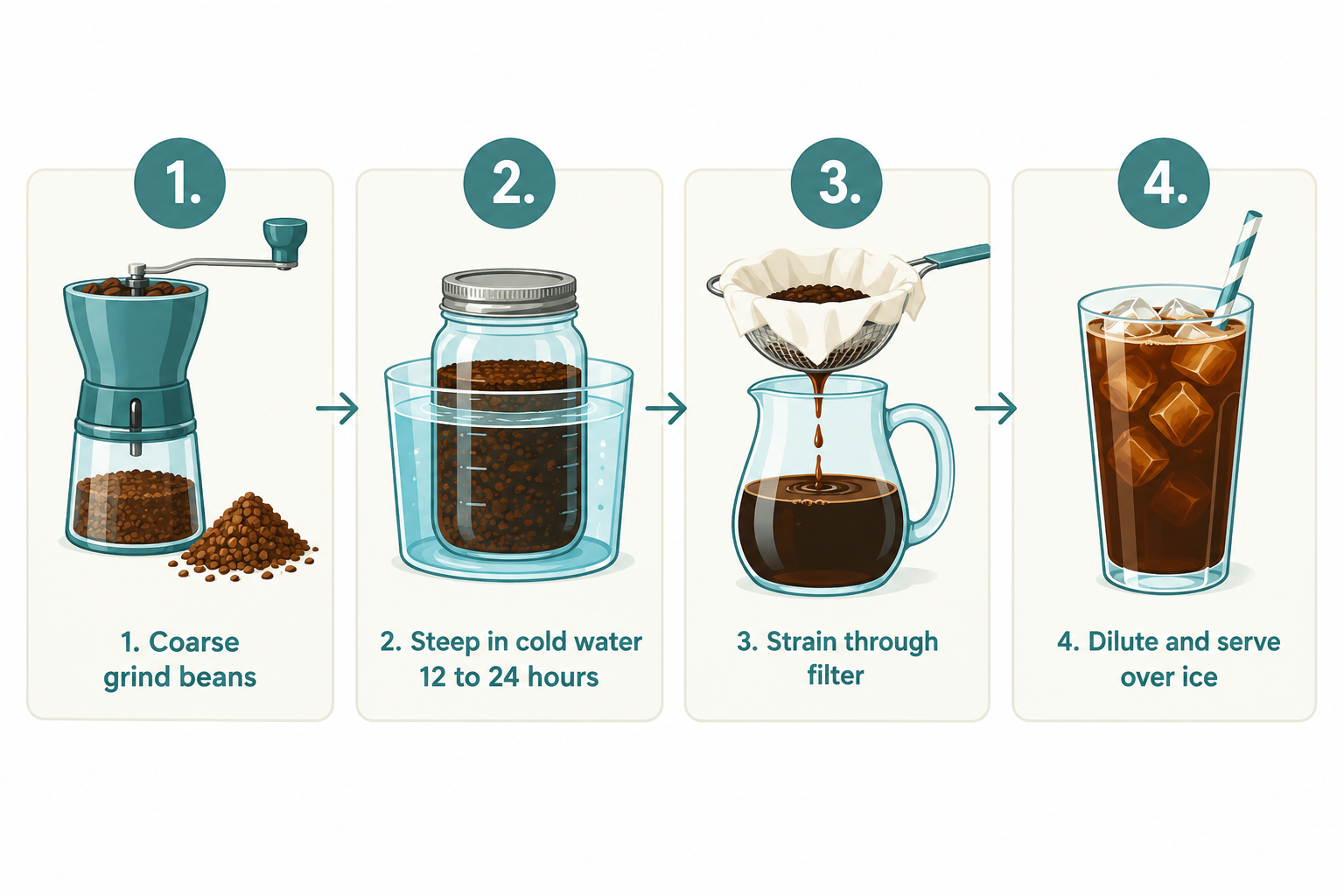
The best cold brew coffee at home starts with coarse ground coffee, cold filtered water, and 12 to 24 hours of patience. Fine grounds are the single most common reason home cold brew turns bitter or cloudy.
Basic method:
- Grind coarse. Use a grind roughly the texture of coarse sea salt, similar to what you'd use for a French press. Fine grind over-extracts during a long steep and pulls out excess bitterness.
- Set your ratio. A common starting point is 1 part coffee to 4 parts water by weight for a concentrate you'll dilute later, or 1 to 8 for a ready-to-drink strength.
- Steep cold. Combine grounds and cold or room-temperature water in a jar or dedicated cold brew maker. Steep in the refrigerator for 12 to 24 hours. A June 2026 guide on mold-free cold brew coffee recommends refrigerator steeping over counter steeping specifically to limit mold risk during the long extraction window.
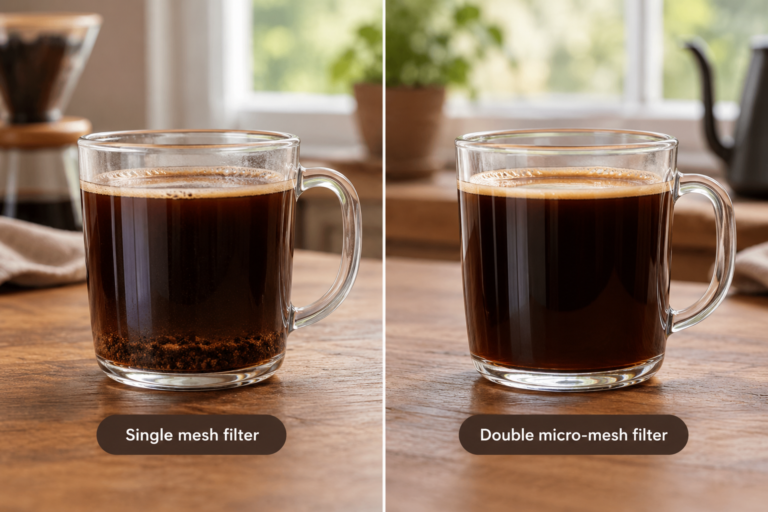
- Strain twice. Pour through a coarse strainer first to remove the bulk of the grounds, then through a paper filter or fine cloth to clear out sediment.
- Dilute and serve. Cut concentrate with water, milk, or a plant-based option like Califia Farms oat milk, then pour over ice.
Edge case: if your cold brew tastes flat or watery, you probably under-extracted, either by steeping too short or using too coarse a grind. If it tastes muddy or bitter, you likely over-extracted with too fine a grind or too long a steep. For a deeper look at adjusting these variables, read our full cold brew brewing method and our guide to advanced cold brew coffee methods once the basic version is dialed in.
Cold Brew Coffee Maker Recommendations
A dedicated cold brew maker isn't required, but it makes straining easier and reduces sediment in the final cup. The two main styles are immersion jars with a built-in filter and slow-drip towers that let water pass through grounds gradually.
- Immersion jars (often a mason jar with a mesh filter insert) are the cheapest option and the easiest to clean. Good for beginners who want to test the method before buying dedicated gear.
- Slow-drip towers cost more and take up counter space, but they produce a cleaner, more consistent extraction because water passes through the grounds at a controlled rate instead of sitting static.
- Reusable mesh or cloth filters cut down on paper filter waste for daily brewers and are worth the small upfront cost if you're making cold brew weekly.
Who should skip a dedicated maker: occasional drinkers who make a batch once a month. A jar and a strainer you already own will do the job without new equipment. If cold brew becomes a weekly habit, a proper maker pays for itself in less mess and better extraction. If you're also assembling a wider home setup, our guide to advanced coffee brewing equipment covers gear that pairs well with a cold brew routine, and regular upkeep matters too, so see our guide to cleaning a coffee maker for the filter and jar cleaning routine.
Cold Brew Coffee Health Benefits and Caffeine Content
Cold brew coffee's biggest reported advantage over hot-brewed coffee is lower acidity, which some drinkers with sensitive stomachs find easier to tolerate, though this is a commonly reported experience rather than a settled clinical finding. Caffeine content depends far more on bean amount and steep time than on temperature.
A few practical points:
- Caffeine isn't automatically higher or lower in cold brew. It depends on the coffee-to-water ratio used. A concentrated cold brew made at a strong ratio can carry more caffeine per ounce than a weaker hot-brewed cup.
- Diluted concentrate has adjustable caffeine. Since you control the dilution, you also control roughly how much caffeine ends up in your final glass, which is one underrated advantage of concentrate over a pre-mixed can.
- Lower acidity is the most consistently reported benefit. Because cold water doesn't extract certain acidic compounds as aggressively as hot water, many drinkers report a smoother, less sour cup, a pattern reflected in guides that recommend cold, controlled steeping specifically to manage extraction.
Common mistake: assuming "cold brew" automatically means "low caffeine." Some cold brew concentrates are stronger than a triple espresso once undiluted straight from the bottle. Always check the label's suggested dilution before treating cold brew like a light drink.
Cold Brew vs Espresso: Which Has More Caffeine?
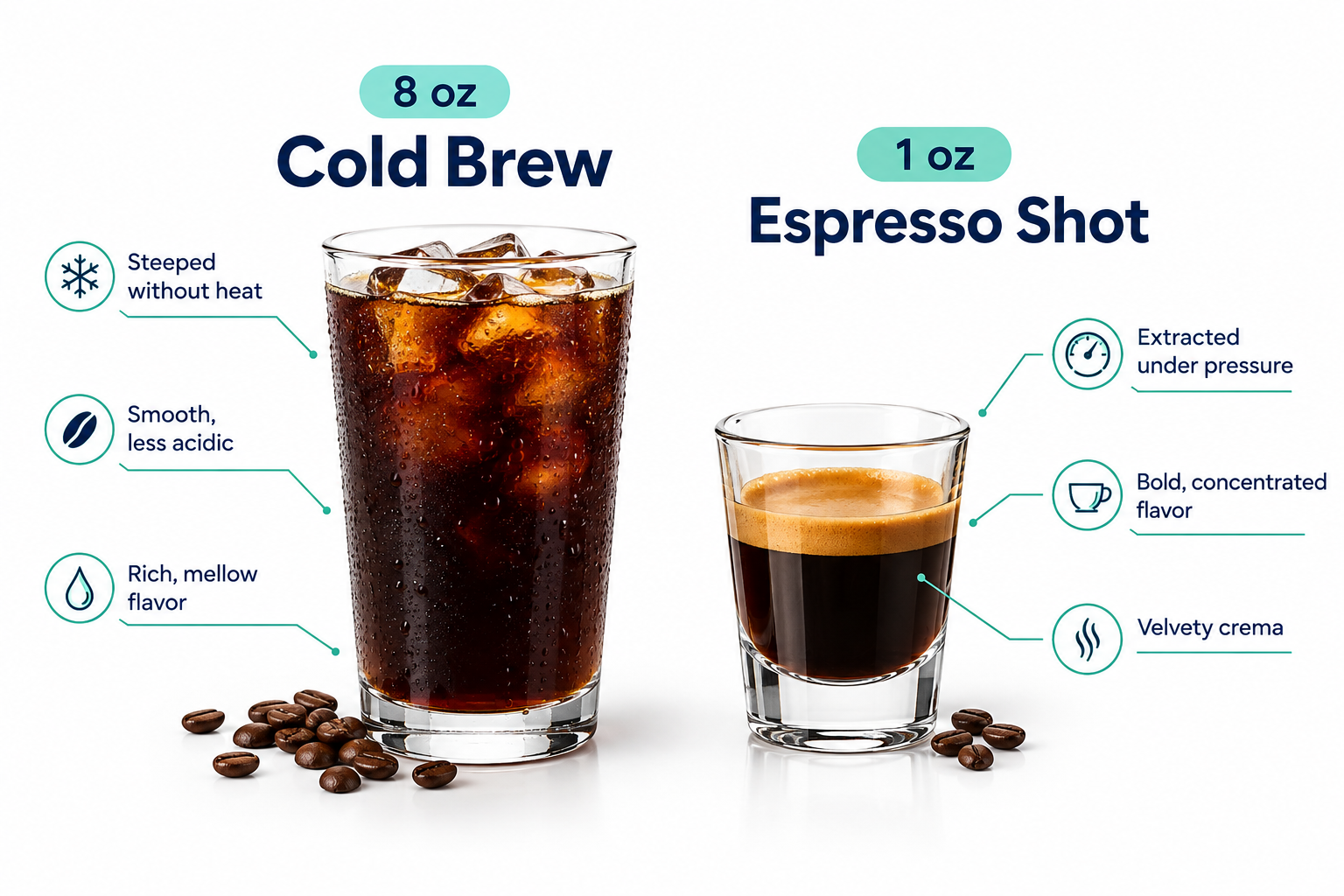
Ounce for ounce, espresso has more caffeine than cold brew because it's a far more concentrated extraction from a small amount of water. But a typical cold brew serving is much larger than a shot of espresso, so total caffeine per drink often ends up in a similar range.
An espresso shot is roughly one to one and a half ounces, brewed under pressure in under a minute. A serving of cold brew is typically eight to twelve ounces, steeped over many hours. The extraction methods are different enough that comparing them by volume alone misses the point. If you're deciding between the two for an afternoon pick-me-up, think in terms of total cup size and dilution, not just the brewing method's reputation for strength. Readers curious about the pressure-based side of that comparison can check our explainer on grind size for espresso machines.
Best Cold Brew for a Sensitive Stomach or a Milder, Less Bitter Cup
If your stomach reacts to regular coffee, look for a cold brew labeled low-acid or made from beans specifically chosen for a long cold steep, since the cold extraction process itself already reduces some of the acidic compounds that trigger discomfort. For drinkers who simply dislike bitterness rather than dealing with stomach sensitivity, a milk-forward or nitro format tends to mask bitterness better than a black concentrate.
- For sensitive stomachs: choose a straight, undiluted-to-taste concentrate like La Colombe or Stumptown and dilute generously with water rather than reaching for a stronger can. Weaker dilution means less total acid and caffeine per sip.
- For drinkers who dislike bitter coffee: a dairy or oat milk-based ready-to-drink option, such as a Califia Farms cold brew or a Starbucks Nitro variety with sweet cream, rounds out bitterness better than a black cup.
- Beans marketed as mold-screened or specifically processed for cold brew are worth seeking out if stomach comfort is the priority, since some 2026 buying guides specifically recommend this category for cold brew drinkers.
Decision rule: if bitterness bothers you more than acidity, add milk or choose a milk-inclusive can. If acidity bothers you more than bitterness, dilute a concentrate further with plain water instead of milk.
Does Cold Brew Coffee Go Bad? How Long It Lasts
Yes, cold brew coffee goes bad, and the timeline depends heavily on the format. Unopened canned or bottled cold brew follows the printed expiration date, often several months out. Homemade cold brew is far more perishable and should be treated like fresh dairy.
- Homemade cold brew concentrate: typically good in the refrigerator for 7 to 10 days when stored in a sealed container. Watch for a sour or off smell as the first sign it's turned.
- Store-bought concentrate, opened: follow the label, usually 7 to 14 days refrigerated after opening.
- Canned or bottled ready-to-drink, unopened: shelf-stable cans like High Brew can sit at room temperature for months before opening, then should be refrigerated once opened and finished within a few days.
- Steeping at room temperature instead of the fridge raises mold risk significantly during the 12 to 24 hour steep window, which is why guides focused on mold-free cold brew specifically recommend refrigerator steeping over counter steeping.
Common mistake: leaving a batch steeping on the counter overnight in a warm kitchen. Refrigerator steeping is slower to reach full extraction but meaningfully safer.
Is Cold Brew More Expensive Than Regular Coffee?
Yes, cold brew is generally more expensive per cup than regular drip coffee, mainly because of the extra time, coffee-to-water ratio, and packaging involved, not because the beans themselves cost more. A canned cold brew easily costs three to five times what a home-brewed drip cup costs.
The gap narrows a lot depending on format:
- Home-brewed cold brew from whole beans costs close to what drip coffee costs per cup, since you're paying mainly for beans and time, not packaging.
- Concentrate bottles land in the middle: pricier than home drip, cheaper than cans, because one bottle stretches across several servings.
- Ready-to-drink cans are the most expensive per ounce because you're paying for convenience, packaging, and in some cases nitrogen infusion equipment.
If cost matters more than convenience, buying whole beans and ground coarse for cold brew at home, paired with a basic jar setup, is the cheapest route to a genuinely good cup. If you want to compare bean options directly, see our guide on choosing coffee beans for home brewing.
Cold Brew Coffee Subscription Services
A cold brew subscription is worth it if you drink concentrate or cans regularly enough that a recurring shipment saves you trips to the store, and not worth it if you only drink cold brew occasionally. Several specialty brands, including Stumptown, Chameleon, and Bizzy, offer subscribe-and-save options directly or through major retailers, typically discounting repeat orders by a modest percentage compared to one-off purchases.
What to check before subscribing:
- Delivery frequency options. A weekly single-drinker household needs a different schedule than a household of two or three coffee drinkers.
- Format flexibility. Some subscriptions let you switch between concentrate and canned formats month to month; others lock you into one format.
- Cancellation terms. Look for subscriptions with no-commitment cancellation rather than a fixed contract length.
If you're not sure a subscription fits your habits yet, our broader guide to choosing a coffee subscription for beginners walks through the tradeoffs before you commit to recurring cold brew shipments.
Comparison Table: Best Cold Brew Coffee Brands at a Glance
| Brand/Product | Format | Known for | Best for | Skip if |
|---|---|---|---|---|
| Stumptown Cold Brew Concentrate | Concentrate | Top overall SR Score of 90; Food Network's top concentrate pick | Buyers who want one reliable, versatile bottle | You want the boldest possible flavor over balance |
| Java House Cold Brew Coffee | Concentrate | NBC Select's "Best strong taste" | Drinkers who want intense, high-caffeine coffee | You prefer a milder, rounder cup |
| Starbucks Nitro Cold Brew | Canned/RTD | Top-rated texture across multiple 2026 can tests | Grab-and-go mornings, commuters | You want to control dilution yourself |
| Starbucks Signature Black Concentrate | Concentrate | No-added-sugar, Latin American arabica | Shoppers who want a familiar name, no syrups | You want a flavored or sweetened option |
| La Colombe Cold Brew | Concentrate/bottled | Balanced, chocolate-forward, widely stocked | Everyday grocery shoppers | You want a specialty small-batch roast |
| High Brew | Canned/RTD | Shelf-stable, travel-friendly | Road trips, gym bags, no fridge access | You always have fridge space at home |
| DaVinci Gourmet Classic Iced Coffee Concentrate | Concentrate | Foodservice-grade consistency | Cafes and high-volume brewing | You're a single-household home drinker |
Frequently Asked Questions
What is the best cold brew coffee brand overall in 2026? Stumptown ranks as the top overall cold brew brand in a seven-brand 2026 comparison, scoring 90 out of 100, and its concentrate is separately named Food Network's top pick for store-bought cold brew.
Is cold brew concentrate the same as ready-to-drink cold brew? No. Concentrate is stronger than normal coffee and needs to be diluted with water or milk before drinking. Ready-to-drink cans and bottles are already at drinking strength and require no mixing.
Does cold brew coffee have more caffeine than regular coffee? It depends on the coffee-to-water ratio, not the brewing temperature. A strong cold brew concentrate can carry more caffeine per ounce than drip coffee, but a diluted serving can land close to a normal cup.
How long does homemade cold brew last in the fridge? Homemade cold brew concentrate typically stays good for 7 to 10 days refrigerated in a sealed container. A sour smell or flat taste is the first sign it has turned.
What grind size works best for cold brew? Use a coarse grind, similar to coarse sea salt or French press grounds. Fine grounds over-extract during the long steep and produce a bitter, muddy cup.
Is cold brew coffee good for a sensitive stomach? Many drinkers report that cold brew feels gentler on the stomach than hot-brewed coffee because cold extraction pulls out fewer acidic compounds, though individual tolerance still varies.
What's the cheapest way to drink cold brew regularly? Buying whole beans and brewing coarse ground coffee for cold brew at home costs less per cup than any bottled concentrate or canned option, once you own a basic steeping jar or maker.
Are cold brew subscriptions worth it? They're worth it for regular drinkers who want convenience and a small discount on repeat orders. Occasional drinkers usually save more buying single bottles or cans as needed.
A Practical Next Step
The best cold brew coffee for your kitchen depends on how much control you want over strength and cost. Grab a concentrate like Stumptown or La Colombe if you want flexibility without brewing from scratch. Grab a can of Starbucks Nitro or High Brew if convenience matters more than customization. And if you already enjoy grinding your own beans, coarse ground coffee for cold brew steeped overnight in the fridge will beat almost anything on a shelf, both on flavor and on cost per cup. Better coffee starts with better answers, and in cold brew's case, the answer usually comes down to how much time you're willing to trade for control.
.cg-cb-wrap{font-family:system-ui,-apple-system,”Segoe UI”,Roboto,sans-serif;max-width:640px;margin:0 auto;background:#F5FAF8;padding:16px;border-radius:10px;border:1px solid #E8F2EE} .cg-cb-title{color:#14231D;font-size:18px;font-weight:700;margin:0 0 10px} .cg-cb-btns{display:flex;flex-wrap:wrap;gap:8px;margin-bottom:12px} .cg-cb-btn{background:#1F6B4A;color:#fff;border:none;padding:8px 12px;border-radius:6px;font-size:13px;cursor:pointer} .cg-cb-btn:hover{background:#145037} .cg-cb-result{background:#E8F2EE;border-radius:8px;padding:12px;color:#23372F;font-size:14px;line-height:1.5;min-height:60px} .cg-cb-result strong{color:#14231D}Cold Brew Format Finder
Keep Exploring Coffee Rank IQ
- Coffee Rank IQ home: reviews, brewing guides, and coffee science
- Cold Brew Ratio: The Concentrate Math That Saves Your Beans
- Best Medium Roast Coffee for Drip, Pour Over, and Espresso
- Best Cold Brew Coffee Maker: 6 Picks for Smooth Batches at Home
- Best Manual Coffee Grinder for Pour Over, Espresso, and Travel
References
- www.nbcnews.com/select/shopping/best-coffee-concentrates-rcna184840
- www.smarterranking.com/food/best-cold-brew-brands-2026
- www.foodnetwork.com/how-to/packages/shopping/product-reviews/best-cold-brew-coffee
- www.target.com/c/coffee-concentrates-beverages-grocery/-/N-unpcr
- organicbeautylover.com/home/best-coffee-for-cold-brew
- www.foodnetwork.com/how-to/packages/shopping/best-cold-brew-coffee
- lexavebrew.com/best-ready-to-drink-canned-coffees
- www.webstaurantstore.com/68229/cold-brew-canned-coffee.html?filter=style:concentrates
- digitalnpq.org/best-ready-to-drink-canned-coffees
- coffeescan.com/best-canned-cold-brew-coffee