Cold Brew Ratio: The Concentrate Math That Saves Your Beans
Quick Answer
The cold brew ratio that most guides land on for concentrate is 1:4 to 1:5 coffee to water by weight, diluted 1:1 or 1:2 before drinking. If you'd rather brew coffee that's ready to drink straight from the fridge, use a looser cold brew ratio of about 1:8, or dilute a stronger concentrate down to roughly 1:10 to 1:14 at the glass.
Key Takeaways
- A 1:4 to 1:5 cold brew ratio makes a strong concentrate meant for dilution, not sipping straight.
- A 1:8 cold brew ratio is the crossover point: strong enough to act as a mild concentrate, light enough to drink over ice without adding water.
- Brewing concentrate and diluting later uses fewer beans per glass than brewing every batch at drinking strength.
- Most finished, ready-to-drink cold brew lands around 1:10 to 1:14 coffee to water once diluted.
- Grind size, water hardness, and bean roast all shift how a given cold brew ratio actually tastes.
- Cold brew concentrate keeps in the fridge for one to two weeks; diluted, ready-to-drink cold brew is best within about a week.
- A coarse or extra-coarse grind is standard for cold brew because fine grounds over-extract during long steep times.
Cold Brew Ratio: What It Means and Why It Matters
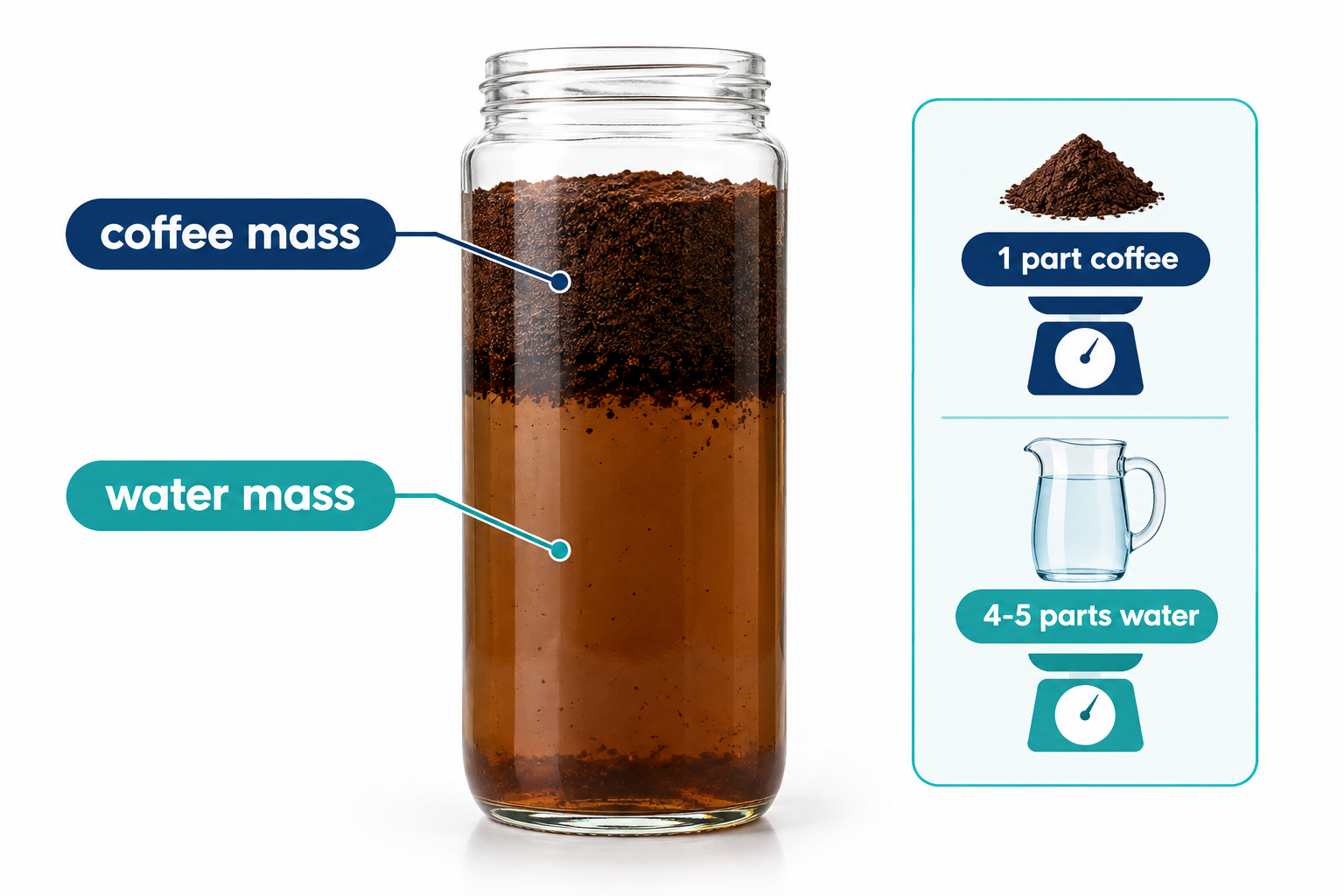
A cold brew ratio is simply the weight of ground coffee compared to the weight of water used to brew it, written as coffee to water, like 1:5. It matters because cold brew skips heat, and heat is what normally speeds up extraction, so the ratio becomes the main lever left for controlling strength.
Hot brewing methods use temperature, time, and grind size all working together fast. A pour over finishes in three minutes. Cold brew steeps for half a day or more, at room temperature or in the fridge, so extraction happens slowly and gently. That slowness pulls out different compounds than hot water does. Cold brew tends to taste smoother and less acidic, but it needs a lot more coffee relative to water to reach a similar strength.
This is why the cold brew ratio gets treated almost like a recipe on its own, separate from grind size or steep time. Get the ratio wrong and no amount of steeping fixes it. Too little coffee gives you flavored water. Too much gives you a batch so strong it borrows the bitterness people associate with over-brewed hot coffee, minus the burnt edge.
If you're still deciding on a bean before you even get to ratio math, our buyers guide to choosing the right coffee beans for your recipes is a good place to start.
What Is the Best Cold Brew Coffee Ratio?
The best cold brew coffee ratio depends on whether you're brewing concentrate or a ready-to-drink batch. For concentrate meant to be diluted, 1:4 to 1:5 is the range most 2026 guides settle on. For a batch you'll drink without adding more water, aim closer to 1:8.
Here's how that breaks down by goal:
| Goal | Cold brew ratio | What it tastes like undiluted |
|---|---|---|
| Strong concentrate for espresso-style use | 1:4 | Thick, intense, almost syrupy |
| Classic, forgiving concentrate | 1:5 | Strong but not harsh, dilutes cleanly |
| Milder concentrate | 1:6 | Noticeably lighter, still needs dilution |
| Sip-ready or light concentrate | 1:8 | Drinkable over ice with no added water |
| Diluted, ready-to-drink strength | 1:10 to 1:14 | Balanced, closer to iced coffee in body |
Coffee Hero's 2026 recipe guide calls 1:4 to 1:5 the standard cold brew ratio for concentrate, then dilutes it 1:1 or 1:2 when serving. Roon's late-September 2026 guide gives similar advice: 1 part coffee to 4 or 5 parts water for concentrate, and closer to 1:8 for anyone who wants to skip the dilution step entirely.
Decision rule: if you plan to store a batch in the fridge and stretch it across a week of drinks, brew concentrate at 1:4 or 1:5. If you want to pour a glass and drink it right away, brew at 1:8 and stop there.
Cold Brew Concentrate Ratio vs Ready to Drink
A cold brew concentrate ratio is deliberately strong so it can be cut with water, milk, or ice before drinking. Ready-to-drink cold brew is brewed at a lighter ratio from the start, so no dilution is needed. Both approaches can end at the same final cup strength, but they use different amounts of coffee and give you different amounts of flexibility.
Coffee Guides' March 2026 breakdown recommends brewing concentrate at 1:5 to 1:8, then adding 1:1 to 1:2 parts water to reach a drinking strength around 1:10 to 1:12. ESPRO's updated ratio explainer describes concentrates as strong as 1:2, which then require heavy dilution, often mixing 1 part concentrate to 4 to 6 parts water to land in the 1:10 to 1:14 range most people find balanced.
The practical difference: concentrate gives you one strong batch that turns into several drinks with different dilutions (straight over ice, cut with milk for a latte, mixed half-and-half for a lighter cup). Ready-to-drink cold brew gives you consistency, since every glass is already at drinking strength, but it takes up more fridge space per cup of usable coffee.
Cold Brew Ratio in Grams
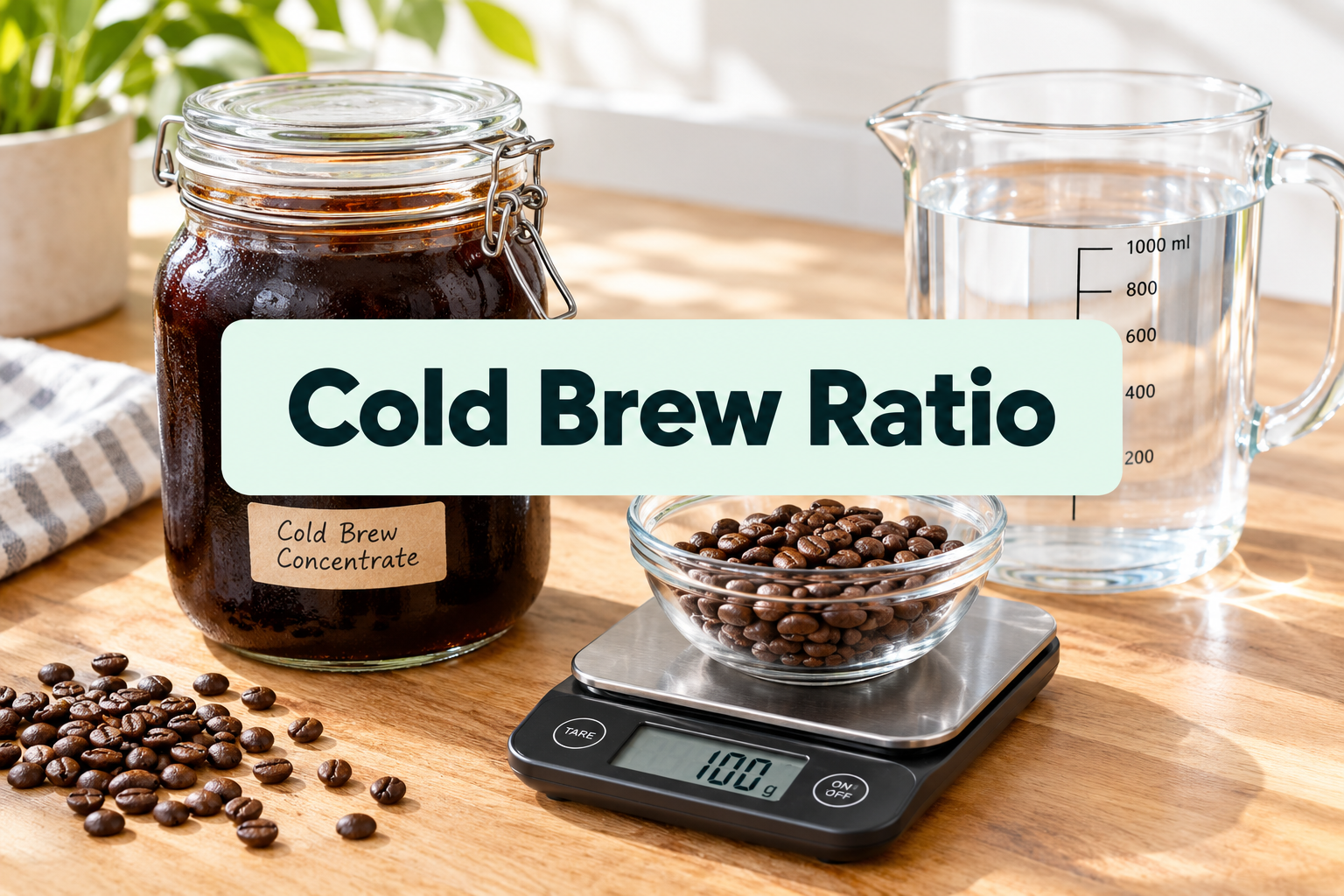
Working in grams removes the guesswork that cups and scoops introduce, because coffee density varies by roast and grind. A kitchen scale turns any cold brew ratio into an exact recipe.
Some documented examples from 2026 recipe guides:
- JayArr Coffee's concentrate method uses 96 g coffee to 600 g water, a 1:6 cold brew ratio, steeped 12 to 16 hours.
- Coffee Studies' guide uses 150 g coffee to 1,200 g water, a 1:8 cold brew ratio, steeped about 18 hours.
- A 1:5 batch with 100 g coffee needs 500 g water, roughly 500 ml.
Example: if your scale only holds 200 g of beans at a time, a 1:5 cold brew ratio means adding 1,000 g of water, which is close to 34 fl oz, or about 4.25 cups.
Cold Brew Ratio in Cups
If you don't own a scale, a rough cold brew ratio in cups works, though it's less exact than weighing. One cup of coarsely ground coffee to four cups of water gives a strong concentrate close to 1:4 by volume. One cup of grounds to five or six cups of water lands closer to a milder concentrate.
Cup measurements drift because ground coffee compacts differently depending on grind size and bean density. A scale removes that variable. If precision matters to you, especially once you're dialing in a favorite bean, weighing beats scooping every time.
Cold Brew Ratio Calculator: Do the Math Once
A cold brew ratio calculator does the multiplication for you: coffee weight times the ratio number equals the water weight you need. The Coffee Locator's September 2026 calculator assumes most home brewers are making concentrate at 1:4 to 1:5, diluted roughly 1:1, and only recommends 1:8 for people who want to skip dilution altogether. Honest Coffee Guide's version frames concentrate as anywhere from 1:4 (strong) to 1:6 (weaker), which matches what most kitchen recipes actually produce.
Use the calculator below to turn any batch size into an exact water measurement.
Cold Brew Ratio Calculator
Is 1:4 or 1:5 Better for Cold Brew Concentrate?
Neither cold brew ratio is objectively better; 1:4 gives you a stronger, more concentrated result that needs more dilution, while 1:5 is the more forgiving choice for anyone new to brewing concentrate. Instacuppa's 2026 guide calls 1:5 "ideal" because it dilutes cleanly at 1:2 without tasting thin.
Mastering Coffee's cold brew guide and The Coffee Locator's calculator both highlight the same tradeoff: 1:4 is extra strong and great for bar-style use or heavy milk drinks, while 1:5 is easier to dilute correctly without landing too weak or too bitter.
Choose 1:4 if: you drink cold brew mostly with milk, want a smaller batch that lasts longer, or plan to use it in lattes where dilution happens anyway.
Choose 1:5 if: you're brewing your first batch, you drink it over ice with a splash of water, or you want more margin for error.
Cold Brew Ratio for Different Brewing Methods
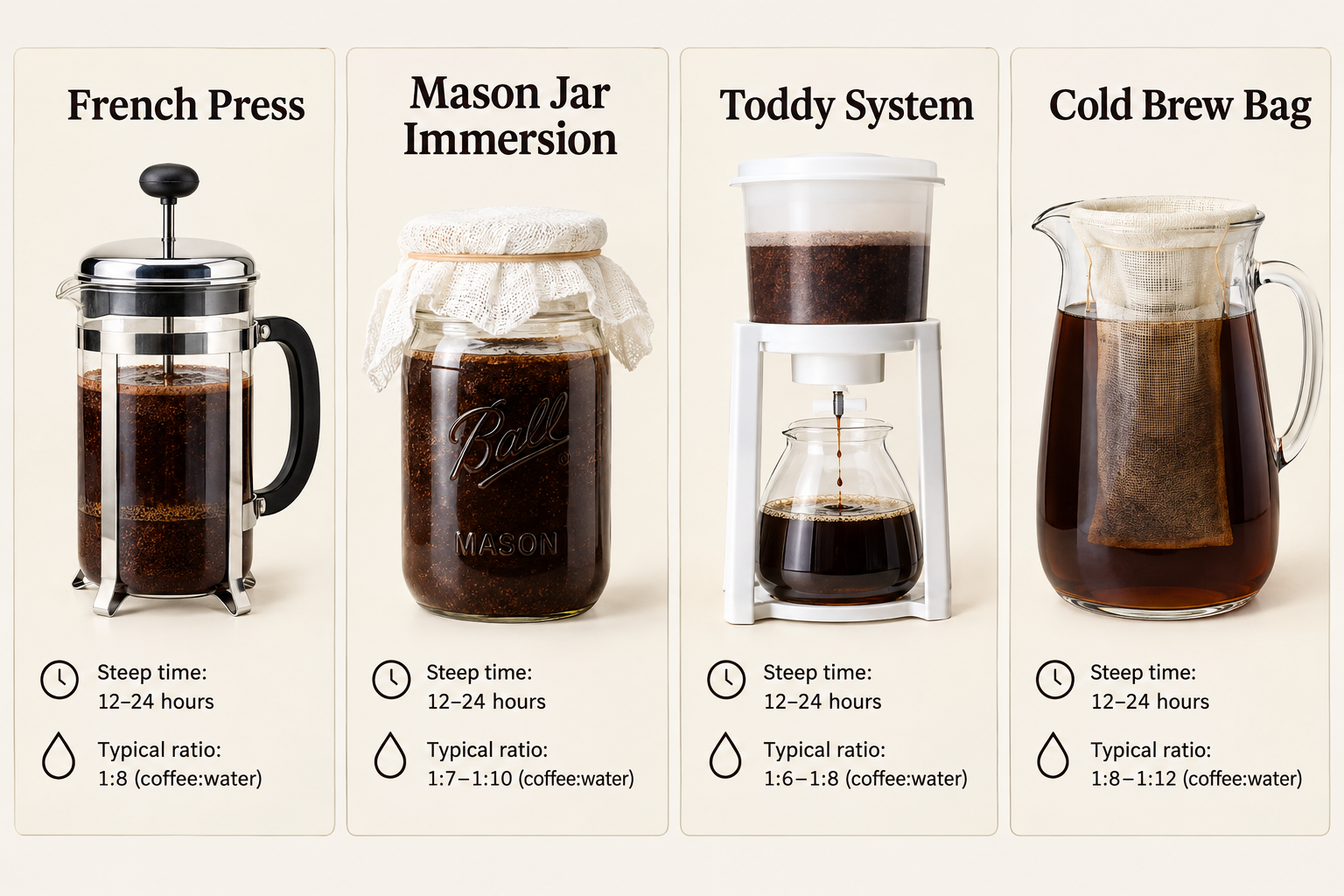
The cold brew ratio math stays the same across methods, but how you strain the grounds changes the equipment and the cleanup. Immersion methods (mason jar, pitcher, cold brew bag) and dedicated systems (Toddy, French press) all steep coffee in water for hours, then separate grounds from liquid.
French press: This is the easiest entry point because most kitchens already have one. Add coarsely ground coffee, pour water using your chosen cold brew ratio, stir gently, and let the plunger sit up (don't press yet). Steep in the fridge, then press slowly to filter. Our guide on how to make cold brew coffee in a French press covers the plunge technique in more detail, since pressing too fast can push fine particles through the mesh and cloud the cup.
Mason jar or pitcher: Combine grounds and water directly, cover, steep, then strain through a paper filter, cheesecloth, or a fine mesh sieve lined with a coffee filter. This method needs a second straining pass more often than a French press.
Cold brew bag or sock: Grounds sit inside a reusable mesh bag submerged in a pitcher of water. Pull the bag out at the end of the steep, no separate straining step needed.
Toddy-style systems: Water drips slowly through grounds into a reservoir below, filtering as it goes. These systems often use ratios closer to 1:5, matching the "classic concentrate" range.
For a deeper comparison of these setups side by side, see advanced cold brew coffee methods and the base recipe in how to make the best cold brew coffee.
Can You Use Any Coffee Beans for Cold Brew, and Does Grind Size Matter?
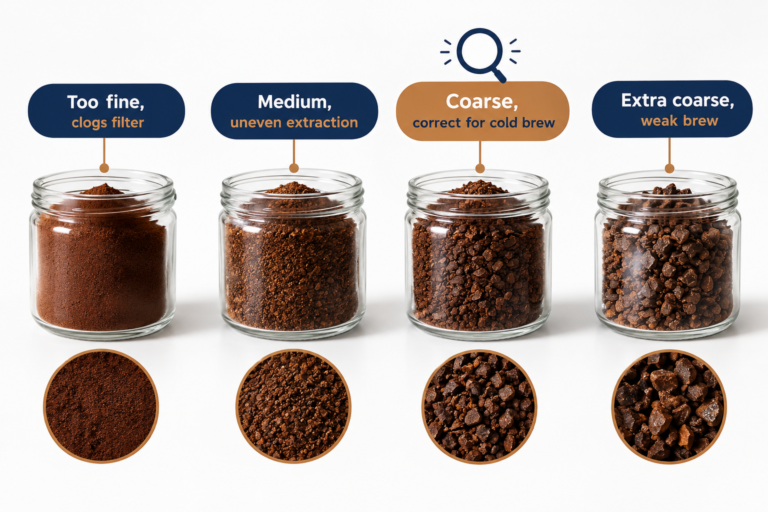
Almost any bean works for cold brew, but medium and dark roasts tend to produce a smoother, less sour result, and a coarse grind is required no matter which bean you choose. Fine grounds over-extract badly during a 12 to 18 hour steep, pulling out excess bitterness and clouding the finished coffee with sediment.
Light roasts can work for cold brew, but their brighter acidity carries through more noticeably than in a dark roast, since cold water doesn't mellow acidity the way heat can. If you're choosing beans specifically for cold brew, our guide to choosing the best coffee beans for home brewing and the broader complete guide to different types of coffee beans both cover how roast level changes flavor outcome.
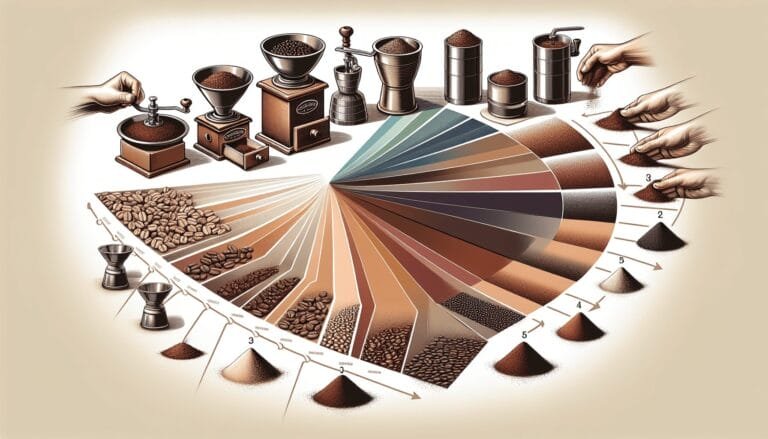
Grind size interacts directly with your cold brew ratio. A coarser grind extracts more slowly, so a slightly finer grind within the "coarse" range can compensate for a shorter steep, and a coarser grind can compensate for a longer one. If you're not sure what coarse actually looks like next to other grind settings, top ways to grind coffee beans for a perfect brew shows the visual difference.
Edge case: using a fine espresso grind with a standard cold brew ratio will over-extract badly and turn bitter fast, even at a correct water ratio. Grind size and ratio aren't interchangeable variables. Fix the grind first, then adjust the ratio.
How Long Should Cold Brew Coffee Steep, and How Long Does It Last?
Cold brew coffee should steep for 12 to 18 hours in the fridge or at room temperature, and how long should cold brew coffee steep depends more on grind size and desired strength than on the ratio itself. Once brewed, cold brew concentrate keeps well in the fridge for one to two weeks, while diluted, ready-to-drink cold brew is best finished within about a week.
Documented steep times from 2026 recipes cluster in a tight band:
- 12 to 16 hours for a 1:6 concentrate with a coarse grind.
- About 18 hours for a 1:8 batch with a similar grind.
- 16 to 18 hours for another 1:8 recipe brewed at room temperature before refrigeration.
A correct cold brew ratio doesn't shorten the required steep time. Ratio controls final strength; steep time controls how much flavor and caffeine transfer into the water regardless of concentration. Under-steeping a strong ratio still gives you a thin, sour cup, just one with more coffee wasted in the grounds.
Storage rule of thumb: the stronger the concentrate, the longer it typically holds its flavor in the fridge, since dilution happens at serving time rather than at brew time. A 1:4 concentrate diluted fresh each morning will taste more consistent on day ten than a full-strength batch brewed at 1:10 on day one.
What Happens If You Use Too Much Coffee, and How Do You Fix a Bad Batch?
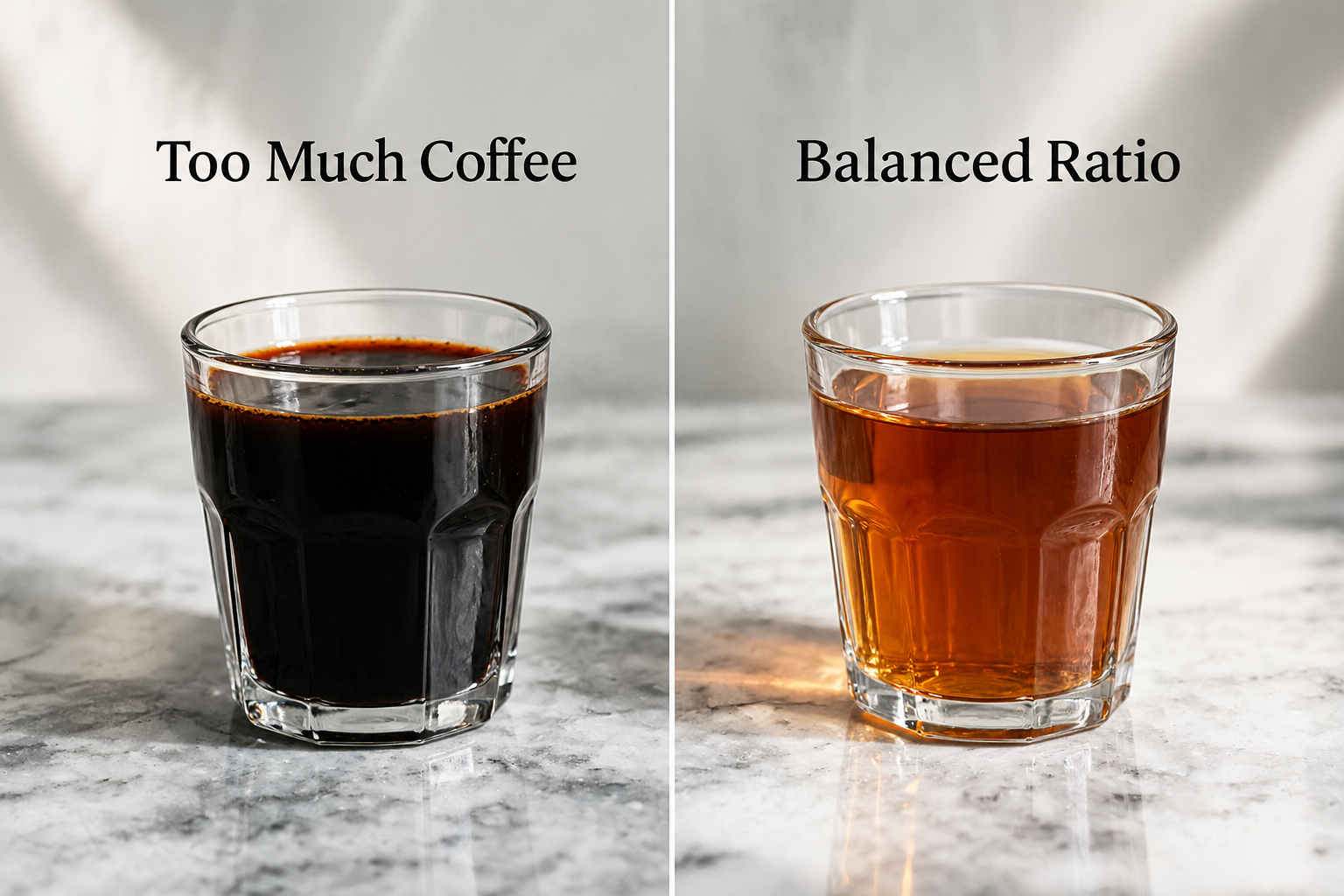
Using too much coffee in a cold brew ratio produces a thick, bitter, almost tannic concentrate that tastes harsh even after dilution, because the water becomes saturated with compounds before the steep finishes. The fix is usually dilution, not a full rebrew.
If your batch is too strong or too bitter:
- Add water gradually, tasting as you go, rather than guessing a full dilution ratio upfront.
- Try a 1:1 dilution first for concentrate brewed at 1:4 or 1:5, then adjust.
- If bitterness persists even at heavy dilution, the grind was likely too fine, or the steep ran long. Note it for next time; this batch may need to be used mostly in milk drinks, where dairy masks some bitterness.
If your batch is too weak or watery:
- Check whether the ratio itself was too loose (more than 1:8 for a concentrate meant to be diluted).
- Steep a second batch of grounds in the existing weak brew instead of starting over, effectively re-extracting at a stronger ratio.
- For next time, weigh the coffee and water rather than eyeballing cups.
Strong versus smooth is a ratio choice, not a flaw. A 1:4 cold brew ratio will always taste bolder and heavier than a 1:8 batch. Neither is wrong; they're suited to different drinks. Bold ratios work well in iced lattes and drinks with milk, where dilution happens naturally. Smoother, lighter ratios work better sipped straight over ice.
Water type matters too. Hard water (higher mineral content) tends to extract slightly more from the same grounds, so a cold brew ratio that tastes balanced with soft tap water might taste a touch stronger with hard well water. If your tap water has a strong mineral taste on its own, filtered water gives more consistent results across batches.
How to Make Cold Brew Coffee: A Simple Step-by-Step Method
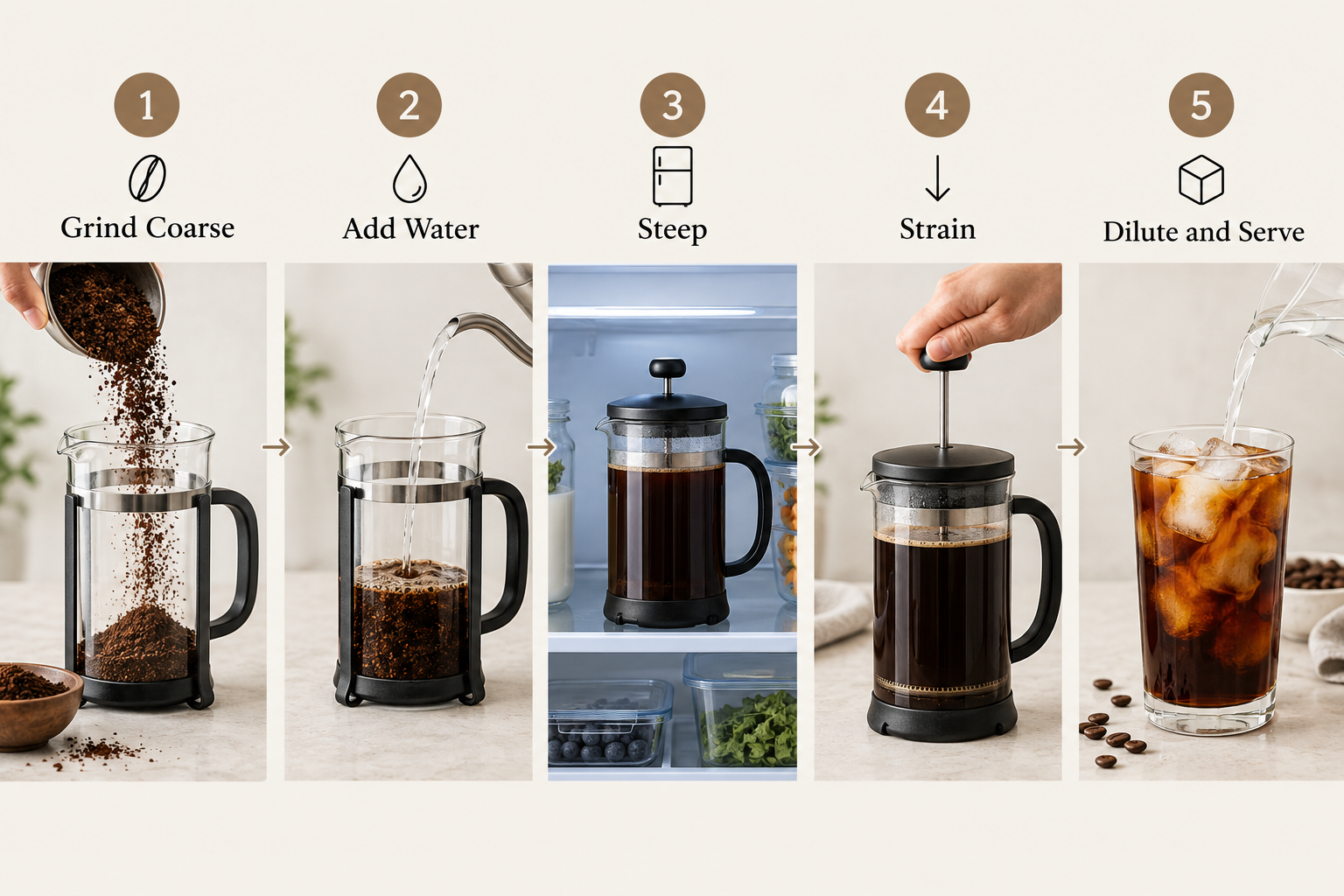
Here's a complete method for how to make cold brew coffee at home using a French press, the most accessible tool for a first batch.
- Weigh your coffee. Use 100 g of coarsely ground coffee for a standard batch.
- Choose your cold brew ratio. For concentrate, weigh out 500 g of cold or room-temperature water (a 1:5 ratio). For a lighter, ready-to-drink batch, use 800 g of water (a 1:8 ratio).
- Combine and stir. Add the grounds to the French press, pour the water over them, and stir gently to make sure all the grounds are saturated.
- Steep. Leave the plunger up (don't press) and place the French press in the fridge for 12 to 18 hours.
- Press slowly. Push the plunger down gradually to filter the grounds from the liquid. Pressing too fast can force fine sediment through the mesh.
- Strain again if needed. For a clearer cup, pour the pressed coffee through a paper filter.
- Dilute to taste. If you brewed concentrate, cut it with water, milk, or ice at roughly 1:1 to start, then adjust.
- Store. Refrigerate in a sealed container. Concentrate holds for one to two weeks; diluted cold brew is best within a week.
For a version of this method with more troubleshooting detail, our full how to make the best cold brew coffee guide walks through the same steps with extra notes on filtering.
FAQ
What is the best cold brew coffee ratio for beginners? A 1:5 cold brew ratio (100 g coffee to 500 g water) is the most forgiving starting point. It's strong enough to dilute cleanly and mild enough to survive a slightly off measurement.
How much coffee do I need for a gallon of cold brew concentrate? A gallon is about 3,785 g of water. At a 1:5 cold brew ratio, that means roughly 757 g of coffee, close to 27 oz by weight.
Can I use pre-ground coffee for cold brew? Yes, as long as it's ground coarse. Most bagged pre-ground coffee is medium grind, meant for drip machines, and will over-extract and turn bitter during a long cold brew steep.
Does cold brew have more caffeine than hot coffee? Cold brew concentrate has more caffeine per ounce than typical drip coffee because it uses far more coffee per unit of water. Once diluted to drinking strength, caffeine levels land closer to regular brewed coffee, though the exact amount varies by bean and ratio.
Why does my cold brew taste sour instead of smooth? Sourness usually points to a light roast bean, an under-extracted batch (grind too coarse or steep too short), or a ratio with too little coffee. Try a slightly finer coarse grind or a stronger cold brew ratio first.
Can I reuse the grounds after making a cold brew concentrate? Once, at most, and only for a much weaker second batch. Most of the extractable flavor is gone after the first long steep, so a second pass mainly adds diluted, flat-tasting water rather than real strength.
Conclusion
The cold brew ratio is the one variable that decides whether your beans stretch across two weeks of drinks or disappear into a single underwhelming pitcher. Start at 1:5 for concentrate if you're new to this, weigh your coffee and water in grams instead of guessing with cups, and dilute to taste rather than following someone else's exact pour every time. Once you've dialed in a cold brew ratio that matches how you actually drink your coffee (black over ice, cut with milk, or somewhere in between) write it down. That one number, checked against a scale, is what turns cold brew from a occasional experiment into a routine worth repeating.
Better Coffee Starts With Better Answers.
Keep Exploring Coffee Rank IQ
- Coffee Rank IQ home: reviews, brewing guides, and coffee science
- Best Cold Brew Coffee Brands: Concentrates, Cans, and Beans
- Best Medium Roast Coffee for Drip, Pour Over, and Espresso
- Best Cold Brew Coffee Maker: 6 Picks for Smooth Batches at Home
- Pour Over Coffee Ratio: The Number Baristas Start With
References
- jayarr.coffee/blog/cold-brew-concentrate-guide
- instacuppastore.com/blogs/main-page/cold-brew-concentrate-how-to-make-store-dilute-perfect-coffee
- javvycoffee.com/blog/articles/the-complete-guide-to-smooth-low-acid-cold-brew-concentrates
- www.onlinecoffeeguide.com/guides/cold-brew-ratio-guide
- sundaytable.co/cold-brew-coffee-concentrate
- masteringcoffee.com/cold-brew-coffee-home
- brewbetterco.com/blog/cold-brew-coffee-ratio
- coffeestudies.com/brew-methods/cold-brew-coffee-guide
- coffeehero.com.au/blogs/news/cold-brew-coffee-guide-recipes
- coffee-guides.com/en/brew/cold-brew-recipe