
Swiss Water Process Decaf: How Water Pulls 99.9% Out
Quick Answer
Swiss water process decaf removes caffeine by soaking green coffee beans in a liquid that is already saturated with coffee flavor compounds, so only caffeine has anywhere to go. That liquid, called Green Coffee Extract, then runs through activated carbon filters sized to grab caffeine and let most other soluble material pass . Swiss Water states the finished coffee leaves with no more than 0.1% of its original caffeine, which is where the 99.9% figure comes from. No methylene chloride. No ethyl acetate. Water, carbon, time, and a little chemistry.
Key Takeaways
- 99.9% means 0.1% remains, not zero. Swiss Water describes coffee leaving the process with no more than 0.1% residual caffeine relative to the starting level, and says it verifies levels before release .
- Green Coffee Extract does the work. Beans soaked in water create a flavor-saturated liquid; a new batch placed in it loses caffeine by diffusion while most flavor compounds stay put .
- Roughly 8 to 10 hours, per Swiss Water's own educational material, though other technical sources report longer cycles depending on batch setup .
- The FDA still permits methylene chloride residues in decaffeinated roasted and soluble coffee up to 10 parts per million under 21 CFR 173.255. A petition to remove several solvents was under FDA review in late 2026 with no final decision identified.
- Demand is climbing. Swiss Water reported a 16% year-over-year increase in processed volume and C$65.9 million in revenue for Q3 2026, with adjusted EBITDA up 50% to C$4.9 million .
- A C$6.2 million expansion at the Delta, British Columbia plant is planned to add about 15% capacity, with construction starting Q1 2027 .
- Price gap is smaller than people assume. Amazon listings checked November 5, 2026 showed Kicking Horse swiss water decaf from $14.95 to $28.73 depending on size and format.
How does the swiss water process actually work?
The process works by removing caffeine's chemical incentive to stay inside the bean while removing flavor's incentive to leave. Four stages, all water-based.
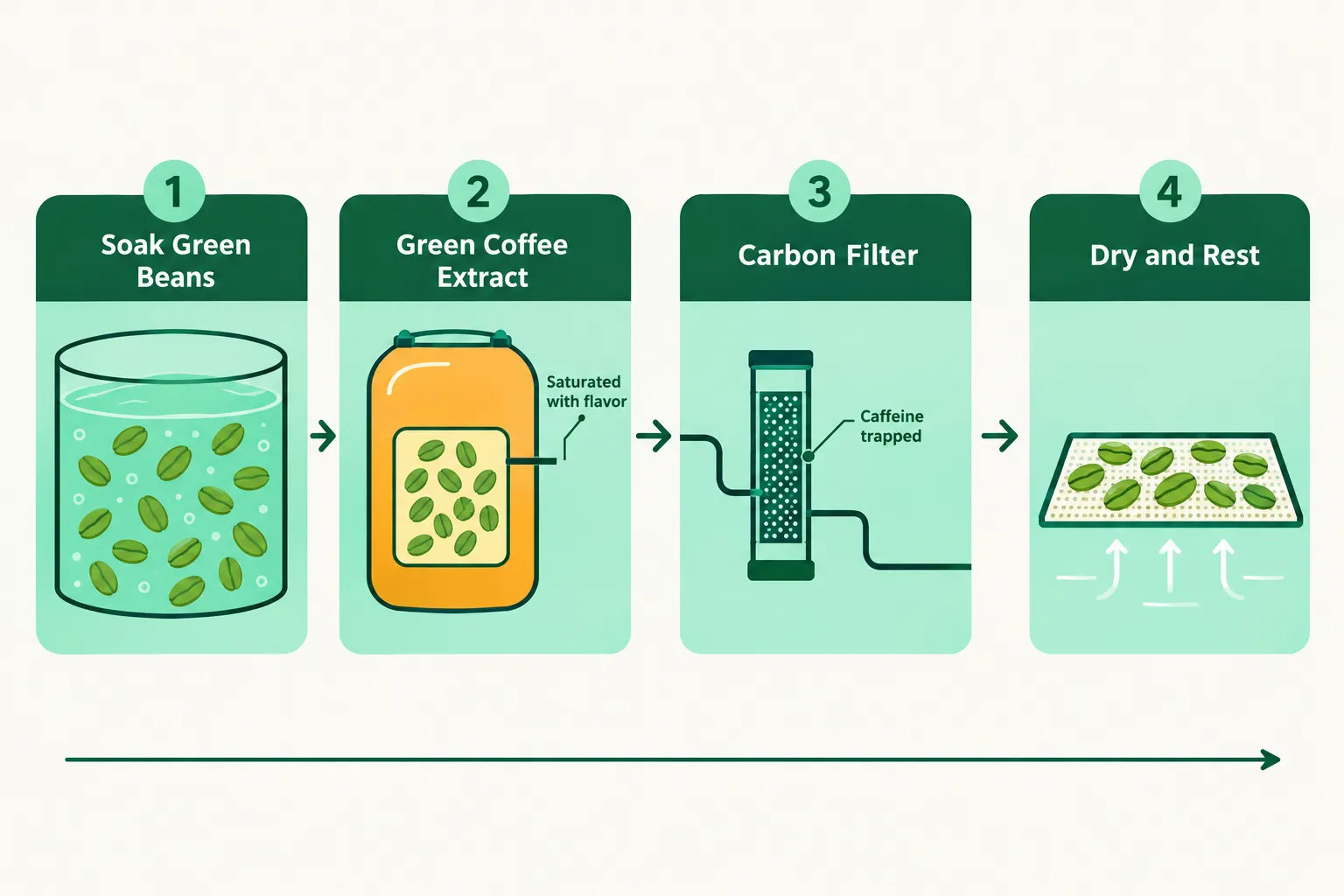
Step 1: Build the Green Coffee Extract. A batch of green, unroasted beans gets soaked in hot water. The water pulls out caffeine plus sugars, acids, proteins, and the other soluble solids that become flavor after roasting. Those first beans are sacrificial. They do not reach your grinder. What matters is the liquid they leave behind, called Green Coffee Extract, or GCE .
Step 2: Let equilibrium do the heavy lifting. The GCE is now loaded with coffee solids. Drop a fresh batch of green beans into it and the flavor compounds inside those beans have almost no concentration gradient to follow, so they mostly stay where they are. Caffeine is the exception. The extract is kept caffeine-poor, so caffeine inside the bean diffuses outward into the liquid . Molecules move from crowded to less crowded. That is the whole trick.
Step 3: Filter the caffeine out. The caffeine-loaded GCE passes through specialized activated carbon filters tuned to adsorb caffeine molecules while letting much of the rest of the extract through . The carbon is regenerated, the extract keeps circulating, and the system runs closed-loop.
Step 4: Dry and restore moisture. Decaffeinated beans are dried under controlled airflow and temperature so they return to a moisture profile suitable for storage, shipping, and roasting. Swiss Water says drying conditions are adjusted by origin .
The liquid is already full of coffee. Caffeine is the only thing with room to move.
Common mistake: assuming the beans you buy are the beans that made the extract. They are not. The extract is a reusable carrier, refreshed through the loop.
Is swiss water process decaf really 99.9 percent caffeine free?
It is 99.9% caffeine-free by Swiss Water's own stated standard, meaning roughly 0.1% of the original caffeine remains. That is a removal percentage, not a promise of zero.
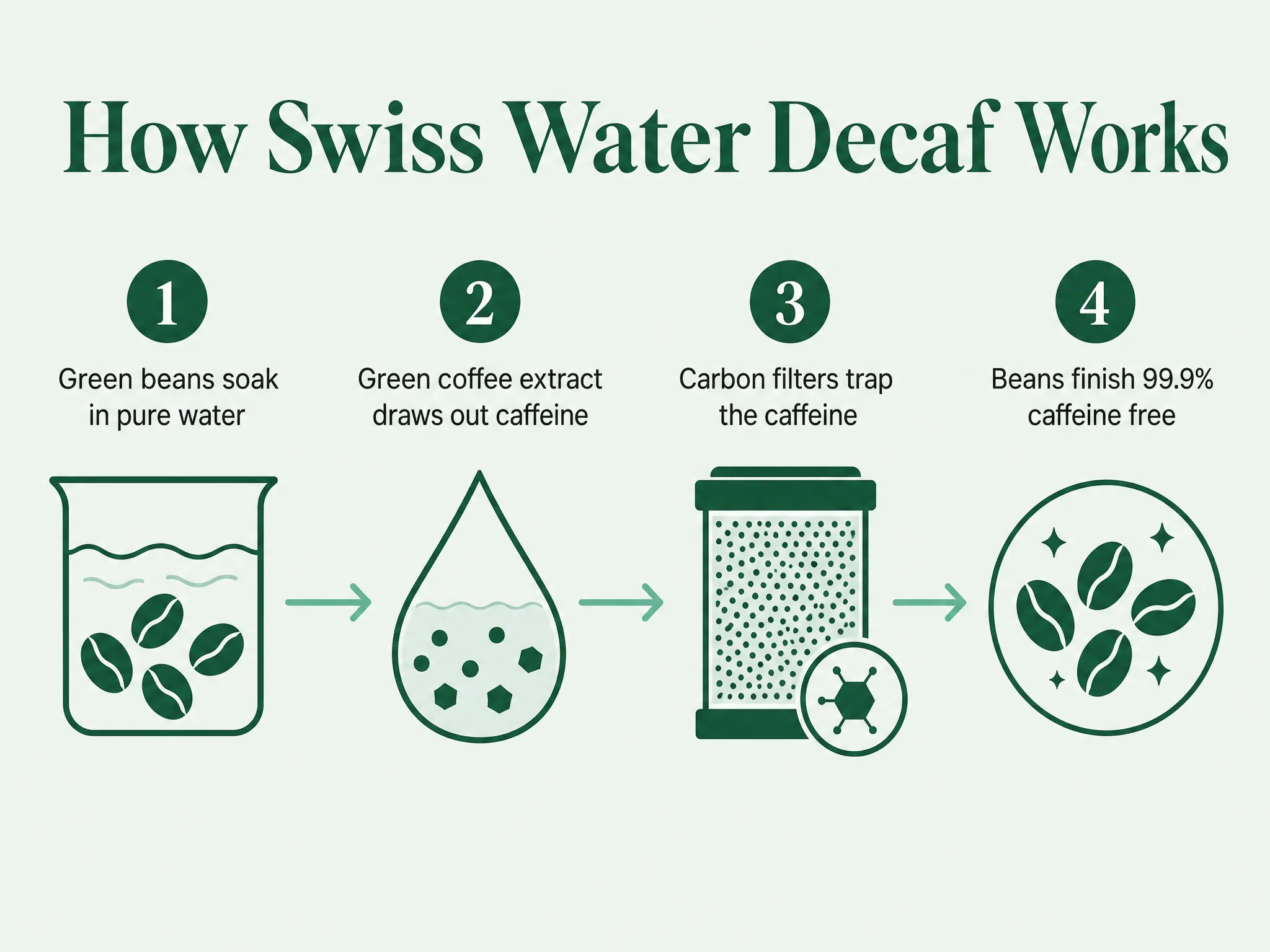
Here is what that means in a cup. Regular brewed coffee runs somewhere around 95 mg of caffeine per 8 oz on typical US estimates. Strip 99.9% and you are left with a trace in the low single digits of milligrams, varying by origin, roast, dose, and brew method. Swiss Water says it checks caffeine levels before releasing coffee .
If you are counting milligrams for medical reasons, read our breakdown of how much caffeine actually remains in decaf coffee before assuming any decaf is caffeine-zero.
Edge case: a 20 oz decaf americano made with a triple shot is not a trace amount anymore. Volume matters. Three or four large decaf drinks can approach the caffeine of one small regular coffee.
Can swiss water process remove 100 percent of caffeine?
No commercial decaffeination method removes 100% of caffeine, and swiss water process decaf does not claim to. The 99.9% figure is the stated ceiling, with up to 0.1% residual caffeine remaining .
Two reasons. First, diffusion slows dramatically as concentrations approach equality, so chasing the last fraction costs enormous time for almost no return. Second, pushing harder damages the bean. Longer soaks and higher temperatures start pulling out the soluble material that makes coffee taste like coffee. The industry stops at 99.9% because the flavor cost beyond that is steep.
Decision rule: if you need true zero caffeine for a medical reason, no coffee product qualifies. Switch to a roasted grain or chicory beverage.
Does swiss water process use any chemicals, and what about methylene chloride decaf?
Swiss water process decaf uses water, coffee extract, and activated carbon. No methylene chloride, no ethyl acetate, no added solvent of any kind . Water is technically a chemical, which is the pedant's objection, but the practical meaning of "chemical free decaf" here is clear: no synthetic solvent touches the bean.
The comparison point most people are reaching for is methylene chloride decaf, also sold as the "European method" or "direct solvent" process. Beans are steamed, then rinsed with methylene chloride, which bonds selectively with caffeine. The solvent evaporates at roughly 104°F and roasting happens above 400°F, so residues at the cup level are extremely small.
What the rules actually say, as of November 2026:
- FDA: 21 CFR 173.255 permits methylene chloride residues in decaffeinated roasted and soluble coffee up to 10 parts per million. A petition seeking removal of several solvents from food regulations was under review; no final decision was identified in available sources.
- EPA: the April 30, 2024 action restricted most consumer and industrial uses of methylene chloride over cancer and neurotoxicity concerns. Food uses sit primarily under FDA jurisdiction, so that action did not ban coffee use.
- International: Swiss Water's Q3 2026 filing states Japan and South Korea prohibit methylene chloride for coffee decaffeination, and Canada requires labeling when it is used .
The misconception worth correcting: people often say solvent decaf is "poisonous" or that water process decaf is "healthier." Neither statement is supported by measured residue data at consumption levels. What is accurate: swiss water process decaf avoids the question entirely, and some buyers reasonably prefer avoiding a question that regulators are still reviewing.
Swiss water process vs CO2 decaf: which is better?
Neither is universally better. The CO2 decaf process competes on scale and consistency; swiss water process decaf competes on traceability, single-origin handling, and a certification mark roasters can print on the bag.
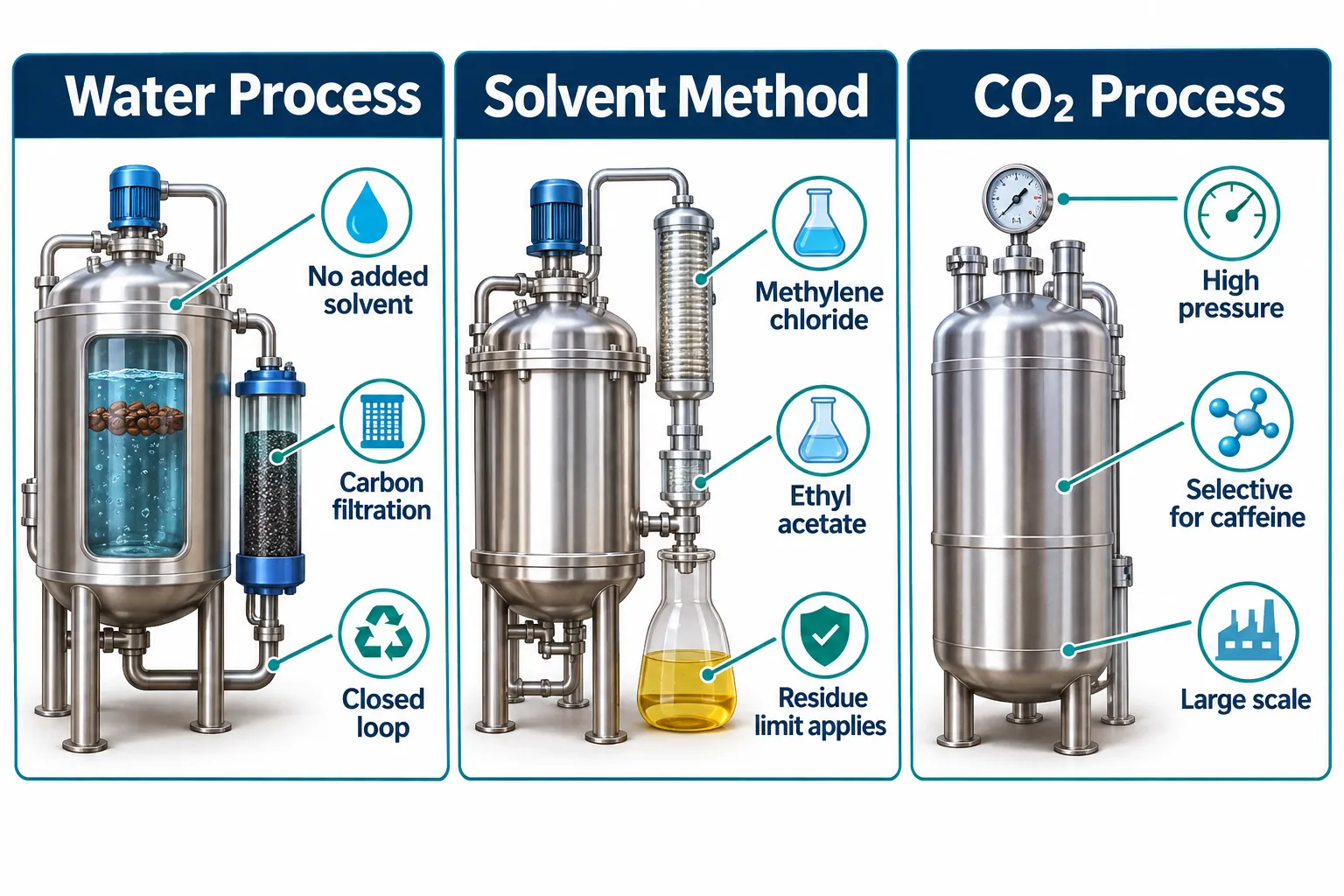
The CO2 method uses carbon dioxide held at high pressure in a supercritical state, behaving partly like a liquid and partly like a gas. It moves through moistened beans and binds caffeine selectively. It is efficient, solvent-free, and widely used for large commercial volumes. The plants are expensive, which limits how many small-lot coffees get run through them.
| Method | Agent used | Stated caffeine removal | Best suited to |
|---|---|---|---|
| Swiss Water Process | Green Coffee Extract plus activated carbon | 99.9% | Single origin and specialty lots, labeled bags |
| CO2 (supercritical) | Pressurized carbon dioxide | Typically 96 to 99%+ depending on operator | High-volume commercial blends |
| Methylene chloride | Synthetic solvent | Typically 96 to 99%+ | Cost-sensitive supermarket decaf |
| Ethyl acetate (“sugarcane”) | Solvent, often cane-derived | Typically around 97% | Colombian origins, naturally sweet profiles |
Choose swiss water process decaf if you want a named origin, a roast date, and a label you can verify. Choose CO2 decaf if your roaster uses it and the cup is good, because the method is not a flavor liability. Choose sugarcane EA decaf if you like a rounder, sweeter profile and you are comfortable with a solvent that is also found naturally in fruit.
What's the difference between swiss water and other water process decaf?
Swiss Water Process is a trademarked, certified process operated at a specific facility in Delta, British Columbia. "Water process" or "natural water process" on a bag without that mark may describe a different water-based operation, most often the Mountain Water Process in Mexico .
The mechanisms are closely related. Both use a flavor-saturated aqueous solution and carbon filtration. Differences show up in facility control, certification, testing protocol, and whether the roaster can show you a chain of custody. Swiss Water says the branded name on the bag is the signal buyers should look for, since generic "water processed" language is not a certification .
Common mistake: treating "naturally decaffeinated" as a synonym for water process. In US labeling, that phrase can cover ethyl acetate derived from fermentation. If the bag does not name the method, the method is unnamed on purpose.
Does swiss water decaf taste as good as regular coffee?
Good swiss water decaf coffee can taste excellent, but it is rarely identical to the same bean undecaffeinated. Removing caffeine means hydrating, soaking, and re-drying green coffee, and that handling changes the bean's structure before it ever meets a roaster.
What actually shifts:
- Density drops. Processed green beans are more porous and less dense, so they absorb heat faster. Roasters generally lower charge temperature and shorten the roast.
- Color lies. Decaf green beans are brown before roasting, which makes visual roast judgment harder. Underdeveloped or scorched decaf is a roaster problem, not a process problem.
- Caffeine's own bitterness is gone. Caffeine contributes roughly a tenth of brewed coffee's perceived bitterness, so decaf can read sweeter and flatter at once.
Swiss Water's marketing position is that flavor compounds stay with the bean because the extract is already saturated with them . That is the mechanism, and it is sound. It is still a company claim about its own process, not an independent sensory study, so treat it as the manufacturer's position.
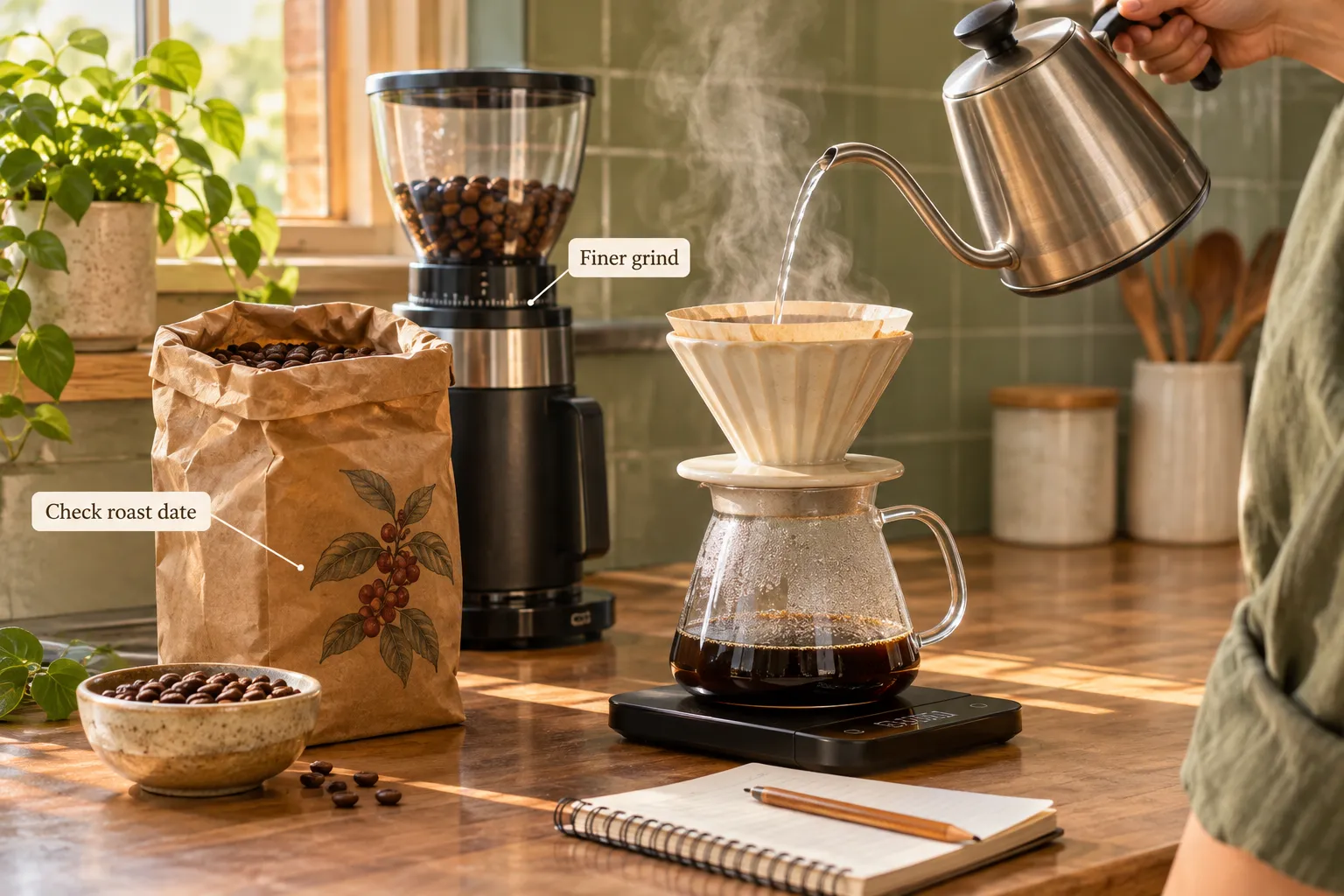
Brewing fix that works: grind finer than you would for the same bean in caffeinated form and push water temperature to the top of your range, 200 to 205°F. The more porous bean structure means extraction behaves differently. If your decaf pour over tastes thin, that is usually under-extraction, not the decaf. Keep the brew ratio at 1:16 and adjust grind first.
Is swiss water decaf good for sensitive stomachs?
For many people the answer is yes, but the reason is caffeine reduction rather than anything the water process does to acidity. Caffeine stimulates gastric acid secretion and increases gut motility, which is a plausible mechanism for discomfort in sensitive drinkers. Removing 99.9% of it removes that stimulus.
What swiss water process decaf does not do is lower chlorogenic acid levels meaningfully or change the pH of your brew in a dramatic way. Decaf coffee is still acidic coffee.
If decaf still bothers you, the variable to change is brew method, not decaffeination method. Cold brew extracts fewer of the compounds associated with perceived harshness, and a longer, cooler steep is worth testing before you conclude coffee is the problem. Our cold brew at home guide covers ratio and steep time.
Not for you if a clinician has told you to eliminate coffee entirely. Trace caffeine and coffee acids both remain.
Why is swiss water process better for the environment?
The environmental argument rests on three verifiable features rather than a general claim: no synthetic solvent enters the supply chain, the Green Coffee Extract circulates in a closed loop, and the activated carbon is regenerated rather than discarded after a single use .
That is a narrower claim than "green coffee." Decaffeination of any kind is energy-intensive. Water must be heated, extract must be circulated, carbon must be regenerated, and beans must be dried. Swiss Water's Delta facility runs on British Columbia's largely hydroelectric grid, which affects the carbon math, but that is a location advantage rather than a process advantage.
Compare fairly: the CO2 decaf process also uses no synthetic solvent and recaptures its CO2. Supercritical systems are pressure-intensive. There is no single published life-cycle comparison in the sources reviewed here that ranks all four methods, so claiming a clear environmental winner would overstate the evidence.
How long does the swiss water decaffeination process take?
Swiss Water's current educational material puts the cycle at roughly 8 to 10 hours . Treat that as a company-stated operating estimate rather than a fixed industry number.
Other technical descriptions report longer durations, depending on whether the measurement includes hydration, the full soak cycle, filtration passes, and drying, and on batch configuration. The comparative work from Kaffeemacher is one example of a source reporting longer figures for water-based decaffeination.
The total time from green bean to your bag is far longer than the decaffeination cycle itself: shipping to Delta, processing, drying, re-bagging, ocean or rail freight to the roaster, roasting, and distribution. Expect weeks, not hours.
What brands use the swiss water process, and where to buy the SWP method decaf beans?
A long list of US specialty roasters use it, and the mark is printed on the bag. The easiest places to find the SWP method decaf beans are Amazon, Whole Foods, Trader Joe's, and the direct websites of the roasters themselves.
Widely available named options, with Amazon listing prices checked November 5, 2026:
- Kicking Horse Decaf (Canadian, dark roast, the SWP methoded). Listings ranged $14.95 to $28.73 depending on size and whole bean versus ground. The main listing showed 8,972 reviews and more than 6,000 units sold per month. A reliable, chocolatey dark roast. If you prefer bright and fruity, this is not your bag.
- SF Bay Coffee Decaf, 2 lb, listed at $30.99 with 3,715 reviews. Larger format, lower per-ounce cost, better suited to drip and French press than espresso.
- Specialty roaster subscriptions often carry a rotating Swiss Water decaf single origin. A subscription is the practical way to try several origins without buying four bags at once. Compare options in our Trade Coffee subscription review.
Prices change. Check the current price before buying, and prefer whole bean with a visible roast date within the last four weeks.
Affiliate disclosure: Coffee Rank IQ earns commission on some retailer links. Prices listed were checked on the date stated and were not verified by hands-on purchase of every product named. This section is based on published product listings, not laboratory testing.
For a wider shortlist across roast levels and formats, see our best decaf coffee roundup, or the decaf K-Cup comparison if you brew single serve.
How much more expensive is swiss water decaf?
Expect a premium of roughly 10% to 30% over comparable caffeinated coffee from the same roaster, and a smaller premium over solvent-processed decaf. The Kicking Horse listings at $14.95 to $28.73 sit close to its caffeinated range, which shows the gap is not always large at the supermarket tier.
Where the cost comes from:
- An extra industrial step. The beans ship to Delta, get processed, get dried, get re-bagged, then ship again.
- Yield loss. Beans lose mass and some are damaged in handling.
- Smaller batches. Specialty single-origin decaf lots do not benefit from commodity-scale economics.
- Certification and testing. Caffeine verification before release adds cost .
Demand is not softening. Swiss Water reported Q3 2026 revenue of C$65.9 million, up 5%, with processed volume up 16% year over year and adjusted EBITDA up 50% to C$4.9 million . Nine-month adjusted EBITDA rose 104% to C$14.5 million, and the company said orders already extended into Q2 2027 . A C$6.2 million expansion at Delta is planned to add about 15% capacity, with construction from Q1 2027 and commercial operation targeted for Q3 2027 .
Swiss Water management estimates its own volume growth has averaged about 5% annually over 25 years against roughly 1% to 2% for the overall decaf market. That is a company estimate, not an independent market measurement, and it should be read as such.
Is swiss water decaf healthier than other decaf methods?
There is no published human study demonstrating a health difference between the SWP method decaf and solvent-decaffeinated coffee at normal consumption levels. The honest framing is exposure avoidance, not measured health benefit.
What is documented: the FDA permits methylene chloride residues in decaffeinated roasted and soluble coffee up to 10 ppm under 21 CFR 173.255, and the EPA's April 2024 action cited cancer and neurotoxicity concerns for other uses of the compound while leaving food uses under FDA authority. Those are regulatory facts about a solvent, not findings about coffee drinkers.
What is not documented: that people who drink solvent decaf experience worse health outcomes. No such association appears in the sources reviewed here, and an association would not establish causation even if it did.
Practical reading: choosing decaf without chemicals is a reasonable preference, especially if you drink several cups daily. Presenting it as a proven health upgrade goes beyond the evidence.
FAQ
Conclusion
For a home brewer, the useful part of the SWP method decaf is not the marketing claim, it is what the mechanism tells you about brewing. The bean arrived at your grinder after a soak and a re-dry. It is more porous, less dense, and browner than a caffeinated green bean, so it roasts faster and extracts faster. Treat it as its own coffee rather than a weaker version of a familiar one.
Next step: buy one bag of whole bean swiss water decaf coffee with a roast date inside four weeks, weigh out a 1:16 brew ratio, and run it at 205°F with a grind two clicks finer than your usual pour over setting. Taste it black. If it reads thin, go finer before you blame the decaf. Compare options in our best decaf coffee guide, and check the current price before you order.
Better Coffee Starts With Better Answers.