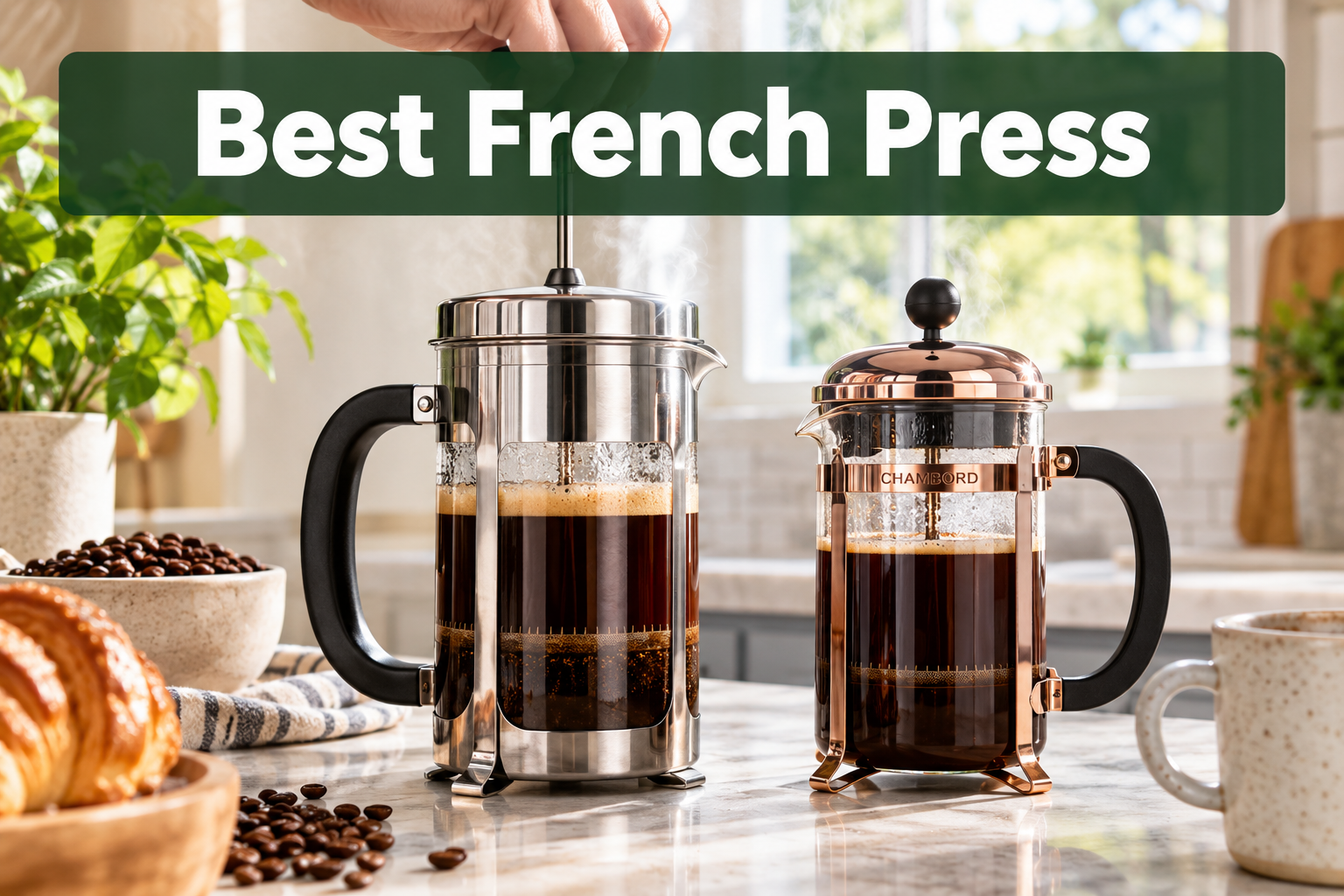
Best French Press: Why the Filter Matters More Than the Glass
Quick Answer
The best french press for most home coffee drinkers is one built around a fine, multi-layer filter, not a specific glass thickness or brand name. Espro's double micro-mesh design consistently produces the clearest cup with the least sediment, Secura's stainless steel french press delivers similar clarity for less money, and the Bodum Chambord french press remains the classic choice for buyers who care about looks first. Pick based on your filter priority, then match capacity and material to your kitchen.
Key Takeaways
- Filter design, not glass quality, separates a gritty cup from a clean one. Double micro-mesh systems like Espro's outperform single-mesh presses on sediment control.
- The Espro french press (P3 and P7) is named a top pick across multiple 2026 buying guides because of its patented double filter.
- The Secura SFP-34DS stainless steel french press is the leading value pick, combining strong filtration with insulation at a lower price than Espro.
- The Bodum Chambord french press stays popular for its classic borosilicate glass look, though testers rank it behind newer multi-filter designs on clarity.
- Stainless steel holds heat far longer than glass: one controlled test recorded 121°F after two hours in a stainless SterlingPro versus 109°F in a stainless Frieling and 111°F in the Hario Double Glass, though all three still rely on metal mesh for separation.
- Coarse ground coffee and a brew ratio near 1:15 water temperature around 195 to 205°F are what most gritty-cup complaints trace back to, not the machine itself.
- A french press works for tea, but you need a dedicated pot since flavor carries over between brews.
- Sizes commonly run from single-serve (12oz) to 34oz to 51oz; buy based on how many mugs you actually pour each morning, not aspirational entertaining.
What Is a French Press and How Does It Work
A french press is a manual brewer that steeps coarse ground coffee directly in hot water inside a carafe, then separates the grounds using a plunger fitted with a mesh filter. It is sometimes called a cafetière or press pot, and it produces a fuller-bodied cup than drip coffee because the coffee's natural oils stay in the water instead of getting caught in a paper filter.
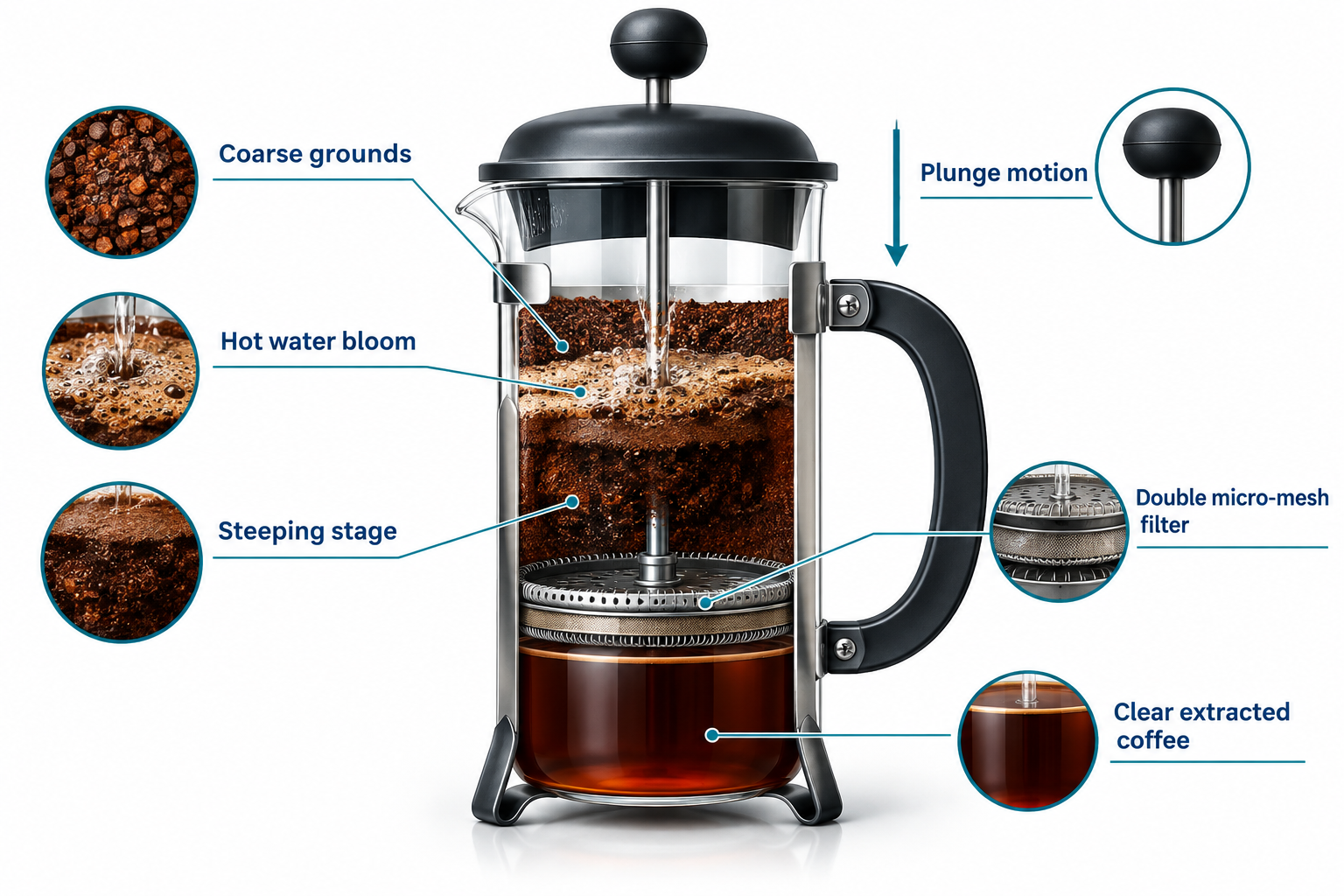
The process has four steps:
- Add coarse ground coffee to the carafe, roughly 1 gram per 15 grams of water.
- Pour hot water over the grounds and let the mixture bloom, meaning the grounds swell as trapped carbon dioxide escapes, for about 30 seconds.
- Steep the full batch for 4 minutes, stirring once if the grounds clump.
- Press the plunger down slowly and steadily, pushing the mesh filter through the liquid to trap the grounds at the bottom.
That last step is where most of the difference between a good cup and a disappointing one gets decided. If you want a full walkthrough with timing and stirring technique, our beginners guide to using a french press for coffee covers it step by step, and our guide to perfecting your french press coffee recipe goes deeper on ratio adjustments.
Best French Press: Why the Filter Matters More Than the Glass
The best french press on the market today is defined by its filter architecture, not its carafe. Glass, stainless steel, and stoneware all hold water. Only the filter decides whether your cup arrives clean or gritty, and that single component explains most of the price gap between a $20 press and a $60 one.
Quick verdict by buyer type:
| Buyer type | Best pick | Why it fits |
|---|---|---|
| Wants the cleanest cup possible | Espro P7 | Patented double micro-mesh filter, near-zero sediment |
| Wants strong filtration for less money | Secura SFP-34DS stainless steel french press | Insulated stainless build, filtration close to Espro at a lower price |
| Wants the classic look on the counter | Bodum Chambord french press | Borosilicate glass, iconic design, acceptable single-mesh filtration |
| Wants a compact, single-serve option | Fellow Clara french press | Double-wall insulated body, sized for one or two mugs |
| Wants zero plastic parts | Frieling stainless press | All-metal build, no plastic components in the brewing path |
| Wants a budget starter press | SterlingPro stainless | Strong heat retention, mesh filter, lower entry price |
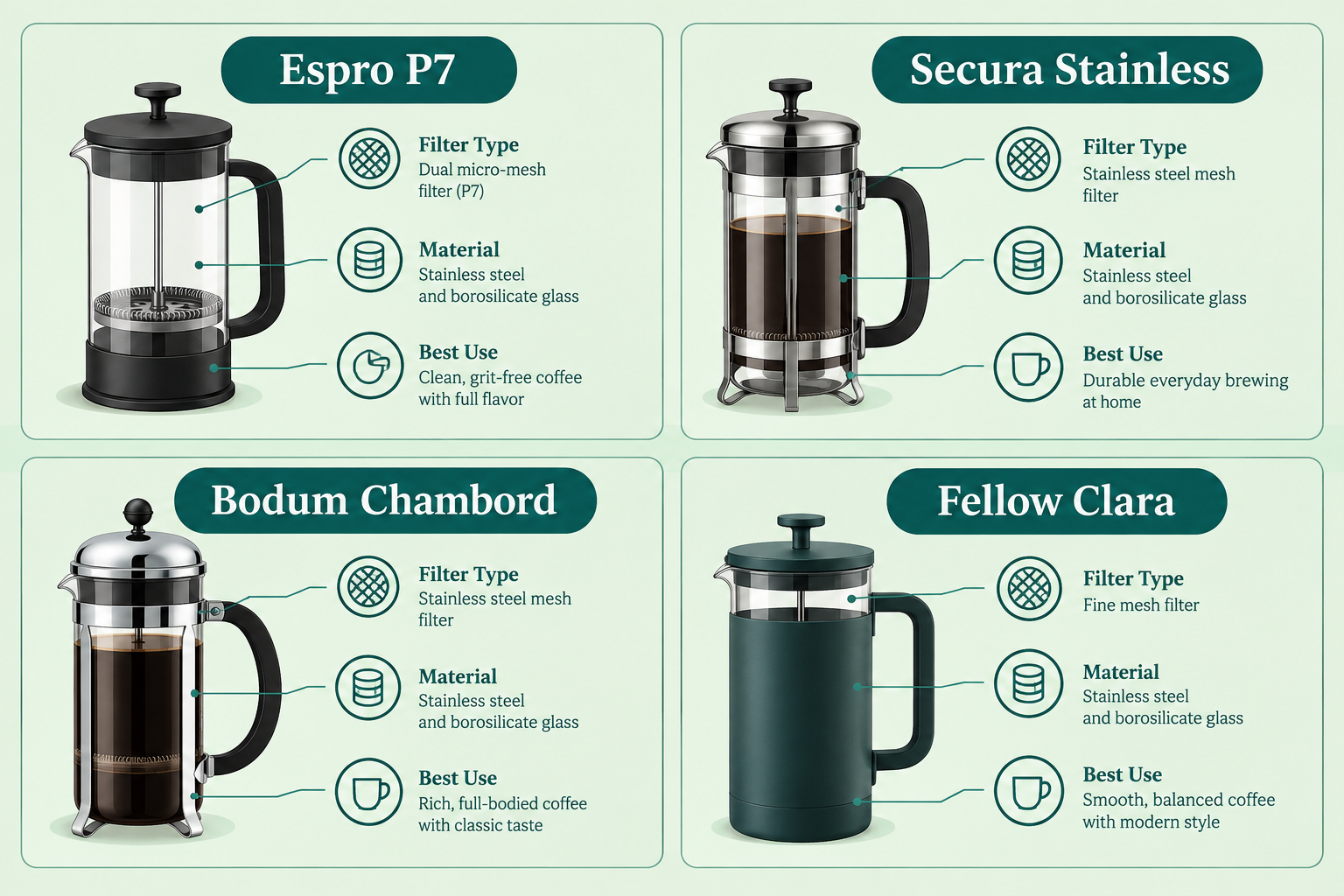
Espro's engineering is worth naming specifically. Its P3 and P7 lines use two nested layers of fine mesh instead of one, and that second layer is what independent test labs point to when they call the resulting cup "silky smooth" or free of silt. The Bodum Chambord french press, by comparison, uses a single mesh screen with a spring-loaded skirt. It filters adequately and it looks the part on a kitchen shelf, but reviewers consistently place it behind multi-filter designs on clarity even while praising its styling.
A stainless steel french press adds a second benefit beyond filtration: heat retention. Insulated stainless carafes keep coffee hot far longer than glass, which matters if you pour a second cup twenty minutes after brewing. But insulation and filtration are separate jobs done by separate parts, and buyers sometimes confuse "keeps coffee hot" with "makes coffee clean." They are not the same claim.
If you are choosing between an espresso machine and a french press for your next equipment upgrade, our buyers guide to choosing the best espresso machine breaks down the tradeoffs in ownership experience.
French Press vs Pour Over vs Aeropress: Which Is Better
None of the three is universally better. Each one changes body, clarity, and speed in a predictable way, so the right choice depends on what you want in the cup.
- French press: full body, visible oils, some sediment even with a good filter, ready in about 5 minutes, no paper filter needed.
- Pour over: lighter body, cleaner cup because paper traps oils and fine particles, more sensitive to grind and pour technique, ready in 3 to 4 minutes.
- Aeropress: flexible between the two, pressure-assisted extraction, small batch size, ready in under 2 minutes, easiest to travel with.
Decision rule: choose a french press if you want body and mouthfeel and don't mind a small amount of sediment even from a good filter. Choose pour over if you want a paper-clean cup and don't mind the extra attention to grind size and pour speed. Choose Aeropress if you make single servings and travel often. For a deeper look at pour over technique specifically, see our notes on whether drip coffee is healthier than pour over.
Best French Press Brands in 2026
Four names come up repeatedly across current buying guides, and each earns its spot for a different reason rather than for having the biggest reputation.
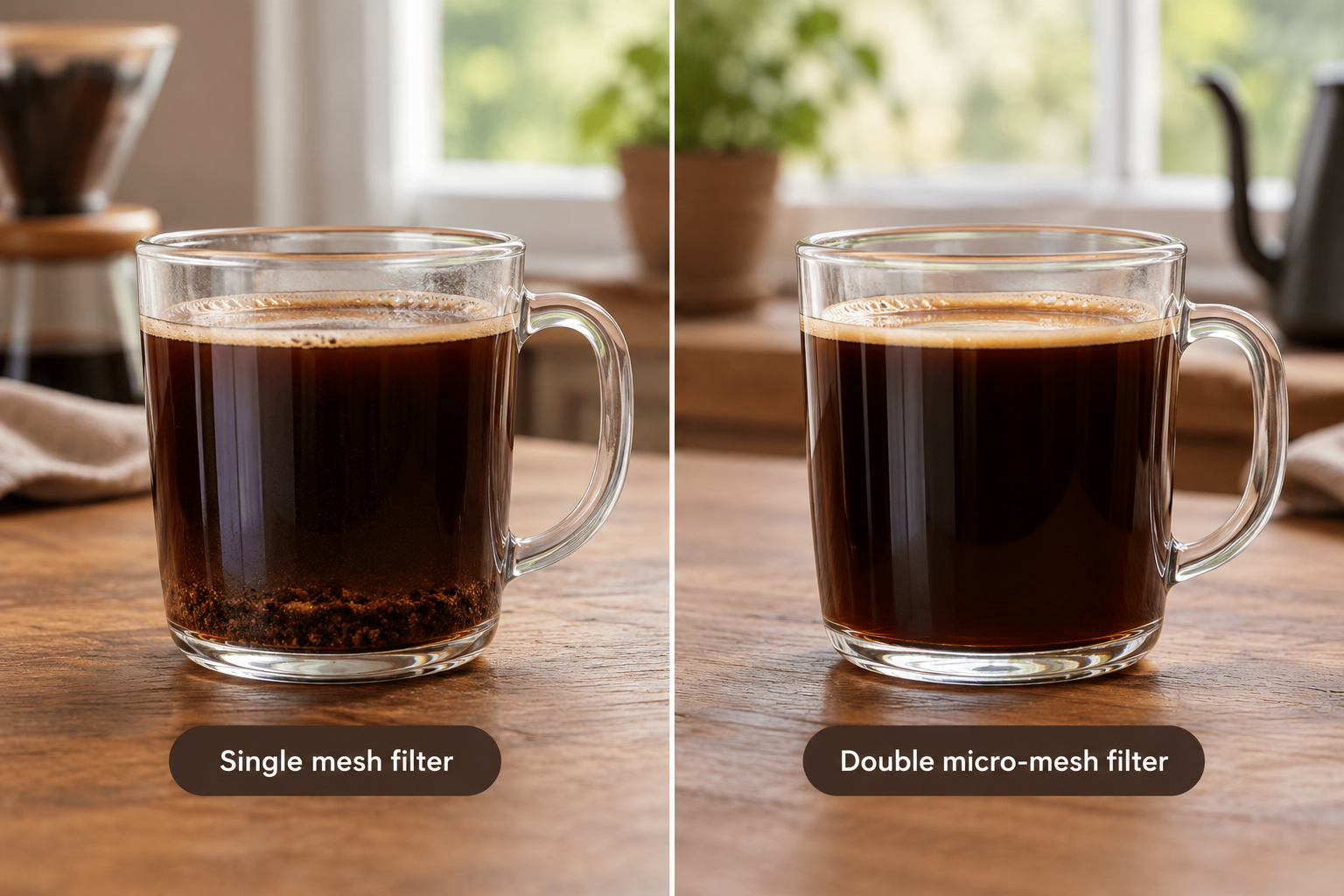
- Espro built its reputation entirely on filtration. The P3 and P7 use a patented double micro-mesh filter that traps fine particles a standard single-mesh screen lets through. Multiple 2026 test guides name the espro french press their top overall pick for this reason.
- Secura makes the leading value stainless steel french press, the SFP-34DS. It pairs an insulated double-wall body with a mesh filter that performs close to premium models at a lower price, which is why it shows up as a repeated top pick in 2026 comparisons.
- Bodum still sells more Chambord units than most competitors combined, and the bodum chambord french press remains the reference point for classic borosilicate glass styling. It is not the filtration leader, but it is a fair, well-known choice for buyers who prioritize looks and a lower price.
- Fellow entered the category with the Clara, a compact double-wall press aimed at buyers who want one or two cups without babysitting a full-size carafe. The fellow clara french press trades batch size for counter space and portability.
If you want a fully plastic-free french press, look at all-metal builds like Frieling or Espro's stainless line, since both keep plastic out of the brewing path entirely, which matters to buyers concerned about hot liquid contacting plastic parts long term.
Analysts following the category expect the next generation of designs to keep pushing on filter mesh count and seal quality rather than carafe material, since glass, stainless, and stoneware have each already proven durable enough for daily use. This is a reasonable expectation based on where 2026 design attention has gone, not a confirmed roadmap from any single manufacturer.
How Much Does a Good French Press Cost
A capable french press costs somewhere between $20 and $90 depending on filter sophistication, insulation, and material. You do not need to spend at the top of that range to get a clean cup, but you do need to know what you're paying for at each tier.
- Entry tier (roughly $20 to $35): basic glass presses with a single-mesh filter, adequate for casual drinkers who don't mind a little sediment.
- Mid tier (roughly $35 to $55): stainless steel french press options like the Secura SFP-34DS, adding insulation and improved mesh fit.
- Premium tier (roughly $55 to $90): Espro's double micro-mesh models, where the price buys measurably less sediment in the cup.
Common mistake: assuming a higher price always means a better cup. A $70 press with a poorly seated single filter can perform worse than a $35 press with a tight double-mesh fit. Check the current price and read the filter specification before comparing dollar figures.
French Press Coffee Tastes Gritty? What You're Doing Wrong
Gritty coffee almost always traces back to grind size, filter quality, or plunging speed, not a defective machine. Fix the grind first, since it's the most common cause.
- Grind too fine: fine particles slip past a single-mesh filter and end up in your cup. Switch to coarse ground coffee, roughly the texture of sea salt.
- Plunging too fast: a quick, forceful push churns fine particles back into suspension. Press slowly and steadily over 15 to 20 seconds.
- Worn or warped filter: mesh filters lose their seal over time, especially on lower-cost presses. If your press is more than a year old and coffee got noticeably grittier, the filter is a likely cause before the grind is.
- Pouring too much of the pot: the last quarter-inch at the bottom of the carafe always holds the most sediment. Stop pouring before you reach it.
Edge case: even a well-maintained Espro or Secura press will leave a thin layer of fine sediment at the bottom of the cup, because no mesh filter is completely nonporous. The goal with a good filter is minimal grit, not zero grit.
Can You Use a French Press for Tea
Yes, a french press works well for loose-leaf tea, and the mechanism is identical: steep loose leaves in hot water, then press the plunger to separate leaves from liquid. The only real requirement is dedicating a separate press to tea, since coffee oils cling to the mesh and carafe walls and will flavor future tea batches.
- Use water at the correct temperature for the tea type (roughly 175°F for green tea, closer to 212°F for black tea), not the near-boiling temperature typical for coffee.
- Steep times run shorter for delicate teas, often 2 to 3 minutes, versus the 4-minute standard for coffee.
- A stainless steel french press works fine for tea and resists lingering odors better than glass over repeated dual use, though a dedicated pot is still the cleaner habit.
French Press Filter Replacement Options
Replacement filters exist for nearly every major french press line, and swapping a worn filter is often cheaper than replacing the whole press. Espro sells direct replacement filter sets for the P3 and P7. Bodum and Secura both sell OEM mesh and spring assemblies sized to their specific carafe diameters.
Beyond OEM parts, two other paths exist:
- Universal reusable mesh filters fit multiple carafe sizes and cost less than brand-specific replacements, though fit can be looser than an OEM part.
- Paper filter inserts placed inside the plunger basket trap more sediment than any mesh alone, at the cost of losing some of the body and oil that makes french press coffee distinct in the first place.
If you're curious how reusable filter technology compares across brewing methods, our guide to the Goldtone reusable basket coffee filter and our guide to the Think Key washable reusable coffee filter cover similar mesh technology used in drip brewers.
French Press Sizes: How Many Cups Do You Need
Match capacity to how many mugs you pour each morning, not to how many guests might show up occasionally. French press sizes are usually labeled in ounces, and the common range runs from single-serve to large batch.
| Size | Approximate mugs | Best for |
|---|---|---|
| 12oz | 1 mug | Single drinker, small kitchen, Fellow Clara territory |
| 20oz | 2 mugs | Couples, light households |
| 34oz | 4 mugs | Standard household size, most Secura and Bodum models |
| 51oz | 8 mugs | Entertaining, offices, large households |
Decision rule: buy one size larger than your daily need if you regularly have a second person drinking coffee with you, since french press coffee doesn't hold well after the first hour and reheating degrades flavor.
Best Grind Size for French Press
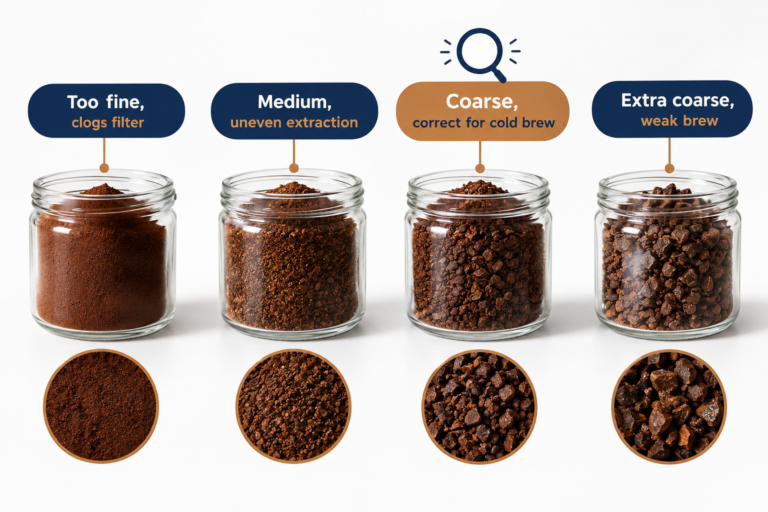
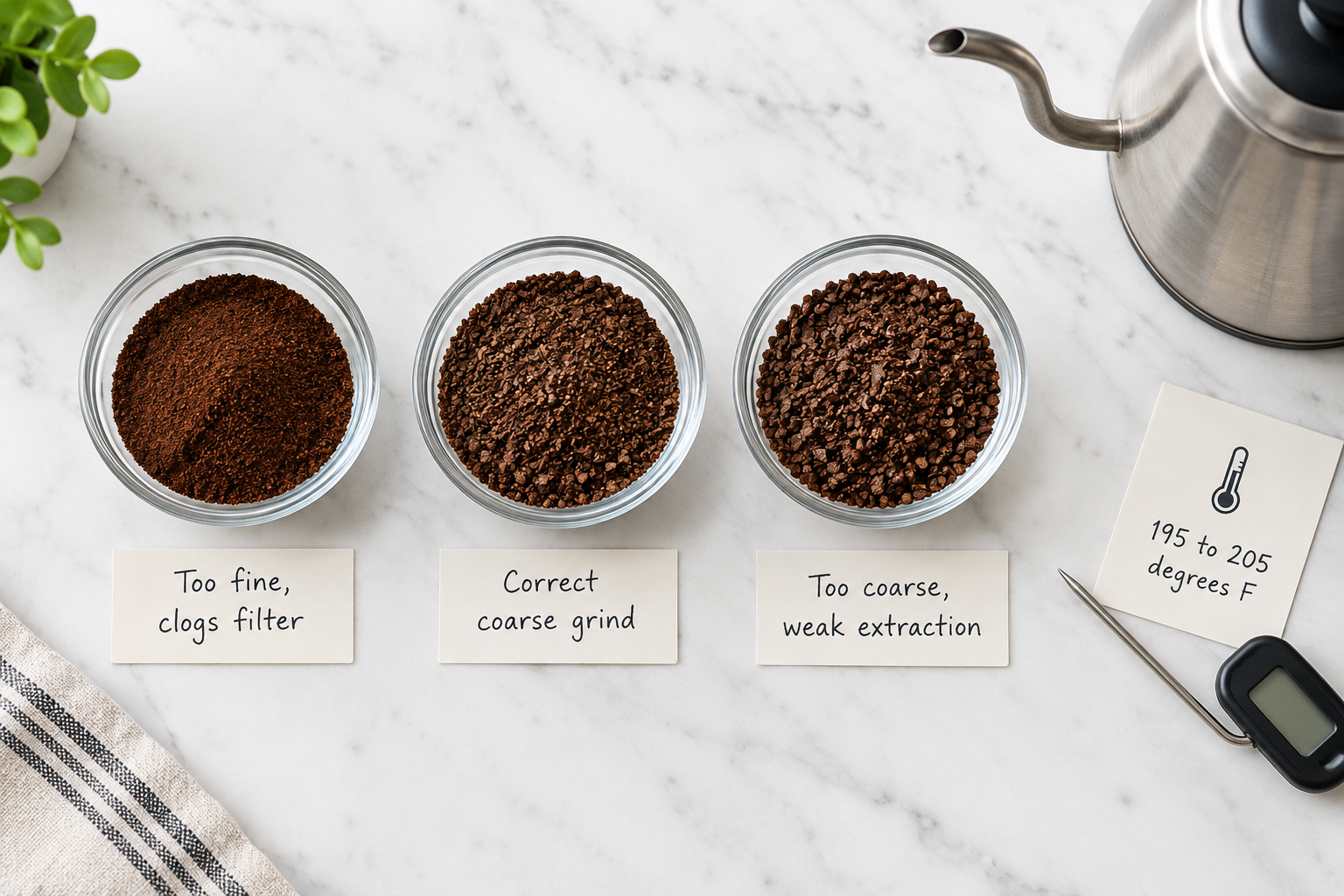
The best grind size for a french press is coarse, roughly the texture of raw sugar or sea salt, and getting this wrong is the single biggest cause of both grit and weak flavor. Water temperature matters almost as much: french press water temperature should sit between 195°F and 205°F, just off a full boil.
- Too fine: clogs the filter, increases sediment, and often over-extracts, producing a bitter cup.
- Correct coarse: allows even water flow through the grounds during steeping and lets the mesh filter do its job cleanly.
- Too coarse: under-extracts, producing a thin, weak cup even after a full 4-minute steep.
A burr grinder set to its coarsest range gives you the most consistent result. Blade grinders chop unevenly, mixing fine dust with larger chunks, which is a common reason home brewers get gritty coffee even when they think they bought a coarse grind. If you're shopping for a grinder to pair with your press, our buyer's notes on choosing the best coffee beans for home brewing covers grind and bean selection together.
French Press Cleaning Tips to Make It Last
Rinse the filter and carafe immediately after each use, since dried coffee oils are what shorten a mesh filter's lifespan and cause lingering staleness. A french press that gets a full clean once a week will outlast one that only gets a quick rinse.
- Disassemble the plunger fully at least once a week and scrub each mesh disc separately, since oil builds up between the layers where a quick rinse can't reach.
- Soak stainless steel french press parts in warm water with a small amount of baking soda monthly to lift oxidized coffee oils that plain soap misses.
- Avoid the dishwasher for glass carafes like the Bodum Chambord french press unless the manufacturer explicitly rates it dishwasher safe, since thermal shock can crack borosilicate glass over repeated cycles.
- Dry all metal parts fully before reassembly to prevent the spring mechanism from developing rust spots.
French Press for Cold Brew: Does It Work
Yes, a french press makes a capable cold brew, though it produces a different result than a dedicated cold brew system. Use a coarser grind than your hot brew ratio, roughly 1:8 coffee to water, and steep in the refrigerator for 12 to 18 hours before pressing.
- The extended steep time extracts differently than heat-based brewing, producing a smoother, less acidic cup.
- Press slowly once the steep is done, since cold, thick concentrate is harder to filter cleanly than hot coffee.
- Filtration quality still matters here. A double-mesh press like Espro's leaves noticeably less sediment in cold brew concentrate than a single-mesh Chambord.
For a full method with ratios and steep timing, read our complete guide to making the best cold brew coffee.
Who Should Use a French Press
A french press suits anyone who wants full-bodied coffee without buying an electric machine, and it's a poor match for anyone who wants a completely clean, sediment-free cup every time. That's the honest tradeoff.
Good fit for:
- Morning coffee drinkers who prefer body and mouthfeel over paper-filtered clarity.
- Anyone who wants a manual brewer with no cords, no descaling schedule, and a low failure rate.
- Travelers and small kitchens, especially with a compact size like the Fellow Clara.
Skip it if:
- You want zero sediment in every cup regardless of filter quality; pour over or a paper-filtered drip machine will serve you better.
- You want espresso-style concentration; a french press cannot build the pressure espresso requires. Our explainer on whether espresso is stronger than coffee covers that distinction in detail.
- You brew for a household of six or more daily; a single french press batch won't keep pace without multiple presses.
Common French Press Mistakes Beginners Make
Most beginner mistakes come from treating a french press like a drip machine instead of a manual steeping device that rewards patience.
- Using drip-ground coffee: it's too fine and clogs the filter, causing sediment and bitterness.
- Skipping the bloom: pouring all the water at once traps carbon dioxide and produces uneven extraction.
- Steeping too long: anything past 4 to 5 minutes starts pulling bitter compounds regardless of grind size.
- Leaving coffee in the carafe after brewing: the grounds keep extracting even after pressing, so transfer coffee to a separate carafe or thermos if you're not drinking it immediately.
- Buying based on looks alone: a beautiful glass carafe with a weak single-mesh filter will always underperform a plain stainless press with a tight double-mesh seal.
For a broader troubleshooting walkthrough, our beginners guide to using a french press for coffee covers each of these in more depth with photos of proper technique.
Which French Press Fits Your Priority?
Find your best french press match
Pick your top priority, then see which pick fits.
FAQ
What makes the best french press different from a cheap one? The filter. Presses that use a double micro-mesh design trap far more fine sediment than a single-mesh screen, which is the main reason premium models like Espro's cost more than basic glass presses.
Is a stainless steel french press better than glass? Stainless steel holds heat noticeably longer, with one test recording 121°F after two hours versus around 110°F for glass models. Glass lets you see the brew, which some buyers still prefer for that reason alone.
How long should I steep coffee in a french press? Steep for 4 minutes at a water temperature between 195°F and 205°F, using coarse ground coffee at roughly a 1:15 coffee-to-water ratio.
Can I use a french press every day without damaging it? Yes, with weekly deep cleaning of the mesh filter and full drying of metal parts between uses. Daily rinsing alone will shorten the filter's effective life over several months.
Does the fellow clara french press work for a family of four? Not well on its own. The Clara is built for one or two mugs. A 34oz press like the Secura SFP-34DS fits a typical four-person household better.
Why does my french press coffee still have some sediment even with a good filter? No mesh filter is completely nonporous. Even top-tier double-mesh presses leave a thin layer of fine particles at the very bottom of the carafe, which is why pouring stops before the last quarter-inch.
Conclusion
The filter is the part doing the real work in every french press, and once you know that, shopping gets easier. Look at mesh design first, material and insulation second, and brand reputation last. If you want the cleanest cup available, check the current price on an Espro P7. If you want most of that clarity for less money, compare the models between the Secura SFP-34DS and a standard Bodum Chambord. Either way, pair whatever press you choose with a coarse, even grind and water in the 195 to 205°F range, and the machine will finally get credit for the coffee it was always capable of making.
Better Coffee Starts With Better Answers.
Keep Exploring Coffee Rank IQ
- Coffee Rank IQ home: reviews, brewing guides, and coffee science
- French Press vs Pour Over: Which Cup Fits Your Morning?
- AeroPress vs French Press: Body, Cleanup, and Cost Compared
- How Long to Steep French Press Coffee: Beyond the 4 Minute Rule
- French Press Coffee Ratio: The Grams, Cups, and Scoops That Work
References
- www.coffeeness.de/en/best-french-press
- www.cnn.com/cnn-underscored/reviews/best-french-presses
- www.nytimes.com/wirecutter/reviews/best-french-press
- www.foodnetwork.com/how-to/packages/shopping/product-reviews/best-french-presses
- brewgazette.com/best-french-press
- www.businessinsider.com/guides/kitchen/best-french-press
- tastefulcoffee.com/best-french-presses
- modelrec.com/best-french-presses
- www.yourbestdigs.com/reviews/best-french-press
- voltagecoffee.com/french-press-maker