AeroPress vs French Press: Body, Cleanup, and Cost Compared
Quick Answer
AeroPress vs French press comes down to filtration and pressure. The AeroPress uses a paper or metal filter plus manual pressure, producing a cleaner, lighter cup in about 2 to 3 minutes. The French press uses a metal mesh filter and gravity, producing a heavier, oil-rich cup in about 4 to 5 minutes with sediment at the bottom of the mug. Pick the AeroPress for single servings, easy cleanup, and travel. Pick the French press for full-bodied batches, low equipment cost, and simple mornings without paper filters.
Key Takeaways
- Body and mouthfeel: French press coffee feels heavier because its metal mesh filter lets coffee oils and fine particles through. AeroPress coffee feels lighter and cleaner, closer to a pour over, when brewed with the standard paper filter.
- Cleanup: AeroPress cleanup takes under a minute since the puck of grounds pops out with the filter. French press cleanup means unscrewing the plunger, rinsing three mesh screens, and scrubbing grounds from the glass carafe.
- Cost: A standard AeroPress runs about 30 to 40 dollars. A French press covers a wider range, from about 20 dollars for basic glass models to 60 dollars or more for insulated steel versions.
- Capacity: French press wins for multiple cups at once, with 34 and 48 ounce models common. AeroPress is built for one to two servings per brew cycle.
- Brew time: AeroPress finishes in roughly 90 seconds to 3 minutes. French press needs a 4 minute steep plus a slow plunge.
- Sediment: French press leaves grit at the bottom of the cup from its metal filter. AeroPress with a paper filter produces almost no sediment.
- Portability: AeroPress travels well in a bag with no glass to break. French press glass carafes are fragile for travel unless you buy a specific travel model.
- Durability: AeroPress plastic bodies can crack after years of heavy use, though the 2026 AeroPress Steel model targets that weakness with a metal build. French press glass carafes are the main failure point in that design.
- Grind size: French press needs a coarse, even grind. AeroPress works across a wider range, from medium-fine to medium-coarse, depending on brew time and pressure.
AeroPress vs French Press: What Changes the Cup
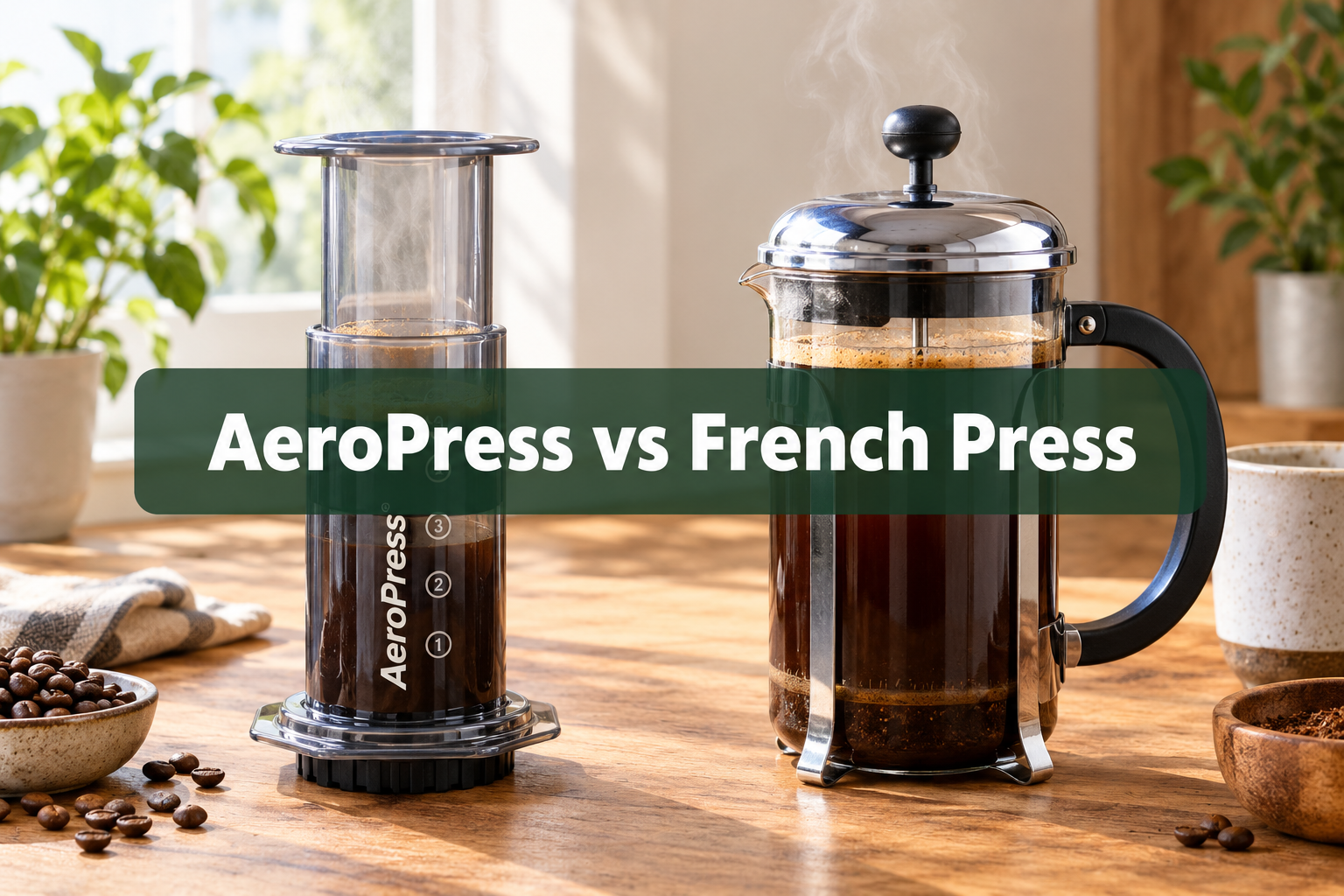
The AeroPress vs French press debate is really a debate about filtration, not brand loyalty. The AeroPress presses hot water through coffee grounds using a paper or metal filter and hand pressure. The French press steeps grounds in hot water for several minutes, then separates them with a metal mesh plunger.
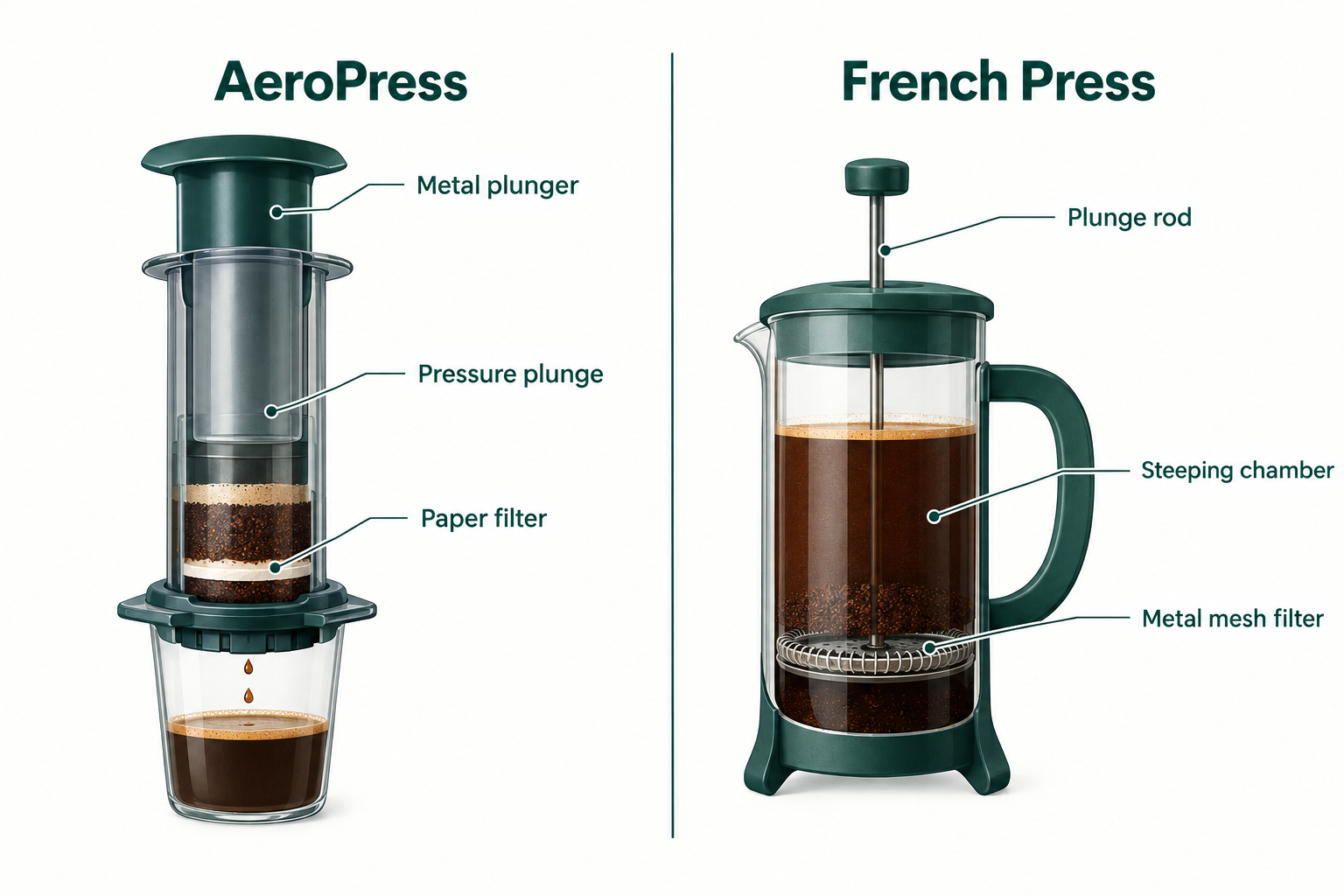
That single difference in filter material explains almost everything else people notice about the two brewers.
- A paper filter (AeroPress) traps most oils and fine particles, so the cup runs lighter and closer to filter coffee in feel.
- A metal mesh filter (French press) lets oils and micro-fines pass into the cup, which builds body and a slightly cloudy texture.
AeroPress inventor Alan Adler designed the device in 2005 as a fast, low-mess alternative to drip machines, using downward air pressure to force water through the grounds in under a minute of active brewing. The French press has a much older lineage, with metal plunger patents tracing back to the 19th century in France and Italy, and the modern glass carafe version becoming a household staple by the mid 20th century.
Decision rule: choose AeroPress if you want a cup close to pour over with less gear and quicker cleanup. Choose French press if you want more body per cup and don't mind a metal mesh cleaning routine.
Which Makes Better Tasting Coffee: AeroPress or French Press
Neither one makes objectively better coffee. They make different coffee, and the right answer depends on the body and clarity you want in the cup.
AeroPress coffee, brewed with its standard paper filter, tends to taste closer to a light pour over: brighter acidity, more defined tasting notes, and a clean finish. That's because the paper filter strips out the fine particles and most of the oils that would otherwise cloud the cup. Swap in the AeroPress metal filter attachment and the cup gets heavier, closer to French press territory, since oils and some fines pass through.
French press coffee tastes rounder and heavier. The metal mesh filter lets natural coffee oils stay in the cup, which carries aroma compounds and builds a fuller mouthfeel. That same mesh also lets through fine grounds, which is why French press coffee often tastes "thicker" even before you notice the sediment at the bottom of the mug.
If you're chasing single origin flavor detail, tasting notes, and a cleaner finish, AeroPress edges ahead. If you want the coffee to taste substantial, almost chewy, in a way that stands up to cream or a heavy breakfast, French press wins that specific job.
Common mistake: using a fine espresso grind in a French press. It slips through the mesh and turns the cup muddy. Match your grind size to your filter, not just your brew time.
AeroPress vs French Press Cleanup and Washing
AeroPress cleanup is faster because the used coffee grounds form a solid puck that ejects with a firm push, landing in the trash or compost with the filter attached. French press cleanup takes longer because grounds spread across the bottom of the carafe and cling to a three-piece metal mesh plunger that needs a full rinse.
Here's what each routine actually involves:
AeroPress cleanup steps:
- Unscrew the filter cap and push the plunger to eject the coffee puck and paper filter.
- Rinse the plastic chamber and plunger under warm water.
- Wipe the rubber seal occasionally so it keeps its grip.
French press cleanup steps:
- Unscrew or lift out the plunger assembly.
- Separate the mesh screens (most models use two to three stacked screens plus a spiral).
- Rinse each screen individually, since grounds hide in the mesh layers.
- Wash the glass or steel carafe, watching for the fragile glass wall.
If reducing cleanup time is your main goal, AeroPress or French press for less cleanup is not a close call. The AeroPress wins because it has one filter and one chamber, not a mesh stack. For a full walkthrough of carafe care between brews, our beginners guide to using a French press for coffee covers the mesh rinse routine step by step, and our guide to cleaning a coffee maker applies to both brewers.
How Much Does an AeroPress Cost vs French Press
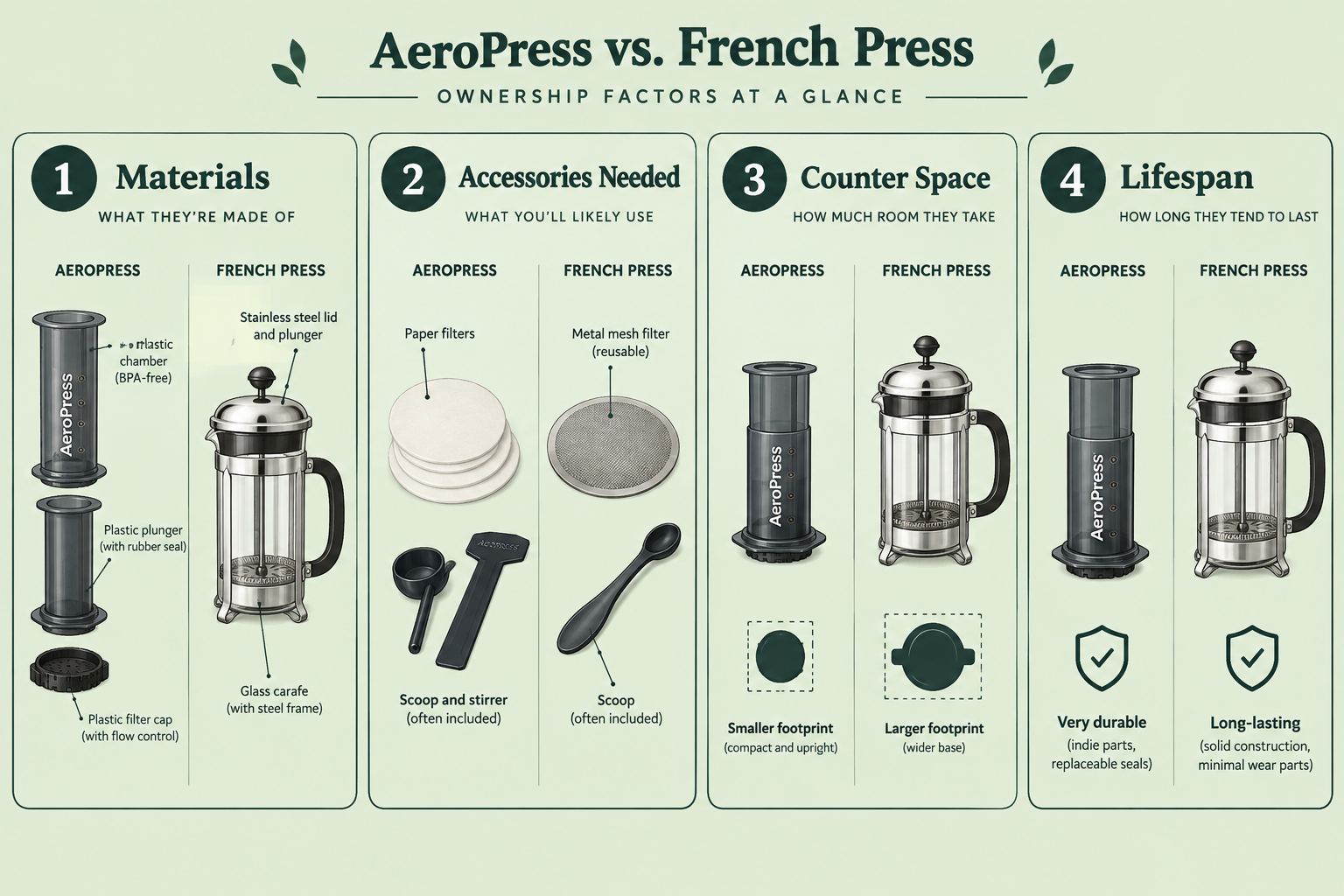
An AeroPress typically costs less than a mid-range French press and roughly the same as a basic one. The standard AeroPress sells for around 30 to 40 dollars from the manufacturer, while French press prices range from about 20 dollars for simple glass models to 60 dollars or more for double-wall steel versions.
Running costs differ too. AeroPress needs paper filters, sold in packs of a few hundred for a small ongoing cost, though the metal filter attachment removes that recurring expense entirely. French press needs no filters at all beyond the reusable mesh screen, which makes it the lower running-cost option over years of daily use, even when the upfront price is similar.
In 2026, AeroPress released the AeroPress Steel, a metal-bodied version aimed at durability and a different body profile than the plastic original. The company markets it alongside language calling the AeroPress a modern alternative to traditional brewers, sometimes framed as a "French press 2.0" style pitch, since it claims a fuller body than the classic paper-filtered AeroPress while keeping the fast brew time. That steel build costs more than the standard plastic AeroPress, positioning it closer to premium French press pricing, but it also removes the plastic-cracking risk that shows up in AeroPress durability complaints after years of hot water exposure.
Decision rule: if upfront price matters most, a basic glass French press is usually the cheapest entry point. If you want the lowest ongoing cost with no filter purchases, get the AeroPress metal filter attachment or lean on the French press mesh screen you already own.
AeroPress or French Press for Beginners
For a first-time buyer, the French press has a gentler learning curve because it has fewer parts and less risk of jamming. The AeroPress rewards a bit of practice with grind size, water ratio, and plunge pressure, but that same tinkering is also why many home brewers enjoy it once they get past the first few cups.
French press mistakes are usually simple to fix: steep time too short, grind too fine, or water not hot enough. AeroPress mistakes can feel more technical at first: the plunger jamming from too fine a grind, coffee dripping through the filter cap before you're ready to press, or over-extraction from steeping too long before plunging.
Beginner path:
- New to manual brewing and want the simplest possible routine: start with French press.
- Comfortable following a written recipe and want more control over strength: start with AeroPress.
Both methods use immersion or near-immersion brewing, so the water temperature guidance is similar: aim for water just off the boil, around 200°F, poured over coarser grounds for French press or medium grounds for AeroPress. Our french press coffee recipe guide walks through ratios and steep times if you're starting there.
Can You Use AeroPress for Large Batches Like French Press
No. The AeroPress is built for one to two servings per brew cycle, while French press models commonly hold 34 to 48 ounces, enough for three to six cups depending on the size you buy. If you regularly serve coffee to more than two people at once, the French press is the practical choice for capacity.
You can brew multiple AeroPress rounds back to back since each cycle takes only a few minutes, but that means standing at the counter repeating the process rather than pouring from one carafe. For a household of one or two people, or for someone brewing a single cup before work, the AeroPress capacity limit rarely matters. For weekend brunches, offices, or families, French press batch size wins outright.
AeroPress vs French Press Brew Time
AeroPress finishes brewing faster, typically 90 seconds to 3 minutes total including the plunge. French press needs a longer steep, usually a full 4 minutes before you even start plunging, plus time for the slow, even push.
That time difference adds up over a week of daily brewing but rarely changes anyone's decision on its own. What matters more is whether you want an active few minutes (pressing, timing, adjusting) or a mostly hands-off steep where you can walk away and come back to plunge.
Quick example: brewing for one person before an early meeting, the AeroPress finishes and cleans up faster end to end. Brewing for a table of four, the French press steep time barely matters since you're pouring one carafe for everyone at once.
French Press Sediment Problem Compared to AeroPress
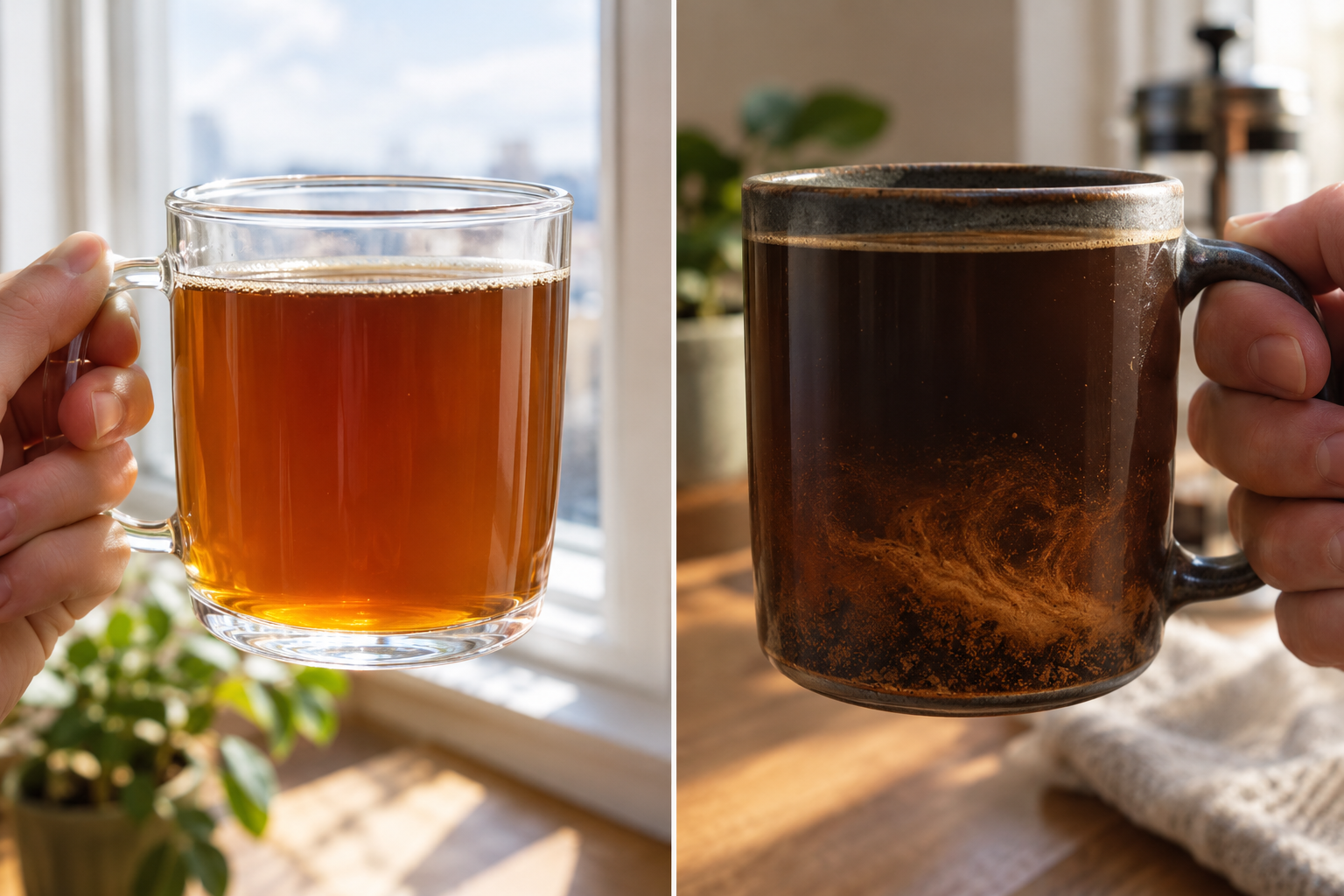
French press coffee regularly leaves fine grit at the bottom of the cup because its metal mesh filter cannot catch every small particle. AeroPress coffee, brewed with the standard paper filter, produces close to zero sediment because paper catches particles the metal mesh lets through.
This sediment issue is one of the most common French press complaints among new users, who sometimes assume something went wrong with their grind. It's actually built into the filtration method itself. A few practical fixes reduce it without switching brewers:
- Use a coarser, more even grind so fewer fine particles form in the first place.
- Let the coffee settle for a minute after plunging before pouring, so grounds sink rather than pour into the cup.
- Pour gently and stop before scraping the very bottom of the carafe.
If sediment bothers you enough to consider switching methods entirely, that's a strong signal to try AeroPress with a paper filter, since it removes the problem structurally rather than through technique.
Best Coffee Grind for AeroPress vs French Press
French press needs a coarse, even grind, close to the texture of rock salt. AeroPress works across a wider grind range, from medium-fine to medium-coarse, since the paper filter and manual pressure compensate for finer particles that would clog a French press mesh.
French press grind size matters more than most beginners expect. Too fine, and you get sediment plus over-extraction, a bitter, muddy cup. Too coarse, and the coffee tastes weak and sour because water moves through it too easily during the 4 minute steep.
AeroPress grind size has more flexibility because brew time and pressure are adjustable. A finer grind with a shorter steep produces a cup closer to espresso in concentration. A coarser grind with a longer steep produces something closer to drip coffee. That range is part of why AeroPress recipes vary so widely online: people are choosing different points on the same spectrum.
A quality burr grinder makes a bigger difference for French press than for drip machines, since uneven particle sizes show up directly as both sediment and inconsistent extraction. For espresso-specific grind guidance, our guide to the best grind for an espresso machine explains why grind consistency changes extraction more broadly.
AeroPress vs French Press Portability and Travel
AeroPress travels better because it has no glass, disassembles into a compact size, and includes travel-friendly variants like AeroPress Go. French press models are mostly glass carafes, which limits travel use unless you specifically buy a stainless steel or unbreakable travel version.
Campers, office workers who brew at a desk, and people who travel for work tend to prefer the AeroPress for this reason alone. It also needs less water and no power source, which matters for hotel rooms and campsites without a full kitchen setup.
Edge case: if you already own a steel French press with a screw-tight lid and no glass parts, portability stops being a real advantage for the AeroPress. The gap only matters with standard glass French press models, which is most of them.
AeroPress vs French Press Durability and How Long They Last
French press failure usually comes from the glass carafe cracking or breaking, since that's the fragile part in most designs. AeroPress failure usually comes from the plastic body cracking after years of repeated hot water exposure and pressure, though the 2026 AeroPress Steel model targets that specific weakness with an all-metal build.
A well-cared-for glass French press can last many years if it's never dropped or thermal-shocked with sudden temperature changes. Steel French press carafes avoid the glass problem entirely and tend to outlast the plastic AeroPress body under heavy daily use.
Buying rule: if you brew multiple times a day for years, a steel carafe (French press) or the new AeroPress Steel reduces your long-term replacement risk more than the standard plastic AeroPress or basic glass French press.
AeroPress vs Pour Over, Espresso, and Chemex: Where It Fits
The AeroPress sits between pour over and espresso in terms of pressure and concentration, while the French press sits in its own immersion category alongside the Chemex as a full-body brewing style.
AeroPress vs pour over: pour over methods like the V60 rely on gravity alone, while the AeroPress adds manual pressure, producing a slightly heavier cup than a V60 with a similar paper filter. AeroPress vs V60 comparisons usually come down to speed and forgiveness: AeroPress tolerates grind and pour inconsistency better than a V60 because the pressure step compensates for uneven extraction.
AeroPress vs espresso: espresso uses much higher pressure (about 9 bars) from a machine, producing a concentrated shot with crema. The AeroPress produces a coffee that's stronger than drip but nowhere near espresso concentration, even with a fine grind and short steep. For readers curious about strength comparisons in general, our piece on whether espresso is stronger than coffee breaks down the concentration math behind that difference.
Chemex vs French press: the Chemex uses a thick paper filter and pour over technique, producing a cup closer to AeroPress in clarity than to French press body. If you're choosing between Chemex and French press specifically, the same body logic applies: paper filters clean the cup, metal mesh keeps it heavy.
AeroPress vs French press vs pour over, taken together, really represents three points on one spectrum: pour over and AeroPress lean toward clarity, French press leans toward body, and AeroPress sits closest to the middle depending on which filter you use.
Quick Comparison Table
| Factor | AeroPress | French Press |
|---|---|---|
| Body | Light, clean with paper filter | Heavy, oil-rich |
| Brew time | 90 sec to 3 min | 4 to 5 min |
| Cleanup | Eject puck, rinse | Rinse mesh screens and carafe |
| Capacity | 1 to 2 cups | 3 to 6 cups |
| Sediment | Minimal | Noticeable |
| Travel friendly | Yes, compact and unbreakable | Limited, glass models fragile |
Try the AeroPress vs French Press Quick Recipe
If you already own both, here's a fair way to taste the difference yourself in one sitting.
AeroPress recipe (inverted method):
- Add 17 grams medium-fine coffee to an inverted AeroPress.
- Pour 250 grams of 200°F water, stir once, steep 90 seconds.
- Attach the paper filter cap, flip, and press for 30 seconds.
French press recipe:
- Add 30 grams coarse coffee to the carafe.
- Pour 500 grams of 200°F water, stir, steep 4 minutes.
- Press slowly and pour immediately to limit sediment.
Taste them side by side. The body difference becomes obvious within the first sip, and that's the whole AeroPress vs French press argument in one tasting.
Frequently Asked Questions
Is AeroPress or French press better for daily use? It depends on how many cups you brew at once. AeroPress suits one or two daily servings with fast cleanup. French press suits households brewing three or more cups from one carafe.
Does AeroPress coffee taste weaker than French press? Not weaker, different. AeroPress with a paper filter produces a lighter body with more clarity. French press produces a heavier, fuller mouthfeel from oils the metal mesh lets through.
Can I use the same coffee beans for both methods? Yes, but adjust the grind. French press grind size needs to stay coarse and even, while AeroPress tolerates a medium-fine to medium-coarse range depending on your recipe.
Which lasts longer, AeroPress or French press? A steel French press carafe or the 2026 AeroPress Steel model both outlast a basic glass French press or the standard plastic AeroPress under heavy daily use, since glass and plastic are each brewer's main failure point.
Is the AeroPress worth it if I already own a French press? It's worth it if you want faster cleanup, single-serving convenience, or a cup closer to pour over. It's not necessary if you're happy with French press body and don't mind the mesh cleaning routine.
What's cheaper long term, AeroPress or French press? French press has the lower running cost since it needs no paper filters. AeroPress running cost depends on whether you buy paper filters regularly or switch to the reusable metal filter.
Conclusion
AeroPress vs French press isn't a contest with one winner. It's two filtration systems built for different mornings. The AeroPress gives you a cleaner cup, a faster wipe-down, and a case you can toss in a backpack. The French press gives you more body per cup, a lower running cost, and enough capacity to pour for a whole table.
If your mornings are solo and rushed, get the AeroPress and keep a stack of paper filters on hand. If your mornings involve more than one mug and you don't mind a mesh screen rinse, the French press earns its counter space. Either way, the grind size and water temperature you use will matter more to the final cup than which device you bought. Better coffee starts with better answers, and now you have the ones that actually change your brew.
Keep Exploring Coffee Rank IQ
- Coffee Rank IQ home: reviews, brewing guides, and coffee science
- French Press vs Pour Over: Which Cup Fits Your Morning?
- Best French Press: Why the Filter Matters More Than the Glass
- How Long to Steep French Press Coffee: Beyond the 4 Minute Rule
- French Press Coffee Ratio: The Grams, Cups, and Scoops That Work
References
- aeropress.com
- en.wikipedia.org/wiki/AeroPress
- www.handsomewade.com/blog/2018/01/battle-presses-aeropress-american-french-press
- handground.com/grind/ultimate-brew-down-aeropress-vs-french-press
- aeropress.com/blogs/blog/french-press-vs-aeropress-what-s-the-difference
- aeropress.com/products/aeropress-coffee-maker-steel
- aeropress.com/pages/welcome