Siphon Coffee Maker Guide: How Vacuum Brewing Works
Quick Answer
A siphon coffee maker brews in two physical stages: heating the sealed lower globe raises vapor pressure and pushes water up a tube into the upper chamber, then removing the heat condenses that vapor, creating a partial vacuum that pulls the finished coffee back down through a filter . The result is full immersion brewing with a filtered finish, so you get body closer to a French press and clarity closer to a pour over . Expect three to five minutes of hands-on work, a medium grind, and roughly $68 to $150 for a capable brewer in the US as of November 2026 .
Key Takeaways
- Two forces, one brewer. Vapor pressure sends water up. A partial vacuum pulls coffee down through the filter .
- Hario Technica, $94.50 on Amazon (checked Nov 5, 2026), 4.7 stars across 1,389 reviews, is the pick for first-timers. Glass build, stainless filter, alcohol burner, aluminum windbreak.
- Yama 8-cup stovetop, $68 (1,076 reviews, Nov 5, 2026) is the budget route, but "8 cups" means eight 3 to 4 ounce servings, roughly 24 ounces total.
- Nispira Belgium balance style, $142.99 is the showpiece. Gorgeous, fussy, not a first brewer.
- Bodum ePEBO, about $149.99, automates the cycle with a 1,000-watt element, 34 ounce capacity, and a 30-minute warming function .
- Grind medium, around table salt, finer than French press and coarser than drip. Too fine and the drawdown stalls.
- Brew temperature in the upper chamber lands near 90 to 95°C (194 to 203°F) . Research summarized by the Specialty Coffee Association found temperature alone did little to sensory profile at 87, 90 and 93°C once strength and extraction were held constant. Change your brew ratio first.
Siphon Coffee Maker: What It Is and How It Works
A siphon coffee maker, also called a vacuum coffee maker or syphon coffee brewer, is a two-chamber glass device that uses heat and pressure to move water up into a brewing vessel, then uses cooling and vacuum to pull the brewed coffee back down through a filter. Nothing inside it is electronic on the traditional models. The physics does the work.
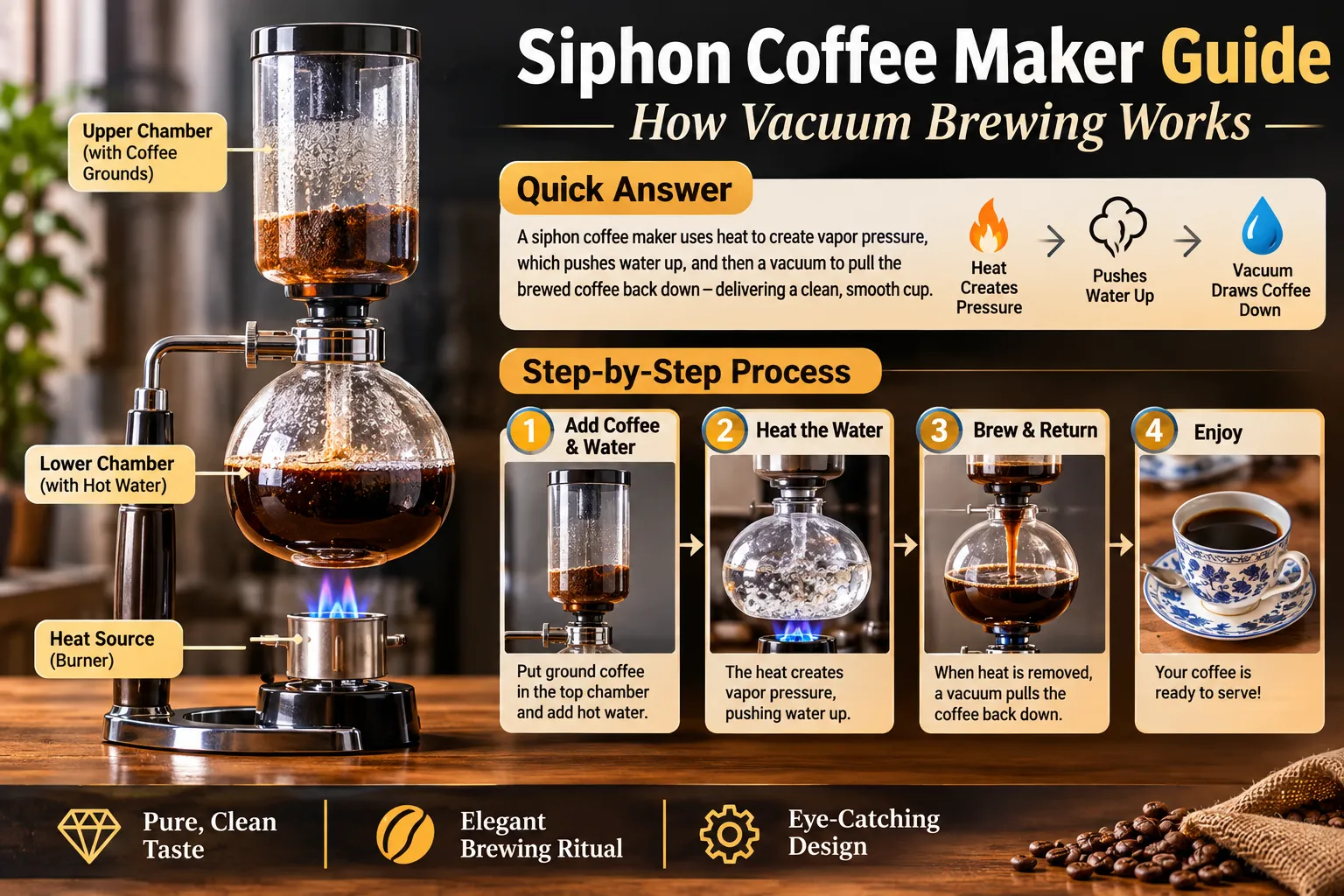
The parts are simple:
- Lower globe (bowl). Holds the water. Gets heated.
- Upper chamber (hopper). Holds the grounds during brewing. Has a tube extending down into the globe.
- Filter. Cloth, paper, or metal, held in place by a hooked chain that clips under the tube.
- Gasket. A rubber or silicone seal around the tube that makes the lower chamber airtight. This is the part most beginners underestimate.
- Heat source. An alcohol burner, a butane beam heater, a stovetop flame, or an electric base.
Here is the part worth understanding: a siphon coffee maker is a full immersion brewer with a filtration step . While the water sits in the upper chamber, every ground is submerged, exactly like a French press. When the heat comes off, the filter separates the grounds out as the liquid descends. You get immersion's even extraction and the filter's clean cup, which is why the method keeps surviving despite being more theatrical than practical.
The design dates to the 1830s in Europe, and the balance-style brewers you see on café back bars are direct descendants of that era. Japanese coffee houses kept the method alive through decades when the rest of the world moved on to drip, which is why Hario and Yama dominate the category today.
How Does Vacuum Brewing Actually Work?
Vacuum brewing works in two distinct physical stages: pressure-driven transfer, then vacuum-driven filtration . Most explanations skip the first half and call the whole thing a vacuum. It isn't.
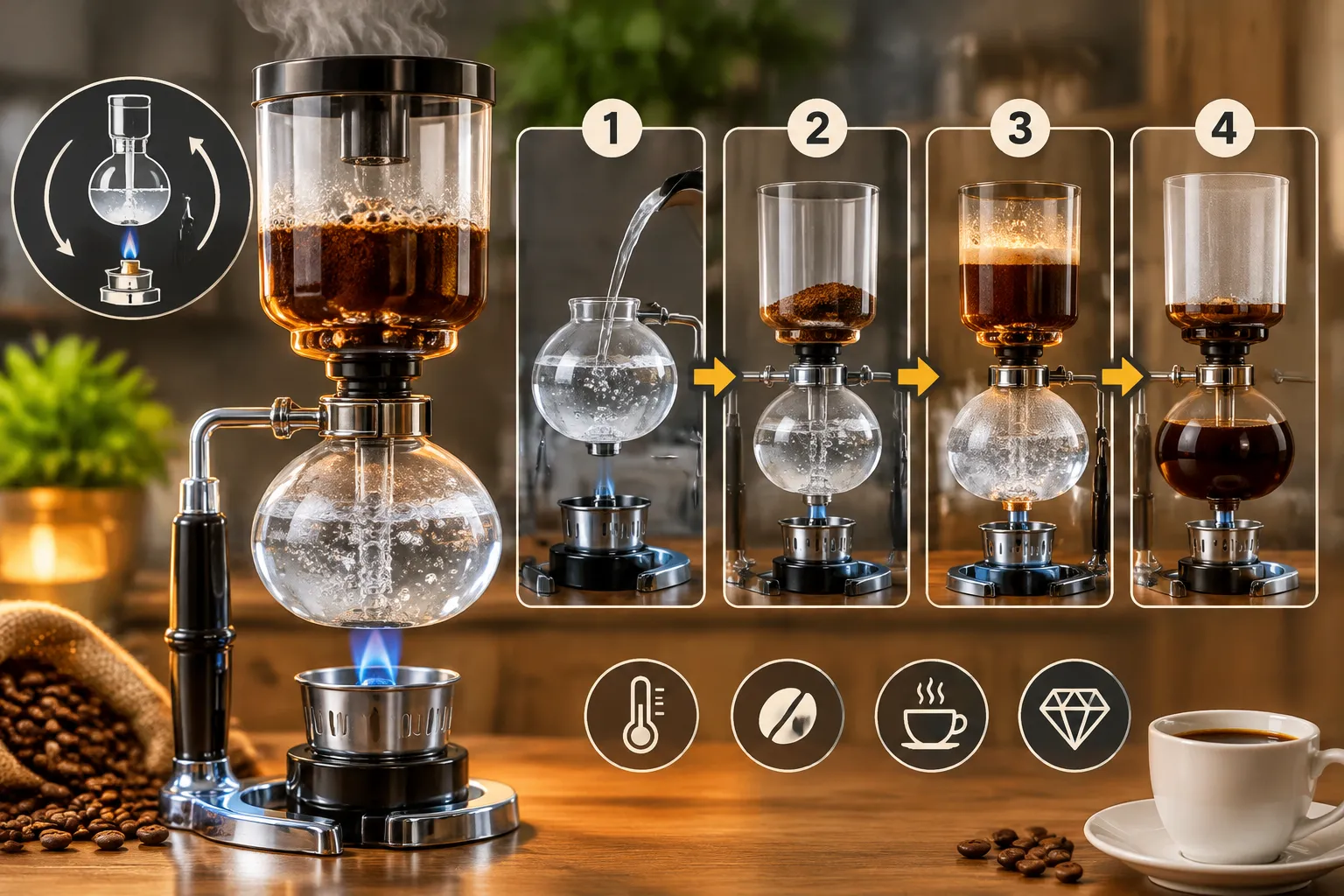
Stage one: vapor pressure brewing pushes water up.
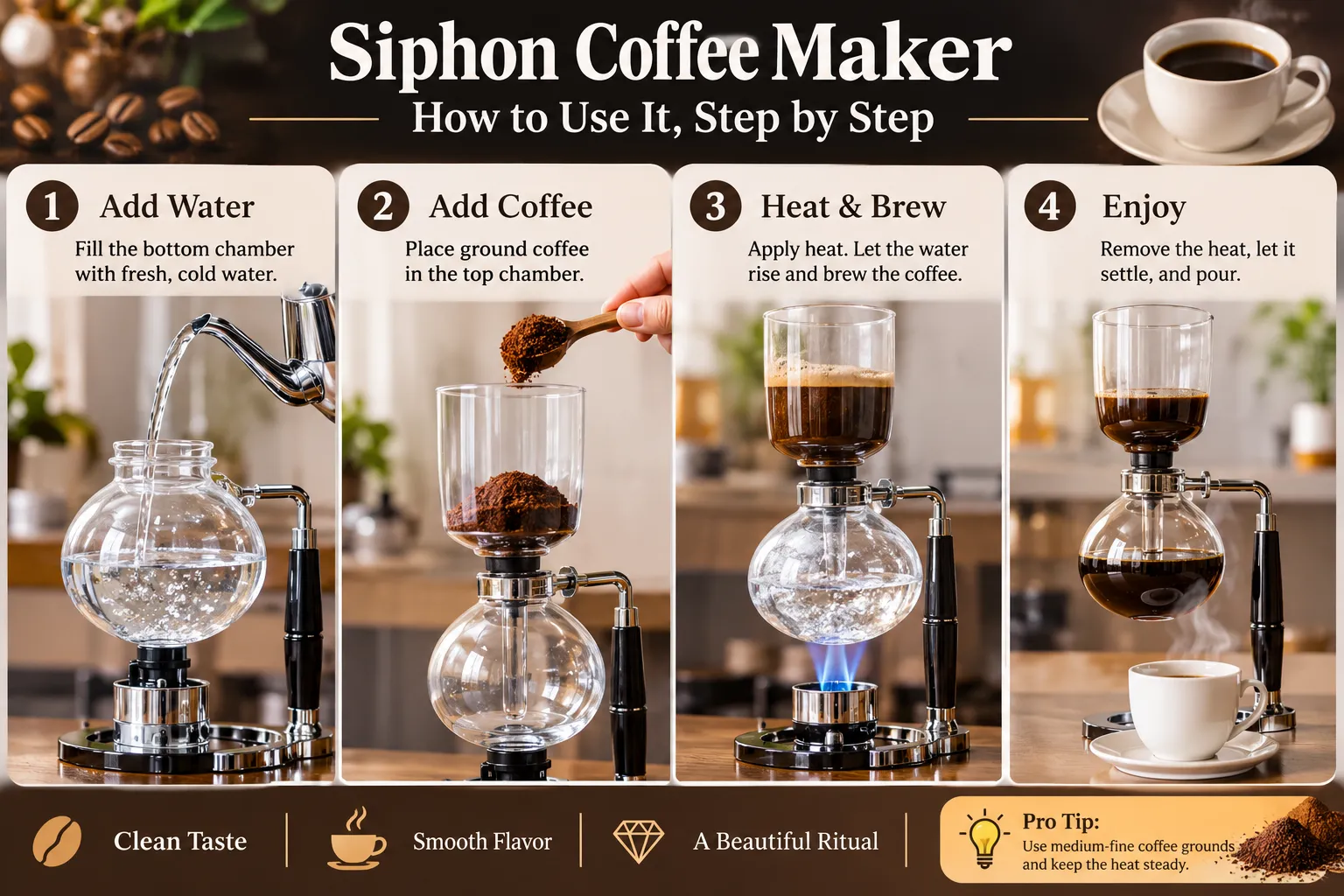
Heat the sealed lower globe. Two things happen at once. The trapped air above the water expands, and water begins converting to vapor. Both raise the pressure inside the sealed chamber. Since the only escape route is the tube running up into the top chamber, the water gets pushed up that tube . It is not sucked. It is shoved.
A small amount of water usually stays behind in the globe, which is normal and keeps the system generating steam.
Stage two: the vacuum pulls the coffee down.
Remove the heat. The vapor in the lower globe condenses back into liquid, and the remaining air contracts as it cools. A gas occupying less volume at the same sealed boundary means lower pressure. Atmospheric pressure outside the brewer is now higher than the pressure inside, so it presses the brewed coffee down through the filter and back into the globe .
The drawdown should take 30 to 60 seconds. If it takes three minutes, your grind is too fine or your cloth filter is clogged.
A siphon brewer is the only common home method where you can literally watch extraction happen through glass. That is most of its charm, and none of its argument.
On temperature. Water in the upper chamber typically sits around 90 to 95°C (194 to 203°F), lower than boiling because heat is lost through the tube and the glass . Siphon brewing temperature gets talked about as though it transforms flavor by itself. Research published by the Specialty Coffee Association from UC Davis tested brews at 87, 90 and 93°C and found little sensory impact attributable to temperature alone once brew strength and extraction yield were held constant. Temperature mainly changed the rate and extent of extraction in that range. Separate SCA-summarized work on full immersion brewing, covering 80°C to 99°C, found equilibrium extraction landing near 21% across a wide range of brew ratios, with brew ratio affecting beverage strength (TDS) more than extraction yield.
The practical meaning: if your siphon cup tastes weak, change the coffee-to-water ratio before you chase temperature. Grind size, stirring, and contact time control how fast you reach that equilibrium. Our broader explainer on coffee brewing temperature covers how this applies to other methods.
How to Use a Siphon Coffee Maker, Step by Step
Here is the working method. Budget 10 minutes total, including heating and cleanup. Target ratio: 60 grams of coffee per liter of water, or 1:16.6. For a 600ml Hario Technica, that's about 36 grams of coffee to 600ml of water.
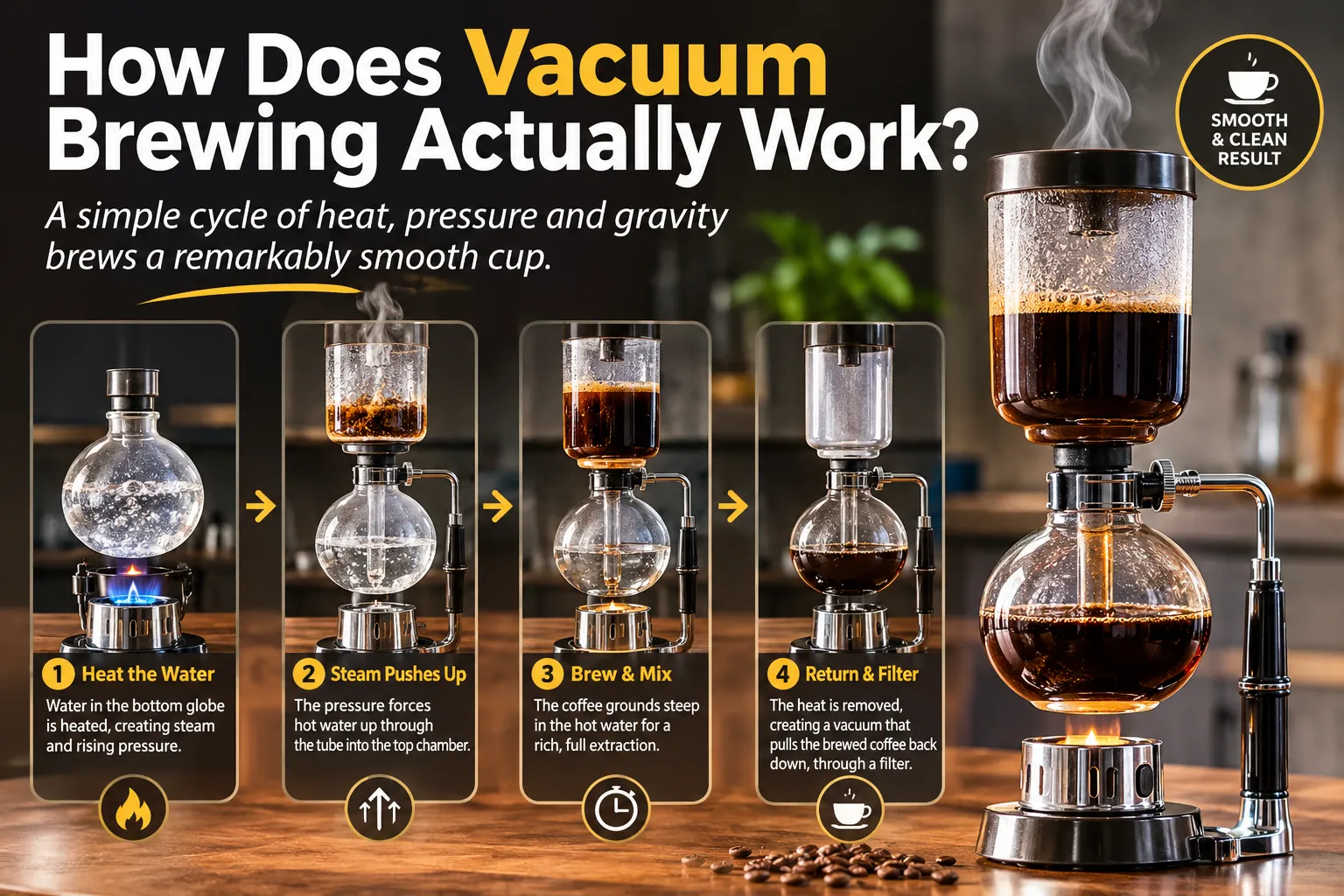
- Pre-heat your water. Fill the lower globe with water already heated in a kettle. Starting cold on an alcohol burner adds eight minutes of nothing.
- Wet and seat the filter. Soak a cloth filter in hot water, wring it out, place it flat in the upper chamber, then hook the chain down through the tube and clip it on the rim. Center it. An off-center filter leaks grounds.
- Assemble and heat. Rest the upper chamber at an angle first (most stands allow this) until the water is bubbling, then seat it firmly so the gasket seals. Water begins climbing.
- Add grounds once the water is up. Dose your medium grind into the upper chamber. Stir gently with a bamboo paddle or spoon, ten light strokes, enough to wet every particle and break the dry crust.
- Brew 60 to 90 seconds. Keep a low flame. The water should look like it is gently swirling, not boiling violently.
- Stir once more, then kill the heat. A short stir before drawdown helps the bed settle evenly. Remove the burner. Coffee descends in 30 to 60 seconds.
- Lift the top chamber off and pour.
Decision rule: if your spent grounds form a flat, level bed in the upper chamber, your stir and grind were right. A mounded or cratered bed means uneven agitation.
What grind size do you use for a siphon coffee maker?
Use a medium grind, roughly the texture of table salt or granulated sugar. That sits finer than French press and slightly coarser than a typical drip basket.
- Metal filter: go a touch coarser. Fines slip through and muddy the cup.
- Cloth filter: medium is ideal. Cloth catches fines without choking.
- Paper filter: you can push slightly finer, but watch drawdown time.
A burr grinder matters more here than the brewer does. Blade grinders produce a mix of boulders and dust, and the dust blocks the filter while the boulders under-extract. You will get bitterness and sourness in the same cup and blame the siphon.
Can you use regular coffee grounds in a siphon coffee maker?
Yes. Pre-ground supermarket coffee works mechanically, since most of it is cut for drip, which is close to the siphon's target grind. Taste is another matter. Pre-ground coffee loses aromatics within days of grinding, and a siphon is a clarity-forward brewer that shows that staleness plainly. Check the roast date on the bag and use beans within three to four weeks of roasting. If you only have pre-ground, choose a drip or medium grind and avoid anything labeled espresso or Turkish.
How long does siphon coffee take to brew?
Total time: 8 to 12 minutes from cold water, or 4 to 6 minutes if you pre-heat. The actual coffee-water contact is only 60 to 90 seconds. The rest is heating and drawdown.
| Stage | Typical time |
|---|---|
| Heating pre-boiled water in the globe | 1 to 2 min |
| Water rising into upper chamber | 30 to 60 sec |
| Brewing (grounds submerged) | 60 to 90 sec |
| Drawdown through filter | 30 to 60 sec |
| Disassembly and rinse | 2 min |
Best Siphon Coffee Maker Brands to Buy and How Much to Spend
Spend $90 to $100 on a Hario Technica if this is your first vacuum coffee maker. Spend $68 on a Yama if you want the cheapest honest entry. Spend $150 on a Bodum ePEBO if you want the siphon look without managing a flame.
Affiliate disclosure: Coffee Rank IQ earns a commission from qualifying purchases through retailer links. Prices below were checked on Amazon on November 5, 2026 and change often. This comparison is based on published manufacturer specifications and retailer listings, not hands-on lab testing.
| Model | Price (Nov 5, 2026) | Heat source | Capacity | Best for |
|---|---|---|---|---|
| Hario Technica 600ml (TCA-5) | $94.50, 4.7 stars, 1,389 reviews | Alcohol burner + windbreak | 600ml / 5 small cups | First-timers. Our pick. |
| Yama 8-cup stovetop | $68, 1,076 reviews | Gas or electric stovetop | ~24 oz / eight 3 oz servings | Budget buyers with a stove |
| Bodum ePEBO | ~$149.99 | Electric, 1,000W base | 1 litre / 34 oz | One-button convenience |
| Nispira Belgium balance style | $142.99 | Alcohol burner, lever balance | ~5 cups | Display pieces and gifts |
Five features we love on the Hario Technica
- Heat-resistant borosilicate glass in both chambers. You can see the water rise, the bloom form, and the bed settle. That visibility is the fastest teaching tool in home brewing.
- Stainless steel stand with an angled rest position. You can park the upper chamber at an angle while the water heats, then seat it when you are ready. Fewer burns, better control.
- Aluminum windbreak around the alcohol burner. Hario lists this in the box. A draft from a kitchen window will otherwise stall your heat and stretch the rise by minutes.
- Reusable cloth filter with a chain hook. No ongoing filter purchases, and cloth gives the cup a slightly fuller body than paper.
- Multiple sizes on one design language. Hario sells the Technica in 2-, 3-, and 5-cup versions, with the TCA-3 listed at about 350mm tall, 95mm deep, and 1,300g packaged. Start small if counter space is tight.
What to watch out for
- Glass breaks. Both chambers are glass. Replacement globes exist, but a knocked-over brewer is a $40 morning.
- "Cups" are not mugs. Yama's 8-cup brews roughly 24 ounces total, around eight 3 to 4 ounce Japanese-style servings. Two American mugs, give or take.
- Cloth filters demand care. Rinse thoroughly, then store wet in a sealed container of water in the fridge, or dry them fully. A half-dried cloth filter goes rancid and ruins the next three brews.
- Alcohol burners are slow. Denatured alcohol takes its time. Pre-heat your water or buy a butane beam heater.
- The ePEBO is heavier and bulkier than the glass-and-stand brewers, and its 1,000-watt base occupies permanent counter space.
- Balance-style brewers like the Nispira are a skill tier up. Lovely objects, genuinely more fiddly, and harder to clean.
Who should buy, and who should skip
Buy a siphon coffee maker if you enjoy process, you already own a burr grinder, you drink black coffee, and you have 10 unhurried minutes on a weekend morning. For that buyer, the Hario Technica at $94.50 is the clear winner: proven design, replaceable parts, the widest community of users to learn from.
Buy the Bodum ePEBO instead if you want the cup without the flame management. It automates heating and timing and holds the brew warm for 30 minutes .
Skip the siphon entirely if your mornings run on a 15-minute window, you drink milk-based café drinks, or you need to brew for four people at once. A siphon will frustrate you. A good drip machine or a pour over setup serves you better.
Pros and cons
Pros
- Clean, tea-like clarity with more body than most paper-filtered methods
- Stable brewing temperature through the whole immersion
- Repeatable once you fix the variables
- Genuinely impressive to watch, which matters for gifting
- No electricity needed on burner and stovetop models
Cons
- Fragile glass, multiple parts
- Cleanup takes longer than a French press
- Small batch sizes
- Cloth filter maintenance is ongoing
- Alcohol burners add fuel cost and slow heating
Siphon Coffee Maker vs French Press and Pour Over: Which Is Better?
Short answer: a siphon splits the difference. It brews by full immersion like a French press, then filters like a pour over . If you like French press body but hate the sediment, the siphon is the compromise worth $95.
| Siphon | French press | Pour over | |
|---|---|---|---|
| Extraction style | Full immersion + filter | Full immersion, metal mesh | Percolation, gravity |
| Body | Medium to full, clean | Full, with sediment | Light to medium, very clean |
| Hands-on time | 8 to 12 min | 5 min | 4 to 5 min |
| Temperature stability | High, heat is continuous | Drops through steeping | Drops with each pour |
| Skill variable that matters most | Grind + stir | Steep time | Pour rate |
| Cleanup | Multi-part, 2 to 3 min | Easy but messy grounds | Easy, toss the filter |
| Entry cost | $68 to $150 | $25 to $120 | $20 to $60 |
Against a French press, the siphon wins on clarity and temperature stability and loses on simplicity and price. A French press holds steady heat poorly and lets fines through the mesh, which some drinkers love. If you want press body with fewer fines, the Espro P7 with its double micro-filter is the cheaper fix.
Against pour over, the siphon wins on consistency and loses on speed. Pour over quality depends heavily on your pouring technique, which is a skill with a learning curve. Siphon quality depends on grind and ratio, which are settings you can write down. Our beginner's pour over guide walks through that technique if you want to compare directly.
Is siphon coffee really better than other methods?
Not categorically. It produces a distinctive cup, and the SCA-summarized full immersion research suggests equilibrium extraction near 21% is reachable across a wide range of ratios, meaning the method is forgiving on yield once your grind and time are sane. What the siphon reliably delivers is clarity plus body in the same cup, and remarkably stable brew temperature. Whether that beats a well-made V60 is a preference question, not a physics one. We lay out the tradeoffs across methods in our brewing methods comparison.
Are siphon coffee makers difficult to use?
Moderately. The brewing itself is easy once set up. The friction is assembly, flame management, and cleanup. Most people get a drinkable cup on attempt one and a good cup by attempt four. The ePEBO removes the flame variable entirely if that is your sticking point.
Do you need special equipment for a siphon coffee maker?
You need three things beyond the brewer: a burr grinder, a scale that reads to 0.1g, and a heat source. Most kits include the burner and filter. A bamboo paddle helps but a chopstick works. No special filters are required if your brewer ships with a cloth or metal one, and no descaling equipment is needed, though hard water will leave scale on the glass over time.
Why Isn't My Siphon Coffee Maker Brewing Properly?
Nine times out of ten the problem is the seal, the grind, or the flame. Work through these in order.
| Symptom | Likely cause | Fix |
|---|---|---|
| Water won't rise | Gasket not sealed, or upper chamber not seated straight | Push the upper chamber down firmly and straight; check the gasket for cracks |
| Water rises then falls back while heating | Flame too low, or a draft | Use the windbreak, raise the flame slightly |
| Drawdown takes over 2 minutes | Grind too fine, or clogged cloth filter | Coarsen one step; deep-rinse or replace the filter |
| Grounds in the finished cup | Filter off-center or chain unhooked | Re-center the filter, confirm the chain is hooked under the tube rim |
| Coffee tastes bitter and hollow | Over-extraction from too-fine grind or too much boiling | Coarsen the grind, keep the flame low during immersion |
| Coffee tastes sour and thin | Under-extraction, or too little coffee | Tighten the grind one step, or move the ratio to 1:15 |
| Cracked glass | Thermal shock from cold water on a hot globe | Always add warm water to a warm chamber |
Common mistakes people make with siphon coffee
- Boiling the brew. A rolling boil in the upper chamber scalds the coffee and agitates it unevenly. Keep the flame low enough that the surface just moves.
- Not stirring. Dry grounds float as a crust and never fully contribute. Ten gentle strokes after dosing.
- Using a stale bag. The siphon's clarity shows oxidation plainly. Buy whole beans with a visible roast date and read our guide on choosing beans for home brewing.
- Over-tightening nothing, under-seating everything. The gasket needs real downward pressure to seal.
- Storing a damp cloth filter in a drawer. It sours. Water in a sealed fridge container, or bone dry.
- Guessing the dose. Weigh it. A scale is $15 and fixes more problems than a new brewer will.
FAQ

Conclusion: The Verdict
A the siphon is a genuinely different brewing tool, not a novelty, and the two-stage physics behind it (vapor pressure up, vacuum down) produces a cup with clarity and body that neither a French press nor a pour over quite matches . It costs you time, glass fragility, and a cloth filter routine. In exchange you get the most temperature-stable immersion brew you can make at home, and a process that teaches you more about extraction in one morning than a week of reading.
The pick: the Hario Technica at $94.50 (Amazon, checked November 5, 2026, 4.7 stars from 1,389 reviews). It is the right first siphon because parts are replaceable, the stand is forgiving, and the windbreak solves a problem beginners don't know they have. If flame management is a non-starter, the Bodum ePEBO at around $149.99 automates the cycle. If $68 is the ceiling and you own a stove, the Yama stovetop does the job, with the caveat that its "8 cups" are 3 ounce servings.
Your next step: before you buy the brewer, confirm you own a burr grinder and a 0.1g scale. Those two tools determine whether your siphon makes remarkable coffee or expensive disappointment. Then compare the models, check the current price, and start with a 1:16.6 ratio on beans roasted within the last three weeks.
Better Coffee Starts With Better Answers.
Siphon brew ratio calculator
Enter your water volume, pick a strength, get your coffee dose and timings.
Grind: ‘+grind+’.
Immersion time: 60 to 90 seconds after stirring.
Expected drawdown: ‘+draw+’.
Target upper-chamber temperature: 90 to 95°C (194 to 203°F).’; });