
Espresso Tamper Sizes: 51, 54 or 58 mm, Spring or Flat
Quick Answer
Your tamper size is set by your portafilter basket, not your taste. De'Longhi Dedica and Stilosa machines take about 51 mm, Breville and Sage machines marketed as "54 mm" actually want a 53.3 to 53.5 mm base, and Gaggia, Rancilio, Rocket and most prosumer machines use the 58 mm class, which runs anywhere from 58.0 to 58.5 mm depending on the basket . Spring-loaded tampers help beginners press the same way twice; flat tampers give experienced hands more control. Level matters more than force.
Key Takeaways
- Measure the basket, not the portafilter. WikiEspresso recommends pulling the basket out and measuring its internal diameter at the top rim, leaving only a small clearance for the tamper .
- A "54 mm" Breville is not 54.0 mm. Normcore specifies 53.3 mm for the Bambino, Bambino Plus, Barista Express, Barista Pro and Barista Touch .
- 58 mm is a category, not a measurement. Gaggia and Rocket list roughly 58 mm, IMS and VST precision baskets call for 58.4 to 58.5 mm, and Decent uses about 58.35 mm .
- VST publishes the tightest spec: a 58.40 mm flat tamper with roughly +0.00/−0.05 mm tolerance for its 15 to 25 g baskets .
- Price check, Amazon, November 5, 2026: Normcore V4 spring-loaded 53.3 mm at $42 with 3,391 reviews and 2,000+ sold per month; a calibrated 51 mm tamper at $16.99.
- 30 lb is not a proven target. Decent's own tamper design uses roughly 15 lb as its compression goal, and 2026 guides have moved toward repeatability and levelness instead of a magic weight .
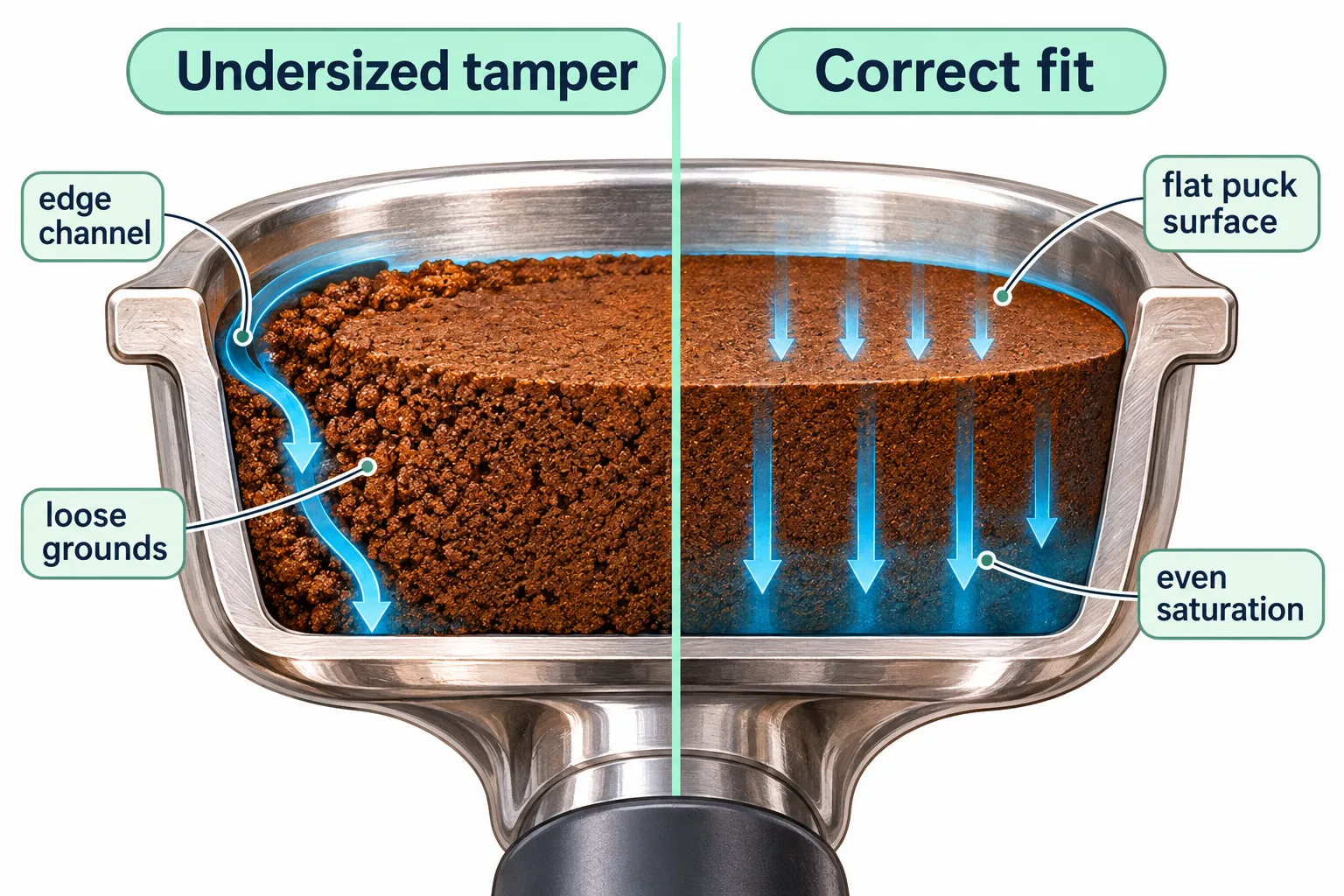
- 1 mm too small leaves a visible gap around the puck edge, and that gap is where water escapes.
What size espresso tamper do I need for my machine?
Find your machine in the chart below, then confirm by measuring the basket. The three common families are 51 mm (De'Longhi manual machines), 53.3 to 53.5 mm (Breville and Sage, sold as "54 mm"), and 58 mm class (Gaggia, Rancilio, Lelit, Rocket, Profitec, La Marzocco and most commercial groups) .
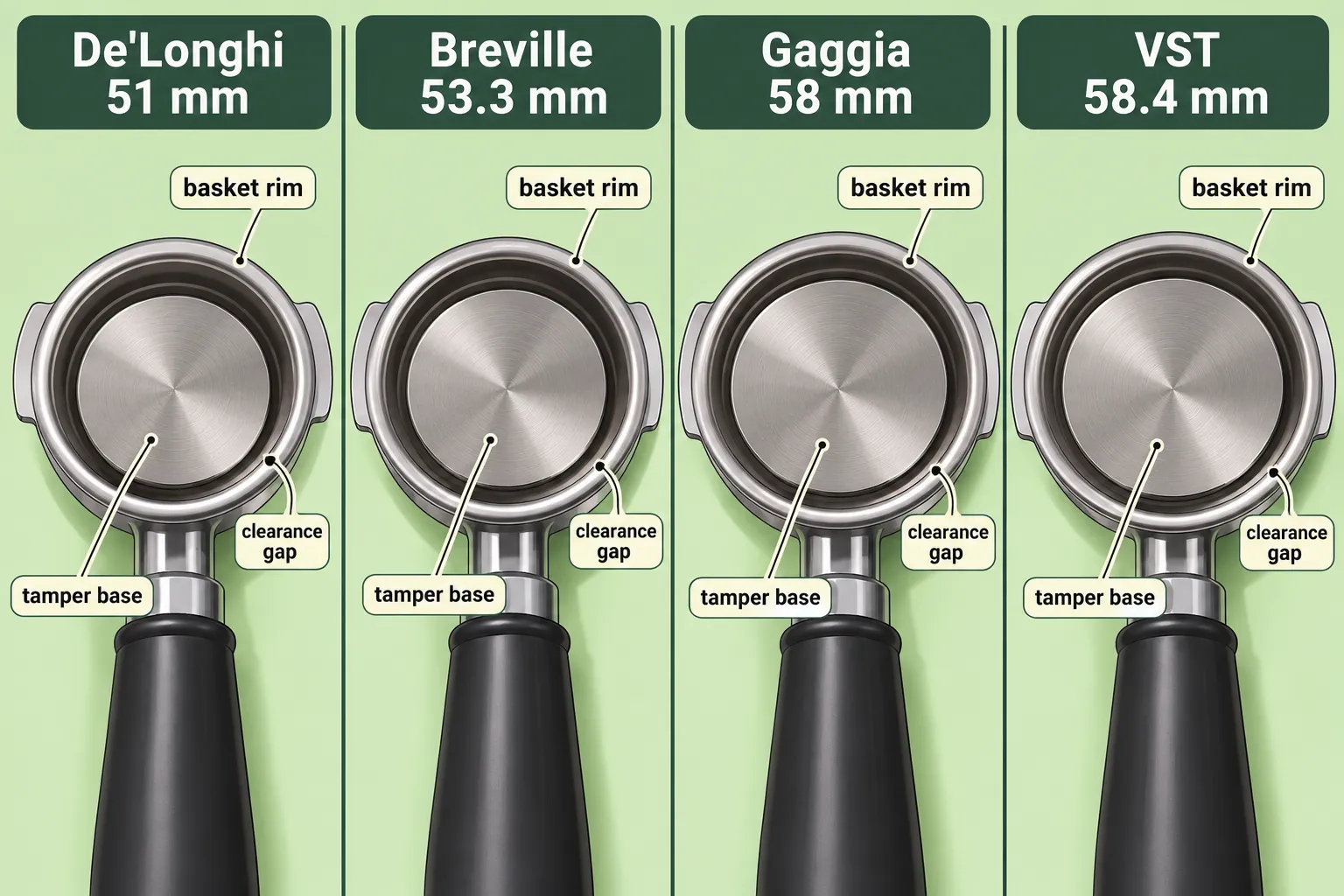
Tamper size by machine
| Machine family | Marketed size | Tamper base to buy | Notes |
|---|---|---|---|
| De'Longhi Dedica, Dedica Maestro, Stilosa, La Specialista | 51 mm | 51 mm | De'Longhi's own DLSC080/DLSC058 accessories sit at this size |
| Breville / Sage Bambino, Bambino Plus, Barista Express, Barista Pro, Barista Touch | 54 mm | 53.3 to 53.5 mm | Normcore lists 53.3 mm, MHW-3BOMBER 53.35 mm, Pesado around 53.5 mm |
| Gaggia Classic Pro, Rancilio Silvia, Lelit, Rocket, Profitec | 58 mm | 58 to 58.5 mm | Stock baskets are forgiving; 58.5 mm gives fuller coverage |
| IMS or VST precision baskets in a 58 mm group | 58 mm | 58.4 to 58.5 mm | VST specifies 58.40 mm flat, tolerance about +0.00/−0.05 mm |
| Decent DE1 | 58 mm | 58.35 mm | Decent argues a looser fit avoids puck suction on lift |
| Flair, Cafelat Robot and other manual levers | varies | check maker | Sizes range widely; see our guide to manual espresso machines |
Decision rule: if you own a Breville, buy 53.3 mm and stop reading size charts. If you own a Gaggia Classic Pro, buy 58.5 mm unless you run VST baskets, in which case buy 58.4 mm. If you own a Dedica, buy 51 mm.
Common mistake: buying a 54.0 mm tamper for a Breville because the box said 54 mm. It will catch on the basket wall, bind, and tilt the puck. The model name describes the group, not the basket bore.
Does espresso tamper size actually matter for the shot?
Yes, and the reason is geometry rather than mysticism. A tamper that is 1 mm narrower than the basket leaves a ring of untamped grounds around the perimeter. Pressurized water follows the path of least resistance, so it runs down that soft ring instead of through the dense center of the puck. That is channeling, and it tastes sour and thin because part of your dose is barely extracted while another part is overextracted.
An espresso tamper that is slightly too wide is worse in a different way. It wedges against the basket wall, scrapes metal, and either refuses to seat level or scores the inside of the basket.
The practical gap most guides recommend is small: enough clearance that the tamper drops in and lifts out without grabbing, not enough to leave a visible rim of loose coffee . On a 58 mm basket that usually means 58.4 to 58.5 mm. On a Breville basket it means roughly 53.3 mm.
A 1 mm gap does not sound like much until you remember it circles the entire puck. That ring is where your shot leaks.
Size is one lever. Grind size, dose and water temperature move the cup more, which is why the guide to extraction and crema is worth reading alongside this one.
Edge case: pressurized baskets
If your machine came with a dual-wall or pressurized basket, the basket itself creates back pressure through a small hole, so tamping quality matters far less. Fit still matters, but you will not see dramatic change from a better tamper until you swap to a single-wall basket and a decent espresso grinder.
What's the difference between spring and flat espresso tampers?
A flat tamper is a solid base and a handle. You supply all the pressure and all the levelling. A spring loaded tamper, also called a calibrated tamper, has an internal spring that compresses and clicks or bottoms out at a set force, so every tamp lands at roughly the same pressure. Many spring models, including the Normcore V4, add a self-levelling collar that rests on the basket rim and holds the base square .
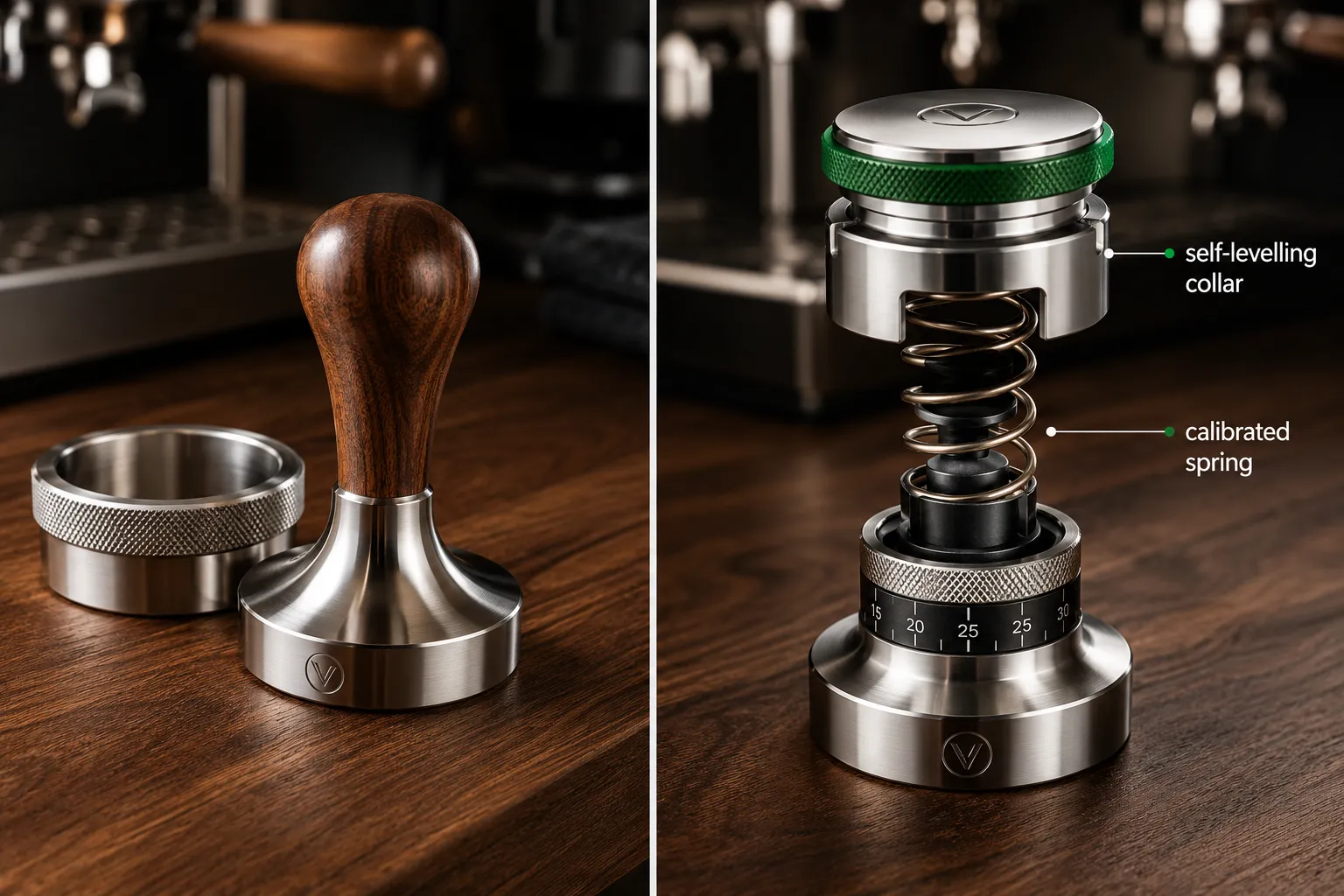
Flat tamper strengths
- Full feedback through your hand, so you can feel an uneven bed
- Nothing to wear out, nothing to recalibrate
- Lower price for a given build quality
- Works with any tamping style, including a light press plus a distribution tool
Spring loaded tamper strengths
- Same pressure on Monday and Saturday, which removes one variable while you chase grind size
- Self-levelling collar makes a tilted puck much harder to produce
- Interchangeable springs on the Normcore V4 (15, 25 and 30 lb) let you change the target later
- Forgiving for anyone who has not developed wrist control
Decision rule: buy spring-loaded if espresso is new to you, if more than one person in the house pulls shots, or if your shots vary wildly day to day. Buy flat if you already pull consistent shots, use a distribution tool, or run precision baskets where you want direct feel.
Do I need a spring tamper, or is a flat one better for beginners?
For most beginners, spring-loaded wins. Not because it produces better espresso in skilled hands, but because it removes two beginner errors at once: inconsistent pressure and a tilted puck. When your shot times swing from 18 to 40 seconds, you want fewer suspects.
The 2026 guides have quietly moved away from "30 lb is the correct pressure." Both Watchmarks and Café Grade frame the spring or click mechanism as a repeatability tool rather than a route to an optimal extraction force . Decent goes further and designs around roughly 15 lb, on the view that heavy compression is unnecessary once the bed is level and the grind is right .
So the honest summary: level beats pressure. Once the puck is flat and the basket is full, the exact poundage matters less than doing the same thing every time.
Who should skip the spring: anyone already using a leveller or distribution wedge before tamping. At that point the collar is redundant and a well-machined flat base feels better.
How do I know if my espresso tamper fits my portafilter?
Pull the basket out of the portafilter and measure the internal diameter at the top rim with calipers. The tamper base should sit just inside that measurement with a small, even clearance all the way around . Measuring the portafilter itself gives you a number that has nothing to do with your coffee.
A three-step check if you already own a tamper:
- Drop test. Place the dry tamper into the empty basket. It should descend under its own weight without grabbing the wall.
- Rock test. Press lightly and rock the handle. A correct tamper has almost no play; a small tamper swivels noticeably.
- Puck test. Tamp a real dose, then look at the puck edge under good light. A clean, compressed ring all the way around means the fit is right. A fuzzy collar of loose grounds means your tamper is undersized.
Edge case: some third-party baskets, especially IMS and VST, are slightly wider inside than the stock basket that came with your machine. If you upgrade the basket, re-check the tamper. VST's published spec of 58.40 mm with a tolerance near +0.00/−0.05 mm leaves little room for guessing .
Can I use the wrong size espresso tamper on my machine?
You can, and plenty of people do for months without realising it. A 58 mm tamper in a 58.5 mm basket still produces drinkable espresso. What you lose is consistency: the gap around the edge gives water a shortcut, so some shots run fast and taste sour while others behave.
Risks of going too small:
- Channeling at the puck edge, inconsistent shot times
- A sloped puck surface because a small base is easy to tilt
- Grounds pushed up the basket wall that then fall into the shot
Risks of going too big:
- The tamper binds and cannot seat flat
- Scratched or scored basket walls
- Suction on lift, which can crack the puck surface as you withdraw. Decent cites this as the reason it chose 58.35 mm over 58.5 mm
Verdict: oversized is a hard no. Undersized by 0.5 mm is survivable. Undersized by 2 mm or more, such as a 51 mm tamper in a Breville basket, will cap how good your espresso can get regardless of bean or grinder.
Which tamper size is most common: 51, 54 or 58 mm?
58 mm is the most widely used size overall because it is the commercial standard, carried across Gaggia, Rancilio, Lelit, Rocket, Profitec, ECM and La Marzocco. In US home kitchens, the 53.3 to 54 mm Breville class is the most common size by unit volume, simply because Breville sells enormous numbers of the Bambino and Barista Express. 51 mm is the smallest group and is effectively a De'Longhi standard .
If you are still choosing a machine, the size follows the machine. Readers weighing a first purchase usually land in the best espresso machine for beginners bracket, which maps almost entirely onto the 51 mm and 53.3 mm groups.
How much should I spend on a good espresso tamper?
Between $17 and $45 for almost everyone. Below $15 you get thin bases that flex and handles that loosen. Above $70 you are paying for finish, exotic handle materials and brand, not for better espresso.
Prices checked on Amazon, November 5, 2026:
Normcore V4 spring-loaded, 53.3 mm. 3,391 reviews, 2,000+ sold per month. Checked Nov 5, 2026.
Calibrated 51 mm tamper for De’Longhi Dedica and Stilosa. Checked Nov 5, 2026.
VST’s published flat tamper spec for its 15 to 25 g baskets, tolerance near +0.00/−0.05 mm .
Decent’s stated compression target, well below the traditional 30 lb advice .
Prices change. Check the current price before you buy.
Does a more expensive espresso tamper make a difference in taste?
Only up to a point. A $40 tamper with a precisely machined base and a self-levelling collar will beat a $9 plastic-handled tamper, because the cheap one is usually undersized and easy to tilt. Going from $40 to $120 buys you a walnut handle and a nicer finish, not a sweeter shot.
What actually changes the cup, in rough order: grind size and grinder quality, dose and brew ratio, freshness and roast date, water temperature, basket quality, then tamper fit. A tamper upgrade cannot rescue stale beans or a blade grinder.
Affiliate disclosure: Coffee Rank IQ earns a commission if you buy through some of our links. Prices and availability were checked on Amazon on November 5, 2026 and change often. This article is based on published manufacturer specifications and current product listings, not on hands-on laboratory testing.
Five features we look for in an espresso tamper
1. Stated base diameter to one decimal place. A listing that says "53.3 mm" knows what it is doing. A listing that says "54 mm fits Breville" often does not. Payoff: you avoid the 1 mm gap entirely.
2. Self-levelling collar. The collar rests on the basket rim and keeps the base square while you press. Payoff: level tamping without practice, which is the single biggest beginner win.
3. Interchangeable springs. The Normcore V4 ships in the 51 to 58.5 mm size range with 15, 25 and 30 lb spring options . Payoff: you can lower the force later without rebuying.
4. Stainless base with a flat, not convex, face. Flat bases suit most home baskets and precision baskets alike. Payoff: an even puck surface and predictable resistance.
5. A handle that actually fits your palm. Short handles suit a straight-down push; taller handles suit a two-hand grip. Payoff: less wrist strain over a few hundred shots.
What to watch out for
- "54 mm" labelling. Treat it as a category name. Buy 53.3 to 53.5 mm for Breville and Sage .
- Spring tampers that creak or stick once coffee oils reach the collar. Wipe the collar dry weekly.
- Convex bases sold as an upgrade. They suit certain commercial baskets and can leave a domed puck in a shallow home basket.
- Weight marketing. A heavy tamper is not a more accurate tamper. Mass is not pressure.
- Basket swaps. Changing to IMS or VST can change your required diameter .
- Recalls. Café Grade's October 2026 check of the US Consumer Product Safety Commission recall database found no recall on the tampers it reviewed . Useful context, not a safety guarantee for every brand.
How do you properly tamp espresso without messing it up?
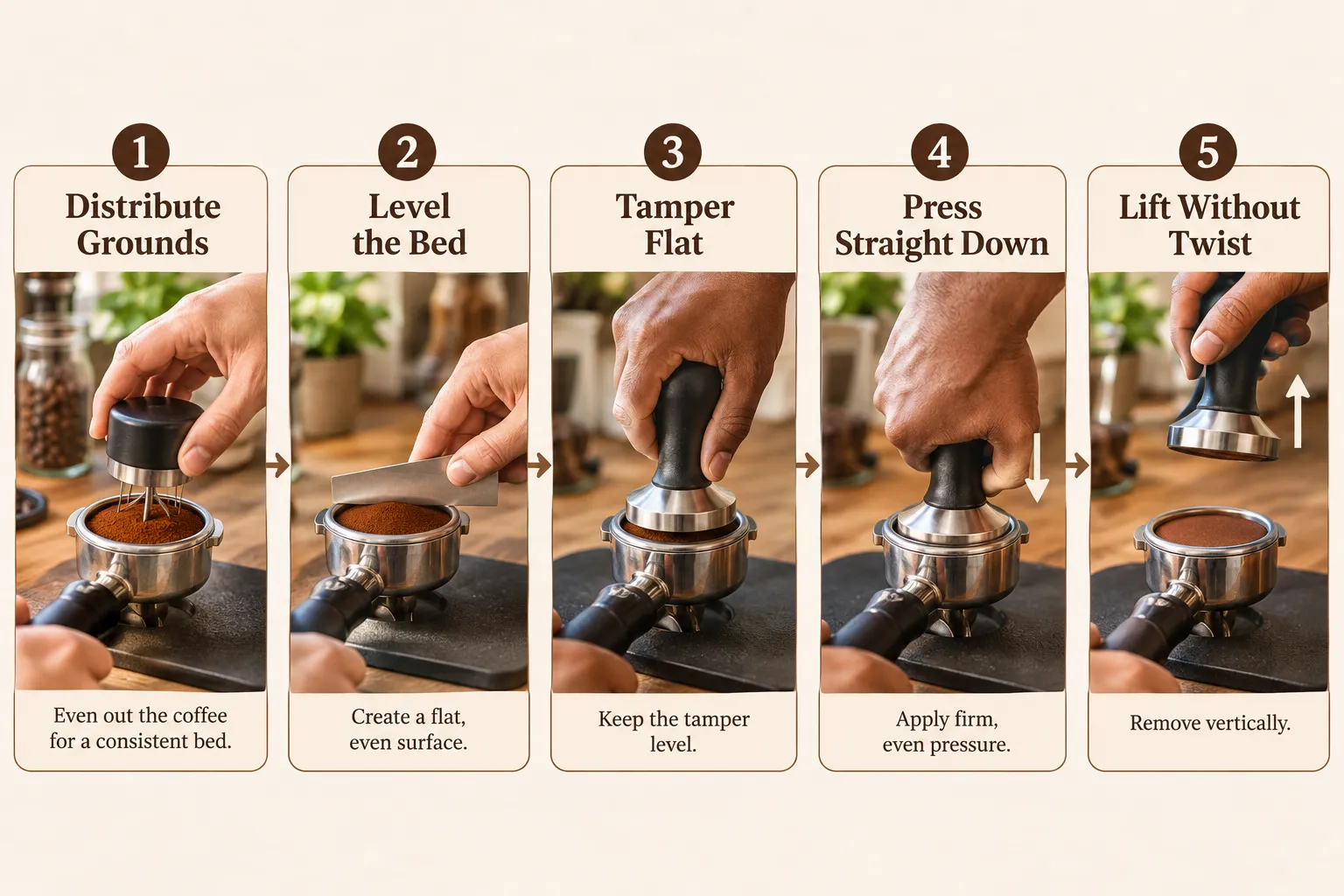
Level first, then press straight down, then lift without twisting. Five steps:
- Dose into a dry basket. Wet baskets make grounds cling to the wall.
- Distribute. Tap the portafilter or use a distribution tool to break up clumps and flatten the bed before the tamper touches it.
- Set the tamper flat. Rest the base on the coffee, check it is square to the rim, and keep your elbow above your wrist.
- Press down once. Firm and steady. With a spring loaded tamper, press until it clicks or bottoms out, then stop.
- Lift straight up. No twist, no polish. The old "polish the puck" habit adds nothing and can smear the surface.
Troubleshooting
| Symptom | Likely cause | Fix |
|---|---|---|
| Shot gushes in under 15 seconds | Grind too coarse, or edge channel from an undersized tamper | Grind finer; check tamper fit |
| Shot chokes past 40 seconds | Grind too fine or dose too high | Coarsen one step, reduce dose 0.5 g |
| One side of the puck is wet after the shot | Tilted tamp | Use a levelling collar or watch your wrist angle |
| Shot times vary day to day | Inconsistent pressure | Spring-loaded tamper, or a distribution tool |
| Puck cracks as you lift the tamper | Suction from a very tight fit | Try a 58.35 mm base instead of 58.5 mm |
More diagnosis lives in our espresso troubleshooting guide.
What can I use if I don't have an espresso tamper?
Short term, a flat-bottomed object of roughly the right diameter will do: the base of a sturdy drinking glass, a small jar lid, a wooden muddler, or the dosing tool that shipped with your machine. Press straight down on a flat surface and keep it level.
Each has a cost. The plastic tamper included with most entry machines is usually 2 to 3 mm undersized and hollow, so it flexes. A glass base can chip. Nothing improvises the clearance problem away.
If you are grinding fresh and using a single-wall basket, a correctly sized espresso tamper at $17 to $42 is the cheapest meaningful upgrade in the whole setup. If you are using capsules or a pressurized basket, you can wait.
How often do you need to replace an espresso tamper?
A solid stainless flat tamper should outlast your machine. There is nothing to wear out beyond a handle that can loosen, and most handles can be re-tightened. Replace it if the base is visibly scored, if the handle separates, or if you change machines and the size no longer matches.
Spring loaded models have one moving part, so treat them as a longer-term consumable. Signs the spring needs attention: the click becomes inconsistent, the collar binds, or the base no longer returns smoothly. Clean coffee oils from the collar and the spring stays usable for years. Models with user-replaceable springs, like the Normcore V4, let you swap the spring instead of the tamper .
Espresso tamper size selector
Which tamper size fits your machine?
Who should buy which espresso tamper
Breville Bambino or Barista Express owner, new to espresso: the Normcore V4 at 53.3 mm, $42 on Amazon as of November 5, 2026, with 3,391 reviews. The self-levelling collar and swappable springs address the two mistakes new users make most. If you own a Barista Express, pair it with the Barista Express setup guide.
De'Longhi Dedica owner on a budget: a calibrated 51 mm tamper at $16.99. Cheap, correctly sized, and a clear improvement on the hollow plastic piece in the box.
Gaggia Classic Pro owner: a 58.5 mm flat tamper, or 58.4 mm if you run VST baskets. Our Gaggia Classic Pro starter guide covers the rest of the workflow.
Experienced home barista with a distribution tool: a flat stainless tamper in the exact basket size. Skip the spring.
Who should skip a tamper upgrade entirely: anyone using a pressurized basket, a capsule machine, or a blade grinder. Fix the grinder first.
Pros and cons
Spring loaded tamper
- Pros: repeatable pressure, level base, forgiving, spring options on better models
- Cons: more expensive, one moving part, collar needs cleaning, redundant if you already level
Flat tamper
- Pros: cheaper at the same build quality, direct feel, nothing to maintain, preferred for precision baskets
- Cons: tilting is easy at first, pressure varies until you build the habit
FAQ

Conclusion
Get the diameter right, keep the puck level, and stop worrying about poundage. For a Breville, that means a 53.3 mm base. For a Dedica, 51 mm. For a Gaggia or any 58 mm group, 58.4 to 58.5 mm, with 58.35 mm a reasonable choice if your pucks crack on lift . Spring-loaded is the better first espresso tamper for most beginners because it removes two variables at once; flat is the better long-term tool once your technique is steady.
Next step: pull your basket out, measure the inside rim with calipers, and buy to that number rather than the number printed on your machine. Then compare the models in your size and check the current price before ordering. Better Coffee Starts With Better Answers.