Best Manual Espresso Machine: Flair, Cafelat, and Lever Picks
Quick answer: The best manual espresso machine for most home brewers who want café-level shots without a pump is the Flair 58, which pairs a stainless steel brew chamber with a pressure gauge and a familiar 58mm portafilter. If you want the cheapest true manual lever that still makes good espresso, the Flair Classic earns that spot. Buyers who want a cult-favorite, zero-electronics machine with exceptional build quality should look at the Cafelat Robot, and travelers should pack a Flair Neo Flex or a Wacaco Picopresso. A pump machine like the De'Longhi Stilosa, priced around $150 as of August 2026, remains the easier baseline if hand-pulled shots sound like more work than you want.
Key takeaways
- A manual espresso machine uses hand or arm force, not an electric pump, to build the 6 to 9 bars of pressure that push hot water through packed grounds.
- The Flair lineup and the Cafelat Robot are the two names that keep showing up across 2026 buying guides as the best manual espresso machine picks for enthusiasts.
- The Flair Neo Flex is a strong beginner lever, but reviewers note it has a narrow margin for error and rewards careful technique over convenience.
- The Cafelat Robot has no electronics at all, uses a 58mm basket, and gets praised for shot quality that BrewBench says can embarrass pricier pump machines.
- A good manual espresso maker will not save you money if you skip a decent burr grinder. Grind size does more to change your shot than the lever itself.
- Prices for real manual lever machines run from about $130 for a portable hand espresso maker to $800 or more for a premium Flair Pro model.
- Manual machines have a real learning curve. Expect several inconsistent shots before your technique and grind settings line up.
Best manual espresso machine
The best manual espresso machine depends on your budget, your counter space, and how much you enjoy fiddling with a lever to get the shot right. There is no single winner for every buyer. There is a clear winner for each type of buyer, and that is a more useful way to shop.
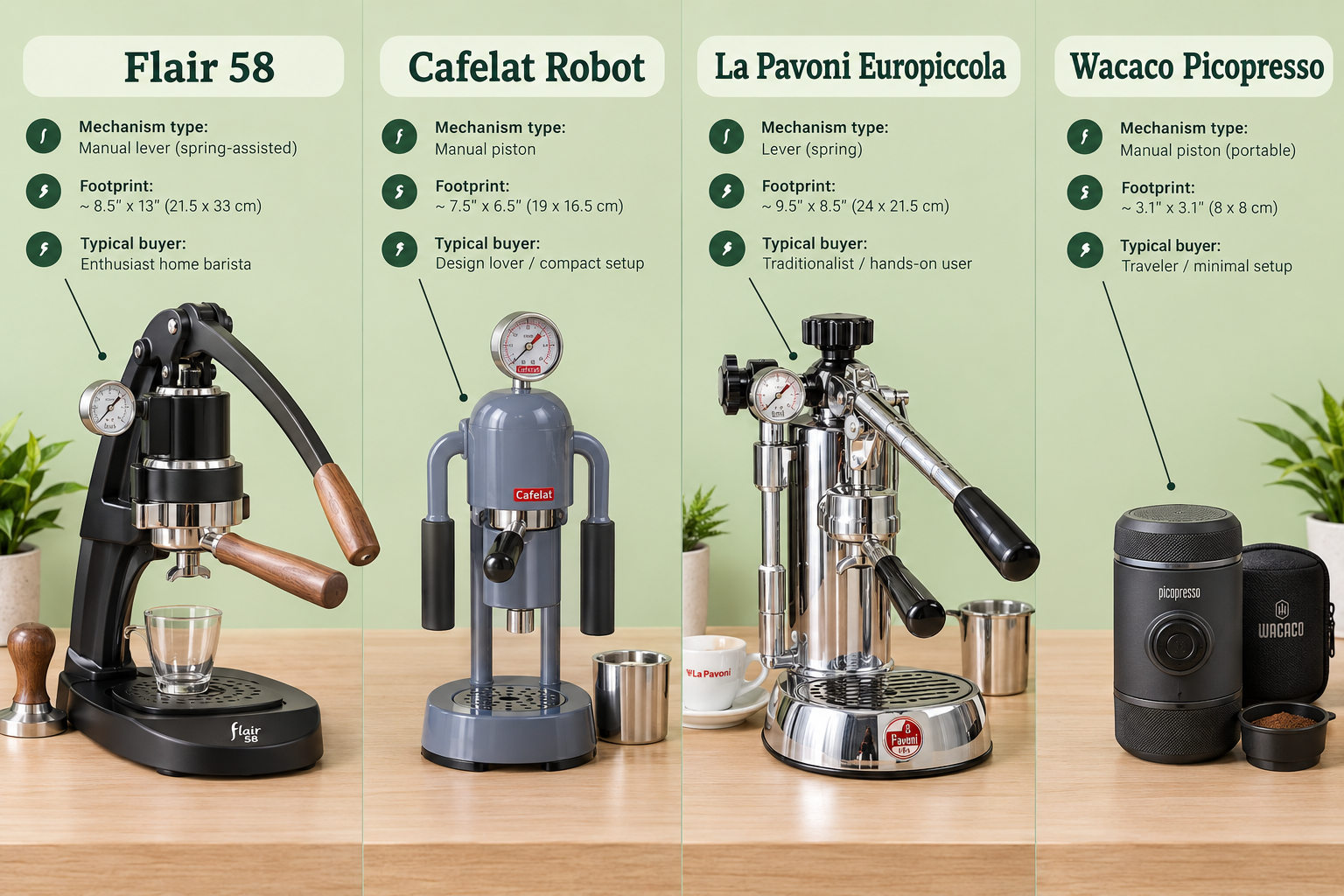
Here is how I would sort readers into buyer types, based on the machines that keep earning top marks in 2026 coverage from CNN Underscored, DripRoast, and BrewBench.
- The curious first-timer: Flair Classic. It comes with a built-in pressure gauge that turns guesswork into feedback, which is why reviewers call it a teachable machine rather than just a gadget.
- The buyer who wants café consistency at home: Flair 58. Stainless steel brew chamber, standard 58mm portafilter, and enough thermal stability to repeat a good shot instead of chasing one.
- The enthusiast who already understands extraction: Flair Pro 3. This is the version built for someone who wants advanced pressure monitoring and does not need training wheels.
- The traditionalist who wants mechanical simplicity: Cafelat Robot. No springs, no electronics, just a piston you press by hand, and a reputation for surprising shot quality from a small, quiet device.
- The traveler: Flair Neo Flex or Wacaco Picopresso. Both pack down small and do not need a wall outlet.
- The vintage design lover: La Pavoni Europiccola. A spring-piston lever machine with a design lineage that dates back decades, still sold new and still fully manual.
- The budget shopper who still wants a real lever: ROK EspressoGC. A non-electric piston machine that costs less than most Flair models while staying in the manual lever category.
If any of those descriptions sound like you, jump to the comparison table below and then read the section on that specific machine further down the page. For a broader look at pump machines too, our buyers guide to choosing the best espresso machine for crafting drinks covers the electric side of the decision.
Manual espresso machine comparison table
| Model | Mechanism | Price range (typical) | Best for | Learning curve |
|---|---|---|---|---|
| Flair Classic | Hand lever, no gauge on base model | $150 to $220 | First-time buyers who want to learn | Moderate |
| Flair 58 | Hand lever, pressure gauge, 58mm basket | $500 to $650 | Buyers who want café repeatability | Moderate |
| Flair Pro 3 | Hand lever, advanced gauge, stainless chamber | $750 to $900 | Enthusiasts who already dial in shots | Higher, but rewarding |
| Cafelat Robot | Piston press, zero electronics, 58mm basket | $180 to $220 | Traditionalists, cult-favorite build quality | Moderate to fiddly |
| La Pavoni Europiccola | Spring-piston lever | $400 to $550 | Vintage design lovers | Higher |
| Wacaco Picopresso | Hand pump, portable | $100 to $140 | Travel and desk setups | Low to moderate |
| ROK EspressoGC | Dual-arm piston lever | $170 to $250 | Budget lever buyers | Moderate |
Prices move around by retailer and season, so check the current price before you decide. None of these numbers include a grinder, and every one of these machines needs one.
What is a manual espresso machine and how does it work
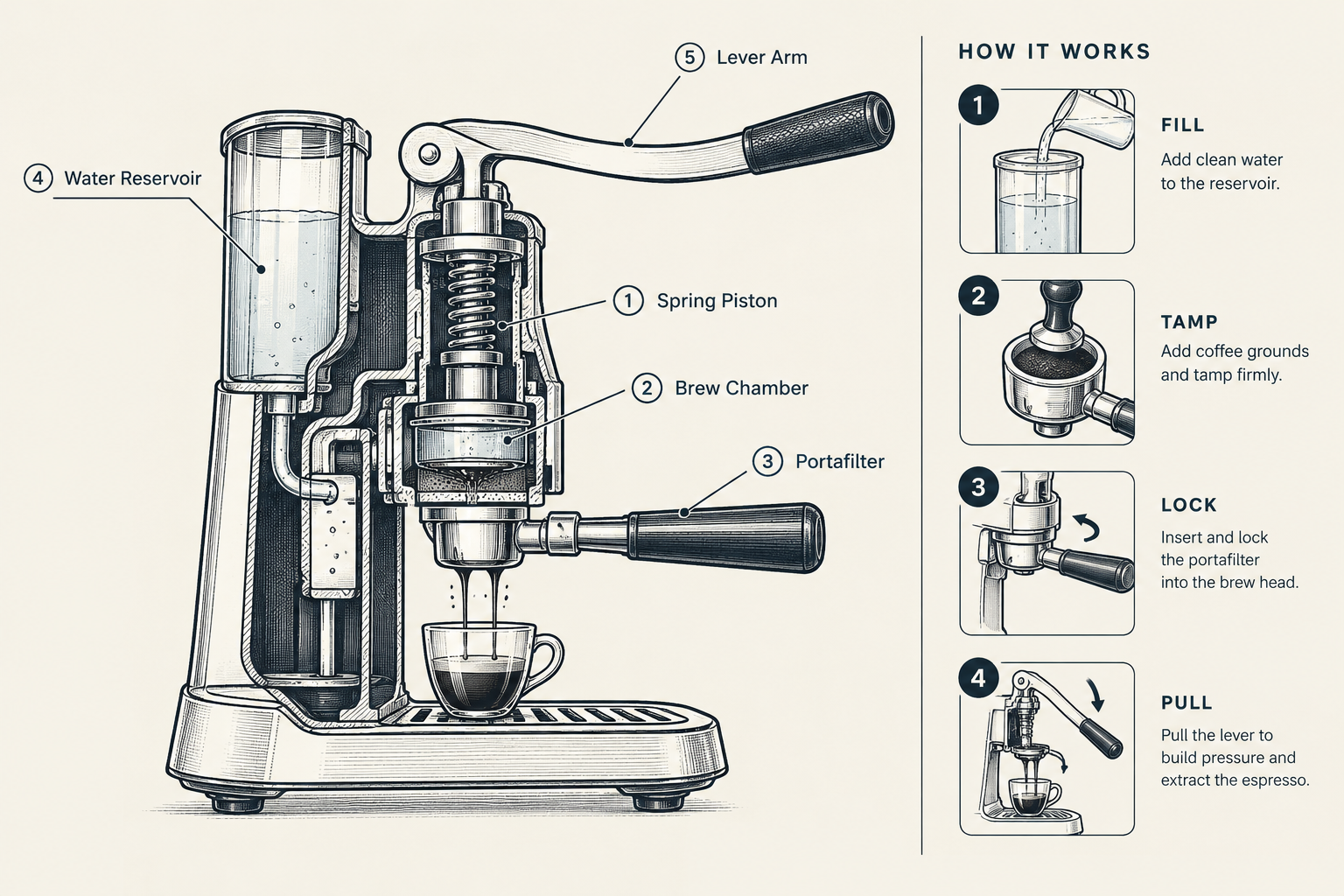
A manual espresso machine is a device that builds brewing pressure through human effort instead of an electric pump. You pull a lever, push a piston, or pump a hand mechanism, and that motion forces hot water through finely ground coffee at roughly 6 to 9 bars of pressure.
Wirecutter's testing team explains the split plainly: pump-driven machines automate the pressure step, while manual machines put that step in your hands, which demands more skill but gives you direct feedback on every pull.
That feedback is the whole appeal of a manual lever espresso machine. You feel resistance change as the puck compresses. You watch the flow rate respond to how hard you press. A pump machine hides all of that behind a switch.
Most manual designs fall into three mechanical families:
- Spring-piston levers (La Pavoni Europiccola) use a spring to store force, then release it through the group head.
- Direct hand levers (Flair Classic, Flair 58, Flair Pro 3) rely entirely on your arm, with no spring assist, which is why the Flair line puts a pressure gauge front and center.
- Piston press machines (Cafelat Robot, ROK EspressoGC) use a plunger you push straight down, closer to a giant syringe than a lever arm.
Choose a spring-piston model if you like the vintage feel and do not mind a steeper learning curve. Choose a direct lever if you want visible pressure feedback while you learn.
Manual espresso machine vs automatic espresso machine
A manual espresso machine trades convenience for control and cost. An automatic or semi-automatic pump machine trades some of that control for repeatability you get on day one, without practice.
Mainstream 2026 buying guides from Tom's Guide, the Guardian, and Business Insider still focus mostly on pump machines with built-in grinders, because those machines forgive small mistakes in dose and tamp. A manual lever espresso machine does not forgive those mistakes the same way. Grind size, dose, and tamp pressure all show up directly in your cup.
Here is the practical difference:
| Factor | Manual lever machine | Automatic pump machine |
|---|---|---|
| Pressure source | Your hand or arm | Electric pump |
| Learning curve | Real, several weeks | Shorter, often days |
| Price for entry model | $150 to $250 | $150 to $400 |
| Portability | Often yes | Rarely |
| Consistency once learned | High | High from day one |
| Repair complexity | Simple, few parts | More electronics to fail |
Choose manual if you already enjoy hands-on brewing methods like a moka pot or pour over and want that same ritual applied to espresso. Choose automatic if you want a repeatable morning shot without dialing in technique first. If you want to see how espresso compares to full pump setups across price points, our top 10 advanced espresso machines roundup covers that ground.
The best manual espresso machines to buy in 2026
The best manual espresso machines heading into 2026 are still the same core names that have dominated the category for several years: Flair Classic, Flair 58, Flair Pro 3, Cafelat Robot, and a smaller group of piston and spring-lever machines like the ROK EspressoGC and La Pavoni Europiccola.
DripRoast's 2026 roundup and CNN Underscored's manual-espresso guide both keep returning to the same short list of proven machines rather than surfacing brand-new platforms. That matters for buyers because it means the category has settled into a period of small refinements, better gauges, sturdier brew chambers, tidier accessories, instead of yearly redesigns.
A few specific notes worth knowing before you shop:
- Flair Neo Flex remains one of the most talked-about entry points. CoffeeGeek's hands-on review calls it capable of "great espresso and a unique, hands-on brewing experience," while flagging cheaper materials and a narrow margin for error that punishes sloppy technique.
- CNN Underscored found the Neo Flex needs real experimentation with grind and dose before it produces its best shots, which makes it a better fit for a hobbyist than someone who just wants a fast morning routine.
- Cafelat Robot keeps its cult reputation. BrewBench rates it 4.6 out of 5 and credits its 58mm basket and zero-electronics design for shots that compete with pump machines costing twice as much.
If you are shopping for the best manual espresso maker specifically for learning technique, start with the Flair Classic and its gauge. If you already know your grind and want the best manual espresso machine for daily use, the Flair 58 or the Cafelat Robot both earn their price.
Flair espresso maker vs Cafelat Robot
The Flair espresso maker line and the Cafelat Robot solve the same problem in different ways, and picking between them comes down to how much you want a lever telling you what pressure you are applying.
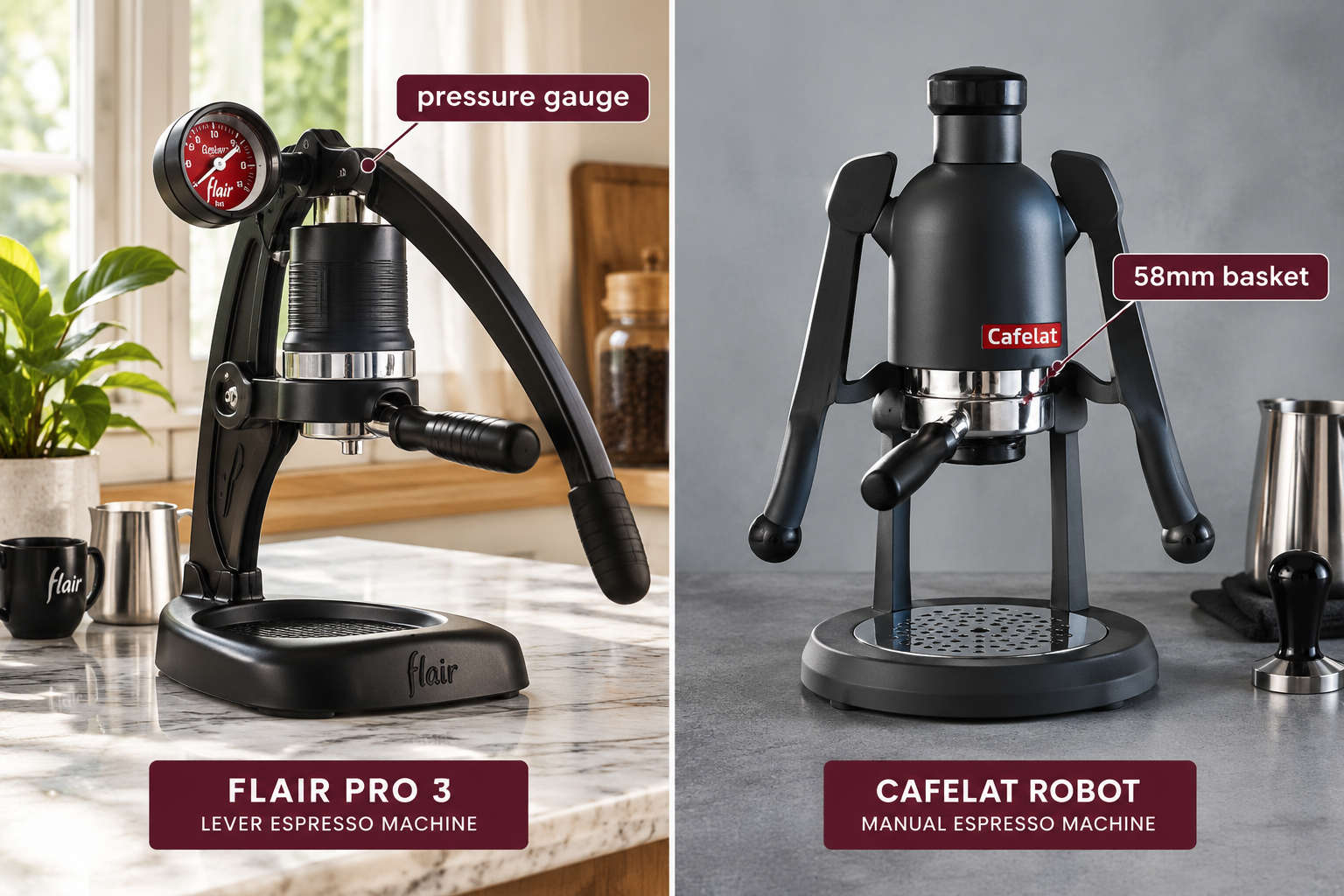
A Flair espresso maker gives you a lever arm and, on the 58 and Pro 3 models, a pressure gauge you watch while you pull. The Cafelat Robot gives you a piston you press straight down with no gauge at all, relying on feel instead of a dial.
CNN Underscored's manual-espresso roundup tested both mechanisms directly and found the Robot's brew-pot-and-portafilter combination more fiddly to operate than a simpler lever, since you have to fill it with hot water and clamp it carefully under the piston before every shot. That extra step does not clearly buy you better espresso than a well-tuned Flair, which is worth knowing before you pay for the Robot's reputation alone.
Here is a quick way to decide:
- Pick the Flair espresso maker if you want a visible gauge while you learn, plan to upgrade parts over time, or want the widest accessory ecosystem.
- Pick the Cafelat Robot if you want the smallest possible footprint, zero moving springs to maintain, and you do not mind a slightly more careful setup ritual each time.
Both machines need the same grind range as a pump espresso machine, somewhere in the fine range you would use for what is the best grind of coffee for an espresso machine. For step-by-step technique on the Flair specifically, our complete guide to using a Flair espresso maker walks through dosing, preheating, and the pull itself.
How much does a good manual espresso machine cost
A good manual espresso machine costs anywhere from about $130 for a portable hand espresso maker to roughly $900 for a premium lever with a stainless brew chamber and an advanced pressure gauge. Most buyers land in the $150 to $600 range.
For context, a basic electric pump machine like the De'Longhi Stilosa runs around $150 as of August 2026, according to Business Insider's home espresso guide. That price sets a useful baseline: manual levers below that price, like the ROK EspressoGC or a base Flair Classic, are genuine budget options. Manual levers well above that price, like the Flair 58 or Pro 3, are positioned as enthusiast upgrades rather than budget picks.
Rough price bands:
- Under $150: Wacaco Picopresso, entry-level Flair Classic bundles
- $150 to $300: Cafelat Robot, ROK EspressoGC, mid-tier Flair Classic sets
- $400 to $650: La Pavoni Europiccola, Flair 58
- $700 and up: Flair Pro 3 and comparable premium levers
Keep in mind that none of these prices include a grinder, and a cheap grinder will hold back an expensive lever faster than anything else in your setup. Check the current price on any model before buying, since retailers rotate bundles and accessory kits often.
Can you make espresso without an espresso machine
Yes, you can approximate an espresso-style shot without any dedicated machine, though the result will not have the same pressure or crema as a real manual espresso machine or pump machine. A moka pot gets closest, and a few manual gadgets exist specifically to bridge the gap.
A moka pot uses steam pressure, roughly 1 to 1.5 bars, far below the 6 to 9 bars a real espresso machine produces. The coffee is strong and concentrated, but it lacks the thick crema that comes from true espresso-level pressure. If you want to try that method, our guide on the best ways to use a stovetop espresso maker for beginners covers the full process.
There are also manual hand-pump devices, like the Wacaco Picopresso, built to get closer to real espresso pressure without electricity, using a hand pump instead of a lever. If you are curious whether household methods can substitute for a machine entirely, we cover that question directly in can you make espresso with regular coffee without a machine.
Choose a moka pot if you want strong coffee with minimal gear. Choose a real manual espresso maker if you specifically want crema and true espresso texture.
Manual espresso machine for beginners
The best manual espresso machine for beginners is one with a pressure gauge, because a gauge turns a guessing game into a skill you can actually track. The Flair Classic remains the clearest starting point for that reason.
Coffeedant's testing highlights the same idea: a built-in pressure gauge removes a huge amount of guesswork when you are learning to pull a shot, since you can watch pressure build in real time instead of relying on feel alone. That kind of visible feedback matters more for a first machine than raw shot quality, because it teaches you what a good pull actually looks like before you chase small improvements.
A few beginner-friendly habits worth building from day one:
- Weigh your dose every time. Guessing by scoop is the fastest way to inconsistent shots.
- Start with a grind on the fine end and adjust in small steps.
- Preheat the brew chamber with hot water before adding grounds. A cold chamber pulls heat out of your shot fast.
- Expect your first ten shots to be rough. That is normal, not a sign the machine is broken.
If you are choosing your first setup entirely, our advanced espresso machine buying guide is written for pump machines but the sizing and workflow questions still apply.
Why is my manual espresso machine not making crema
Weak or missing crema on a manual espresso machine almost always traces back to one of three things: grind that is too coarse, a dose that is too low, or water that is not hot enough when it hits the puck.
Crema forms from CO2 and oils in freshly roasted coffee getting emulsified under pressure. If your grind is too coarse, water moves through the puck too fast and never builds enough pressure to produce that emulsion. If your roast date is old, much of the CO2 that creates crema has already escaped the beans.
Quick troubleshooting order:
- Check your roast date. Coffee more than a few weeks past roasting will struggle to produce thick crema no matter what machine you use.
- Grind finer, in small increments, and watch how flow time changes.
- Confirm your dose matches your basket size. An underfilled basket almost never builds proper pressure.
- Preheat the brew chamber. A cold chamber drops water temperature exactly when you need it hottest.
For a deeper look at the mechanics behind crema and extraction, our piece on the science behind the perfect espresso shot and creamy drink breaks down what is actually happening chemically during that pull.
Manual espresso machine vs moka pot
A manual espresso machine and a moka pot both live on the stovetop-adjacent, hands-on side of coffee brewing, but they are not interchangeable. A manual lever builds true espresso pressure, while a moka pot relies on gentler steam pressure and produces a different drink entirely.
The practical differences:
| Factor | Manual lever espresso machine | Moka pot |
|---|---|---|
| Pressure | 6 to 9 bars | 1 to 1.5 bars |
| Crema | Yes, when dialed in | Minimal to none |
| Grind needed | Fine, espresso-specific | Medium-fine |
| Heat source | None needed (Flair, Robot) or a kettle | Stovetop or hot plate |
| Learning curve | Real, but rewarding | Shorter |
Choose a moka pot if you want strong coffee with almost no learning curve and don't mind skipping crema. Choose a manual espresso maker if crema, texture, and milk-drink compatibility matter to you. If you already own a moka pot and want to get more out of it, the best ways to use a moka pot for beginners is worth a read before you buy anything new.
Best manual espresso machine for travel
The best manual espresso machine for travel is one that breaks down small and does not need electricity. The Flair Neo Flex and the Wacaco Picopresso are the two most common picks for that job.
The Flair Neo Flex packs into a compact case and still uses the same lever mechanism as its larger siblings, which means the shots taste closer to your home setup than most travel gadgets manage. The tradeoff, per CoffeeGeek's hands-on review, is a narrower margin for error and materials that feel less substantial than the full-size Flair 58.
The Wacaco Picopresso goes even smaller. It skips the lever entirely for a hand pump, trading some shot consistency for a genuinely pocketable size.
Pick the Flair Neo Flex if you want the closest match to home espresso quality while traveling. Pick the Picopresso if size and weight matter more than matching your home shot exactly. For a wider view of portable brewing gear, our guide to portable espresso machines for camping trips covers a few more options built for outdoor use.
Do I need a grinder for manual espresso
Yes. A manual espresso machine needs a burr grinder capable of a fine, consistent espresso grind, and skipping this step is the single most common reason a new lever owner gets disappointing shots.
Pre-ground coffee, even coffee labeled "espresso grind," goes stale fast and rarely matches the exact fineness a specific machine needs. A burr grinder lets you adjust in small steps until your flow rate and shot time line up with what your manual lever machine actually needs.
Wirecutter's beginner guide groups the grinder and the machine together as one purchase decision rather than two separate ones, because the wrong grind setting will make even a premium Flair Pro 3 produce a weak or bitter shot. If you already know your grinder but want to confirm your settings, read what is the best grind of coffee for an espresso machine before your next pull.
Common mistake: buying a $700 lever machine and pairing it with a $30 blade grinder. The blade grinder produces uneven particle sizes that no amount of lever pressure can fix.
Manual espresso machine learning curve
Expect a real learning curve with any manual espresso machine, usually a few weeks of inconsistent shots before your grind, dose, and pull technique settle into a repeatable routine.
The Guardian and Tom's Guide both frame manual levers as specialist tools precisely because of this curve, contrasting them with integrated-grinder pump machines that give acceptable results almost immediately. That framing is fair. A manual lever espresso machine rewards patience more than any pump machine will.
What actually shortens the curve:
- A gauge-equipped machine (Flair 58, Flair Pro 3, Flair Classic with gauge upgrade) so you can see pressure instead of guessing at it.
- A scale for dosing, every single time, no exceptions.
- Keeping a simple log of grind setting, dose, and shot time for your first twenty pulls.
- Sticking with one bag of beans while you dial in technique, so the coffee itself is not a variable.
Edge case: if you already pull consistent shots on a pump machine, expect the curve to be shorter but not zero. Pressure feedback from your own arm is a different skill than watching a machine do it for you.
Cheapest manual espresso machine that works well
The cheapest manual espresso machine that still produces genuinely good shots is the base Flair Classic, typically listed in the $150 to $220 range depending on the accessory bundle, with the ROK EspressoGC as a close alternative in a similar price band.
Both machines skip the premium materials and advanced gauges of the higher Flair models, but the fundamentals, a real lever or piston producing true espresso pressure, are intact. DripRoast's 2026 coverage makes a point of separating budget lever picks from premium ones rather than assuming price always tracks quality.
Choose the Flair Classic if you want the largest accessory ecosystem and the most published technique guides to learn from. Choose the ROK EspressoGC if you prefer a dual-arm piston motion over a single lever and want to skip the gauge entirely. Skip both, and consider a $150 pump machine instead, if a learning curve sounds more like a chore than a hobby.
Manual espresso machine maintenance and cleaning
A manual espresso machine needs less mechanical upkeep than a pump machine, since there is no pump or boiler to descale, but it still needs regular cleaning of the brew chamber, portafilter, and any rubber seals.
The main enemies are dried coffee oil buildup and worn gaskets. Oil buildup turns bitter over time and can throw off your pressure readings. A worn seal, whether on a Flair piston or a Cafelat Robot's plunger, will leak water and pressure exactly when you need both.
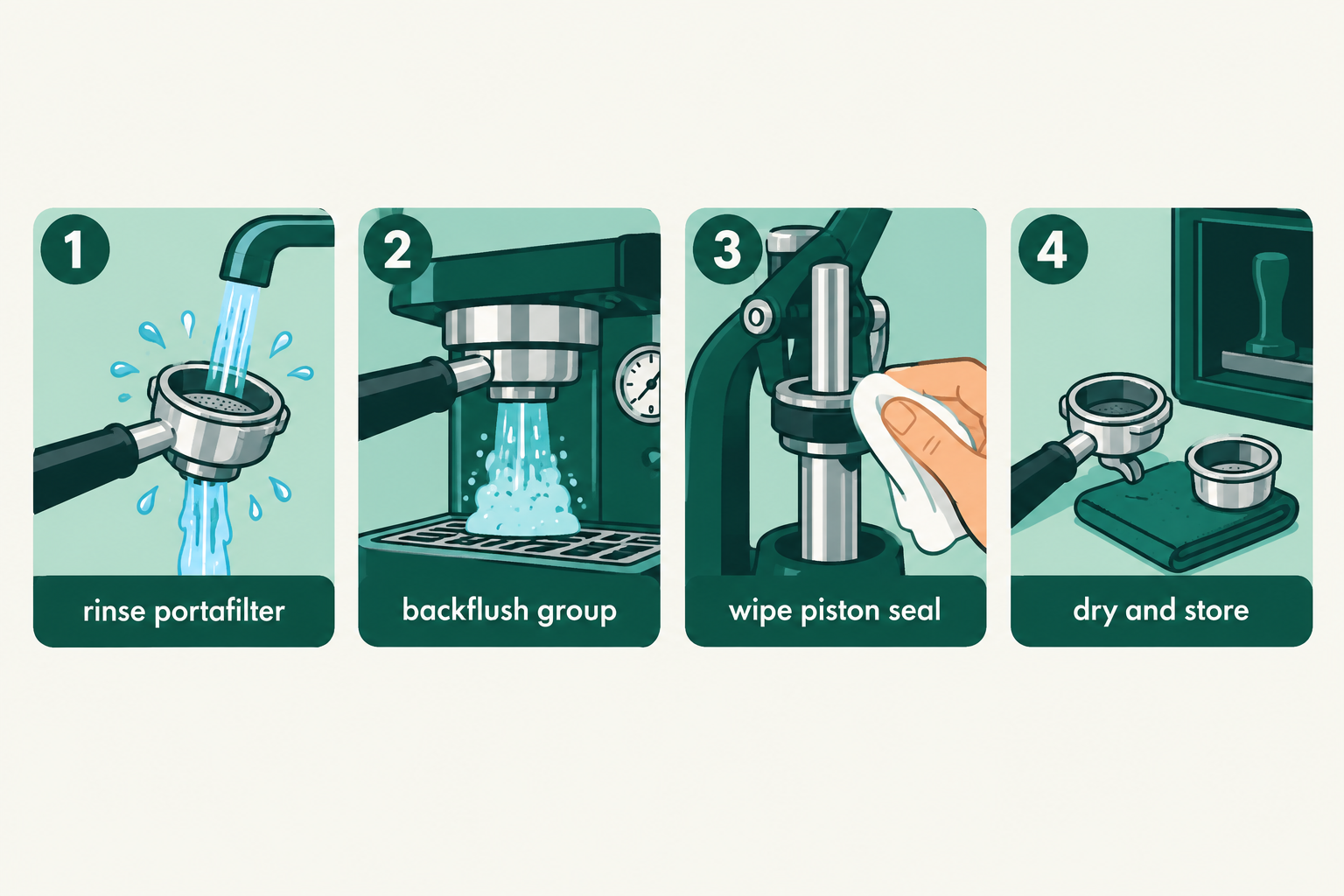
A simple routine that covers most manual machines:
- Rinse the portafilter and basket after every shot. Do not let grounds dry inside overnight.
- Wipe the piston or lever seal with a damp cloth weekly. Dry coffee oil hardens fast on rubber.
- Deep clean the brew chamber with hot water and a brush every one to two weeks, more often with daily use.
- Check gaskets every few months and replace them once you notice water seeping past a seal that used to hold tight.
For a broader routine that applies across espresso equipment, including grinders and steam wands, see our advanced espresso machine maintenance tips.
FAQ
Is a manual espresso machine better than an automatic one? Neither is universally better. A manual espresso machine gives you more control and usually costs less at entry level, but demands practice. An automatic pump machine gives faster consistency out of the box.
What is the best manual espresso machine for a small kitchen? The Cafelat Robot and the Flair Neo Flex both have small footprints and no water tank to find room for, which makes them the easiest fits for tight counters.
Do manual espresso machines need electricity? No. Every machine covered here, the Flair line, the Cafelat Robot, the La Pavoni Europiccola, the ROK EspressoGC, and the Wacaco Picopresso, runs entirely on human effort with hot water you heat separately.
Can a manual espresso machine froth milk? Not on its own. None of these machines include a steam wand, so you will need a separate handheld frother or a milk pitcher and whisk. Our guide to the best ways to froth milk for your espresso drinks covers the options.
Is the Flair 58 worth the price jump over the Flair Classic? If you already know you enjoy pulling manual shots and want a standard 58mm portafilter along with a stainless brew chamber for better temperature stability, yes. If you are still deciding whether manual brewing suits you, start with the Classic first.
How long does it take to learn a manual espresso machine? Most people need two to four weeks of regular use before shots become consistent, based on the pattern reviewers describe across Flair and Cafelat Robot testing.
Conclusion
The best manual espresso machine is not one machine. It is the right lever for your specific patience level, counter space, and budget. Start with the Flair Classic if you want to learn the craft with a gauge to guide you. Move up to the Flair 58 or Pro 3 once you know you enjoy the process and want café-level repeatability. Grab a Cafelat Robot if mechanical simplicity and a small footprint matter more to you than a pressure dial. And if you travel, pack the Neo Flex or the Picopresso instead of leaving good coffee behind.
Whatever you choose, pair it with a real burr grinder and a fresh bag of beans. That combination will change your shots more than any single machine upgrade. Compare the models above against your own kitchen and your own patience for a learning curve, then check the current price before you buy.
Keep Exploring Coffee Rank IQ
- Coffee Rank IQ home: reviews, brewing guides, and coffee science
- Best Espresso Machine for Beginners: 7 Picks That Forgive Mistakes
- Best Super Automatic Espresso Machine: Read the Cleaning Specs First
- Best Semi Automatic Espresso Machine for Real Home Kitchens
- Best Espresso Machine Under 500: Where the Money Actually Goes
References
- www.cnn.com/cnn-underscored/reviews/best-manual-espresso-maker
- www.businessinsider.com/guides/kitchen/best-espresso-machines-reviewed
- www.driproast.com/best-manual-espresso-machine
- www.nytimes.com/wirecutter/reviews/best-espresso-machine-grinder-and-accessories-for-beginners
- www.brewbenchgear.com/espresso-machines/cafelat-robot
- www.tomsguide.com/home/coffee-makers/best-coffee-makers
- www.expertreviews.co.uk/home-garden/small-appliances/coffee-machines/best-coffee-machine
- coffeegeek.com/reviews/snapshot/flair-neo-flex-entry-level-espresso-snapshot-review
- www.theguardian.com/thefilter/2024/nov/21/best-coffee-machines
- edition.cnn.com/cnn-underscored/reviews/best-manual-espresso-maker