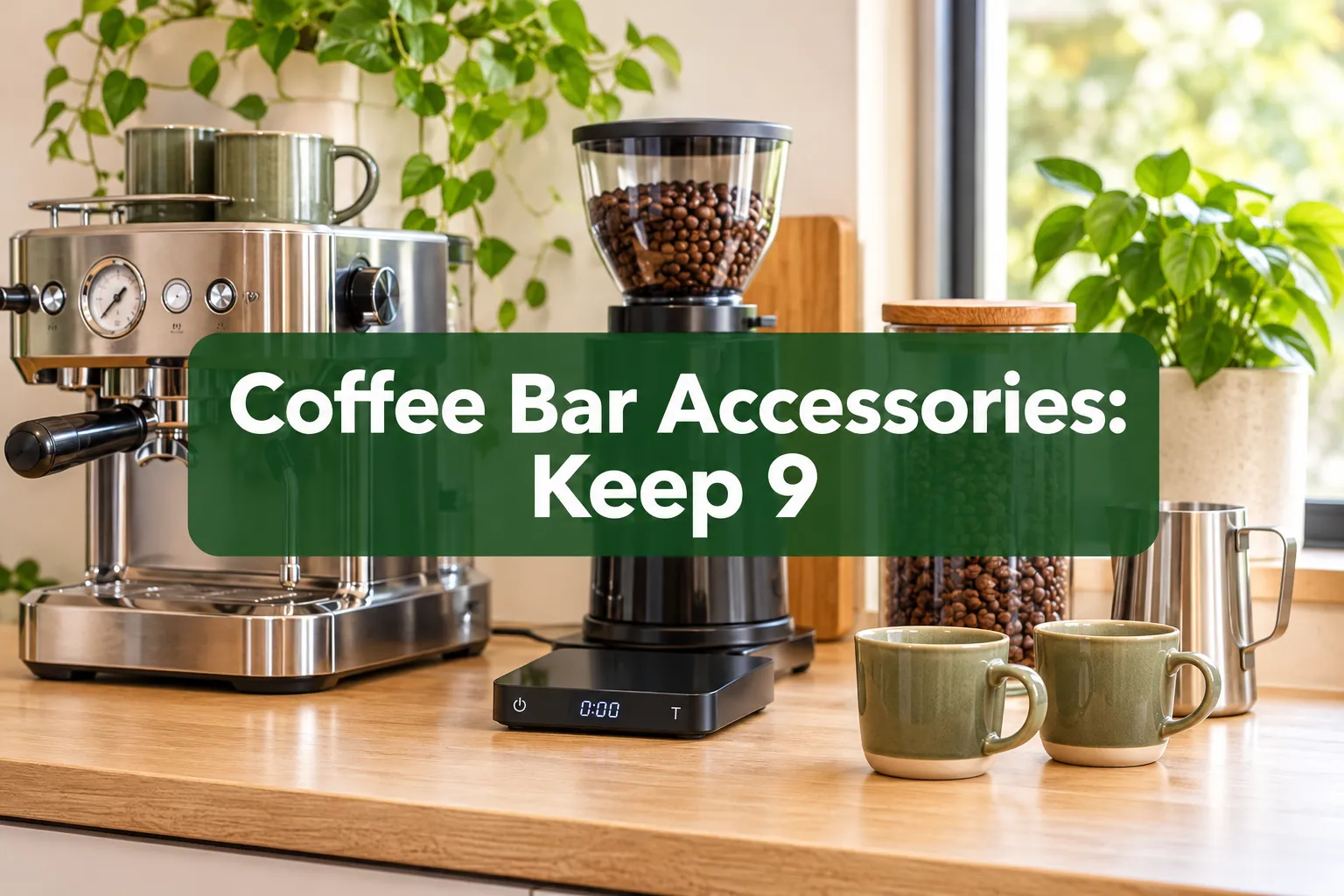
9 Coffee Bar Accessories Worth the Space, 6 to Skip
A $30 scale will improve your coffee more than a $300 machine upgrade. That is the uncomfortable arithmetic behind most home setups, and it is the lens this guide uses to sort coffee bar accessories into two piles: the nine that get touched every single morning, and the six that quietly become counter sculpture within a month.
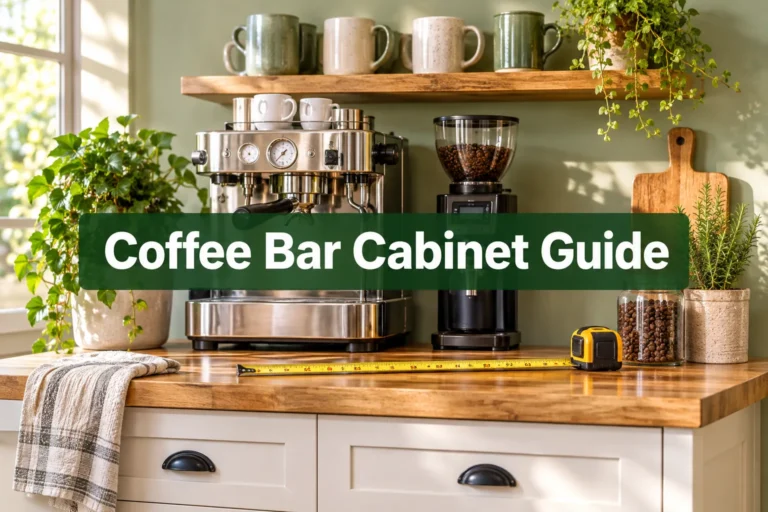
The counter is the constraint. Most American kitchens give a coffee station somewhere between 18 and 36 inches of usable width, and an espresso machine eats half of that before anything else arrives. So every item has to answer one question: how many times will you pick this up this week?
Below, the nine keepers are ranked by daily contact, not by price or prestige. Then the six skips, each with the honest reason it stops getting used. Prices were checked November 5, 2026, and typical street prices shift, so check the current price before buying.
Key Takeaways
- A digital scale with a built in timer, roughly $25 to $70, is the single highest-return purchase for a beginner because it makes brew ratio repeatable.
- A burr grinder, $100 to $250 for a decent home entry model, changes the cup more than any accessory under $100. Grind size controls extraction.
- Airtight opaque bean storage runs $20 to $35 and protects the roast date you paid for.
- A variable-temperature gooseneck kettle, $50 to $100, matters for pour over and does nothing for a super-automatic owner.
- Small organizers earn their footprint: the Mind Reader condiment station sells for $15.39 on Amazon with 9,327 reviews and 3,000-plus purchases a month, and a wooden countertop coffee bar organizer runs $19.99.
- A 12 ounce milk pitcher ($12 to $20), a calibrated tamper ($25 to $40), a knock box ($20 to $35), and a basic cleaning kit ($15 to $25) round out the espresso side.
- Skip the neon sign, the pod carousel, the café-size syrup pumps, the duplicate milk frother, the leveling distributor disc, and app-locked smart gadgets.
Coffee Bar Accessories
The phrase covers everything that is not the brewer itself: measurement, storage, preparation, cleaning, and organization. The useful way to sort coffee bar accessories is by contact frequency. Something you touch twice a day for five years is cheap at $60. Something you touch twice a year is expensive at $15.
Market analysts have noticed the category growing alongside home espresso. Reports tracking coffee machine accessories describe steady expansion driven by premium home installations and the aftermarket that follows them . Equipment and supplies research points the same direction, with accessories growing faster than the machines themselves in several segments .
That growth has a side effect. Search "coffee bar essentials" and you get a sea of wooden signs and tiered trays. Those sell well because they photograph well. They are not what makes a flat white taste better.
Product design is moving the other way at the professional end. The Specialty Coffee Association's 2026 Best New Product listings for the accessories category include OutIn's Claro2, a dosing cup that integrates a weighing surface, pouring spout, upward-facing display and IPX5 splash resistance in one body; Kopel Labs' DigiTamper, which reads tamp force in real time; SYNCFO's Aqua connected scale; and Squeaky's Satellite, a guard that redirects water and heat away from an espresso scale so baristas stop shuffling it during flushes. Those entries were listed as current in late October and early November 2026. The pattern is measurement and integration, not decoration.
Home buyers can borrow that logic without buying competition gear. Choose coffee station accessories that measure something, protect something, or save a step. Everything else is coffee bar decor.
So what do you actually need? If you brew drip or pour over: grinder, scale, storage, kettle. If you pull espresso: grinder, scale, storage, tamper, pitcher, knock box, cleaning kit. That is the whole list. The organizer is a quality-of-life upgrade once the working tools are in place.
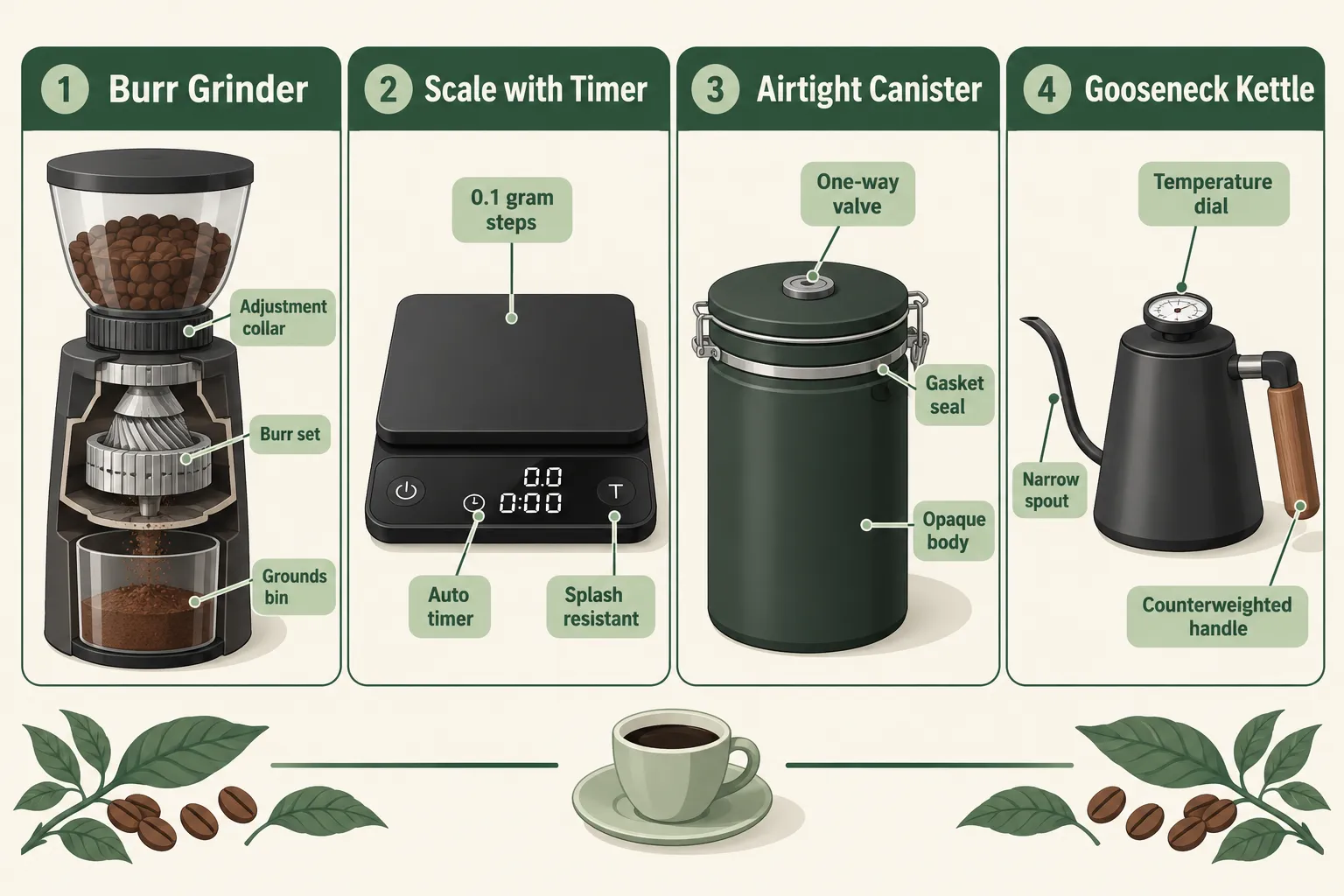
1. A Burr Grinder: The One Accessory That Rewrites the Cup
Touched: every brew, twice a day for many households. Price range: $100 to $250 for a capable home entry model; good manual grinders start near $70.
Grind size is the variable that controls extraction, the process of dissolving soluble compounds out of ground coffee into water. Too coarse and the water runs through fast, pulling acids and leaving sweetness behind. Too fine and it stalls, pulling bitterness. A blade grinder cannot produce a consistent particle size, so it produces both problems in the same cup.
A burr grinder crushes beans between two shaped surfaces set a fixed distance apart. Particle distribution tightens. The cup gets clearer, sweeter, and more repeatable.
This is where the "do I need an espresso machine or just a grinder" question usually lands. If the budget is $400 and the choice is a $400 espresso machine with pre-ground beans or a $150 grinder plus a $250 machine, take the grinder every time. Espresso is the most grind-sensitive method there is. A machine that cannot be dialed in produces expensive disappointment.
Manual grinders deserve serious consideration in an apartment. They are quiet at 6 a.m., they take up the footprint of a thermos, and the burr quality at $80 to $150 often matches electric grinders twice the price. The trade is 40 to 90 seconds of cranking. For single-cup households that is fine. For two espresso drinks before work it gets old. Our roundup of the best manual coffee grinder options walks through the trade-offs by brew method.
2. A Digital Scale With a Built-In Timer
Touched: every brew. Price range: $25 to $70.
Ask ten baristas for the most important coffee accessory for beginners and most will say the scale, not the machine. The reason is repeatability. Volume measurement lies. A scoop of light-roast beans and a scoop of dark-roast beans differ in mass because darker roasts lose more water and expand. Weight does not care about roast level.
With a scale you can set a brew ratio, the relationship between dry coffee and finished beverage. Say 1:16 for pour over: 20 grams of coffee to 320 grams of water. Repeat it tomorrow. If the cup tastes thin, you now know the grind was too coarse rather than guessing whether you used less coffee.
What is the difference between a scale and a timer for coffee? A timer tells you how long. A scale tells you how much. You need both numbers to diagnose anything, which is why integrated scales dominate the category now. Timemore's Black Mirror Nano is a useful benchmark for what compact models deliver in 2026: 0.1 gram increments, a 2,000 gram capacity, automatic timing modes, a footprint around 3.9 by 4.5 by 0.8 inches, and a claimed 15 hours of battery life, per Timemore's product page.
For espresso, 0.1 gram resolution matters because you are weighing a 18 gram dose and a 36 gram yield. For drip, 1 gram resolution is plenty. A flat profile that slides under a portafilter matters more than almost any other spec, because a scale that does not fit under the group head stops getting used.
Water resistance is worth paying a little extra for. Espresso counters are wet counters, and the fact that professional products now exist purely to shield scales from flush water tells you how often they die.
3. Airtight, Opaque Bean Storage
Touched: every brew. Price range: $20 to $35 for a quality canister with a one-way valve.
Coffee stales through oxidation and the loss of volatile aroma compounds. Light accelerates it. Heat accelerates it. The paper bag with the folded top does almost nothing after day three.
A proper canister does three jobs. It blocks light with an opaque body. It seals with a gasket. And on better models, a one-way valve lets carbon dioxide escape from freshly roasted beans without letting oxygen back in. That matters most in the first two weeks after the roast date, when beans are still degassing.
Practical rule: buy beans in quantities you will finish in three weeks, keep them sealed on the counter, and do not refrigerate. The fridge is a humid, odor-rich environment and coffee absorbs both. Freezing works for long-term storage in sealed single-dose portions, but repeated freeze-thaw cycles cause condensation on the beans.
Transparent glass jars look wonderful in photos and quietly degrade your coffee. If you want the glass, keep it in a cupboard. Our guide to the best coffee storage containers for fresh beans compares valve designs and sizes.
4. A Variable-Temperature Gooseneck Kettle
Touched: daily for pour over and filter drinkers. Never for pod and super-automatic owners. Price range: $50 to $100 for a decent electric model; $25 to $40 for stovetop gooseneck with no temperature control.
Water temperature changes which compounds dissolve and how fast. Hotter water extracts more, quickly. Most specialty roasters suggest somewhere in the 195 to 205 degree Fahrenheit band for filter brewing, with lighter roasts favoring the top of that range.
The gooseneck shape matters as much as the thermostat. A narrow curved spout gives you a slow, controlled, vertical stream. That makes the bloom, the initial pour that wets the grounds and releases trapped carbon dioxide, far easier to do evenly. Pour from a wide-mouth kettle and you blast a channel through the bed on contact.
Honest limitation: this is a method-specific purchase. If your household runs on a super-automatic machine or a Keurig, a gooseneck kettle is a $75 tea kettle. Buy it when you buy the dripper, not before. The comparison of coffee brewing methods will tell you quickly whether pour over is your lane.
5. A Calibrated Tamper That Matches Your Basket
Touched: every espresso shot. Price range: $25 to $40 for calibrated; $15 to $25 for a solid flat-base tamper.
The plastic tamper bundled with most machines is undersized, light, and usually 51mm or 53mm plastic pretending to fit a 58mm basket. Gaps around the edge leave loose grounds. Water finds the loose path, rushes through, and you get a sour shot with a wet puck.
Two specs do the work. Diameter should match your basket within about 0.5mm. Flat base beats convex for most home users. A calibrated tamper adds a spring that clicks at a set force, usually around 30 pounds, which removes one variable while you learn.
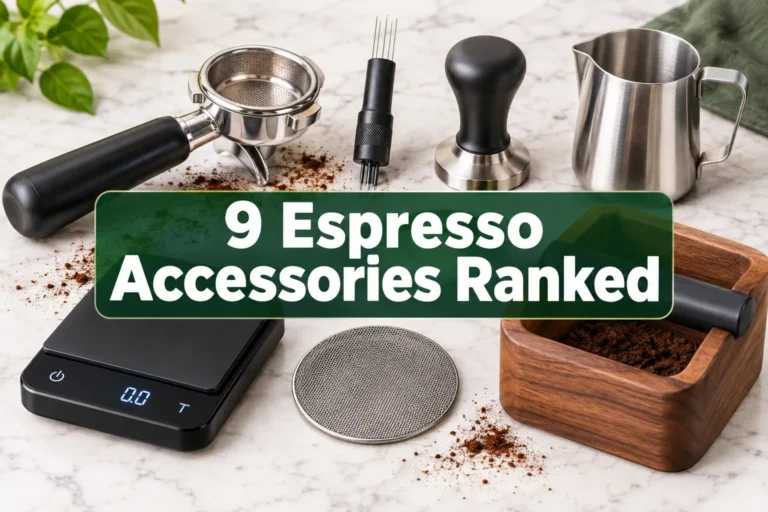
Coffee tamper versus distribution tool, which is better? For most home setups, the tamper. A leveling distributor spins across the top of the dose and flattens the surface, but it does not fix clumping deeper in the basket. If uneven extraction is the problem, a $5 WDT tool, essentially a handle holding fine needles that you stir through the grounds, solves more of it for a fraction of the cost. The distributor disc is the one most people buy second and use least.
Interestingly, force measurement is now a design frontier: Kopel Labs' DigiTamper, listed by the SCA in 2026, reads tamp force in real time. For home use, a calibrated spring achieves the same consistency without the screen.
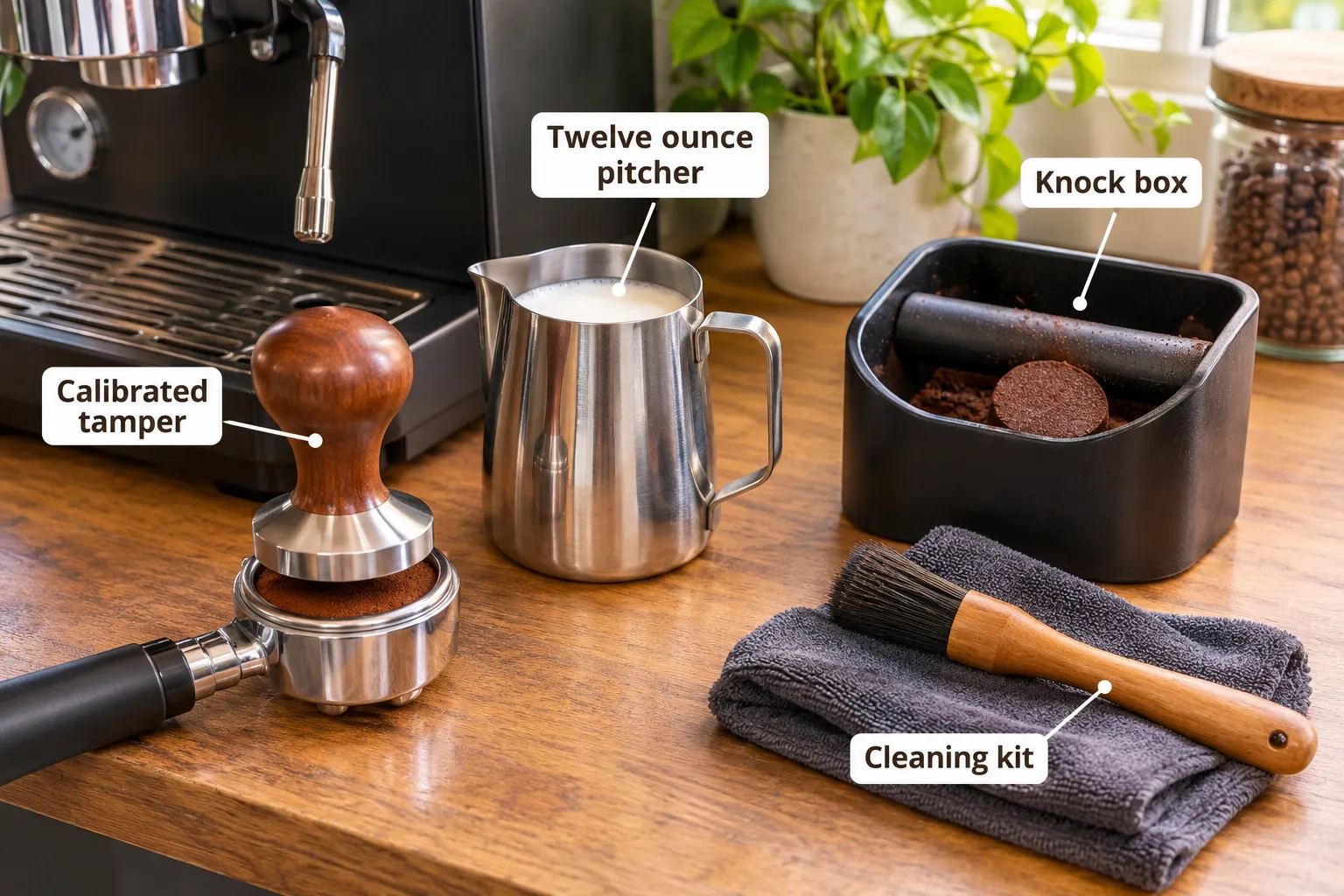
6. A 12-Ounce Stainless Milk Pitcher
Touched: daily in any household that drinks lattes, cappuccinos, or flat whites. Price range: $12 to $20.
Pitcher size determines whether you can steam milk properly. Too large and the steam wand cannot build a vortex in a small volume of milk. Too small and the milk climbs out. For one or two 6 to 8 ounce drinks, a 12 ounce pitcher is the sweet spot. Fill to the base of the spout, no higher.
The spout shape controls pour. A tighter, more defined spout gives you control over where the microfoam lands, which is the difference between a latte and a flat white in the cup. Microfoam is milk aerated into bubbles too small to see individually, giving a glossy, paint-like texture rather than stiff foam. Our breakdown of flat white versus latte and the microfoam detail explains why texture, not volume, defines the drink.
Stainless steel is standard because it conducts heat to your hand. You feel the milk approaching 140 degrees Fahrenheit before a thermometer would tell you. That tactile feedback is why experienced baristas rarely use thermometers.
Why this matters more in 2026: the 2026 National Coffee Data Trends report from the NCA and SCA found that 47% of American adults had consumed an espresso-based drink in the previous week, and 36% of past-day specialty coffee drinkers had their coffee prepared away from home, compared with 23% of traditional coffee drinkers. Milk drinks are the main thing people are trying to reproduce at home.
7. A Knock Box
Touched: every espresso shot. Price range: $20 to $35.
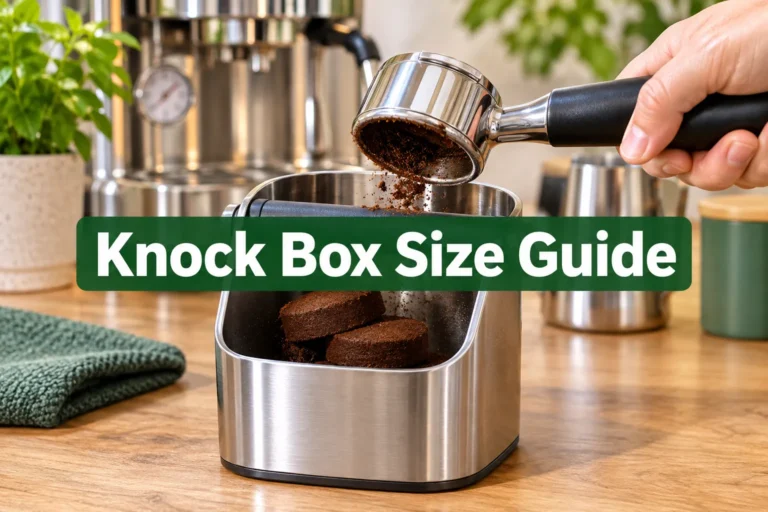
A spent espresso puck is a compressed disc of wet grounds. Knocking it into a kitchen bin splashes. Rinsing it down the sink builds a sludge layer in the trap that eventually costs more than the knock box. A knock box is a small bin with a padded crossbar that takes the impact.
Look for a removable bar for cleaning, a non-slip base, and a size that suits your counter. Low-profile rectangular models tuck beside the machine. Round drum models look better and take more space.
This is the least glamorous item on the list and one of the most used. Nobody posts photos of their knock box. Everyone who pulls shots daily owns one within two months.
8. A Real Cleaning Kit
Touched: daily wipe, weekly backflush. Price range: $15 to $25 for brush, detergent, and microfiber cloths; $25 to $40 if you add a blind filter and descaler.
Dirty gear makes bitter coffee. Coffee oils oxidize and turn rancid on group head screens, in portafilter baskets, in grinder chambers, and inside milk wands. The taste arrives gradually, which is why people blame their beans.
The working kit: a group head brush with angled bristles, espresso machine detergent powder for backflushing, a blind filter if your machine supports it, a bottle brush for the water tank, and two microfiber cloths, one for the steam wand and one for everything else. Purge the steam wand immediately after every use and wipe it while the milk is still liquid. Dried milk protein needs soaking.
For drip brewers, descaling matters more than anything else. Mineral scale insulates the heating element, which drops brew temperature, which under-extracts the coffee. If your drip machine has started making weak coffee, descale before you blame the roaster.
9. A Compact Organizer for Syrups, Pods, and Spoons
Touched: daily, in households that sweeten or flavor drinks. Price: Mind Reader condiment station, $15.39 on Amazon, 9,327 reviews, 3,000-plus bought per month, checked November 5, 2026. Wooden countertop coffee bar organizer, $19.99, 2,000-plus bought per month, same check date.
This is the one organization item that earns its footprint, with a condition attached: it has to replace sprawl, not add to it. A condiment station with compartments for sugar packets, stirrers, and two syrup bottles turns 18 inches of scattered clutter into an 8-inch block. A wooden coffee bar organizer with a mug rack section does the same for cups and a filter stack.
The failure mode is buying the organizer first and letting it set the size of your collection. A six-slot coffee syrup organizer encourages six syrups. You will use two. Buy the smallest unit that holds what you actually reach for, and measure the counter before ordering, including the vertical clearance under your upper cabinets.
Flavor-wise, syrup quality varies far more than the bottle count suggests. Our ranking of the best sugar free coffee syrups compares Torani, Monin, and ChocZero if you are narrowing down which two to keep.
For a small apartment kitchen, the whole station can live on a 24 inch tray: machine, grinder, canister, scale, organizer. Putting everything on a tray means you can lift the entire coffee bar to clean under it, which you will otherwise never do.
The 6 Coffee Bar Accessories to Skip
Each of these sells well. Each has a specific reason it stops being touched.
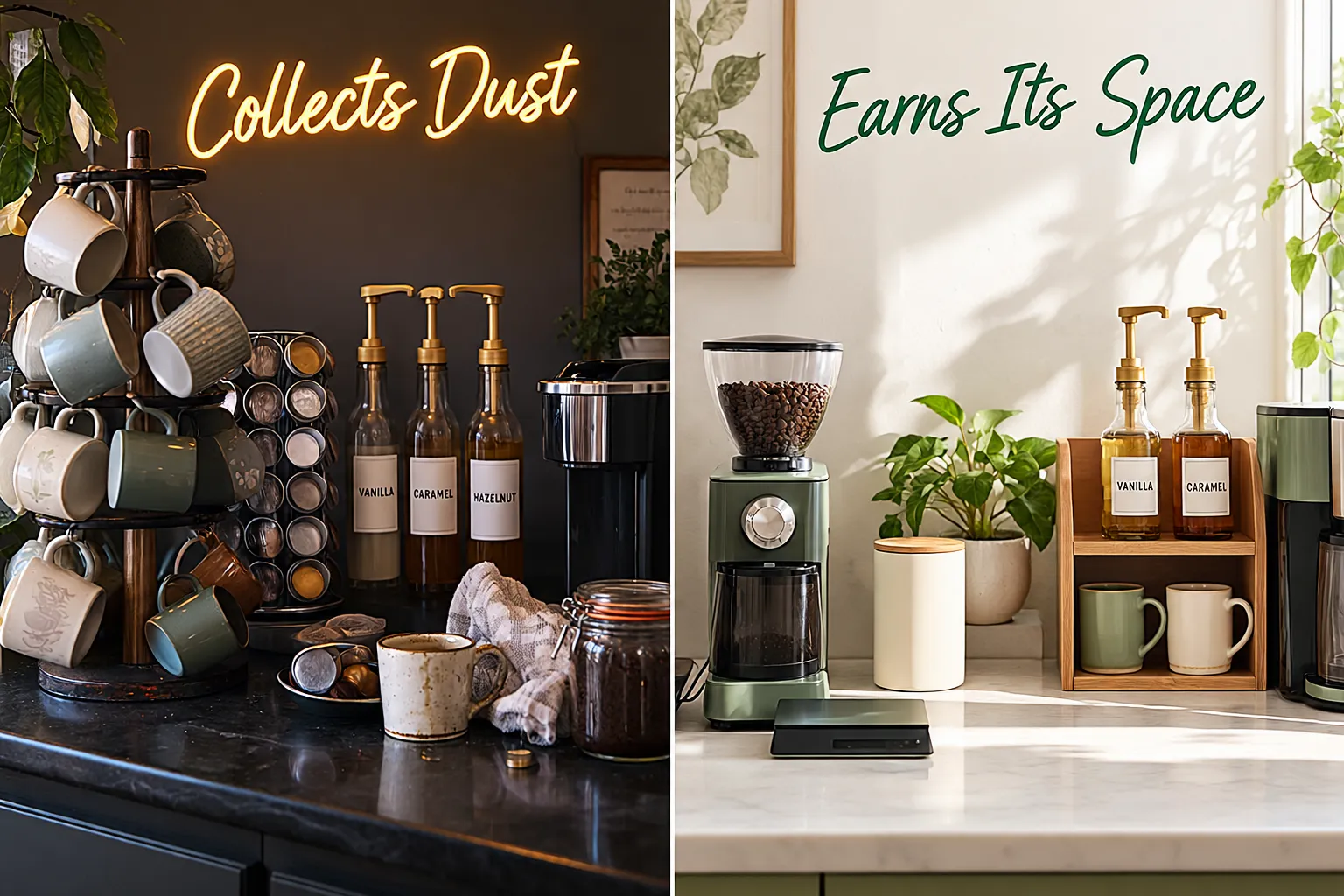
1. Neon Signs, Chalkboards, and "But First, Coffee" Wall Art
The honest reason it collects dust: it does nothing, and it occupies the vertical space where a mug rack or a grinder could live.
Coffee bar decor sells on the promise that the station will feel like a café. What makes a café feel like a café is the smell of fresh grinding and someone competent making your drink. A $45 neon sign delivers neither and becomes invisible in nine days. If the wall is empty and you want something there, a floating shelf holding beans and cups does the same visual job and stores things.
2. Café-Size Syrup Pump Bottles
The honest reason: a 750ml or 1L syrup bottle with a pump head opens a clock you cannot beat at home.
Pumps are built for a café pushing 40 vanilla lattes a day. At home, a 1L bottle lasts months, the pump mechanism crusts with sugar, and the syrup separates. Buy the small bottles, use the cap, keep two flavors maximum, and store open bottles in the fridge if the label says to. The pump set looks professional in photos and gums up in practice.
3. A Standalone Electric Milk Frother, If Your Machine Has a Steam Wand
The honest reason: duplication.
Electric frothers are genuinely good purchases for drip and pod households. They heat and aerate milk in 90 seconds with no skill required. But if you bought an espresso machine with a steam wand, the frother sits in a cupboard after the second week, because the wand is faster, makes better microfoam, and is already on the counter.
Decide which device makes your milk. Own one. The exception is a household split between an espresso drinker and someone who wants hot chocolate on demand.
4. The Pod Carousel
The honest reason: it holds 30 pods and takes the footprint of a grinder.
Carousels and pod drawers solve a storage problem that a $4 drawer organizer also solves, while consuming prime counter real estate. They also lock you into a format that is changing. CNN reported on November 2, 2026 that Lavazza brought its $129 Tablì system to the United States using compressed coffee tablets rather than plastic or aluminum capsules, and that Keurig launched its Alta system with compostable pods in October. If your pod format changes, the carousel does not adapt.
A related note from the same reporting: Caraway's $495 stainless-steel-and-glass coffee maker sold out through January, which says something about where demand is heading. Durable materials and refillable formats are the direction. Buy storage that works for whatever you switch to.
5. The Leveling Distribution Tool
The honest reason: it addresses the top of the puck, and your problem is usually deeper.
A distributor spins a bladed disc across the surface of the dose to flatten it. It produces a satisfying result you can see. What it cannot do is break up clumps formed during grinding, which are the actual cause of most channeling, the condition where water carves a fast path through the coffee bed and under-extracts everything around it.
A WDT tool, a handle with fine needles that you stir through the grounds before tamping, costs $5 to $15 and addresses the full depth of the basket. Buy that first. If you still see uneven extraction after three weeks of consistent WDT and a calibrated tamp, then consider the distributor. Most people never get there.
6. App-Locked Smart Gadgets With Sealed Batteries
The honest reason: the app outlives nothing, and the battery is not replaceable.
Smart mug warmers, app-paired tampers, and connected brewers with proprietary firmware depend on a company continuing to maintain a phone app. When support ends, the hardware degrades to a very expensive dumb object. Sealed batteries make it worse, because a $120 device dies when a $4 cell does.
This is not hypothetical policy noise. On November 3, 2026, the European Commission opened a consultation on future ecodesign requirements intended to make a wide range of products easier to repair, with feedback open until February 9, 2027. The practical takeaway for a buyer today: favor replaceable batteries, standard parts, washable components, and designs that work without a phone. A connected scale is fine if it also works as a scale when the app disappears.
Keepers at a Glance
9 Keepers: Price and Daily Use
| Accessory | Typical price | How often used | Problem it solves |
|---|---|---|---|
| Burr grinder | $100–$250 | Every brew | Inconsistent grind size |
| Scale with timer | $25–$70 | Every brew | Unrepeatable brew ratio |
| Airtight canister | $20–$35 | Every brew | Staling after roast date |
| Gooseneck kettle | $50–$100 | Daily (filter only) | Pour and temperature control |
| Calibrated tamper | $25–$40 | Every shot | Uneven, channelling pucks |
| 12 oz milk pitcher | $12–$20 | Daily (milk drinks) | Poor microfoam control |
| Knock box | $20–$35 | Every shot | Puck mess and sink sludge |
| Cleaning kit | $15–$25 | Daily wipe, weekly deep | Rancid oils, bitter cups |
Ninth keeper: compact condiment or syrup organizer, $15–$20, used daily in sweetened-drink households. Prices checked November 5, 2026 and will vary.
What to Watch Out For
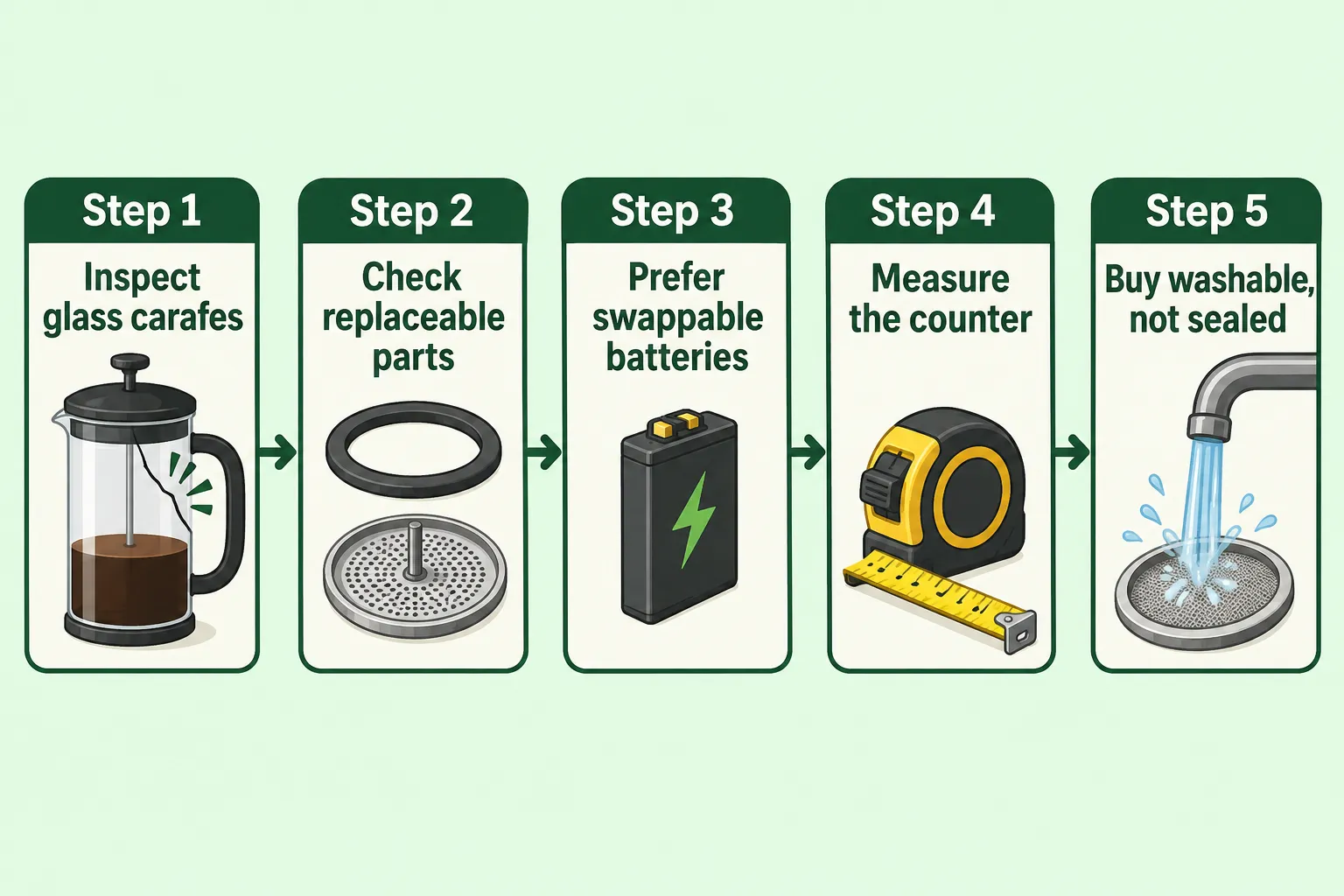
Damaged glass is a real safety issue, not a cosmetic one. In early November 2026, Bodum USA recalled roughly 5.9 million French presses with replaceable glass carafes because a cracked or damaged carafe can break during use, as reported by KUTV. If you own a glass brewer, hold the carafe up to the light and look for hairline cracks and chips at the rim and base before pressing anything. Replace carafes with the manufacturer's part rather than assuming cheap drinkware is interchangeable.
Buy for the brewer you own. A $90 gooseneck kettle is dead weight next to a super-automatic. A 58mm tamper is useless if your portafilter is 54mm. Measure your basket with a ruler before ordering.
Measure vertical clearance. The most common returned accessory is the one that does not fit under the kitchen cabinet. Check the height of your canister, your kettle with the lid on, and your organizer. Also check whether the water tank lifts out upward, because many machines cannot be refilled under a cabinet.
Prefer washable over sealed. A grinder you can open and brush will last a decade. A sealed one accumulates stale oil you cannot reach.
Be skeptical of bundles. Fourteen-piece "barista kits" at $49 tend to be one usable item and thirteen fillers. Buying the tamper, pitcher, and knock box separately costs slightly more and leaves you with gear you keep.
Cited Numbers, Checked November 2026
Accessory demand tracks that home-preparation number closely. Market research on coffee maker accessories attributes projected growth through 2035 largely to the expanding premium espresso installed base, which is the same households buying tampers and scales . Broader coffee equipment and supplies analysis describes the same pattern across both home and commercial segments .
FAQ

Conclusion
Pick by budget tier. Under $100, buy the scale with a timer and an airtight canister, then spend the rest on better beans with a recent roast date. Between $100 and $300, the burr grinder is the purchase, manual if your kitchen is small, electric if two people need drinks before work. Above $300, add the espresso-side set: calibrated tamper, 12 ounce pitcher, knock box, cleaning kit, and a compact organizer to keep the counter workable.
Next step: weigh your coffee tomorrow morning and write down the dose, the water, and the time. Brew it the same way for three days, then change one thing. That habit, more than any purchase, is what separates a good home cup from a guess. Better Coffee Starts With Better Answers.
Affiliate disclosure: Coffee Rank IQ may earn a commission from purchases made through links on this page. Recommendations here are based on published specifications, manufacturer documentation, and current retail listings checked November 5, 2026, not on paid placement. Prices change, so check the current price before ordering.