Espresso Knock Box Sizes: How Many Pucks Fit
Quick answer
Most home setups are fine with a box rated for 10 to 20 pucks. Breville lists its Knock Box 10 at up to 10 pucks in a 4.4 by 4.8 by 4.8 inch body, and its Knock Box 20 at up to 20 pucks in a 6.4 by 6.3 by 6.3 inch body . Those ratings are manufacturer estimates, not certified measurements, so plan on filling any box to about three quarters before emptying. Two shots a day means a 10-puck box gets dumped every three or four days. Six shots a day means you want 20 or more.
Key takeaways
- A spent double puck weighs roughly 30 to 40 grams wet, from an 18 to 21 gram dry dose plus retained water, which is why capacity claims vary so much between brands.
- Breville Knock Box 10: up to 10 pucks, 4.4 x 4.8 x 4.8 inches . Amazon price checked November 5, 2026: $33.95, with 1,418 ratings and 2,000+ bought in the past month.
- Breville Knock Box 20: up to 20 pucks, 6.4 x 6.3 x 6.3 inches . Roughly double the capacity for roughly double the counter footprint.
- Ninja Luxe Cafe knock box: listed at 10 double pucks, $29.97 on Amazon as of November 5, 2026.
- Budget option: a basic plastic knock box runs about $14.99, with 1,000+ bought in the past month as of November 5, 2026.
- Working capacity is about 75% of the rated number. A 600 ml box gives roughly 10 to 12 comfortable pucks; a 350 to 400 ml mini knock box gives about 6 or 7 before strikes get messy.
- Portafilter diameter matters. A 58 mm puck takes more floor area than a 51 mm puck, so "15 pucks" is not the same claim across every box.
Espresso knock box sizes: how many pucks fit, by daily shot count
The honest answer: an espresso knock box holds between 5 and 50 pucks depending on its volume, and your daily shot count decides which end of that range you need. Di Pacci's October 2026 sizing guide frames it simply: one person usually produces 2 to 6 pucks a day, a household produces 6 to 15, and an office or small bar produces 20 to 60.
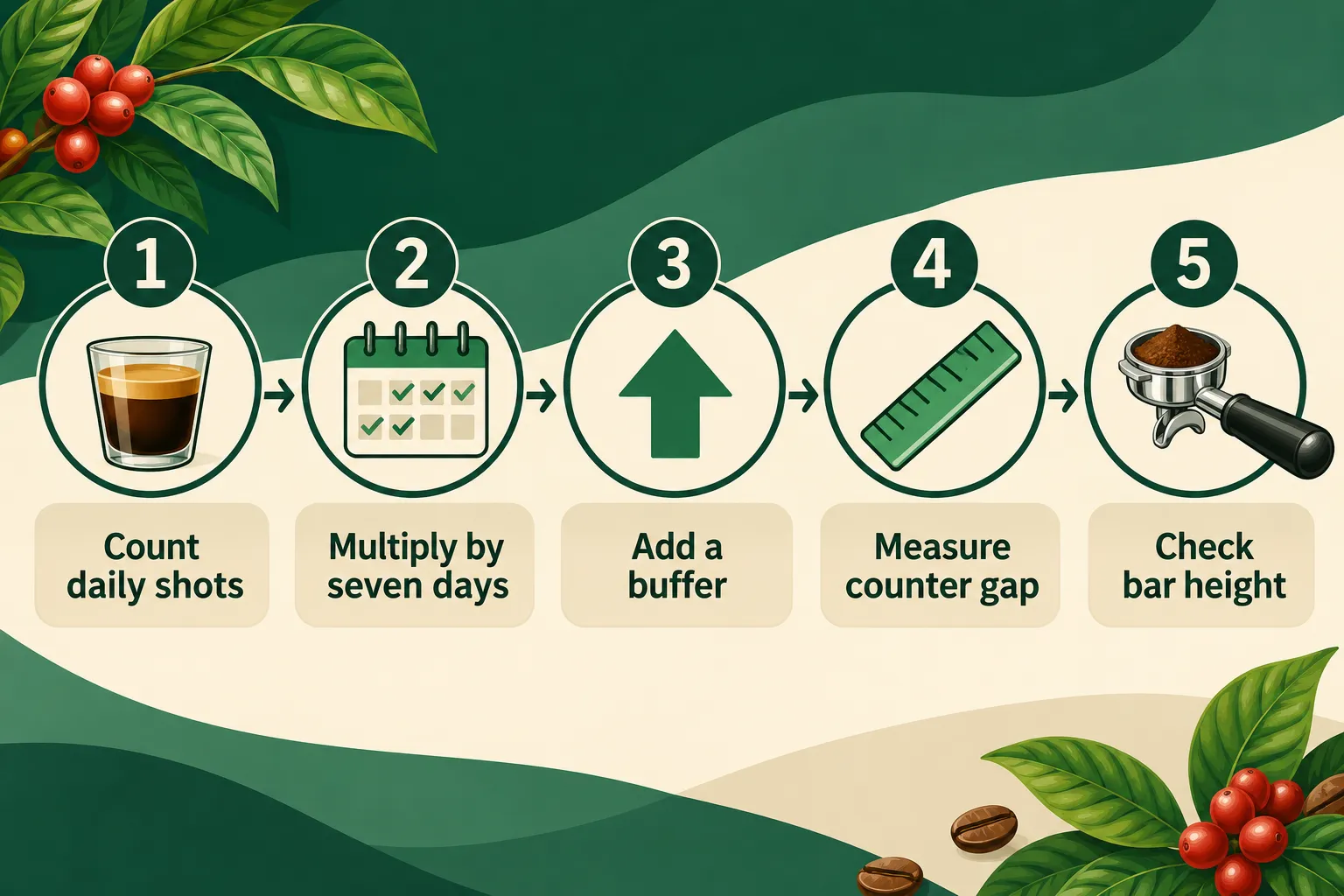
Run the arithmetic before you shop. Daily shots times the number of days you want between emptyings, plus a 25% buffer so the last few strikes do not scatter grounds across the counter.
| Your routine | Pucks per day | Empty every | Knock box size to buy |
|---|---|---|---|
| One flat white before work | 2 | 4 to 5 days | Compact, 10-puck class |
| Two people, one drink each | 4 | 3 days | 10 to 15 pucks |
| Weekend latte habit plus guests | 6 to 8 | 2 to 3 days | 20-puck class |
| Home office, dialing in shots | 10+ | Daily | 20+ or a knock box drawer |
Dialing in a new bag inflates that number fast. Three throwaway shots while you chase a 1:2 brew ratio fills a mini knock box before breakfast is over. If you grind fresh and adjust often, buy one class larger than your drink count suggests. Our guide to espresso equipment essentials and maintenance covers where a knock box sits in the wider accessory stack.
What size espresso knock box do I actually need?
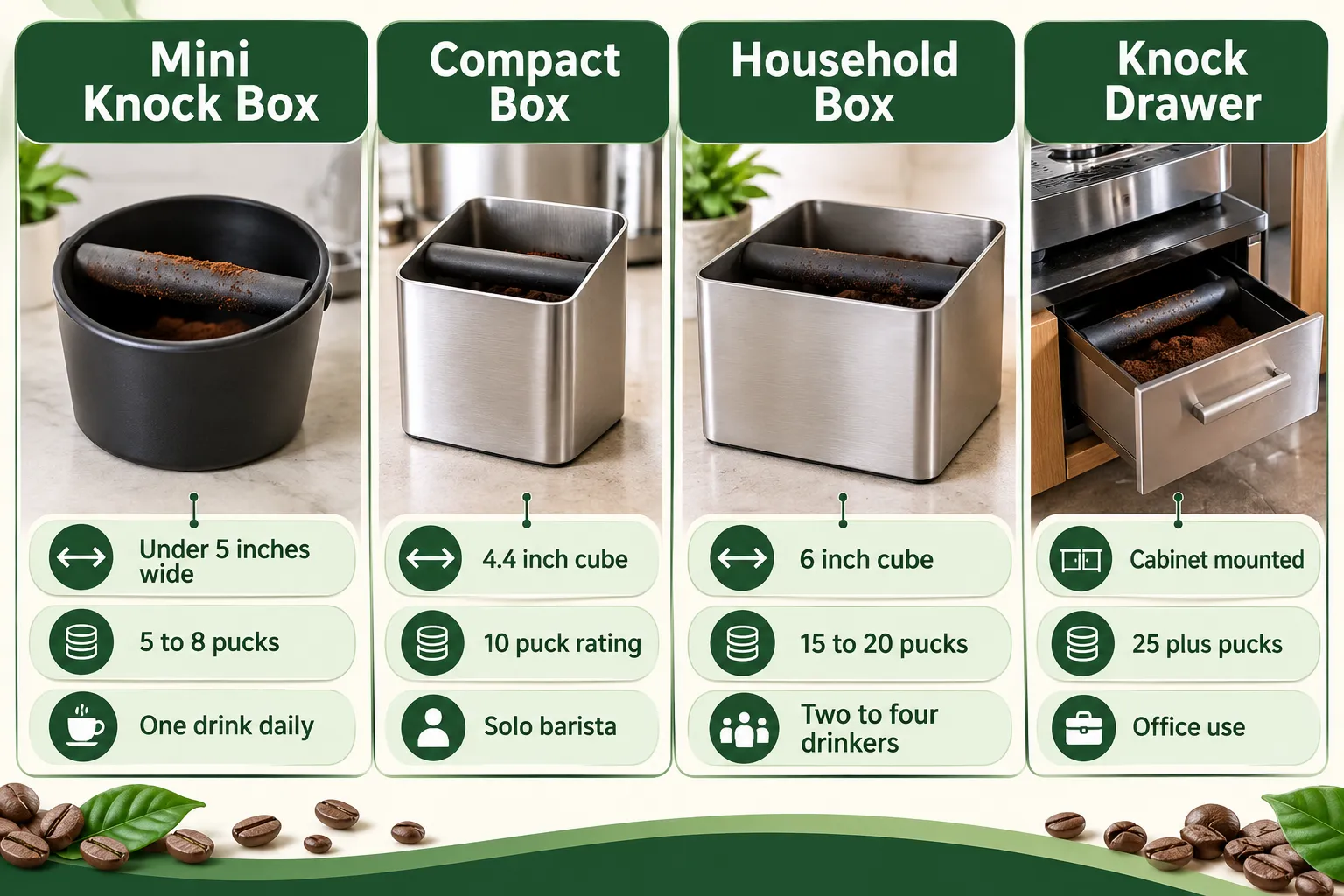
Match the box to your counter first, then to your pucks. A box under 5 inches wide suits one or two shots daily but needs emptying every two or three days. A 6 inch cube suits a household pulling 6 to 10 shots.
Three measurements decide it:
- Width of the gap between your machine and the grinder. Measure it before you browse.
- Height of the knock bar. The bar should sit low enough that the portafilter spout clears the rim on the downswing.
- Volume in millilitres, if the brand lists it. Home Espresso HQ's October 2026 sizing guide estimates a 600 ml box reaches a practical working level at roughly 10 to 12 pucks, while a 350 to 400 ml compact holds 6 or 7 before strikes start throwing grounds.
Decision rule: if you pull fewer than four shots a day and your counter is tight, buy compact and accept emptying twice a week. If you ever make two milk drinks back to back for guests, buy the 20-puck class.
How many espresso pucks can a knock box hold in real use?
Fewer than the box claims. Rated capacity assumes pucks settle flat and the bin fills to the rim, which never happens in a working kitchen. Espresso Verdict's November 2026 guide recommends treating compact models as roughly 10 to 15 pucks in normal use and café-style units as 25 or more, because you need clearance above the grounds pile for a clean strike.
Thomas Acres, updated November 4, 2026, groups the market into the same three bands: compact around 10 pucks, mid-size 15 to 25, and large units 50 or more. My Home Espresso lists the Rattleware 4 inch box at roughly 5 to 6 pucks and small plastic models at about 6 to 8.
Capacity claims are comparative marketing, not lab measurements. No standards body certifies what "20 pucks" means.
Common mistake: buying by the number on the box without looking at the shape. A tall narrow bin and a wide shallow bin can share a capacity rating and behave nothing alike. Broken pucks pack tighter than intact ones; a tamped puck that lands whole wastes a lot of air.
Does portafilter size affect how many pucks fit?
Yes, and more than most buyers expect. A spent double puck from a 58 mm commercial basket covers noticeably more horizontal area than one from a 51 or 54 mm basket, so a box that swallows 15 pucks from a Gaggia Classic Pro may take only 11 or 12 from a 58 mm machine.
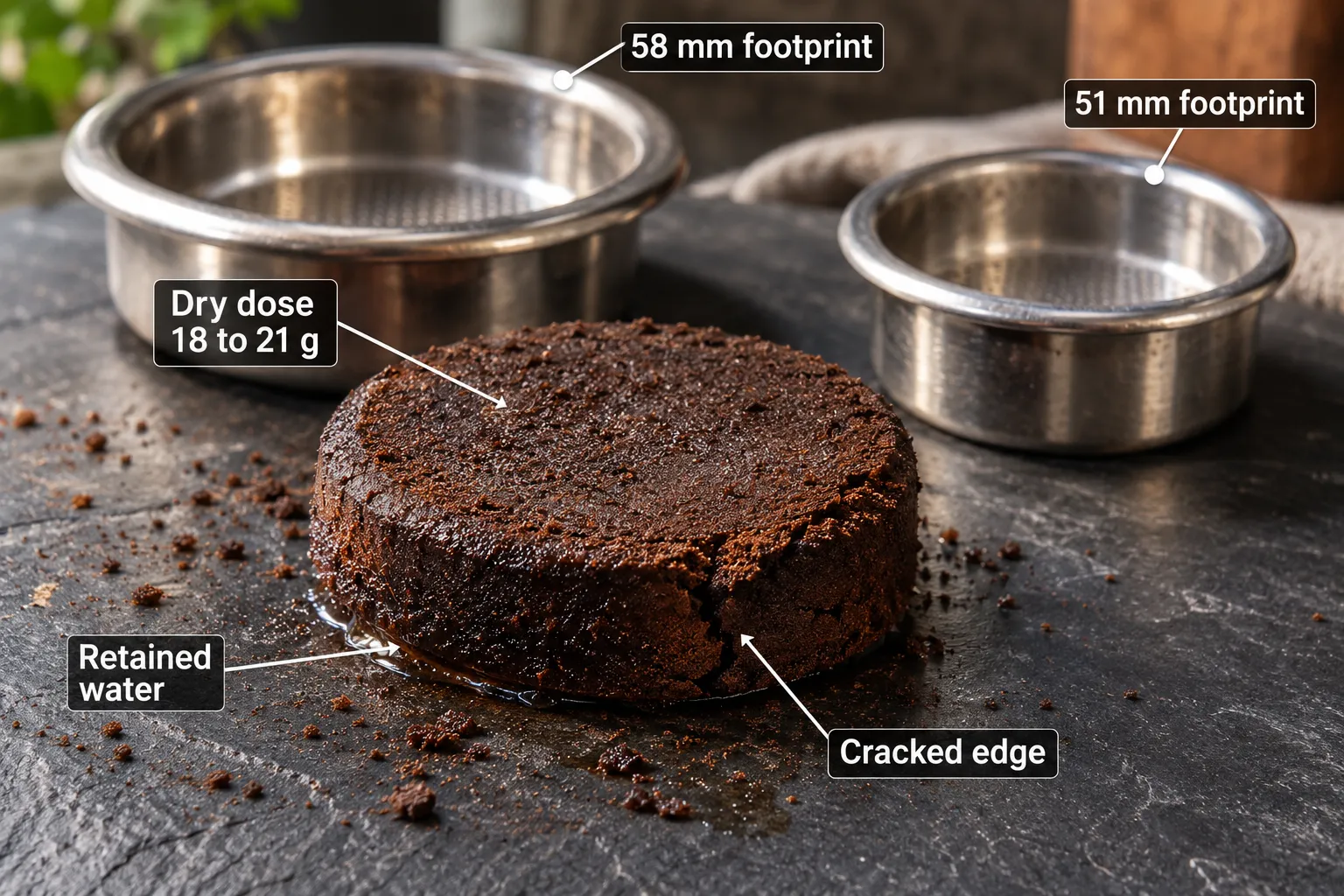
Dose changes it too. Espresso Verdict estimates a wet spent puck at roughly 30 to 40 grams, from an 18 to 21 gram dry dose plus retained brew water. A 14 gram puck from a pressurised basket is a different object entirely.
Quick conversion for shoppers:
- 51 mm baskets (many entry machines): small pucks, add roughly 20% to any stated capacity.
- 54 mm baskets (Breville Barista range): the capacity ratings on Breville boxes are written around these.
- 58 mm baskets (Gaggia, Rancilio, most prosumer): subtract roughly 20%.
If you are still choosing a machine, the basket size is worth noting alongside everything else in our guide to the best espresso machine for beginners.
Standard espresso knock box dimensions and capacity
There is no legal standard, but the market has settled into predictable sizes. Breville's two models bracket the home range neatly.
| Model | Rated pucks | Dimensions | Price (Nov 5, 2026) |
|---|---|---|---|
| Breville Knock Box 10 | Up to 10 | 4.4 x 4.8 x 4.8 in | $33.95 (Amazon) |
| Breville Knock Box 20 | Up to 20 | 6.4 x 6.3 x 6.3 in | Check current price |
| Ninja Luxe Cafe knock box | 10 double pucks | Compact countertop | $29.97 (Amazon) |
| Generic budget plastic box | 6 to 8 typical | Approx. 4 to 5 in wide | $14.99 (Amazon) |
Prices checked on Amazon November 5, 2026 and will move. Coffee Rank IQ uses affiliate links; a purchase may earn the site a commission at no extra cost to you.
Small vs medium vs large: which espresso knock box should you get?
Pick the smallest box that survives three days of your actual routine. Counter space is the scarcer resource in most kitchens.
- Small or mini knock box (5 to 10 pucks, under 5 inches): one drinker, one or two shots daily. Cheapest, quietest to store, emptied twice a week. Loses its appeal the moment a second person starts pulling shots.
- Medium (10 to 20 pucks, roughly 6 inch cube): the default for households. Burr & Basket's August 2026 comparison recommends 1 litre or larger for households and batch sessions. Emptied every two or three days.
- Large or commercial (25 to 50+ pucks): offices, home bars, and anyone hosting regularly. Heavy enough to stay put, big enough that forgetting it for a week has consequences you will smell.
Choose the medium if you are unsure. The price gap between small and medium is usually under $15, and the regret runs one direction.
Best espresso knock boxes under $50 and the features worth paying for
Three boxes cover the under-$50 bracket well, all checked on Amazon November 5, 2026.
Breville Knock Box 10, $33.95. The volume seller, with 1,418 ratings and 2,000+ bought in the past month. Stainless body, removable knock bar, 10-puck rating in a 4.4 inch cube .
Ninja Luxe Cafe knock box, $29.97. Listed at 10 double pucks and matched to Ninja's own machine styling. Reasonable value if you already own the Luxe Cafe.
Budget plastic box, $14.99. 1,000+ bought in the past month. Does the job for one or two shots a day. Lighter body means it can skate across the counter during a firm strike.
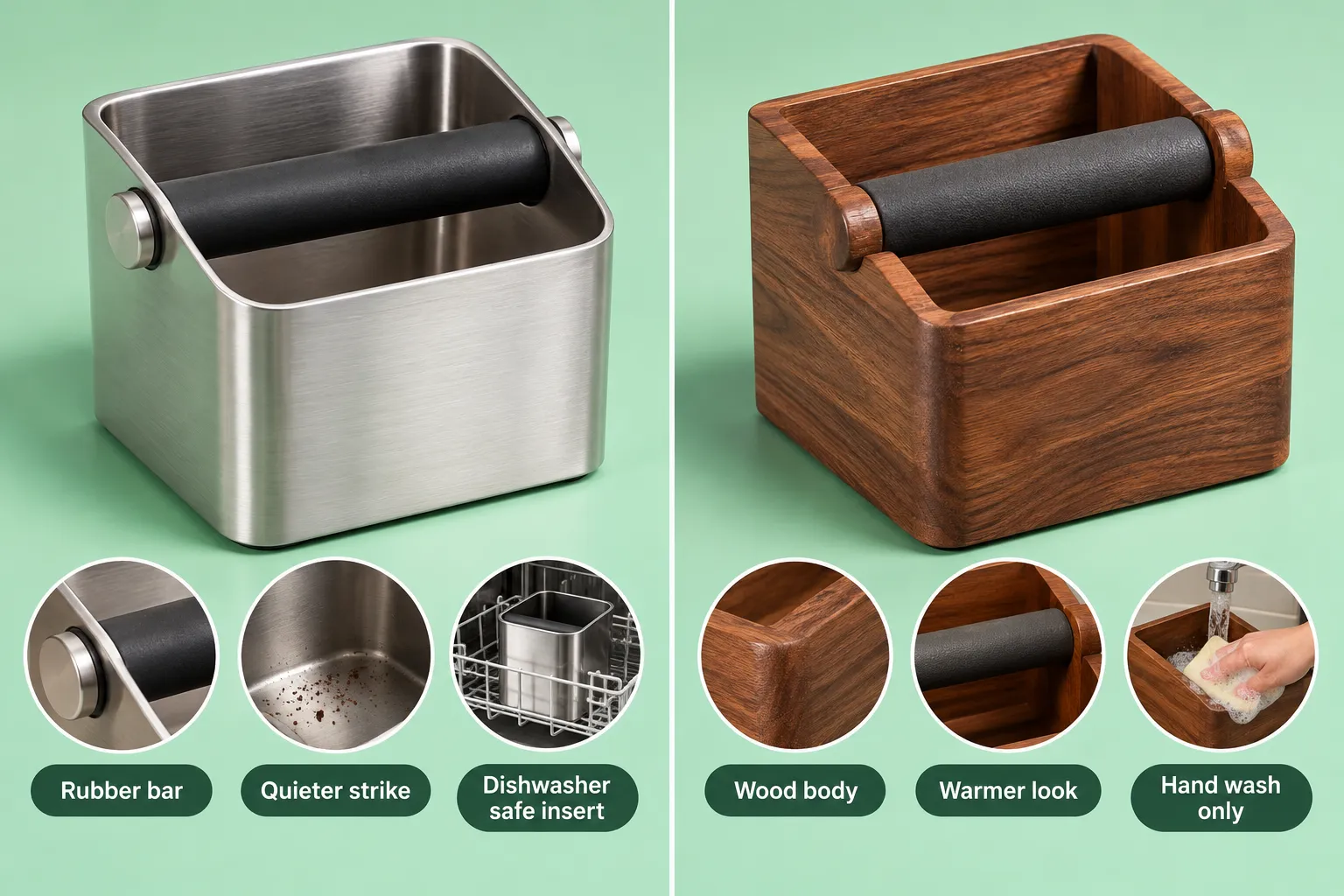
Five features we love
- A removable knock bar. Lift it out, rinse the sludge, dry it. Fixed bars trap grounds at the mounting point and start smelling sour within a fortnight.
- A rubber or silicone sleeve on the bar. Softer impact, less noise, and far less chance of denting a portafilter rim.
- Non-slip feet. They stop the box sliding when you strike hard. Cheap boxes without them need a second hand to hold them steady.
- A wide mouth relative to the body. Wide openings catch stray grounds that bounce off the bar, which keeps your counter clean.
- Dishwasher-safe stainless internals. Coffee oils go rancid. Being able to run the insert through a cycle once a week is the difference between a clean box and a science project.
What to watch out for
- Noise. A thin stainless shell on a stone countertop rings like a bell. If you brew before a sleeping household wakes, look for a rubber base and a heavier gauge body.
- Low knock bars. On boxes shorter than about 4 inches, a 58 mm portafilter spout can clip the rim.
- Slippery bodies. Light plastic boxes under $20 often need holding down.
- Overstated capacity. Every rated number assumes level packing. Discount by a quarter.
- Wood that cannot be washed. Pretty, and a slow-motion hygiene problem if you leave pucks in over a weekend.
Pros and cons of the compact 10-puck class
Pros
- Fits in a 5 inch counter gap
- Usually the cheapest stainless option, around $30
- Light enough to carry to the bin one-handed
- Forces frequent emptying, which keeps it clean
Cons
- Needs dumping every two or three days
- Fills in a single session while dialing in grind size
- Small mouth means more stray grounds
- Tends to slide without non-slip feet
Who should buy which
- Solo drinker, one or two shots, tight counter: Breville Knock Box 10 at $33.95. The winner for this buyer on footprint and build.
- Two-person household, 4 to 8 shots: the Knock Box 20 at 6.4 x 6.3 x 6.3 inches . Fewer trips to the bin.
- Ninja Luxe Cafe owner: the matching knock box at $29.97, mostly for the styling and the 10 double puck rating.
- Testing whether you even want one: the $14.99 plastic box. Upgrade later if the habit sticks.
- Skip a dedicated box entirely if you pull two shots a week and already keep a lined compost bin beside the machine.
Rubber vs wood espresso knock boxes: pros and cons
Rubber-barred stainless boxes win on hygiene and noise. Wood wins on looks and nothing else that matters at 6 a.m.
Rubber bar, stainless or plastic body
- Quieter strike, softer on the portafilter rim
- Removable and washable
- Replacement bars are cheap and widely available
- The rubber eventually stains dark brown; cosmetic only
Wood body or wood bar
- Warmer appearance on an open shelf
- Naturally dampens some ring
- Absorbs coffee oils over time and usually cannot go in a dishwasher
- Higher price for the same capacity
Decision rule: if the box sits on a visible open counter in a styled kitchen and you empty it daily, wood is a reasonable indulgence. For everyone else, a stainless body with a silicone-sleeved bar is the sensible buy.
Knock box drawer vs countertop: which style suits your setup?
A countertop box suits almost every home kitchen. A knock box drawer suits built-in setups, offices, and anyone who wants zero visible clutter.
Drawers mount under the machine or inside cabinetry and typically swallow 25 or more pucks, which is why Di Pacci recommends knock tubes and drawers for offices producing 20 to 60 pucks daily. They cost more, need installation depth, and are harder to deep clean.
A knock box drawer also moves the strike height. If the drawer sits low under a cabinet, check you can swing the portafilter without clipping the shelf above. Measuring the space above the machine is one of the most skipped steps in buying any espresso accessory, and it applies here too.
Can you use alternatives to an espresso knock box?
Yes, temporarily. A lined kitchen bin, a deep plastic food container with a wooden spoon handle laid across it, or a sturdy ceramic bowl will all catch pucks. None of them give you a padded bar at the right height.
What goes wrong with each:
- Striking the bin rim: dents and eventually cracks the portafilter rim, which ruins the group seal.
- Tapping the sink edge: grounds go down the drain and build a plug. Plumbers have opinions about this.
- A bowl with no bar: pucks come out in pieces and bounce.
Spent grounds are useful elsewhere. They go into compost, into garden beds in moderation, and some people keep a jar for scrubbing pans. The puck is wet, acidic, and heavy, so a bin liner is kinder to your rubbish bag than a loose dump.
What happens when your espresso knock box gets too full?
Three things, in order: the strike stops working, grounds fly, and the box starts to smell.
Once the pile reaches the knock bar, a puck has nowhere to fall. It bounces off the mound and lands on the counter. Past about 75% full, every strike pushes grounds up the walls and over the rim. Leave wet grounds for more than three or four days in a warm kitchen and mould appears on the surface, usually a white or grey bloom. It is not dangerous to the machine, but it smells sour and transfers to anything the box touches.
How often should you empty an espresso knock box?
Every two to three days for a home box, or whenever the pile reaches two thirds. Rinse it weekly and run removable parts through the dishwasher.
A practical schedule:
- Daily: glance at the fill level before the first shot.
- Every 2 to 3 days: empty into compost or bin.
- Weekly: remove the bar, wash with hot water and a drop of dish soap, dry fully.
- Monthly: check the bar sleeve for splits and the feet for loosening.
Coffee oils are the reason for soap. Rinsing alone leaves a film that turns rancid, and a rancid box sitting beside your cups is a flavour problem waiting to happen. If you are tightening up the rest of your routine, our troubleshooting guide for trouble-free espresso brewing covers the cleaning habits that actually change the cup.
Do all espresso machines work with standard knock boxes?
Almost all of them. A knock box is a passive bin; it has no electrical or plumbing connection to the machine. The only compatibility questions are portafilter diameter, bar height, and whether the box fits your counter.
Where problems appear:
- Super-automatic machines eject pucks into an internal bin, so a knock box is redundant. Check our roundup of super automatic espresso machines if one-touch drinks are the goal.
- Capsule machines eject capsules, not pucks. No knock box required.
- Bottomless or naked portafilters have no spout, which makes striking easier and the bar height less fussy.
- Very heavy prosumer portafilters need a box that will not slide. Weight and non-slip feet matter more than capacity here.
Can an espresso knock box hold pucks from multiple portafilters?
Yes. Pucks from a 51 mm single, a 54 mm double, and a 58 mm triple all go in the same bin without issue. Mixed sizes actually pack slightly better than uniform ones, because smaller pucks fill the gaps between larger ones.
The variable to track is total volume, not puck count. If two people are using two machines, add their daily shots together, then size the box for the combined figure plus 25%. A dual-machine household pulling 10 shots a day wants the 20-puck class at minimum.
Is a bigger espresso knock box worth buying?
Only if you have the counter space and the shot volume to justify it. Going from the Breville Knock Box 10 to the Knock Box 20 doubles rated capacity from 10 to 20 pucks and raises the footprint from a 4.4 inch cube to roughly a 6.4 inch cube . That is close to twice the counter area for a convenience gain measured in bin trips.
Buy bigger when:
- You pull six or more shots daily
- You dial in new beans weekly and generate throwaway shots
- You host, or the machine serves a home office
- Your counter has the room and you dislike mid-week chores
Stay small when:
- Your counter gap is under 6 inches
- You pull two shots a day
- You would rather spend the difference on a better espresso grinder, which changes the cup far more than a bigger bin does
Common mistakes when choosing an espresso knock box
Five mistakes show up repeatedly in buyer reviews and forum threads.
- Buying on rated capacity alone. Ratings are brand estimates. Discount by 25%.
- Not measuring the counter gap. A 6.4 inch box does not fit a 5 inch space, and returns are a nuisance.
- Ignoring the bar height. Spouted portafilters need clearance above the rim.
- Choosing a fixed, non-removable bar. Cleaning becomes a cotton swab exercise.
- Overlooking noise and stability. Thin metal on stone rings loudly, and light boxes slide. A rubber base fixes both.
A sixth, quieter mistake: assuming the knock box is an upgrade priority. It is not. Grind consistency, water temperature, and a fresh roast date move the cup; the knock box just keeps your counter tidy while you work on those. Our espresso extraction and crema guide is a better place to spend your attention.
Sizing calculator
What size knock box do you need?
‘+cls+’
‘+note; });
Sourced stat cards
Breville Knock Box 10 rated capacity and dimensions, manufacturer listing . Amazon price checked Nov 5, 2026: $33.95.
Breville Knock Box 20 rated capacity and dimensions, manufacturer listing .
Ninja Luxe Cafe knock box, listed at 10 double pucks. Amazon price checked Nov 5, 2026.
Budget plastic knock box, 1,000+ bought in the past month. Amazon price checked Nov 5, 2026.
Estimated weight of one wet spent puck, from an 18 to 21 g dry dose plus retained water (Espresso Verdict, updated Nov 1, 2026).
Capacity recommended for households and batch brewing, versus compact boxes for one or two drinks daily (Burr & Basket, Aug 7, 2026) .
FAQ

Conclusion
Buy the Breville Knock Box 10 at $33.95 if you pull one to four shots a day and your counter gap is under 6 inches. Step up to the Knock Box 20 at 6.4 x 6.3 x 6.3 inches if you pull six or more, host regularly, or dial in new beans weekly . The $14.99 plastic box is a fine way to find out whether you want one at all, and the $29.97 Ninja option makes sense for Luxe Cafe owners who like matched gear.
Next step: measure the gap between your machine and your grinder with a tape measure, then count how many shots you pulled yesterday. Those two numbers settle the decision in about ninety seconds. Run them through the calculator above, then compare the models before you buy.
Better Coffee Starts With Better Answers.