Dual Boiler Espresso Machine: Who Actually Needs One
Quick Answer
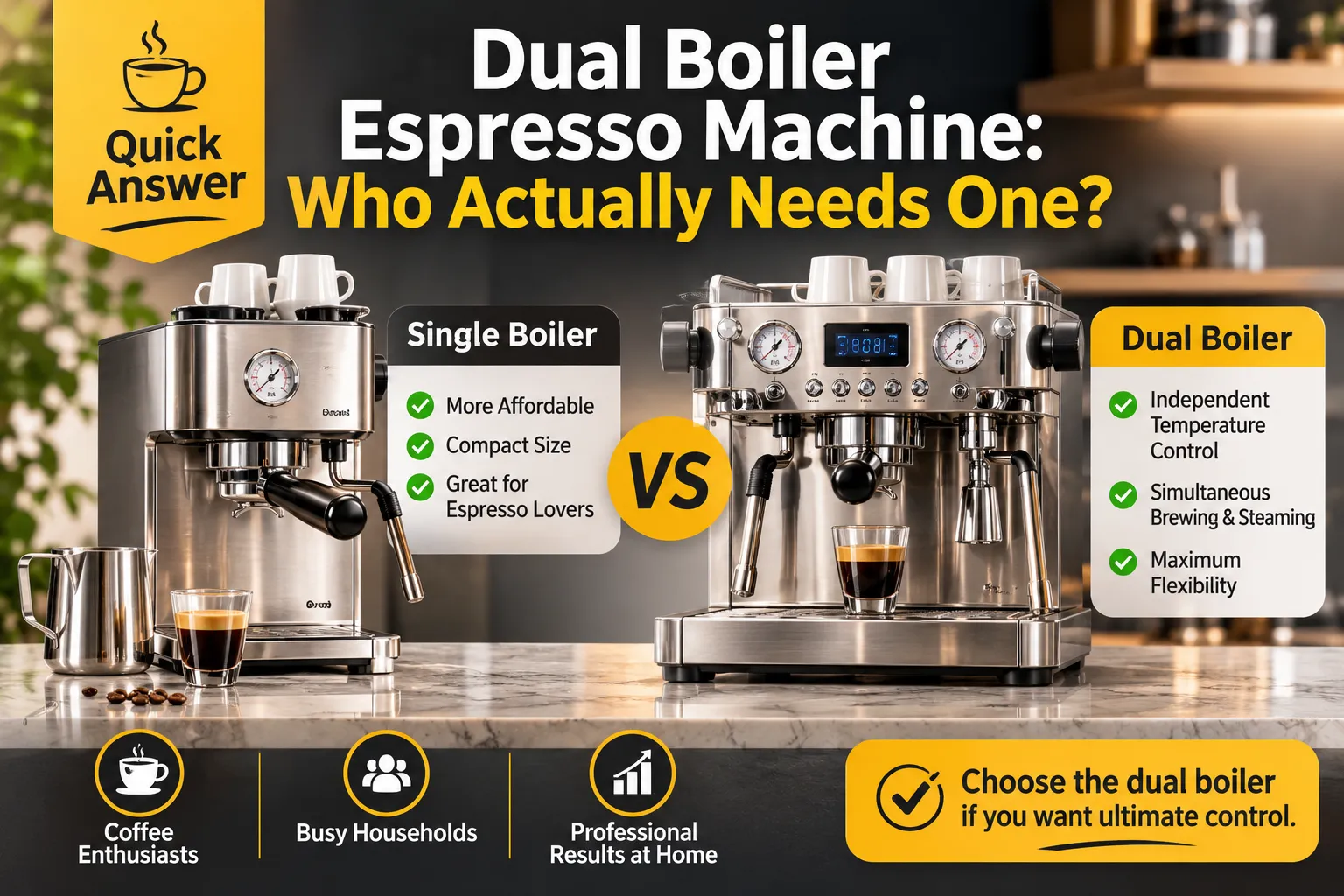
A dual boiler espresso machine earns its price only if you regularly make two or more milk drinks back to back, or you brew light roasts where brew temperature needs to move independently of steam pressure. If you drink straight espresso alone in the morning, the second boiler sits there heating water you never use. The honest test is a drink count, not a feature list.
Key Takeaways
- The drink-count test: two or more milk drinks in a single session, most mornings, justifies a dual boiler espresso machine. One flat white for one person does not.
- Dual boiler vs single boiler comes down to waiting. A single boiler makes you switch temperatures between brewing and steaming, usually 30 to 60 seconds each way.
- Breville's Oracle Dual Boiler sits at $2,999.95 in the US (Breville, price checked November 6, 2026) and bundles an integrated Baratza grinder, 45 grind settings, and automatic milk texturing.
- Lelit's Elizabeth3 launched October 1, 2026 with a 200 ml brew boiler, 600 ml steam boiler, and the new Pagaia flow-control system, from £1,499.95 in the UK (T3, 2026).
- Rocket's R58 Tune carries a 0.58 L brew boiler and a 1.8 L steam boiler with PID on both, per Seattle Coffee Gear (September 2026).
- Heat exchanger machines also brew and steam at the same time for less money, with a cooling flush of roughly 2 to 6 ounces or 30 to 45 seconds as the tradeoff.
- Warm-up is slower than the display suggests. Kaffeemacher's test of 12 machines recommended about 25 minutes before brewing so the group head stabilizes, not just the boiler water.
What is a dual boiler espresso machine, and how does it actually work?
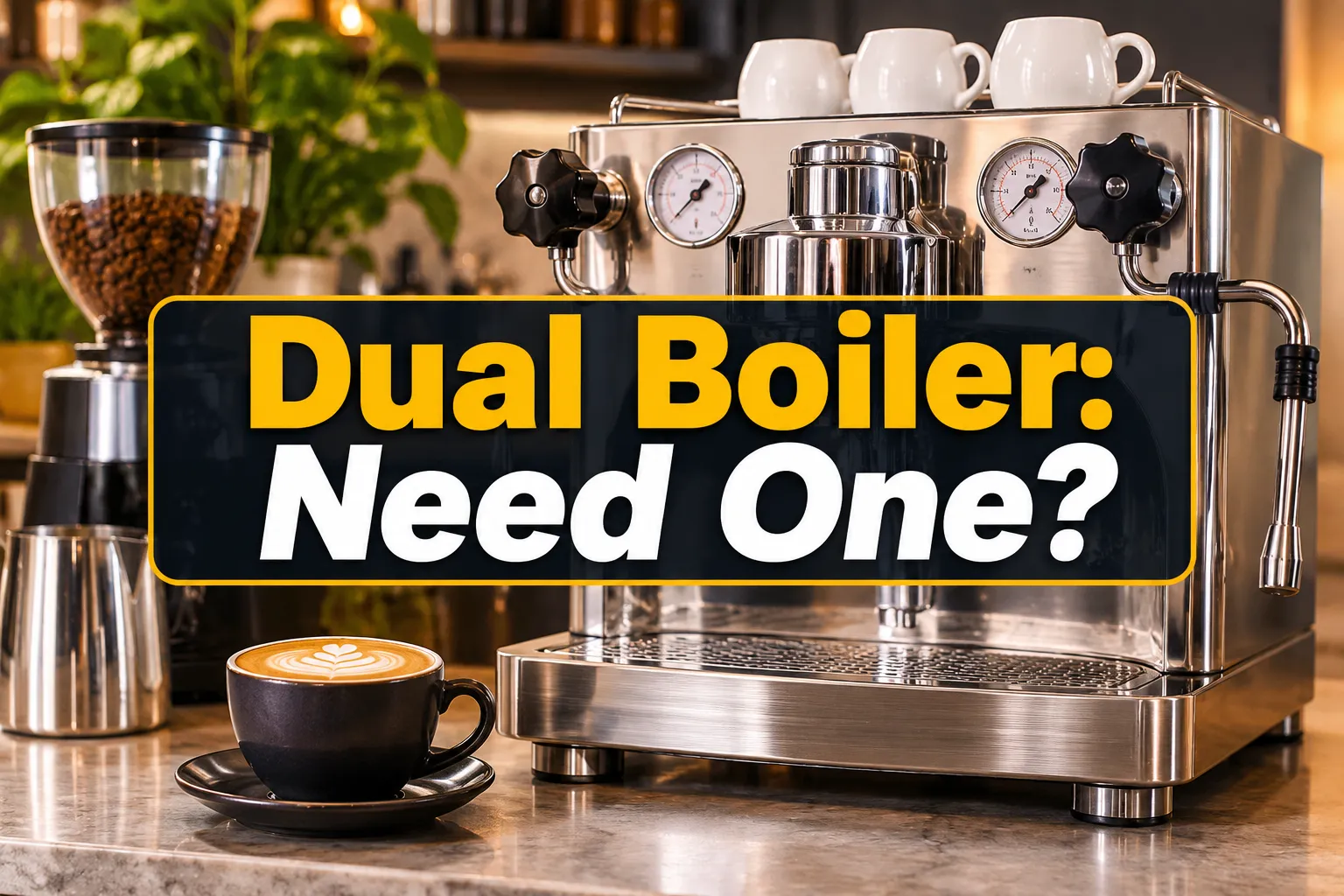
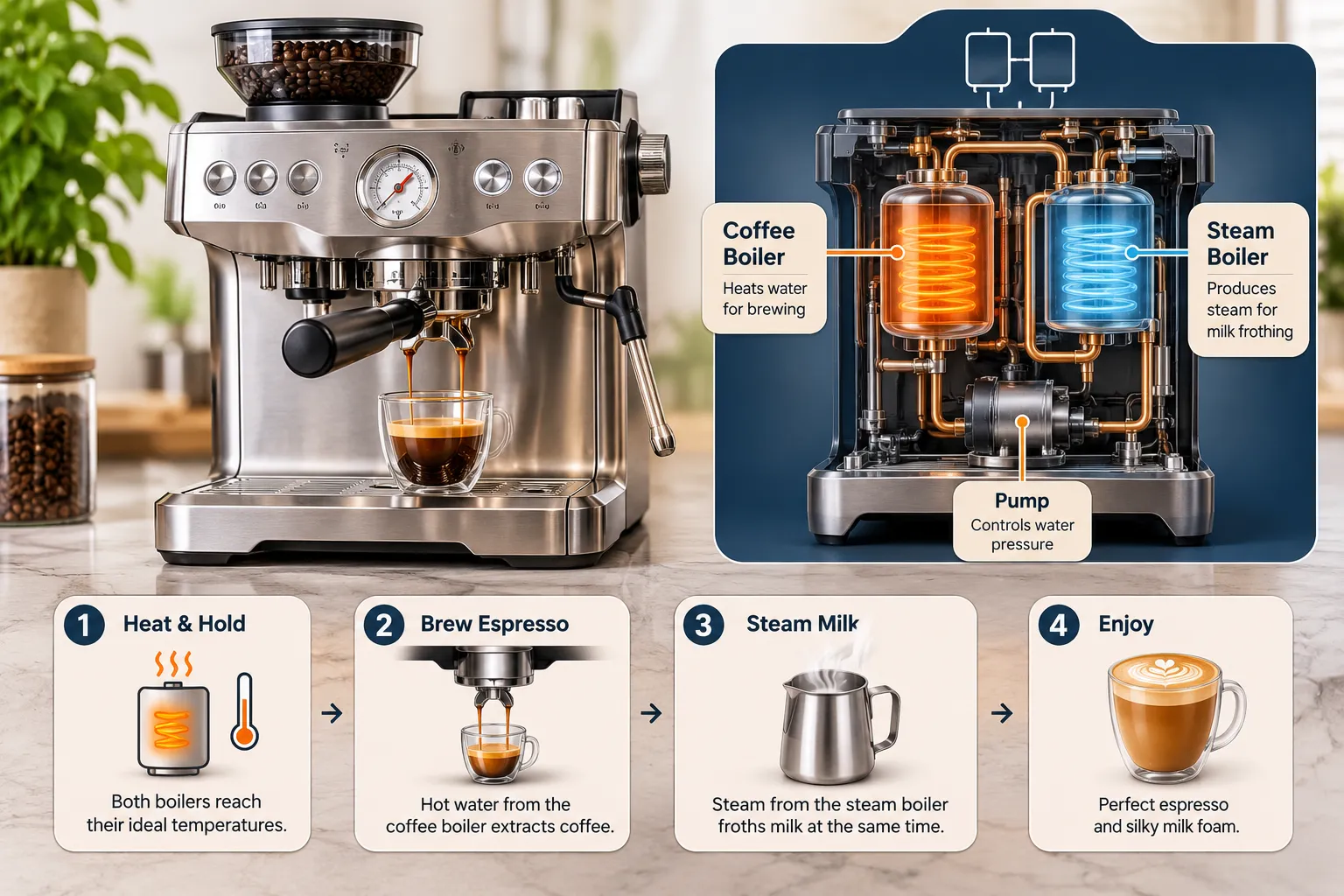
A dual boiler espresso machine uses two separate, independently heated water vessels: one held near brewing temperature (typically 198 to 204°F) and one held at steam temperature (around 250 to 265°F). Each has its own heating element and, on most models, its own PID temperature controller, which is a small circuit that holds a setpoint instead of swinging between on and off.
The mechanical picture is simple. Water leaves the tank, a pump pushes it toward the brew boiler, and that boiler feeds the group head where the portafilter locks in. Meanwhile, the steam boiler sits at a higher temperature and pressure, feeding the wand and usually a hot water tap. Breville's BES920 adds two pumps and an actively heated group head, so the metal the coffee passes through is also held warm rather than relying on leftover heat .
Because the two circuits never share water duties, changing your brew temperature by two degrees does nothing to your steam pressure. That independence is the whole product.
Common mistake: assuming "dual boiler" automatically means "fast." Boiler water hitting its setpoint is not the same as the group head, portafilter, and plumbing being thermally settled. Kaffeemacher's comparison of 12 espresso machines recommended roughly 25 minutes of warm-up before the first shot. Put the machine on a timer plug.
Dual boiler espresso machine: who actually needs one?
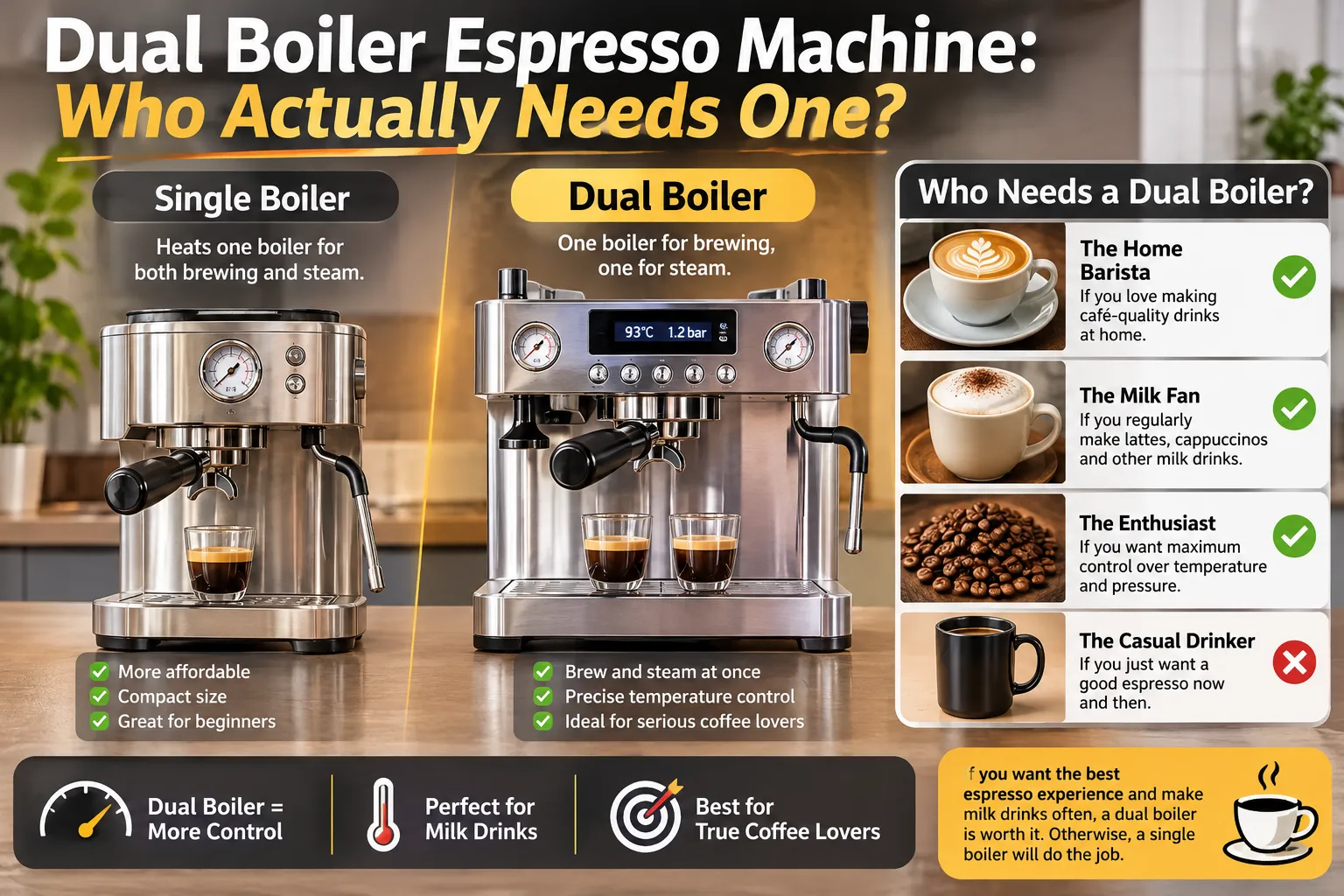
You need a dual boiler espresso machine if your typical session involves back-to-back milk drinks for two or more people, or if you brew light roasts and want to move brew temperature around without touching steam performance. Everyone else is buying capability they will not use.
Run the drink-count test honestly over one week:
| Your typical morning | What you need |
|---|---|
| One espresso or americano, solo | Single boiler. The second boiler is dead weight. |
| One cappuccino, solo, no rush | Single boiler with a good PID. Wait 40 seconds to switch. |
| Two milk drinks, two people, before work | Dual boiler, or a heat exchanger if you accept the flush. |
| Four or more drinks, guests, weekends | Dual boiler. Steam recovery matters here. |
| Light-roast single origin, varying temperature by bean | Dual boiler with independent PID. |
That middle row is where most buyers in the $300 to $1,500 range actually live. Two drinks is the hinge. On a single boiler, the second latte means waiting for the boiler to drop from steam temperature back to brew temperature, which usually means running water through the group until the thermostat resets. It works. It is just slow and a little annoying at 7:12 a.m.
Buy the machine that fits your weekday, not your fantasy Sunday.
Secondary readers deserve a straight answer too. If you want one-touch drinks with no learning curve, a super-automatic serves you better than any dual boiler; our guide to the best super automatic espresso machine covers that path. Gift buyers should almost never buy a prosumer dual boiler for someone who has not already been grinding their own coffee for a year.
What's the difference between a dual boiler and single boiler espresso machine?
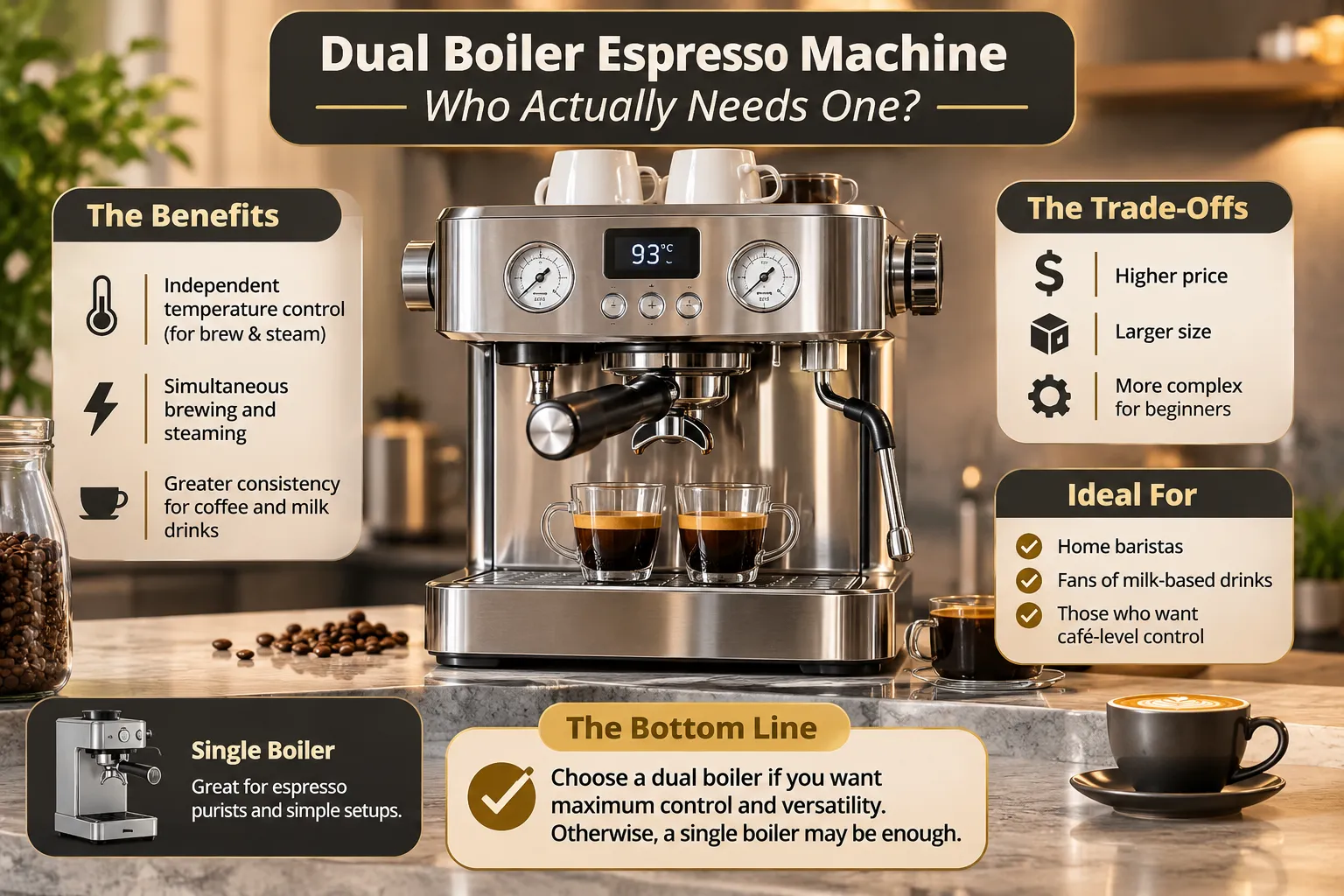
The difference is whether you can brew and steam at the same time. A single boiler has one vessel that must be heated to brew temperature for extraction and then reheated higher for steam, so the two tasks happen in sequence. A dual boiler runs both simultaneously .
Practical consequences of dual boiler vs single boiler:
- Sequencing. Single boiler: pull the shot, flip the steam switch, wait, steam, then cool the boiler back down before the next shot. Dual boiler: both ready at once.
- Temperature drift. Single boilers with simple thermostats can swing several degrees across a shot. A PID narrows that. Whole Latte Love reported that dual-boiler brew temperature in their testing held within roughly one degree of setpoint, though that figure depends on group design, boiler size, PID tuning and how they measured it.
- Steam power. Single-boiler steam on a 300 ml vessel runs out. Dual boilers dedicate 600 ml to 1.8 L to steam alone, so milk texture stays consistent across several pitchers.
- Price. Single boiler machines like the Gaggia Classic Pro land under $500. Dual boilers start around $1,200 and climb fast.
A well-tuned single boiler still makes excellent espresso. The Gaggia Classic Pro walkthrough exists because plenty of serious home baristas never move past one.
Dual boiler vs heat exchanger espresso machine: which should you get?
Choose a heat exchanger if you drink medium or dark roasts, want commercial-style steam, and will happily run a cooling flush. Choose a dual boiler if you brew light roasts, change beans often, or want brew temperature as an adjustable dial rather than an inherited consequence.
A heat exchanger (HX) machine has one boiler held at steam temperature, with a tube running through it. Brew water passes through that tube on its way to the group, picking up heat as it goes. It works, and HX machines also brew and steam at the same time . The catch is that water sitting in that tube while the machine idles gets too hot, so you purge a short flush first.
Typical cooling flush guidance sits around 2 to 6 ounces, or roughly 30 to 45 seconds, depending on design and idle time (Home-Barista; Complete Home Barista). That is a workflow cost, not a cup-quality verdict. A practiced HX user with a dark-roast blend will not taste a disadvantage.
Decision rule: if you cannot picture yourself cheerfully flushing water into a drip tray every single morning, buy the dual boiler. If that sounds like nothing, an HX machine saves you several hundred dollars and often gives you more steam.
Is a dual boiler espresso machine worth the extra cost?
It is worth it when the time saved and the temperature control get used. For a two-person household making four milk drinks a day, the second boiler pays back in minutes every morning and in consistency over years. For a solo espresso drinker, the same money buys a far better grinder, which changes the cup more.
Here is the uncomfortable math. A $1,400 dual boiler paired with a $150 grinder will usually be beaten by a $600 single boiler paired with a $950 grinder. Grind size and grind consistency drive extraction more than boiler count does. If your budget is one lump sum, split it in favor of the grinder first, then the machine. Our espresso grinder comparison walks through where that money actually shows up in the cup.
Also count the café math on your own terms. Two $6 lattes a day is about $4,380 a year at full retail, so hardware amortizes quickly if you genuinely switch. The failure mode is buying a machine you use twice a week.
- $2,999.95 for the Breville Oracle Dual Boiler, with integrated Baratza grinder, 45 grind settings, 5.7-inch display and a 2-year repair warranty (Breville).
- £1,499.95 starting price for the Lelit Elizabeth3, launched October 1, 2026, with a 200 ml brew boiler and 600 ml steam boiler (T3).
- 0.58 L brew / 1.8 L steam boilers with PID on both in the Rocket R58 Tune (Seattle Coffee Gear, September 2026).
- 950 ml dedicated steam boiler in the Breville BES920, plus dual pumps and a heated group head (Breville BES920 manual).
- ~25 minutes recommended warm-up before brewing, from Kaffeemacher’s test of 12 espresso machines.
- $2,125 starting price for the limited Porsche x La Marzocco Linea Micra collection launched October 30, 2026 (Hypebeast).
What are the best dual boiler espresso machines under 2000 dollars?
Under $2,000, the realistic shortlist is short: the Breville Dual Boiler (BES920) for the best feature-per-dollar ratio, and the Lelit Elizabeth family for buyers who want prosumer build and flow control in a compact body. Above that line, E61 machines like the Profitec Pro 700 and ECM Synchronika take over.
| Machine | Price (checked Nov 6, 2026) | Boilers | Best for |
|---|---|---|---|
| Breville Dual Boiler (BES920) | Around $1,600 US | PID brew + 950 ml steam, dual pumps | First dual boiler under 2000, milk drinks for two |
| Lelit Elizabeth3 | From £1,499.95 UK | 200 ml brew + 600 ml steam | Small counters, flow profiling, light roasts |
| Breville Oracle Dual Boiler | $2,999.95 US | Dual boiler + built-in Baratza grinder | One-touch buyers who still want dual boiler output |
| Rocket R58 Tune | Above $3,000 US | 0.58 L brew + 1.8 L steam, dual PID | E61 workflow with programmable pre-infusion |
Prices move. Check the current price before buying. Coffee Rank IQ earns affiliate commissions on some links, which does not change what we recommend.
Five features worth paying for
- Independent PID on both boilers. Lets you set 201°F for a washed Ethiopian and 198°F for a dark Brazilian without touching steam. The R58 Tune and most prosumer models have this.
- Actively heated group head. The Breville BES920 heats the group itself, so the first shot is not colder than the fifth.
- Dedicated steam boiler of 600 ml or more. Enough to texture two 12 oz pitchers without pressure sag.
- Programmable pre-infusion. Rocket's digitally controlled pre- and post-infusion softens the puck before full pressure, which helps with light roasts and channeling.
- Flow control. Lelit's Pagaia system on the Elizabeth3 brings pressure and flow profiling to a 38 x 36 x 41.5 cm footprint, previously a large-machine feature.
If you want the full E61 prosumer tier, read our Profitec Pro 700 and ECM Synchronika guides for the side-by-side on build quality, rotary pumps and plumb-in options.
Are dual boiler espresso machines good for beginners?
Mostly no, with one clear exception. A traditional dual boiler espresso machine assumes you already dose by weight, adjust grind size daily, and read a shot by taste and timing. That is a lot to learn alongside two temperature systems.
The exception is automated dual boilers. Serious Eats highlighted the Breville Oracle Dual Boiler in early November 2026, with editor Rochelle Bilow describing it as guiding the user through grinding, extraction and milk texturing rather than automating a single stage . Automatic grinding, dosing, tamping and milk texturing remove the three skills beginners fumble most.
If you are starting out and the $3,000 figure makes you flinch, start cheaper and learn the variables. The best espresso machine for beginners roundup and the Breville Barista Express guide are better first stops. You can resell a Barista Express. A disappointing $2,000 purchase stings longer.
Can you really brew and steam at the same time on a dual boiler?
Yes. Separate boilers, separate heating elements, and on many models separate pumps mean extraction and steaming run concurrently with no measurable interference in brew temperature . That is the functional definition of the category.
What this looks like in practice: lock the portafilter, start the shot, and immediately purge the steam wand and start texturing milk. Both finish within about 35 seconds of each other. You pour, and the machine is ready for the second drink while the first is still hot.
Edge case: very small brew boilers can run short on long back-to-back lungos or americanos for a crowd. A 200 ml brew boiler refills quickly, but if you are making eight americanos at a holiday brunch, a larger brew boiler or a separate pour over setup is the saner answer.
What are the most common problems with dual boiler espresso machines?
The frequent complaints are scale buildup in the steam boiler, failed solenoid valves, leaking group gaskets, and PID or sensor faults that are harder to diagnose than on a simple single boiler . Two boilers also means two things that can break.
Ranked by how often owners report them:
- Scale. The steam boiler runs hotter, so mineral deposits form faster there. Hard water accelerates this badly.
- Group gasket wear. The rubber seal around the portafilter hardens and leaks, usually every 9 to 18 months with daily use.
- Solenoid valve blockage. Coffee fines and scale clog the three-way valve, causing weak backflush or a soggy puck.
- Electrical and sensor faults. More electronics means more failure points, and parts can be slow to arrive for European prosumer brands.
- Underpowered circuits. High-wattage machines should go into a grounded outlet directly, not an extension cord (Coffee Gear 360, 2026).
Serviceability deserves weight in your decision. Before buying, check whether gaskets, shower screens and the steam valve are user-replaceable and whether a US parts supplier stocks them. Our espresso equipment maintenance guide covers the routine in detail.
How much maintenance does a dual boiler need, and how often should you descale?
Plan on a 30-second daily wipe-down, a weekly chemical backflush, gasket replacement roughly once a year, and descaling every 3 to 6 months on hard water or every 6 to 12 months on filtered or softened water. Many manufacturers advise against descaling certain stainless boilers chemically, so read your manual before pouring anything in.
A workable schedule:
- Daily: purge and wipe the steam wand immediately after each use. Knock out the puck, rinse the basket, flush the group.
- Weekly: backflush with a blind basket and espresso machine detergent. Soak the portafilter and baskets.
- Monthly: remove and clean the shower screen and dispersion plate.
- Every 3 to 6 months: descale if your water is hard, or replace the inline filter cartridge if your machine uses one.
- Annually: replace the group gasket.
The cheapest maintenance decision is water. Filtered water with moderate mineral content prevents most scale problems before they start and will not flatten your extraction the way distilled water can. See our coffee machine descaling walkthrough for the method and the chemicals that are safe for which materials.
Should you buy a used dual boiler espresso machine?
A used dual boiler can be a smart buy, but only with service history, a live demonstration, and known water conditions. A neglected $2,500 machine with a scaled steam boiler can cost $400 to $700 to return to health, which erases the discount.
Checklist before you hand over cash:
- Ask what water the owner used. "Tap, straight from the sink" in a hard-water region is a red flag.
- Watch it make a drink. Check that steam pressure holds and the group does not drip after the shot ends.
- Look under the drip tray for crusty white mineral deposits and green copper corrosion.
- Ask for descaling and gasket replacement dates.
- Confirm parts availability for that exact model, not just the brand.
- Factor in a $150 to $250 service as part of your purchase budget.
Prosumer E61 machines like the Profitec Pro 700 and ECM Synchronika hold value well partly because they are rebuildable. A ten-year-old one with records can be a better buy than a three-year-old plastic-heavy model with none.
What mistakes do people make with a dual boiler espresso machine?
The biggest one is pairing an expensive machine with a cheap grinder. After that: brewing before the group is stabilized, over-flushing out of HX habit, and never adjusting brew temperature despite paying for the ability to.
Specific errors worth avoiding:
- Underpowered grinder. A blade grinder or a low-end burr grinder will undermine every dollar you spent on temperature control.
- Brewing at minute five. Allow around 25 minutes from cold, based on Kaffeemacher's testing recommendation.
- Leaving the default temperature forever. Light roasts usually want 201 to 204°F; dark roasts often taste better at 195 to 198°F.
- Skipping backflush. Oils build up in the three-way valve and the next shot tastes stale before you blame the beans.
- Steaming too much milk. A 12 oz pitcher for a 6 oz cappuccino means wasted milk and a thin texture. The cappuccino vs latte breakdown explains the ratios.
- Ignoring roast date. A dual boiler cannot rescue beans roasted four months ago.
Alternatives to a dual boiler that still pull great shots
If your drink count is low or your budget is tight, three alternatives deliver real espresso without two boilers: a PID-equipped single boiler, a heat exchanger machine, or a quality semi-automatic plus a separate milk frother.
- Single boiler with PID. Under $800, stable brew temperature, perfectly good for one or two drinks with a short wait. Start with our best semi automatic espresso machine picks.
- Heat exchanger. Simultaneous brew and steam, commercial steam power, cooling flush required. Often several hundred dollars less than a comparable dual boiler.
- Single boiler plus standalone milk frother. An automatic frother textures milk while the boiler stays at brew temperature. Not latte-art grade, but fine for cappuccinos.
- Super-automatic. If convenience is the real goal, stop pretending you want a hobby and buy one.
- Manual lever. For the cost of a mid-range dual boiler you can buy an excellent manual espresso machine and a serious grinder.
Pros and cons at a glance
Pros
- Brew and steam at the same time, no waiting, no flushing.
- Independent brew temperature control for different roast levels.
- Strong, consistent steam across several pitchers.
- Built to be serviced and rebuilt on prosumer models.
- Noticeably faster for households making 3+ drinks.
Cons
- $1,200 to $3,000 entry, often more than a grinder upgrade would improve the cup.
- Longer warm-up, around 25 minutes for full stability.
- More components to maintain and more failure points.
- Larger footprint and higher power draw.
- Wasted capability for solo straight-espresso drinkers.
FAQ
Conclusion
The verdict: a a dual boiler is the right purchase for households making two or more milk drinks back to back on ordinary weekday mornings, and for anyone brewing light roasts who wants brew temperature as a dial. Straight espresso drinkers, occasional users, and anyone still running a budget grinder will get more cup improvement from spending that money elsewhere.
Your next step is a one-week drink count. Write down every espresso drink made in your home, who it was for, and whether two were made back to back. If back-to-back milk drinks happen four or more mornings, compare the Breville Dual Boiler and the Lelit Elizabeth3 and check the current price on both. If they do not, buy a better burr grinder first and run the test again in six months.
Better Coffee Starts With Better Answers.
Affiliate disclosure: Coffee Rank IQ earns commissions from some product links. Prices were checked November 6, 2026 and change without notice. This article is based on published specifications, manufacturer documentation and cited third-party testing, not on hands-on testing of every model named.