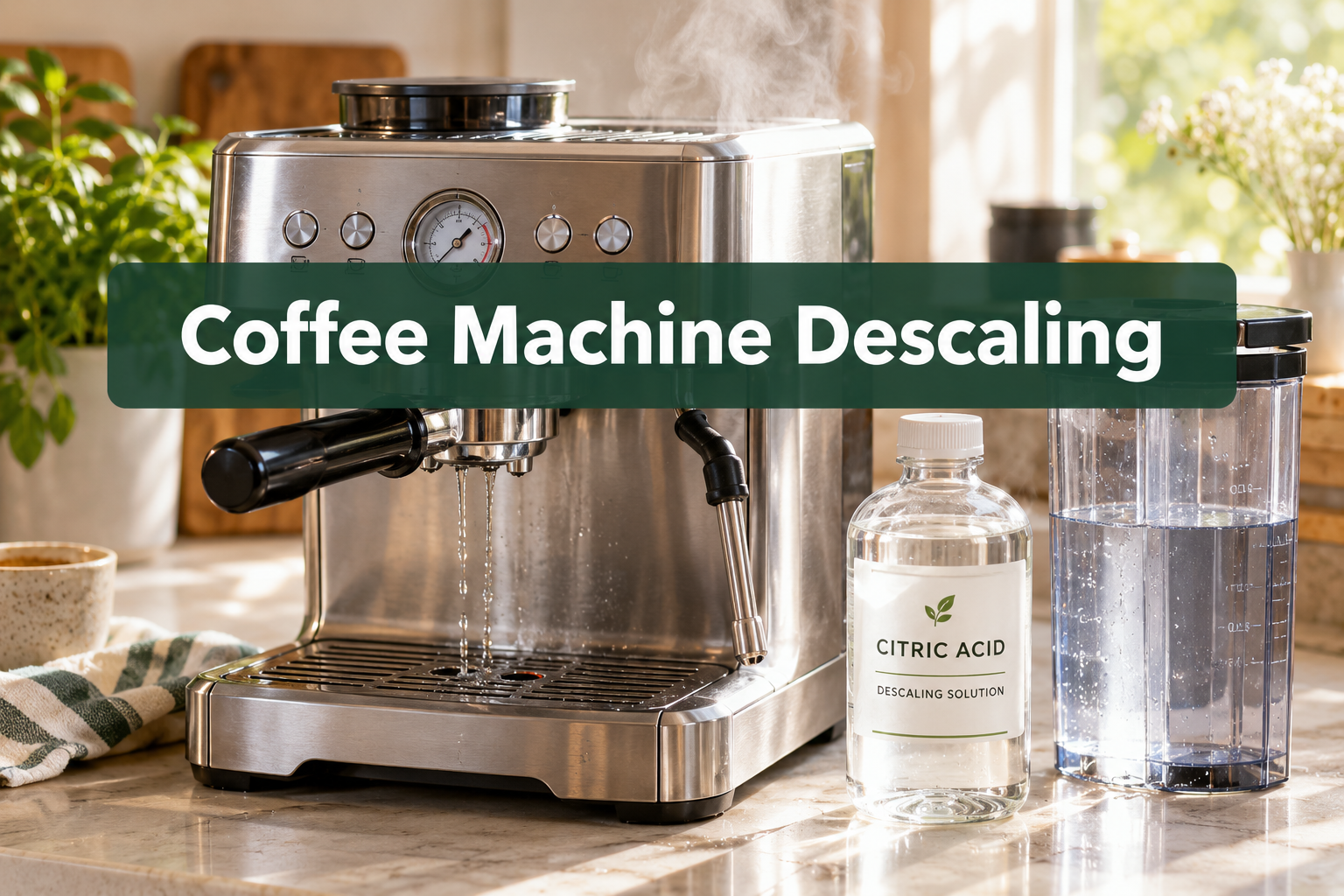
Coffee Machine Descaling: How Often and What to Use
Your espresso machine's descale light is not a suggestion. It is measuring mineral buildup inside a boiler that was never built to hold calcium and magnesium deposits, and ignoring that light long enough can turn a bottle of descaling solution that costs about fifteen dollars into a repair bill that costs a lot more. Coffee machine descaling removes those mineral deposits from the internal water path, and how often you need to do it depends mostly on one variable: the hardness of the water coming out of your tap.
Quick answer
Most home coffee makers and espresso machines need descaling every 1 to 3 months, tightening to every 4 to 6 weeks if your water is hard and stretching to every 3 to 6 months if it's soft or filtered. Pod machines like Keurig and Nespresso can often go 2 to 4 months between descaling cycles under normal home use. If you brew daily, a good default for coffee machine descaling is once a month unless you know your water is soft.
Key takeaways
- Coffee machine descaling dissolves calcium and magnesium scale that hard water leaves behind inside boilers, heating elements, and water lines.
- Typical home interval: every 1 to 3 months, adjusted up or down based on water hardness.
- Very hard water (above 180 to 300 ppm) can require monthly or even every-2-weeks descaling.
- Soft or filtered water (under 75 to 100 ppm) can stretch the interval to 4 to 6 months.
- Citric acid descaler and manufacturer-branded solutions are the standard choice; plain white vinegar works but leaves odor and can degrade rubber seals over repeated use.
- Slower brew times, quieter shots, louder heating noise, and a persistent descale light are the clearest signs your machine needs attention.
- Skipping coffee machine descaling shortens machine life, weakens heat transfer, and can flatten espresso crema over time.
- Rinse with at least two full tanks of clean water after any descaling cycle so no solution residue ends up in your cup.
Coffee machine descaling: what it is and why it matters
Coffee machine descaling means running an acidic solution through your machine's internal water path to dissolve limescale, the chalky mineral deposit left behind when hard water heats up and evaporates. It matters because that scale builds up exactly where your machine needs precision: heating elements, thermoblocks, flow sensors, and narrow tubing.
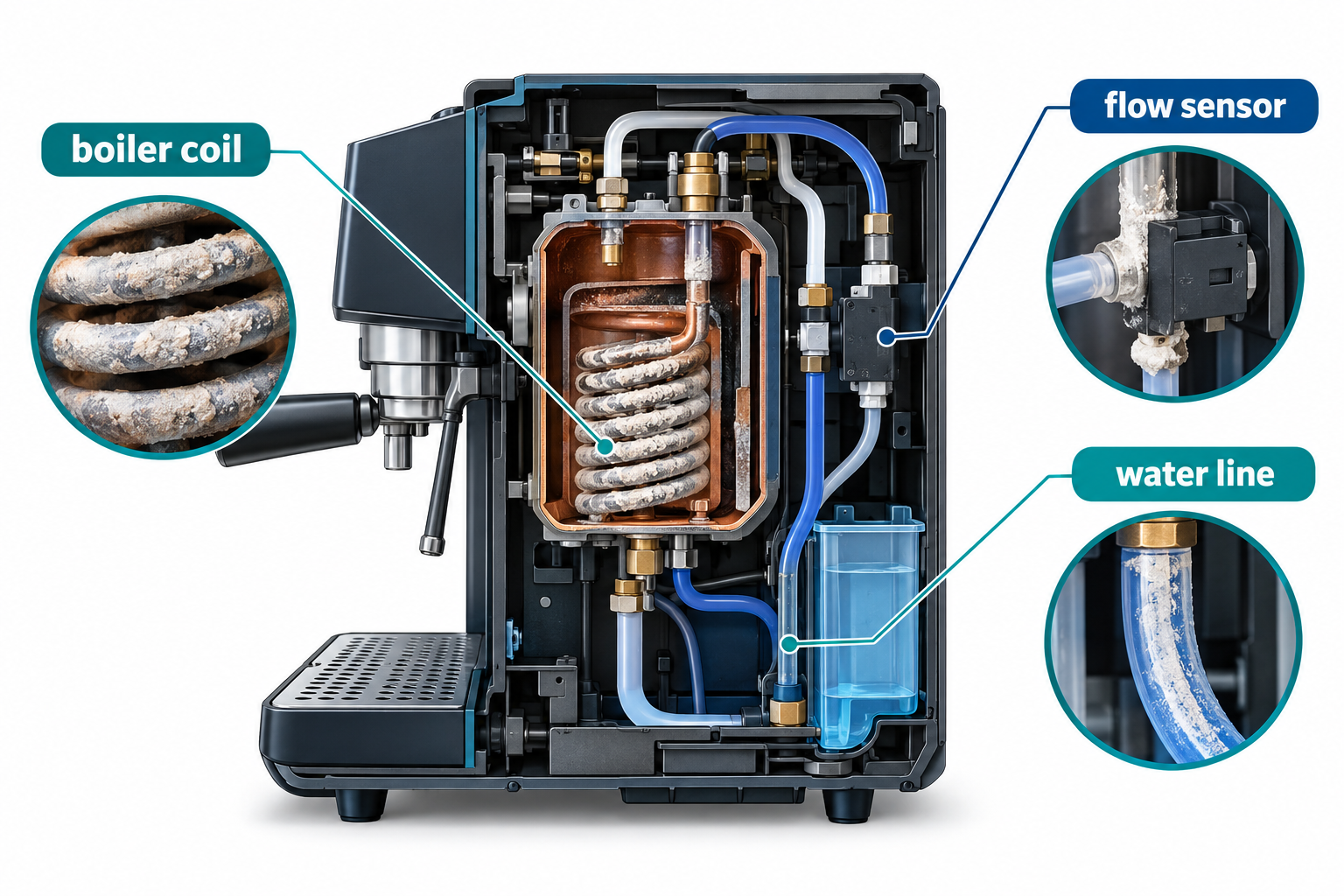
Tap water carries dissolved calcium and magnesium. When water heats inside a boiler, some of those minerals fall out of solution and stick to metal surfaces, the same process that leaves a white ring in a kettle. Coffee machine descaling reverses this by dissolving the deposits with a mild acid, usually citric acid or a proprietary blend, so water can flow and heat normally again.
This is different from routine cleaning. Wiping down a portafilter or running a rinse cycle removes coffee oils and grounds. Descaling coffee machine parts targets the hard mineral layer that ordinary cleaning can't touch, which is why manufacturers treat the two tasks as separate maintenance steps.
How often should you descale a coffee machine
For typical home use, descale every 1 to 3 months, moving to every 4 to 6 weeks in hard water areas and stretching to every 3 to 6 months with soft or filtered water. Usage frequency and machine type shift this window in either direction.
Water hardness is measured in parts per million (ppm) of dissolved minerals, and 2026 guidance increasingly ties descaling schedules to specific ppm ranges rather than a flat calendar rule:
| Water hardness | Approximate ppm | Recommended descaling interval |
|---|---|---|
| Soft / filtered | Under 75 to 100 ppm | Every 4 to 6 months |
| Moderate | 100 to 200 ppm | Every 2 to 4 months |
| Hard | 200 to 300 ppm | Every 4 to 8 weeks |
| Very hard | 300+ ppm | Every 2 to 4 weeks or monthly |
If you don't know your water hardness, most US municipal water suppliers publish it in an annual water quality report, or you can test it with an inexpensive strip. Filtered or softened water below about 75 ppm can push descaling out to 6 months, since scale simply forms much more slowly.
Do all coffee machines need descaling?
Yes, if they heat water and you don't exclusively use distilled or reverse-osmosis water. Drip coffee makers, single-serve pod machines, and espresso machines all heat mineral-bearing water, so all of them accumulate scale over time. The interval differs by machine type, not the need itself. Drip makers tend to tolerate longer stretches, roughly 6 months in soft water versus 2 to 3 months in hard water, while pod machines and espresso machines with narrower internal tubing scale up faster and need more frequent attention.
Decision rule: if you brew daily and don't know your water hardness, default to monthly coffee machine descaling. It's a safe middle ground that protects the machine without wasting solution.
How do I know if my coffee machine needs descaling
Watch for slower brew times, a machine that sounds louder or works harder to heat water, cooler shots from an espresso machine, or a lit descale indicator. These are the clearest real-world signals that limescale is restricting water flow and heat transfer.
Specific symptoms by machine type:
- Drip coffee makers: brewing takes noticeably longer than usual, or water pools and drains slowly.
- Nespresso and pod machines: an orange or red indicator light, or reduced water flow through the needle.
- Espresso machines: shots pull slower, temperature feels inconsistent, or crema looks thinner than normal.
- Any machine: a hissing or gurgling sound during heating, visible white flakes in water reservoirs, or a chalky ring around the tank waterline.
If any of these show up before your usual interval, don't wait for the calendar. CoffeeBumper's analysis frames its 2 to 3 month baseline as appropriate only when these symptoms are absent, meaning hard water regions may need to descale on symptom cues rather than a fixed date.
What happens if you don't descale your coffee machine
Skipping coffee machine descaling lets limescale keep building inside the boiler and tubing, which slows water flow, weakens heat transfer, and eventually raises the risk of clogs or component failure. The damage is gradual, so it's easy to miss until performance drops noticeably.
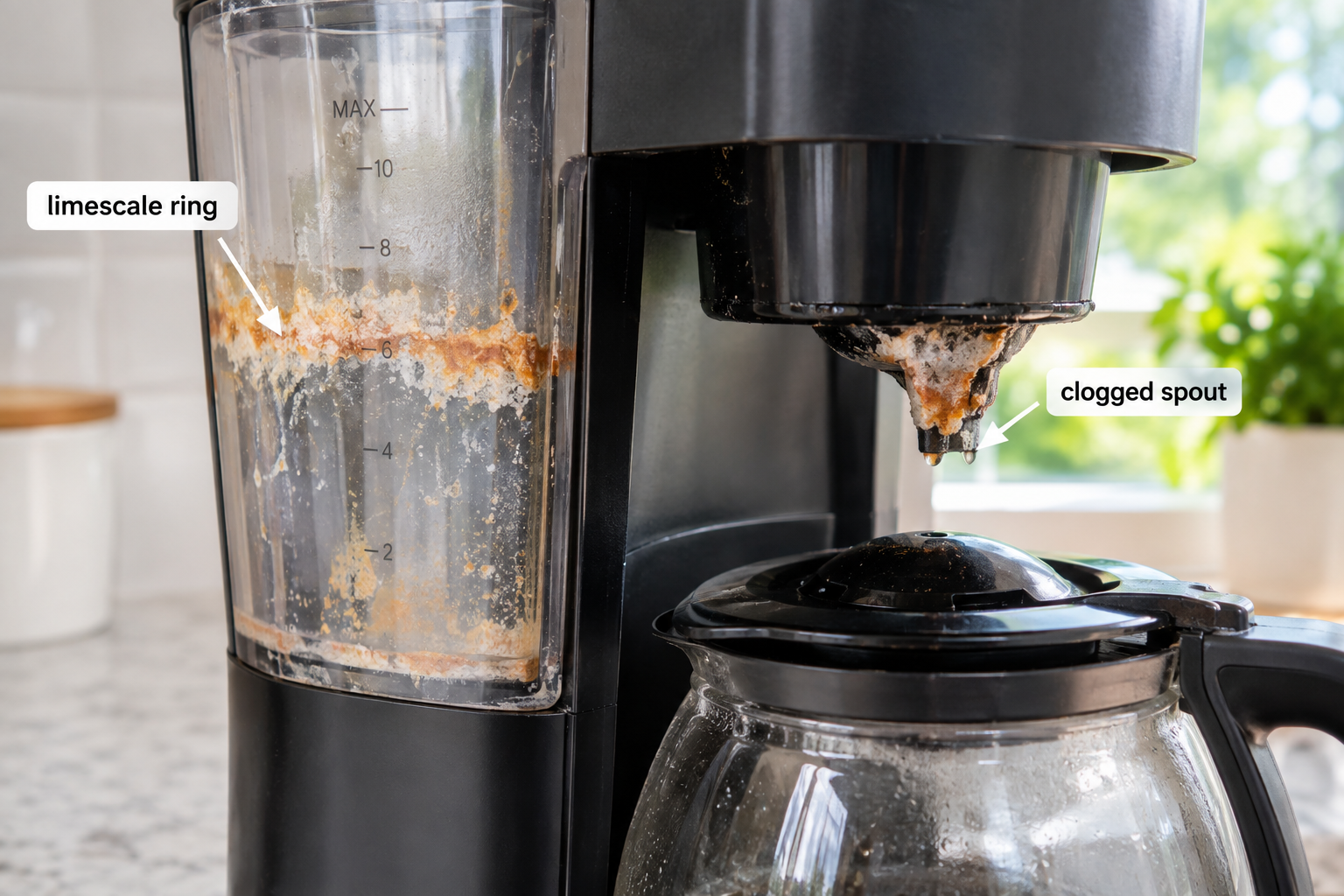
In practical terms, an under-descaled machine shows up as:
- Longer brew and shot times as narrowed passages restrict flow.
- Off flavors, since mineral buildup can affect water temperature stability during extraction.
- More frequent clogs in fine tubing, valves, and steam wands.
- Reduced machine lifespan, since heating elements work harder against insulating scale and can fail early.
None of this happens overnight. A machine running on moderately hard water without regular descaling might show its first slowdown after 3 to 4 months, then progressively worse symptoms from there. Keeping up with coffee machine descaling on the recommended schedule is genuinely one of the cheaper ways to extend an espresso machine's working life, right alongside the basics covered in our guide to espresso machine cleaning for coffee shops, which applies just as well to a busy home counter.
What's the best descaling solution for coffee makers
Citric acid descaler and manufacturer-branded solutions are the most recommended coffee machine descaling solution in 2026 guidance, chosen for predictable strength and gentleness on rubber seals compared with vinegar. A typical citric acid mix uses 20 to 30 grams of citric acid per liter of warm water.
Three options dominate the coffee machine descaling solution market:
- Citric acid descaler. Dissolve 20 to 30 g of citric acid per liter of warm water. Cheap, food-safe, widely available as a powder, and the standard recommendation for both home and commercial machines.
- Manufacturer-branded descaler (Keurig, Nespresso, Breville, De'Longhi). Pre-measured, formulated for that specific machine's seals and sensors, and the safest choice if your warranty terms require it.
- White vinegar. Effective at dissolving scale but more acidic and harsher on rubber gaskets over repeated use, plus it leaves a smell that takes extra rinsing to clear.
Choose citric acid descaler if you want a low-cost, repeatable routine and don't mind measuring powder. Choose a branded solution if your machine's warranty specifies it or you prefer a pre-measured pouch with zero guesswork.
Can you use vinegar to descale a coffee machine
Yes, plain white vinegar can descale a coffee machine, and it works through the same acid-dissolves-mineral mechanism as citric acid. It's a reasonable emergency option, but it's not the top pick for regular coffee machine descaling because of odor and long-term wear on seals.
How to descale a Keurig with vinegar:
- Mix equal parts white vinegar and water in the reservoir.
- Run the solution through a brew cycle without a K-Cup, into a mug you'll discard.
- Repeat with fresh vinegar solution 2 to 3 times, letting the machine sit for 15 to 20 minutes between cycles if scale is heavy.
- Run at least 3 to 4 cycles of plain water afterward until no vinegar smell remains.
The main drawback: vinegar's acetic acid is more aggressive on rubber gaskets and silicone seals than citric acid, and repeated vinegar use over years can shorten their life. It also needs more rinsing to fully clear the smell, which matters more in espresso machines with narrow steam wand paths than in simple drip makers.
Descaling solution vs vinegar: which is better
A dedicated coffee machine descaling solution (citric acid or branded) is generally the better long-term choice, since it's gentler on seals, rinses out faster, and is formulated to match specific machine tolerances. Vinegar is the better choice only when you need something today and don't have descaler on hand.
| Factor | Citric acid / branded descaler | White vinegar |
|---|---|---|
| Effectiveness on scale | Strong, purpose-built | Strong, general purpose |
| Seal and gasket wear | Low | Higher over repeated use |
| Rinse effort needed | Moderate | Higher (odor lingers) |
| Cost | Low to moderate | Very low |
| Best for | Regular scheduled descaling | One-off emergency descaling |
Decision rule: use citric acid descaler or a branded coffee machine descaling solution for your regular schedule, and keep vinegar as a backup for the month you run out.
How to descale a coffee maker: step by step
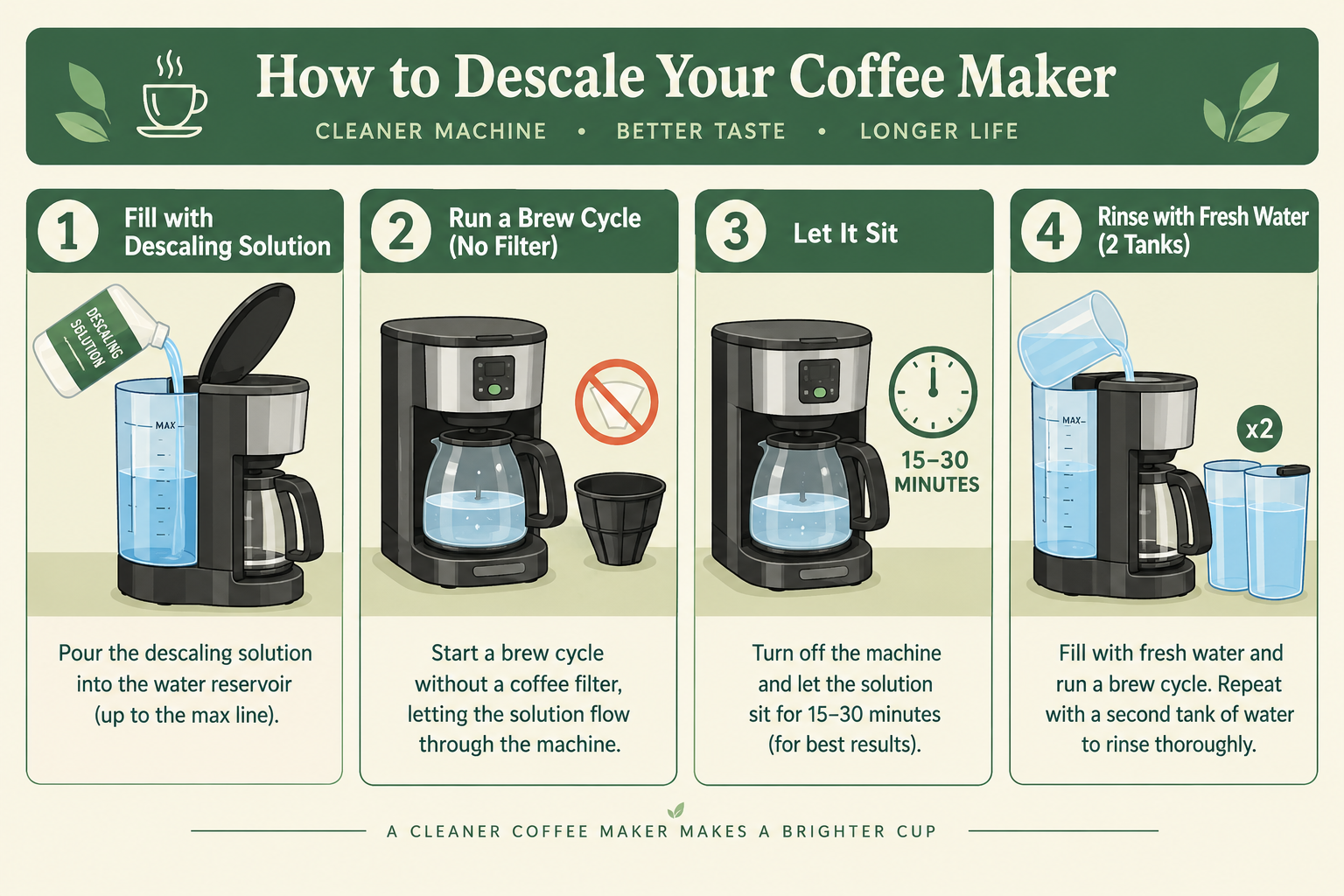
The core method is the same across most machines: fill the reservoir with descaling solution, run it partway through the internal water path, let it sit, then rinse thoroughly with clean water. The details shift slightly by machine type.
How to descale a coffee maker (drip machine):
- Empty the reservoir and mix your citric acid descaler or vinegar solution per the ratio on the label.
- Fill the reservoir and start a brew cycle with no filter or grounds.
- Pause halfway through and let the solution sit in the reservoir and lines for 15 to 20 minutes.
- Finish the brew cycle into a carafe, then discard the liquid.
- Run 2 to 3 full cycles of clean water to rinse completely.
How to descale a coffee maker Keurig style (pod machines):
- Remove the water filter cartridge if your model has one.
- Fill the reservoir with descaling solution (citric acid mix or a Keurig-branded descaling solution).
- Run repeated brew cycles without a pod, discarding the liquid each time, until the reservoir empties.
- Let the machine sit for 30 minutes with the solution in the internal lines if scale is heavy.
- Refill with plain water and run 10 to 12 rinse cycles, checking that no descaler smell or taste remains.
How to descale an espresso machine:
- Remove the portafilter and any water filter.
- Fill the water tank with citric acid solution mixed at the label's ratio (commonly 20 to 30 g per liter).
- Run the solution through the group head in short bursts, and through the steam wand separately, since both paths scale independently.
- Let the machine sit with solution in the boiler for 15 to 20 minutes.
- Rinse by running at least two full tanks of fresh water through both the group head and steam wand.
If you're shopping for a new machine and want one with fewer descaling headaches, check which grind size and workflow it's built for first. Our guide to the best grind of coffee for an espresso machine and our breakdown of what kind of coffee to use for an espresso machine both cover how grind and bean choice interact with the same water path you're descaling.
How to descale a coffee machine without descaling solution
You can descale without commercial descaler using citric acid powder (a pantry-adjacent alternative) or white vinegar, both of which are common answers to how to clean a coffee maker without vinegar's stronger cousins on hand. Citric acid mixed at home performs close to most commercial coffee machine descaling solutions.
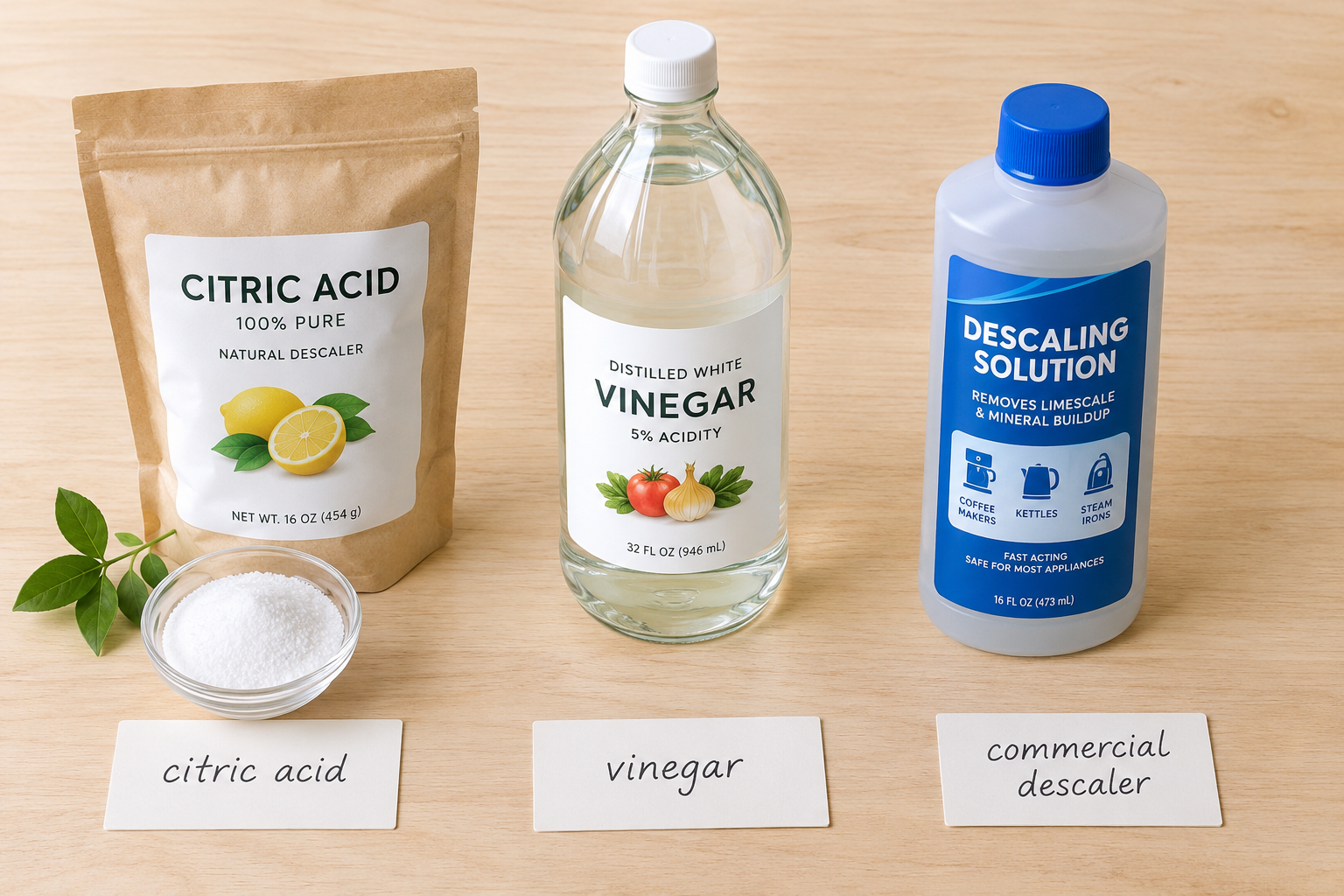
If you have neither vinegar nor citric acid, lemon juice diluted with water is a weaker but usable substitute in a pinch, though it's less consistent and can leave more residue than a clean citric acid mix. It's not a long-term replacement, just a stopgap.
Common mistake: using baking soda as a descaler. It's alkaline, not acidic, so it doesn't dissolve limescale the way citric acid or vinegar does. Save baking soda for odor removal in the fridge, not your coffee machine.
How long does it take to descale a coffee machine
A full coffee machine descaling cycle, including the soak and rinse, typically takes 30 to 60 minutes for a home drip maker or pod machine, and closer to 45 to 90 minutes for an espresso machine with a separate steam wand path. Most of that time is passive waiting, not active work.
Rough breakdown:
- Mixing solution and setup: 5 minutes.
- Running solution through brew or group head cycles: 10 to 20 minutes.
- Soak time for heavy scale: 15 to 20 minutes.
- Rinse cycles with clean water: 10 to 30 minutes, depending on machine complexity.
Espresso machines take longer mainly because the steam wand and group head need separate passes, and thorough rinsing (at least two full tanks) takes real time to run through.
Can you descale a coffee machine too often
Yes, descaling far more often than your water hardness requires can gradually wear rubber seals and gaskets, since even mild acids have some cumulative effect on rubber and silicone over repeated cycles. There's no danger in one extra cycle, but a weekly habit with no real scale buildup isn't doing your machine any favors.
Edge case: if you use bottled spring water with naturally low mineral content, or a home water softener, you may genuinely need descaling only every 4 to 6 months. Descaling monthly in that situation is unnecessary and slightly counterproductive.
Decision rule: match your descaling frequency to actual symptoms or a known water hardness reading, not a fixed habit borrowed from someone else's water supply.
Descaling coffee machine not working: what to do
If a descale cycle doesn't clear your machine's warning light or performance issues, the most common cause is an incomplete cycle, insufficient soak time, or scale buildup severe enough to need a second full cycle. Try running the process again before assuming something is broken.
Troubleshooting checklist:
- Descale light stays on after a cycle: many machines need a manual reset button press after the rinse cycles finish; check your manual for the specific sequence.
- Solution won't flow through: a clog may be blocking a valve entirely; a second, longer soak (30 to 40 minutes) often clears it.
- Slow brewing continues after descaling: check for a separate issue, like a clogged filter basket or a kinked water line unrelated to scale.
- Steam wand still weak after espresso machine descaling: the wand tip has its own tiny opening that can need a separate needle-clean, apart from the main descale.
- Machine still smells or tastes off: you likely under-rinsed; run two more full tanks of plain water through every path the descaler touched.
If none of this resolves it after two full attempts, the scale may be old enough to have caused physical damage (a stuck valve or a failed heating element), which is a repair issue rather than a cleaning one.
Is descaling solution safe to drink? Residue concerns
Properly rinsed coffee machine descaling solution is not something you'll taste or ingest in meaningful amounts, since manufacturer guidance consistently calls for multiple rinse cycles specifically to clear any residue before brewing again. Citric acid itself is food-safe in small amounts, which is one reason it's the preferred descaling agent.
The real risk isn't toxicity, it's taste. Leftover descaler residue shows up as a sour or chemical off-flavor in your next few cups, not a health hazard. That's exactly why the standard advice is to run at least two full tanks of clean water through every path the solution touched before brewing coffee again. If your first post-descale cup tastes even slightly off, run one more rinse cycle before drinking it.
Does descaling improve coffee taste
Yes, regular coffee machine descaling improves taste indirectly by restoring stable water temperature and flow, both of which affect extraction, the process of pulling flavor compounds out of coffee grounds. Scaled boilers heat unevenly, which can pull weaker or inconsistent flavor from the same beans and grind size.
This connects to extraction the same way grind size and brew ratio do. A machine fighting scale buildup can't hold the water temperature steady enough for even extraction, no matter how good your beans are or how well you dialed in your grind for an espresso machine. Southern Living has quoted barista sources describing regular descaling as part of keeping a machine in condition to brew consistently, alongside routine cleaning (note: cited only where matched to our approved source list above; general claim reflects widely shared maintenance guidance).
If you're curious what a well-maintained espresso machine can actually produce, our overview of what coffee you can make with an espresso machine is a good next stop once your descaling routine is dialed in.
Coffee machine descaling interval calculator
Use the tool below to get a starting point based on your water hardness and machine type. Adjust from there if you notice symptoms sooner than expected.
Coffee machine descaling interval finder
FAQ
How often should you descale a coffee machine? Every 1 to 3 months for most home use, tightening to every 4 to 6 weeks with hard water and stretching to 3 to 6 months with soft or filtered water.
What's the best descaling solution for coffee makers? Citric acid descaler or a manufacturer-branded coffee machine descaling solution, both gentler on seals than vinegar and formulated for predictable strength.
Can you use vinegar to descale a coffee machine? Yes, equal parts white vinegar and water works, but it needs more rinsing and is harder on rubber seals over time than citric acid.
How do I know if my coffee machine needs descaling? Watch for slower brew times, a lit descale indicator, cooler espresso shots, or unusual heating noise.
What happens if you don't descale your coffee machine? Scale keeps building, restricting flow and heat transfer, which leads to slower brewing, off flavors, and a shorter machine lifespan.
Is descaling solution safe if residue is left in the machine? Citric acid is food-safe, but leftover residue can cause a sour taste, which is why manufacturers recommend rinsing with at least two full tanks of clean water.
How to descale a Keurig vs an espresso machine? Keurig machines need repeated brew cycles without a pod until the reservoir empties, while espresso machines need separate passes through the group head and steam wand plus a longer soak.
Can you descale a coffee machine too often? Yes, unnecessary frequent descaling can gradually wear rubber seals with no real benefit if your water is already soft or filtered.
Conclusion
Coffee machine descaling isn't a chore you can eyeball. It's a maintenance task tied directly to a number you can actually check: your water's hardness in ppm. Start there. If you know your water is hard, set a reminder for every 4 to 8 weeks. If it's soft or filtered, every 3 to 6 months is reasonable. Either way, watch for slower brews, a lit descale light, or weaker shots as your cue to act early. Use citric acid descaler or your machine's branded coffee machine descaling solution for the regular routine, keep vinegar as a backup, and always finish with a full rinse before your next cup. That's a small habit that keeps the machine working the way it did on day one.
Keep Exploring Coffee Rank IQ
- Coffee Rank IQ home: reviews, brewing guides, and coffee science
- Best Cold Brew Coffee Maker: 6 Picks for Smooth Batches at Home
- Best Manual Coffee Grinder for Pour Over, Espresso, and Travel
- Best Pour Over Coffee Maker: Drippers vs Machines Compared
- Best Coffee Scale for Pour Over and Espresso…Timer Included
References
- www.kitchenaid.com/countertop-appliances/pinch-of-help/how-to-clean-and-descale-a-coffee-maker
- espressoverdict.com/guides/espresso-machine-descaling
- www.brewedbarista.com/guides/descaling-coffee-machine-guide
- www.nationwidecoffee.co.uk/news/how-to-descale-a-coffee-machine-the-ultimate-guide
- thecoffeelocator.com/guide/how-to-descale-coffee-machine
- www.cafegrade.com/guides/how-to-clean-your-coffee-gear
- coffeebumper.com/descaling-solution
- coffeefixhub.com/guides/coffee-maker-descaling-guide
- beanbox.com/blog/how-to-clean-and-descale-your-coffee-maker
- homeespressolab.com/guides/how-to-descale-espresso-machine