Best Espresso Grinder: The Spec That Decides Your Shot
Quick Answer
The best espresso grinder for most home buyers today is a flat burr model with stepless adjustment, because espresso needs finer, more repeatable grind steps than drip coffee ever does. The DF54 leads on value, the Breville Smart Grinder Pro leads on all-around convenience, and the Eureka Mignon Specialita leads on cafe-grade consistency. Your pick depends on budget, counter space, and whether you dose single shots or run a full hopper.
Key Takeaways
- A best espresso grinder needs fine, repeatable steps. Most drip grinders stop adjusting before espresso range even starts.
- Burr size and burr geometry, not brand name, decide grind consistency and shot-to-shot repeatability.
- Plan to spend $150 to $300 for a grinder that will not bottleneck a good espresso machine.
- The DF54 is the strongest value pick under $200 with a 54mm flat burr and stepless dialing.
- The Breville Smart Grinder Pro covers espresso and drip in one machine at a mid-range price.
- The Fellow Opus 2 is the easiest upgrade from a blade grinder without jumping to premium pricing.
- Baratza Encore ESP reset the entry-level baseline for espresso-capable grinders.
- Grind retention (leftover grounds trapped inside the grinder) matters more for single-dose drinkers than for hopper users.
- Stepless grind adjustment is not required for good espresso, but it removes guesswork between settings.
- Clogging almost always traces back to oily dark roast beans, static buildup, or skipped cleaning, not a broken burr.
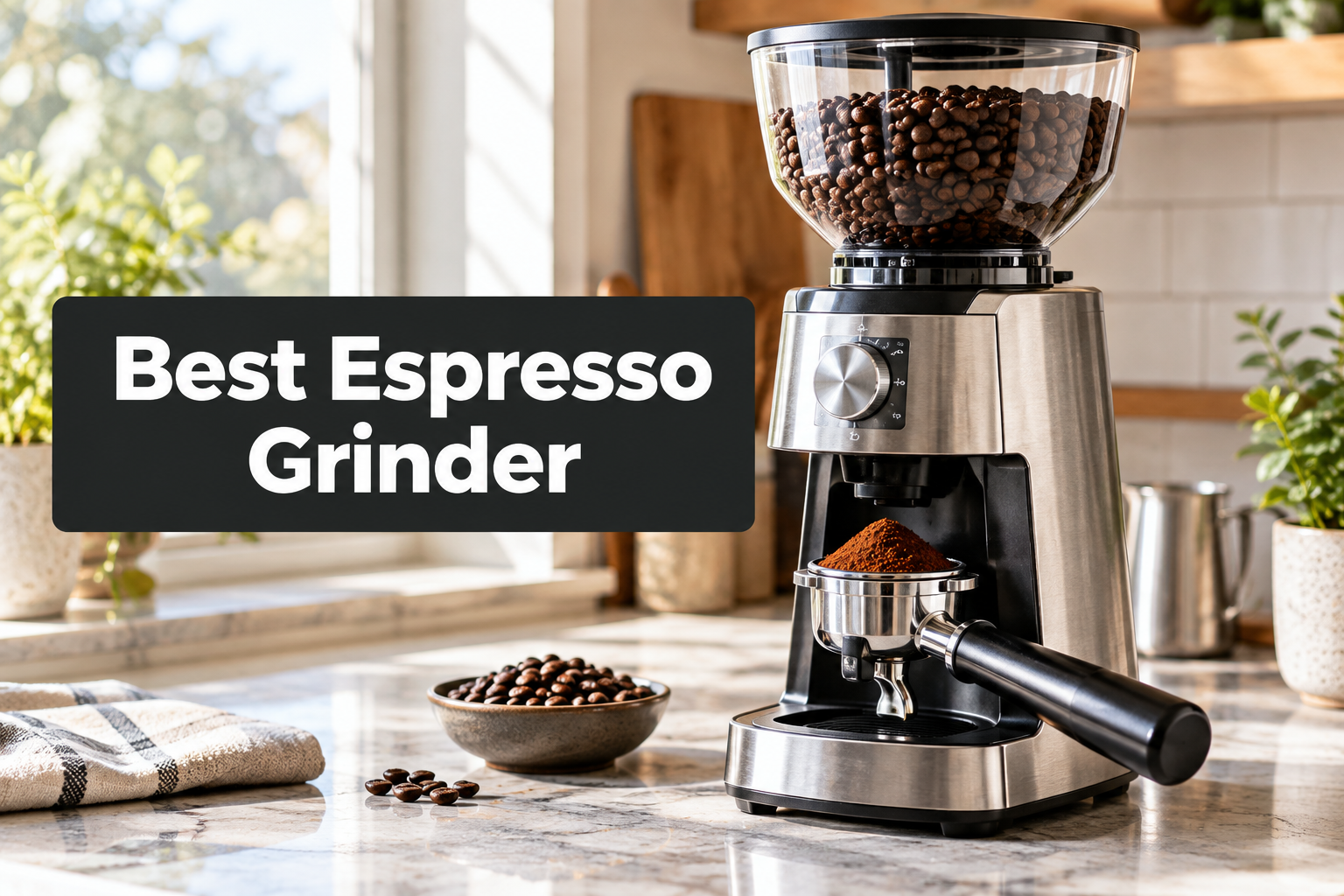
Best Espresso Grinder
Six models cover almost every home buyer in 2026: the DF54, Breville Smart Grinder Pro, Fellow Opus 2, Baratza Encore ESP, Baratza Virtuoso+, and Eureka Mignon Specialita. Each earns its spot for a specific kind of drinker rather than everyone at once.
If you want the shortest path to a good decision, match yourself to one of these:
- Tightest budget, still want real espresso grind: DF54
- One grinder for espresso and drip coffee: Breville Smart Grinder Pro
- Upgrading from a blade grinder for the first time: Fellow Opus 2
- Buying your first dedicated espresso grinder: Baratza Encore ESP
- Want speed and long-term durability, under $300: Baratza Virtuoso+
- Chasing cafe-level shot consistency: Eureka Mignon Specialita
Here is how those six compare on the specs that actually change your shot.
| Grinder | Burr type & size | Adjustment | Retention | Best for |
|---|---|---|---|---|
| DF54 | Flat, 54mm steel | Stepless | Low | Best value under $200 |
| Breville Smart Grinder Pro | Flat, 40mm steel | 60 stepped clicks | Moderate | Espresso plus drip in one unit |
| Fellow Opus 2 | Flat, 40mm stainless | Stepless | Low | First upgrade from a blade grinder |
| Baratza Encore ESP | Conical, 40mm steel | 30 stepped clicks | Moderate | First dedicated espresso grinder |
| Baratza Virtuoso+ | Conical, 40mm steel | 40 stepped clicks | Moderate | Speed and durability under $300 |
| Eureka Mignon Specialita | Flat, 55mm steel | Stepless | Low | Cafe-grade consistency at home |
Check the current price before you buy, since availability and bundle deals shift through the year.
What Makes a Good Espresso Grinder Different From Regular Coffee Grinders
A good espresso grinder gives you finer, more repeatable settings than a drip or French press grinder, because espresso brews in under 30 seconds under pressure instead of several minutes at rest. That short brew window means small grind changes cause big taste swings.
Drip coffee tolerates a wide grind range. Espresso does not. A grinder built for pour over might offer 40 settings between "coarse" and "medium." An espresso burr grinder often needs 40 settings between "fine" and "slightly less fine," because the useful espresso range sits in a narrow band.
Three things separate a real espresso grinder from a general-purpose one:
- Fine-range precision. Espresso settings live at the bottom of the dial, and a grinder needs enough resolution there to matter.
- Consistent particle size. Uneven grounds cause channeling, where water rushes through gaps and leaves other grounds under-extracted.
- Low static and low retention. Stray grounds stuck in the chute change your dose shot to shot.
Decision rule: if a grinder's marketing photo shows one dial with labels like "coarse," "medium," and "fine" and nothing else, it is a drip grinder wearing an espresso costume. Walk away.
Burr Size and Grind Consistency for Espresso Explained
Burr size and burr shape decide how evenly a grinder cuts beans, and bigger burrs generally grind faster and cooler with less heat buildup. This is the single spec that decides your shot more than any button or screen on the machine.
Burr size is measured across the diameter of the cutting disc, usually in millimeters. Home espresso grinders commonly run 40mm to 65mm. Larger burrs cut each bean fewer times before it exits, which means less frictional heat and less flavor loss from that heat.
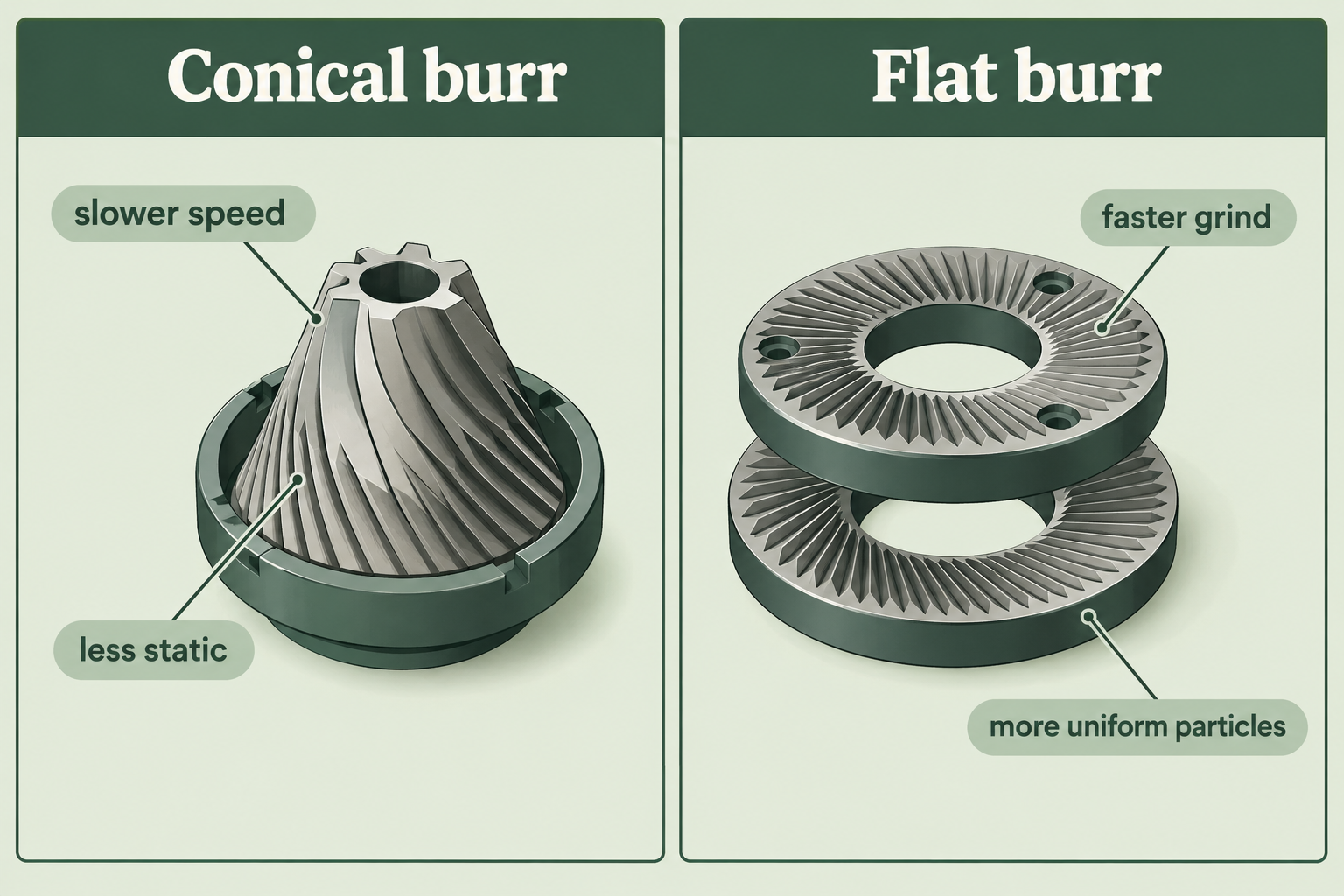
Conical vs flat burr grinder is the other major choice:
- Conical burrs sit as a cone inside a matching ring. They run quieter, cost less to manufacture, and produce a slightly wider particle spread. The Baratza Encore ESP and Virtuoso+ both use conical burrs.
- Flat burrs use two parallel discs. They run louder and pricier but produce a tighter, more uniform particle size, which matters more as burrs age. The DF54, Fellow Opus 2, and Eureka Mignon Specialita all use flat burrs.
Neither geometry is objectively better for every drinker. A conical vs flat burr grinder choice comes down to noise tolerance and how much you value the last 10 percent of consistency.
Common mistake: assuming a bigger number always means a better grinder. A 40mm flat burr from a well-engineered brand can outperform a poorly aligned 54mm burr. Burr size is one variable, not the whole spec sheet.
How Much Should You Spend on an Espresso Grinder
Plan to spend $150 to $300 for a home espresso grinder that will not hold back a decent espresso machine, and treat anything under $100 as a compromise on consistency. The grinder usually matters more to your cup than the machine itself, which surprises a lot of new buyers.
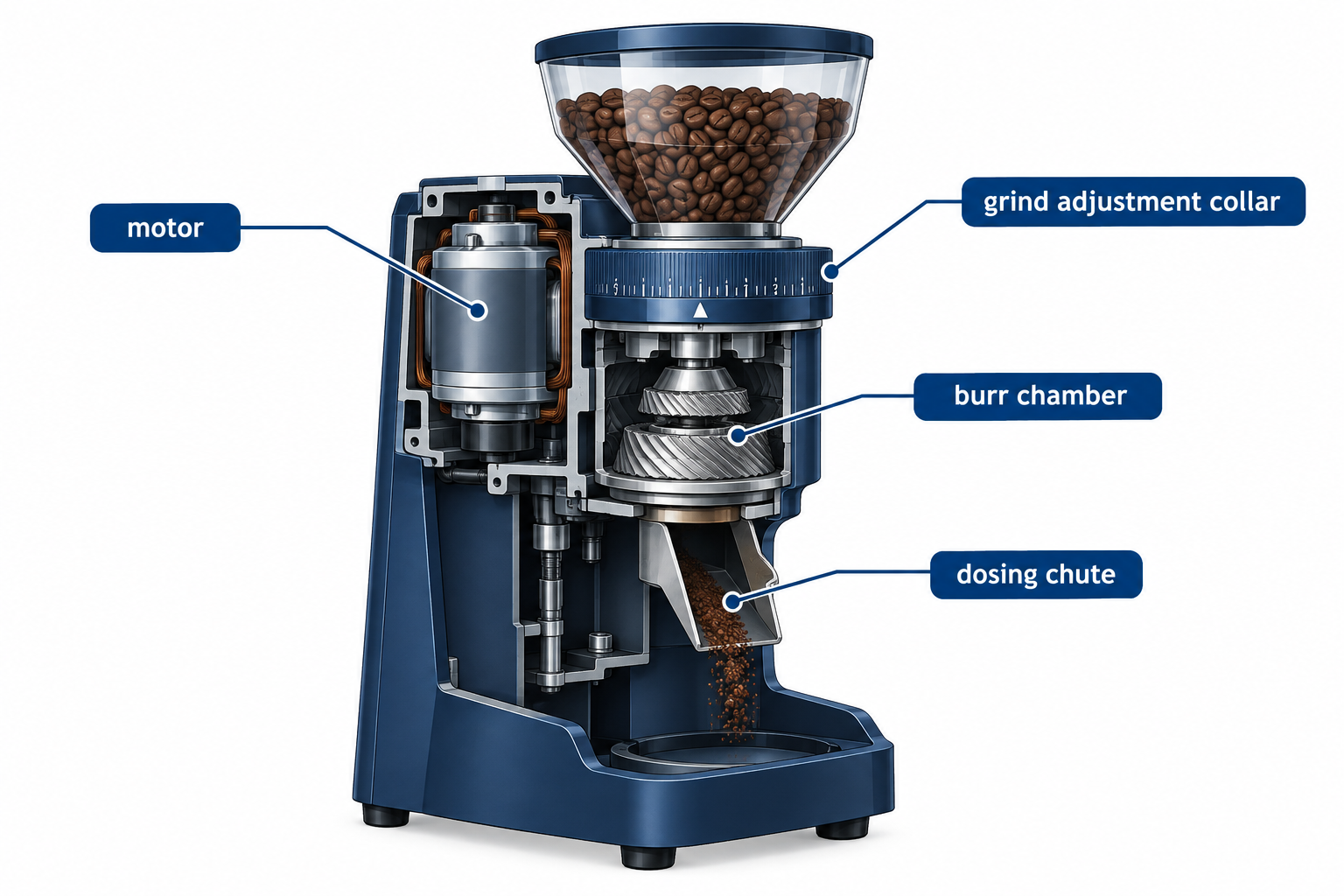
Here is a rough map of what money buys:
- Under $150: Entry-level conical burr grinders with stepped adjustment. Fine for casual drinkers who want one good latte a day.
- $150 to $300: The sweet spot. Flat or conical burrs, tighter tolerances, low retention designs. Most of the models in this guide live here.
- $300 to $600: Commercial-adjacent flat burr grinders like the Eureka Mignon Specialita, built for daily durability and cafe-level repeatability.
- $600 and up: Specialty single-dose grinders aimed at people who treat grinding as a hobby, not just a step.
Decision rule: if your espresso machine cost under $400, a $150 to $200 grinder is proportionate. If your machine cost $800 or more, a sub-$150 grinder will bottleneck it every time.
Best Espresso Grinder Under $200
The best espresso grinder under $200 today is the DF54, which pairs a 54mm flat burr with stepless adjustment at a price usually reserved for smaller, lower-precision burrs. That combination is unusual below $200 and explains why it keeps showing up in value roundups.
Runner-up picks in this price range:
- Fellow Opus 2: Stepless flat burr grinding with a cleaner design and a smaller footprint, aimed at kitchen counters where space is tight.
- Baratza Encore ESP: A conical burr grinder built specifically to hit the fine end of the range that older Encore models could not reach.
Who should skip this tier: anyone running a prosumer espresso machine with a PID temperature controller and a serious portafilter setup. A sub-$200 grinder can create a consistency ceiling that a nicer machine will expose fast.
Baratza Sette vs Wilfa Uniform vs Eureka Mignon: Which Is Better
The Eureka Mignon Specialita is the stronger overall pick between these three, because it pairs a 55mm flat burr with stepless adjustment, while the Sette and Wilfa Uniform each trade one of those advantages for a different strength.
Here is how the three actually differ:
- Baratza Sette 30: Uses a direct-drive conical burr system with very low retention, built for single dosing. Grind speed is fast and the geometry favors weight-based dosing over volume.
- Wilfa Uniform: A conical burr grinder aimed at simplicity, with stepped settings and a straightforward single-dose hopper. It suits buyers who want minimal fuss over maximum tuning range.
- Eureka Mignon Specialita: Flat burr, stepless adjustment, higher build quality, and the widest fine-tuning range of the three, at a noticeably higher price.
Choose the Sette 30 if you weigh every dose and want the lowest retention of the group. Choose the Wilfa Uniform if you want single dosing without a learning curve. Choose the Eureka Mignon Specialita if budget is flexible and you want the tightest grind consistency available at this size class.
Espresso Grinder Burrs Clogging: What to Do
Espresso grinder burrs usually clog from oil buildup on dark roast beans, static cling from dry beans, or old grounds packed into the chute, not from a mechanical fault. Clean the grinder before assuming it is broken.
Fix it in this order:
- Unplug the grinder and remove the hopper or bean container.
- Brush the burrs with the small cleaning brush most grinders include, working in the direction the burrs spin.
- Run grinder cleaning tablets (rice substitutes are not recommended by most manufacturers) through the chamber if oil buildup is heavy.
- Check the chute for compacted grounds, which is the most common cause of sudden dosing drops.
- Wipe the exit funnel with a dry cloth, since static cling collects there more than anywhere else.
Edge case: if clogging happens only with one specific bag of beans, the beans are likely too oily for your grinder's burr clearance. Switch to a lighter roast and see if the problem disappears before blaming the machine.
Do You Need Stepless Grind Adjustment for Espresso
No, stepless grind adjustment is not required for good espresso, but it removes the frustration of a stepped grinder that jumps from "too coarse" to "too fine" with no setting in between. Stepless grind adjustment lets you dial in any point along a continuous range instead of picking from fixed clicks.
Stepped grinders like the Baratza Encore ESP and Virtuoso+ still make excellent espresso. They just ask you to work around fixed increments, which matters most with lighter roasts that need finer tuning.
Decision rule: choose stepless if you plan to experiment with different beans and roast levels often. Choose stepped if you plan to dial in one bean and rarely touch the setting again.
Single Dose vs Hopper Fed Espresso Grinders: Which Is Better
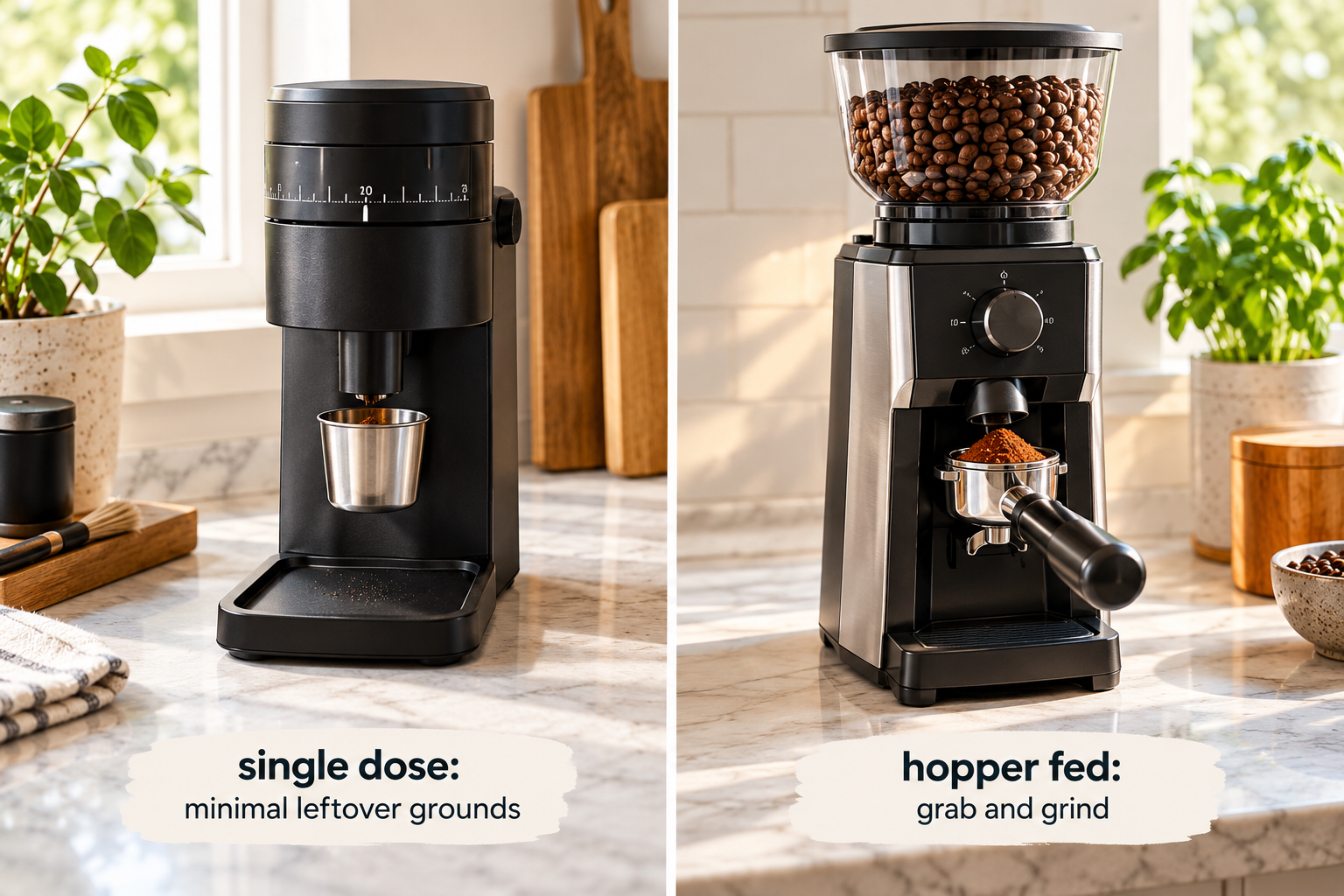
Single dose grinders suit drinkers who want minimal leftover grounds and fresher shots bean by bean, while hopper fed grinders suit drinkers who want to grab beans and grind without weighing anything first. Neither format is universally better.
Best single dose espresso grinder workflow benefits:
- Less grind retention, meaning fewer stale grounds mixed into your fresh dose
- Easier bean switching for tasting different origins back to back
- Slightly slower morning routine, since you weigh beans before grinding
Hopper fed benefits:
- Faster mornings, since beans sit ready to go
- Less daily fuss for one-bean households
- Slightly more retention risk if the grinder is not cleaned often
Who should skip single dosing: households that drink the same bean every day and want speed over control. The extra step of weighing beans adds friction without adding flavor benefit if you never change beans.
Common Mistakes People Make Choosing an Espresso Grinder
The biggest mistake is buying a best coffee grinder for espresso based on price alone and ignoring whether the fine end of its range is actually fine enough. A cheap grinder that stops one notch short of true espresso fineness will never make a good shot, no matter how well you tamp.
Other frequent mistakes:
- Matching grinder price to machine hype, not machine need. A $150 grinder is fine for a $300 machine and wrong for an $800 one.
- Ignoring grind retention on a single-dose routine, which mixes yesterday's stale grounds into today's fresh shot.
- Buying a blade grinder because it is cheap, without checking whether it can even reach espresso fineness.
- Skipping burr type research. Conical and flat burrs taste and behave differently, and the difference is worth understanding before buying, not after.
- Overlooking noise, especially in apartments or shared kitchens where a loud flat burr grinder at 6 a.m. becomes a real problem.
If you are still building your shot-pulling skills alongside your equipment, our guide to best ways to advance your espresso making skills covers the technique side that a grinder alone cannot fix.
Espresso Grinder Too Fine or Too Coarse How to Tell
A grind that is too fine chokes the machine, producing a slow drip or no flow and a bitter, over-extracted shot. A grind that is too coarse runs too fast, producing a thin, sour shot that finishes in under 20 seconds.
Use shot time as your first diagnostic:
- Under 20 seconds for a double shot: too coarse. Grind finer.
- 20 to 30 seconds for a double shot: in range. Taste it before changing anything.
- Over 35 seconds with visible dripping instead of flowing: too fine. Grind coarser.
Common mistake: changing the dose and the grind size at the same time. Change one variable, pull a shot, taste it, then adjust again. For a deeper walkthrough of dialing in extraction, see our guide on what is the best grind of coffee for an espresso machine.
Best Espresso Grinder for Home Use vs Cafe
The best espresso grinder for home use prioritizes counter space, quiet operation, and single-dose flexibility, while a cafe grinder prioritizes speed, motor endurance, and hopper capacity for back-to-back orders. Buying a cafe grinder for a home kitchen usually means paying for endurance you will never use.
Home buyers should look at:
- Compact footprint that fits under standard cabinets
- Reasonable noise level for early mornings
- Single-dose or small hopper capacity, since fresh beans matter more than volume
Cafe buyers should look at:
- Motor rated for continuous daily grinding, not occasional bursts
- Larger hopper capacity to reduce refill interruptions
- Commercial-grade burr coffee grinder components rated for thousands of grind cycles
A best hand grinder for espresso is worth considering for home users who travel often or want a quiet manual option. Manual hand grinders with steel conical burrs can hit espresso fineness, though grinding by hand for a double shot takes real forearm effort, something worth trying before committing to one as your only grinder.
Can You Use a Blade Grinder for Espresso
No, a blade grinder cannot reliably reach the fine, even particle size espresso requires, because blade grinders chop beans unevenly instead of crushing them between calibrated surfaces. The result is a mix of coarse chunks and powder-fine dust in the same dose, which causes channeling no matter how carefully you tamp.
A best burr coffee grinder, whether conical or flat, uses two fixed cutting surfaces set at a controlled distance apart. That distance is the actual grind size setting. Blade grinders have no equivalent control, just spin time.
Edge case: a blade grinder can work in a pinch for a moka pot or French press, where grind tolerance is wider. It should never be your only grinder if espresso is a regular part of your routine.
Espresso Grinder Noise Level Comparison
Conical burr grinders generally run quieter than flat burr grinders at the same price point, because flat burrs spin faster and process more material per rotation. If early morning noise is a real concern in your household, burr shape matters as much as burr size.
Rough comparison by category:
- Quietest: Manual hand grinders, since there is no motor at all
- Quiet: Conical burr grinders like the Baratza Encore ESP and Virtuoso+
- Moderate: Mid-range flat burr grinders like the Fellow Opus 2 and DF54
- Loudest: High-torque flat burr grinders like the Eureka Mignon Specialita, which trade quiet operation for grind speed
Decision rule: if you grind before anyone else in the house is awake, weigh noise as heavily as price. A grinder you resent using every morning will not get used consistently.
How Often Do Espresso Grinder Burrs Need Replacing
Steel burrs on a home espresso grinder typically last 300 to 700 pounds of coffee before grind quality noticeably drops, which for most households works out to several years of daily use. Ceramic burrs wear differently and are more prone to chipping than steel, though they resist heat buildup better.
Signs your burrs need replacing:
- Grind size drifts coarser even though the setting has not changed
- Shots taste flat or muted despite fresh beans and a correct grind range
- Grind time slows noticeably at the same setting you always use
Common mistake: assuming burr replacement means buying a new grinder. Most home models, including the Baratza and Eureka lines discussed above, sell replacement burr sets designed to install in the existing body.
Which best espresso grinder fits your budget?
FAQ
What is the best espresso grinder for a beginner? The Baratza Encore ESP is the strongest beginner pick because it was built specifically to reach true espresso fineness at an entry-level price.
Is a flat burr or conical burr grinder better for espresso? Flat burrs generally produce more uniform particle size and run louder. Conical burrs run quieter with a slightly wider particle spread. Both can make good espresso; the right choice depends on noise tolerance and budget.
How much retention is normal in an espresso grinder? Well-designed home grinders hold under 0.3 grams between doses. Anything that leaves visible clumps of old grounds in the chute after each grind is worth cleaning or reconsidering.
Do I need stepless adjustment to make good espresso? No. Stepped grinders like the Baratza Virtuoso+ make excellent espresso. Stepless adjustment simply removes the gaps between fixed settings, which matters most when switching between different roast levels often.
Can I use the same grinder for espresso and pour over? Yes, if the grinder's range covers both fine espresso settings and coarser pour over settings. The Breville Smart Grinder Pro is built with that dual use in mind.
How do I know if my espresso grinder burrs are worn out? Watch for grind size drifting coarser at the same setting, flatter tasting shots despite fresh beans, and slower grind times. Most home grinders sell replacement burr sets rather than requiring a full new unit.
Conclusion
The best espresso grinder for you is the one whose fine-range precision, burr type, and retention match how you actually drink coffee, not the one with the most features on the box. A tight budget still gets real results with the DF54 or Fellow Opus 2. A flexible budget opens the door to the Eureka Mignon Specialita and its cafe-level consistency. Somewhere in between, the Breville Smart Grinder Pro, Baratza Encore ESP, and Baratza Virtuoso+ cover almost every daily routine.
Start with your actual habits: how many shots you pull, how often you switch beans, and how much noise your kitchen can tolerate at 6 a.m. Then match a grinder to that answer instead of chasing the biggest burr number on the spec sheet. Compare the models above against your morning, pick one, and give it two weeks of dialing in before judging the shot. Better coffee starts with better answers, and in espresso, most of those answers start at the grinder.
Keep Exploring Coffee Rank IQ
- Coffee Rank IQ home: reviews, brewing guides, and coffee science
- Best Espresso Machine With Grinder Built In: 7 Picks
- Best Manual Coffee Grinder for Pour Over, Espresso, and Travel
- Best Espresso Machine for Beginners: 7 Picks That Forgive Mistakes
- Best Super Automatic Espresso Machine: Read the Cleaning Specs First
References
- www.cafegrade.com/guides/best-espresso-grinder
- balancejournal.co/food-drink/best-espresso-grinder
- www.tomsguide.com/best-picks/best-coffee-grinder
- www.dognotebook.com/best-espresso-grinders
- acfc.org/best-espresso-grinders
- cocinare.com/blogs/journals/best-coffee-grinder-for-espresso-in
- www.peggyomara.com/best-espresso-grinders
- naturescarving.com/grinders/best-rated-espresso-grinder
- www.brewsift.com/gear/grinders
- timeforespresso.com/best-espresso-grinders-2026