Best Espresso Machine With Grinder Built In: 7 Picks
Quick Answer
The best espresso machine with grinder for most home buyers in 2026 is the Breville Barista Express for beginners, the Breville Barista Touch Impress for the best overall experience, and the Café Affetto Automatic for anyone who wants push-button simplicity with no manual dialing in. Buyers who want café-level milk drinks with oat milk should look at the Jura E8 or Philips 3200 LatteGo, and buyers with real counter space and a bigger budget should consider the Breville Oracle Jet.
Key Takeaways
- A built-in grinder saves counter space and setup time, but experts consulted by Forbes Vetted in 2026 still recommend a separate grinder when grind control matters more than convenience.
- The Breville Barista Express remains the standard first real espresso machine with a grinder built in, pairing a conical burr grinder with a 54mm portafilter[13-style workflow described across multiple 2026 buying guides].
- The Breville Barista Touch Impress is named best overall in Coffeeness's 2026 rankings for balancing touchscreen guidance with real burr grinding.
- The De'Longhi La Specialista Arte is the most affordable semi-automatic with a built-in grinder among major 2026 comparison lists.
- Fully automatic, bean-to-cup machines like the Café Affetto and Jura E8 grind, dose, and pull the shot with one button, which suits buyers who want a café Affetto-style morning without any manual steps.
- Weak shots and clogging almost always trace back to grind size, dose, or a dirty burr chamber, not a broken machine.
- Expect to spend $500 to $2,200 for a real espresso machine with grinder built in, depending on boiler type, grinder quality, and milk automation.
Best Espresso Machine With Grinder: The 7 Picks at a Glance
The best espresso machine with grinder for you depends on how hands-on you want your morning to be and how much counter space you can give up. Below is a quick comparison of the seven picks in this guide, followed by full reviews of each.
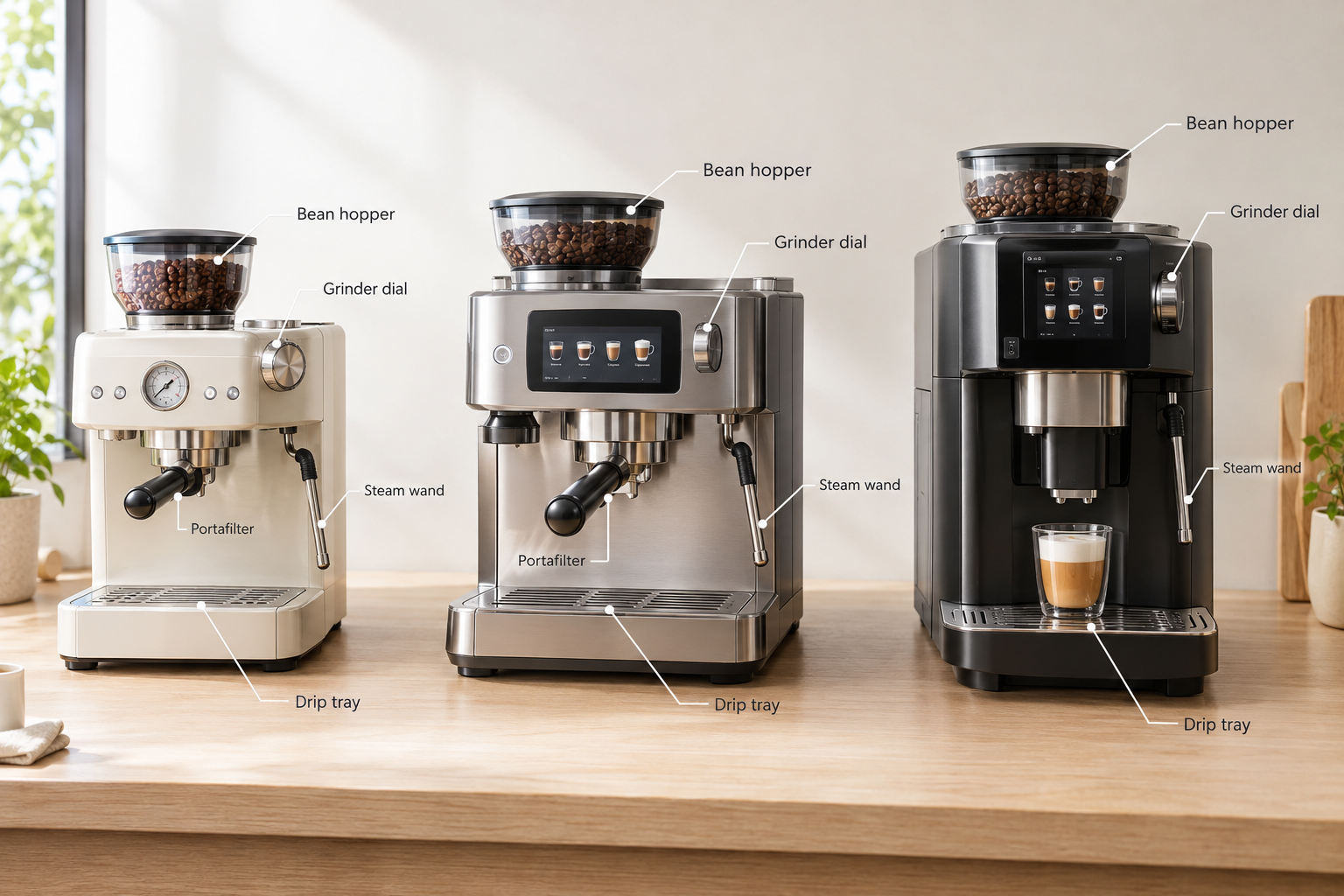
If you want one sentence: buy the Breville Barista Express if this is your first real machine, the Barista Touch Impress if you want guided precision, and the Jura E8 if you never want to touch a grind dial again.
| Pick | Best For | Grinder Type | Approx. Price (estimate) |
|---|---|---|---|
| Breville Barista Express | Beginners | Conical burr, built in | $500 to $700 |
| Breville Barista Pro | Upgraders | Conical burr, built in | $700 to $900 |
| Barista Touch Impress | Best overall | Conical burr, built in | $1,000 to $1,300 |
| De’Longhi La Specialista Arte | Budget semi-auto | Conical burr, built in | $600 to $750 |
| Café Affetto Automatic | One-touch simplicity | Burr, built in | $400 to $550 |
| Breville Oracle Jet | Premium dual boiler | Conical carbon-steel, 45 settings | $1,700 to $2,000 |
| Jura E8 | Milk drinks, oat milk | Ceramic, built in | $2,000 to $2,400 |
Prices above are estimates based on 2026 comparison coverage and change by retailer, so check the current price before buying. If you want the full buying logic behind boiler type and grind range, our advanced espresso machine buying guide covers the mechanics in more depth.
The 7 Best Espresso Machines With Grinder Built In (Full Reviews)
Each pick below names the buyer it suits, what it does well, and where it falls short. None of these machines is right for everyone, which is the whole point of picking carefully.
Breville Barista Express: best espresso machine with grinder for beginners
Verdict: the safest first purchase for someone who has never owned a machine that grinds its own beans.
The Barista Express pairs a conical burr grinder with a 54mm portafilter and a 15-bar pump, and multiple 2026 buying guides call it the default first real espresso machine because it removes the guesswork of matching a separate grinder to a separate machine. NBC News Select's 2026 buying guide specifically named it its top pick for a built in grinder espresso machine, and it remains one of the more common recommendations for someone comparing the breville barista express against pricier siblings.
Strengths: dose control dial, a grind size dial you can actually feel click into place, and a manageable footprint for a first counter.
Drawbacks: the steam wand is manual, and the grinder chamber needs regular brushing to avoid stale grounds building up near the burrs.
Skip it if: you already own a separate grinder you like, or you want touchscreen guidance instead of manual dials.
Breville Barista Pro: best upgrade pick
Verdict: the machine to buy if you want a faster heat-up and a slightly more capable grinder than the Express, without jumping to a dual boiler.
Business Insider's August 2026 testing named the Barista Pro its top home espresso machine, pointing to the built-in grinder and consistently balanced shots as the reason it outranked competitors. The Strategist notes the Barista Pro costs about the same as a Rancilio Silvia, a machine with no grinder at all, which means you are getting grinding included at a similar price point rather than paying extra for it.
Strengths: a ThermoJet heating system that reaches temperature in seconds, plus the same reliable conical burr grinder family used across Breville's lineup.
Drawbacks: single boiler design means you cannot brew and steam at the exact same moment.
Skip it if: you regularly make two milk drinks back to back for a household of four or more.
Breville Barista Touch Impress: best overall
Verdict: the best overall pick when you want the grinding precision of the Barista line with guided, touchscreen-led shot pulling.
Coffeeness's 2026 ranking of the top espresso machines with grinder names the Barista Touch Impress the best overall model, citing its advanced features and intuitive touchscreen as the reason it sits ahead of more manual machines. If you have shopped the breville barista touch line before, the Impress update adds automatic milk texturing and a visual grind confirmation step that reduces guesswork for a new owner.
Strengths: touchscreen shot profiles, automatic milk frothing, and a grinder that Wirecutter's 2026 review compares favorably to mid-range standalone Baratza grinders.
Drawbacks: the price puts it well past entry-level territory, and the touchscreen adds a component that could eventually need service.
Skip it if: you want full manual control over every variable, or your budget caps out near $700.
De'Longhi La Specialista Arte: best budget semi-automatic
Verdict: the most affordable way into a real semi-automatic espresso machine with grinder built in, if you are choosing between the Breville and De'Longhi ecosystems.
The Strategist's 2026 roundup lists the de'longhi la specialista Arte alongside the Barista Pro as one of only two semi-automatic machines on its list with a built-in grinder and no dual boiler, framing it as the budget route into this category. Good Housekeeping's lab-tested coverage of grinder-equipped machines confirms De'Longhi sits among the main players in the affordable integrated-grinder tier.
Strengths: a lower price than most Breville equivalents, plus a familiar dial-based grind adjustment.
Drawbacks: the milk frothing system is more basic than Breville's higher-tier models, and the water tank sits in a slightly awkward spot for quick refills.
Skip it if: you want automatic milk texturing included at this price, since you will not find it here.
Café Affetto Automatic: best automatic espresso machine with grinder for simplicity
Verdict: the best automatic espresso machine with grinder if your morning has no time for dialing in shots.
HGTV's 2026 roundup names the Café Affetto Automatic its top pick for a built-in grinder among fully automatic machines, highlighting its one-touch, bean-to-cup workflow as the reason it suits busy households better than semi-automatic options. If you are comparing the best automatic espresso machine for home use where nobody in the house wants to learn tamping, this is the category to shop.
Strengths: push one button, get a shot, with grinding and dosing handled internally every time.
Drawbacks: less control over grind size and dose than a semi-automatic machine, and the burr grinder is not swappable for a standalone unit later.
Skip it if: you enjoy the ritual of tamping and want to taste the difference between grind settings.
Breville Oracle Jet: best premium all-in-one
Verdict: the machine for buyers who want dual-boiler performance and a genuinely capable grinder without assembling a separate setup.
Forbes Vetted's March 2026 review reports the Oracle Jet's built-in grinder uses conical carbon-steel burrs from the Baratza Sette lineage, with 45 grind settings that produced reliably good coffee in testing. Wirecutter separately describes Breville's high-end grinder as comparable in build quality to mid-range standalone Baratza grinders, which is a real compliment for something built into the machine.
Strengths: dual boiler for simultaneous brewing and steaming, plus a grinder good enough that testers did not feel they needed to swap it out.
Drawbacks: the Strategist lists the standard dual-boiler Oracle at around $2,148, and even the Jet trims that cost only modestly. Four experts consulted by Forbes still recommend a separate grinder for anyone who prioritizes maximum grind control, since a failed built-in grinder can mean sending in the whole machine for repair.
Skip it if: counter space or budget is tight, or you already own a grinder you trust.
Jura E8: best for milk drinks and oat milk
Verdict: the strongest pick for someone who wants café-style milk drinks, including oat milk, without any manual steps.
A jura automatic espresso machine handles grinding, dosing, brewing, and milk texturing in one sequence, which suits buyers comparing the jura e8 against Philips's 3200 LatteGo for the smoothest oat milk foam. Both machines use automated milk systems built to handle plant-based milk without the scorching or thin foam that can happen with a basic steam wand.
Strengths: consistent one-touch drinks, a ceramic grinder built for longevity, and programmable drink profiles for a household with different preferences.
Drawbacks: the price sits at the top of this list, and the milk system needs a daily rinse cycle to avoid buildup.
Skip it if: you want to taste the effect of adjusting your own grind size, or your budget is under $1,000.
Built-In Grinder vs Separate Grinder: What Actually Changes
A built-in grinder shares housing with the espresso machine and doses beans straight into the portafilter, while a separate grinder is a standalone unit you dose into manually. The real difference is not convenience alone. It is control, repair risk, and how far you can upgrade later.
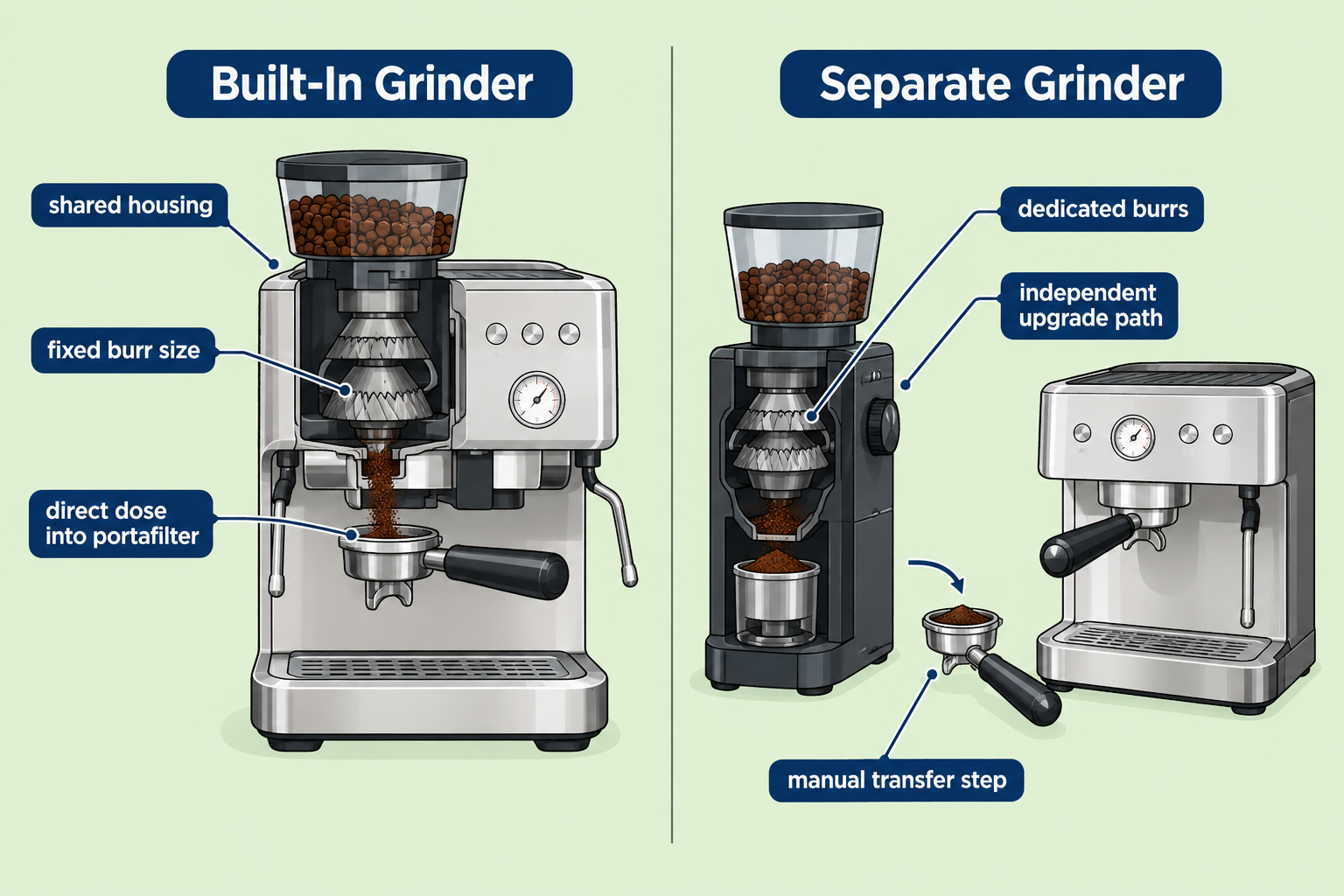
Do you really need a grinder built into your espresso machine? No, not strictly. Pre-ground espresso works, but grind size affects extraction more than almost any other variable, and pre-ground coffee stales fast once the bag is open. Grinding fresh, whether built in or separate, is what actually improves the cup. If you are still deciding whether grinding at home matters, our guide on the best grind of coffee for an espresso machine walks through why grind size changes flavor.
Is a built-in grinder better than a separate burr grinder? It depends on the model. Forbes Vetted's 2026 panel of four experts recommends deprioritizing the built-in grinder specifically because a standalone grinder gives finer control and does not force you to replace the whole machine if the grinder fails. But Wirecutter's 2026 testing found some built-in grinders, on Breville's Oracle series, perform close to mid-range standalone units. So the honest answer is: a great built-in grinder beats a mediocre standalone one, but a dedicated grinder still wins on flexibility and long-term serviceability.
Choose a built-in grinder if: counter space is limited, you want one less thing to plug in, or you are buying your first machine and do not yet know what grind range you prefer.
Choose a separate grinder if: you already brew pour-over or drip coffee and want one grinder for everything, or you plan to upgrade the machine and grinder on different timelines.
Best Espresso Machine With Grinder for Small Kitchens
For a small kitchen, the best espresso machine with grinder is one that keeps its footprint under roughly 8 inches wide without sacrificing grind quality, and the Breville Barista Express fits that description better than most bean-to-cup machines.
The Café Affetto Automatic is another compact option if you are willing to trade manual control for a smaller body and one-button operation. Both avoid the wider chassis that comes with dual-boiler machines like the Oracle Jet, which needs real depth on the counter, not just width. Measure the height above your outlet too. Grinder hoppers often sit higher than the rest of the machine and can bump into upper cabinets.
Best Espresso Machine With Grinder for Oat Milk Drinks
The best espresso machine with grinder for oat milk drinks is one with an automated milk system built for plant-based milk texture, and the Jura E8 and Philips 3200 LatteGo both fit that requirement.
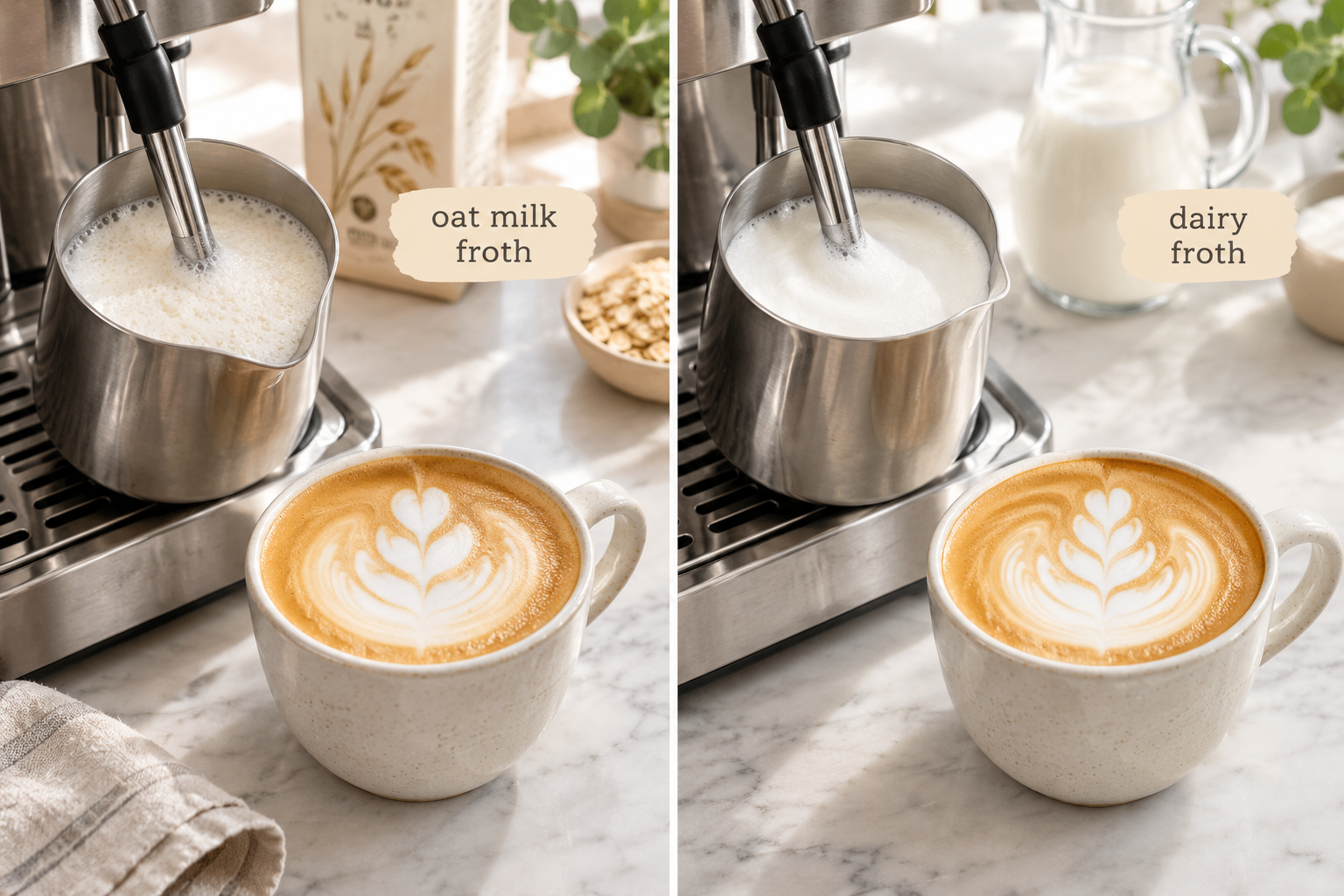
Oat milk froths differently than dairy. It can scorch faster and produce a thinner foam with a basic manual steam wand, which is why automated systems tuned for plant milk matter here. The Philips 3200 LatteGo uses a two-part milk carafe designed to avoid the buildup that clogs typical frothing systems, which matters for oat milk's higher sugar content. If you want to improve results with a manual wand instead of buying a new machine, our guide on the best ways to froth milk for espresso drinks covers wand angle and milk temperature in detail.
Skip an automated milk machine if: you already froth well by hand and do not want to pay for automation you will not use daily.
How Much Should You Spend on an Espresso Machine With Grinder
Plan to spend between $500 and $2,400 for a real espresso machine with grinder built in, with the exact number set by grinder quality, boiler type, and whether milk texturing is automatic.
- $500 to $700: entry semi-automatic machines with a manual steam wand and a basic conical burr grinder, like the Barista Express.
- $700 to $1,300: better heating systems, sometimes touchscreen guidance, and a slightly wider grind range, like the Barista Pro and Barista Touch Impress.
- $1,700 and up: dual boilers, premium grinders borrowed from standalone grinder brands, or full milk automation, like the Oracle Jet and Jura E8.
Spending more buys you speed, grind precision, and automated milk, not a fundamentally different cup if your technique is solid. For a broader breakdown of what separates entry machines from premium ones, our buyer's guide to choosing the best espresso machine for crafting drinks is worth reading before you commit to a price tier.
Best Espresso Machine With Grinder Under 500
True built-in grinder machines rarely list under $500 new, but the Breville Barista Express occasionally drops close to that mark during sales, making it the most realistic best espresso machine with grinder under 500 target if you watch pricing.
If $500 is a hard ceiling, consider a basic entry machine paired with a separate blade-free grinder instead of holding out for an integrated model at that price. CoffeeChronicler's 2026 coverage points out that any realistic espresso budget has to account for a grinder somewhere, whether built in or bought separately, so the $500 line is really about where that grinder cost lands. Our advanced espresso machine buying guide has more on stretching a tight budget without buying a machine you will outgrow in a year.
Breville vs De'Longhi Espresso Machine With Grinder: Which Should You Buy
Breville generally offers a wider range of grinder-equipped tiers, from the entry Barista Express to the premium Oracle Jet, while De'Longhi's La Specialista Arte competes mainly at the affordable end with a similar built-in grinder concept at a lower price.
Choose Breville if you want room to move up within one ecosystem, since the Barista Express, Barista Pro, and Barista Touch Impress share a family resemblance in controls and accessories. Choose the De'Longhi La Specialista Arte if your priority is the lowest price for a real semi-automatic with grinder built in, and you are comfortable with a more basic manual steam wand. Neither brand makes a bad machine at this tier. The difference is how much you plan to grow into the hobby.
Espresso Machine With Grinder for Home Use vs Cafe Quality: What Changes
A home espresso machine with grinder built in can match cafe-quality extraction on the shot itself, but it usually cannot match a commercial machine's shot-to-shot consistency across a busy morning rush.
Cafe machines run on commercial-grade pumps with rock-steady temperature control across dozens of shots in a row, and staff dial in grind size fresh throughout the day as beans and humidity shift. At home, you are pulling maybe two to four shots a day, so a well-maintained built-in grinder easily keeps pace. What actually separates a home cup from a cafe cup is usually bean freshness and technique, not the machine tier. If you want to understand what else a home machine can produce beyond a straight shot, see our guide on what coffee you can make with an espresso machine.
Choose a home setup if: you are making one to four drinks a day for yourself or a small household.
Choose cafe-grade gear if: you are running a home business or hosting large groups regularly, where shot-to-shot consistency across dozens of pulls actually matters.
Troubleshooting: Weak Shots, Coarse Grind, and Clogging
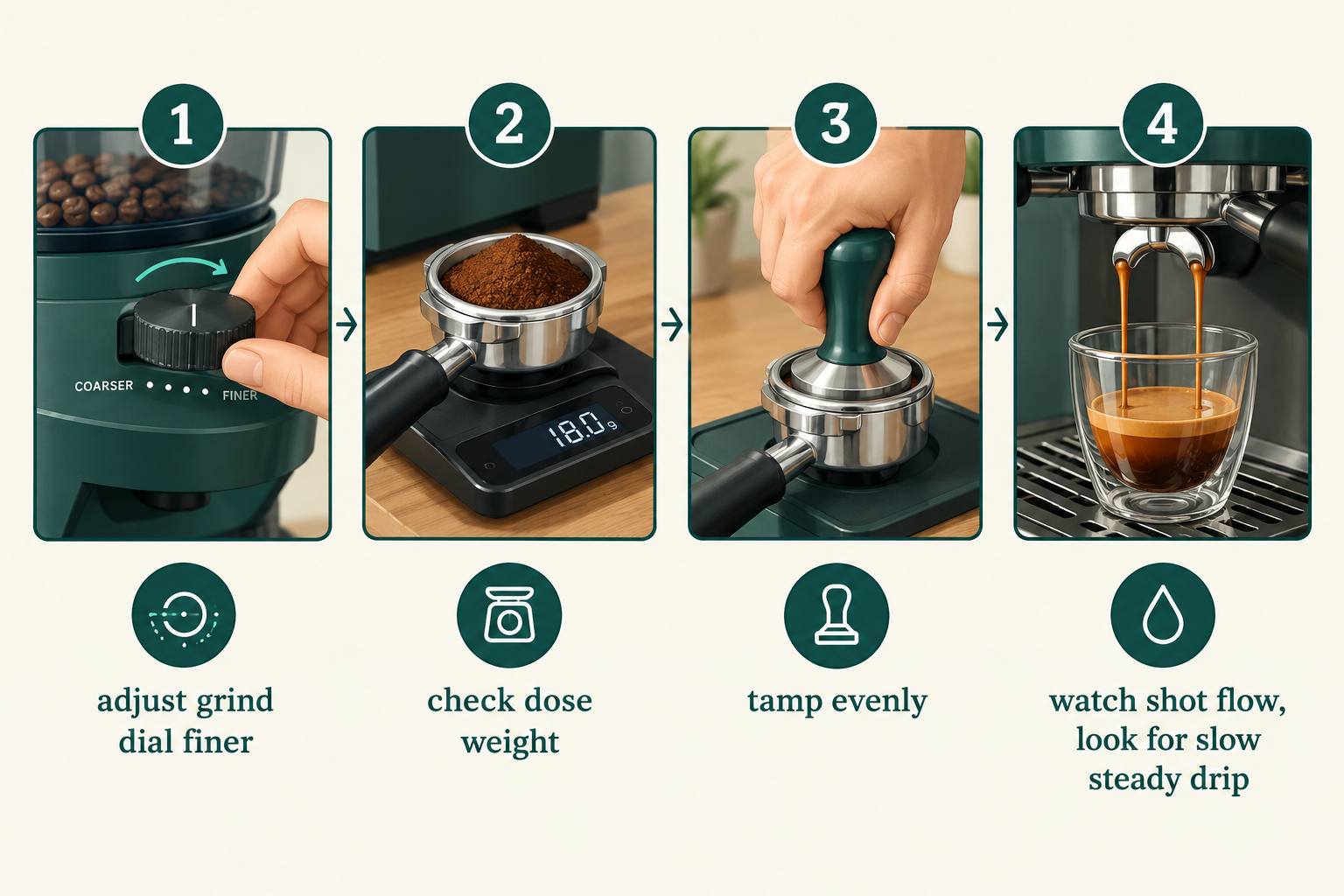
If your espresso machine with grinder is producing weak shots, the grind is almost always too coarse, the dose is too light, or the shot is pulling too fast, and all three fixes start at the grinder dial, not the machine itself.
Espresso machine with grinder not grinding fine enough: check that the burrs are not worn and that the grind dial is actually set within the espresso range, not the drip coffee range. Some built-in grinders have a wide dial that spans both, so it is easy to sit one notch too coarse without noticing.
Espresso machine with grinder making weak shots, what to do:
- Grind finer, one setting at a time.
- Increase your dose slightly, by half a gram to a gram.
- Check your shot time. A 25 to 30 second pull for a double shot is a reasonable target before you adjust further.
Espresso machine with grinder that doesn't clog: the fix is routine, not magic. Brush out the grinder chamber weekly, run a backflush cycle on the group head per the manufacturer's schedule, and never leave old grounds sitting in the dosing chute overnight, since oils from stale grounds are what actually cause buildup. For a full maintenance routine, our advanced espresso machine maintenance tips guide covers cleaning intervals by machine type, and our advanced espresso machine troubleshooting tips guide covers issues beyond grind and dose.
Common mistake: blaming the machine for a weak shot when the real cause is beans that are three weeks past roast date. Stale beans lose the gas that helps build resistance during extraction, so even a perfect grind setting will pull fast and thin.
FAQ
Is a built-in grinder as good as a standalone grinder? Sometimes. Wirecutter's 2026 testing found Breville's higher-end built-in grinders performed close to mid-range standalone Baratza grinders, but Forbes Vetted's expert panel still recommends a separate grinder for maximum control and easier repairs.
What's the best espresso machine with grinder for a first-time buyer? The Breville Barista Express, because it combines a proven conical burr grinder with a manageable learning curve and a lower price than Breville's touchscreen models.
Do I need a separate grinder if I buy a machine with one built in? No. A quality built-in grinder handles daily use fine. A separate grinder only makes sense if you want more grind range, plan to brew other methods like pour over, or want to isolate repair risk.
How much should I budget for a best espresso machine with grinder purchase? Plan for $500 to $700 at the entry level, $700 to $1,300 for mid-range with more automation, and $1,700 or more for dual-boiler or fully automated milk systems.
Why is my espresso machine with grinder making weak, watery shots? Grind size that's too coarse, a light dose, or stale beans are the three most common causes. Adjust the grind finer first, then check dose and roast date.
Which is better for oat milk, Breville or Jura? Jura's automated milk system, along with the Philips 3200 LatteGo, is built specifically around consistent plant-milk texture, while Breville's manual steam wands require more hand technique to get the same result with oat milk.
Conclusion
The best espresso machine with grinder for your kitchen comes down to three questions: how much counter space you have, how hands-on you want your morning to be, and how much you are willing to spend on automation you might not use every day. Start with the Breville Barista Express if this is your first machine, move to the Barista Touch Impress if you want touchscreen guidance, and go straight to the Jura E8 if oat milk lattes are the whole point of buying a machine at all. Whichever pick you choose, check the current price before buying, since these models move in and out of sales through the year, and compare the models side by side one more time before you check out.
Keep Exploring Coffee Rank IQ
- Coffee Rank IQ home: reviews, brewing guides, and coffee science
- Best Espresso Grinder: The Spec That Decides Your Shot
- Best Manual Coffee Grinder for Pour Over, Espresso, and Travel
- Best Espresso Machine for Beginners: 7 Picks That Forgive Mistakes
- Best Super Automatic Espresso Machine: Read the Cleaning Specs First
References
- www.nytimes.com/wirecutter/reviews/best-espresso-machine-grinder-and-accessories-for-beginners
- www.forbes.com/sites/forbes-personal-shopper/article/best-espresso-machine
- www.businessinsider.com/guides/kitchen/best-espresso-machines-reviewed
- nymag.com/strategist/article/best-espresso-machine.html
- www.coffeeness.de/en/best-espresso-machine-with-grinder
- www.goodhousekeeping.com/what-to-buy/kitchen-products/g44421282/best-espresso-machines-with-grinders
- coffeechronicler.com/gear/espresso-machines