How to Brew Eight O’Clock Coffee: Ratios for Every Brewer
Eight O’Clock The Original is a medium roast, 100% Arabica coffee sold mainly for drip machines. The same bag works in a pour over, a French press, an AeroPress or a moka pot once you match the grind and the dose to the brewer. This guide gives you both, method by method.
How to brew eight o’clock coffee, in short: To brew Eight O’Clock The Original, use 10 grams (2 level tablespoons) of coffee per 6 ounce cup, which is the brand’s own drip guideline, with water at 195°F to 205°F. Grind medium for drip, medium-coarse for pour over and coarse for French press, then adjust the dose by taste.
How to Brew Eight O’Clock Coffee: Ratios for Every Brewer
Most people brew a bag of Eight O’Clock the same way every morning without measuring anything. A kitchen scale and ten minutes of attention will get more out of that bag than a new machine will.
Understanding Eight O’Clock The Original Coffee
Four facts about the bag shape how you should brew it.
The History
Eight O’Clock began as a coffee brand of the A&P grocery chain, which was founded in 1859. According to the brand’s own history, A&P started selling coffee under the Eight O’Clock name in 1919 after a survey found that 8 a.m. and 8 p.m. were the most popular times to drink coffee.
The Flavor Profile
Eight O’Clock The Original Coffee boasts a sweet, fruity, and well-balanced flavor profile. Knowing this will guide you in perfecting the brew to highlight these natural notes.
The Roast
The Original Coffee is a medium roast, which makes it versatile for various brewing methods. The medium roast allows for a balanced profile, preserving both acidity and body.
The Beans
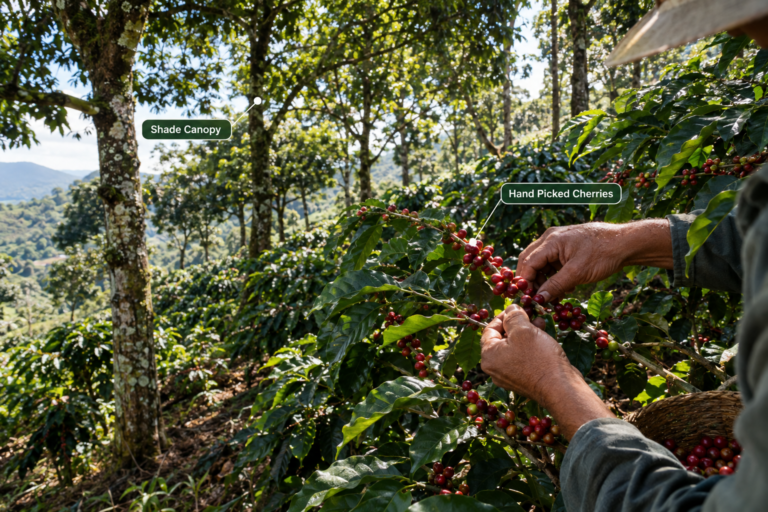
The Original is 100% Arabica, sourced from Latin America to East Africa according to the brand. Arabica is the species behind nearly all specialty coffee, prized for sweetness and aroma over raw caffeine punch.
Essential Brewing Equipment
Check your equipment before you brew. A cheap grinder or a guessed scoop costs you more flavor than the beans ever will.
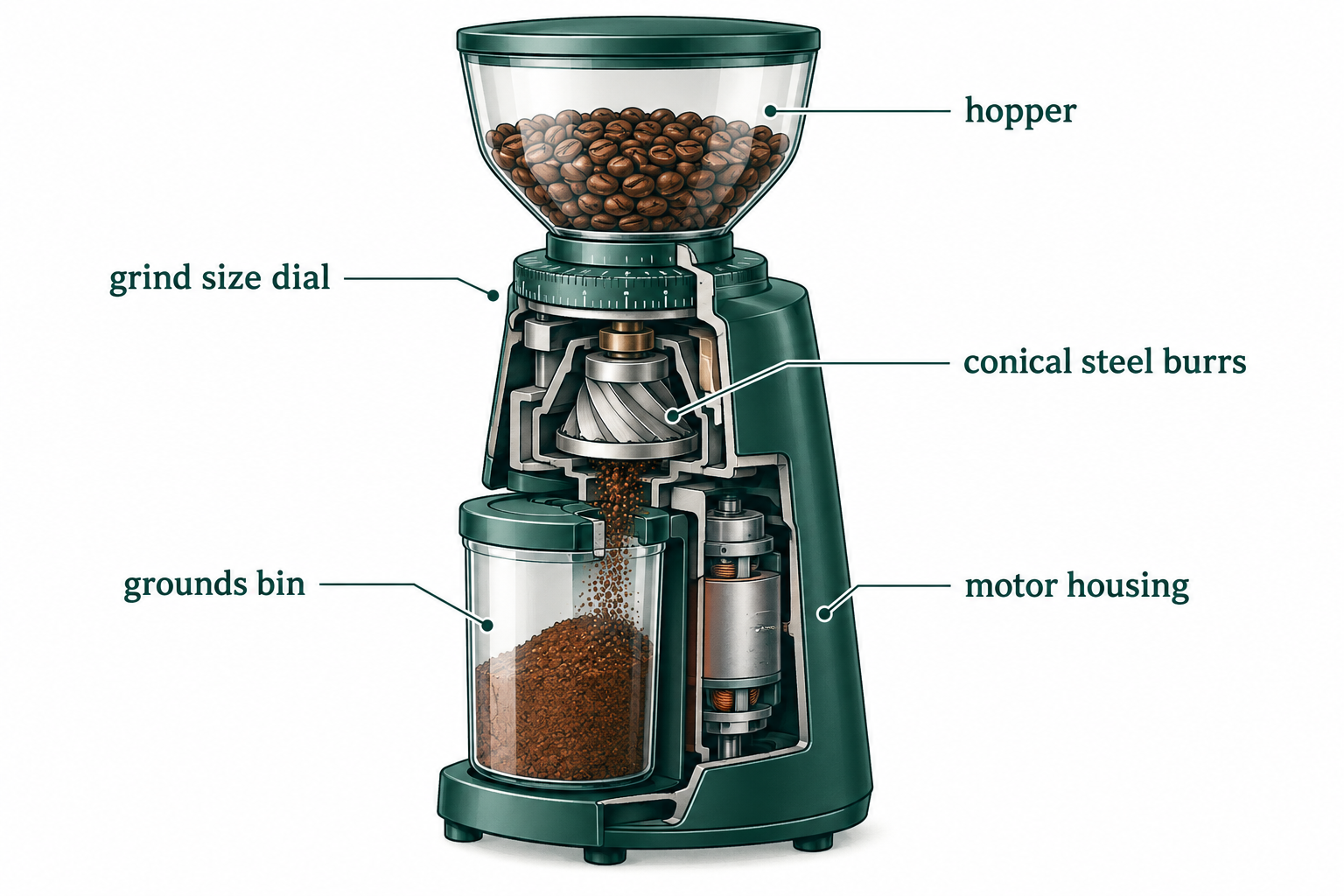
Coffee Grinder
A good grinder ensures uniform coffee particles, which is essential for a balanced extraction.
| Type | Pros | Cons |
|---|---|---|
| Blade | Inexpensive, widely available | Inconsistent grind size |
| Burr | Consistent grind size, versatile | Expensive, requires maintenance |
Coffee Scale
A coffee scale helps you measure coffee and water accurately, ensuring consistency in your brew.
Kettle
A kettle with a gooseneck spout gives you controlled pouring, which matters most for pour over.
Filter Brewing Device
Depending on your preference, choose an Aeropress, Chemex, French Press, or any other coffee maker that fits your style.
Water Quality and Temperature
Water makes up around 98% of your coffee, so its quality and temperature are vital.
Water Quality
Consumer Options:
- Filtered Water: Removes impurities that can alter the taste.
- Spring Water: Natural minerals that help extraction.
- Tap Water: Affordable but may contain impurities depending on your location.
Ideal Temperature
Water temperature should be between 195°F to 205°F (90.6°C to 96.1°C). Too hot and you’ll over-extract; too cold and the coffee will be under-extracted.
Coffee-to-Water Ratio
The ratio of coffee to water can make or break your brew. A general rule of thumb is a 1:15 to 1:18 coffee-to-water ratio by weight.
Measuring
Using a coffee scale, measure your coffee and water for precision. For example, for each gram of coffee, use 15-18 grams of water.
Brewing Methods
Here is how The Original works in four common brewers. Each one brings out a different side of the same beans.
Pour-Over (Chemex)
- Grind Coffee: Medium-coarse
- Coffee-to-Water Ratio: 1:16
- Procedure:
- Rinse the filter with hot water.
- Add ground coffee to the filter.
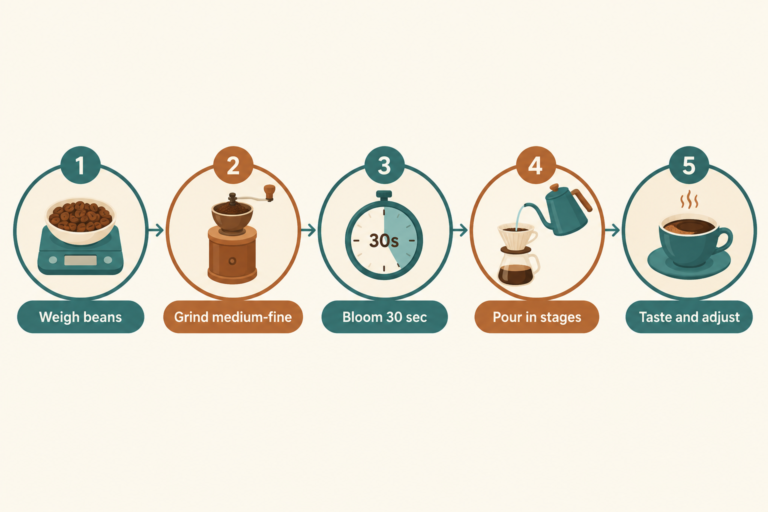
- Pour a small amount of water to bloom the coffee (30 seconds).
- Gradually pour the remaining water in a circular motion.
- Total brew time should be around 4 minutes.
French Press
- Grind Coffee: Coarse
- Coffee-to-Water Ratio: 1:15
- Procedure:
- Add ground coffee to the French Press.
- Pour hot water over the coffee.
- Stir gently to ensure all grounds are saturated.
- Allow to steep for 4 minutes.
- Plunge slowly and serve immediately.
AeroPress
- Grind Coffee: Medium-fine
- Coffee-to-Water Ratio: 1:16
- Procedure:
- Assemble AeroPress and place filter in cap.
- Rinse filter with hot water.
- Add ground coffee to the chamber.
- Pour hot water and stir for 10 seconds.
- Insert plunger and press gently for 30 seconds.
Drip Coffee Maker
- Grind Coffee: Medium
- Coffee-to-Water Ratio: 1:17
- Procedure:
- Add ground coffee to the filter basket.
- Fill the reservoir with water.
- Start the coffee maker and allow the cycle to complete.
Troubleshooting Common Issues
Even after following the best practices, you may encounter some issues. Here’s how to tackle them:
Bitter Coffee
- Cause: Over-extraction
- Solution:
- Grind Coarseness: Use a coarser grind.
- Brew Time: Reduce brew time.
- Temperature: Use water at a lower temperature within the recommended range.
Sour Coffee
- Cause: Under-extraction
- Solution:
- Grind Coarseness: Use a finer grind.
- Brew Time: Increase brew time.
- Temperature: Use water at a higher temperature within the recommended range.
Weak Coffee
- Cause: Too little coffee or too much water
- Solution:
- Coffee Amount: Increase the amount of coffee.
- Water Amount: Reduce the amount of water.
Strong Coffee
- Cause: Too much coffee or too little water
- Solution:
- Coffee Amount: Reduce the amount of coffee.
- Water Amount: Increase the amount of water.
Storing Your Coffee
Proper storage ensures that your coffee retains its freshness and flavor for as long as possible.
Airtight Container
Store your coffee in an airtight container to protect it from moisture, air, and light.
Cool, Dark Place
Keep your coffee in a cool, dark place. A cabinet or pantry away from direct sunlight is ideal.
Whole Bean vs. Ground Coffee
Whole beans stay fresh longer than pre-ground coffee. Grind your coffee just before brewing for the best results.
Small Upgrades for a Better Cup
Once the basics are set, a few small habits make the next bag taste better.
Using Fresh Ingredients
Always use freshly roasted beans and grind them just before brewing. Fresh ingredients make a significant difference in taste.
Experimenting with Grind Sizes
Different grind sizes can yield different flavors. Don’t be afraid to experiment until you find your preferred taste profile.
Exploring Coffee Pairings
Food changes how coffee tastes. Pastries, cheese and fruit each pull the cup in a different direction.
Table: Common Coffee Pairings
| Food | What It Does to the Cup |
|---|---|
| Chocolate | Brings out the coffee’s natural sweetness |
| Cheese | Balances the acidity |
| Fruit (e.g., Berries) | Brings the fruity notes forward |
| Pastries | Complements the richness and body |
How Much Eight O’Clock Coffee per Cup? The Brand’s Own Numbers
Eight O’Clock publishes its own starting dose, and it is more specific than most bags. For an electric drip machine, the brand’s drip brewing page says to use 10 grams, or 2 level tablespoons, of medium ground coffee per cup. Its general brewing tips give a wider range: 1 to 2 rounded tablespoons per 6 ounces of water.
Do the math on 10 grams per 6 ounce cup and you land near 1:18, the weaker end of the 1:15 to 1:18 range above. That suits a medium roast the brand describes as sweet and fruity with a well-balanced finish. If your mug tastes thin, move toward 12 grams per cup before you change anything else.
One catch: the “cup” on a coffee maker is not a mug. Many drip machines count a cup as 5 or 6 ounces, so a “12 cup” pot fills about six real mugs. Check the manual and measure by the lines on the reservoir, not by your favorite mug. Our scoops of coffee per cup chart covers the scoop conversions if you do not own a scale.
Drip Batch Chart for Eight O’Clock The Original
These amounts follow the brand’s 10 grams per cup guideline. Use level tablespoons, not heaped ones, or the numbers drift.
| Machine cups | Coffee | Level tablespoons |
|---|---|---|
| 4 | 40 g | 8 |
| 6 | 60 g | 12 |
| 8 | 80 g | 16 |
| 10 | 100 g | 20 |
| 12 | 120 g | 24 |
Brew Chart by Method: One 12 Ounce Mug
Every recipe below uses 350 grams of water (about 12 ounces) so you can compare methods side by side. Start here, taste, then change one thing at a time.
| Method | Grind | Coffee | Ratio | Brew time |
|---|---|---|---|---|
| Drip machine | Medium | 20 g | 1:17.5 | Machine cycle |
| Pour over (Chemex) | Medium-coarse | 22 g | 1:16 | 3:30 to 4:30 |
| French press | Coarse | 23 g | 1:15 | 4 minutes |
| AeroPress | Medium-fine | 22 g | 1:16 | About 2 minutes |
| Cold brew concentrate | Coarse | 44 g | 1:8, then dilute 1:1 | 12 to 18 hours, fridge |
Two Methods This Guide Skipped: Moka Pot and Cold Brew
Moka Pot
Eight O’Clock’s own tips call for a fine grind in moka pots, finer than drip but short of espresso powder. Fill the lower chamber with hot water up to the safety valve, fill the basket level without tamping, and brew on medium heat with the lid open. Pull the pot off the burner the moment it starts to sputter. That last 20 seconds of gurgling is where the burnt taste comes from.
Cold Brew
Cold brew pulls less acidity out of a medium roast, which makes The Original a smooth, low-effort iced option. Stir coarse grounds into cold water at 1:8, steep in the fridge for 12 to 18 hours, strain, and cut the concentrate with an equal amount of water or milk. Our cold brew ratio guide walks through stronger and weaker batches.
Ground, Whole Bean or K-Cup: Which Bag Fits Your Brewer
The Original is still on shelves in 2026 as ground coffee, whole bean coffee and K-Cup pods, plus a decaf version in all three. On the brand’s store, the whole bean Original was listed at $13.79 for an 11 ounce bag and $31.99 for a 30 ounce bag in September 2026. Grocery prices and bag sizes vary by store.
- Drip machine or pour over: pre-ground is fine. Supermarket ground coffee is usually ground for drip brewers.
- French press or cold brew: buy whole bean. A drip grind in a press leaves silt at the bottom of every cup, and a burr grinder set coarse fixes it.
- Single serve brewer: the K-Cup pods skip the math entirely. Use the 8 ounce setting for a stronger cup.
Want the bean origins, roast notes and how The Original compares with the rest of the lineup? Our Eight O’Clock The Original review covers the coffee itself, and the Coffee Rank IQ homepage has the rest of our brewing guides.
FAQ
How much Eight O’Clock coffee do I use per cup?
Use 10 grams, or 2 level tablespoons, per cup for a drip machine. That is Eight O’Clock’s own recommendation. If you measure by volume for other brewers, the brand suggests 1 to 2 rounded tablespoons per 6 ounces of water.
Can I use Eight O’Clock The Original for espresso?
You can, but it is a medium roast built for drip. It works well in a moka pot at a fine grind. For an espresso machine, Eight O’Clock sells a separate Dark Italian Espresso roast in ground and whole bean bags.
Is Eight O’Clock The Original 100% Arabica?
Yes, The Original is 100% Arabica. The brand says it sources the beans from Latin America to East Africa and roasts them to a medium level for sweet, fruity notes and a balanced finish.
Conclusion
Start with the brand’s 10 grams per cup, grind to match your brewer and keep the water between 195°F and 205°F. Change one thing at a time and write down what worked. A scale costs less than a month of cafe lattes, and it will make this bag taste better tomorrow morning.
Keep Exploring Coffee Rank IQ
- Coffee Rank IQ home: reviews, brewing guides, and coffee science
- Best Coffee Grinder for Every Brew Method and Budget
- Best Cold Brew Coffee Maker: 6 Picks for Smooth Batches at Home
- Best Iced Coffee Maker: Brew-Over-Ice and Cold Brew Picks Compared
- Best Cold Brew Coffee Brands: Concentrates, Cans, and Beans