Best Coffee Grinder for Every Brew Method and Budget
Quick Answer
The best coffee grinder for most home brewers is a conical burr grinder in the $130 to $200 range, such as the Baratza Encore ESP or the OXO Brew Conical, because both grind evenly enough for pour over, drip, and French press while staying easy to clean. Espresso drinkers need a grinder with a finer, more precise range, like the Baratza Virtuoso+ or Fellow Ode Gen 2. Budget shoppers under $50 should look at the Hamilton Beach Fresh Grind or a basic KRUPS burr model instead of a blade grinder.
Key Takeaways
- A burr coffee grinder crushes beans between two surfaces for consistent particle size. A blade grinder chops randomly, which causes uneven extraction.
- The best burr coffee grinder for most kitchens costs between $130 and $200 and handles pour over, drip, French press, and light espresso work.
- Espresso needs a grinder with fine, repeatable adjustment. Cheap blade grinders cannot produce the range or consistency espresso demands.
- Conical vs flat burr grinder is mostly a taste and workflow question, not a strict quality gap. Flat burrs are common in premium single-dose models.
- Grind size, not just the grinder, controls extraction speed and bitterness. Adjust before assuming the machine is broken.
- A $30 blade grinder can make acceptable French press coffee for someone who is not ready to spend more, but it will never match a burr grinder's consistency.
- Clean a home grinder's burrs every two to four weeks with brush and dry rice or grinder-specific cleaning tablets to prevent oil buildup and jamming.
Best Coffee Grinder for Every Brew Method and Budget: Quick Picks by Buyer Type
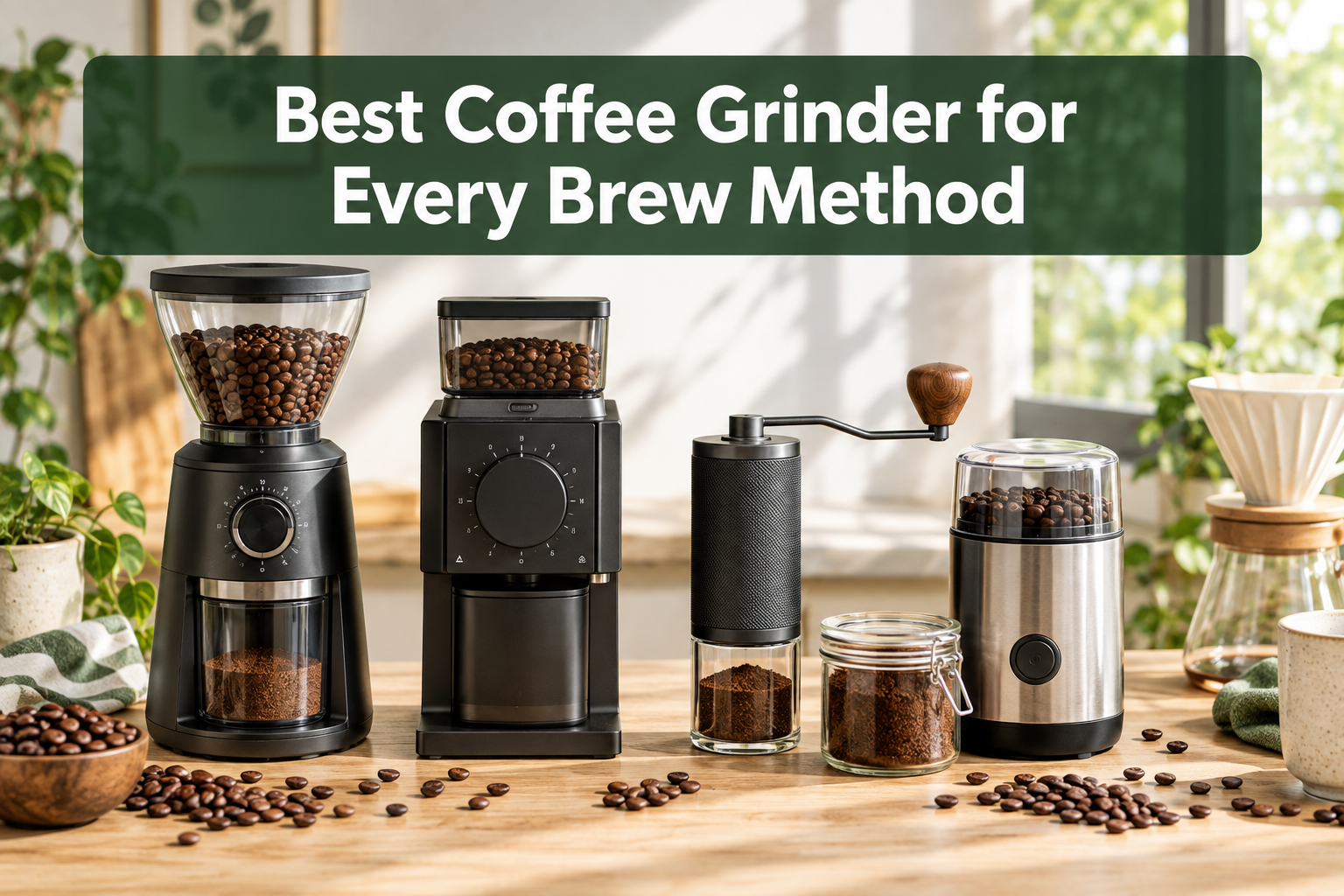
The best coffee grinder depends on how you brew, not on brand reputation alone. Below are direct picks for seven common buyer situations, based on current published testing and specification comparisons from Wirecutter, Tom's Guide, CNN Underscored, and other outlets.
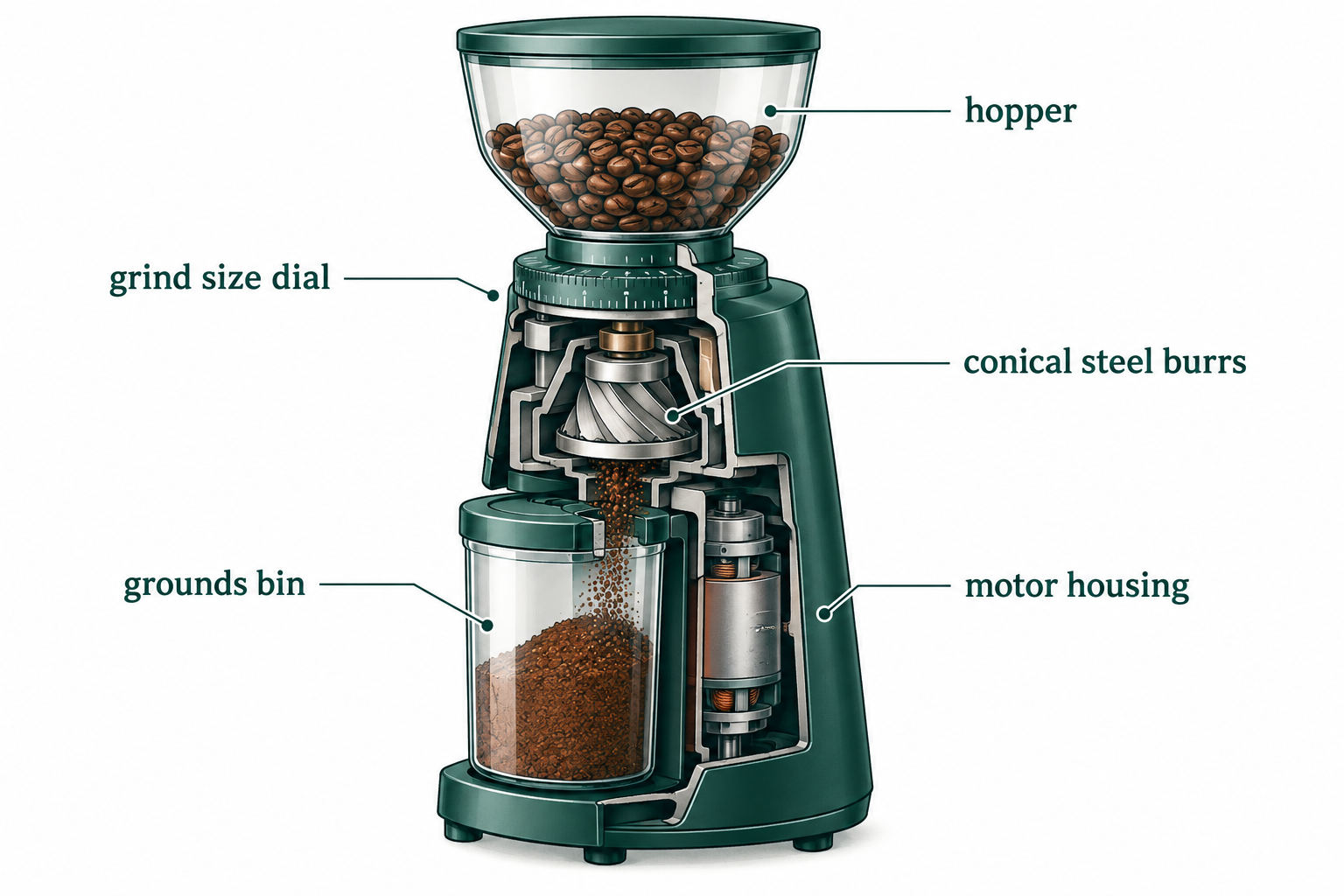
- Best overall for most people: OXO Brew Conical Burr Grinder, widely rated the top all-around pick for home use.
- Best for every brew method: Baratza Encore ESP, built with a wider grind range that stretches from espresso to French press.
- Best for espresso specifically: Baratza Virtuoso+ or Fellow Ode Gen 2, both praised for grind consistency at fine settings.
- Best budget pick under $50: Hamilton Beach Fresh Grind, the dominant choice in the ultra-budget segment.
- Best upgrade or high-end pick: Timemore Sculptor 078S or Niche Zero for enthusiasts chasing near-zero retention and flat-burr precision.
- Best for beginners: Baratza Encore, the long-running favorite because of its simple dial and forgiving learning curve.
- Best manual grinder for travel or small kitchens: 1Zpresso hand grinders, valued for stepless adjustment in a compact body.
What Makes a Good Coffee Grinder
A good coffee grinder produces particles that are close to the same size, adjusts easily between brew methods, and retains little leftover coffee between uses. Those three traits, consistency, adjustability, and low retention, separate a grinder worth owning from one that just spins.
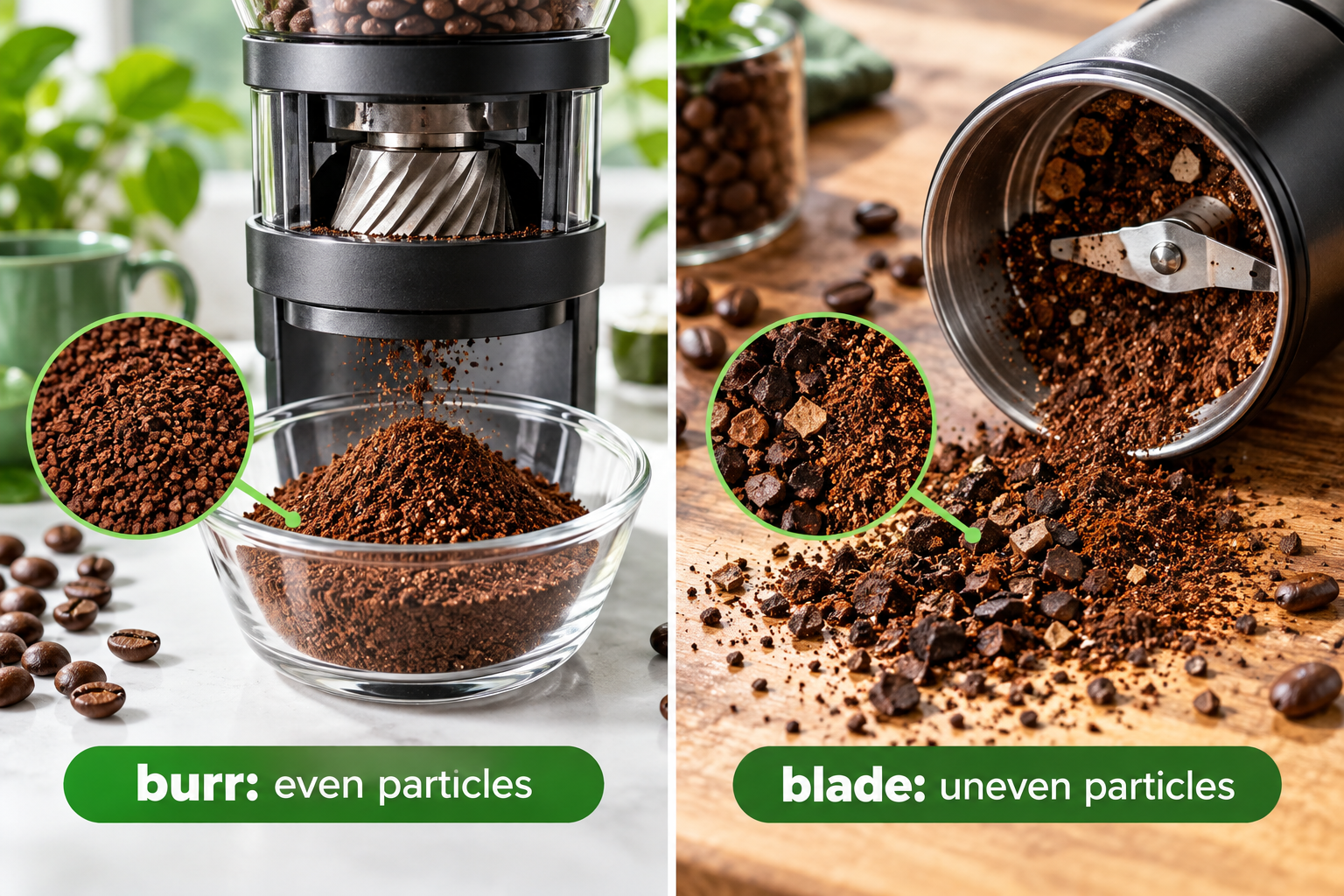
Consistency matters because uneven grounds extract unevenly. A batch with both fine dust and large chunks gives you over-extracted bitterness from the dust and under-extracted sourness from the chunks at the same time. That mixed result is why so many home brewing complaints trace back to the grinder rather than the beans or the water.
Testing groups in 2026 have shifted their methodology to match this reality. Reviewers now weigh particle uniformity and grind speed more heavily than they did five years ago, using sieve tests and photographed grind samples rather than relying on marketing claims. That shift is good news for shoppers: it means published rankings increasingly reflect what actually happens in the grounds bin, not just how a grinder looks on a counter.
A few practical markers of quality worth checking before you buy:
- Burr material and size. Larger, hardened steel or ceramic burrs tend to run cooler and last longer under daily use.
- Number of grind settings. More settings, especially stepless dials, give finer control for dialing in espresso.
- Retention. Some grinders leave several grams of ground coffee trapped in the chute after every use. That's wasted coffee and it can turn stale before your next pot.
- Noise and speed. A loud grinder isn't a flaw by itself, but a slow one that overheats beans during a long grind can flatten aroma.
Decision rule: choose a grinder rated for uniform particle size in independent testing over one that only advertises "professional grade" burrs with no test data behind the claim.
Burr Grinder vs Blade Grinder: Which Is Better
A burr grinder is better than a blade grinder for almost every brew method because it produces even particle sizes through a crushing motion, while a blade grinder chops beans at random with spinning blades. The only situation where a blade grinder makes sense is a very tight budget and infrequent brewing.
Here's the mechanical difference. A burr coffee grinder pulls beans between two burrs, either two cones (conical) or two flat discs (flat burr), set at a fixed distance apart. That distance is the grind size setting. Every bean passes through the same gap, so the output stays close to uniform. A blade grinder has no gap setting at all. It just spins a propeller-shaped blade and hopes for the best, which means grind time becomes a rough proxy for grind size, and it's a bad proxy.
| Factor | Burr grinder | Blade grinder |
|---|---|---|
| Particle consistency | High | Low |
| Grind size control | Precise, repeatable | Rough, time-based guess |
| Suitable for espresso | Yes, with a fine range | No |
| Typical price | $30 to $700+ | $15 to $40 |
| Heat generated | Low to moderate | Higher, from blade friction |
Decision rule: choose burr if you brew more than once a week or care about taste consistency. Choose blade only if you brew occasionally, use a French press exclusively, and want to spend under $20.
Common mistake: assuming a more expensive blade grinder closes the gap with a cheap burr grinder. It doesn't. The mechanism is the limiting factor, not the price tag.
Best Coffee Grinder for Espresso
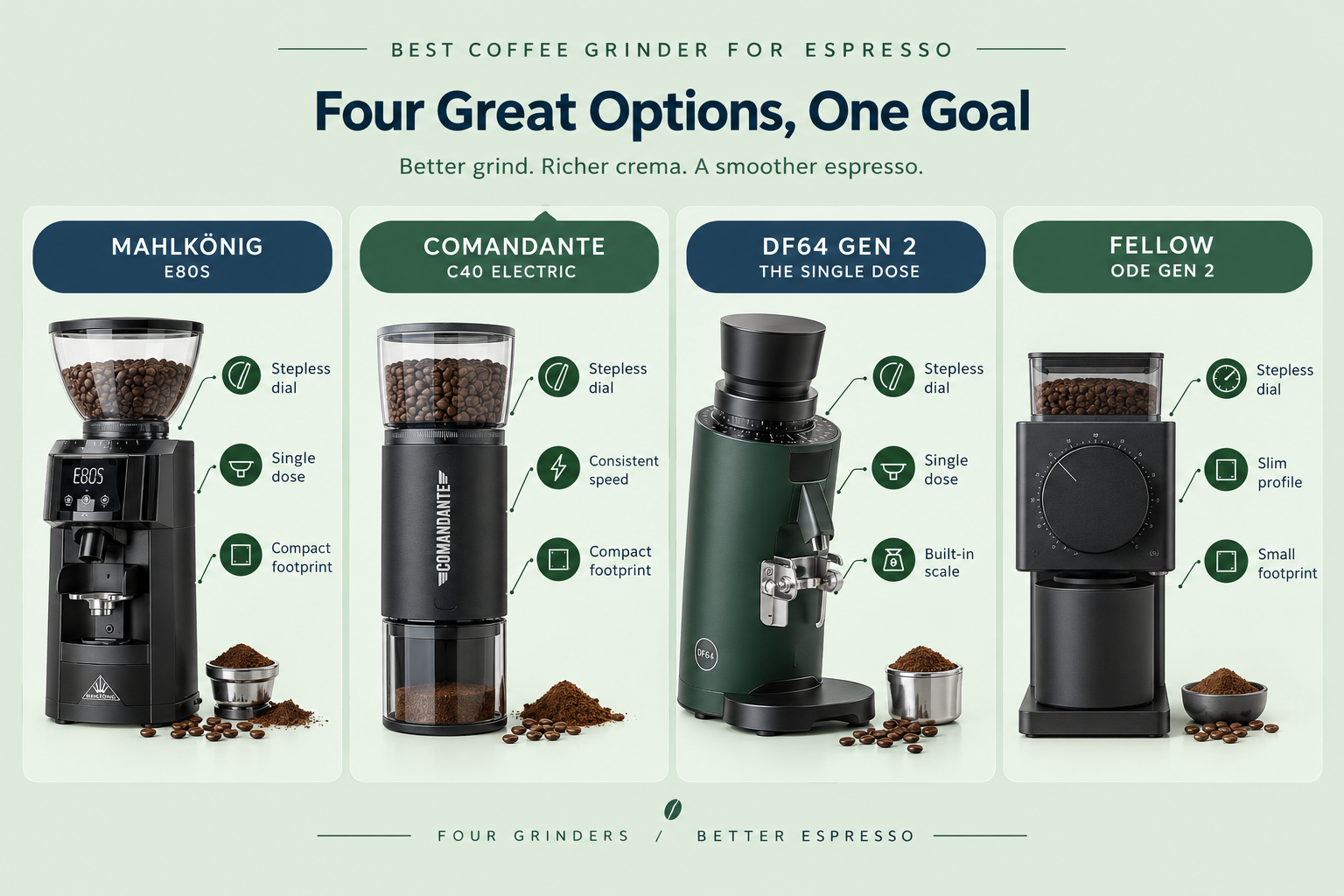
The best coffee grinder for espresso needs a fine grind range, tight step adjustments, and consistency that holds up shot after shot. Baratza Virtuoso+ and Fellow Ode Gen 2 are the strongest choices at home espresso price points in 2026.
Espresso is unforgiving. A pour over can tolerate a slightly uneven grind because the water has minutes to work through the bed. Espresso pushes hot water through a compacted puck in under 30 seconds, so any inconsistency shows up immediately as channeling, sourness, or a shot that runs too fast. That's why our what is the best grind of coffee for an espresso machine guide treats grind size as the single biggest variable in a home espresso setup.
- Baratza Virtuoso+: A long-standing favorite for its 40 step settings and digital timer, giving repeatable dosing without a scale built in.
- Fellow Ode Gen 2: Originally built for filter coffee, the Gen 2 version added a fine espresso burr set, making it one of the few flat-burr grinders that genuinely covers both ends of the spectrum.
- Breville Smart Grinder Pro: A practical all-in-one option with a built-in scale and 60 grind settings, useful for buyers who want espresso and drip coverage without owning two machines.
- Niche Zero: A premium single-dose flat-burr grinder favored by enthusiasts for near-zero retention, though it costs several times more than the Virtuoso+.
Decision rule: if you pull shots daily and want minimal fuss, choose the Virtuoso+. If you also brew a lot of pour over and want one grinder for both, choose the Fellow Ode Gen 2.
Edge case: pairing a great grinder with a cheap espresso machine still limits you. Grind quality matters, but temperature stability and pressure control on the machine side set a ceiling too, a topic covered in our best ways to improve your advanced espresso brewing skills guide.
Best Coffee Grinder for Pour Over
The best coffee grinder for pour over is one with a medium-fine range and enough adjustment steps to fine-tune flow rate, since pour over depends on gravity rather than pressure to pull flavor from the grounds. The Fellow Ode Gen 2 and OXO Brew Conical both perform well here.
Pour over brewing, whether through a V60, Chemex, or a basic dripper, relies on water passing through the bed at a controlled rate. Too fine a grind and the water stalls, over-extracting and turning bitter. Too coarse and it rushes through, leaving the cup thin and sour. Our beginners guide to using a pour over coffee maker walks through the pour technique itself, but the grind is the foundation that technique builds on.
For pour over specifically, look for:
- A wide enough range to move between medium-fine and medium-coarse without huge jumps between settings.
- Flat burrs if you want more clarity and separation between flavor notes, since flat-burr grinders tend to produce a narrower particle distribution at these settings.
- A grounds bin or catch cup that makes it easy to weigh your dose, since brew ratio precision matters as much as grind size for pour over results.
Decision rule: choose a flat-burr grinder like the Fellow Ode Gen 2 if you brew single origin pour overs and want to taste subtle differences between beans. Choose the OXO Brew Conical if you want one reliable grinder that also handles drip and French press without switching burrs or settings constantly.
Best Coffee Grinder for French Press
The best coffee grinder for French press is one that grinds coarse and even, since French press uses a metal mesh filter that lets fine particles through into the cup as sediment. Almost any decent burr grinder, from the Baratza Encore up to premium options, handles this range comfortably.
French press is the most forgiving brew method for grind size, but it still punishes a bad grinder. A blade grinder's mix of powder and chunks means some grounds sit in the sediment at the bottom of your cup while others never fully extract. A burr grinder set to a coarse, even setting solves both problems at once.
- Aim for a grind size similar to coarse sea salt.
- Extend steep time slightly, around four minutes, if your grinder tends to run a bit fine at its coarsest setting.
- If you already own a basic burr grinder, French press is the easiest method to get right without buying anything new.
Decision rule: if French press is your only brew method, you don't need to spend above $150. A mid-range electric burr coffee grinder with a simple dial will outperform a $500 espresso-focused grinder here because coarse consistency is easy to achieve across most burr designs.
Best Budget Coffee Grinder Under $50
The best budget coffee grinder under $50 is the Hamilton Beach Fresh Grind, a blade-style grinder that dominates the ultra-budget segment because of its low price and simple one-button operation. It won't match a burr grinder's consistency, but it's a real upgrade from pre-ground coffee for a first-time buyer.
Under $50, options split into two camps: basic blade grinders and a small number of entry-level burr models, usually refurbished or older generation units. If your budget is firm and you brew mostly French press or drip coffee at home, a blade grinder in this range is a reasonable starting point.
- Hamilton Beach Fresh Grind: Fast, cheap, and widely available, this is the standard recommendation for shoppers who just want fresher coffee than a bag that's been open for weeks.
- KRUPS Precision Electric Coffee Grinder: A mainstream favorite that sits at the edge of this price tier, sometimes available with light burr-style grinding depending on the model year.
Common mistake: buying a sub-$50 grinder and expecting espresso-quality results. It won't happen. Set expectations at drip and French press only.
Decision rule: choose this tier if you're testing whether grinding your own beans is worth the extra step before committing to a $150+ burr grinder. If you already know you'll stick with it, skip straight to a burr model instead, since you'll likely upgrade within a year anyway.
Best High End Coffee Grinder Worth the Money
A high-end coffee grinder earns its price through lower retention, tighter particle consistency, and quieter, more durable motors, not through extra buttons. The Timemore Sculptor 078S and Niche Zero are the two names enthusiasts and reviewers keep returning to in 2026.
Coffee Locator and BrewSift, both enthusiast-focused testing sites, score grinders on repairability and long-term part availability in addition to raw grind quality. That's a useful lens for anyone considering a $400 to $700 purchase: a grinder you can service yourself for another decade is a different value proposition than one you'll replace in three years.
- Timemore Sculptor 078S: A flat-burr grinder with strong reviews for consistency at fine settings, popular among espresso hobbyists who want café-level results at home.
- Niche Zero: Conical burr, single-dose design, praised for near-zero retention, meaning almost no leftover grounds sit in the chute between uses.
- 1Zpresso (manual, high-end): For readers who want premium grind quality without an electric motor, 1Zpresso's higher-tier hand grinders offer stepless adjustment that rivals electric options at a fraction of the footprint.
Decision rule: spend above $400 only if you already know your brew routine and want to remove the last inconsistencies from it. A beginner rarely benefits from a grinder this precise before they've built the habit of weighing beans and dialing in ratios.
Compare the Models: Named Grinders at a Glance
| Grinder | Burr type | Best for | Approx. price (checked Sept 2026) |
|---|---|---|---|
| Hamilton Beach Fresh Grind | Blade | Ultra-budget drip and French press | Under $25 |
| Baratza Encore | Conical | Beginners, general home use | Around $170 |
| Baratza Encore ESP | Conical | Every brew method in one grinder | Around $200 |
| OXO Brew Conical | Conical | Best overall for most households | Around $100 to $130 |
| Baratza Virtuoso+ | Conical | Espresso and everyday brewing | Around $260 |
| Fellow Ode Gen 2 | Flat | Pour over clarity and espresso range | Around $350 |
| Breville Smart Grinder Pro | Conical | All-in-one with built-in scale | Around $200 |
| Timemore Sculptor 078S | Flat | High-end espresso, enthusiast use | Around $500+ |
| Niche Zero | Conical | Low retention, single-dose enthusiasts | Around $700 |
Prices shift with retailer promotions. Check the current price before buying, and compare the models side by side if you're choosing between two finalists.
Coffee Grinder Keeps Jamming: What to Do
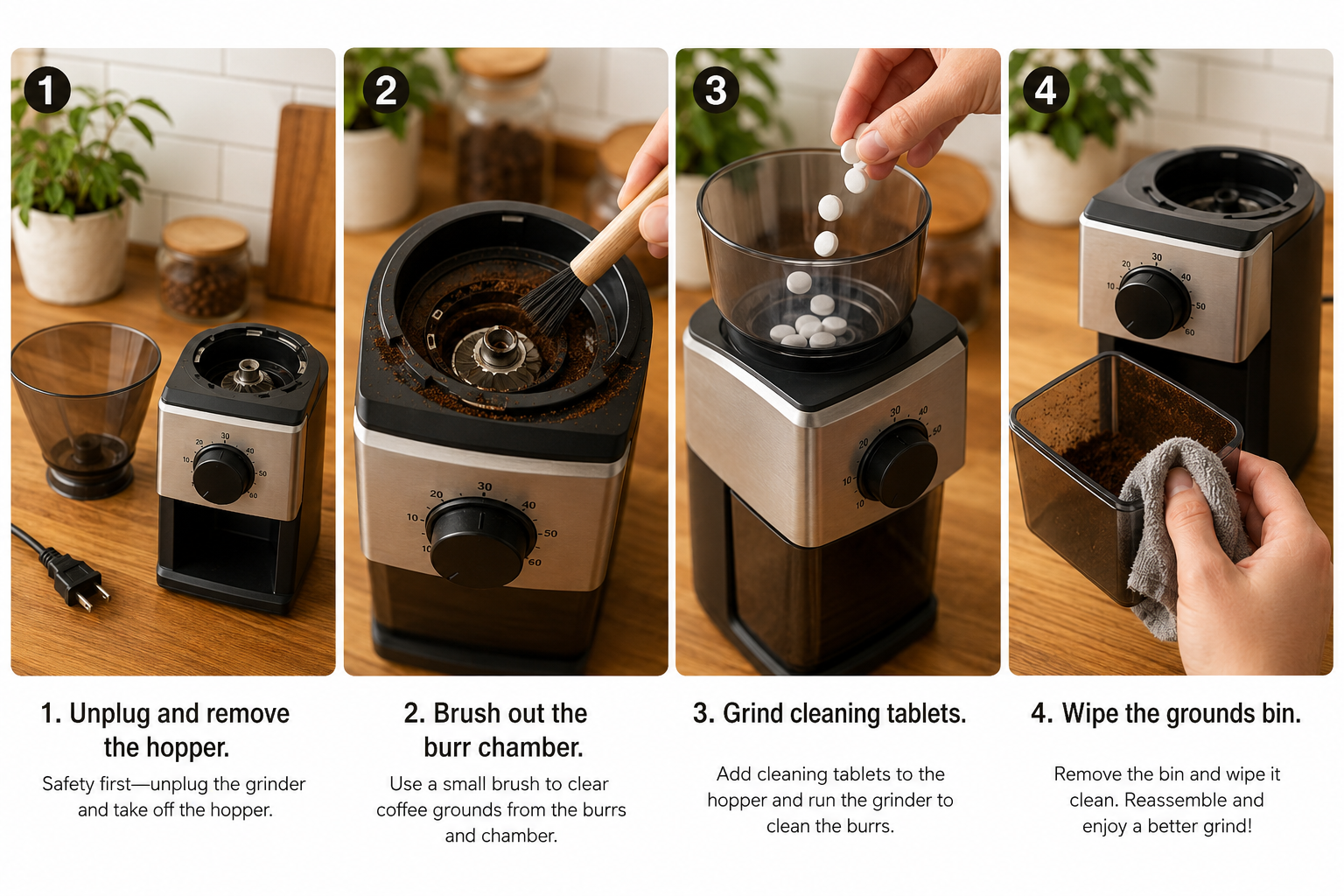
A coffee grinder that keeps jamming usually has oil buildup on the burrs, a foreign object like a small stone in the beans, or a grind setting that's too fine for the bean's roast level. Clear the hopper, remove any beans stuck near the burrs, and run a batch of dry rice or a grinder-cleaning tablet through on a coarse setting.
Dark roast beans release more oil than light roasts. That oil coats the burrs over time, and coated burrs grip beans less efficiently, which increases jamming. If you mostly drink dark roast, clean your grinder more often than the general schedule below.
Troubleshooting steps in order:
- Unplug the grinder before doing anything inside the hopper or chute.
- Remove the hopper and check for a stray bean fragment or foreign object blocking the burr gap.
- Brush loose grounds out of the chute with a dry, stiff-bristled brush.
- Run a small batch of uncooked rice through on a coarse setting to absorb oil residue, then discard the rice-tainted grounds.
- If jamming continues, loosen the grind setting one notch and test again.
Edge case: if a burr grinder jams immediately on the finest espresso settings but works fine on coarser ones, the burrs themselves may be worn or misaligned rather than dirty. That's a repair or replacement issue, not a cleaning one.
How Often Should I Clean My Coffee Grinder
Clean a home coffee grinder every two to four weeks with light daily use, and clean it immediately if you notice a change in taste, slower grinding, or visible oil residue on the burrs. Heavy dark-roast drinkers should lean toward the two-week end of that range.
A regular cleaning routine covers three levels:
- Weekly: Wipe the hopper and grounds bin with a dry cloth to remove loose grounds and static buildup.
- Monthly: Run cleaning tablets or dry rice through the burrs to lift oil and fine dust that brushing alone can't reach.
- Every three to six months: Remove the burrs completely, following the manufacturer's instructions, and brush out the compacted grounds that collect underneath them. This is where most stale, musty flavors originate.
For a broader routine that covers your whole setup, our best ways to clean a coffee maker for beginners guide pairs well with grinder maintenance since both machines affect the same cup.
Decision rule: if your coffee has started tasting flat or slightly rancid despite fresh beans, clean the grinder before you blame the roast date.
Manual vs Electric Coffee Grinder: Pros and Cons
A manual grinder gives you more control and portability at a lower price, while an electric burr coffee grinder saves time and effort for anyone grinding more than one cup's worth per session. Neither is universally better; the right choice depends on your morning routine and how much coffee you make at once.
| Factor | Manual grinder | Electric grinder |
|---|---|---|
| Speed | Slower, 1 to 3 minutes per dose | Seconds per dose |
| Portability | Excellent, no power needed | Limited to countertop use |
| Price range | $20 to $250 | $25 to $700+ |
| Best for | Single servings, travel, camping | Households, multiple cups, offices |
| Learning curve | Requires arm effort and consistency | Mostly automatic once dialed in |
1Zpresso has built a strong reputation among manual grinder fans for stepless adjustment that rivals electric burr coffee grinders at a fraction of the size. That makes a manual grinder a genuinely good pick for a small kitchen or frequent traveler, not just a budget compromise.
Decision rule: choose manual if you make one to two cups a day and enjoy the small ritual of hand-cranking. Choose electric if you regularly make coffee for more than one person or you're grinding for a full French press or drip pot.
Coffee Grinder Too Fine or Too Coarse: How to Adjust
If your coffee tastes bitter and the brew runs slow, your grind is too fine; adjust one or two settings coarser. If it tastes sour, weak, or watery and drains too fast, your grind is too coarse; adjust one or two settings finer. Change one variable at a time and taste again before making another adjustment.
Grind size controls extraction speed because it changes the total surface area exposed to water. Finer particles expose more surface area, which pulls flavor faster and can over-extract if left too long. Coarser particles expose less surface area, slowing extraction and risking a thin, under-extracted cup.
- Espresso running too fast (under 20 seconds) with a sour, thin taste: grind finer.
- Espresso running too slow (over 35 seconds) with a bitter, harsh taste: grind coarser.
- Pour over draining in under 2 minutes with a weak cup: grind finer.
- Pour over stalling past 4 minutes with a bitter cup: grind coarser.
Common mistake: changing both grind size and brew ratio in the same session. You won't know which change fixed or worsened the result. Adjust one variable, brew, taste, then decide on the next change. Our top ways to grind coffee beans for a perfect brew guide breaks this process down by method if you want a longer walkthrough.
Best Coffee Grinder for Beginners
The best coffee grinder for beginners is the Baratza Encore, because its single dial and straightforward on/off switch remove the guesswork while still delivering real burr-grinder consistency. It remains a top recommendation for anyone buying their first grinder in 2026.
A first grinder doesn't need every feature. It needs to be forgiving, easy to clean, and simple enough that you'll actually use it every morning instead of falling back on pre-ground coffee out of frustration.
- Look for a wide grind range so you can experiment with different brew methods before settling on your favorites.
- Avoid grinders with too many settings between coarse and fine at first; a huge range can make small, useful adjustments hard to find.
- Buy from a brand with clear documentation and available replacement parts, since burrs eventually wear out even on a beginner-friendly model.
Decision rule: if you're not sure yet whether you'll end up brewing pour over, drip, or French press, choose a grinder with a wide range like the Encore or Encore ESP rather than a specialist model built for one method.
Do I Really Need a Burr Grinder or Is Blade Okay
You don't strictly need a burr grinder if you brew French press occasionally and don't mind some sediment and inconsistency in the cup, but a burr coffee grinder is the better long-term investment for anyone who wants noticeably better, more consistent coffee across multiple brew methods.
Think of it as a threshold question. If coffee is a once-in-a-while habit and you're happy with "good enough," a $20 blade grinder removes the worst problem, stale pre-ground coffee, without asking you to learn anything new. If coffee is a daily ritual you want to get better at, a burr grinder is the single upgrade that changes the most about your cup, more than a better kettle or a fancier dripper.
Decision rule: skip the burr grinder only if you brew fewer than three times a week and exclusively use French press. Otherwise, the jump in consistency is worth the extra $80 to $150 over a blade grinder.
Coffee Grinder Not Grinding Evenly: Why
A coffee grinder that produces uneven grounds usually has worn or misaligned burrs, a grind setting near the edge of its range where consistency drops off, or beans that are too oily or too stale to feed through the burrs smoothly. Check burr alignment and grind setting first before assuming the whole unit needs replacing.
Every burr grinder has a sweet spot in its adjustment range where particle consistency peaks. Pushing a grinder to its absolute finest or coarsest setting often produces worse results than a middle setting, because the burrs weren't primarily engineered for those extremes.
- Worn burrs: After thousands of grinds, steel or ceramic burrs lose their edge and start crushing unevenly rather than cutting cleanly. Most home burrs last two to five years with regular use before needing replacement.
- Stale or very oily beans: Beans that have lost moisture grind more inconsistently than fresh beans still within a few weeks of their roast date. Check our how to choose the best coffee beans for home brewing guide for storage tips that keep beans grinding well longer.
- Loose or misaligned burr housing: On some cheaper grinders, the burr carrier can shift slightly over time, throwing off the gap consistency between one side and the other.
Edge case: if unevenness appeared suddenly rather than gradually, suspect a mechanical shift or foreign object rather than normal wear. Sudden problems are usually fixable; gradual decline over years usually means it's time to replace the burrs.
FAQ
What is the best coffee grinder for someone who brews multiple methods at home? The Baratza Encore ESP is built specifically for this situation, with a wider grind range that covers espresso through French press in one machine.
Is a $700 grinder actually worth it over a $150 one? For most home brewers, no. The jump matters most for espresso hobbyists chasing the last bit of consistency and low retention. Drip and French press drinkers rarely notice the difference.
Can I use the same grind setting for pour over and drip coffee? Mostly yes. Both use similar medium grind sizes, though drip machines with faster flow rates sometimes benefit from a slightly finer grind than a manual pour over.
Does grinding coffee right before brewing actually matter? Yes. Ground coffee loses aroma compounds within minutes of exposure to air, so grinding right before brewing preserves more flavor than pre-ground coffee that's been sitting for days or weeks.
How do I know if my burrs need replacing instead of cleaning? If a thorough cleaning doesn't fix uneven grounds or a sudden increase in fine dust, and the grinder is several years old, worn burrs are the likely cause.
Is a flat burr grinder better than a conical burr grinder? Neither is strictly better. Flat burrs tend to produce a slightly narrower particle range and are common in premium espresso and pour over grinders, while conical burrs run quieter and often retain fewer grounds. Choose based on your brew method and budget rather than assuming one design wins outright.
Conclusion
The best coffee grinder for your kitchen depends on how you actually brew, not on which model has the most reviews. A single-method drinker sticking to French press can get real results from a $100 burr grinder, while an espresso drinker chasing consistency will notice the difference a $250 model like the Baratza Virtuoso+ makes shot after shot. Start with your most common brew method, match a grinder built for its range, and upgrade later if your habits change. Better coffee starts with better answers, and in this case, the answer starts with the grinder, not the beans.
Keep Exploring Coffee Rank IQ
- Coffee Rank IQ home: reviews, brewing guides, and coffee science
- Best Manual Coffee Grinder for Pour Over, Espresso, and Travel
- Best Coffee Maker With Grinder: Fresh Grounds Without an Extra Gadget
- Best Espresso Grinder: The Spec That Decides Your Shot
- Best Espresso Machine With Grinder Built In: 7 Picks
References
- www.reddit.com/r/JamesHoffmann/comments/1k97ls1/whats_the_best_coffee_grinder_to_buy_right_now
- www.nytimes.com/wirecutter/reviews/the-best-coffee-grinder
- www.tomsguide.com/best-picks/best-coffee-grinder
- www.cnn.com/cnn-underscored/reviews/best-coffee-grinders
- www.goodhousekeeping.com/what-to-buy/g30986295/best-coffee-grinders
- www.popularmechanics.com/home/food-drink/g39353405/best-coffee-grinders
- www.homesandgardens.com/buying-guides/best-coffee-grinder
- www.foodnetwork.com/how-to/packages/shopping/product-reviews/best-coffee-grinders
- www.brewsift.com/gear/grinders