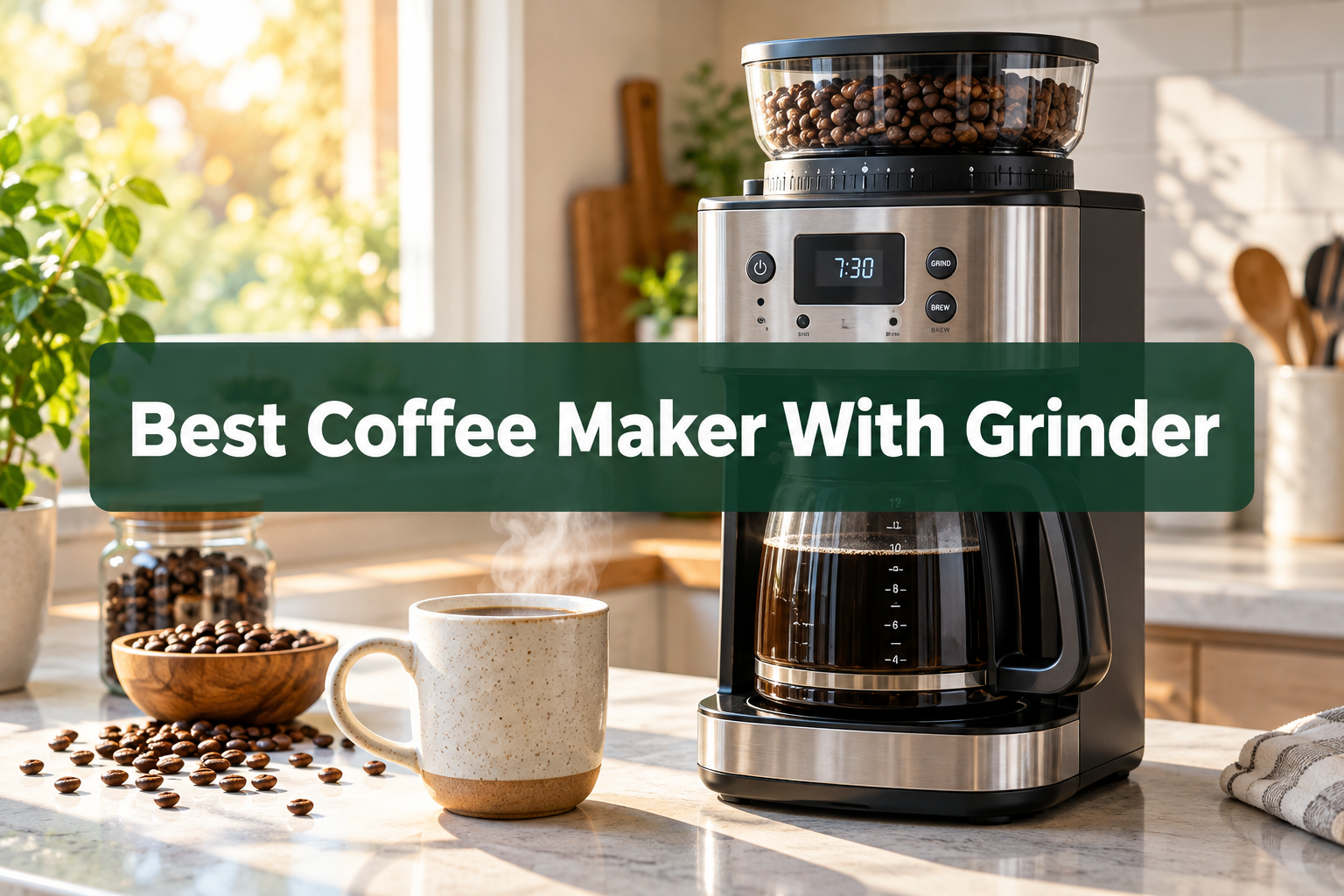
Best Coffee Maker With Grinder: Fresh Grounds Without an Extra Gadget
Quick Answer
The best coffee maker with grinder for most kitchens is the Breville Grind Control. It grinds a measured dose per cup with a conical burr grinder and topped a 2026 test that brewed more than 1,000 cups across competing machines. If your budget stops at $200, the Cuisinart Grind and Brew covers the same job at a smaller footprint and price. If you want espresso from whole beans instead of drip coffee, skip the grind-and-brew category entirely and look at a bean-to-cup machine like the Philips 3200 LatteGo.
Key Takeaways
- The Breville Grind Control shows up as the top overall pick for best coffee maker with grinder across several 2026 buying guides, including Forbes, Good Housekeeping, Business Insider, and Homes and Gardens.
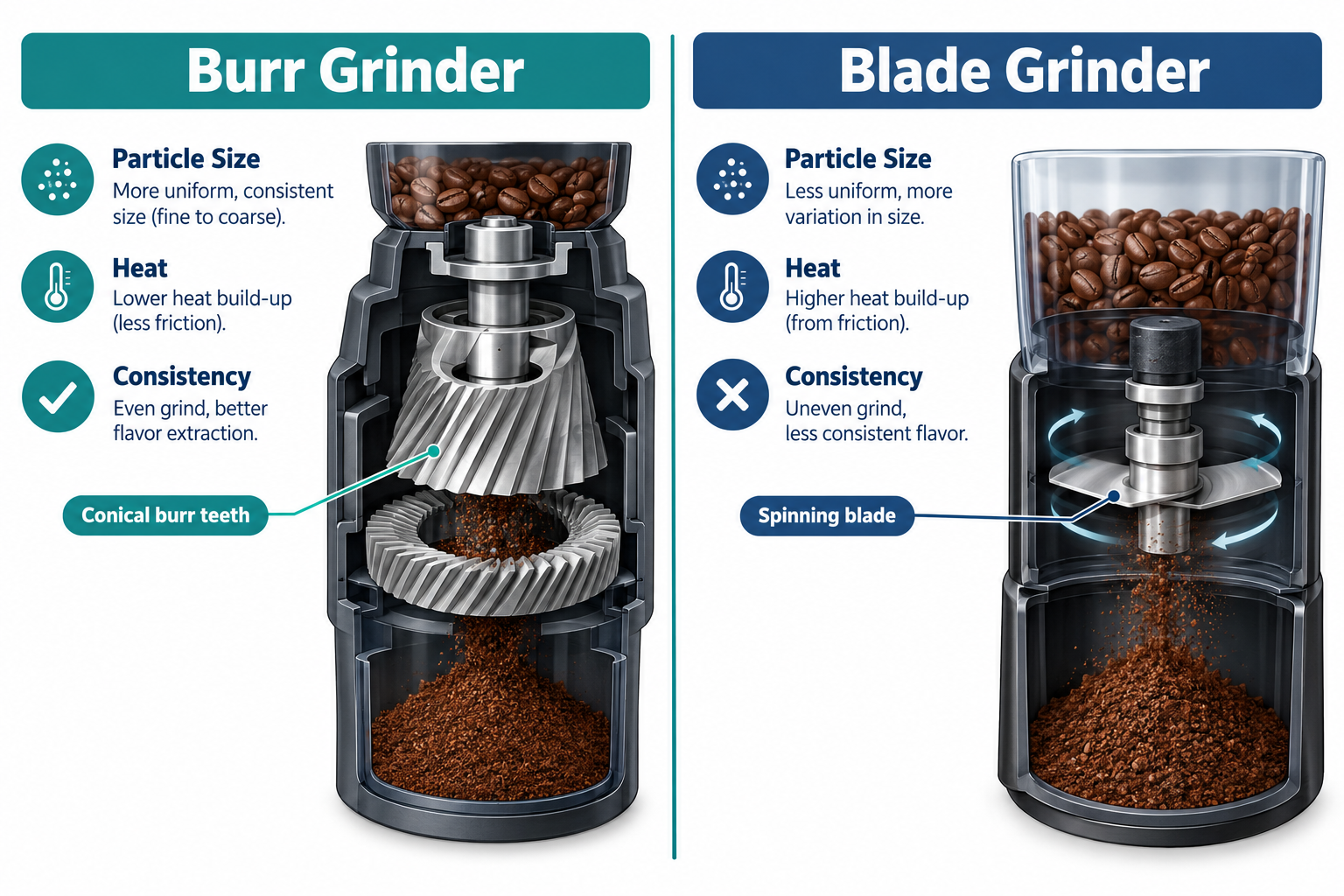
- A burr grinder crushes beans between two revolving surfaces for an even particle size. A blade grinder chops unevenly, which pulls uneven extraction into the cup.
- The Cuisinart Grind and Brew is the most-cited best drip coffee maker with grinder under $200 for small kitchens and single drinkers.
- Café Specialty Grind & Brew is one of the few drip machines built around a true burr grinder rather than a blade.
- A separate burr grinder paired with a dedicated brewer usually gives finer grind control than a built-in unit, though it takes more counter space and two things to clean instead of one.
- Espresso machines with grinders, sometimes called bean-to-cup machines, are a different appliance category from drip grind-and-brew makers and deserve their own shortlist.
- Grinding beans right before brewing keeps aroma compounds in the grounds instead of in the air, which is why pre-ground coffee tastes flatter by the time you brew it.
Best Coffee Maker With Grinder: The Quick Verdict for Buyer Types
The right best coffee maker with grinder depends on how many cups you make, whether you drink espresso or drip coffee, and how much counter space you have. Six buyer types cover almost every reader shopping this category in 2026.
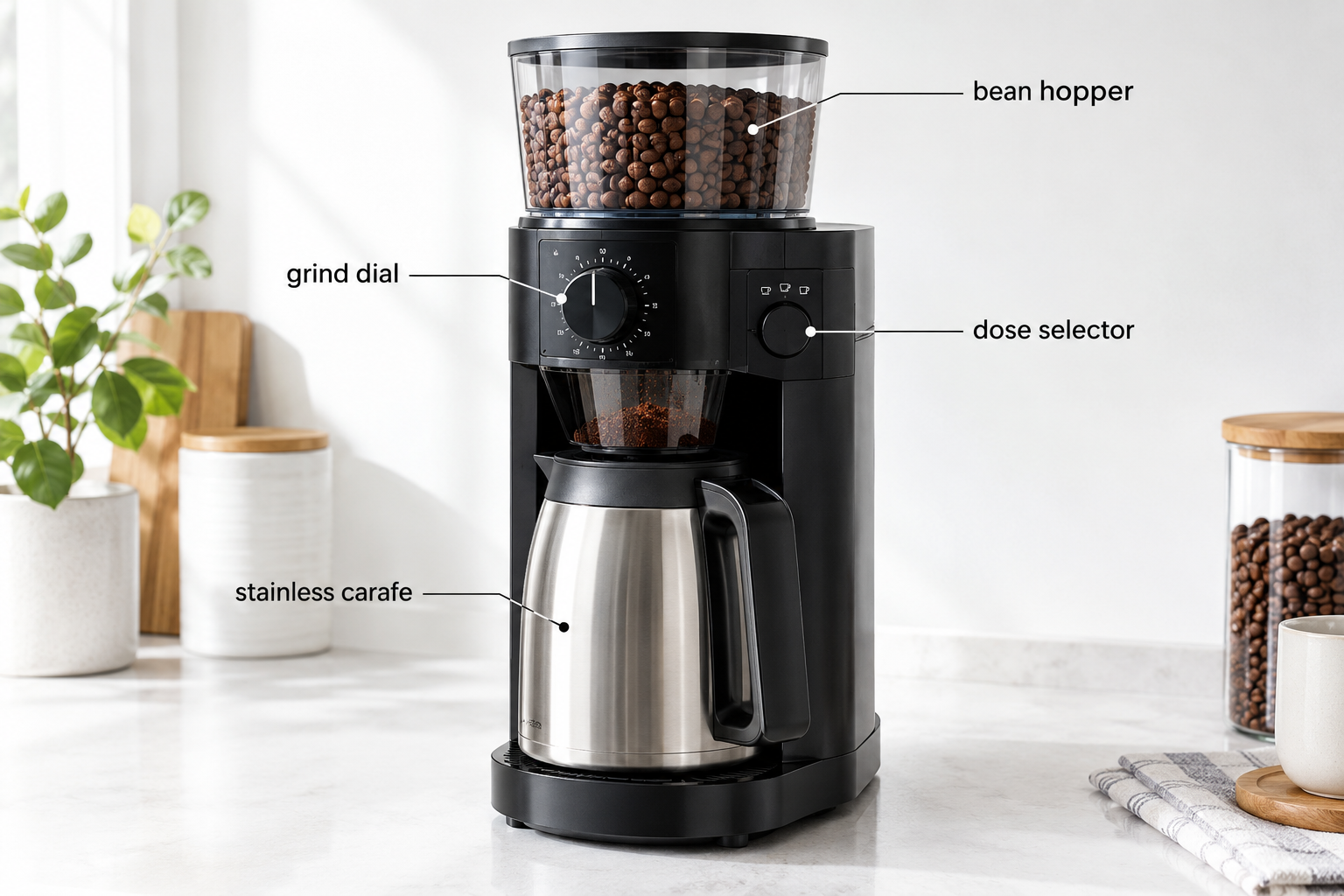
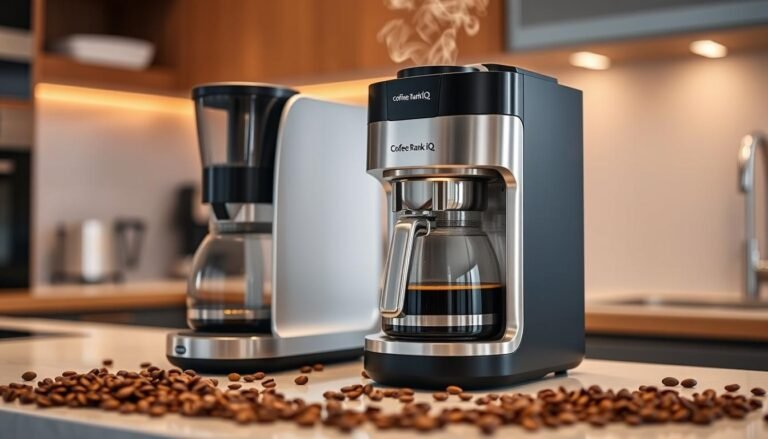
Best overall: Breville Grind Control. A 12-cup capacity, a conical burr grinder, and a per-cup dose dial make this the machine most testers land on. Good Housekeeping's lab ran over 1,000 cups through competing coffee makers before naming it their top pick with a grinder. Dimensions run 8.5 x 12.5 x 16.3 inches, with a brew cycle of roughly 5 to 8 minutes per pot.
Best drip coffee maker with grinder under $200: Cuisinart Grind and Brew. Smaller footprint, blade grinder, and a price that fits a first apartment or a guest room kitchen.
Best for busy mornings: Any grind-and-brew machine with a programmable timer, so beans grind and brew while you are still in the shower. The Breville and the Cuisinart both offer this.
Best for large families: The Breville Grind Control's 12-cup carafe and adjustable grind dose handle a house full of coffee drinkers better than single-serve models.
Best single serve coffee maker with grinder: Compact units like the Black+Decker Mill and Brew or a Gevi grind-and-brew model, both built for one or two cups at a time without a full carafe taking up shelf space.
Best for espresso from whole beans: A bean-to-cup machine such as the Philips 3200 LatteGo, which grinds and pulls a shot rather than brewing a drip pot.
If you are still deciding what kind of machine fits your routine at all, our beginner's guide to choosing the right coffee maker walks through the basic categories before you compare models.
Best Coffee Maker With Grinder: Comparison Table
| Model | Grinder type | Capacity | Best for | Price tier |
|---|---|---|---|---|
| Breville Grind Control | Conical burr | 12 cups | Families, daily brewers | Upper mid-range |
| Cuisinart Grind and Brew | Blade | 12 cups | Budget buyers, small kitchens | Entry level |
| Café Specialty Grind & Brew | Burr | 10 cups | Burr grinding on a budget | Mid-range |
| Black+Decker Mill and Brew | Blade | 5 cups | Single drinkers | Entry level |
| Gevi Grind and Brew | Blade | 4 to 6 cups | Compact single serve | Entry level |
| Philips 3200 LatteGo | Ceramic burr, bean-to-cup | Single shots | Espresso and milk drinks | Upper mid-range |
Check the current price on any of these before buying. Retailer pricing on grind-and-brew machines shifts often, and the model number matters more than the brand name alone.
Burr Grinder vs Blade Grinder in a Coffee Maker With Grinder
A burr grinder crushes beans between two ridged surfaces set at a fixed gap, producing particles close to the same size. A blade grinder spins a propeller-shaped blade that chops beans into a mix of chunks and dust, which brews unevenly no matter how long you run it.
Grind size drives extraction, the process of pulling flavor and caffeine out of ground coffee with hot water. Uneven particles extract at different speeds inside the same brew cycle. The small pieces over-extract and taste bitter. The big pieces under-extract and taste sour or thin. A burr grinder narrows that spread, which is the main reason coffee professionals treat "has a grinder" and "has a good grinder" as two different claims.
Most budget coffee makers with grinder built in use a blade grinder because it costs less to manufacture. The Café Specialty Grind & Brew stands out specifically because it pairs a drip brewer with a true burr grinder instead of a blade, a combination that is still rare below the premium price tier. If grind consistency matters more to you than price, that is the detail to check on the spec sheet before you buy any burr grinder coffee maker.
Decision rule: choose a burr grinder coffee maker if you drink black coffee or pour over style drip and can taste bitterness from over-extraction. Choose a blade model if you drink coffee with milk and sugar, where the palate is more forgiving of an uneven grind.
For more on how grind size and evenness interact with extraction, see our advanced guide to coffee grinders.
Best Coffee Maker With Grinder Under $200
The Cuisinart Grind and Brew is the model most 2026 guides point to for a best coffee maker with grinder under $200. It uses a blade grinder rather than a burr, which is the tradeoff that keeps the price down.
Who it suits: someone brewing for one or two people, without much counter space, who wants grind-and-brew convenience without paying for a conical burr or a large carafe.
Who should skip it: anyone brewing for a household of four or more, or anyone who has already noticed uneven extraction from a blade grinder and wants to fix that specific problem. For that buyer, the step up to a Café Specialty Grind & Brew or a Breville Grind Control buys a real burr grinder instead of a blade.
Common mistake: buying the cheapest grind-and-brew machine and expecting café-quality coffee. A $150 blade grinder inside a drip machine will still make drinkable coffee. It will not match a $20 hand burr grinder paired with a $40 drip cone, because grind evenness is the limiting factor, not the brewer.
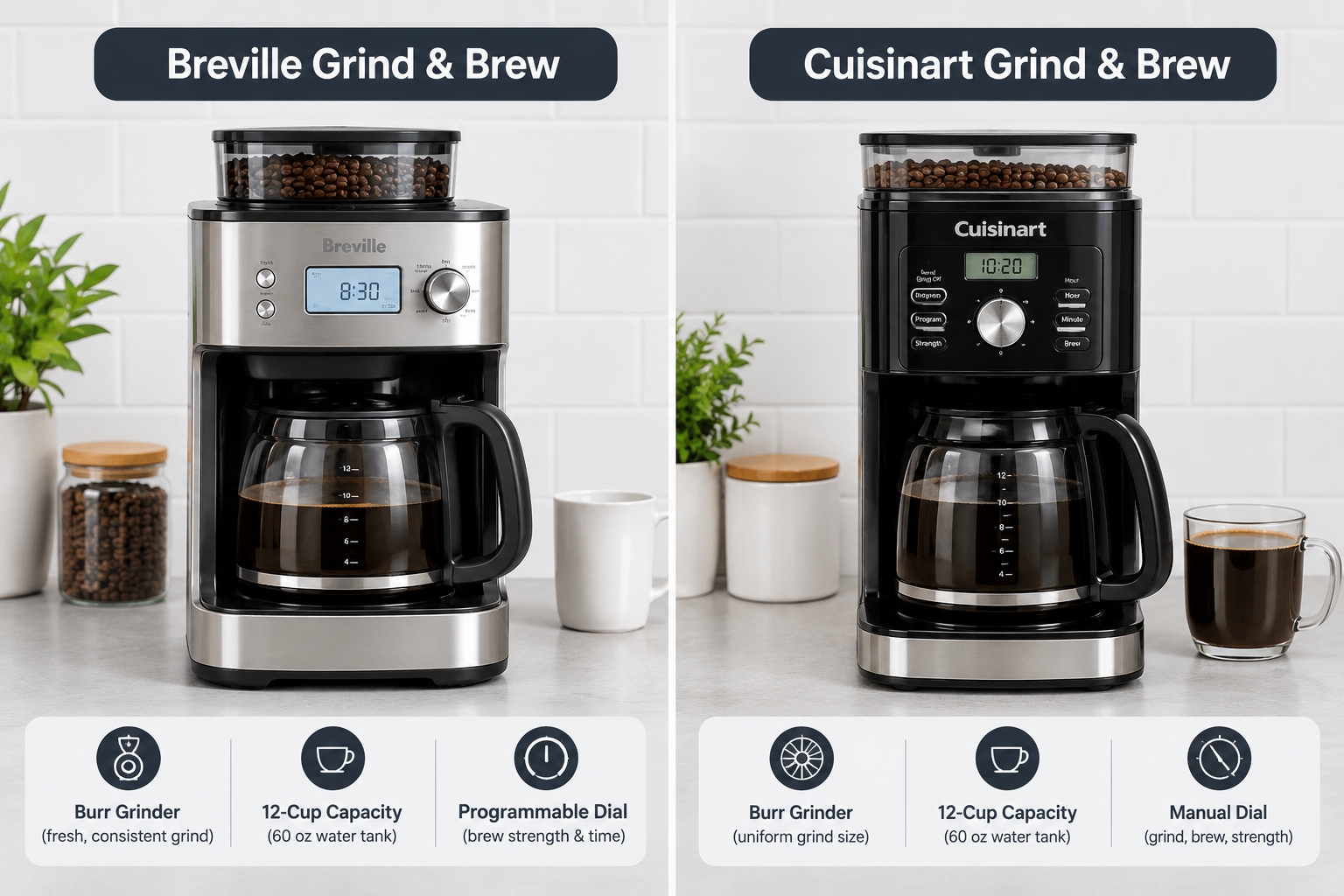
Best Drip Coffee Maker With Grinder: Breville Grind Control vs Cuisinart Grind and Brew
The Breville Grind Control and the Cuisinart Grind and Brew represent the two ends of the best grind and brew coffee maker category: one built for grind precision and family-size batches, the other built for a lower price and a smaller footprint.
Breville Grind Control strengths: a conical burr grinder, a dial that sets grind dose by number of cups rather than guesswork, a 12-cup carafe, and a design that has now been through repeated rounds of testing across multiple 2026 buying guides. Homes and Gardens and Business Insider both keep it near the top of their lists for the same reason: it does the grinding and dosing job with less user error than most competitors.
Breville Grind Control tradeoffs: it is bigger and pricier than a basic drip machine, and cleaning the grinder chute adds a step most simple coffee makers do not have.
Cuisinart Grind and Brew strengths: smaller, cheaper, and simple to operate. Good for a dorm, a small apartment, or a second machine at a vacation house.
Cuisinart Grind and Brew tradeoffs: blade grinder instead of burr, so grind consistency will not match the Breville.
Who should skip both: anyone who already owns a good burr grinder and a brewer they like. Buying an all-in-one grind-and-brew machine to replace a setup that already works well is spending money to solve a problem you do not have.
The Black+Decker Mill and Brew and Gevi grind-and-brew models sit below both of these on capacity and grinder quality, but they cost less and fit smaller kitchens, which is exactly why they show up on the single-serve shortlist later in this guide.
Best Coffee Maker With Grinder for Espresso
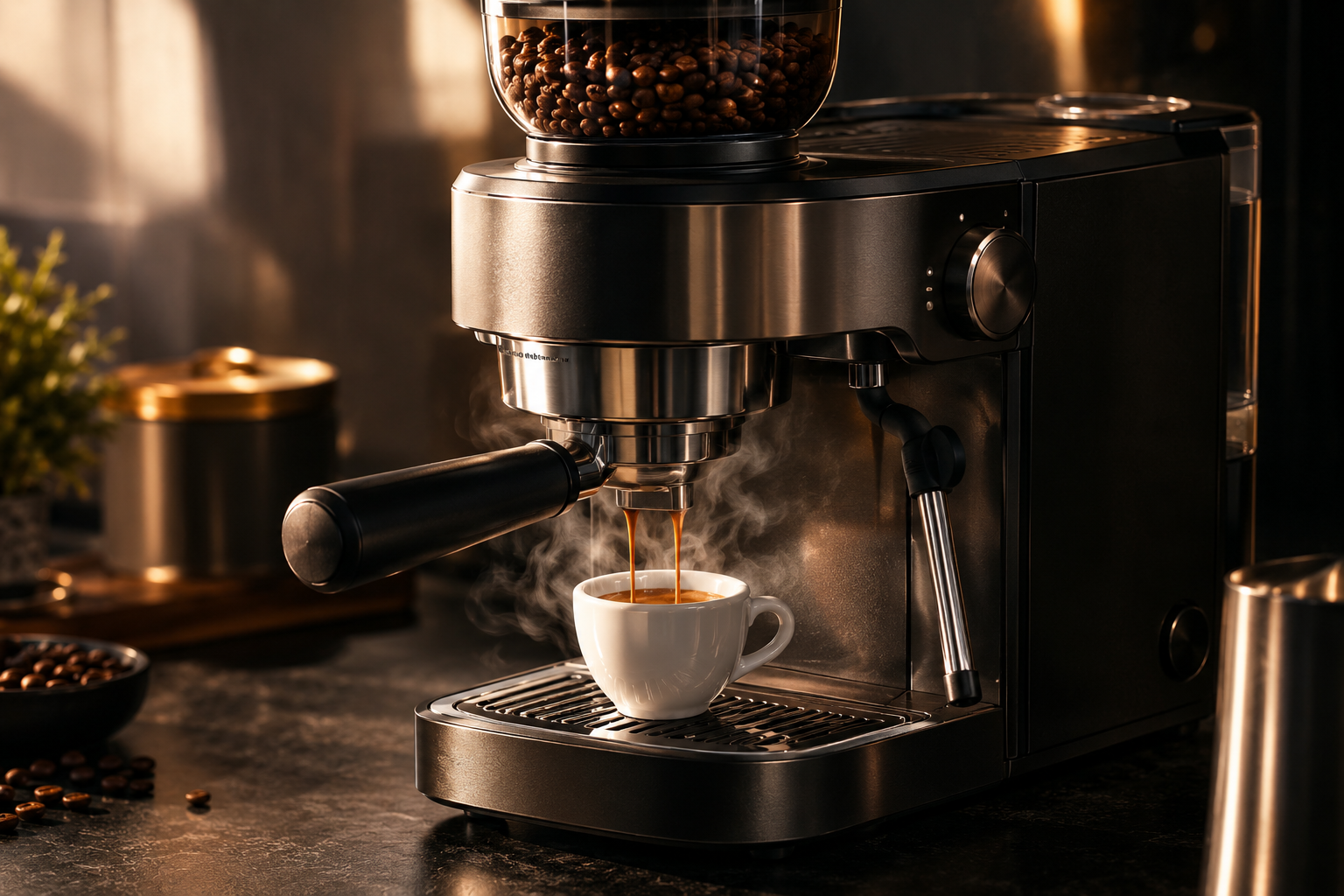
If espresso is the goal, the best coffee maker with grinder is not a drip machine at all. It is a bean-to-cup espresso machine, sometimes marketed as the best espresso machine with grinder, which grinds a dose and pulls a shot through pressurized water instead of dripping through a filter.
The Philips 3200 LatteGo is the model most often named in this category for 2026 buying guides. It grinds beans with a built-in ceramic burr grinder, then pulls espresso and steams milk through the same interface, which removes the step of grinding with one machine and brewing with another.
Who it suits: someone who drinks espresso-based drinks daily and wants one countertop appliance instead of a separate grinder plus espresso machine.
Who should skip it: drip coffee drinkers. A bean-to-cup espresso machine is not built to make a 12-cup pot, and it costs more than a drip grind-and-brew for a feature you would not use.
Grind size for espresso needs to be finer and more consistent than drip coffee, because water passes through the grounds in under 30 seconds under pressure instead of several minutes by gravity. Read our full breakdown of the best grind of coffee for an espresso machine if you are dialing in a shot on a new machine.
Built-In Grinder vs Separate Grinder and Machine: Which Is Better
A built-in grinder wins on convenience. A separate burr grinder plus a dedicated brewer usually wins on grind control, cleaning, and long-term flexibility.
Multiple 2026 buying guides make the same point: the grinder quality matters more than whether it is built into the brewer or sold on its own. A cheap blade grinder inside an expensive coffee maker still produces an uneven grind. A quality standalone burr grinder paired with a basic drip cone can outperform it.
Choose a built-in coffee maker with grinder if:
- You want one appliance and one power cord on the counter.
- Your morning routine has no time for two separate steps.
- You are fine with the grind settings the manufacturer built in.
Choose a separate grinder and brewer if:
- You want to change grind size for different brew methods, like switching between pour over and cold brew.
- You already own a brewer you like and just need better grounds.
- You want to service or replace one part without replacing the whole machine.
Edge case: if you make both espresso and drip coffee at home, a single built-in grind-and-brew machine cannot do both well. You will end up buying a second grinder anyway, so a separate grinder from the start often saves money.
Can You Use Pre-Ground Coffee in a Coffee Maker With Grinder
Yes. Every coffee maker with grinder built in has a bypass setting or a way to skip the grinding step and add pre-ground coffee directly to the filter basket.
This matters for two situations: when you run out of whole beans, or when you specifically want to use a bag of pre-ground coffee you already own. The grinder hopper and the brew basket are separate parts on these machines, so using pre-ground coffee does not damage the grinder or void anything mechanical.
Common mistake: leaving stale, months-old pre-ground coffee in the machine's bypass basket and expecting the same result as fresh-ground beans. Pre-ground coffee loses aroma faster than whole beans because more surface area is exposed to air. If you are going to use pre-ground coffee regularly, buy smaller bags and use them within two to three weeks of the roast date printed on the bag.
Does Grinding Coffee Right Before Brewing Make a Difference
Yes, and the reason is simple: grinding exposes coffee's oils and aromatic compounds to air, and those compounds fade within minutes, not days.
Whole beans hold their aroma far longer than ground coffee because the bean's outer structure limits how much surface area touches oxygen. Once you grind, you multiply that surface area many times over, and the compounds responsible for fragrance and some of the brighter tasting notes start to leave the coffee before water ever touches it.
This is the entire argument for a coffee maker with grinder in the first place. Grinding on demand, right before brewing, keeps more of those compounds in the cup than grinding the night before or buying pre-ground coffee at the store.
Practical takeaway: if you already buy whole bean coffee and grind by hand or with a separate grinder each morning, an all-in-one machine will not improve your cup. It just removes a step. If you currently buy pre-ground coffee out of convenience, switching to any grind-and-brew machine, from a Gevi to a Breville, is the upgrade that changes the flavor most.
How Fine Should You Grind Coffee in Your Machine
Grind size should match your brew method: coarse for cold brew and French press, medium for drip coffee, and fine for espresso.
Most built-in grinders on drip coffee makers offer a narrower range than a standalone burr grinder, usually tuned for medium grind sizes that suit a standard drip cycle. That is fine for drip coffee but a limitation if you also want to make espresso or cold brew on the same machine.
| Brew method | Grind size | Why |
|---|---|---|
| Espresso | Fine, like table salt | Water passes through fast, under pressure |
| Drip / auto-drip | Medium | Balances contact time with flow rate |
| Pour over | Medium-fine | Slightly finer than drip for a similar flow |
| French press | Coarse | Long steep time needs bigger particles |
| Cold brew | Extra coarse | Long steep time, no heat to help extraction |
Decision rule: if your built-in grinder only offers 3 to 5 settings and you want to brew cold brew or French press on the side, plan to buy a separate grinder for those methods rather than forcing your all-in-one machine outside its design.
For a deeper walkthrough of adjusting grind by method, see our guide to grinding coffee beans for a perfect brew.
How Do I Clean the Grinder in My Coffee Maker
Clean the hopper, burrs or blade, and grind chute weekly if you use the machine daily, and always before switching bean types.
Steps:
- Empty the bean hopper and wipe it dry. Leftover oils from dark roasts build up over time.
- Remove the grind chute or burr chamber, if the manufacturer allows it, and brush out trapped grounds with a small brush.
- Run a grinder cleaning tablet or a handful of dry rice through the mechanism, if the manufacturer recommends it, to absorb oils.
- Wipe the exterior chute with a dry cloth. Do not use water directly on the grinder mechanism unless the manual says the part is removable and washable.
- Descale and clean the brew basket and carafe separately, on a normal coffee maker cleaning schedule.
Common mistake: cleaning the carafe and filter basket regularly while ignoring the grinder completely. Ground coffee oils go stale and can clog the chute, which is often the real cause of a machine that grinds slower over time. For the brewing side of the machine, our guide to cleaning a coffee maker covers descaling and carafe care in more detail.
Why Is My Coffee Maker Grinder Making Noise or Not Grinding
A grinder that makes a loud grinding or rattling noise, or refuses to grind at all, usually points to one of three causes: a jammed bean, built-up static and residue, or a bean type the grinder was not designed for.
- Jammed bean or foreign object: a small stone, a broken bean fragment, or debris can lodge between burrs or against the blade. Unplug the machine and clear the hopper and chute before running it again.
- Oil buildup on burrs: dark roast beans are oilier than light roasts, and that oil builds up on burr surfaces over weeks of use, adding friction and noise. Clean the burrs as described above.
- Wrong bean type: flavored beans coated in oil or sugar, and beans that are too fresh and still releasing gas, both grind less predictably than a standard roast a week or two past its roast date.
Edge case: if the grinder runs but produces almost no ground coffee, check whether the hopper actually has beans in the grind path, not just sitting above it. Some hoppers need a minimum bean level to feed correctly.
Coffee Maker With Grinder That Doesn't Overheat the Beans
Grinding always generates some friction heat, but a well-designed burr grinder set at a slower speed keeps that heat low enough that it does not noticeably cook the beans before brewing.
Fast blade grinders spin at higher speeds and generate more friction heat in a shorter time than slower-turning conical burrs. That heat can drive off some of the same aroma compounds that fresh grinding is supposed to protect, which is a small irony of cheap grind-and-brew machines: they grind fresh, but they grind hot.
What to look for: manufacturers rarely publish exact grinder RPM, so the practical signal is grinder type. Conical burr grinders, like the one in the Breville Grind Control, generally run slower and cooler than the spinning blades in budget models. If you notice a burnt or scorched smell right after grinding, that is a sign of excess heat, not a normal part of fresh grinding.
For more on how grind method affects the final cup, our advanced guide to coffee grinding methods covers heat, static, and particle size in more depth.
Find Your Grind Size
Grind size finder
Pick a brew method to see the grind size a best coffee maker with grinder should use.
FAQ
Is a coffee maker with grinder worth buying over a drip machine without one? It is worth it if you currently buy pre-ground coffee. Grinding right before brewing keeps more aroma in the cup than pre-ground beans that have sat on a shelf for weeks.
What is the best coffee maker with grinder for a family of four or more? The Breville Grind Control, with its 12-cup carafe and per-cup dose dial, handles larger households better than single-serve models like the Black+Decker Mill and Brew or Gevi grind-and-brew machines.
Does a coffee maker with grinder work for espresso? No, not a drip grind-and-brew machine. For espresso from whole beans, you need a bean-to-cup espresso machine, such as the Philips 3200 LatteGo, which grinds and brews under pressure instead of by drip.
Can I put regular pre-ground coffee in a coffee maker with a built-in grinder? Yes. These machines include a bypass basket that skips the grinder, so pre-ground coffee works the same as it would in a standard drip machine.
How often should I clean the grinder part of my coffee maker? Weekly for daily use, and always before switching between bean types or roast levels, since oil residue is what usually causes clogging and noise.
Should I buy a coffee maker with a built-in grinder or a separate grinder and brewer? Buy built-in for simplicity and one less appliance on the counter. Buy separate if you brew multiple methods, like espresso and cold brew, since a built-in grinder is usually tuned for one job.
Conclusion
The best coffee maker with grinder for your kitchen depends less on the brand and more on how you actually drink coffee. If you want one appliance and a family-size pot, the Breville Grind Control has earned its spot at the top of most 2026 lists through repeated testing. If your budget or counter space is tight, the Cuisinart Grind and Brew gets you grind-and-brew convenience for less. If espresso is the real goal, skip drip machines entirely and look at a bean-to-cup model like the Philips 3200 LatteGo.
Whichever you choose, the grinder inside matters more than the brand name on the front. A burr grinder coffee maker will beat a blade grinder machine on flavor consistency almost every time, regardless of price. Compare the models against your actual morning routine, not just the spec sheet, and check the current price before you commit to a size and a grinder type you will live with for years.
Keep Exploring Coffee Rank IQ
- Coffee Rank IQ home: reviews, brewing guides, and coffee science
- Best Manual Coffee Grinder for Pour Over, Espresso, and Travel
- Best Coffee Grinder for Every Brew Method and Budget
- Best Espresso Machine With Grinder Built In: 7 Picks
- Best Espresso Grinder: The Spec That Decides Your Shot
References
- www.forbes.com/sites/forbes-personal-shopper/article/best-coffee-makers
- www.goodhousekeeping.com/what-to-buy/g71683163/best-coffee-makers-with-grinder
- www.businessinsider.com/guides/kitchen/best-coffee-makers
- www.nytimes.com/wirecutter/reviews/best-coffee-maker
- www.reviewed.com/cooking/best-right-now/best-drip-coffee-makers
- www.homesandgardens.com/buying-guides/best-coffee-maker
- www.goodhousekeeping.com/what-to-buy/a73297818/best-coffee-makers
- www.independent.co.uk/extras/indybest/house-garden/coffee/best-coffee-machines-b2375287.html
- www.femmeactuelle.fr/deco/maison-pratique/les-meilleures-machines-a-cafe-automatiques-avec-broyeur-comparatif-2159849