Niche Zero Review: Paying Extra for Low Retention
Quick Answer
The Niche Zero is a 63mm conical burr single dose grinder that costs about $689 direct from the maker (US pricing checked November 6, 2026), and the money buys workflow rather than a louder flavor upgrade. Independent testing summarized by CoffeeLabAdvisor puts measured retention at roughly 0.2 g temporary and about 0.7 g permanent until cleaning, which is very low but not literally zero . If you switch beans daily, that near-clean swap is worth paying for. If you drink one bag at a time, a bellows-equipped DF64 Gen 2 at around $389 does most of the same job for roughly half the money.
Key Takeaways
- Direct US price checked at $689 on November 6, 2026; the UK listing sits at £559 before local taxes and duties .
- US buyers importing have reported landed totals near $860 after shipping and duties, so the sticker is not the final number.
- Used units commonly trade between $450 and $650, with eBay listings seen around $779.99 for near-new stock.
- Published specs: 63mm conical burrs, about 1 gram per second grind speed, ±0.2 g dose consistency, roughly 72 dB while grinding .
- Measured retention is low but real. Testing cited by CoffeeLabAdvisor records about 0.7 g held inside until cleaning .
- The main rival is the DF64 Gen 2 at about $389, which closes much of the retention gap with a bellows and an angled chute .
- Flat burr clarity seekers should look at the Niche Duo (83mm flat burrs) rather than the Zero .
Niche Zero
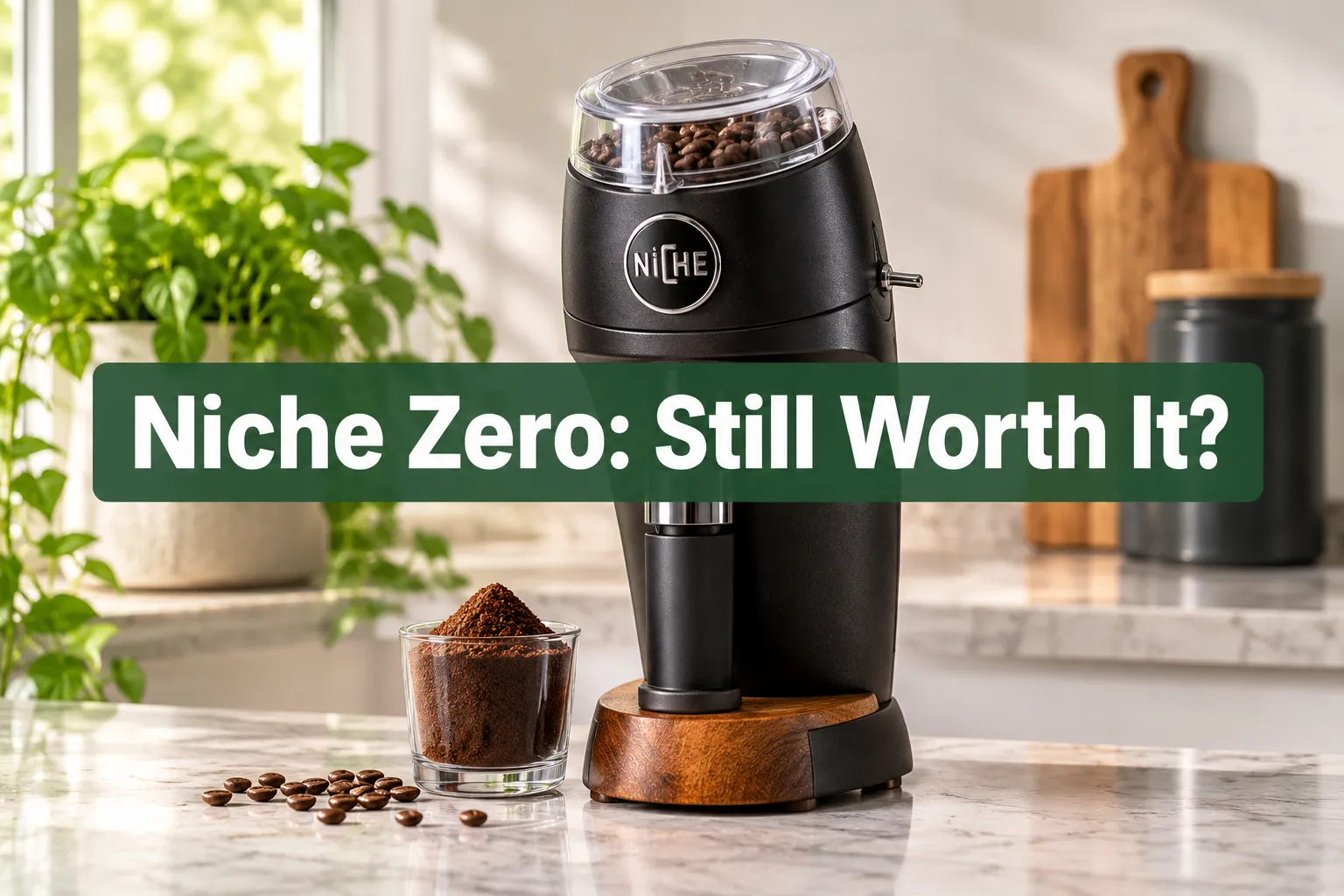
The Niche Zero is a single dose conical burr grinder built around one idea: put in 18 grams of beans, get back as close to 18 grams of grounds as the physics allow, then move on. It serves espresso and filter from the same machine using a stepless adjustment collar, and it does it quietly for a 63mm grinder. That is the whole pitch, and it explains the price better than any flavor claim does.
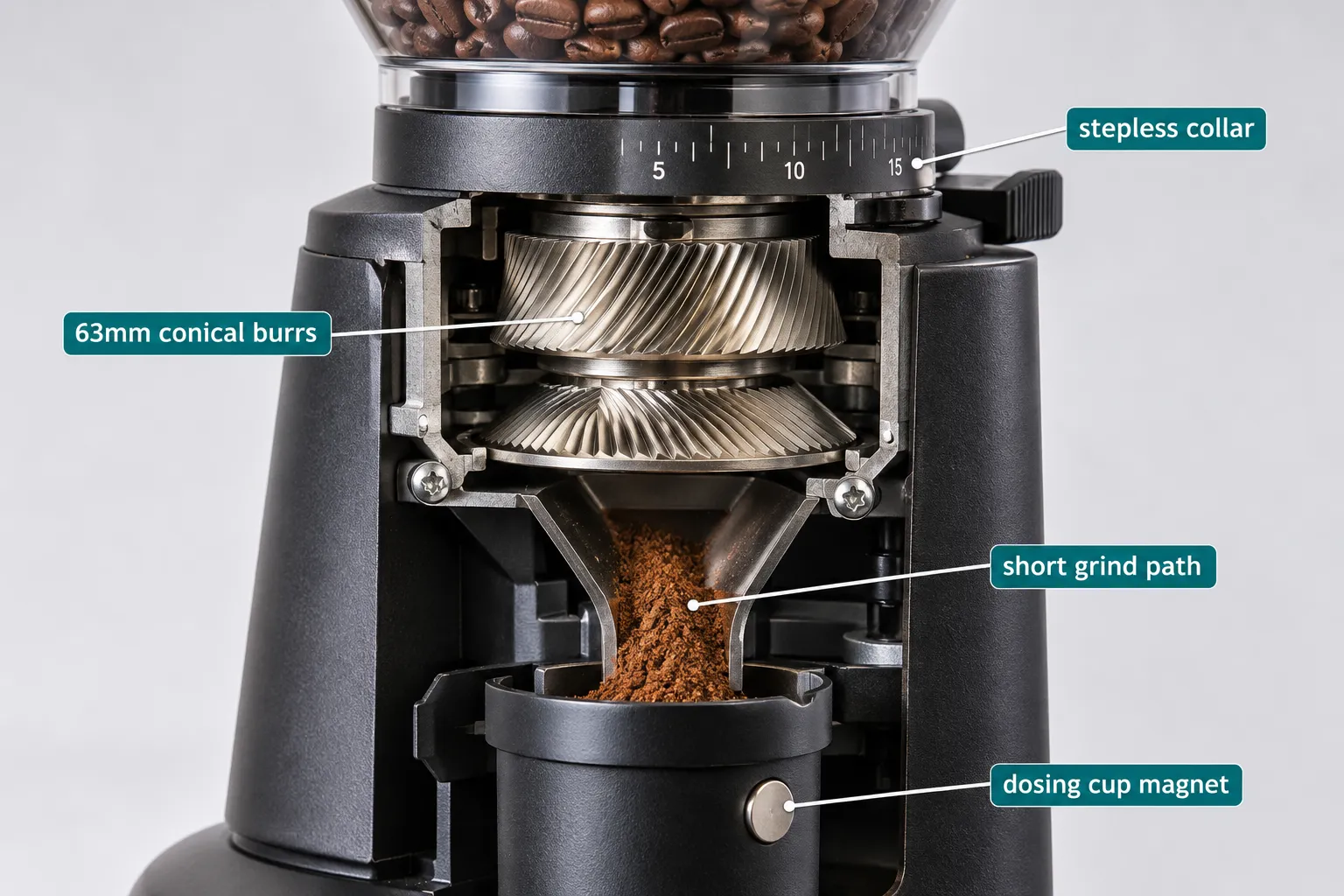
Single dosing means you weigh each individual brew's beans instead of filling a hopper. It gained popularity because home brewers started buying 250 gram bags of single origin coffee with a visible roast date and wanted to rotate between them without wasting a dozen grams every swap.
A conventional hopper grinder punishes that habit. Grounds sit in the chute and the exit path, so the first few grams of today's Ethiopian are actually last week's Brazilian. A low retention grinder reduces that carryover to something you can ignore.
Verdict first: the Niche Zero is a very good grinder with an excellent workflow and a price that has aged awkwardly. The hardware has not changed. The competition has.
What is the niche zero grinder and why is it so expensive?
It is a UK-designed, single dose, 63mm conical burr grinder with a short internal grind path, a magnetically held dosing cup, and an infinitely adjustable dial that moves between espresso and pour over without steps or clicks. The price reflects the burr size, the die-cast body, the short production runs, and import costs for US buyers .
Four details carry the cost:
- 63mm conical burrs. Larger than the 40mm to 54mm sets common under $400. Bigger burrs cut rather than crush, which tends to produce a tidier particle distribution at espresso fineness.
- A very short grind path. Grounds fall almost straight into the cup. Less travel means less residue.
- Stepless adjustment. No fixed detents, so you can make tiny changes to grind size mid-dial-in. The tradeoff is no repeatable numbers to return to.
- Build and finish. A heavy cast housing, a walnut-topped version in some markets, and a footprint small enough to fit under most wall cabinets.
What it does not buy you: a quieter motor than its rivals (about 72 dB, which is normal), a built-in scale, or any form of timed dosing .
Price check, November 6, 2026: $689 direct US, £559 in the UK before local taxes and duties . Importers have reported totals near $860 once shipping and duty land. That gap matters when you compare.
What does coffee retention mean, and why does it matter?
Retention is the coffee that stays inside the grinder instead of coming out with your dose. The term gets used loosely, which is why review numbers disagree so wildly. There are three different measurements hiding behind one word.
- Temporary retention: grounds that sit briefly and come out on the next grind. This is the figure that causes bean-to-bean carryover.
- Permanent retention: grounds stuck on burr faces and in corners that stay put until you brush the machine out.
- Exchange or dose-to-output retention: the difference between what you weighed in and what came out, which is what most YouTube reviews actually measure.
A review quoting 0.1 g average over 30 shots and a lab quoting 0.9 g absolute are not contradicting each other. They are measuring different things .
Why it matters in the cup: stale grounds oxidize fast. Ground coffee loses aromatics within minutes, not days. If 2 g of yesterday's dark roast rides along in today's 18 g washed Kenyan, that is 11% of the dose arriving pre-oxidized, and the tasting notes you paid for get muddied. Decaf drinkers care even more, since caffeine carryover is a genuine issue for late-evening cups.
Decision rule: if you grind the same coffee every day for a week, retention is close to a non-issue and you should spend the money on burrs or a better espresso machine instead.
How much coffee does the niche zero waste compared to other grinders?
Very little, but not zero. Testing summarized by CoffeeLabAdvisor records roughly 0.2 g temporary retention and about 0.7 g permanent retention that remains inside until a cleaning . Older Home-Barista style measurements landed near 0.5 g of internal residue including coffee clinging to the burrs . In normal use, dose-in versus dose-out usually falls within a couple tenths of a gram.
For context, a traditional hopper grinder with a doser can hold 5 to 15 g in its chute and exit path. That is the gap the design closes.
| Measurement type | Reported figure | What it means for you |
|---|---|---|
| Temporary retention | ~0.2 g | Carryover when you swap beans |
| Permanent retention | ~0.7 g | Sits in the burr chamber until brushed |
| Dose consistency (maker spec) | less than ±0.2 g | Expect a near 1:1 in/out ratio |
| Typical enthusiast dose-to-output | 0.05 to 0.2 g | Practical day-to-day variance |
Common mistake: reading "zero retention" literally, then weighing output and feeling cheated by a 0.3 g shortfall. The marketing name is aspirational. The measured performance is still classed as very good for single dosing .
A compact way to see what that costs you over a year:
How much coffee does retention cost you?
Rough value: $”+cost.toFixed(2)+” per year”; } [‘cgR’,’cgS’,’cgP’].forEach(function(id){document.getElementById(id).addEventListener(‘input’,cgCalc);}); cgCalc();
Is the niche zero worth the price for home coffee?
It is worth it for daily bean switchers and decaf drinkers, and hard to justify for anyone brewing one coffee at a time. At $689 direct, you are paying roughly $300 over a DF64 Gen 2 for a shorter grind path, bigger conical burrs, and a tidier machine .
Work out the value this way:
- You rotate two or three bags, plus decaf, every week. The clean swap saves grams and saves fuss. Worth it.
- You buy a 2 lb bag and grind it down. Retention is mostly irrelevant to you. Skip it.
- You want flat burr clarity for filter. Buy the Niche Duo with its 83mm flat burr sets instead, since that is the model aimed at separation and brightness .
- You are moving from a blade grinder or a $60 burr unit. Any decent burr grinder will be a leap. The jump from $389 to $689 is much smaller than the jump from blades to burrs.
Used stock changes the math. At $450 to $650 secondhand, the value argument flips in its favor, because burrs at this size last for years of home volume. eBay listings near $779.99 for sealed units are not a deal.
Affiliate disclosure: Coffee Rank IQ earns commission from some retailer links. Prices were checked on November 6, 2026 and change often. Check the current price before buying.
Does the niche zero work well for espresso or just filter coffee?
Both, and that dual-duty range is a real part of the value. The stepless collar travels from Turkish-fine to coarse cold brew on one dial, and the maker positions this model as the general-purpose conical option across its range .
What the conical geometry tends to do in the cup is well documented in gear writing: conical burrs are associated with body, sweetness, and forgiving espresso, while 83mm-plus flat burrs are associated with more separation and clarity, especially in filter . That is a preference, not a ranking.
Practical notes for espresso:
- Dialing in is fast because the adjustment is continuous, but there are no numbers to return to. Mark your collar with a pencil line per coffee.
- Expect some clumping. A quick stir with a needle distribution tool before tamping removes the channeling risk.
- For a deeper look at what changes once the grounds hit the basket, read our guide to espresso extraction and crema.
For filter, it handles a V60 or Chemex well. Owners chasing maximum clarity at coarse settings usually migrate to flat burrs eventually.
How fast does the niche zero grind, and what is daily use like?
The maker publishes roughly 1 gram per second, meaning an 18 g espresso dose takes about 18 seconds, plus a few seconds of settling . Noise is listed at about 72 dB, comparable to a loud conversation close by.
The routine, start to finish:
- Weigh beans into the supplied dosing cup.
- Tip them into the bean chamber.
- Switch on, let it run until the motor sound changes.
- Tap the body twice.
- Lift the cup off the magnet and tap the grounds into the portafilter.
Roughly 30 seconds. No hopper to empty, no purge dose, no bellows puff needed.
A documented commercial use case published by the maker in October 2026 described a mobile barista van running this grinder as a dedicated secondary unit beside a hopper grinder, specifically for clean decaf switching rather than volume service. That is a fair summary of its strengths: fast enough for a household, not built to pull 200 shots an hour.
Niche Zero vs DF64, Fellow Ode and Wilfa Svart: which should you buy?
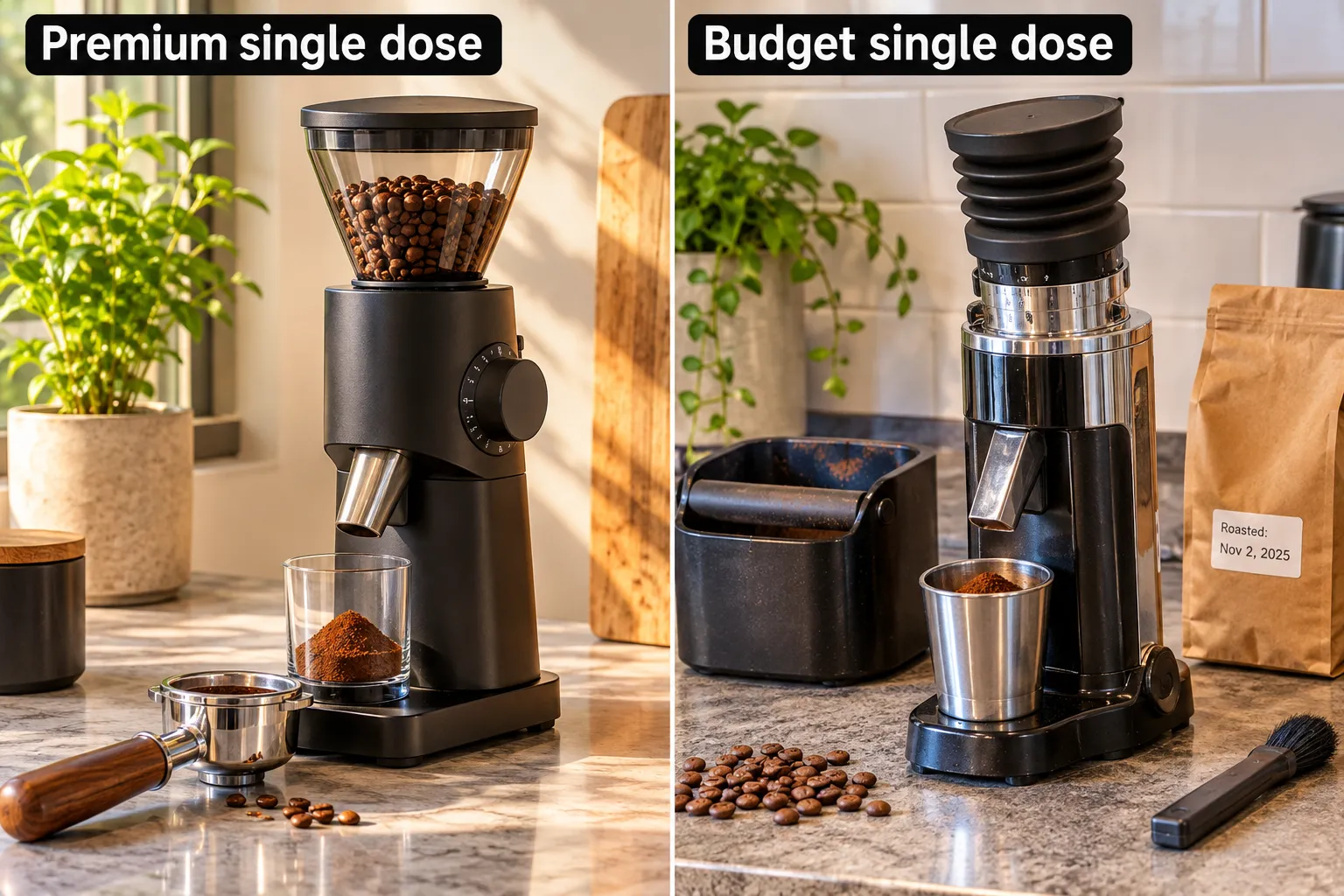
For espresso-first buyers who switch beans daily, the DF64 Gen 2 at about $389 is the smarter purchase unless you want the bigger conicals and the tidier build. For filter-only drinkers, the Fellow Ode Gen 2 wins on price and clarity. The Wilfa Svart is the budget filter choice and not an espresso grinder.
| Grinder | Price (Nov 6, 2026) | Burrs | Best for |
|---|---|---|---|
| Niche Zero | $689 direct US (£559 UK) | 63mm conical | Daily bean switchers, espresso plus filter |
| DF64 Gen 2 | about $389 | 64mm flat | Espresso value, bellows handles retention |
| Fellow Ode Gen 2 | about $345 | 64mm flat | Filter clarity, quiet, small footprint |
| Wilfa Svart / Uniform | about $200 | 58mm conical | Budget pour over and French press only |
| Niche Duo | higher than the Zero | 83mm flat, swappable | Clarity seekers wanting one machine for both |
The niche zero vs DF64 question, settled: the DF64 Gen 2 ships with a bellows and an angled chute that push its practical retention under half a gram. You give up the cleaner footprint, the stepless feel, and the conical sweetness. You keep about $300. For most first-time single dose buyers, that is the better trade.
Choose the Zero anyway if: you want conical body in espresso, hate purging, and value a machine that looks and feels finished. Compare the models before you commit, because the gap is workflow and feel, not a different league of coffee.
What problems do people complain about with the niche zero?
Four recurring complaints show up across owner reports and reviews, and none of them are dealbreakers on their own.
- The name oversells it. Measured permanent retention of about 0.7 g is not zero . Buyers who took the branding literally feel misled.
- No reference scale on the dial. Stepless adjustment is lovely to use and annoying to document. Returning to a previous setting is guesswork without a pencil mark.
- Price drift. The hardware is unchanged while $389 rivals have narrowed the gap. In 2026 the Zero is competing on refinement, not on being unmatched.
- Static and clumping. Dry roasts in a dry kitchen will stick. A drop of water on the beans, known as the RDT, fixes it in two seconds.
- US purchasing friction. Shipping and duty can push the landed cost toward $860, and warranty service across the Atlantic takes longer than a domestic return.
Edge case: if you live somewhere with hard winter heating and very dry indoor air, static will be worse than most reviews suggest. Budget for the water trick as part of normal use.
Five features worth the money
- 63mm conical burrs. More cutting surface per rotation at a size usually found in pricier machines. Payoff: steady espresso particle distribution without a 90 second grind.
- Short vertical grind path. Grounds barely travel. Payoff: the clean bean swap that justifies the whole purchase.
- Stepless adjustment collar. Payoff: micro-corrections while dialing in a shot, with no detent fighting you.
- Magnetic dosing cup. Payoff: catches the grind without static scatter and doubles as your weighing vessel.
- Under-cabinet footprint. Payoff: it fits beside an espresso machine on a normal 15-inch-deep counter, which is more than many 64mm flat grinders manage.
What to watch out for
- No timer, no scale, no automation. Weighing is your job.
- Clumping is real; plan on a distribution tool for espresso.
- No numbered settings to log.
- Warranty and parts logistics are slower for US buyers importing direct.
- At coarse filter settings, flat burr grinders deliver more separation if that is your priority.
Pros and cons
Pros
- Measured retention among the lowest in home grinders
- Handles espresso through cold brew on one dial
- Compact, well-finished, pleasant to live with
- Conical burrs favor body and sweetness in espresso
- Resale value stays strong, with used units at $450 to $650
Cons
- $689 direct US price against a $389 DF64 Gen 2
- "Zero" is a name, not a measurement
- No repeatable grind settings
- Clumps without a water spritz or a distribution tool
- Shipping and duty can add well over $100 for US buyers
Who should buy the niche zero, and who should skip it?
Buy it if you rotate single origin bags weekly, drink decaf in the evening, want one machine for espresso and pour over, and want the cleanest swap available at this size. You are the buyer this grinder was designed for, and no cheaper machine quite matches the feel.
Skip it if a bellows-equipped DF64 Gen 2 covers your routine, if you grind one coffee for weeks, if you want numbered settings for repeatability, or if filter clarity is your main goal. In that last case, look at the Duo or a flat burr rival.
Buy used if you can find a clean unit at $450 to $650. Conical burrs at this size outlast most home owners' interest in the hobby.
How do you clean and maintain it, and can you return it?
Brush it out every two to four weeks and do a full burr clean every few months. The maker runs a direct-sale returns policy with a cooling-off window for unused goods; third-party retailers set their own terms, so confirm the return window and who pays return shipping before you order, especially if you are importing.
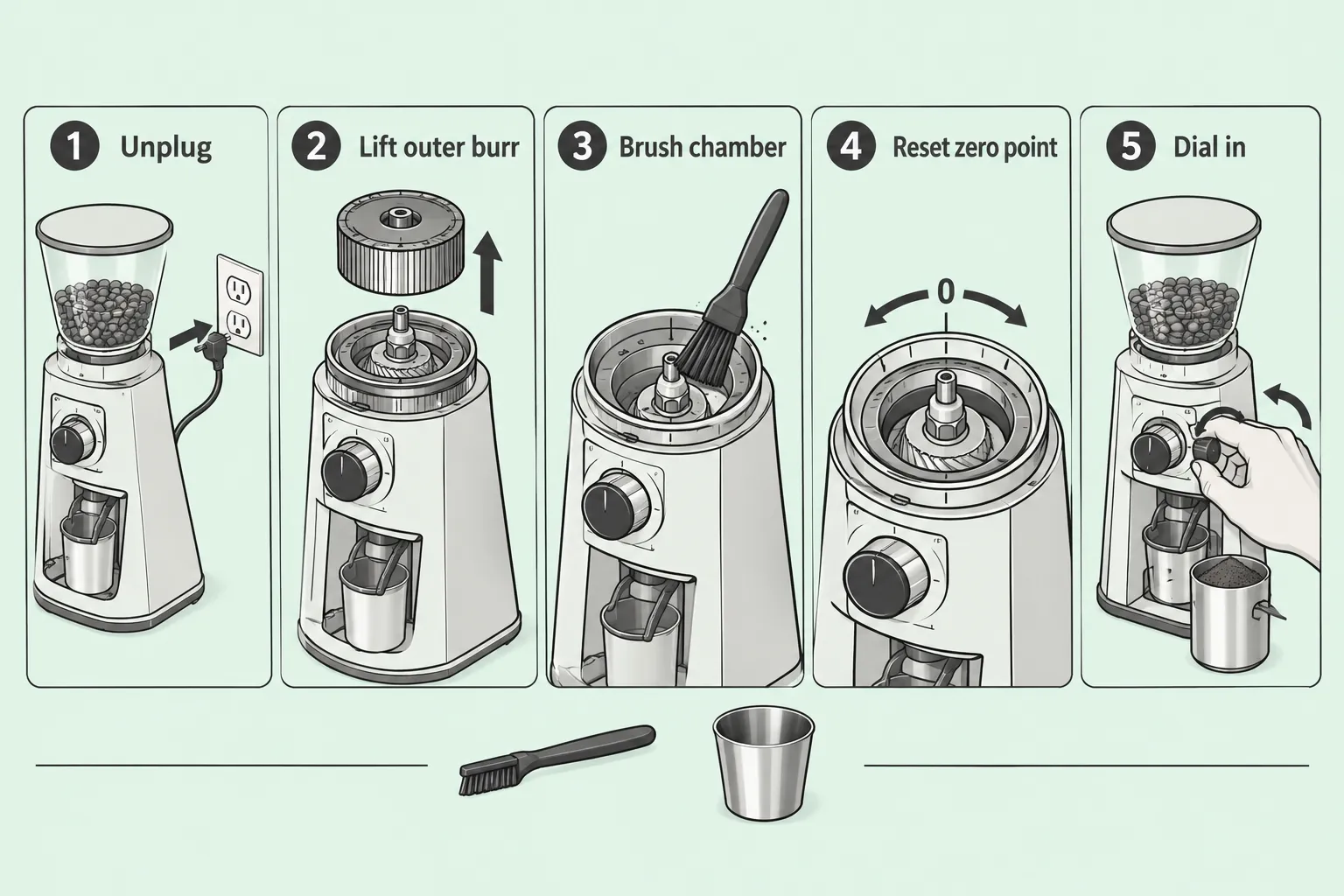
Maintenance routine:
- Unplug the machine.
- Remove the bean chamber and lift out the outer burr.
- Brush the burr faces and the chamber with a stiff dry brush. No water on burrs.
- Vacuum the loose grounds rather than blowing them deeper into the housing.
- Reset the zero point by turning the collar until the burrs just touch, then back off.
Never grind cleaning tablets rated for flat burrs without checking compatibility. Coffee oils build faster with dark roasts, so if you drink something like Illy's extra dark roast, shorten the cleaning interval.
Common mistake: skipping the zero point reset after reassembly, then wondering why espresso settings have shifted two full turns.
FAQ

Conclusion
The this grinder earns its reputation on workflow. Bigger conical burrs, a short grind path, and measured retention near 0.2 g temporary make it one of the cleanest bean swaps you can buy for a home counter . What it does not earn, in 2026, is an automatic recommendation at $689 when a bellows-equipped DF64 Gen 2 at about $389 covers the same single dose routine for most people.
So the verdict splits cleanly. Rotate beans daily or drink decaf at night, and the extra money buys you something you will notice every morning. Grind one bag at a time, and put the difference toward better coffee or a better machine.
Next step: weigh your actual routine first. Count how many times you switched beans last week. Three or more, check the current price on the Zero and the used market. Fewer than three, compare the models in the $350 to $400 range and spend the savings on fresher beans. Better Coffee Starts With Better Answers, and that one is a counting exercise, not a leap of faith.
Related reading: top 10 coffee gear reviews and our coffee education and product hub.
Review method: documented research and published specifications, plus independent retention measurements cited below. No hands-on testing by Coffee Rank IQ is claimed. Prices checked November 6, 2026.