Does Coffee Make You Live Longer? The 500,000-Person Data
Quick Answer
In the largest single study on the question, 498,134 UK adults followed for about 10 years, coffee drinkers had roughly 8% to 16% lower all-cause mortality than non-drinkers, with the best numbers around 2 to 7 cups a day . So does coffee make you live longer? The data shows a consistent association, not proof. Genetic studies designed to test causation have not confirmed that coffee itself extends life . Drink it because you enjoy it, and treat any extra years as unproven.
Key Takeaways
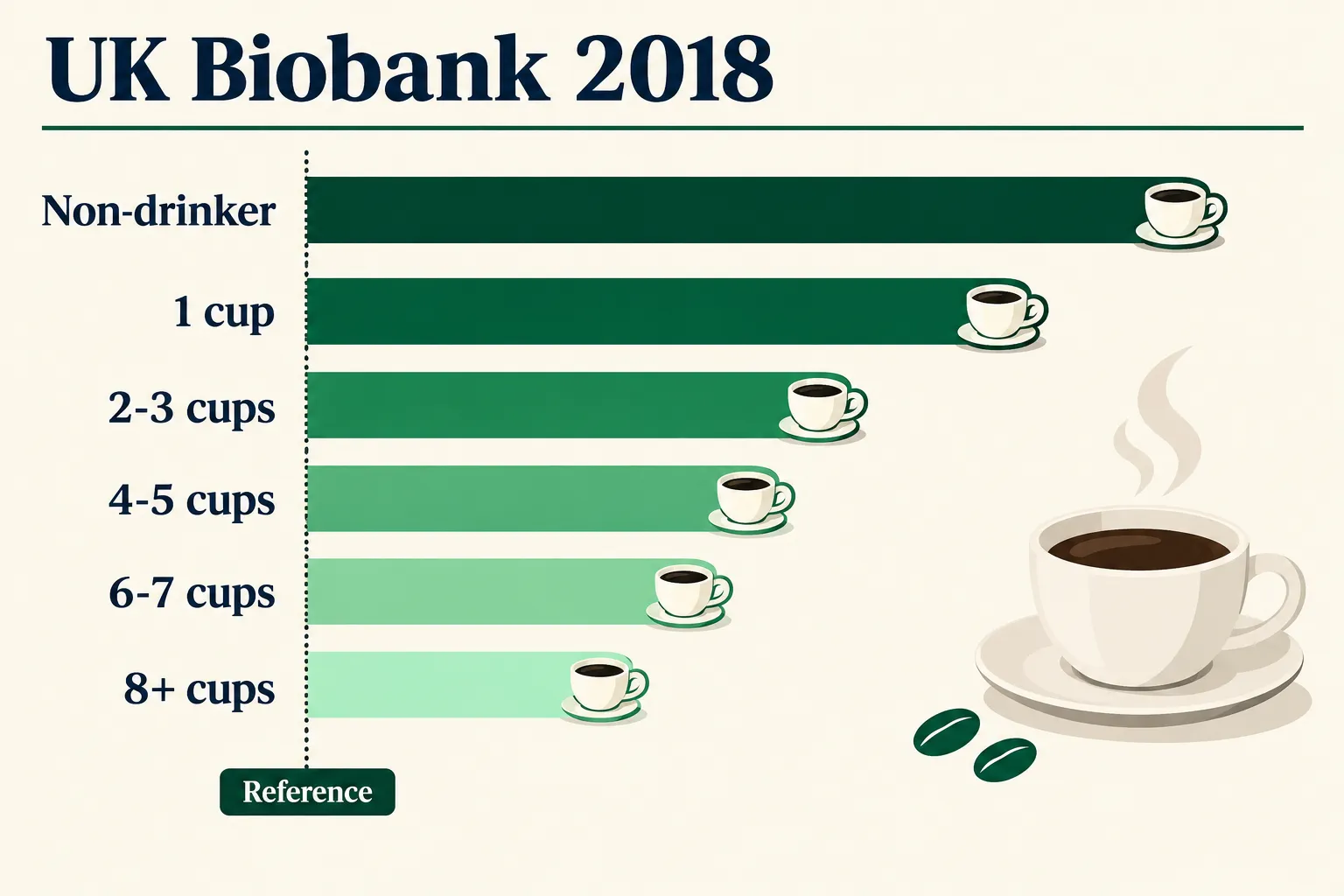
- UK Biobank, 498,134 participants, published in JAMA Internal Medicine on July 2, 2018: adjusted hazard ratios were 0.92 at 1 cup/day, 0.88 at 2 to 3 cups, 0.84 at 6 to 7 cups, and 0.86 at 8 or more cups, compared with non-drinkers .
- A meta-analysis of 20 prospective cohort studies (973,904 people, 129,538 deaths) found a relative risk of 0.86 for high versus low intake, about 14% lower mortality .
- A separate review of 17 studies (1,054,571 people) found a U-shape: RR 0.89 at 1 to under 3 cups, 0.87 at 3 to under 5, and 0.90 at 5 or more .
- Instant, ground, and decaf all showed inverse associations in UK Biobank, which argues against caffeine being the whole story .
- Mendelian randomization studies, which use genetics to reduce confounding, found no clear causal effect of coffee on all-cause mortality .
- The American Heart Association's 2026 scientific statement puts the generally safe ceiling at about 400 mg caffeine daily, roughly 3 to 5 eight-ounce cups .
- Sugar and cream change the picture. A 2025 analysis of 46,222 US adults linked lower mortality to black or lightly sweetened coffee, not to high-sugar, high-fat drinks .
What did the 500,000-person study actually show?
It showed a dose response that flattens out, not a straight line to immortality. Erikka Loftfield, Marilyn Cornelis, Neil Caporaso, Rashmi Sinha and colleagues analyzed 498,134 UK Biobank participants, published in JAMA Internal Medicine on July 2, 2018. Over roughly 10 years of follow-up there were 14,225 deaths. After adjusting for smoking, alcohol, diet, body mass index and other factors, every coffee-drinking group had lower mortality than non-drinkers .
)
Here are the adjusted hazard ratios reported in that paper, compared with people who drank no coffee:
| Daily coffee intake | Hazard ratio for death from any cause |
|---|---|
| 1 cup | 0.92 |
| 2 to 3 cups | 0.88 |
| 4 to 5 cups | 0.88 |
| 6 to 7 cups | 0.84 |
| 8 or more cups | 0.86 |
A hazard ratio of 0.88 means the coffee group's risk of dying during the study period was about 12% lower than the non-drinkers' risk. It does not mean anyone gained 12% more years. And an 8-cup-a-day habit did not beat a 6-cup habit, which is a clue that something other than a simple dose effect is at work.
Two details from the same paper matter more than the headline. The inverse association held for instant, ground and decaffeinated coffee. And it did not meaningfully change based on participants' genetic caffeine-metabolism profile . If caffeine were driving the benefit, slow metabolizers should have looked different. They did not.
The authors also flagged a problem with their own cohort: UK Biobank's participation rate was about 5.5%, which skews the sample toward healthier, more engaged volunteers .
Does coffee make you live longer?
Based on the current evidence, coffee drinkers die at modestly lower rates than non-drinkers, but no study has shown that coffee causes that gap. The association is real, repeated across continents, and survives heavy statistical adjustment. The causal link is still missing.
Three bodies of evidence line up on the association side:
Then the counterweight. A systematic review of Mendelian randomization studies, published in Nutrition Research Reviews, found that genetically predicted coffee consumption showed no clear causal effect on all-cause or cancer mortality . Mendelian randomization uses inherited gene variants that nudge people toward drinking more or less coffee. Because those variants are set at birth, they are not tangled up with income, exercise or smoking the way adult habits are. It is the closest thing to a natural experiment nutrition research has.
When the observational studies say yes and the genetic studies say "no clear signal," the honest answer to "does coffee make you live longer" is: coffee drinkers live longer, and nobody has shown coffee is the reason.
That gap is why the question keeps getting re-asked. If you want the broader picture on coffee and daily health claims, our piece on whether coffee actually dehydrates you works through a similar evidence gap.
How much coffee should you drink per day for longevity?
The research clusters around 2 to 4 cups a day, and benefits stop increasing past roughly 5. Going higher does not appear to keep helping, and in cardiovascular analyses it may start to cost you.
- The 17-study review found the lowest relative risk at 3 to under 5 cups (0.87), with 5 or more cups slightly worse at 0.90 .
- The American Heart Association's July 2026 scientific statement places the generally safe caffeine ceiling for most adults at 400 mg per day, about 3 to 5 eight-ounce cups of regular coffee depending on strength .
- The AHA also reported that 2 to 4 cups daily were associated with lower risks of heart disease, heart failure and stroke, while intake above about 4 cups was linked to higher heart-failure risk in some analyses .
So 3 to 4 cups of coffee a day sits in the sweet spot across most datasets. A decision rule: if you already drink two to four cups and sleep fine, there is no evidence-based reason to change. If you drink eight, the data gives you no reward for cups five through eight, and the AHA gives you a reason to trim.
One caveat on cup size. "A cup" in these studies usually means 8 ounces of brewed coffee, not a 20-ounce travel mug. Measure once and you may find your "two cups" is actually four.
Does coffee reduce your risk of dying early, or just look like it does?
It looks like it does, and researchers cannot rule out that the appearance is the whole effect. Two specific problems explain why.
Confounding. Coffee drinkers differ from non-drinkers in ways that are hard to measure: education, employment, income, social contact, physical activity, access to health care, diet quality, smoking history. Statistical adjustment can correct for the variables that were recorded, and only as accurately as they were recorded. Self-reported diet questionnaires are rough instruments.
Reverse causality. People who are quietly becoming ill often cut back on coffee. Nausea, medication, disrupted sleep, a doctor's advice. That pushes sicker people into the "non-drinker" group before they die, which makes non-drinkers look worse and coffee look protective. Researchers try to handle this by excluding deaths in the first few years of follow-up, but exclusion windows are judgment calls, not solutions .
Healthy volunteer bias. UK Biobank's 5.5% participation rate means the cohort is not a cross-section of Britain . It skews healthier and more affluent, which can distort how any exposure behaves.
Common mistake: reading "17% lower all-cause mortality" and translating it into "I will live X years longer." Relative risk reductions in a cohort study describe a group over a study window. They do not convert to personal lifespan.
Is decaf coffee as good as regular coffee for living longer?
In UK Biobank, yes, broadly. Decaf drinkers showed inverse mortality associations similar to ground and instant drinkers . That finding is one of the most interesting in the whole literature, because it points away from caffeine as the explanation.
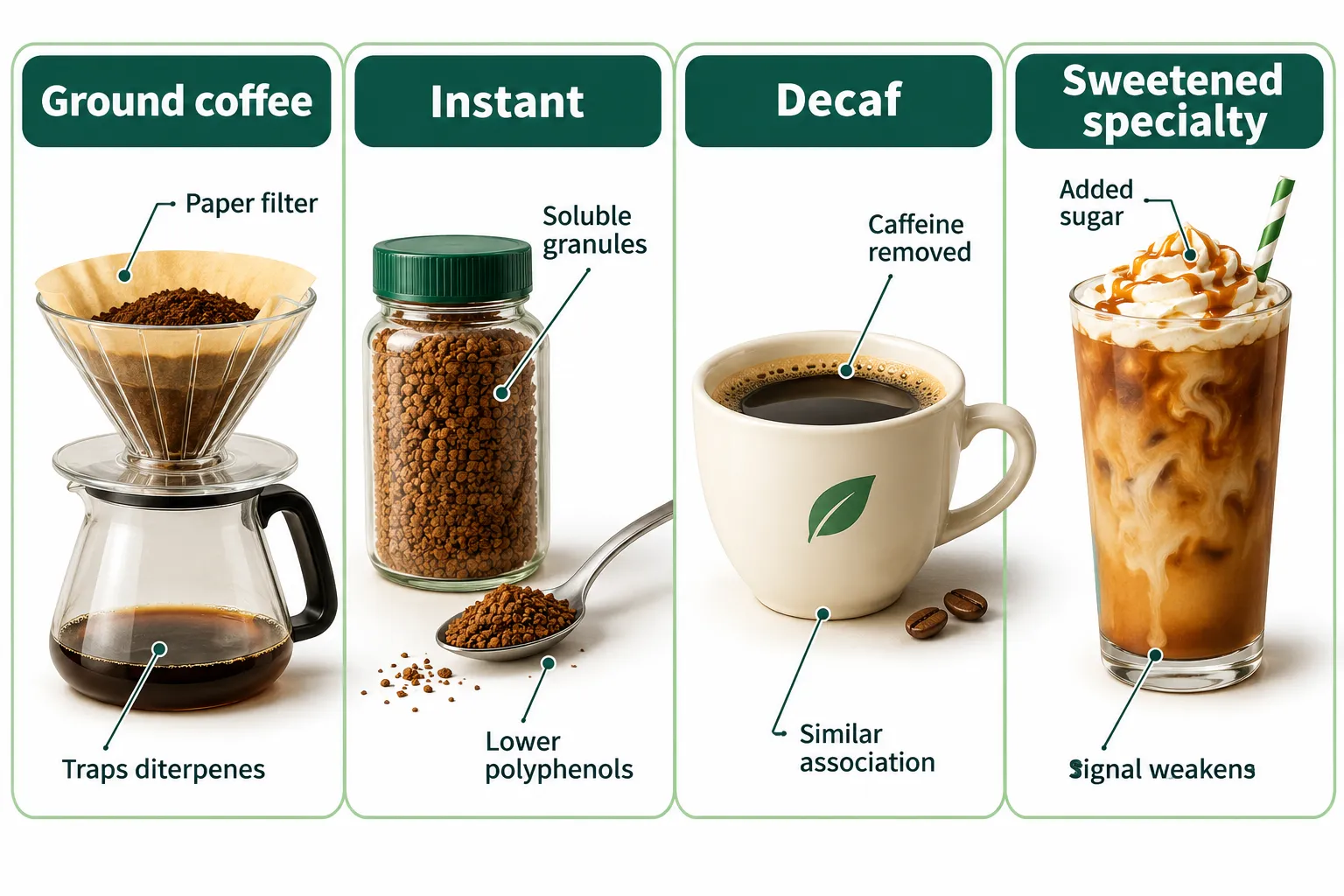
Coffee contains chlorogenic acids and other polyphenols, plant compounds that survive decaffeination. If those compounds matter, decaf should behave like regular. It does. That is consistent with a polyphenol story, and it is also consistent with the duller explanation: decaf drinkers may simply share the lifestyle traits of coffee drinkers generally.
If caffeine disrupts your sleep or spikes your anxiety, decaf is a reasonable swap with no clear mortality penalty in the data. Worth knowing before you switch: decaf is not caffeine free. Our breakdown of how much caffeine is actually in decaf has the milligram numbers.
What type of coffee is healthiest, and does the way you make coffee matter?
Preparation matters more for what you add than for how you brew. A 2025 analysis of 46,222 US adults found lower mortality associated with black coffee or coffee low in added sugar and saturated fat, and not with heavily sweetened or high-fat preparations .
)
| Preparation | What the data shows | Practical note |
|---|---|---|
| Ground, paper-filtered | Inverse mortality association in UK Biobank | Paper traps cafestol and kahweol, oily compounds that raise LDL cholesterol |
| Instant | Inverse association, similar direction | Convenient, lower aromatic quality, no filtration concern |
| Decaffeinated | Inverse association reported | Still contains some caffeine; polyphenols largely remain |
| Sweetened specialty drinks | Benefit not observed in the 46,222-adult analysis | Sugar and saturated fat appear to offset the signal |
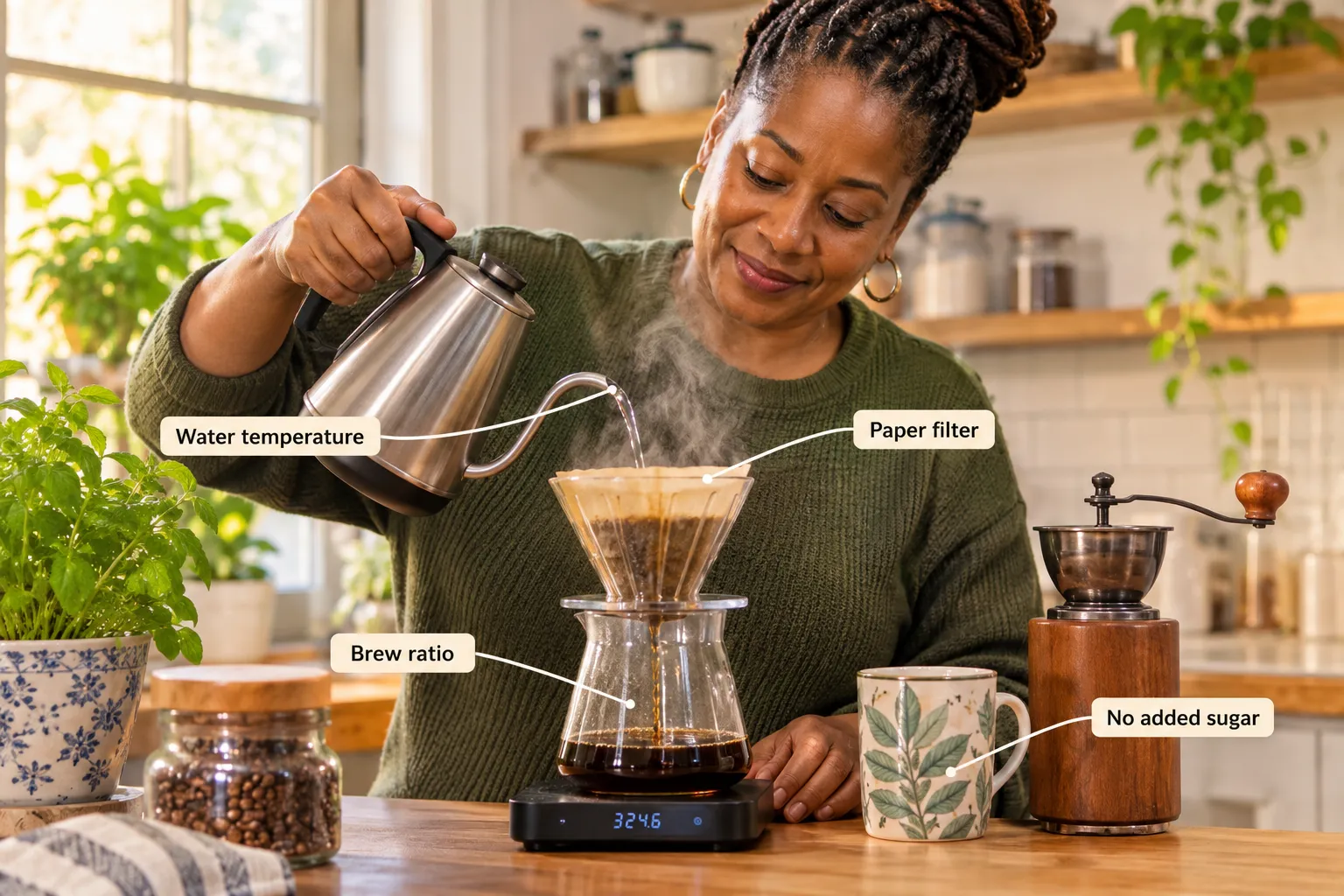
The brewing lever worth pulling is filtration. Unfiltered coffee, French press, Turkish, boiled, carries more diterpenes into the cup. A paper filter removes most of them. If your cholesterol is a concern, a pour over setup is the simpler fix than giving up coffee.
The second lever is what goes in after brewing. If your daily drink carries 40 grams of sugar, that is the variable to change first. Our guide to making your coffee order healthier covers the swaps that actually subtract calories without ruining the drink.
Can drinking too much coffee be bad for you, and what about high blood pressure?
Yes, caffeine has a ceiling, and the symptoms arrive long before anything serious does. Above roughly 400 mg a day most people start noticing it: broken sleep, jitteriness, a faster resting heart rate, reflux, headaches on the days they skip .
Daily side effects worth tracking:
- Sleep disruption. Caffeine has a half-life of about 5 hours in most adults. A 3 p.m. cup still has a quarter of its caffeine working at 11 p.m.
- Blood pressure. Caffeine causes a short-term rise in blood pressure. In habitual drinkers the effect blunts over time, but it is real in the hours after a cup.
- Anxiety and palpitations. Highly individual. Some people hit their limit at two cups.
- Pregnancy. Guidance is stricter; discuss intake with your clinician.
On high blood pressure specifically: the American Heart Association's 2026 statement does not tell people with hypertension to quit coffee, and it stresses that effects vary by individual and by preparation . If you have diagnosed high blood pressure, an arrhythmia, heart failure, or you take medication that interacts with caffeine, ask your doctor what your personal ceiling is. That is a question with a specific answer for you, and a general article cannot give it.
What is the link between coffee and heart health?
Observational evidence associates 2 to 4 cups daily with lower risks of coronary heart disease, heart failure and stroke, while intake above about 4 cups has been linked to higher heart-failure risk in some analyses . The AHA's framing is deliberately more cautious than the "coffee is good for your heart" headlines, because the same statement notes that responses differ by person and by how the coffee is made.
Does coffee benefit everyone, or just some people?
No, and the evidence does not claim it does. Population averages hide individual variation, and several groups have reasons to be more careful.
Choose caution if you:
- Have diagnosed hypertension, heart failure, or an arrhythmia. Talk to your clinician.
- Are pregnant or breastfeeding. Guidance sets lower caffeine limits.
- Have GERD, an ulcer, or severe anxiety. Coffee can worsen symptoms regardless of mortality statistics.
- Take medications affected by caffeine metabolism.
- Cannot sleep. Poor sleep has its own well-documented health cost, and it will not be offset by a hazard ratio.
Choose freely if you are a healthy adult who drinks 2 to 4 cups, sleeps normally, and takes your coffee black or close to it. The Mayo Clinic's position is that moderate coffee intake is fine for most healthy adults and that the health concerns of earlier decades have largely not held up .
One edge case worth naming: the UK Biobank finding that genetic caffeine metabolism did not change the mortality association . That cuts against the popular idea that "slow metabolizers should avoid coffee" for longevity reasons. It does not change the fact that slow metabolizers often feel worse after a late cup.
How does coffee compare to tea for living longer?
They look similar, and combining them may look slightly better than either alone. A UK Biobank analysis published in the British Journal of Nutrition examined coffee, tea and plain water together and found the lowest mortality risk at roughly 7 to 8 total drinks per day across all three .
The more interesting finding: once total beverage intake passed four drinks a day, replacing some plain water with coffee or tea was associated with lower mortality. The researchers also reported a potentially greater association for a coffee-and-tea combination than for either beverage on its own .
Treat that gently. It is one observational cohort, and "swap water for coffee" is not sound general advice. The reasonable reading is that coffee and tea are not competitors in the longevity data. If you like both, the evidence gives you no reason to pick a side.
What matters more than coffee for living longer?
Almost everything else. A hazard ratio of 0.88 is small next to the factors that dominate mortality statistics.
)
In rough order of effect size, the levers that outrank your coffee habit:
- Not smoking. Nothing in the coffee literature comes close.
- Regular physical activity. Large, consistent, and causally supported by trials.
- Sleep. Which your 4 p.m. espresso can actively damage.
- Body weight and metabolic health.
- Blood pressure control and alcohol intake.
- Overall diet quality, of which coffee is one small component.
Here is the practical version. If you are choosing between adding a third cup of coffee and adding a 30-minute walk, the walk is the better bet by a wide margin. Coffee is not a health intervention you deploy. It is a drink that, on current evidence, does not appear to shorten life in moderate amounts and may travel alongside better outcomes.
Is the research on coffee and longevity actually proven?
No. Every major finding on coffee and longevity comes from observational cohorts, and the one method built to test causation has not confirmed it.
The misconception worth correcting: "a 2018 study of half a million people proved coffee extends your life." It did not. It measured an association in a self-selected cohort with a 5.5% participation rate, and its own authors described it as observational . The 20-cohort meta-analysis authors said the same thing explicitly, cautioning that the design cannot establish causation . The Mendelian randomization review found no clear causal effect on all-cause mortality, while noting its own limits: genetic instruments can miss nonlinear relationships and depend on the validity of the variants chosen .
What would settle it? A large randomized trial assigning people to drink or not drink coffee for 20 years. That trial will not happen. Nobody will fund it, few people would comply, and the ethics committee would have questions. So the question stays open, and anyone who tells you it is closed is selling something.
That uncertainty is not a reason to quit. It is a reason to stop treating a 12% hazard ratio as a life-extension plan.
FAQ
Interactive: compare the mortality numbers
Reported mortality risk vs non-drinkers
Longer bar = larger reported risk reduction. Observational associations only.
Sources: UK Biobank, JAMA Internal Medicine, 2018 (498,134 participants); British Journal of Nutrition meta-analysis of 20 cohorts (973,904 participants); Public Health Nutrition review of 17 studies (1,054,571 participants).
Conclusion: what this means for your daily cup
Does coffee make you live longer? The most accurate answer available in 2026 is that people who drink 2 to 4 cups a day die at modestly lower rates than non-drinkers across more than a million pooled participants, and no study has shown coffee is the cause . The genetic evidence, which is the best tool we have for separating cause from correlation, has not backed the longevity claim .
What to do with that:
- Keep your intake between 2 and 4 cups of 8 ounces. That range sits inside every major dataset and inside the AHA's 400 mg guidance .
- Cut the sugar before you cut the coffee. The added-sugar signal in the 46,222-adult analysis is the one variable clearly under your control .
- Use a paper filter if cholesterol is on your radar.
- Stop drinking it by early afternoon. Sleep has stronger evidence behind it than any coffee finding.
- If you have a diagnosed heart or blood pressure condition, ask your doctor for your personal ceiling.
Next step: measure one cup properly. Weigh your beans, check your brew ratio, and find out whether your "three cups" is really five. Better Coffee Starts With Better Answers, and this one starts with a scale. If you want to tighten up the cup itself, start with our guide to making coffee taste better.