
How Long Does It Take for Caffeine to Kick In? 15 Minutes
Quick Answer
How long does it take for caffeine to kick in? Roughly 15 minutes for the first noticeable lift, with blood levels climbing toward a peak somewhere between 30 and 60 minutes after you swallow. Caffeine is absorbed fast: pharmacology references compiled by the NIH (StatPearls, caffeine monograph) report that close to 99% of an oral dose is absorbed within about 45 minutes, and that peak plasma concentration can land anywhere from 15 to 120 minutes depending on your stomach contents and how quickly it empties. The 15-minute figure is the early edge of that range, not a stopwatch guarantee.
Key Takeaways
- 15 minutes is the typical earliest onset for oral caffeine. Most people describe a clearer effect across the 15 to 45 minute window.
- Peak blood concentration commonly arrives at 30 to 60 minutes. The FDA describes peak serum levels for ordinary oral caffeine as occurring in under two hours.
- Average half-life is about 5 hours in healthy adults, with a reported range of roughly 1.5 to 9.5 hours. Half the dose can still be circulating at dinner.
- An empty stomach speeds things up because gastric emptying is faster. Fat, protein, and fiber slow the climb without reducing the total dose absorbed.
- The viral "2 hour coffee rule" has no single study behind it. It appeared in 5 of the 24 People Also Ask boxes checked for this article, and the pieces of it that hold up are about cortisol timing and iron absorption, not caffeine onset.
- The FDA's consumer guidance still cites 400 mg a day as an amount not generally linked to negative effects in healthy adults, roughly two to three 12-ounce cups of coffee.
- A preliminary November 2026 abstract presented at the American Heart Association reviewed 28,345 FDA adverse-event reports and flagged higher cardiac-report rates for stimulant products. It is association data, not proof of harm.
How Long Does It Take for Caffeine to Kick In?
How long does it take for caffeine to kick in from a normal cup of coffee? About 15 minutes before anything registers, 30 to 60 minutes before the effect is at full strength, and several hours before it fades.
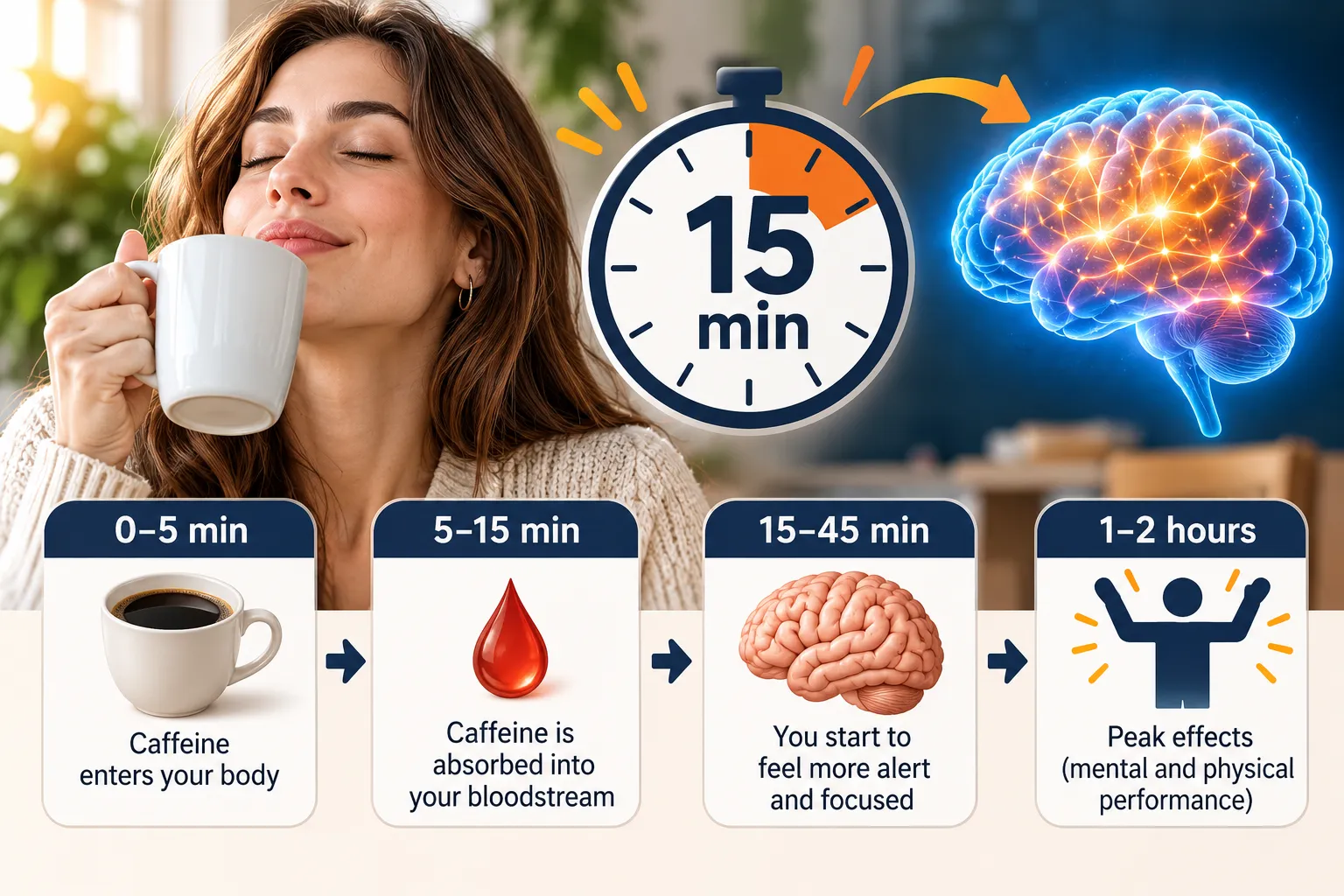
Here is the sequence, drawn from the pharmacokinetic ranges in the NIH StatPearls caffeine monograph and the FDA's own consumer material:
- 0 to 5 minutes. Caffeine leaves the cup and sits in your stomach. Nothing neurological has happened yet. Any lift you feel is aroma, warmth, and expectation, which is real but is not pharmacology.
- 10 to 20 minutes. Absorption begins in earnest, mostly through the small intestine. Blood levels rise quickly. This is where the 15-minute number comes from.
- 30 to 60 minutes. Typical peak plasma concentration for most people. Alertness, reaction time, and perceived effort are at their most changed.
- 2 to 6 hours. The slow decline. With a five-hour average half-life, a 200 mg dose at 8 a.m. leaves roughly 100 mg at 1 p.m.
- 8 to 12 hours. Trace amounts remain in slow metabolizers.
Decision rule: if you need to be sharp for something at 9:00, drink at 8:15. Not 8:55.
The common mistake is treating 15 minutes as the full effect. It is the opening, not the summit. People who feel nothing at the 12-minute mark often pour a second cup, then get the combined peak of both drinks at once around the 45-minute mark and call it jitters.
Why Does Caffeine Take 15 Minutes to Kick In?
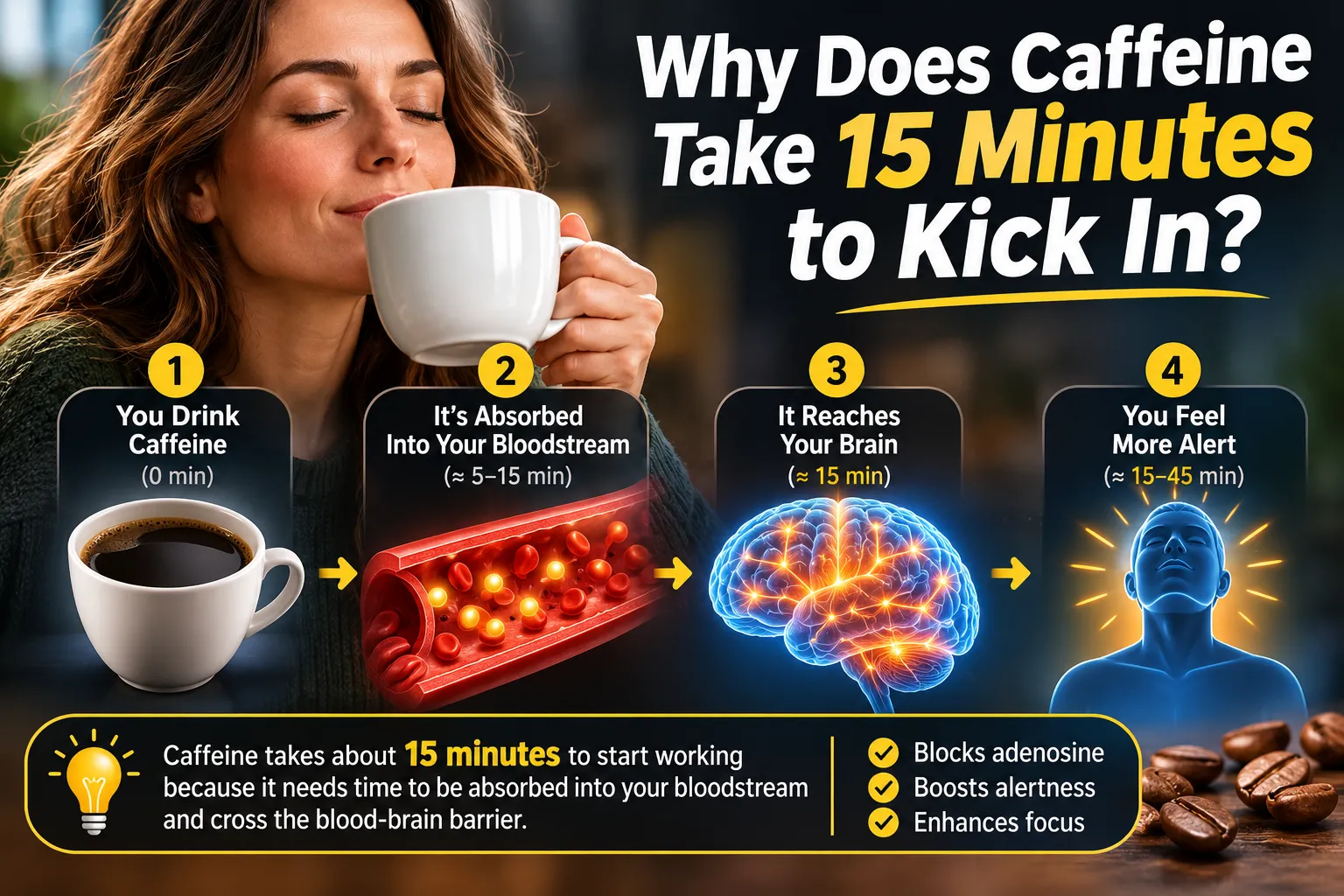
Because it has to travel. Caffeine must clear your stomach, cross the intestinal wall, enter the bloodstream, then cross the blood-brain barrier before it can do anything to how you feel.
Once it arrives, the mechanism is subtraction, not addition. Adenosine is a molecule that builds up in the brain across the waking day and binds to receptors that make you feel drowsy. Caffeine has a similar enough shape to sit in those receptors without activating them. The sleepiness signal gets blocked. You feel more awake, but no new energy was created, and the adenosine keeps piling up behind the blockade. That is why the crash lands hard when the caffeine clears.
The 15-minute lag is mostly gastric. Anything that slows your stomach from emptying slows the clock.
Does Caffeine Work Faster if You Haven't Eaten?
Yes. On an empty stomach, caffeine reaches the bloodstream faster because there is nothing competing for gastric emptying, which is why caffeine on empty stomach speed feels noticeably sharper than the same cup after breakfast.
How Long Does It Take for Caffeine to Kick In With Food in Your Stomach?
Expect the front edge to shift later, often toward the 30 to 45 minute mark instead of 15. The StatPearls reference attributes part of the wide 15 to 120 minute peak range to dietary constituents, fiber among them.
What changes and what does not:
- Changes: how fast levels rise, and how sharp the peak feels.
- Does not change much: the total amount absorbed. Food blunts the spike, it does not cancel the dose.
- Edge case: people prone to acid reflux or an unsettled stomach often get the worst of both, a fast jittery onset plus discomfort. Oatmeal or toast first is a reasonable fix.
Choose this if: you want a steady morning rather than a spike, eat first. If you want the fastest caffeine kick in time before a workout or a drive, drink it before food.
How Long Does Caffeine Last in Your Body?
Much longer than it takes to kick in. The average half-life in healthy adults is about five hours, meaning half the dose is gone after five hours and half of what remains is gone five hours after that. Reported half-lives range from roughly 1.5 to 9.5 hours across individuals.
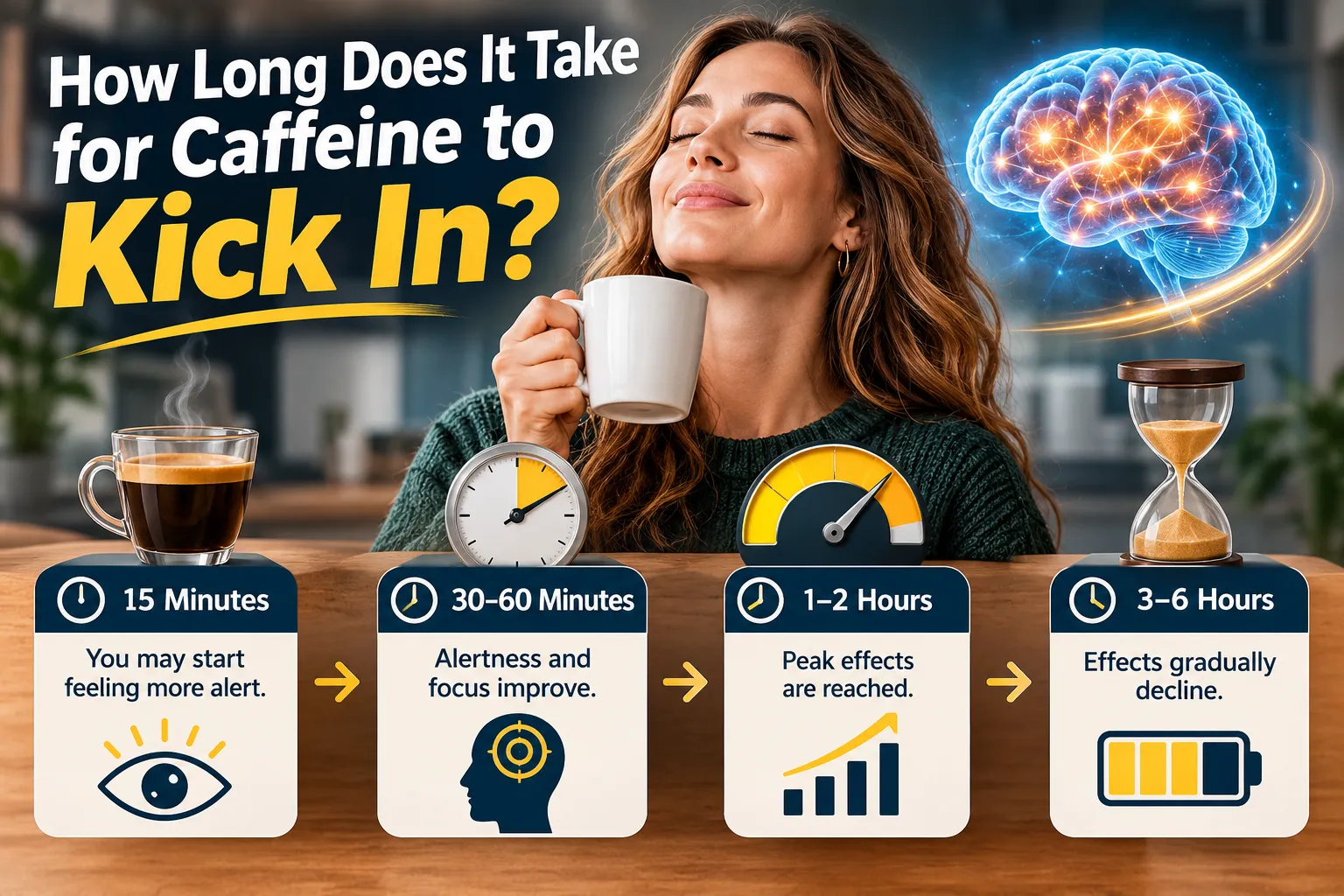
A practical illustration using a 200 mg cup at 8:00 a.m. and a five-hour half-life:
| Time | Approximate caffeine remaining |
|---|---|
| 8:00 a.m. | 200 mg |
| 1:00 p.m. | 100 mg |
| 6:00 p.m. | 50 mg |
| 11:00 p.m. | 25 mg |
Twenty-five milligrams is not much. For a sensitive sleeper it is still enough to shorten deep sleep. Pregnancy, oral contraceptives, and liver conditions lengthen the half-life considerably; heavy smoking shortens it. If you take prescription medication, the interaction list for caffeine is longer than most people expect, so ask your pharmacist rather than guessing.
What Is the 2 Hour Coffee Rule, and Is It Real?
The "2 hour coffee rule" is a social-media claim that you should wait roughly 90 minutes to 2 hours after waking before drinking coffee. There is no single study that established it. It appeared in 5 of the 24 People Also Ask boxes checked for this article, with no consistent citation behind any of them.
What the rule actually bundles together:
- The cortisol argument. Cortisol rises naturally in the 30 to 45 minutes after waking. The claim is that caffeine on top of that peak is wasted and builds tolerance faster. Cortisol's morning rise is well documented. The leap to "therefore delay your coffee by two hours" is an inference, not a tested result, and human trials comparing fixed delay schedules for tolerance outcomes are thin.
- The iron and nutrient argument. Coffee polyphenols do reduce non-heme iron absorption when consumed with a meal. That is a real, repeatedly measured effect, and it supports spacing coffee away from an iron-rich breakfast. It says nothing about alertness.
- The adenosine argument. Blocking adenosine first thing does not remove it. True, and also true at 10 a.m.
The honest version of the rule: delaying coffee may help your iron absorption and may reduce the midday dip for some people. It will not change how long it takes for caffeine to kick in when you finally drink it.
If the delay suits your morning, keep it. If it makes you miserable before a 7 a.m. meeting, the evidence does not require it.
How Long Before Caffeine Hits: Energy Drinks vs Coffee?
Energy drinks and coffee deliver caffeine on a similar clock, around 15 minutes to onset, 30 to 60 to peak. What differs is dose, volume, serving speed, and what else is in the can.
| Drink | Typical caffeine | Felt onset | Why |
|---|---|---|---|
| Single espresso | ~63 mg | 10 to 20 min | Small volume, finished in seconds |
| 12 oz drip coffee | ~120 to 180 mg | 15 to 45 min | Sipped over 10 to 20 minutes |
| 16 oz energy drink | ~160 to 300 mg | 15 to 45 min | Cold, carbonated, often drunk fast |
| 16 oz cold brew | ~200 mg+ | 20 to 60 min | Large volume over ice, slow sipping |
What's the difference between caffeine and energy drinks?
Caffeine is one compound. An energy drink is a formulated product that usually contains caffeine plus sugar, taurine, B vitamins, and sometimes additional stimulant botanicals such as guarana, which is itself a caffeine source. Stacking those is how people reach high doses without realizing it.
Regulators are circling this. The FDA's Human Foods Program put draft guidance on caffeine-content labeling on its June 2026 priority agenda, though any such guidance would be nonbinding and would not by itself force exact-milligram disclosure nationally. States are moving faster: New Jersey Senate Bill 4183 would require a "High caffeine" disclosure for beverages at or above 80 mg per serving on menus and drive-through boards, while Pennsylvania proposals have floated thresholds of 150 to 250 mg. In India, FSSAI was reported in November 2026 to be challenging PepsiCo's "energy drink" labeling on products including Sting Energy, citing caffeine, sugar, and taurine content alongside the absence of a defined national category standard.
A November 2026 abstract presented at the American Heart Association's Scientific Sessions reviewed 28,345 FDA adverse-event reports from 2017 to 2025 and found that reports involving caffeine or stimulant energy products mentioned cardiac arrest about 11 times more often, heart attack about 4.5 times more often, and arrhythmias or palpitations about four times more often than comparison products. Around 45% of those cardiovascular reports involved adults aged 18 to 34. Read that carefully: adverse-event reports cannot establish causation, exposure, or population incidence. The Council for Responsible Nutrition criticized the analysis on exactly those grounds, and the work had not been peer reviewed as of early November 2026. Researchers themselves flagged confounders including intense exercise, alcohol, multiple stimulants, and undiagnosed heart disease.
Why Isn't My Coffee Working Anymore?
Usually tolerance. With regular daily intake, the brain responds to blocked adenosine receptors by making more of them, so the same dose produces less of a lift and skipping it produces a headache.
Signs you have crossed into tolerance:
- You need coffee to reach baseline, not to exceed it.
- A missed morning brings a dull headache by midday.
- Dose creep: two cups became four without a decision.
Fixes that work, in order of difficulty:
- Hold the dose steady for two weeks. No increases. Tolerance partly stabilizes on its own.
- Cut the afternoon cup first. It is doing the most damage to sleep and the least for alertness.
- Taper, do not quit cold. Reduce by about 25% a week to sidestep the withdrawal headache.
- Swap one cup for decaf, which still contains measurable caffeine so the ritual survives the reduction.
Also check your actual dose. A home brew made with a long steep or a very high-caffeine roast is not the same as a café cup. Death Wish Coffee's caffeine content is a useful reality check if you assume all coffee lands near 100 mg.
Why Do Some People Feel Caffeine and Others Don't?
Metabolism and genetics. The enzyme CYP1A2 handles most caffeine clearance, and variation in that gene splits people into faster and slower metabolizers. Fast metabolizers clear it quickly and often report little effect; slow metabolizers get a longer, stronger ride from the same cup.
Other factors that move the needle:
- Body weight. The same 200 mg hits a 55 kg adult harder than a 95 kg adult.
- Habitual intake. Tolerance flattens the curve.
- Medications and conditions. Several common drugs slow caffeine clearance. If you have a heart rhythm condition, an anxiety disorder, or are pregnant, discuss your intake with your doctor rather than working from a blog.
- Sleep debt. Caffeine works against adenosine pressure. More sleep debt, more adenosine, more that caffeine has to push against.
How much caffeine is too much per day?
The FDA's consumer guidance cites 400 mg per day as not generally associated with negative effects in most healthy adults, roughly two to three 12-ounce cups of coffee, while stressing that sensitivity varies with weight, medication, metabolism, and tolerance. Single doses around 1,200 mg are where the FDA has flagged toxic effects such as seizures, which is why pure powdered caffeine is a genuine hazard and brewed coffee is not.
Is caffeine safe for teenagers?
Lower limits apply, and the usual guidance from pediatric bodies sits near 100 mg a day for adolescents, with energy drinks discouraged entirely. The concern is dose stacking rather than coffee itself. South Korean authorities reported in October 2026 that products marketed to students for concentration contained guarana-derived caffeine, with some single pouches supplying about the full stated daily maximum for a 40 kg adolescent. The same math applies to a 300 mg energy drink and a 15-year-old.
Does Caffeine Affect Sleep if Taken in the Afternoon?
Yes, more than most people assume. With a five-hour half-life, a 3 p.m. coffee still leaves roughly a quarter of its caffeine in your system at 1 a.m.
How long after caffeine can you sleep? A practical cutoff is 8 to 10 hours before bedtime for sensitive sleepers, and at least 6 hours for everyone else. Research on caffeine taken six hours before bed has repeatedly found reductions in total sleep time that the drinkers themselves did not notice, which is the uncomfortable part. People often sleep worse without feeling they slept worse.
The nap exception: drinking a coffee immediately before a 20-minute nap works because the caffeine arrives at the 15 to 20 minute mark, right as you wake, and adenosine has partly cleared during the nap. Timing is the whole trick.
What Can You Take Instead of Caffeine for Energy?
Nothing replaces caffeine's pharmacology, but several things address the reason you reached for it.
- Daylight within 30 minutes of waking. Free, and it shifts your circadian timing rather than masking fatigue.
- 10 minutes of brisk movement. Raises alertness quickly and does not cost you sleep tonight.
- Water. Mild dehydration mimics tiredness. Coffee itself is less dehydrating than folklore suggests, as covered in what the research says about coffee and dehydration.
- A protein-forward breakfast instead of pastry, which blunts the mid-morning dip.
- Decaf or a half-caff blend for the ritual without the dose.
- A 20-minute nap before 3 p.m.
If you are tired every single day despite seven to eight hours in bed, that is a question for a doctor, not a stronger roast.
FAQ
Conclusion
The honest answer to how long does it take for caffeine to kick in is 15 minutes for the first signal, 30 to 60 minutes for the peak, and about five hours before half of it is gone. Those three numbers cover most of the practical decisions you will ever make about coffee.
Your next step takes one morning. Note the exact minute you finish your first cup, then note the minute you first notice the change. Do it three days running, once after breakfast and twice before. You will learn your own onset window more precisely than any article can tell you, and you will know whether your 3 p.m. cup is quietly costing you an hour of sleep.
Better Coffee Starts With Better Answers.
Caffeine timing calculator
Estimates onset, peak, and what is left at bedtime using a 5-hour half-life.
Estimate only, based on an average 5-hour half-life (NIH StatPearls range: 1.5 to 9.5 hours). Not medical advice.