Is Coffee Good for Your Liver? What Studies Show
Quick answer
Yes, is coffee good for your liver looks like a cautious yes in the research: in a 2026 UK Biobank analysis of 354,957 adults followed for a median 13 years, people drinking three to four cups a day had roughly 35% lower cirrhosis risk and 41% lower liver-related mortality than non-drinkers . Every one of those findings is an association from observational data, not proof that coffee treats or prevents anything. If you already have a diagnosed liver condition, bring this to your hepatologist before you change your intake.
Is coffee good for your liver, according to the best available evidence?
Is coffee good for your liver? The honest answer: habitual coffee drinkers show consistently better liver outcomes than non-drinkers across large population studies, imaging data, and blood protein analysis, and the effect size is large enough that two major gastroenterology societies now mention coffee in their guidance. What nobody has done is run a randomized trial where one group drinks coffee for a decade and the other does not. Without that, the link stays an association.
Key takeaways
- A 2026 UK Biobank study of 354,957 adults without cirrhosis at baseline found a graded association between coffee intake and better liver outcomes over a median 13 years .
- At 3 to 4 cups daily, the study reported roughly 35% lower cirrhosis risk and 41% lower liver-related mortality versus non-drinkers .
- The same study scanned nearly 29,000 participants with liver MRI: heavier coffee drinkers had less liver fat, lower liver iron, and lower fibroinflammation markers .
- The American College of Gastroenterology's 2025 guideline conditionally suggests preferably 2 or more cups a day for people with chronic liver disease, explicitly flagging the evidence as low quality .
- Decaf showed broadly similar associations to caffeinated coffee in the 2026 analysis, which argues against caffeine being the whole story .
- Hepatology commentary through late 2026 has settled on 2 to 4 cups as the sensible range, not five-plus .
- Coffee "does not treat MASLD" and "does not reverse fibrosis," as Dr. David Bernstein's review of the newer evidence put it .
What do studies say about coffee and liver health?
Four separate lines of evidence point the same direction: cohort studies, meta-analyses of fibrosis markers, liver MRI imaging, and blood proteomics. That convergence is why hepatologists stopped dismissing the coffee question around a decade ago.
The cohort evidence. The 2026 analysis by Hyun-Seok Kim, Ju Dong Yang and colleagues in Clinical Gastroenterology and Hepatology tracked 354,957 UK Biobank adults who had neither cirrhosis nor liver cancer at enrollment. Over a median 13-year follow-up, hazard ratios for people drinking five or more cups daily came out at 0.68 for cirrhosis and 0.58 for liver-related death compared with non-drinkers . Limitation worth holding onto: coffee intake was self-reported, usually once, at the start. People change habits over 13 years.
The older meta-analysis. A frequently cited 2016 meta-analysis in Alimentary Pharmacology and Therapeutics by Kennedy and colleagues pooled cohort studies and estimated that two additional daily cups were associated with about a 44% lower risk of cirrhosis. It drew on a modest number of studies with varied definitions of a "cup," which is a real weakness in any coffee research.
Coffee liver fibrosis data. Meta-analyses examining fibrosis specifically have reported roughly 27% lower odds of advanced fibrosis among regular coffee drinkers with chronic liver disease. These are cross-sectional and case-control heavy, so reverse causation is plausible: people who already feel unwell often cut back on coffee.
The imaging and protein layer. This is what made the 2026 study different. Among roughly 29,000 UK Biobank participants with liver MRI, those drinking at least five cups daily had a hepatic proton-density fat fraction about 0.83 percentage points lower than non-drinkers, along with lower iron and lower fibroinflammation scores . The Cleveland Clinic newsroom and Cedars-Sinai both covered the proteomic signals that accompanied those scans .
354,957 adults analyzed in the 2026 UK Biobank liver study, median follow-up 13 years
0.68 hazard ratio for cirrhosis at 5+ cups per day vs non-drinkers
0.83 percentage points lower liver fat fraction on MRI at 5+ cups per day
≥2 cups/day conditionally suggested by the ACG 2025 guideline for chronic liver disease, on low-quality evidence
400 mg daily caffeine ceiling the FDA cites for healthy adults
Note on scope: this article covers fibrosis, cirrhosis, and fatty liver. Hepatocellular carcinoma is a separate subject with its own body of research, and it gets its own article on this site.
How much coffee for liver benefit, and how much is safe per day?
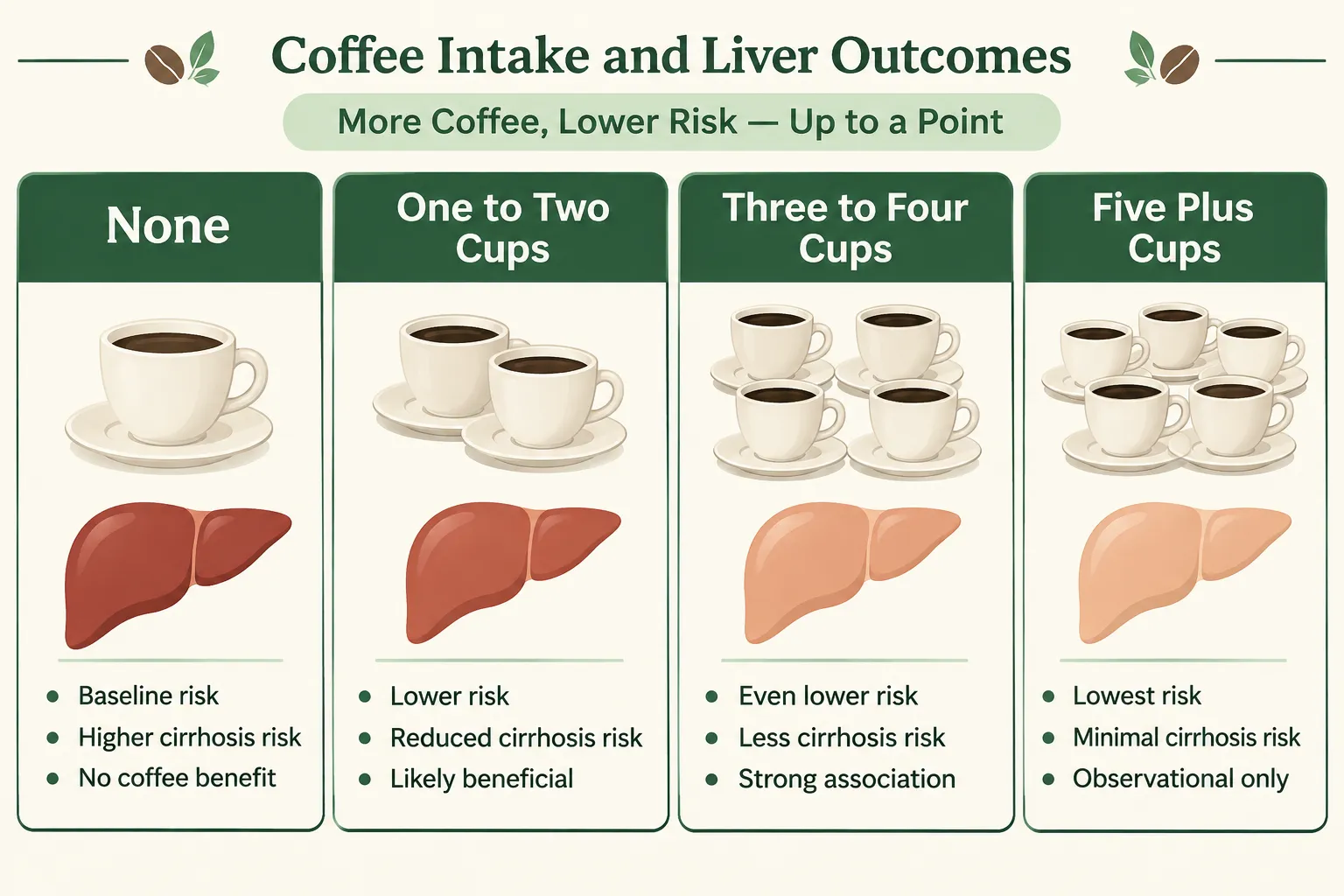
The dose-response curve flattens after about four cups. Hepatology commentary through September to November 2026 has converged on 2 to 4 cups daily for adults who already tolerate coffee, rather than telling anyone to climb to five . The ACG's 2025 guideline phrasing is "preferably ≥2 cups per day" for people with chronic liver disease .
Here is what the 2026 dose-response data reported, compared with non-drinkers :
| Daily intake | Cirrhosis risk | Liver-related mortality |
|---|---|---|
| 1 to 2 cups | ~20% lower | ~31% lower |
| 3 to 4 cups | ~35% lower | ~41% lower |
| 5 or more cups | ~32% lower | ~42% lower |
Cirrhosis risk did not keep improving past four cups. That plateau is the single most practical finding in the whole dataset.
Decision rule: if you currently drink zero coffee and sleep badly or have an anxiety disorder, the liver association is not a strong enough reason to start. If you already drink one cup and enjoy it, moving to two or three is where the curve is steepest. For people wondering whether a single daily cup does anything at all, our breakdown of whether one cup of coffee per day is good goes into the general health picture.
Caffeine ceiling: the FDA generally cites up to 400 mg of caffeine a day for healthy adults, roughly four 8-ounce brewed cups. Actual caffeine varies hugely by brew ratio, grind size, and serving size. A 16-ounce café drip can carry the caffeine of two and a half home cups.
Does coffee actually help with fatty liver disease?
Coffee and fatty liver is the best-studied subgroup after cirrhosis, and the association holds: an umbrella review and systematic review published through the Institute for Scientific Information on Coffee found coffee consumption linked to lower prevalence of non-alcoholic fatty liver disease and to less fibrosis among people who already had it . The 2026 MRI data supports that at the tissue level .
What the evidence does not show is that adding coffee to an unchanged diet shrinks liver fat. Bernstein's 2026 review was blunt: coffee "does not treat MASLD" and "does not reverse fibrosis" . MASLD (metabolic dysfunction-associated steatotic liver disease, the current name for most fatty liver) responds to weight change, blood sugar control, and alcohol reduction. Coffee sits beside those, not in front of them.

Mechanism, briefly. Researchers point to chlorogenic acids (antioxidant plant acids abundant in lighter roasts), trigonelline (an alkaloid that degrades into niacin during roasting), and diterpenes such as cafestol and kahweol found mainly in unfiltered coffee . Animal and cell work suggests these affect fat accumulation and stellate cell activation, which is the process that lays down scar tissue. Cell models are not people.
Common mistake: treating a daily latte with syrup as a liver intervention. The sugar load works against the metabolic picture that drives fatty liver in the first place.
Can coffee prevent liver cirrhosis or damage?
No, coffee cannot be described as preventing cirrhosis. It is associated with lower cirrhosis risk in population data, which is a different claim. Coffee and cirrhosis research is observational across the board, including the 2026 UK Biobank work .
European guidance from EASL makes the caveat explicit: the apparent effect may partly reflect differences between coffee drinkers and non-drinkers, and coffee's influence is far smaller than stopping alcohol misuse or smoking. Coffee drinkers in these cohorts tend to be employed, socially active, and healthy enough to tolerate a stimulant. Researchers adjust for what they can measure. They cannot adjust for what they did not record.
The edge case that matters: some people reduce coffee because early liver trouble makes them feel rough. That alone would produce part of the observed pattern, with no biological effect at all. It is called reverse causation, and no cohort study fully escapes it.
What actually reduces cirrhosis risk, with trial evidence behind it: cutting alcohol, treating hepatitis B and C, managing weight and type 2 diabetes, and avoiding unnecessary hepatotoxic medication. Coffee is a reasonable adjunct for people who like it.
Is decaf coffee as good for your liver as regular coffee?
Close to it, based on the best current data. In the 2026 UK Biobank analysis, protective associations ran broadly similar for caffeinated and decaffeinated coffee . That finding reshapes the whole mechanism question, because if caffeine were doing the work, decaf should have looked much weaker.
The likely actors are the non-caffeine compounds: chlorogenic acids, trigonelline, and the diterpenes, all of which survive decaffeination largely intact . Instant coffee showed associations too in the broader literature, though generally weaker than ground.
Worth knowing: decaf is not caffeine-free. Our piece on how much caffeine is actually in decaf coffee has the milligram numbers by brew method. For someone with a liver condition who also has arrhythmia or reflux, decaf is a sensible way to keep the compounds and drop the stimulant.
Choose decaf if: caffeine wrecks your sleep, you are pregnant, or a doctor has restricted stimulants. The liver-related evidence does not punish you for it.
Does black coffee work better than coffee with cream and sugar?
For liver health, yes, and the reason is the sugar rather than the coffee. EASL guidance states plainly that the observed associations do not extend to high-fat, high-sugar coffee beverages. Added sugar, especially fructose, is a well-documented driver of hepatic fat accumulation.
A short comparison of what typically ends up in the cup:
| Drink | Added sugar | Liver-relevant note |
|---|---|---|
| Black filter coffee | None | The form used in most cohort research |
| Espresso or cortado | None to minimal | Small milk volume, negligible sugar |
| Cold brew, unsweetened | None | Lower acidity, same compounds |
| Flavored syrup latte, 16 oz | Often 30 to 50 g | Sugar load works against fatty liver management |
| Blended frappe with whipped cream | Frequently 50 g+ | Treated as a dessert in dietary guidance |
One more variable: filtration. Diterpenes such as cafestol raise LDL cholesterol and are largely trapped by a paper filter. French press, Turkish, and boiled coffee pass them through. Someone managing both fatty liver and high cholesterol has a practical reason to run coffee through paper. If you are rethinking the whole order, our guide on making your coffee order healthier covers the swaps that actually change the numbers.
What happens if you have hepatitis, and can coffee help you if you already have liver disease?
For people with existing chronic liver disease, including hepatitis B and C, the ACG's 2025 guideline conditionally suggests preferably two or more cups daily to reduce the risk of fibrosis progression . AASLD calls its own coffee recommendation weak and says there is not enough evidence to specify an ideal dose or preparation. Both bodies made the suggestion anyway, which tells you the risk-benefit looks acceptable.
Coffee liver enzymes research sits underneath this. Multiple observational studies have linked higher coffee intake to lower serum ALT and GGT, two enzymes that rise when liver cells are stressed. An Annals of Hepatology review of coffee consumption and liver outcomes covers this enzyme pattern across populations . Lower enzymes are a marker, not a cure, and nobody should read a drop in GGT as resolved disease.
If you have a diagnosed liver condition, do this: mention your exact daily cup count at your next appointment, including size and whether it is caffeinated. Ask whether anything in your medication list interacts with caffeine. People with cirrhosis sometimes clear caffeine far more slowly than usual, so a four-cup habit can behave like eight. Your hepatologist knows your fibrosis stage and your labs. A website does not.
Clinician-facing summaries of this evidence exist too, including a five-point rundown of what the coffee and liver disease data means in practice .
How does coffee compare to tea and other liver friendly drinks?
Coffee has more liver-specific evidence behind it than any other common beverage, with green tea the closest competitor and plain water the undisputed baseline. Tea studies show some association with lower liver fat, but the datasets are smaller and less consistent than the coffee cohorts .
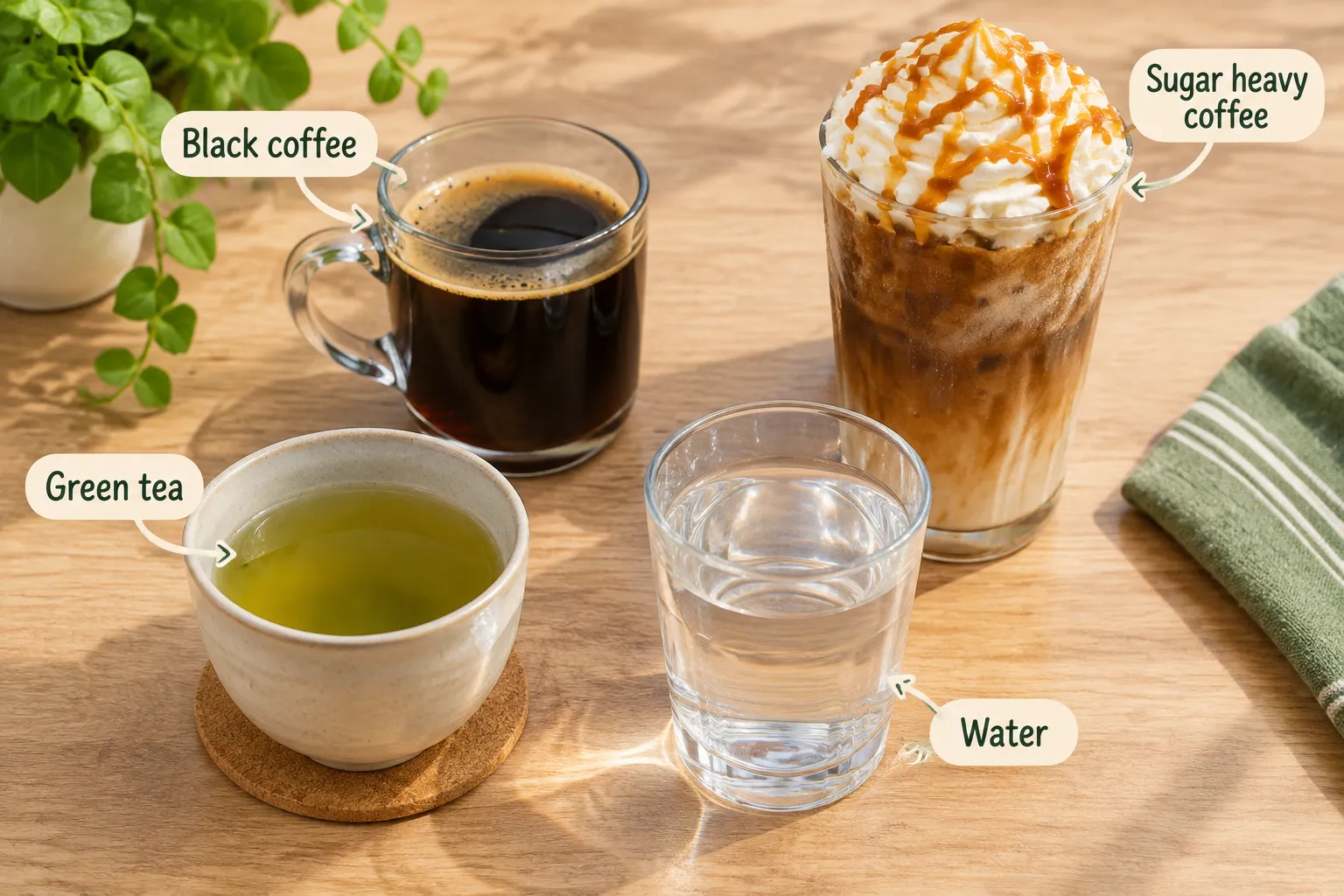
Where the common liver friendly drinks land:
- Water. No direct liver benefit claim needed. It displaces sugary drinks, which is the real win.
- Green tea. Contains catechins, studied for liver fat. Evidence thinner than coffee's. High-dose green tea extract supplements have actually been linked to drug-induced liver injury, which is a separate issue from drinking the brewed beverage.
- Black tea. Some observational signal, less studied for fibrosis specifically.
- Coffee. The largest cohorts, the MRI data, and the only beverage named in ACG and AASLD liver guidance .
- Alcohol. The clearest negative. Nothing in the coffee data offsets it.
Decision rule: if you dislike coffee, do not force it down for your liver. Water instead of soda will do more for hepatic fat than a drink you resent. Our piece on why not drinking coffee can be good for you covers that side fairly.
What are the risks of drinking too much coffee, and who shouldn't drink it?
Above roughly 400 mg of caffeine daily, healthy adults commonly report insomnia, anxiety, tremor, palpitations, and reflux. None of that is liver damage, but all of it is a cost. Is coffee good for your liver for everyone? No. Several groups should be careful or should skip it.
Caution or avoidance applies to:
- People with decompensated cirrhosis. Impaired caffeine clearance plus hepatic encephalopathy risk makes this a doctor's call.
- People on fluid restriction for ascites. Volume counts.
- Anyone with poorly controlled arrhythmia, severe anxiety, or uncontrolled hypertension.
- People taking medication metabolized by CYP1A2. Caffeine competes for the same enzyme pathway. Ask a pharmacist.
- Pregnant readers. Most guidance caps caffeine around 200 mg daily, well below the amounts in the liver studies.
- Anyone whose coffee arrives with 45 grams of sugar. The sugar undoes the point.
Does caffeine affect liver function negatively?
In healthy adults at ordinary intakes, no evidence shows caffeine harming liver function, and the 2026 decaf findings suggest caffeine is not the active ingredient anyway . The documented hepatic risk in this space comes from concentrated caffeine powders and some herbal or botanical supplements, not from brewed coffee. Energy drinks with very high caffeine plus niacin loads have been associated with liver injury case reports, which is a supplement problem rather than a coffee one.
The misconception worth correcting
The common version online runs like this: "Coffee cleanses the liver" or "coffee reverses fatty liver." Neither is supported.
Coffee is associated with better liver outcomes in large observational studies. It is not a detox, not a treatment, and not a substitute for anything your doctor has recommended.
The liver does not need cleansing. It is the organ that does the cleaning. What the 2026 UK Biobank data supports is narrower and more useful: among 354,957 adults, habitual coffee drinkers showed less liver fat on MRI and fewer cirrhosis diagnoses over 13 years . Those people did not drink coffee as medicine. They drank it because they liked it, and their livers looked statistically better. That is the finding. Stretching it into a cure is where accurate research becomes bad advice.
Coffee intake and cirrhosis risk
Relative risk reduction vs non-drinkers. Observational association only.
Source: UK Biobank analysis, Clinical Gastroenterology and Hepatology, 2026; 354,957 adults, median 13-year follow-up.
FAQ
Conclusion
For a healthy adult who already enjoys coffee, two to four cups of black, filtered coffee a day sits comfortably inside what the 2026 UK Biobank data and the ACG's 2025 guideline describe . Is coffee good for your liver? The evidence says coffee drinkers have better liver outcomes. It does not say coffee caused them. That distinction is the whole article.
Your next step is small and concrete: count your actual daily cups for one week, including size and anything you add. If your total sugar from coffee is above about 20 grams a day, fix that before you think about cup count. If you have any diagnosed liver condition, take the number you counted to your doctor and ask what it should be.
Better Coffee Starts With Better Answers, and the honest answer here has edges on it. Want the brewing side? Read the essential guide to coffee brewing for grind size, water temperature, and brew ratio that make a black cup worth drinking without sugar.