How Does Caffeine Work? The 45 Minute Timeline
Quick Answer
Caffeine is near fully absorbed within about 45 minutes of swallowing it, with blood levels peaking anywhere from 15 to 120 minutes depending on the person and what else is in their stomach. It gives you nothing. Caffeine works by blocking adenosine, the molecule that builds up in your brain while you are awake and tells you that you are tired. Remove the brake, and the alertness that was already there becomes available again.
How Does Caffeine Work
Caffeine works by sitting in your adenosine receptors without switching them on. Adenosine is the brain's sleep-pressure signal. It accumulates in the extracellular space across a long day of wakefulness and quietens neuronal firing, which you experience as heaviness, slower thinking, and the urge to nap . Caffeine's molecular shape is close enough to adenosine that it fits the same docking sites, mainly the A1 and A2A receptor subtypes, but it does not activate them. It occupies the parking space and leaves the engine off.
A November 4, 2026 review in Nutrition Research Reviews describes caffeine crossing the blood brain barrier and acting principally through adenosine receptor antagonism, with phosphodiesterase inhibition and calcium release effects becoming relevant only at higher concentrations than ordinary coffee produces . A 2026 mechanistic review makes the same point more bluntly: for normal dietary intake, receptor blockade is the most defensible explanation, and the other pathways need doses you are unlikely to reach with a flat white .
Key takeaways
- Caffeine is near fully absorbed within roughly 45 minutes, with peak blood concentration landing between 15 and 120 minutes depending on the individual.
- The main mechanism is competitive antagonism at A1 and A2A adenosine receptors, confirmed as the dominant everyday pathway by a 2026 mechanistic review .
- Human PET imaging in 15 participants found caffeine displaced 5% to 44% of a brain A1-receptor tracer, with half-maximal displacement at roughly 450 mg in a 70 kg adult, about four to five cups of coffee.
- PET work in people with Parkinson's disease measured striatal A2A occupancy of 54.2% after 129.5 mg of coffee caffeine and 65.1% after 259 mg.
- Germany's Federal Institute for Risk Assessment restated the EFSA benchmark in November 2026: a single dose up to 200 mg, or about 3 mg per kg of body weight, raises no safety concern for healthy adults .
- Caffeine does not supply energy. It supplies disinhibition, which is why the tiredness arrives later rather than never.
Caffeine does not add energy to your system. It blocks the signal telling you that you have run low.
What does caffeine actually do to your brain and body?
Caffeine reduces the inhibitory grip of adenosine, and the systems adenosine was holding back speed up. That is the whole trick, and it explains both the good and the unpleasant parts of a strong cup.
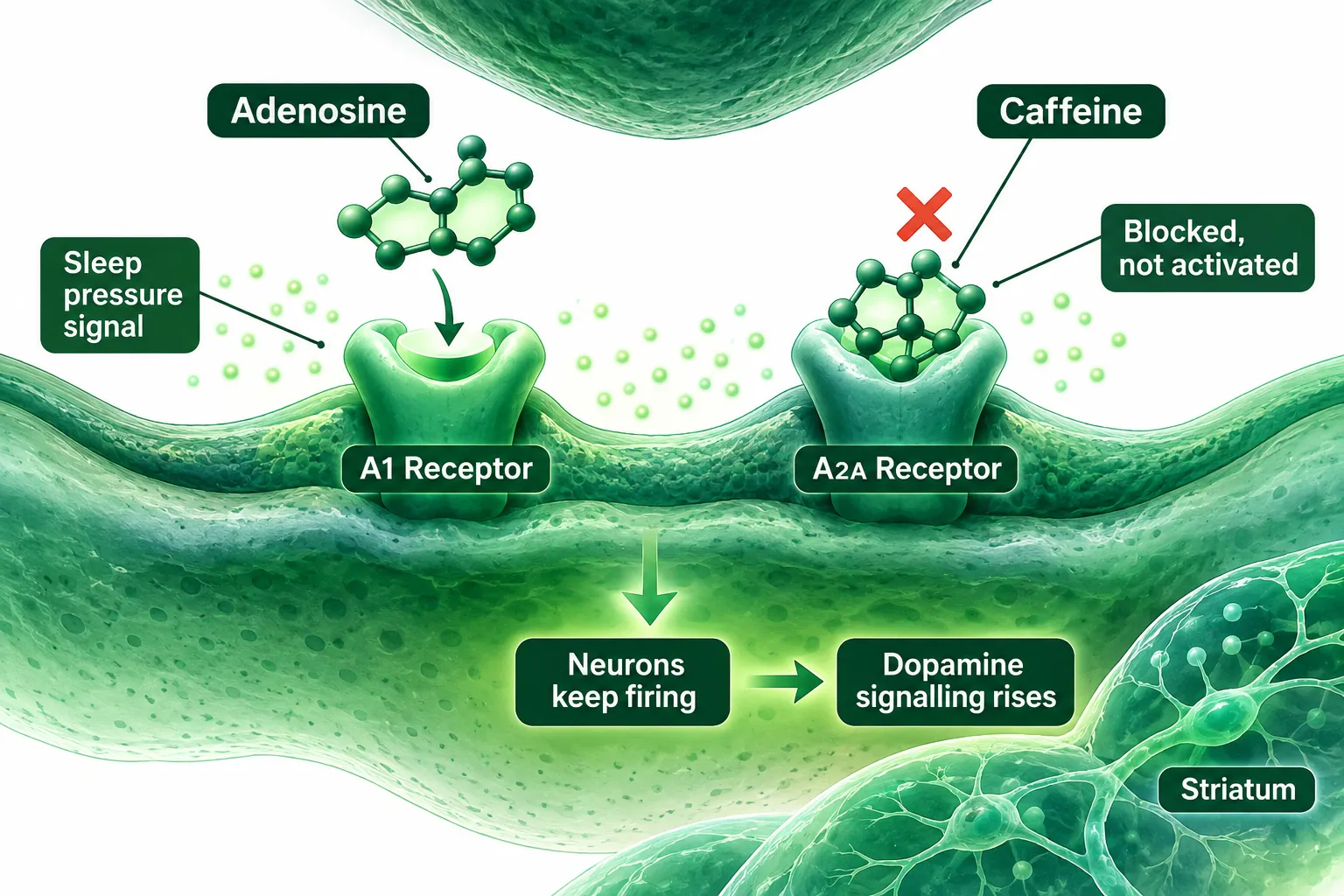
Once adenosine's influence drops, neural firing rises and several neurotransmitters become more available: noradrenaline, acetylcholine, glutamate, and dopamine. Vigilance improves. Reaction time sharpens. The same disinhibition also produces the racing pulse, the tight chest, and the mild anxiety some drinkers get at 300 mg.
Caffeine and dopamine, with the hype removed
Caffeine dopamine effects are real and modest. A PET study using 300 mg of caffeine found increased D2/D3 receptor availability in the putamen and ventral striatum, which fits with raised dopamine signalling in selected regions rather than a brain-wide flood. Compare that with amphetamine-class stimulants and the difference is enormous. Caffeine nudges the motivation circuitry. It does not hijack it.
Two receptor subtypes carry most of the load:
| Receptor | Where it matters most | What blocking it does |
|---|---|---|
| A1 | Widely distributed across the cortex and hippocampus | Raises general neuronal firing, supports alertness and vigilance |
| A2A | Concentrated in the striatum and motivational circuits | Increases dopamine signalling, contributes to drive and mood lift |
The PET data put real numbers on this. A1 displacement in healthy volunteers ran from 5% to 44% and tracked dose closely, with half-maximal displacement around 450 mg in a 70 kg person. A2A occupancy in the striatum reached 54.2% at 129.5 mg of caffeine delivered as coffee. Those PET studies were small and the Parkinson's cohort was not a healthy population, so treat the percentages as mechanistic evidence, not a prescription.
Outside the brain, caffeine mildly raises blood pressure in non-habitual users, increases stomach acid, acts as a weak diuretic, and modestly lifts resting metabolic rate. None of those effects are dramatic at ordinary coffee doses.
How long does it take caffeine to kick in, and when does it peak?
Most people feel something within 15 to 20 minutes, caffeine absorption time runs to roughly 45 minutes for near complete uptake from the gut, and caffeine peak time in the blood falls somewhere between 15 and 120 minutes. The spread is wide because stomach contents, drink temperature, and individual metabolism all move the number.
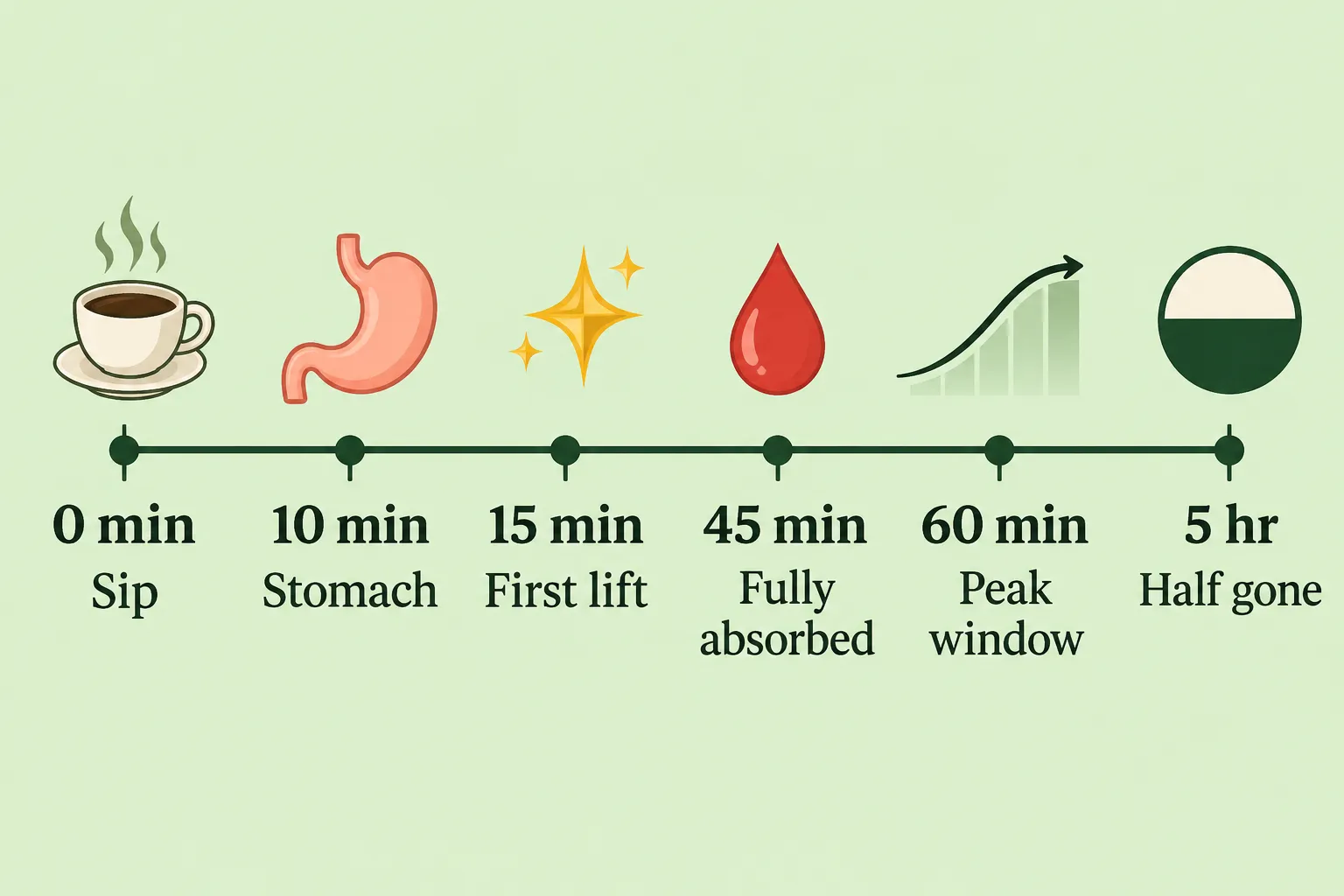
Here is the realistic sequence for a 95 mg cup of brewed coffee on a reasonably empty stomach.
Caffeine in the body: one 95 mg cup
Absorption and peak ranges per NCBI StatPearls. Individual timing varies.
One practical note on the 45 minute figure: it describes absorption into the bloodstream, not the moment the fog lifts. Receptor occupancy builds alongside blood concentration, so the subjective lift usually feels like a slope rather than a switch.
Decision rule: if you need to be sharp for a 9:00 meeting, drink at 8:15, not 8:55.
Why does caffeine make some people jittery?
Jitters happen when the disinhibition goes further than the person's nervous system wants. The same reduced adenosine braking that improves vigilance also allows more noradrenaline release, which raises heart rate and muscle tension.
Three things push someone into the jittery zone:
- Dose relative to body weight. The EFSA single-dose benchmark is about 3 mg per kg . A 55 kg adult hits that at roughly 165 mg, which is one large café drink.
- Genetic metabolism speed. Slow metabolizers clear caffeine less quickly, so the same cup produces a higher sustained concentration.
- Empty stomach and fast delivery. A shot of espresso on no food absorbs faster than the same caffeine in a milky drink with breakfast.
Robusta beans carry roughly twice the caffeine of arabica, which is why a blend matters more than most drinkers realise. If you are curious what your regular chain uses, our breakdown of whether Starbucks brews arabica or robusta covers the bean side of this.
Common mistake: blaming the roast. Dark roasts are not low in caffeine in any meaningful way. The bean species, the dose by weight, and the brew ratio do far more.
If you get palpitations or chest discomfort from ordinary coffee, that is a conversation for your doctor, not a forum. A November 2, 2026 American Heart Association announcement reported that caffeinated drinks and stimulant supplements appeared disproportionately in reports of cardiac arrest and heart attack among young adults, based on a review of more than 28,000 FDA adverse-event reports from 2017 to 2025. Those are voluntary reports showing an association, concentrated around high-dose stimulant products, and they do not establish that coffee caused the events.
Does caffeine work differently depending on age or weight?
Yes. Body weight, liver enzyme activity, age, pregnancy, smoking status, and some medications all change how long caffeine stays active and how strongly it hits.
- Body weight. Safety benchmarks are expressed per kilogram for a reason. 200 mg in a 60 kg adult is a bigger exposure than 200 mg in a 95 kg adult .
- Age. Clearance tends to slow with age, and children and adolescents are more sensitive per kilogram. England's July 16, 2026 consultation outcome confirmed legislation prohibiting sales of high-caffeine energy drinks to under-16s, covering drinks other than tea or coffee above 150 mg of caffeine per litre, with implementation expected in April 2027. Wales opened its own consultation on November 5, 2026 on a matching restriction.
- Pregnancy. Caffeine half-life lengthens considerably in later pregnancy. Anyone pregnant should follow their clinician's guidance rather than general figures.
- Smoking. Tobacco smoke induces the CYP1A2 enzyme and speeds caffeine clearance, which is why people who quit smoking often feel suddenly over-caffeinated on their usual intake.
Edge case: oral contraceptives can roughly double caffeine half-life for some people. If your afternoon cup started disrupting sleep after a medication change, that is a plausible reason to raise with your prescriber.
Can you build a tolerance to caffeine, and why does caffeine stop working for you?
Yes, tolerance is well documented, and the usual reason caffeine stops working is receptor upregulation combined with poor sleep. With regular intake, the brain responds to persistent adenosine blockade by producing more adenosine receptors. More receptors means the same dose covers a smaller share of them.

Two signs you have crossed into pure maintenance drinking:
- Your first coffee does not make you feel alert. It makes you feel normal.
- Skipping it produces a headache by mid-morning.
That is dependence doing the work, not alertness. Tolerance to the alertness effect develops faster than tolerance to the sleep disruption, which is the cruel part of the arrangement. You stop feeling the lift long before you stop losing deep sleep.
The fix most people get wrong: increasing the dose. Chasing the feeling with 400 mg buys a few weeks before the same flattening returns. A two to three week taper down, or a reset to a smaller baseline dose, restores sensitivity more reliably than escalation. High-caffeine products make escalation very easy, which is worth remembering before you reach for something in the Death Wish Coffee caffeine bracket.
If caffeine has stopped working for you, check sleep debt first. No dose of adenosine blockade replaces the restoration that sleep provides. It only postpones the invoice.
Is caffeine addictive, and how do you quit without headaches?
Caffeine produces genuine physical dependence and a recognised withdrawal syndrome, but it is not addictive in the way that compulsive, harm-driven substance use disorders are. Most people can reduce intake with a planned taper and no lasting trouble.
Withdrawal symptoms typically begin 12 to 24 hours after the last dose, peak around day one or two, and resolve within two to nine days. The headache comes from rebound cerebral blood vessel dilation after chronic caffeine-induced constriction.
A taper that usually works:
- Count your actual daily milligrams for three days. Most people underestimate by a third.
- Cut 25% per week, not all at once.
- Replace the ritual, not just the drink. Keep the cup, the grinder, the bloom, the smell.
- Swap your afternoon cup first, since it costs you the most sleep.
- Use half-caf as a midpoint. Decaf is not caffeine free, and the real figures are in our piece on how much caffeine decaf coffee actually contains.
- Keep water intake and sleep steady through the taper week, which blunts the headache.
Edge case: if you drink 500 mg or more daily, tapering over four to six weeks is kinder than three.
How much caffeine is safe to drink per day?
For healthy non-pregnant adults, the widely used benchmarks are up to 400 mg per day and up to 200 mg in a single dose, or roughly 3 mg per kg of body weight at once. Germany's Federal Institute for Risk Assessment restated the EFSA single-dose figure in its November 2026 energy drink assessment, including for consumption less than two hours before intense exercise under normal conditions .
Rough caffeine content by drink, using common US serving figures:
| Drink | Typical serving | Approximate caffeine |
|---|---|---|
| Brewed drip coffee | 8 oz | 80 to 100 mg |
| Single espresso | 1 oz | 60 to 75 mg |
| Cold brew concentrate, diluted | 8 oz | 100 to 200 mg |
| Black tea | 8 oz | 40 to 50 mg |
| Energy drink | 8.4 oz can | 75 to 80 mg |
| Decaf coffee | 8 oz | 2 to 7 mg |
Regulators are paying closer attention. The FDA placed draft guidance on labeling caffeine content in foods and beverages on its Human Foods Program agenda in June 2026, though as of October 28, 2026 it was not yet a binding nationwide labeling rule. Until then, brewed coffee carries no mandatory caffeine declaration at all, so your café americano is an estimate.
Anyone with a diagnosed heart rhythm problem, anxiety disorder, reflux, or a pregnancy should get a personal number from their own clinician rather than a national average.
Caffeine versus sugar and B vitamins: which actually produces energy?
Only sugar supplies energy in the metabolic sense. Caffeine blocks a tiredness signal, B vitamins act as cofactors in energy metabolism and do little for anyone who is not deficient, and sugar supplies calories your cells can burn immediately.
| Source | What it does | Onset | Downside |
|---|---|---|---|
| Caffeine | Blocks A1 and A2A adenosine receptors | 15 to 45 minutes | Tolerance, sleep disruption, jitters at high doses |
| Sugar | Supplies glucose directly as fuel | 5 to 15 minutes | Short duration, common post-spike slump |
| B vitamins | Cofactors in converting food to usable energy | No acute lift | Little effect without a documented deficiency |
| Sleep | Clears accumulated adenosine | Hours | Requires actual time, no shortcut exists |
That last row is the one the energy drink category would rather not discuss. Caffeine delays the adenosine bill. Sleep is what pays it.
What is the best time of day for caffeine, and how do you clear it faster?
The practical rule is to finish your last caffeinated drink at least eight hours before bed, and there is no reliable way to speed up clearance once it is in you. Caffeine's average half-life in healthy adults is around five hours, which means a 200 mg dose at 3:00 pm leaves roughly 100 mg circulating at 8:00 pm and about 50 mg at 1:00 am.
Things that genuinely change clearance speed: liver enzyme genetics, pregnancy, smoking, certain medications, and liver disease. Things that do not: cold showers, exercise, large volumes of water, or standing up quickly. Hydration helps you feel better. It does not accelerate CYP1A2.
What actually helps while you wait it out:
- Eat something. Food will not clear caffeine, but it softens the stomach discomfort and the shaky feeling.
- Walk. Light movement helps dissipate the restless energy.
- Avoid stacking more stimulants, including pre-workout and some cold remedies.
- Keep the room cool and the lights low if you are trying to sleep through it.
Best-time rule: many people do better delaying the first cup 60 to 90 minutes after waking rather than drinking it in bed, because morning cortisol is already doing some of the alerting work. That timing claim is a practical habit suggestion, not a settled research finding.
Does caffeine dehydrate you, or is that a myth?
Mostly a myth at ordinary intakes. Caffeine is a mild diuretic, but the fluid in a cup of coffee more than offsets the extra urine it prompts, and regular drinkers develop tolerance to the diuretic effect within days.
The net fluid balance of a standard coffee is positive. Where it gets murkier is with large single doses in people who never drink caffeine, which can produce a measurable short-term diuresis. For the full research picture, including what the hydration studies measured and where they fall short, see our breakdown of whether coffee dehydrates you.
The misconception worth correcting, plainly: coffee counts toward your daily fluid intake. It does not need to be offset glass for glass with water.
FAQ
Conclusion
The 45 minute figure is the one to keep. Caffeine is near fully absorbed in roughly three quarters of an hour, peaks somewhere between 15 and 120 minutes, and then spends about five hours halving. Knowing how does caffeine work changes what you do with that cup: you drink it before the task rather than during it, you stop by early afternoon, and you stop expecting it to replace sleep it was never capable of replacing.
Your next step is the boring one that works. Count your real daily milligrams for three days, note the clock time of your last caffeinated drink, and compare that against your bedtime. If the gap is under eight hours, move the last cup earlier for a week and judge the mornings.
Better Coffee Starts With Better Answers. If you want to reduce afternoon intake without losing the ritual, a chilled drink with less coffee in it does the job nicely, and our guide to making cold foam at home is a good place to start.