How Long Does Caffeine Stay in Your System? The Real Math
Quick Answer
Caffeine has an average half-life of about 5 hours in healthy adults, so roughly half your dose is still circulating 5 hours after the last sip, and a quarter of it is still there at 10 hours. Full clearance usually takes somewhere between 15 and 30 hours depending on your liver enzymes, pregnancy status, smoking, medications and age. The honest version of how long does caffeine stay in your system is not one number. It is a decay curve, and you can do the arithmetic on your own cup in about ten seconds.
Key Takeaways
- Average caffeine half-life: about 5 hours. Food Standards Australia New Zealand's 2026 safety assessment describes a typical adult range of roughly 3 to 7 hours, and clinical ranges stretch from 2 to 10 hours.
- Drake et al., 2013, Journal of Clinical Sleep Medicine: 400 mg taken 6 hours before bed reduced measured total sleep time by more than an hour in a double-blind trial of 12 healthy adults.
- A 2026 randomized crossover trial in 23 men found 400 mg disturbed sleep at 12, 8 and 4 hours before bed, with the worst fragmentation at 8 hours, while 100 mg produced no statistically significant sleep effect .
- A September 2026 systematic review of caffeine EEG research concluded caffeine most consistently suppresses slow-wave activity, the deep non-REM sleep that makes rest feel restorative .
- A March 2026 mixed-methods study of 200 Indian adults aged 18 to 35 reported actigraphy-measured sleep onset of 29.4 minutes for those drinking caffeine after 6 p.m. versus 16.1 minutes for those who did not .
- The FDA's benchmark is up to 400 mg per day for most healthy adults, with the agency noting that sensitivity and clearance vary widely between people.
- Decaf is not caffeine-free. Most decaf cups carry roughly 2 to 15 mg.
The Simple Math Behind How Long Caffeine Stays in Your System
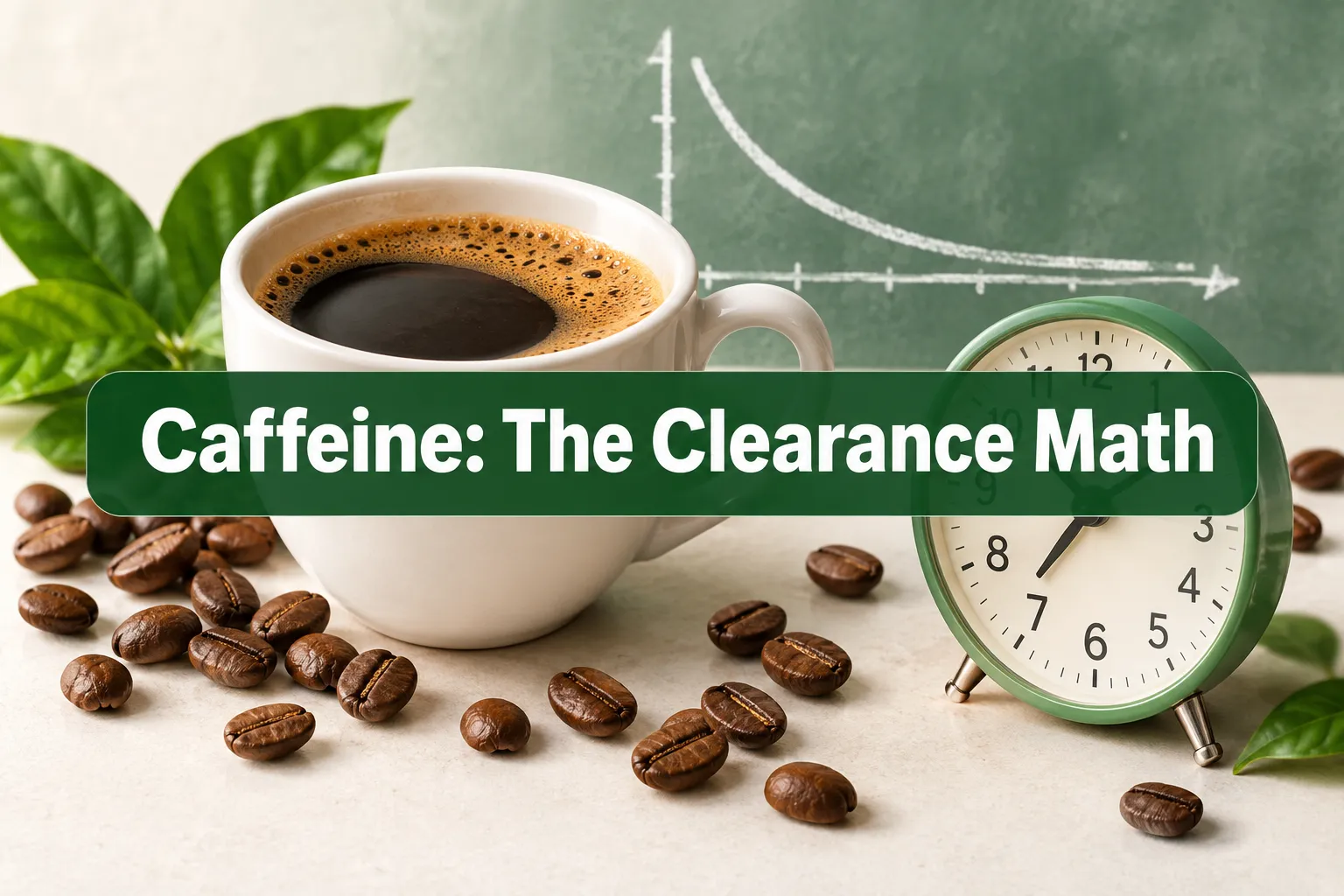
Caffeine does not switch off. It decays exponentially, losing about half of what remains every half-life period, which is why "how long does caffeine last" has no tidy answer.
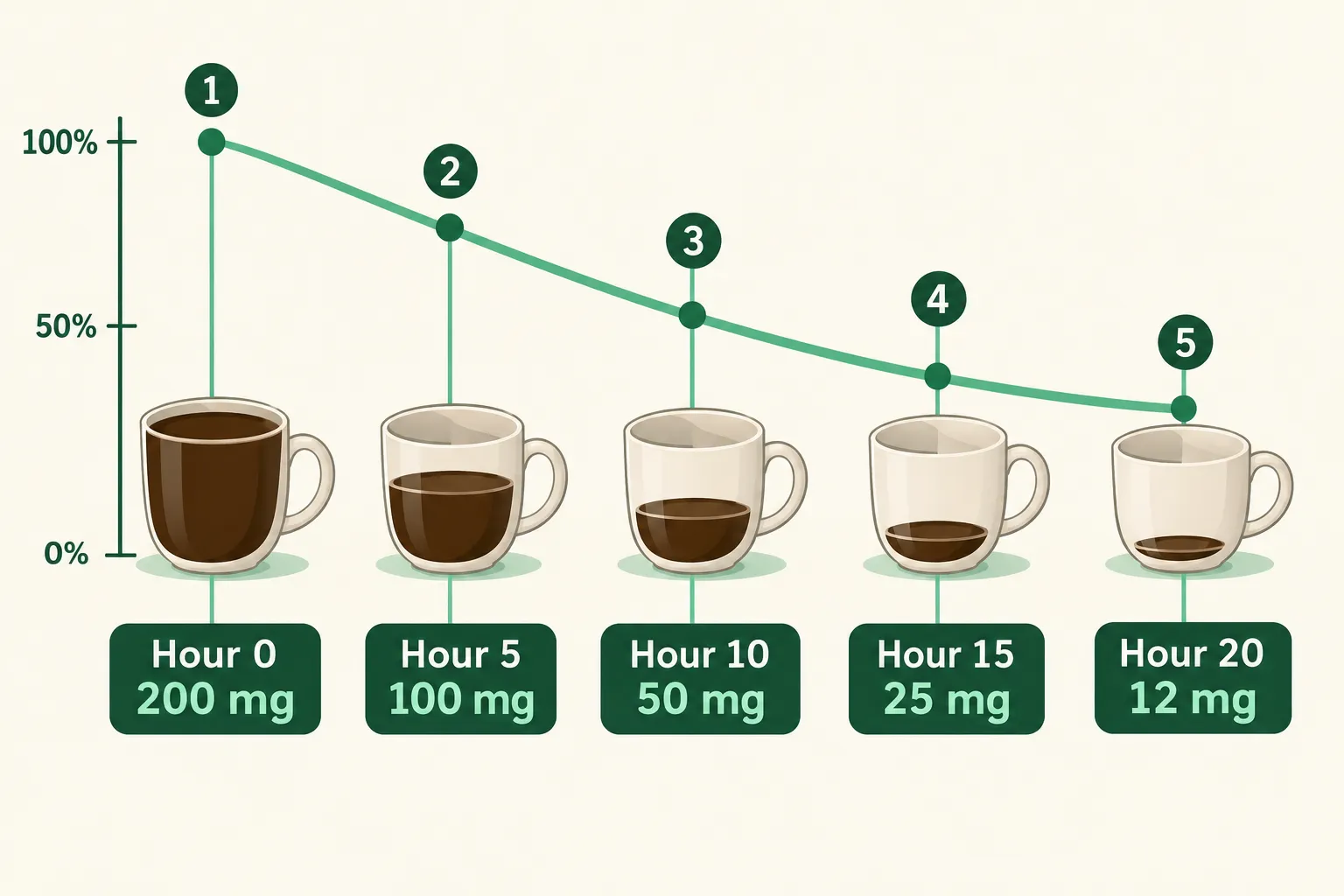
Take a 200 mg dose, which is roughly a 12 oz mug of drip coffee, and assume a 5 hour half-life:
| Hours after your cup | Caffeine still in your blood |
|---|---|
| 0 | 200 mg |
| 5 | 100 mg |
| 10 | 50 mg |
| 15 | 25 mg |
| 20 | 12.5 mg |
| 25 | 6 mg |
That 50 mg still floating around at hour 10 matters. It is about the dose of a strong cup of black tea, and your body does not care that you drank it ten hours ago.
The decision rule: if you want under 25 mg of caffeine left at bedtime, stop at four half-lives before lights out. For an average metabolizer that is 20 hours for a 400 mg day, or about 15 hours for a 200 mg cup. Most people find that uncomfortable reading. It is still the arithmetic.
)
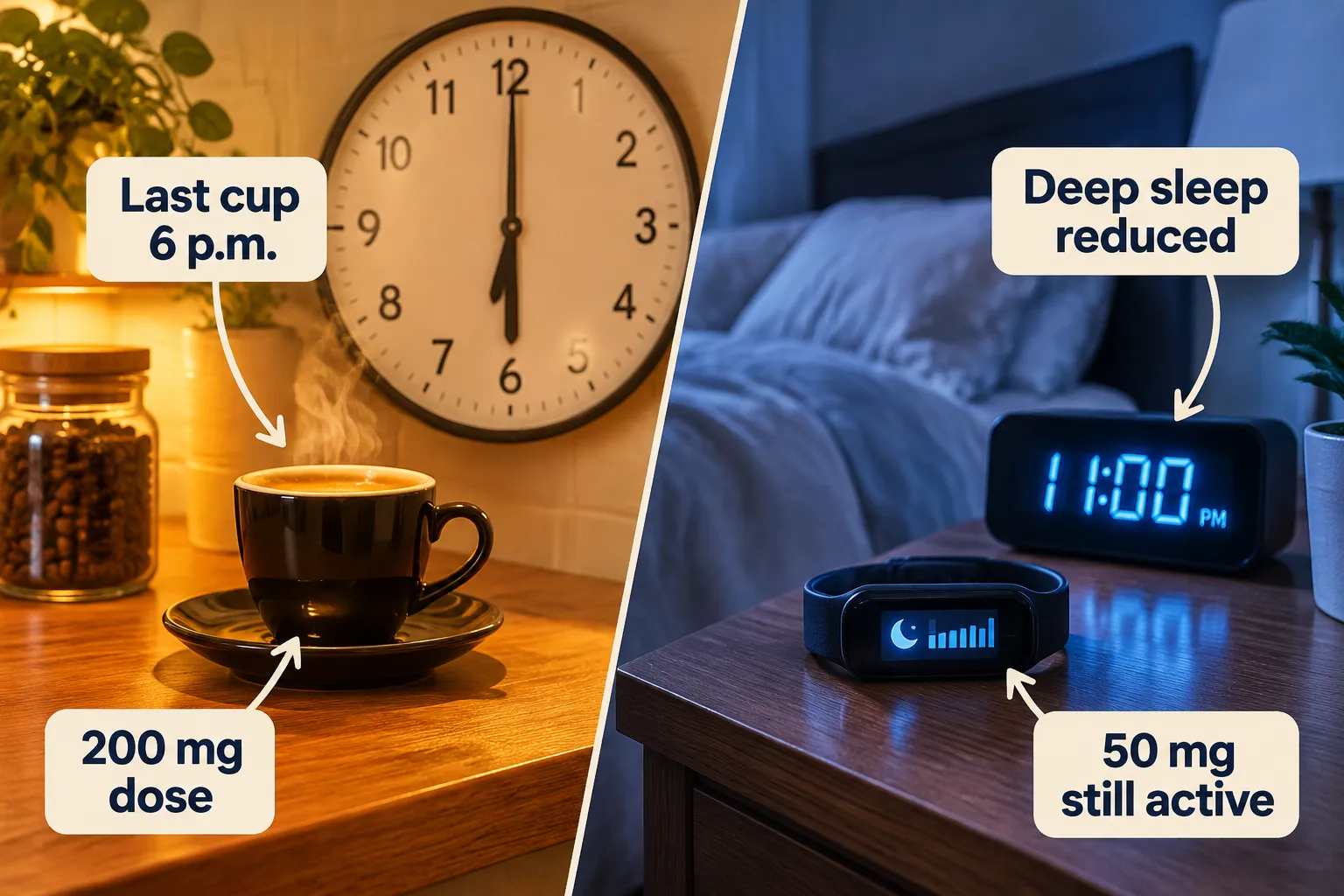
Common mistake: assuming "I fell asleep fine" means the caffeine cleared. The September 2026 EEG review found caffeine reduces low-frequency non-REM activity even when sleep onset looks normal . Falling asleep is not the same measurement as sleeping well.
Run the math on your own cup
Use this calculator with the actual milligram figure from your drink. Our espresso shot and brewed cup caffeine breakdown gives starting numbers if you are not sure.
Caffeine clearance calculator
You would need about ‘+t25.toFixed(1)+’ hours to fall below 25 mg.
‘+msg; });
How Long Does Caffeine Stay in Your System, Exactly?
For most healthy adults, caffeine peaks in the blood 30 to 60 minutes after drinking, has a half-life near 5 hours, and is effectively cleared after about 15 to 30 hours. Food Standards Australia New Zealand's 2026 safety assessment puts the typical adult half-life at 3 to 7 hours, and clinical pharmacology data widens that to 2 to 10 hours once you account for pregnancy, smoking, liver function and medication.
So the answer to how long does caffeine stay in your system splits into three useful markers:
- Peak effect: 30 to 60 minutes after the cup.
- Half gone: about 5 hours (your personal number may be 2 or 10).
- Functionally cleared: 5 half-lives, which is 25 hours at the average and 15 hours if you clear fast.
The misconception this article corrects: people talk about caffeine "wearing off" after 4 to 6 hours. What actually happens at hour 5 is that you stop noticing it while half the dose is still in your bloodstream. Perception of alertness and caffeine clearance time are two different measurements. Adenosine receptor blockade feels like it fades long before the molecule leaves.
Who this matters most for: anyone who drinks a second cup after 2 p.m., anyone taking fluvoxamine or ciprofloxacin (both slow caffeine metabolism considerably), and pregnant drinkers. If you have a diagnosed heart rhythm, liver or anxiety disorder, ask your doctor what your own ceiling should be. Your prescriptions change the math more than your brew method does.
What Is the Half-Life of Caffeine in Your Body?
Caffeine half-life is the time your body needs to eliminate 50% of the caffeine currently in your blood, and in healthy adults it averages about 5 hours. Half-life is the single most useful number for working out how long does caffeine stay in your system, because it is the only one that scales to your dose.
A few things worth knowing about the mechanism:
- Roughly 95% of caffeine is broken down by the liver enzyme CYP1A2, which converts it into paraxanthine, theobromine and theophylline. Paraxanthine itself is stimulating.
- Caffeine shows first-order kinetics at ordinary doses, meaning a fixed percentage clears per unit of time rather than a fixed amount.
- Very little caffeine leaves unchanged in urine, which is why "flushing it out" is mostly wishful thinking.
Quick example: a 300 mg day split as 150 mg at 7 a.m. and 150 mg at 1 p.m. leaves about 9 mg from the first cup and 37 mg from the second at 11 p.m., assuming a 5 hour half-life. Total near 46 mg at bedtime, roughly a cup of tea's worth.
Why Does Caffeine Affect Some People More Than Others?
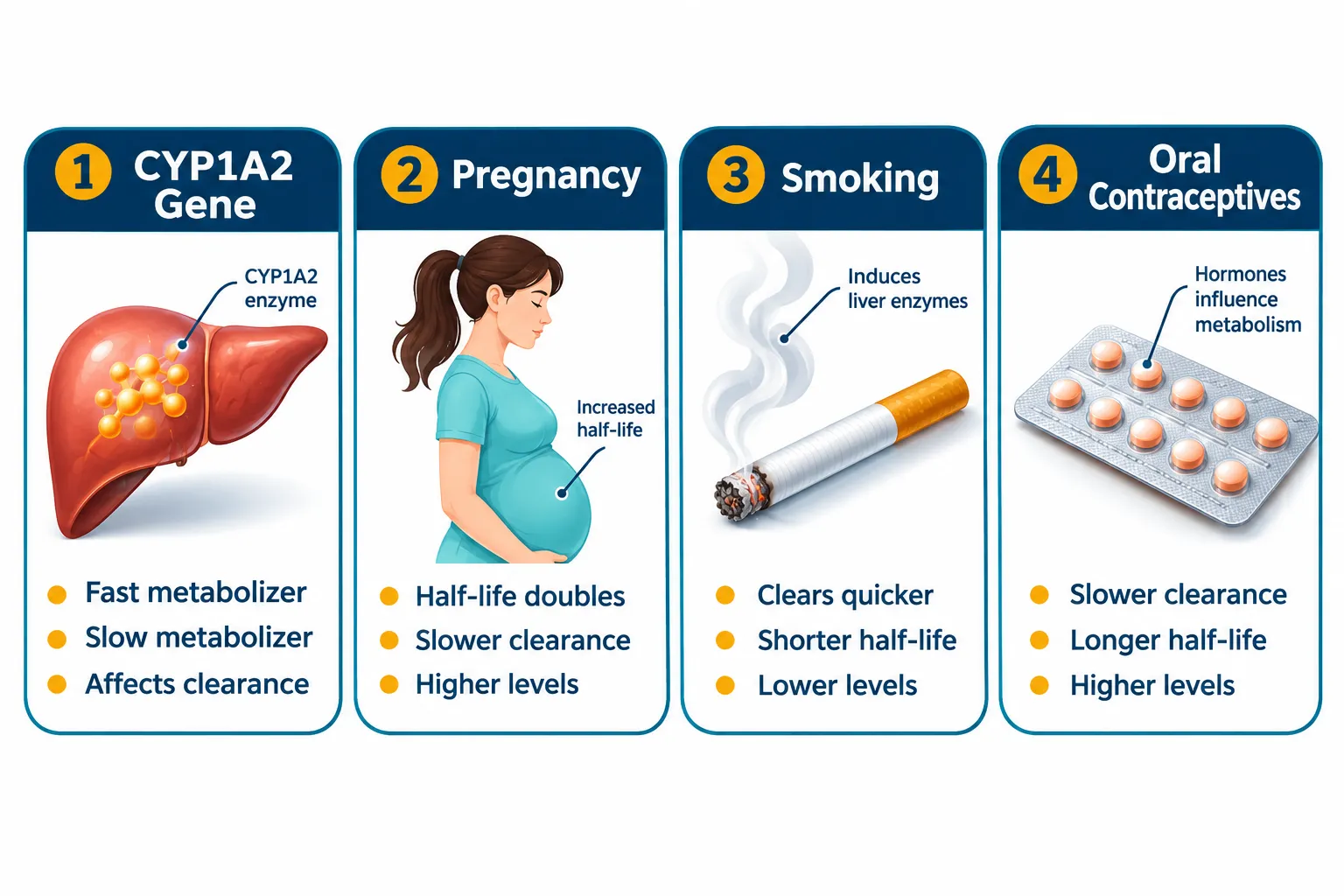
Genetics, mostly. Variants in the CYP1A2 gene sort people into fast and slow metabolizers, and the difference can be a half-life of 2 hours versus 8 hours from the same cup. The ADORA2A gene, which codes for an adenosine receptor, separately influences whether you feel jittery or calm at the same blood level.
Other factors that change caffeine metabolism:
- Smoking induces CYP1A2 and can roughly halve caffeine half-life. Quitting reverses this within days, which is why new quitters often feel overcaffeinated on their usual coffee.
- Oral contraceptives containing estrogen inhibit CYP1A2 and can roughly double half-life.
- Liver disease slows clearance substantially.
- Certain medications, including fluvoxamine and some fluoroquinolone antibiotics, can extend half-life dramatically. Check with your pharmacist rather than guessing.
)
Edge case: two people at the same café, same 180 mg latte, same 3 p.m. One has 11 mg left at midnight. The other has 80 mg. Neither is doing anything wrong. They just carry different enzyme copies.
Does Caffeine Stay in Your System Longer If You're Pregnant?
Yes, considerably. Caffeine half-life lengthens through pregnancy, commonly reaching 9 to 11 hours or more by the third trimester as CYP1A2 activity drops. A cup that clears by dinner at week 6 may still be working at breakfast the next day by week 32.
Food Standards Australia New Zealand's 2026 assessment recommends limiting intake to 200 mg per day during pregnancy, which is in line with guidance from the American College of Obstetricians and Gynecologists. That is roughly one 12 oz brewed coffee, or two shots of espresso with a bit of room.
This is association and physiology, not a prescription. If you are pregnant or breastfeeding, set your number with your obstetrician or midwife, not with a blog. Decaf is a genuinely useful tool here, and our guide to how much caffeine decaf actually contains gives the real milligrams.
Does Caffeine Metabolism Slow Down With Age?
Modestly, and less than most people expect. Caffeine half-life in healthy older adults is broadly similar to younger adults, though liver blood flow and concurrent medications can stretch it. What changes more reliably with age is sleep architecture: deep slow-wave sleep naturally declines after about 40, so the same residual caffeine has less deep sleep to interfere with.
Practical read: if coffee started bothering your sleep in your forties and your dose has not changed, the likely culprit is your sleep becoming more fragile rather than your liver becoming slower.
Do Kids Metabolize Caffeine Differently Than Adults?
Yes. Newborns clear caffeine extremely slowly, with half-lives measured in days rather than hours, because CYP1A2 is barely active at birth. By roughly 6 months the enzyme matures and children actually clear caffeine at adult or slightly faster rates per kilogram.
The practical issue for kids and teens is dose relative to body weight, not clearance speed. A 110 lb teenager drinking a 160 mg energy drink gets a per-kilogram dose roughly double what a 200 lb adult gets from the same can. The American Academy of Pediatrics discourages energy drinks for children and adolescents entirely.
How Long Does Caffeine From Energy Drinks Last Versus Coffee?
The caffeine molecule is identical and the half-life is the same, so an energy drink does not last longer than coffee at an equal dose. What differs is absorption speed, dose size and what else is in the can.
| Drink | Typical caffeine | Hours to fall under 25 mg* |
|---|---|---|
| Brewed coffee, 12 oz | ~180 mg | ~14 hours |
| Double espresso | ~128 mg | ~12 hours |
| Cold brew, 12 oz | ~200 to 280 mg | ~15 to 17 hours |
| Standard energy drink, 8.4 oz | ~80 mg | ~8 hours |
| Large energy drink, 16 oz | ~160 to 300 mg | ~13 to 18 hours |
| Black tea, 8 oz | ~47 mg | ~4.5 hours |
| Decaf coffee, 8 oz | ~2 to 15 mg | Already under |
*Assumes a 5 hour half-life. Caffeine figures are typical ranges from published beverage databases and vary by bean, grind size, brew ratio and water temperature.
Sugar and taurine in energy drinks change how the experience feels, including the slump when blood sugar falls, but they do not change caffeine clearance time. One genuine difference: cold brew is often served in larger volumes at higher concentrations, so the dose creeps up quietly. If you make your own, our Toddy cold brew method walkthrough explains how brew ratio drives strength.
What's the Difference Between Caffeine From Tea and Coffee?
Chemically, none. Caffeine in tea and caffeine in coffee are the same molecule with the same half-life. The difference is dose and company: an 8 oz brewed coffee carries roughly 95 mg while 8 oz of black tea carries about 47 mg, and tea also contains L-theanine, an amino acid studied for its calming effect on attention tasks.
People often report tea feels "smoother." That is a reasonable description of a smaller dose arriving alongside L-theanine, not evidence that tea caffeine leaves faster. Matcha deserves a flag here: whole-leaf powder pushes a serving toward 60 to 70 mg, closer to coffee than to a tea bag.
Can You Build Up a Tolerance to Caffeine?
Yes, and fairly fast. Regular daily intake prompts the brain to add adenosine receptors, so the same dose blocks a smaller proportion of them. Partial tolerance to alertness and blood pressure effects develops within days to a couple of weeks in controlled studies.
Important distinction: tolerance is a receptor story, not a clearance story. Your half-life does not shorten because you drink more. The caffeine still sits in your blood for the same number of hours. You just stop feeling it, which is exactly why habitual drinkers underestimate how much is active at bedtime.
If you want to reset, taper by about 25% every three days rather than quitting cold. Withdrawal headaches typically start 12 to 24 hours after the last dose and peak around day one or two. Switching your afternoon cup to a good decaf is the least painful route, and decaf K-cups that still taste like coffee make the swap easier to stick with.
Does Caffeine Sensitivity Increase the More You Drink It?
Generally the opposite. Regular drinking produces tolerance, so sensitivity usually decreases. When people report becoming more sensitive over time, the usual explanations are a slower-clearing physiology (new medication, pregnancy, quitting smoking), worsening baseline sleep, or an anxiety condition that lowers the threshold at which jitters register.
There is a reverse-sensitivity trap worth knowing: chronic caffeine use fragments sleep, poor sleep increases next-day fatigue, and fatigue increases caffeine intake. The loop tightens without the dose feeling different.
Does Caffeine Stay Longer in Your System If You Have Anxiety?
No. Anxiety does not slow caffeine metabolism or extend caffeine half-life. What anxiety changes is the response: the same blood concentration produces more noticeable heart rate increase, muscle tension and intrusive worry in people with anxiety disorders, partly through ADORA2A receptor variation.
Caffeine can provoke panic symptoms in susceptible people at doses that most drinkers tolerate without issue. If you have a diagnosed anxiety or panic disorder, talk to your clinician about your personal ceiling. Cutting the dose in half, rather than quitting entirely, is often enough and is worth discussing before an all-or-nothing change.
How Can You Flush Caffeine Out of Your System Faster?
You mostly cannot. Caffeine clearance is set by CYP1A2 enzyme activity in your liver, and no drink, food or exercise meaningfully speeds that up. Water, cold showers, sweating and large meals do not shorten the half-life.
What genuinely helps:
- Wait. The half-life is the half-life. Time is the only reliable lever.
- Eat something. Food slows absorption of any caffeine still in your stomach, blunting the peak rather than the total.
- Drink water for the symptoms, not the clearance. Hydration eases headache and dry mouth. It does not accelerate elimination. We covered the related myth in whether coffee actually dehydrates you.
- Light walking can reduce the jittery feeling by burning off adrenaline, without changing blood caffeine.
- Avoid stacking. Do not chase a jittery afternoon with another cup at 5 p.m.
Common mistake: treating grapefruit juice, vitamin C or charcoal tablets as caffeine antidotes. Nothing on that list has reliable human evidence for faster caffeine clearance.
How Long Before Bed Should You Stop Drinking Caffeine to Sleep?
Make it dose-specific rather than clock-specific. The 2026 randomized crossover trial in 23 men found 400 mg measurably disturbed sleep when taken 12, 8 or 4 hours before bedtime, with the worst fragmentation at the 8 hour mark, while a 100 mg dose caused no statistically significant disruption under the study conditions . That lines up with Drake et al., 2013, in the Journal of Clinical Sleep Medicine, where 400 mg taken 6 hours before bed cut measured total sleep time by more than an hour in 12 healthy adults.
)
Working cutoffs for an 11 p.m. bedtime, assuming an average 5 hour half-life:
- Up to 100 mg (single espresso, cup of tea): fine until roughly 7 p.m.
- 200 mg (standard mug of drip): stop by about 2 p.m.
- 400 mg (large cold brew, double energy drink): stop by late morning. The 2026 trial found disruption even at 12 hours.
A March 2026 mixed-methods study of 200 Indian adults aged 18 to 35 found caffeine consumed after 6 p.m. was associated with actigraphy-measured sleep onset of 29.4 minutes versus 16.1 minutes in those without late intake, and perceived onset of 46.2 versus 19.8 minutes . That is an association in a single-country sample of young adults, not proof of cause, and self-reported intake is a known weak point in this design.
The September 2026 EEG review found caffeine's clearest signature is suppressed slow-wave activity . You can sleep seven hours and still lose the deep part.
Limitations worth holding onto: the 2026 crossover trial used 23 men only, so it says nothing certain about women, older adults or pregnancy. Drake et al. used 12 participants. Both are small. The direction of effect is consistent across them, the exact hours are not settled.
Is Decaf Coffee Actually Caffeine-Free?
No. Decaffeination removes roughly 97% of caffeine under US standards, leaving about 2 to 15 mg in a typical 8 oz cup. Compare that to about 95 mg in regular brewed coffee.
For nearly everyone, that residue is irrelevant at bedtime. Three qualifications: very sensitive drinkers can notice it, espresso-based decaf drinks can run higher than drip, and multiple decaf cups add up. If you are tracking a strict pregnancy limit, count decaf as a small real number rather than a zero. The full breakdown is in our decaf caffeine milligram guide.
Is There a Safe Amount of Caffeine Per Day?
The FDA's standing benchmark is up to 400 mg per day for most healthy adults, roughly four 8 oz cups of brewed coffee, while noting that sensitivity and clearance vary widely. Food Standards Australia New Zealand's 2026 assessment recommends 200 mg per day during pregnancy.
Who should sit lower:
- Pregnant or breastfeeding drinkers: 200 mg or as your clinician advises.
- Adolescents: commonly capped around 100 mg, with energy drinks discouraged.
- People with arrhythmias, uncontrolled hypertension, anxiety or panic disorders, or liver impairment: set a number with your doctor.
- Anyone on fluvoxamine, ciprofloxacin or similar CYP1A2 inhibitors.
Dose-tracking is easier when you know what your gear actually produces. If you are rebuilding a routine, our guide to choosing a home coffee maker covers how brew method changes the dose per cup.
FAQ
Conclusion: What This Means for Your Daily Cup
The useful answer to how long does caffeine stay in your system is not a single hour count. It is 5 hours to lose half, roughly 15 to 25 hours to lose almost all of it, and a personal half-life that may be double or half the average depending on your genes, your prescriptions and whether you smoke. Knowing that, you can keep your coffee and still protect your deep sleep, because the variable you actually control is timing paired with dose.
Your next step: find the real milligram figure for your most common drink, open the calculator above, and run it against your bedtime. If you land over 50 mg at lights out, move one cup two hours earlier for a week and see what changes. Better Coffee Starts With Better Answers, and this one takes ten seconds of arithmetic.
If you have a diagnosed heart, liver, anxiety or pregnancy-related condition, bring your number to your doctor rather than setting it from an article.