Does Coffee Raise Blood Pressure? Spike vs Long Term
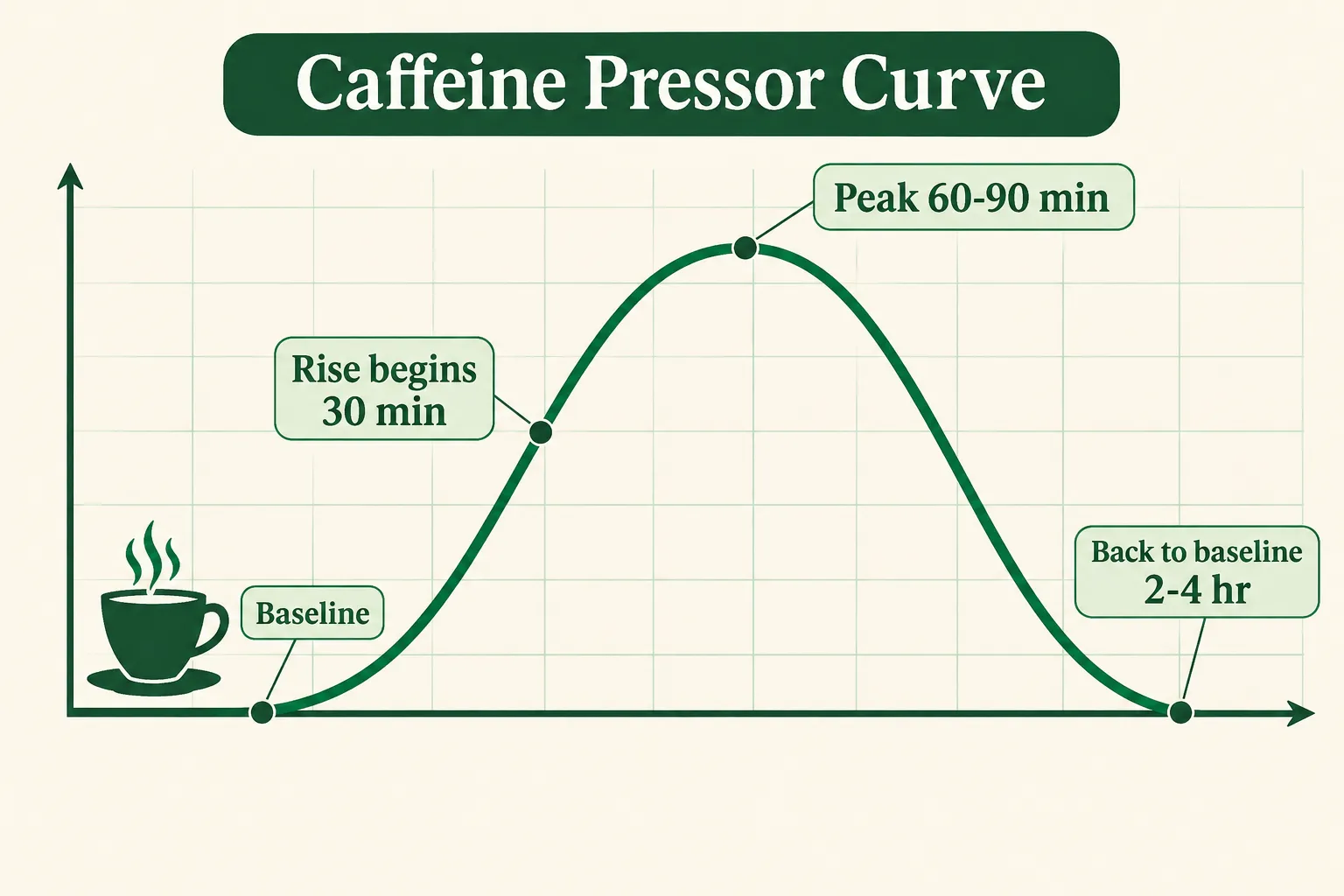
Quick answer: Yes, but briefly. A single dose of about 80 to 300 mg of caffeine, roughly one to three cups of brewed coffee, raises systolic blood pressure by about 3 to 8 mmHg and diastolic by about 4 to 6 mmHg, with the rise starting around 30 minutes in, peaking at 60 to 90 minutes, and fading within 2 to 4 hours . So the honest reply to "does coffee raise blood pressure" is: for a couple of hours, measurably. Over years of habitual drinking, the long-term cohort evidence has not shown coffee drinkers developing hypertension at higher rates than non-drinkers . The American Heart Association's July 2026 scientific statement puts up to 400 mg of caffeine a day, roughly three to five 8-ounce cups, in the generally-safe range for most adults .
Key takeaways
- A single 80 to 300 mg caffeine dose raised systolic pressure about 3 to 8 mmHg and diastolic about 4 to 6 mmHg in the evidence reviewed in Nutrition Research Reviews .
- The spike has a clock: it begins near 30 minutes, peaks at 60 to 90 minutes, and returns toward baseline in 2 to 4 hours .
- The American Heart Association's 2026 scientific statement on caffeine and cardiovascular disease sets 400 mg daily as a population-level safety reference, not a personal prescription .
- In the PAMELA study, clinic, home, and 24-hour ambulatory readings were not higher in habitual coffee drinkers, and people drinking more than three cups a day had slightly lower clinic systolic pressure than non-drinkers .
- PAMELA's roughly 10-year follow-up found no significant difference in new-onset hypertension between heavy, moderate, and non-coffee drinkers .
- Experts still disagree. A 2026 American Journal of Hypertension debate paired Guido Grassi (no chronic risk) against Paolo Palatini (risk in susceptible subgroups) .
- Energy shots are a different product: roughly 40 to 69 mg of caffeine per fluid ounce, three to four times the concentration of brewed coffee .
Does coffee raise blood pressure? Here is the real number
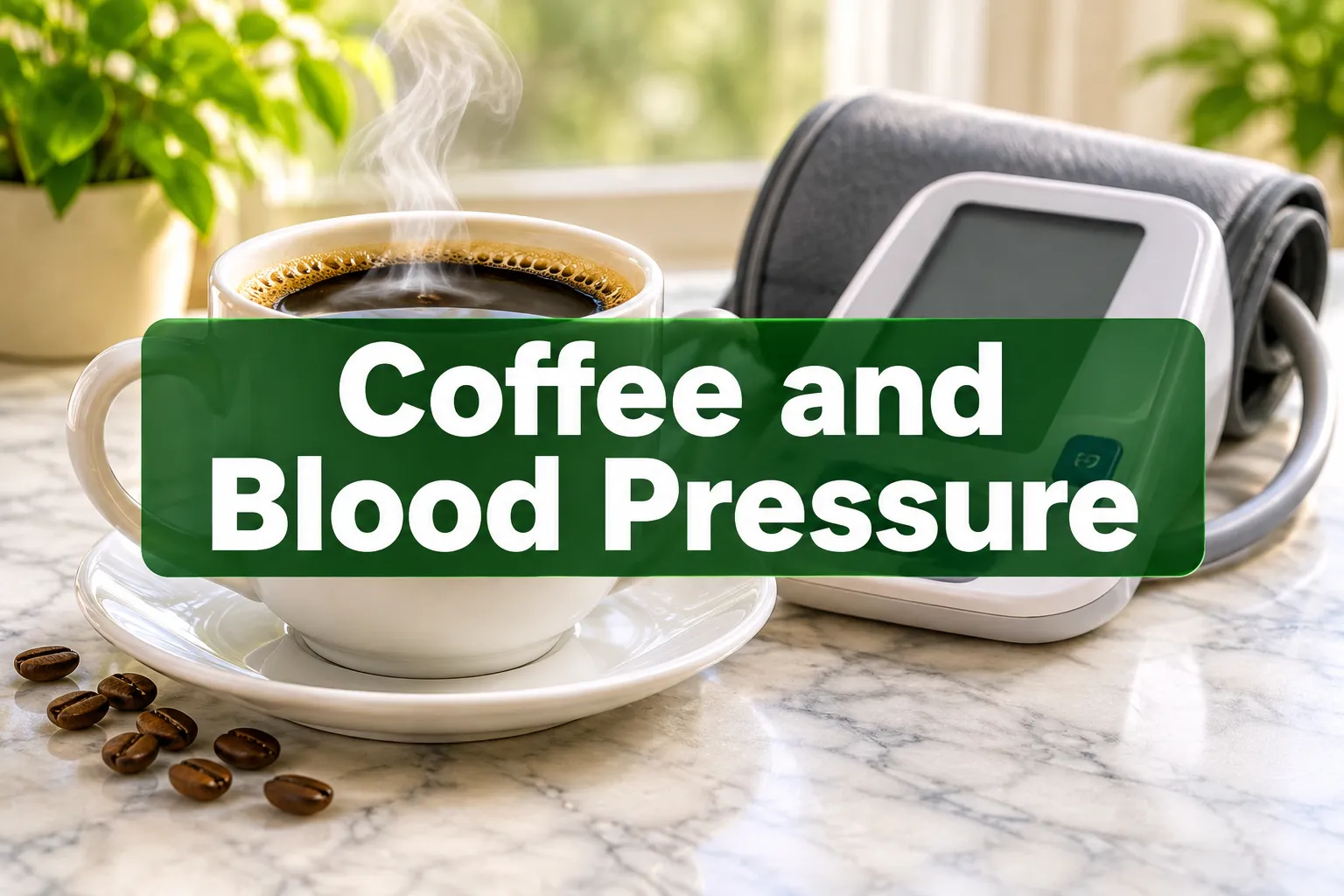
Does coffee raise blood pressure? Short term, yes, by single digits of mmHg for a couple of hours. Long term, the cohort data does not show habitual drinkers running higher pressure or developing hypertension more often than non-drinkers.
Two different questions hide inside one sentence, and most arguments about coffee and blood pressure come from mixing them up.
The first is acute: what happens to your reading in the hour after a cup. That one has a clean answer. The Nutrition Research Reviews critical review of caffeine and blood pressure, summarizing controlled dosing studies, reports average increases of about 3 to 8 mmHg systolic and 4 to 6 mmHg diastolic after single doses of roughly 80 to 300 mg of caffeine, with wide variation between individuals . For scale, an 8-ounce cup of drip coffee typically carries somewhere near 95 mg of caffeine, though the real figure moves with grind size, brew ratio, and the bean itself.
The second question is chronic: does drinking coffee every morning for twenty years push your resting pressure up. That one has a messier answer, and the messiness is the interesting part.
A 3 to 8 mmHg rise that disappears by lunchtime is a physiological event. A 3 to 8 mmHg rise that never goes away is a diagnosis. The research says coffee produces the first kind.
How much does coffee actually raise your blood pressure, and how long does the spike last?
A caffeine blood pressure spike typically starts about 30 minutes after you drink, peaks between 60 and 90 minutes, and settles back toward your baseline within 2 to 4 hours .
That timeline is why your pre-meeting americano can quietly change a reading taken at 10:15 but not one taken at noon.
The size depends on dose and on habit:
- Dose. The 3 to 8 mmHg figure covers single doses of 80 to 300 mg . A triple-shot drink sits at the top of that band.
- Habit. The acute response is strongest in non-habitual drinkers and tends to shrink with regular consumption .
- Measurement method. A single office reading catches the peak if your timing is unlucky. Home and 24-hour ambulatory monitoring smooth it out, which is one reason older studies disagree with newer ones .
Decision rule: if you want a reading that reflects your actual resting pressure, take it at least 3 hours after your last caffeinated drink, or before your first one.
Does the blood pressure spike from coffee go away, or is it permanent?
It goes away. The pressor effect of caffeine is transient, resolving within roughly 2 to 4 hours, and the long-term data does not show it accumulating into chronic hypertension for most people .
The strongest single piece of evidence here comes from Guido Grassi's analysis of the PAMELA study, a population cohort in Monza, Italy, that measured blood pressure three ways: clinic, home, and 24-hour ambulatory. Habitual coffee drinkers were not higher on any of the three. People drinking more than three cups daily actually showed slightly lower clinic systolic pressure than non-consumers .
PAMELA then followed participants for about a decade. Blood pressure changes over that period were comparable among heavy, moderate, and non-drinkers, and there was no significant difference in new cases of hypertension .
The limitation, stated plainly: PAMELA is observational. It can show that coffee drinkers did not fare worse. It cannot prove coffee caused the slightly lower clinic readings. Self-reported intake, Italian espresso-sized servings, and the kind of person who drinks four coffees a day all sit inside that result.
Does drinking coffee every day permanently damage your blood pressure?
Current evidence does not support that. Long-term cohort data, including PAMELA's 10-year follow-up, found no excess new-onset hypertension among habitual coffee drinkers , and the AHA's 2026 statement places moderate intake in the generally-safe category for most adults .
What the AHA did not do is more telling. Caffeine was left out of its 2026 dietary guidance because the evidence was judged insufficient for a single intake recommendation that would apply to everyone . That is a careful position, not a green light or a warning.
Why does coffee affect some people's blood pressure more than others?
Because caffeine response varies by genetics, metabolism, age, medications, underlying disease, and how much coffee you already drink. Gregory M. Marcus, M.D., M.A.S., who chaired the AHA writing group, made exactly this point when the 400 mg figure was published: it is a population reference, not an individualized prescription .
Factors the Nutrition Research Reviews methodological review identified as materially changing the result include age, sex, genetics, smoking, alcohol, sodium and potassium intake, body weight, caffeine dose, and the timing of measurement .
This disagreement is live. A 2026 debate in the American Journal of Hypertension ran two expert positions side by side: Grassi argued coffee does not increase chronic hypertension risk, while Paolo Palatini argued it may in genetically or physiologically susceptible groups, such as slow caffeine metabolizers . Neither is fringe. Both read the same literature.
Edge case: if a cup reliably gives you a pounding chest and a jittery hour, your caffeine heart rate and pressure response is on the sensitive end. That is useful personal data, even though it is not a diagnosis.
Can you build a tolerance to coffee's blood pressure effects over time?
Partly, yes. The acute pressor response is strongest in non-habitual drinkers and tends to diminish with regular intake, which is why coffee tolerance blood pressure effects show up clearly in dosing studies but fade in daily-drinker populations .
Grassi notes that studies have not consistently found a rise after acute coffee intake in regular drinkers at all . Tolerance is uneven though, and it is not a licence to scale up indefinitely. The AHA's 400 mg ceiling still applies.
Is it the caffeine or something else in coffee raising blood pressure?
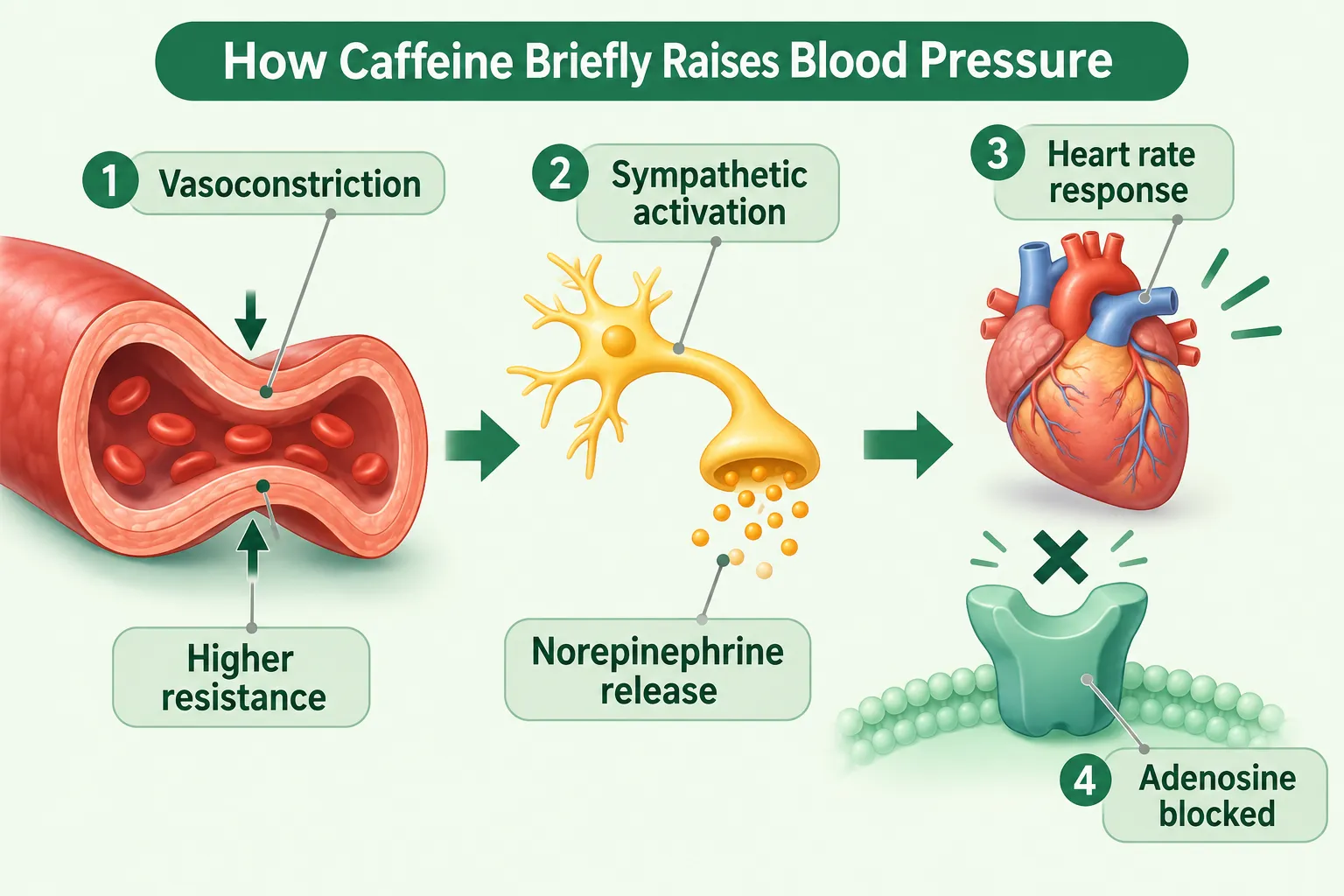
Mostly caffeine, but not entirely. Caffeine drives the effect through sympathetic activation: it can increase norepinephrine, raise vascular resistance, and increase sympathetic nerve activity, producing short-lived vasoconstriction and a higher reading .
The complication is that decaffeinated coffee has also raised blood pressure in some non-habitual drinkers, which suggests other compounds in coffee occasionally contribute . Coffee carries chlorogenic acids, diterpenes like cafestol and kahweol (largely trapped by a paper filter), potassium, and polyphenols. Some of those are associated with favourable effects on vascular function. The net result is not a single-ingredient story, which is why asking "does coffee raise blood pressure" is harder than asking what caffeine alone does.
Worth separating from this topic: hydration. Coffee's diuretic reputation is weaker than most people assume, and we covered the evidence in what the research says about coffee and dehydration.
Can you still drink coffee if you have high blood pressure?
That is a question for the clinician who manages your treatment, and this article does not replace that conversation. If you have diagnosed hypertension, are on blood pressure medication, or have a known arrhythmia, ask your doctor about your caffeine intake before changing it either direction.
What the published guidance says, in general terms:
- The AHA's 2026 statement treats up to 400 mg of caffeine daily as generally safe for most adults, while stressing individual variation by age, medication, disease, genetics, and metabolism .
- Caffeine was excluded from the AHA's 2026 dietary guidance precisely because the evidence was not strong enough for one universal number .
- Higher caffeine doses, especially from concentrated products, were associated with increased blood pressure and abnormal heart rhythms .
People often ask specifically about black coffee high blood pressure concerns, as though milk and sugar were the variable. For pressure, the caffeine dose and your own sensitivity matter more than whether you take it black. For overall cardiometabolic load, the syrup pumps matter plenty, which is the subject of our guide to making your coffee order healthier.
Does decaf coffee raise blood pressure?
Usually less, and often not at all in habitual drinkers, but decaf is not a guaranteed zero. Decaffeinated coffee has produced measurable rises in some non-habitual drinkers in the literature Grassi reviewed .
Two practical points:
- Decaf still contains caffeine. Trace amounts, not none. We broke down the actual milligrams in how much caffeine is really in decaf coffee.
- Quality has improved. Swiss Water and CO2 processes have made decaf worth drinking rather than merely tolerating. If you are switching for sleep or sensitivity reasons, start with our roundup of the best decaf coffee options.
Does dark roast vs light roast coffee affect blood pressure differently?
There is no good evidence that roast level meaningfully changes coffee's effect on blood pressure. Roast does change caffeine content slightly by weight versus by volume, and it changes chlorogenic acid levels, but no study in the sources reviewed here measured a blood pressure difference between roast degrees.
What actually moves your dose:
| Variable | Effect on caffeine per cup |
|---|---|
| Brew ratio | Strongest lever. More coffee per litre, more caffeine. |
| Grind size | Finer grind, faster extraction, slightly more caffeine. |
| Serving size | A 16 oz cup carries roughly double an 8 oz cup. |
| Roast level | Minor. Dark beans weigh less, so scoop-measuring shifts dose slightly. |
If you want to control your dose, control the brew. Weighing beans with a scale beats guessing, and our pour over coffee ratio guide explains how a consistent ratio keeps both flavour and caffeine predictable.
Do other caffeinated drinks raise blood pressure as much as coffee?
Not equally. The dose and the concentration differ, and the AHA's 2026 statement singles out energy drinks and energy shots as a separate category from ordinary coffee.
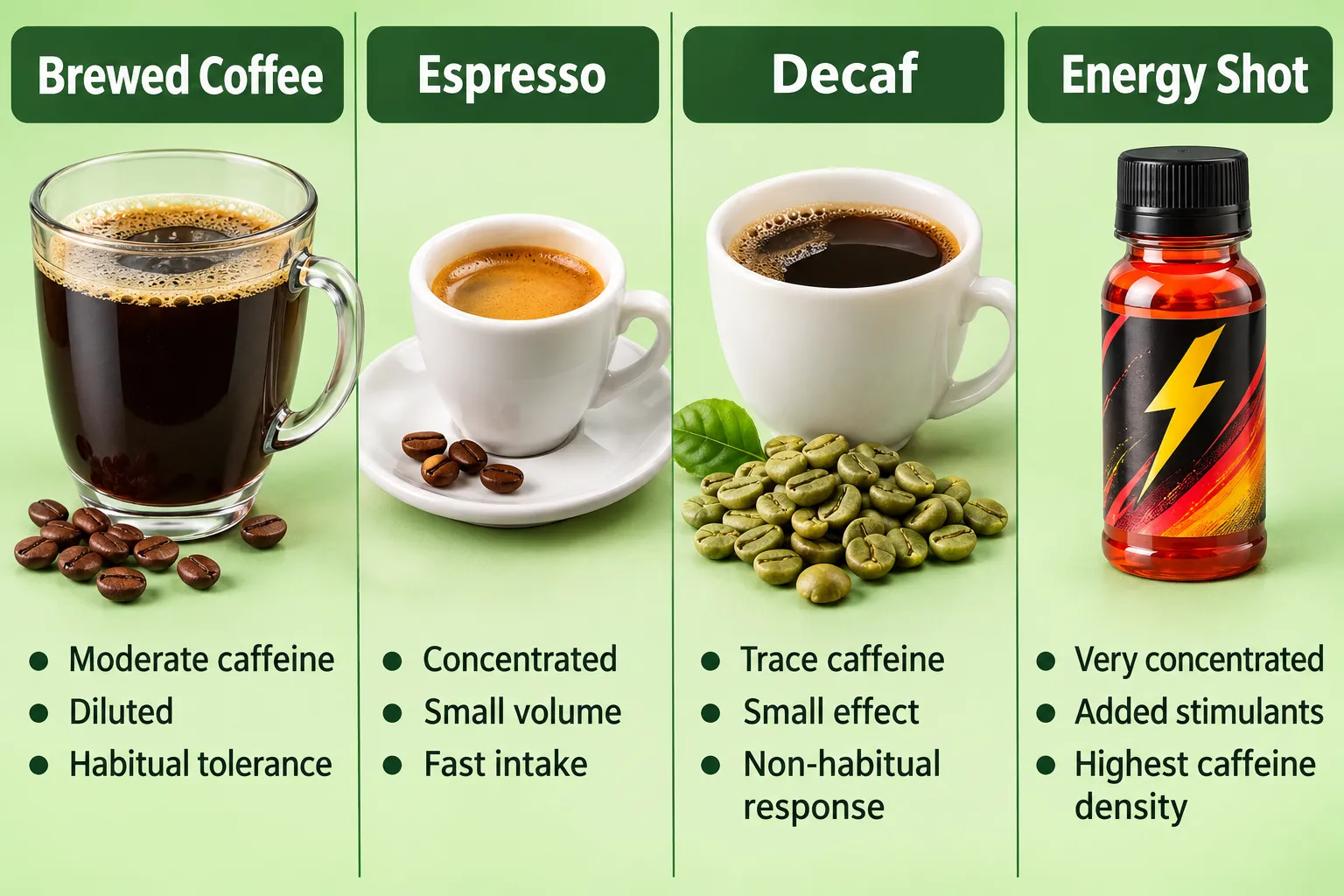
Energy-shot products may contain roughly 40 to 69 mg of caffeine per fluid ounce, about three to four times the concentration of regular brewed coffee, and higher caffeine doses in that range were associated with raised blood pressure and abnormal rhythms .
| Drink | Typical caffeine | Concentration | What to watch |
|---|---|---|---|
| Brewed coffee, 8 oz | ~95 mg | Low, diluted | Cup size creep at cafés |
| Espresso, single | ~63 mg | High per ounce | Doubles and triples add up fast |
| Cold brew | Varies widely | Depends on dilution | Concentrate served undiluted |
| Decaf coffee | Trace | Very low | Not caffeine-free |
| Energy shot | High per bottle | ~40 to 69 mg per fl oz | AHA flags BP and rhythm effects |
Cold brew deserves a note. Undiluted concentrate can carry far more caffeine than the same volume of drip. If you brew it at home, dilute to the recipe rather than by eye. Our guide to making cold brew at home covers the ratios.
Is it safe to drink coffee before a blood pressure test?
Safe, yes. Accurate, no. Caffeine within the previous 2 to 4 hours can sit your reading several mmHg above your true resting pressure, because the pressor effect peaks at 60 to 90 minutes .
Practical checklist before a reading:
- No caffeinated coffee, tea, energy drink, or cola for at least 3 hours.
- No nicotine for 30 minutes.
- Sit quietly for 5 minutes with your back supported and feet flat.
- Arm supported at heart level, cuff on bare skin.
- Note on your log whether you had coffee, and when. Your clinician can interpret it.
Common mistake: skipping coffee entirely on test day after years of daily drinking. Caffeine withdrawal brings its own headache and irritability, which is not the resting state you want to measure either. A consistent routine beats a dramatic one.
What are good coffee alternatives if you have hypertension?
If your clinician has asked you to cut caffeine, the realistic swaps keep the ritual and drop the dose. None of these treat high blood pressure, and none should replace medical advice.
- Good decaf, brewed properly. Same cup, same routine, trace caffeine.
- Half-caf. Blend decaf and regular beans to taper rather than quit.
- Herbal infusions. Rooibos, chamomile, peppermint. No caffeine, different flavour entirely.
- A smaller cup of the real thing. A 4 oz serving of excellent coffee at a controlled brew ratio can satisfy more than 16 oz of mediocre coffee.
If you are cutting back, brewing better matters more, not less. Fewer cups should be better cups, which usually means fresher beans, a decent burr grinder, and a stable water temperature. Start with how to make coffee taste better.
The misconception this article corrects
The common belief is that because coffee raises blood pressure in the hour after you drink it, daily coffee must therefore raise your long-term hypertension risk. That inference does not hold.
The acute spike is real and measurable. The chronic effect is where the evidence runs the other way: PAMELA found no higher clinic, home, or ambulatory pressure in habitual drinkers and no excess new hypertension over a decade . A transient physiological response and a permanent change in resting pressure are different outcomes with different evidence bases.
So when someone asks "does coffee raise blood pressure," the useful reply names which window they mean. Two hours, or twenty years.
The honest caveat: observational cohorts cannot establish causation, Palatini's 2026 position that susceptible subgroups may face real risk remains on the table , and the AHA deliberately declined to issue a universal caffeine recommendation . Three cheerful studies do not close a question.
Caffeine and systolic blood pressure: the first 4 hours
Illustrative curve for a single 80 to 300 mg caffeine dose in a non-habitual drinker. Source: Nutrition Research Reviews critical review.
Averages only. Individual response varies with genetics, metabolism, medication, age and habitual intake. Not medical advice.
FAQ

Conclusion: what this means for your daily cup
Coffee gives you a short pressure bump and no demonstrated long-term penalty for most adults. The 3 to 8 mmHg systolic rise is real, it starts near 30 minutes, peaks at an hour and a half, and is gone by mid-morning . The decade-scale data from PAMELA found habitual drinkers no worse off, and in clinic readings marginally better . The AHA's 400 mg figure gives you a sensible ceiling without pretending one number fits every body .
If you have diagnosed hypertension or take medication for it, that conversation belongs with your doctor, not with a blog post or a bag of beans.
Your next step: before your next home reading, note the time of your last cup. Take one reading 90 minutes after coffee and one at least 3 hours after. The gap between them is your personal caffeine response, and it is more useful than any population average. Then go make a better cup. Better Coffee Starts With Better Answers.