
Does Coffee Dehydrate You? What the Research Actually Says
Quick Answer: Coffee does not dehydrate you at the amounts most people drink. Mayo Clinic, Cleveland Clinic, and a 2014 study published in PLOS ONE all found that coffee contributes to daily fluid intake in roughly the same way water does. The diuretic effect people fear only shows up at high single doses, generally above 500 milligrams of caffeine, which is more coffee than most drinkers finish in one sitting.
Key Takeaways
- Does coffee dehydrate you? Not at normal intakes. Research supports coffee counting toward daily fluid needs.
- Coffee is a mild diuretic, but a diuretic effect and dehydration are not automatically the same outcome.
- The FDA's general caffeine guidance for healthy adults sits near 400 milligrams a day, about four 8-ounce cups of brewed coffee.
- A measurable diuretic effect tends to appear around 500 milligrams of caffeine in a single sitting, roughly 4 to 5 cups back to back.
- Decaf coffee carries very little caffeine, so it is not a meaningful diuretic at normal serving sizes.
- Black coffee, coffee with milk, iced coffee, and espresso shots all count toward your fluid total for the day.
- Habitual coffee drinkers build tolerance to caffeine's mild diuretic effect faster than occasional drinkers.
- People with certain heart conditions, pregnancy, or caffeine sensitivity should still track total caffeine, separate from hydration.
Does Coffee Dehydrate You? The Short Answer From the Research
Does coffee dehydrate you at the amount a typical American drinks in a day? Current research says no. Cleveland Clinic notes that a normal cup of coffee does not pull more fluid out of the body than it puts in, because the water in the cup outweighs caffeine's mild diuretic pull.
This is not a fringe opinion. Mayo Clinic updated its guidance on caffeinated drinks to state plainly that coffee and tea help meet daily fluid needs rather than working against them. That update matters because for years, coffee sat on "avoid if you want to stay hydrated" lists in casual health advice, often without a study behind the claim.
The short version: does coffee dehydrate you? Only in specific, high-dose situations covered later in this piece. For the cup you drink at breakfast, the honest answer is no.
Is Coffee a Diuretic? The Mechanism Behind the Coffee Dehydration Myth
Coffee is a mild diuretic, meaning it can increase how much urine your body produces. But being a diuretic is not the same thing as being dehydrating, and mixing up those two terms is where the coffee dehydration myth comes from.
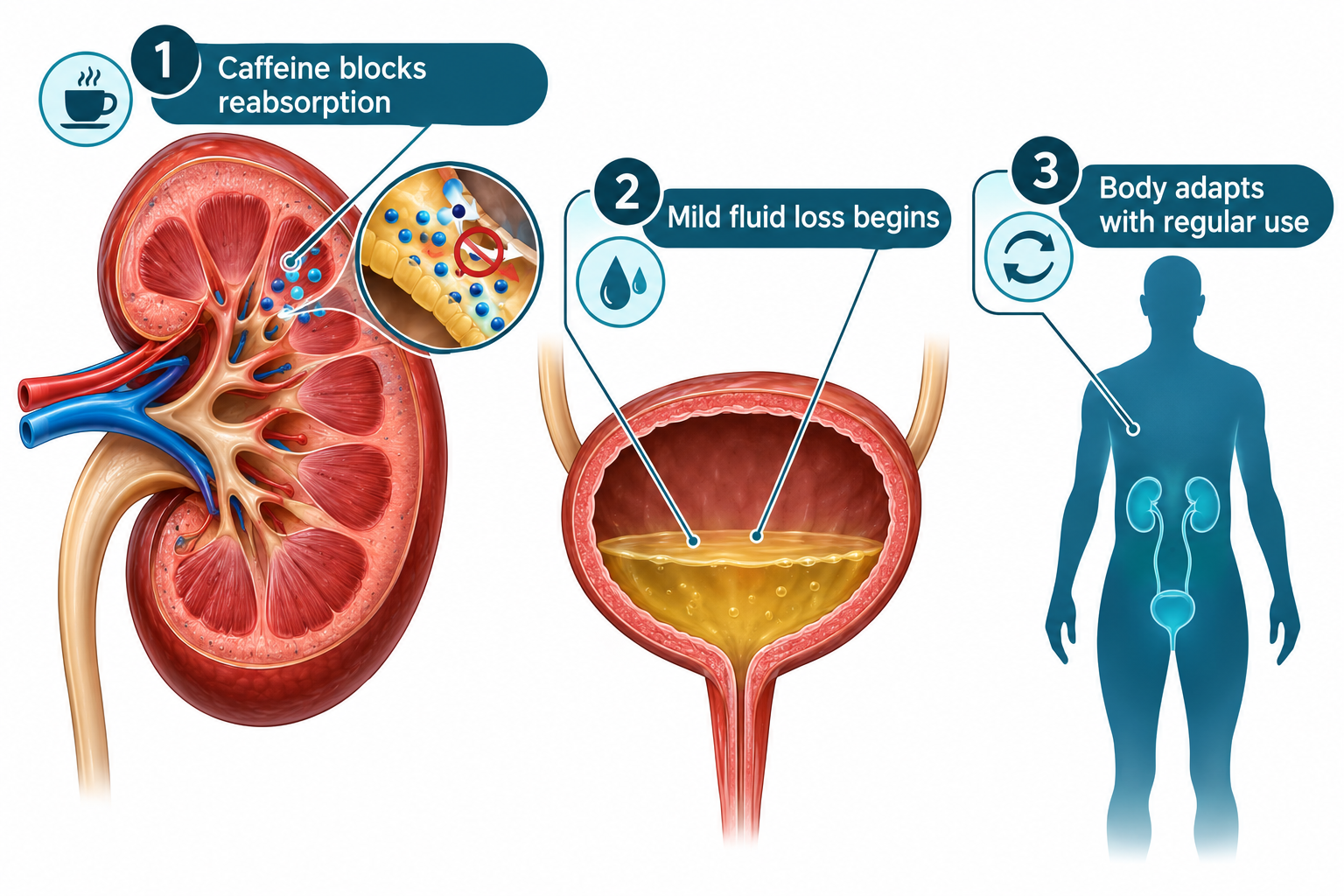
Caffeine works on the kidneys by blocking a hormone called adenosine, which normally tells the kidneys to hold onto sodium and water. With adenosine blocked, the kidneys release a bit more fluid into urine. That is the diuretic mechanism, confirmed by nutrition researchers at eatrightpro and echoed in Cleveland Clinic's explanation of the process.
Does caffeine dehydrate you or is that a myth?
Caffeine alone does not dehydrate you at typical intakes. The diuretic effect is real but small, and the fluid in your cup replaces what gets flushed out, so the net hydration effect stays close to neutral.
Why do people think coffee is dehydrating
The coffee dehydration myth spread for a simple reason: caffeine's diuretic action is well documented, and it got flattened into "coffee dehydrates you" without the dose detail. A 2026 explainer from The Star's fact-check column traced this exact confusion, noting that older advice conflated a mild diuretic effect with actual water loss. Once a claim like that repeats in enough casual health articles, it starts sounding like settled science even when the newer research disagrees.
How Much Coffee Can You Drink Before It Dehydrates You
You would need to drink well beyond a normal daily habit before coffee starts working against your hydration. A July 2026 expert review found the diuretic effect becomes noticeable around 500 milligrams of caffeine in one sitting, which works out to roughly 4 to 5 cups of brewed coffee consumed close together.
For context, the daily caffeine limit recommended by the FDA for healthy adults sits near 400 milligrams a day, about four 8-ounce cups of coffee spaced through the day. Staying under that limit keeps you well below the dose where researchers start seeing a real diuretic signal.
Decision rule: if you are drinking 1 to 3 cups of coffee spread across a normal day, hydration is not something to worry about. If you are downing 5 or more cups back to back, especially in a short window, that is when the math changes.
Can you drink too much coffee and get dehydrated?
Yes, but it takes a lot more than a normal habit. Sports and heat-exposure research shows that up to about 300 milligrams of caffeine a day has no meaningful effect on fluid balance, even during exercise. Dehydration risk from coffee shows up mainly in single large-dose situations, like drinking several strong cups back to back on an empty stomach, not from a routine morning cup.
Does Coffee Count Toward Your Daily Water Intake?
Yes. Authoritative nutrition bodies including the British Nutrition Foundation state that tea and coffee count toward daily fluid intake targets, not against them. This directly answers a common follow-up question: does coffee hydrate you, or does it just feel like it does?
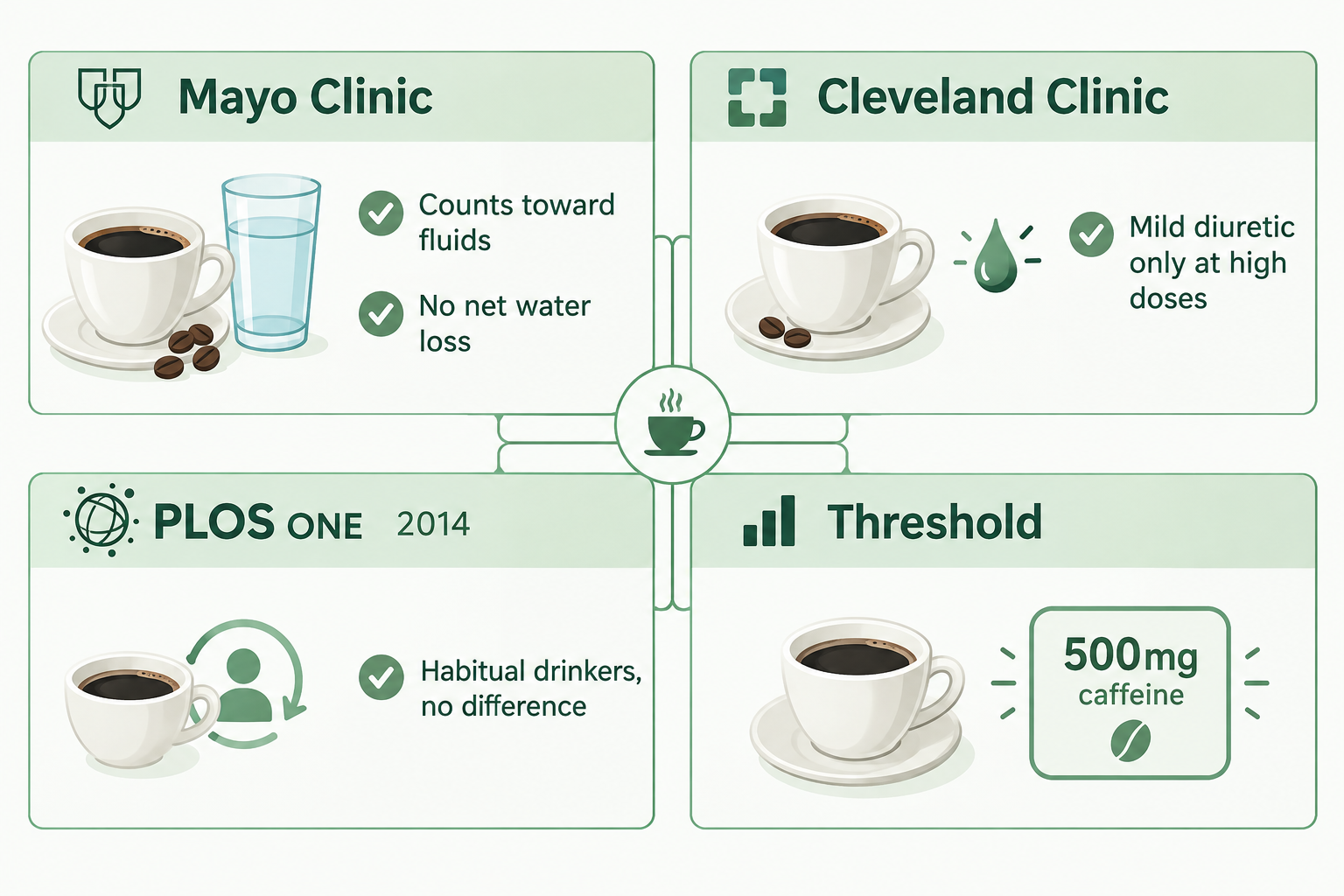
Coffee is roughly 98 percent water by volume. Even with its mild diuretic pull, the fluid volume you take in outweighs the extra fluid your kidneys release. Mayo Clinic's updated position reflects this same math: caffeinated drinks help you meet fluid needs rather than creating a deficit.
Common mistake: treating coffee as a "negative" toward a hydration goal, then adding extra water to compensate. You do not need to drink a matching glass of water for every cup of coffee just to break even.
Coffee vs Water for Hydration: What Changes the Outcome
Plain water hydrates with nothing else attached. Coffee hydrates with caffeine, plant compounds, and heat or cold layered on top, but the core fluid contribution is similar for most drinkers.
Controlled research comparing coffee and water intake in 2024 and 2025 found similar hydration markers between the two, measured through urine concentration and body water tracking in study participants. The practical difference shows up in edge cases: very high caffeine doses, people with low caffeine tolerance, or situations involving heavy sweating without any fluid replacement.
| Factor | Water | Black coffee (8 oz, brewed) |
|---|---|---|
| Fluid contribution | Full | Nearly full, mild diuretic offset |
| Caffeine | None | ~95 mg |
| Diuretic effect | None | Mild, more noticeable above 500 mg total |
| Counts toward daily fluid goal | Yes | Yes, per Mayo Clinic and UK nutrition guidance |
Does Decaf Coffee Dehydrate You Like Regular Coffee?
No. Does decaf coffee dehydrate you the way regular coffee supposedly does? It does not, because decaf carries only a small fraction of the caffeine in regular coffee, usually under 5 milligrams per cup compared to roughly 95 milligrams in a regular brewed cup.
Is decaf coffee a diuretic? Not in any way that matters at normal serving sizes. Since the diuretic mechanism depends on caffeine blocking adenosine in the kidneys, and decaf barely contains caffeine, there is nothing meaningful left to trigger that response. If you are choosing between regular and decaf purely on hydration grounds, that choice will not move the needle either way.
Does Black Coffee Dehydrate You More Than Coffee With Milk?
No, adding milk, cream, or sugar does not change coffee's hydration effect in any measurable way. The diuretic action comes from caffeine, not from what you stir into the cup.
Does adding cream or sugar to coffee affect its dehydrating effects? Milk actually adds a small amount of extra fluid and a bit of protein and fat, which can slow how quickly the stomach empties. That has nothing to do with dehydration risk, but it does mean a milky latte and a plain black coffee land in roughly the same place on the hydration question, once you account for the caffeine dose in each.
Is Coffee Dehydrating If You're Already Drinking Enough Water?
No, adding coffee on top of adequate water intake does not push you into a fluid deficit. The two sources add up rather than cancel each other out, based on the same hydration research already cited.

If you already meet your daily fluid target through water, juice, or other drinks, your usual coffee habit sits on top of that baseline without undoing it. The exception is the same one that applies everywhere in this article: extreme caffeine intake, well above 400 to 500 milligrams in a short window, can start working against you regardless of how much water you drank earlier.
What Does the Research Say About Coffee and Hydration?
The clearest research points in one direction: moderate coffee intake does not dehydrate healthy adults. A 2014 study published in PLOS ONE followed habitual coffee drinkers through a controlled cross-over design comparing coffee days to water-only days, and found no meaningful difference in hydration status between the two conditions.
That finding lines up with more recent reviews. A 2024 caffeine misconception review concluded that typical caffeine doses do not increase urine volume enough to cause a fluid deficit. Cleveland Clinic's patient-facing explanation reaches the same conclusion in plainer language, stating that moderate coffee drinking does not cause dehydration for most people.
One limitation worth naming: most of this research studies habitual coffee drinkers, people whose bodies have adjusted to a regular caffeine intake. Someone who rarely drinks caffeine and suddenly has a large dose may notice a stronger diuretic response than the long-term averages suggest.
Does Iced Coffee Dehydrate You Differently Than Hot Coffee?
No, temperature does not change coffee's hydration effect. Whether the coffee is hot, cold-brewed, or poured over ice, the caffeine dose and fluid volume are what matter, not the serving temperature.
Iced coffee and cold brew often carry more fluid volume per serving because of melting ice or a longer glass, and cold brew sometimes has a slightly higher caffeine concentration depending on the brewing method used. Neither of those facts changes the underlying mechanism: caffeine's mild diuretic pull, offset by the water already in the drink.
Can Coffee Actually Help You Stay Hydrated?
Yes, in the sense that it adds real fluid volume to your day, the same way any other water-based drink does. Coffee is not a hydration boost beyond what its water content provides, but it is not a hydration drain either.
If you struggle to drink plain water but enjoy a few cups of coffee a day, that habit is doing real work toward your fluid needs rather than working against them. Readers curious about the wider health picture, beyond hydration alone, can look at what happens to your body when you drink coffee and the broader benefits of coffee for more context.
Does Espresso Dehydrate You?
No, espresso does not dehydrate you differently than drip coffee once you account for dose. A single 1-ounce espresso shot contains roughly 63 milligrams of caffeine, less than a full cup of drip coffee, even though it tastes stronger.
Because espresso is served in a small volume, someone drinking several shots in a row can reach a meaningful caffeine dose faster than someone sipping a large drip coffee slowly. The hydration risk still traces back to total caffeine, not the brewing method. For a closer look at how espresso and drip coffee compare beyond hydration, see is it better to drink espresso or coffee.
Who Should Avoid Drinking a Lot of Coffee for Hydration Reasons?
Most healthy adults do not need to limit coffee for hydration reasons specifically. A few groups should still pay closer attention to total caffeine, even though hydration is rarely the main concern:
- People with certain heart arrhythmias, since high caffeine intake can affect heart rhythm independent of hydration.
- Pregnant individuals, who are often advised to keep caffeine under 200 milligrams a day for reasons unrelated to fluid balance.
- People new to caffeine, since a body without built-up tolerance may notice a stronger diuretic response at doses a habitual drinker would barely register.
- Anyone training or working in heat who is also drinking large amounts of coffee instead of water, since coffee alone will not replace electrolytes lost through heavy sweating.
If any of these apply to you, the conversation is really about total caffeine intake, and reading how long it takes to detox from coffee or whether coffee once a week is a reasonable habit can help set a personal limit.
Practical Steps to Stay Hydrated as a Coffee Drinker
You do not need a complicated system. A few habits keep hydration simple even for a multi-cup coffee day:
- Track total caffeine, not cups. A large latte and a small espresso are not equal. Aim to stay under the daily caffeine limit of roughly 400 milligrams.
- Space out large doses. Spreading 4 cups across a workday causes a very different response than drinking all 4 within an hour.
- Drink water with meals, not as a coffee "penalty." You do not owe your body a matching glass of water for every cup of coffee.
- Watch new caffeine habits closely. If you just started drinking coffee regularly, give your body a week or two before assuming your usual amount is fine.
- Choose decaf later in a heavy caffeine day if you want the ritual without adding to your total caffeine count.
For readers building a better daily setup around coffee, our guides on what type of coffee bean is healthiest and is coffee actually healthy for you go beyond hydration into the wider health picture.
Coffee and Hydration at a Glance
FAQ: Does Coffee Dehydrate You?
Does coffee dehydrate you if you drink it every day? No, daily coffee drinking does not cause dehydration in healthy adults at normal amounts. Habitual drinkers also build tolerance to caffeine's mild diuretic effect over time.
Is coffee a diuretic or a hydrating drink? Both, in a limited sense. Coffee has a mild diuretic effect from caffeine, but its water content offsets that effect, so it still counts toward daily fluid intake.
Does coffee hydrate you the same as water? Close to it. Studies comparing coffee and water intake found similar hydration markers in healthy adults drinking moderate amounts.
Does decaf coffee dehydrate you at all? Barely, since decaf carries very little caffeine. Is decaf coffee a diuretic in any meaningful way? Not at normal serving sizes.
Does espresso dehydrate you more than drip coffee? No. Espresso has less caffeine per shot than a full cup of drip coffee, so the hydration effect depends on total caffeine consumed, not the brewing method.
What is the daily caffeine limit for avoiding any diuretic effect? The FDA's general guidance for healthy adults sits near 400 milligrams a day. A noticeable diuretic effect tends to show up closer to 500 milligrams in one sitting.
Conclusion
Does coffee dehydrate you? At the amounts most people drink, the research says no. Mayo Clinic, Cleveland Clinic, and a 2014 study in PLOS ONE all point to the same conclusion: coffee counts toward your fluid intake, and its mild diuretic effect only becomes a real concern well above a normal daily habit.
The practical takeaway is simple. Keep your total caffeine under roughly 400 milligrams a day, notice how your own body responds if you are new to caffeine, and stop treating your morning cup as something you need to "make up for" with extra water. Your coffee is already doing some of that work for you.
Better Coffee Starts With Better Answers. If you want to build a better setup around your daily cup, our guides on how do I know what coffee beans to buy and what coffee is best for beginners are a good next stop.
Keep Exploring Coffee Rank IQ
- Coffee Rank IQ home: reviews, brewing guides, and coffee science
- Does Decaf Coffee Have Caffeine? The Real Milligrams
- Best Decaf Coffee That Still Tastes Like Coffee
- Drip Coffee vs Espresso: Caffeine, Flavor, and the Real Difference
- Used Coffee Grounds: Which Plants Love Them…and Which Don't
References
- www.mayoclinic.org/healthy-lifestyle/nutrition-and-healthy-eating/expert-answers/caffeinated-drinks/faq-20057965
- health.clevelandclinic.org/coffee-dehydration
- www.nutrition.org.uk/nutritional-information/hydration
- www.thestar.com.my/news/true-or-not/2026/02/05/quickcheck-can-coffee-dehydrate-you
- pmc.ncbi.nlm.nih.gov/articles/PMC12348139
- www.healthline.com/nutrition/does-coffee-dehydrate-you
- www.cnatra.navy.mil/tw6/assets/docs/safety/caffeine-usage.pdf
- www.coffeeandhealth.org/health/media-content/information-campaign/debunking-coffee-myths-the-truth-behind-your-brew
- www.eatrightpro.org/news-center/practice-trends/is-caffeine-considered-a-diuretic
- pmc.ncbi.nlm.nih.gov/articles/PMC10930107