Caffeine Headache: Why Coffee Causes and Cures One
Quick Answer
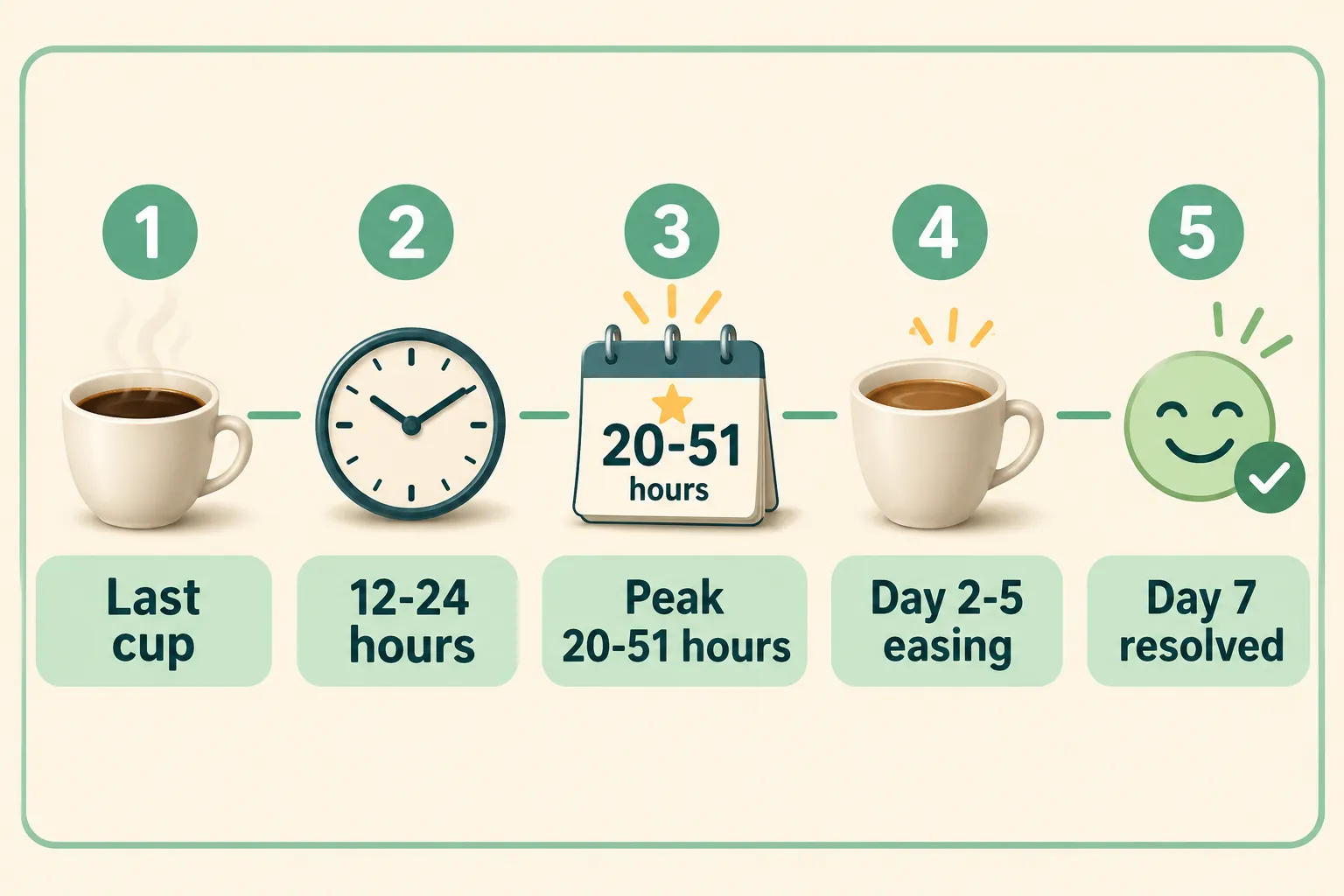
A caffeine headache is usually a withdrawal headache: it starts about 12 to 24 hours after your last dose, peaks around 20 to 51 hours, and clears within a week . Caffeine narrows blood vessels in the brain, so when it leaves, those vessels widen and the ache arrives. The same molecule sits in Excedrin-class pain tablets at roughly 65 mg per dose, which is why coffee can both cause and relieve head pain. Tapering by about 25% a week beats quitting cold turkey.
Caffeine Headache
A caffeine headache is head pain triggered either by stopping regular caffeine or, less often, by a large spike in intake. The International Classification of Headache Disorders, third edition (ICHD-3), describes caffeine-withdrawal headache in people consuming more than 200 mg per day for over two weeks, beginning within roughly 24 hours of cessation and resolving within seven days of abstinence, or within about one hour of taking at least 100 mg of caffeine .
Key takeaways
- A May 2026 randomized case-crossover analysis of the CRAVE trial (NCT03671759) found headaches on 10% of caffeinated-coffee days versus 30% of abstinence days, roughly twice the risk after adjustment.
- In that same analysis, 76% of regular coffee drinkers reported a headache on at least one study day.
- Symptoms commonly begin 12 to 24 hours after cutting back and peak at 20 to 51 hours, per StatPearls clinical guidance updated September 14, 2026 .
- ICHD-3 applies the withdrawal label at intakes above 200 mg/day sustained for more than two weeks .
- A small rescue dose of 50 to 100 mg caffeine can end withdrawal symptoms quickly, but it also keeps dependence going .
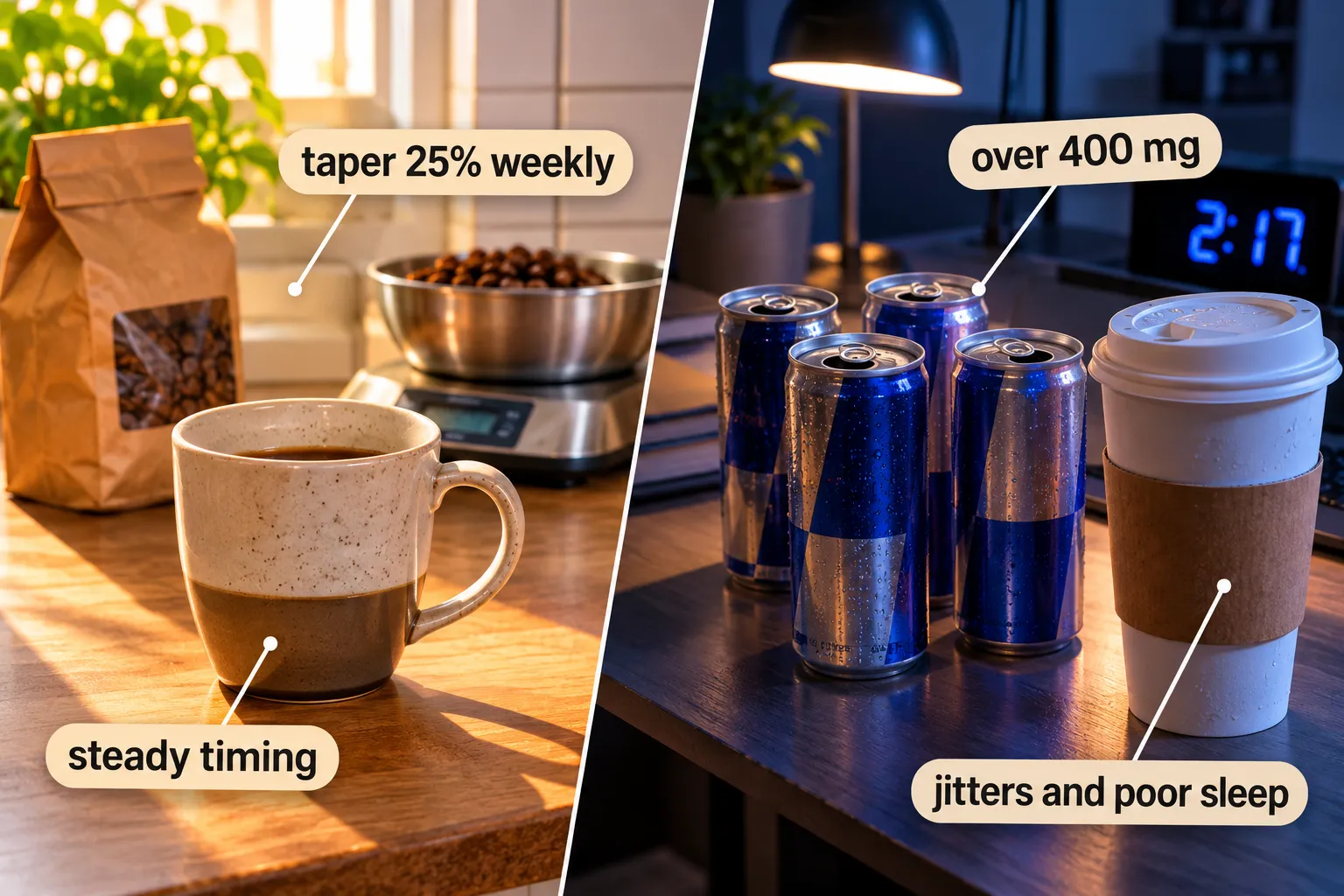
- The American Migraine Foundation suggests people with episodic migraine cap intake near 200 mg/day and taper by about 25% per week.
- Combination pain relievers containing caffeine taken on 10 or more days per month raise the risk of medication-overuse headache.
The misconception worth correcting: most people assume coffee gives them headaches. For habitual drinkers, the evidence points the other direction. Missing the usual dose is the more common trigger.
What causes caffeine headaches?
Caffeine blocks adenosine receptors in the brain, and adenosine is a signalling molecule that widens blood vessels. With caffeine on board, cerebral blood vessels constrict slightly. Remove the caffeine after weeks of daily use and the receptors, now more numerous, respond strongly: vessels widen, blood flow rises, and pain follows .
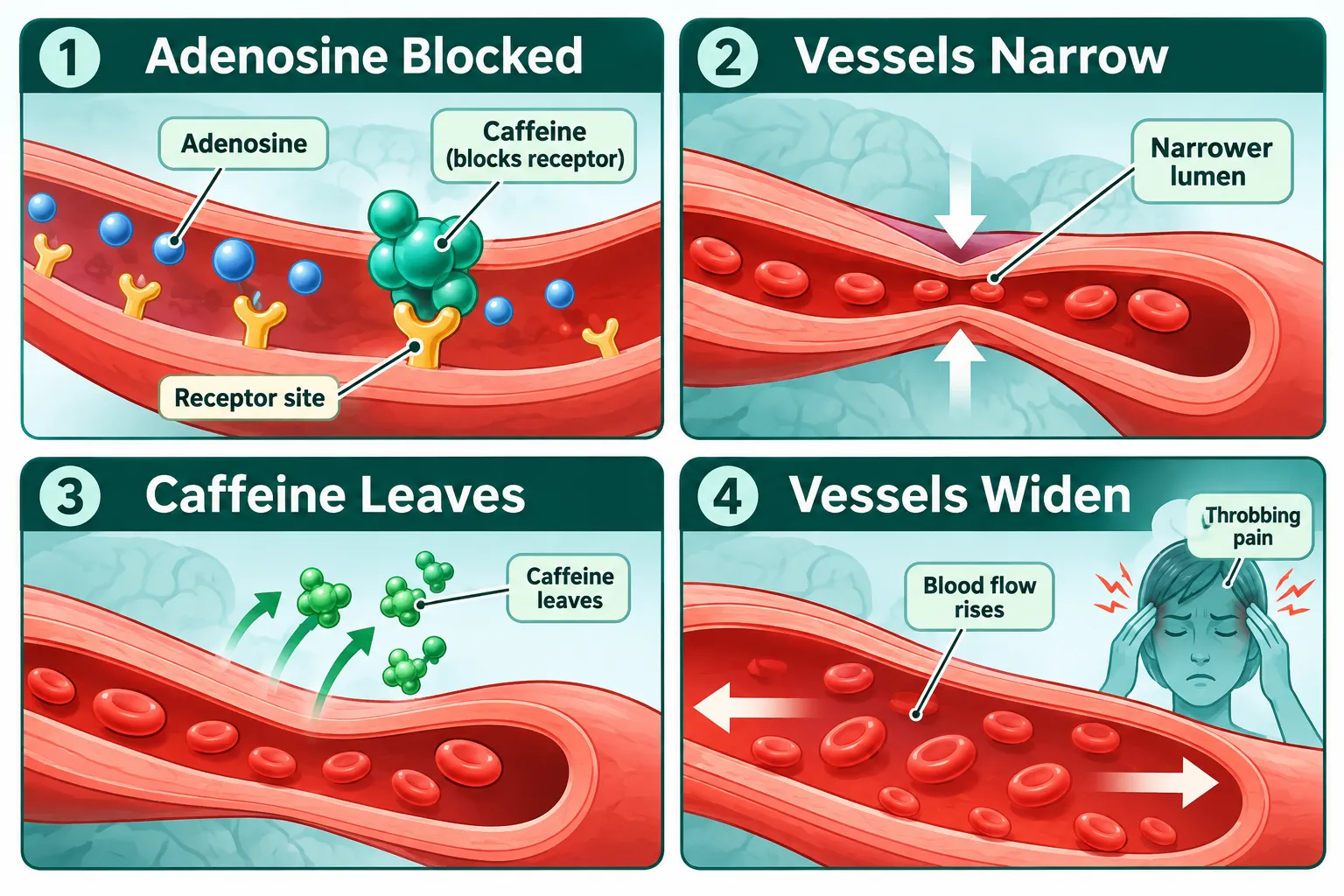
Two separate mechanisms are at work, and they explain the whole confusing picture.
- Withdrawal. The dominant cause. Your brain adapted to a daily dose and then did not get it.
- Acute overload. Very large single doses, or poor sleep driven by late caffeine, can set off head pain in sensitive people.
A systematic review published in BMC Neurology on May 19, 2026, synthesizing 19 studies, concluded that acute excessive intake and abrupt withdrawal were the patterns most consistently associated with migraine risk, while habitual moderate use was not consistently linked to a heavier average migraine burden. That review pooled heterogeneous observational studies, so it shows association rather than cause. The same review flagged a possible dose inflection near 97.5 mg/day in one included analysis, below which migraine risk rose about 0.38% per extra milligram. Treat that number as exploratory, not a clinical threshold.
Edge case: decaf. Why does decaf give me a headache? Usually because it is not caffeine-free. An 8 oz cup typically carries a few milligrams, far below a regular cup, so swapping straight to decaf still produces a withdrawal gap. Our breakdown of how many milligrams are actually in decaf coffee has the numbers.
How long do caffeine withdrawal headaches last?
Most caffeine withdrawal headaches resolve within two to nine days, with the worst of it between 20 and 51 hours after the last dose . ICHD-3 frames resolution at seven days of continued abstinence .
| Stage | Timing after last dose | What people typically report |
|---|---|---|
| Onset | 12 to 24 hours | Dull frontal pressure, low mood, trouble concentrating |
| Peak | 20 to 51 hours | Throbbing headache, fatigue, irritability |
| Easing | Days 3 to 5 | Shorter, milder episodes |
| Resolution | Within 7 to 9 days | Headache gone; sleep and alertness normalizing |
So how long does caffeine withdrawal last overall? The headache is the short part. Fatigue and low mood can linger a little past the week in heavy users. For the fuller symptom picture across a full reset, read our coffee detox timeline.
How do I get rid of a caffeine headache fast?
The fastest documented relief is a small caffeine dose: roughly 50 to 100 mg, which ICHD-3 associates with resolution within about an hour . That is half a standard cup of drip coffee. The trade-off is obvious. It works, and it keeps the dependence intact.
Practical order of operations when a caffeine headache hits:
- Drink water. Hydration and rest are the first-line management recommended in clinical guidance .
- Decide your goal. Quitting? Skip the rescue dose and ride it out. Not quitting? Take 50 to 100 mg and get on with your day.
- Consider a simple analgesic if the pain interferes with work (see the section below on what to take).
- Sleep if you can. Withdrawal fatigue amplifies the pain.
- Then fix the pattern, not just today's headache.
Decision rule: choose the small caffeine dose if you need function in the next hour and are not trying to quit. Choose water, food and rest if you are three days into a taper, because another dose resets your clock.
Does drinking more caffeine help caffeine headaches?
For a withdrawal headache, yes, temporarily. For a headache caused by overdoing it, no. That is the uncomfortable symmetry at the center of the question "does coffee help headaches."
Caffeine in headache medicine is well established. It appears in over-the-counter combination tablets, commonly around 65 mg alongside acetaminophen and aspirin in Excedrin-class formulations, partly because of that vessel-narrowing effect and partly because it helps analgesics work. Caffeine is an ingredient in pain relief, not folklore.
The catch is rebound headache coffee territory. The American Migraine Foundation's 2026 medication-overuse material identifies combination pain relievers used on 10 or more days per month as a risk pattern, and notes that more than 200 mg of caffeine daily may worsen medication-overuse headache in some patients. You can treat yourself into a chronic daily headache.
Caffeine is a short-acting fix for a problem caffeine created. Useful once. Expensive as a habit.
Can too much coffee give you a headache?
Yes, though less often than withdrawal does. Large acute doses are the pattern linked to migraine in the 2026 BMC Neurology review, alongside abrupt withdrawal. The route is frequently indirect: caffeine late in the day shortens sleep, and short sleep is a well-known headache trigger.
Signs you're drinking too much caffeine:
- Jitteriness, hand tremor or a racing heart after your usual amount
- Trouble falling asleep, or waking at 3 a.m. reliably
- Stomach upset and reflux
- Needing a second or third cup just to feel normal
- Afternoon crash headaches on days you drink more than usual
The FDA has long cited 400 mg per day as an amount not generally associated with negative effects in healthy adults. Roughly: four 8 oz cups of drip coffee. High-caffeine products move the math fast, which is why we broke down the actual caffeine load in Death Wish Coffee.
In late June 2026, the FDA placed caffeine labeling among its regulatory priorities, reportedly weighing draft guidance on how manufacturers disclose caffeine in packaged foods and drinks. As of November 6, 2026, that remains policy development, not a final rule. It matters because there is still no standardized caffeine figure on every product you buy.
What's the difference between a caffeine headache and a regular headache?
A caffeine headache is defined by timing and by what fixes it. Tension headaches and migraines are not tied to your last cup.
| Feature | Caffeine withdrawal headache | Tension-type headache | Migraine |
|---|---|---|---|
| Timing | 12 to 24 hours after last dose | Any time, often after stress or screen hours | Often with warning signs, lasts 4 to 72 hours |
| Location | Usually both sides, frontal | Band-like pressure around the head | Frequently one-sided, throbbing |
| Relieved by 100 mg caffeine within an hour | Typically yes | Not specifically | Sometimes, variably |
| Other symptoms | Fatigue, low mood, poor focus | Neck and shoulder tightness | Nausea, light and sound sensitivity, aura |
| Pattern clue | Worse on weekends or vacation days | No dietary pattern | Personal triggers vary |
The weekend clue is the useful one. A Monday-to-Friday 300 mg habit plus a lazy Saturday morning produces the classic weekend caffeine headache.
If you have diagnosed migraine, a headache disorder, high blood pressure, a heart condition, or you are pregnant, talk to your doctor before changing caffeine intake. Nothing here replaces that conversation, and the right target for you may be lower than general guidance.
Should I quit caffeine cold turkey or taper off?
Taper. Clinical guidance recommends gradual reduction rather than abrupt cessation, precisely because abrupt cessation is what produces the headache . The American Migraine Foundation suggests cutting intake by about 25% per week.
A workable four-week taper from roughly 400 mg/day:
- Week 1: 300 mg. Replace one cup with half-caf.
- Week 2: 225 mg. Shift your last caffeinated drink earlier.
- Week 3: 165 mg. Swap an afternoon cup for decaf.
- Week 4: 125 mg and hold, or continue down to your target.
Keep the ritual. Many people miss the cup more than the stimulant, and a well-made pour over with half-caf beans keeps the morning intact while the dose falls. Grind size, brew ratio and water temperature all shift extraction, which shifts how much caffeine ends up in the cup, so weigh your dose rather than eyeballing scoops.
Common mistake: tapering the number of cups while increasing cup size. Measure milligrams, not mugs.
Who is more likely to get caffeine headaches?
Daily consumers above 200 mg per day for more than two weeks are the defined risk group under ICHD-3 . Beyond that, a few patterns stand out.
- Irregular drinkers. Weekday-heavy, weekend-light schedules create a withdrawal gap every Saturday.
- People with migraine. The American Migraine Foundation notes wide individual variability: some find a cup helps during an attack, others find caffeine or its absence triggers one.
- Heavy users above 400 mg/day. More receptor adaptation, bigger rebound.
- Fasting or travel. Skipped breakfast plus a time-zone shift delays the usual dose by hours.
- Slow metabolizers. Caffeine clearance varies between people; those who clear it slowly may feel effects longer but still get withdrawal when the pattern breaks.
What can I take for a caffeine headache, and is ibuprofen safe?
Simple analgesics are the standard recommendation alongside hydration and rest . Ibuprofen is a reasonable choice for an occasional caffeine headache in adults who can take NSAIDs, and it carries no caffeine of its own, which avoids feeding the cycle. Follow the label dose and ask a pharmacist or doctor if you have stomach, kidney, heart or bleeding concerns, or take other medications.
Choices and trade-offs:
- Ibuprofen or naproxen: no caffeine, useful for occasional use. Take with food.
- Acetaminophen: no caffeine, gentler on the stomach, daily dose limits matter.
- Caffeine combination tablets (around 65 mg caffeine per dose): effective, and they also deliver the exact substance you may be trying to reduce.
The ceiling to respect: using any combination analgesic on 10 or more days per month is the medication-overuse pattern the American Migraine Foundation warns about. If you are reaching for pills most weeks, that is a doctor conversation, not a dosing question.
How to prevent caffeine headaches from happening
Consistency prevents more caffeine headaches than abstinence does. Harvard Health's August 19, 2026 explainer described caffeine as more likely to help prevent or dull headaches when intake is steady and moderate, commonly approximated as one or two cups a day. Irregular timing is the bigger problem.
A prevention checklist:
- Fix a daily ceiling. 200 mg if you have migraine; under 400 mg otherwise.
- Keep weekends the same as weekdays. Same dose, same hour.
- Weigh your coffee. Our scoops-per-cup chart makes the dose repeatable.
- Stop caffeine at least eight hours before bed.
- Keep a headache diary for four weeks. Log dose, time and symptoms. The American Migraine Foundation recommends this over assuming caffeine is always helpful or always harmful.
- Plan travel doses. Pack instant or a small brewer rather than skipping.
One more detail from that May 2026 CRAVE analysis: the sequence mattered. Headache frequency during abstinence was lower after two preceding coffee days than after one, and severity in one comparison was about 41% lower. Recent intake pattern, not just today's cup, shapes how an abstinence day feels. It was a secondary analysis of a trial designed for a different question, so treat it as suggestive.
Caffeine withdrawal headache timeline calculator
Caffeine taper planner (25% per week)
Reduction rate follows American Migraine Foundation guidance of about 25% per week. 8 oz drip coffee is roughly 95 mg. Educational tool, not medical advice.
FAQ

Conclusion
For a daily drinker, a steady dose at a steady hour prevents more head pain than quitting does. If you want to cut back, do it at about 25% a week and keep the ritual while the milligrams fall. If you want to stay where you are, pick a number under 400 mg, hold it on weekends, and stop caffeine eight hours before bed.
Next step: weigh tomorrow's dose and write it down, then log any headache alongside it for four weeks. That diary will tell you more about your own the rebound ache pattern than any average ever will. Better Coffee Starts With Better Answers.