Coffee Bag Valve: Why It’s There and When Beans Peak
Quick Answer
The coffee bag valve is a one-way plastic vent that lets carbon dioxide escape from freshly roasted beans without letting oxygen back in. Roasted coffee keeps releasing CO2 for days, fastest in the first 24 to 48 hours, which is why a sealed bag without a valve would balloon and eventually split. For taste, most filter coffee drinks well within a few days of the roast date, while espresso usually tastes sweeter and pulls more evenly after 7 to 14 days of rest.
Key Takeaways
- The valve vents gas, not air. The Specialty Coffee Association describes the function plainly: roasted coffee continues releasing CO2, and the valve lets that gas out while keeping oxygen-rich air from returning.
- Degassing is fastest in the first 24 to 48 hours, then slows, with measurable CO2 loss continuing through roughly the first 20 days after roasting, according to SCA-published material on coffee freshness.
- Oxygen is the main staling variable. An SCA literature review on coffee staling cites research where dropping oxygen in a container to 0.5% increased shelf life by as much as 20-fold, and other cited work reporting roughly a 10% faster degradation rate for each 1% rise in oxygen.
- Heat speeds it all up. The same review cites a whole-bean Q10 near 1.5, meaning a 10°C temperature rise multiplies the degassing rate by about 1.5 times.
- There is no universal peak day. Darker and faster roasts generally release more CO2 over time than light roasts, so the rest window shifts with the bean and the brew method.
- Valves are now a recycling issue, not just a freshness one. Packaging suppliers report that under the EU Packaging and Packaging Waste Regulation, the valve, zipper, inks and barrier layer all count toward a pouch's recyclability assessment .
- The valve stops working the moment you open the bag. Every reopening refills the headspace with fresh oxygen.
What does the valve on a coffee bag do?
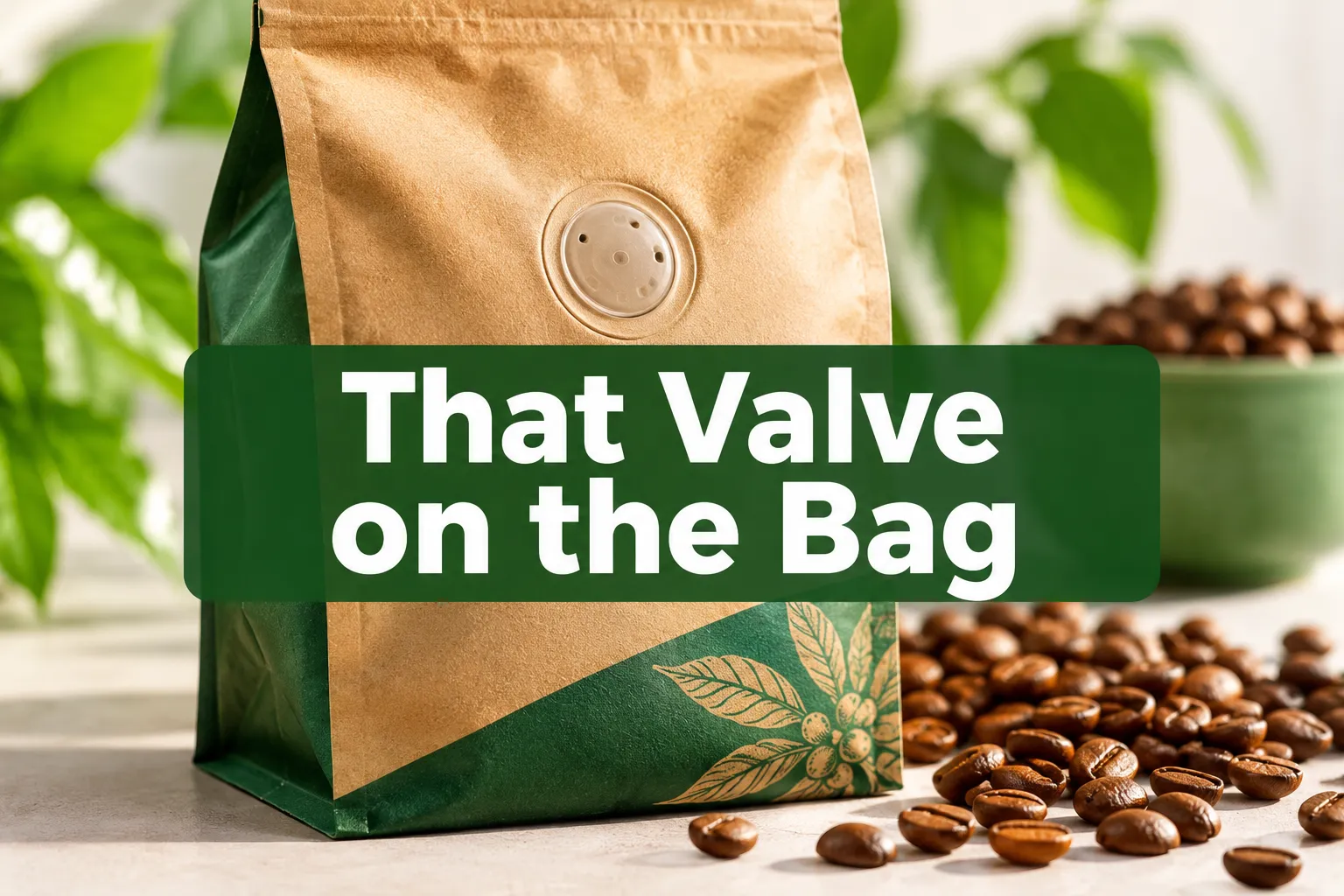
It releases carbon dioxide from one side only. The valve is a small plastic disc, usually mounted on the inside face of the pouch, with a flexible membrane sitting on a film of food-grade silicone oil. When internal pressure builds past a set threshold, the membrane lifts, gas escapes, and the membrane settles back onto the oil seal. Outside air cannot push through in the other direction.
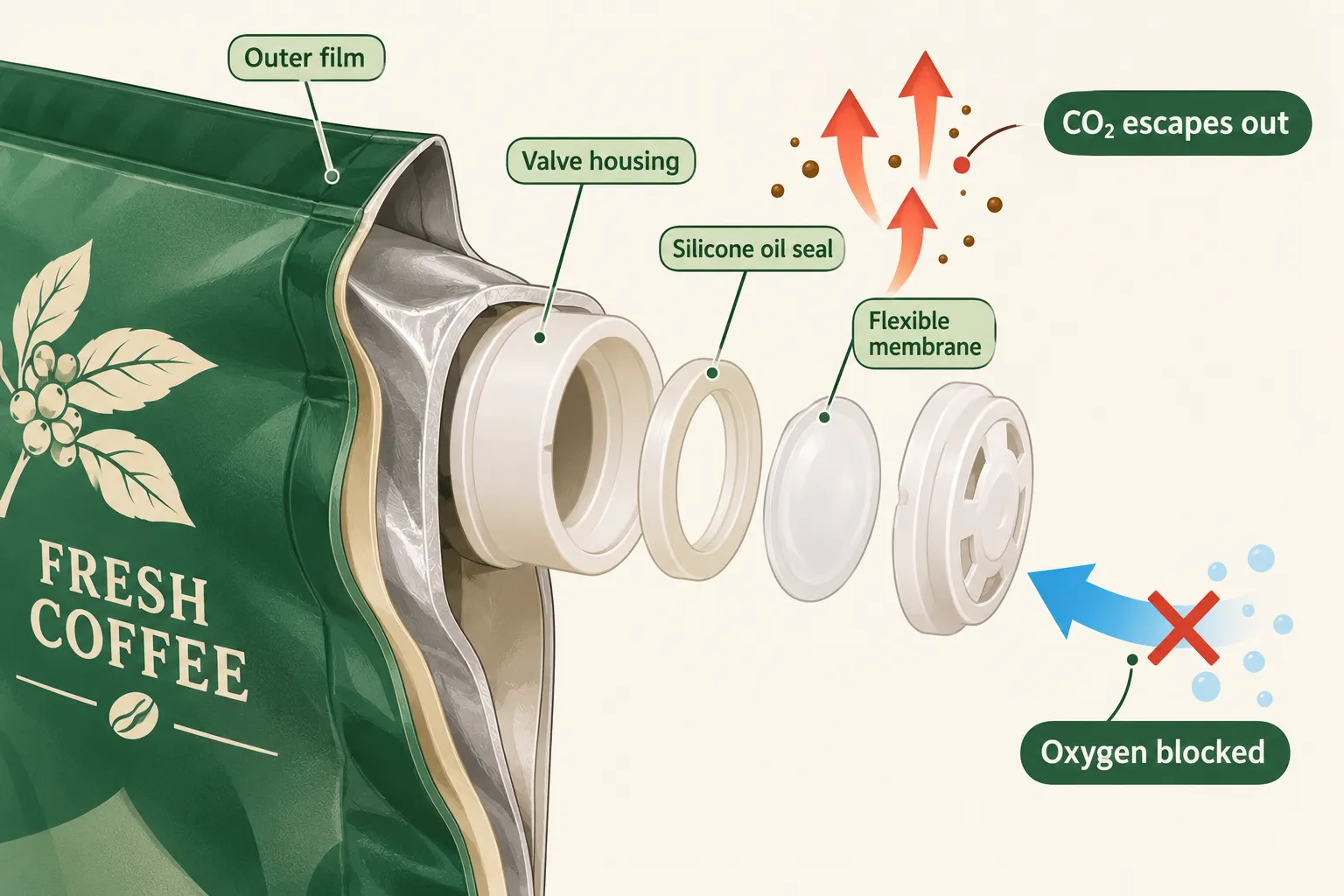
Valve suppliers describe the same basic build: a vent housing, a membrane, and an oil seal, applied to the film during bag production . Some valves are designed to be pressed by the shopper so aroma puffs out at the shelf. That is marketing with a functional base, and it slightly spends the CO2 the beans are holding.
Three things the valve does not do:
- It does not remove the oxygen already sealed into the bag at packing. Roasters handle that with nitrogen flushing or tight headspace control.
- It does not add shelf life after opening.
- It does not fix a bad roast, stale green coffee, or a bag stored on top of a hot espresso machine.
Quick example: a 12 oz bag packed one hour after roasting may vent noticeably for two or three days. A bag of the same coffee packed 48 hours later vents much less, because the loudest part of the degassing already happened in open air.
Coffee bag valve: why it's there and when beans peak
The coffee bag valve exists to solve a packaging problem and a freshness problem at the same time: coffee must be sealed away from oxygen immediately, yet it cannot be sealed hermetically without the package deforming. The peak drinking window that follows depends on roast level and brew method, not on a single magic number.
Here is what the published science supports, and where it stops.
Degassing curve. SCA material on coffee freshness places the fastest CO2 release in the first 24 to 48 hours after roasting, with the rate declining afterward but remaining meaningful through about the first 20 days. That curve is why coffee degassing matters more to an espresso shot at day 3 than at day 30.
Roast degree changes the shape. SCA reporting notes that darker and faster-roasted coffees generally release more CO2 over time, while lighter roasts degas more slowly. A light Ethiopian natural and a dark Italian-style blend will not share a rest schedule.
Packing early beats resting in air. One experiment summarized by the SCA compared coffees packed at 0, 12, 24 and 48 hours after roasting and found that the longer pre-packaging rest produced a steeper decline in quality. That is one experiment with specific conditions, not a universal law, but it supports what roasters already do: bag it fast and let it rest inside the valve bag.
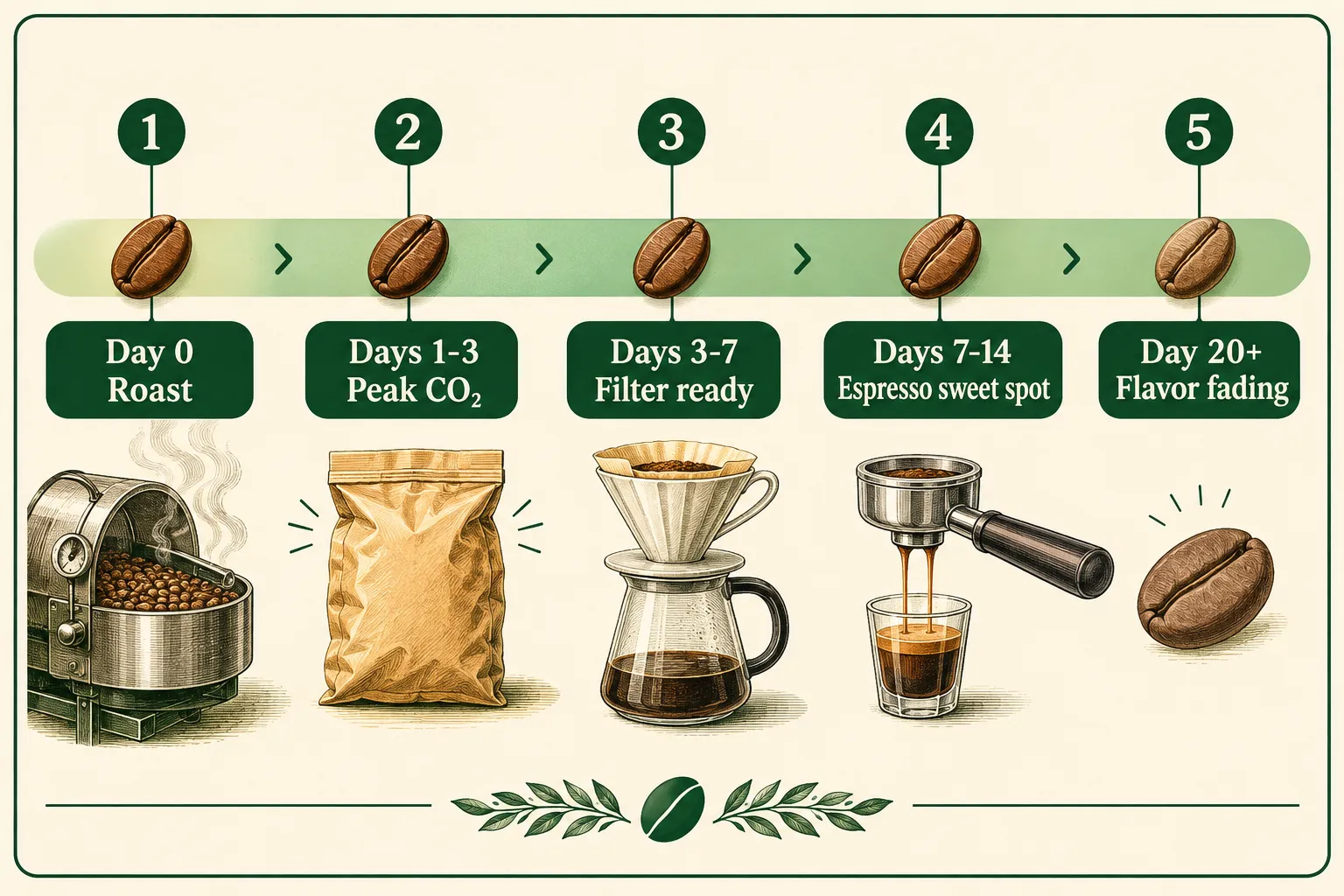
Practical rest windows by brew method
| Brew method | Typical usable window after roast date | Why |
|---|---|---|
| Pour over / drip | Day 2 to day 21 | Lower pressure tolerates residual CO2; aromatics are the priority |
| French press / immersion | Day 3 to day 21 | Long contact time evens out gassy early days |
| Espresso (medium to dark) | Day 7 to day 14 | Gassy coffee channels, gushes, and tastes sour under 9 bar |
| Espresso (light roast) | Day 10 to day 21+ | Slower coffee degassing, denser beans |
| Cold brew | Day 5 to day 30 | Cold water and long steeping blunt freshness differences |
How long to degas coffee is really a question about your equipment. If you are chasing a clean pour over, gas is a minor nuisance. If you are dialing in espresso, it is the main variable changing your shot time day to day.
Decision rule: if your espresso gushes, tastes sour, and the puck looks cratered on a fresh bag, wait three more days before changing the grind size.
How long do beans stay fresh in a one way valve coffee bag?
Unopened and stored cool, a valve bag of whole beans usually tastes good for four to eight weeks from the roast date, with the sharpest quality in the first three. Once opened, think in weeks rather than months.
What actually sets the number:
- Oxygen level inside the bag. The SCA staling literature review cites research where reducing oxygen to 0.5% increased shelf life by up to 20-fold, and separate cited work where each 1% rise in oxygen raised the degradation rate by roughly 10%. Nitrogen-flushed bags therefore outlast simple heat-sealed ones.
- Temperature. With a Q10 around 1.5 for whole beans, a cupboard above the stove is working against you.
- Whole bean versus ground. Ground coffee has vastly more exposed surface area. If you are weighing the trade, read the breakdown of whole bean versus pre-ground coffee.
- Roast level. Darker roasts carry more surface oil, which oxidizes and turns rancid faster.
When are coffee beans freshest? Flavor-wise, somewhere between the day gas stops interfering and the day aromatics start thinning. For most medium roasts that lands around days 7 to 18.
Does a coffee bag valve actually work?
Yes, for its intended job. A functioning coffee bag valve reliably releases pressure and resists reverse flow, which is why a well-packed bag of day-two coffee sits flat instead of swelling. Valve manufacturers specify opening pressures and test for backflow resistance as standard product criteria .
Its limits are worth stating plainly:
- A valve cannot lower the oxygen already trapped at sealing. Barrier film and gas flushing do that .
- Valves have a pressure threshold. Below it, nothing vents, which is normal.
- A valve on a thin, low-barrier film will not save the coffee. Suppliers note that the barrier layer and the valve work as a system .
Common mistake: squeezing the bag hard to smell it, repeatedly, for weeks. Each squeeze pushes out stored CO2 that was protecting the coffee in the headspace.
Coffee bag puffed up: what does that mean?
A puffed coffee bag almost always means the beans are very fresh and actively degassing, with gas building faster than the valve releases it. It is a good sign on a bag roasted within the last week.
When a swollen bag is a problem:
- No valve on the bag at all. Then the pressure has nowhere to go and the seam can fail.
- A ground coffee bag swelling late, weeks after the roast date. That can point to a valve that is blocked or has lost its oil seal.
- A bag that has been warm. Heat raises the degassing rate, so a bag left in a car can inflate dramatically.
A flat bag is not automatically bad news either. Older coffee simply has less gas left. Check the roast date printed on the bag before reading anything into its shape.
Valve bag vs zipper bag vs vacuum seal vs storage container
For unopened coffee, a nitrogen-flushed valve bag wins. For coffee you have already opened and will finish in two to three weeks, an airtight container or a valve bag with a good zipper are both fine. Vacuum sealing fresh beans without a vent is the one choice that can go wrong.
| Storage option | Handles CO2? | Blocks oxygen? | Best for |
|---|---|---|---|
| One way valve coffee bag | Yes, vents it | Good, with foil or high-barrier film | Unopened fresh coffee, days 0 to 21 |
| Zipper bag, no valve | No, pressure builds | Fair, depends on film and seal | Coffee already rested past two weeks |
| Vacuum sealed, no vent | No, bag re-inflates | Excellent at first | Rested or frozen coffee, not day-one beans |
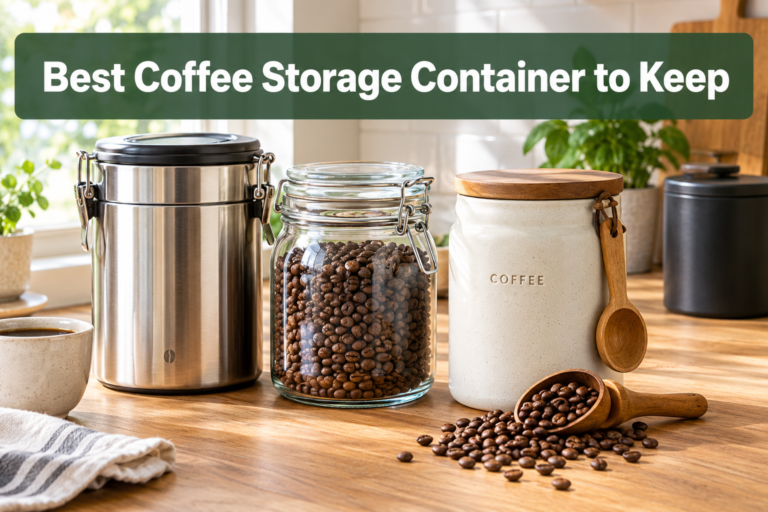
| Airtight canister with valve | Yes, if vented | Very good, and reusable | Opened bags, daily home use |
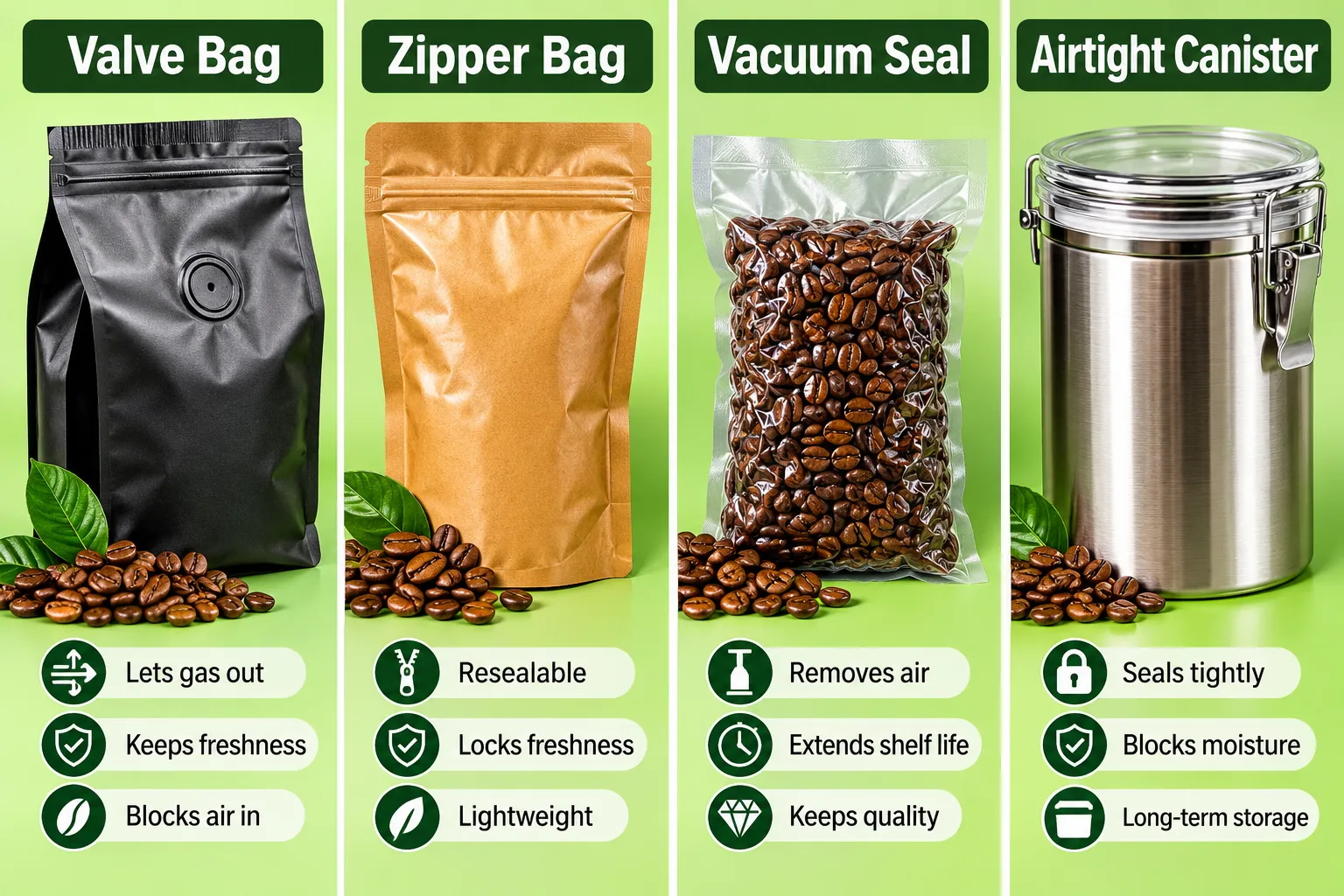
Should you store coffee in a container or the valve bag? If the bag has a solid zipper and you will finish it inside three weeks, leave it in the bag, squeeze out the extra air, and seal it. If the bag has no reseal, or you buy in larger quantities, move it to a sealed canister. Our picks are in the best coffee storage containers for fresh beans guide.
Valve bag vs zipper bag for keeping coffee fresh: the valve matters most in week one, the zipper matters most after opening. The better pouches have both.
Can you reuse coffee bags with valves?
You can reuse a valve bag for short-term storage of beans you plan to drink within a week or two, but it will not perform like the original sealed package. The heat seal across the top is gone, the zipper is the only closure, and the valve has already spent part of its silicone oil film.
Reasonable reuses:
- Storing a smaller amount of beans after you decant the rest.
- Carrying coffee on a trip inside a larger container.
- Portioning beans for a weekend brew setup.
Poor reuses:
- Freezing, unless you overwrap. Repeated condensation degrades the seal.
- Long-term storage beyond a month.
- Storing a different coffee without washing, since oils from a dark roast linger.
One more practical note: a one way valve coffee bag that has been emptied and refilled from a bulk bin provides no gas flush and no fresh seal. If your coffee comes from a bulk hopper, buy small and brew fast.
Valve coffee bag stopped working: how to tell if it's damaged
A valve is likely damaged if the bag swells hard within a week of roasting and will not release gas when you press gently near the vent, or if you can see oil streaks, a cracked disc, or a lifted edge around the valve.
Checks you can run in under a minute:
- Press test. Press the bag flat beside the valve. A working valve releases a faint hiss and a strong coffee aroma.
- Visual check. Look for a torn membrane, a loose rim, or glue failure where the valve meets the film.
- Smell check. A sharp, flat, cardboard note from a recently roasted bag suggests oxygen got in, usually through a seal fault rather than the valve itself.
- Shape check over 24 hours. Fresh coffee in a damaged bag stays rigid. Fresh coffee behind a working valve firms up, then relaxes.
What to do about it:
- Move the beans into an airtight container immediately.
- Grind and brew the affected coffee sooner, and prefer immersion methods, which are forgiving.
- If the bag was recently bought and tastes papery, contact the roaster. Reputable roasters replace faulty packaging.
A blocked valve on an unopened bag can also come from fine coffee dust or oil clogging the vent. That is a manufacturing or handling issue, and it is uncommon on bags from established roasters.
Do all specialty coffees come in valve bags?
No. Most whole-bean specialty coffee uses a valve pouch, but plenty of small roasters, subscription boxes and sample packs ship coffee in valveless bags, tins, or compostable films where a valve is not compatible.
Why a roaster might skip the valve:
- Small sample sizes. A 50 g sampler holds little gas and is usually brewed within days.
- Rest before packing. A roaster who lets coffee sit 24 to 48 hours before bagging may skip the valve, accepting the quality trade-off the SCA experiment described.
- Recyclability. Suppliers report that under the EU Packaging and Packaging Waste Regulation, which started applying in 2026, a pouch is assessed as a whole package, with valve material, adhesives, inks and zipper all capable of changing the outcome . Mono-material designs with compatible valves are one response, and valve makers have introduced lighter, mono-material-friendly degassing valves for exactly that reason .
If you are comparing roasters or subscriptions, bag format is a reasonable tiebreaker. Our coffee subscription comparison looks at how different services handle roast dates and shipping speed.
Coffee bag valve common mistakes to avoid
The most expensive mistake is ignoring the roast date and blaming the grinder. A coffee bag valve tells you the roaster planned for degassing, but only the printed roast date tells you where in the curve your beans sit.
Mistakes worth fixing today:
- Buying by "best before" instead of roast date coffee labeling. A 12-month best-before date says nothing about freshness. If no roast date appears anywhere, treat the coffee as older than you would like.
- Chasing grind adjustments on day two espresso. Gassy coffee produces fast, sour, erratic shots. Wait before you re-dial. A capable burr grinder will not out-run physics.
- Storing the bag by the stove or on top of the machine. Heat accelerates both coffee degassing and staling.
- Leaving the bag open on the counter. Roll it down, press out the air, seal the zipper.
- Refrigerating beans. Condensation and odor transfer are real, and the fridge is not cold enough to be useful.
- Treating the valve as a freshness guarantee after opening. It isn't. The headspace refills with oxygen each time you reach in.
- Buying three months of coffee at once. Better to buy twice as often. Our guide on how to choose coffee beans covers quantity along with origin and processing method.
A coffee bag valve buys you time with gas. It does not buy you time with oxygen. The clock restarts the moment you open the bag.
A quick coffee resting time planner
When will these beans peak?
Bean age today: ‘+age+’ days. ‘; msg+= age<s? 'Still degassing. Expect gassy, sour shots if you push it early.': (age<=21? 'In range. Dial in now.': 'Past the sweet spot. Try immersion or cold brew.'); o.style.display='block';o.innerHTML=msg; });
FAQ

Conclusion
For a home brewer, the coffee bag valve is a reading device as much as a vent. A firm bag with a recent roast date means the coffee is still coffee degassing and your espresso will behave strangely for a few more days. A soft bag with an old date means the aromatics have already thinned, and no grind adjustment will bring them back.
Three habits turn that into better coffee:
- Buy by roast date, not best-before. Look for a printed date and buy what you will finish in three weeks.
- Match your coffee resting time to your brew. Filter from day two or three. Espresso from day seven. Light-roast espresso later still.
- Protect the oxygen side. Press the air out, seal the zipper, keep the bag cool and dark, and move large bags into a sealed canister.
Next step: find the roast date on the bag sitting on your counter right now, count the days, and pick a brew method that suits where those beans are in the curve. If the bag has no date, that is useful information too. Start with how to choose the best coffee beans for home brewing and buy smaller, more often.
Better Coffee Starts With Better Answers.