
First Crack Coffee Roasting: The Sound That Decides
Quick Answer
First crack coffee roasting is the moment a bean audibly pops, roughly around 385 to 400F bean temperature, when trapped steam and carbon dioxide rupture the bean's rigid cell walls. That pop is the dividing line between raw and drinkable. Everything you call a roast level (city, full city, Vienna) is measured from the first crack, not from the start of the roast. Stop at the pop and you get a sour, underdeveloped cup. Go too far past it and you trade origin flavor for roast flavor.
Key takeaways
- First crack happens near 385 to 400F bean temperature; second crack arrives around 435 to 450F, when oils migrate and the cell structure begins breaking down.
- Published temperature figures disagree on purpose. Coffearium summarizes bean cracking broadly around 180 to 200C (356 to 392F), while other technical sources place it near 195 to 205C, because probe placement and calibration differ between machines .
- Research reported by the Specialty Coffee Association (Anokye-Bempah, Donis-González, and Ristenpart, UC Davis) found bean color at first and second crack stayed nearly consistent across very different roast profiles, supporting a "universal coffee color curve." Color travels between roasters better than a thermometer number does.
- A multi-study investigation by Münchow, Alstrup, Steen, and Giacalone, published in Beverages, found that at the same final roast color, development time after first crack shaped sensory results more than time taken to reach first crack.
- Automatic detection is now commercial: ROEST's L200 Plus sample roaster uses a built-in microphone to separate cracking sounds from drum noise, and Cropster's software forecasts first crack about three minutes early.
- An open-source Audio Spectrogram Transformer model trained on 973 labeled 10-second clips from 15 roast recordings reported 91.1% precision and 97.6% recall on a 303-sample test set (July 12, 2026). Small dataset, one set of machines, so treat it as promising rather than proven everywhere.
First Crack Coffee: What Actually Happens Inside the Bean
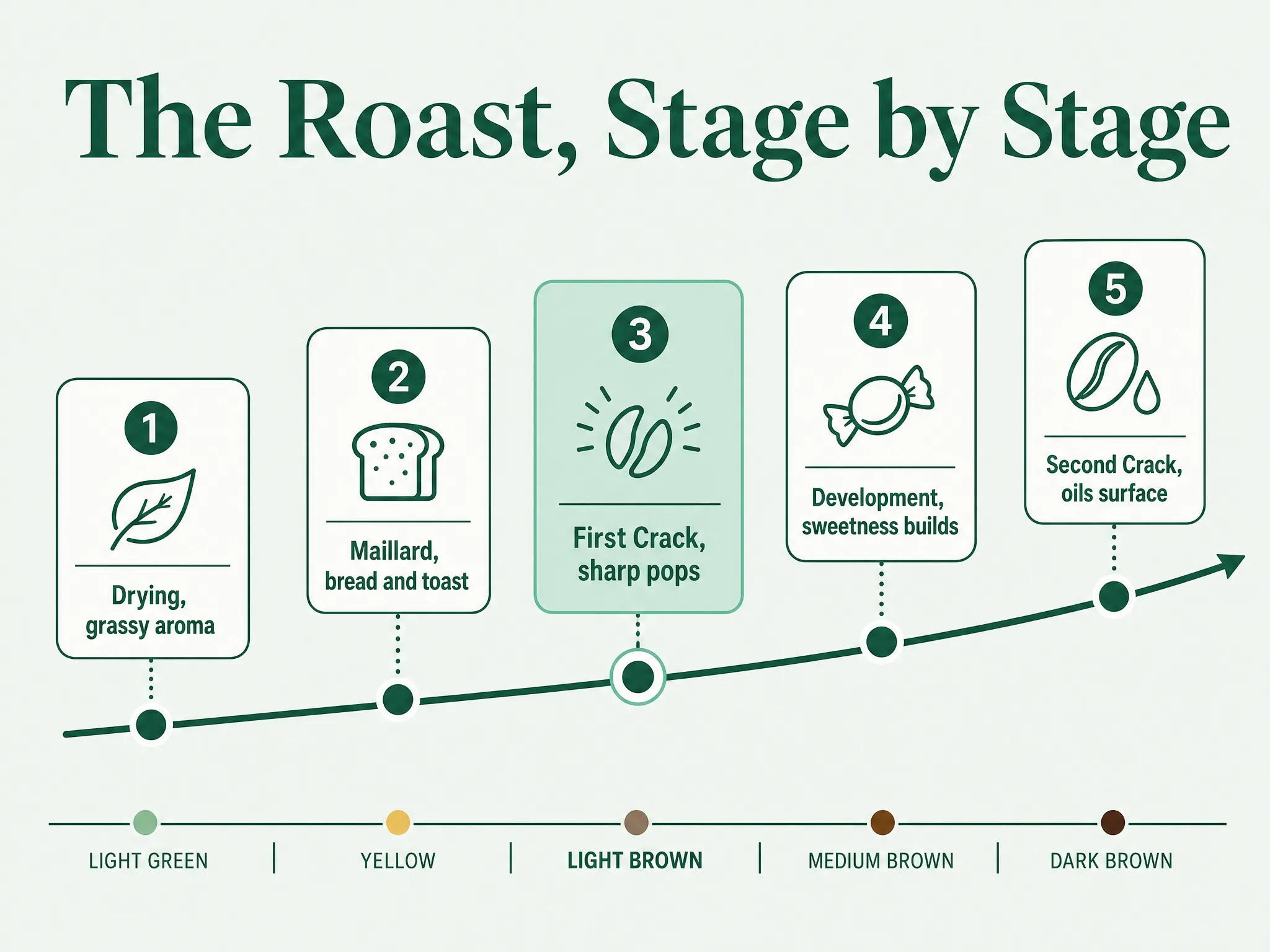
First crack coffee is the sound of a bean failing structurally under internal pressure. Green coffee holds about 10 to 12 percent moisture. As the drum climbs past 300F, that water turns to steam while the Maillard reaction and caramelization produce carbon dioxide inside a sealed, woody cell matrix. Pressure rises. Around 385 to 400F the walls give way and the bean splits with a pop, expanding noticeably in volume and shedding chaff.

Three things change in that instant, and all three matter in your cup.
- The bean becomes porous. Ruptured cells let water through during brewing. That is why green coffee cannot be brewed and lightly roasted coffee can.
- The reaction turns exothermic. The bean starts releasing its own heat, so the roaster's job shifts from pushing heat in to controlling a reaction already running .
- Acid chemistry pivots. Chlorogenic acids break down, sweetness becomes perceptible, and grassy, vegetal notes stop dominating.
Before the pop, the roast moves through drying and then browning, the phase where the maillard reaction roasting stage builds the bready, nutty, toasted aromas you smell from the kitchen. First crack is the end of that build and the beginning of the part roasters obsess over.
A roaster who cannot hear first crack is driving with the speedometer taped over. The gauge still exists, but the decision is being made blind.
What Does the First Crack Sound Like?
It sounds like scattered popcorn in a pan: sharp, dry, irregular cracks that start as one or two isolated snaps and build to a rolling clatter over 30 to 90 seconds. Second crack sounds completely different, smaller and faster, closer to Rice Krispies in milk or a twig fire.
Useful distinctions when you are listening for the first time:
- Isolated and loud. The first pops arrive alone, often with awkward gaps of several seconds. That gap is normal.
- Low-pitched. Compared with the snappier, higher, denser crackle of second crack, first crack has weight to it.
- Accompanied by smell. The aroma shifts from bread dough and toast to something sweeter and sharper. Your nose is a second sensor.
- Chaff flies. On a drum roaster the chaff output usually spikes right around onset.
Edge case worth knowing: a few pops at the very start of a roast can come from moisture escaping a cracked or damaged bean. If you hear two pops, then silence for 45 seconds, and the bean is still pale tan, you heard a false start.
How Do I Know When First Crack Is Happening in My Roast?
Confirm first crack with three signals at once: sound, color, and time. Any single one can lie. Together they are reliable enough to log and repeat.
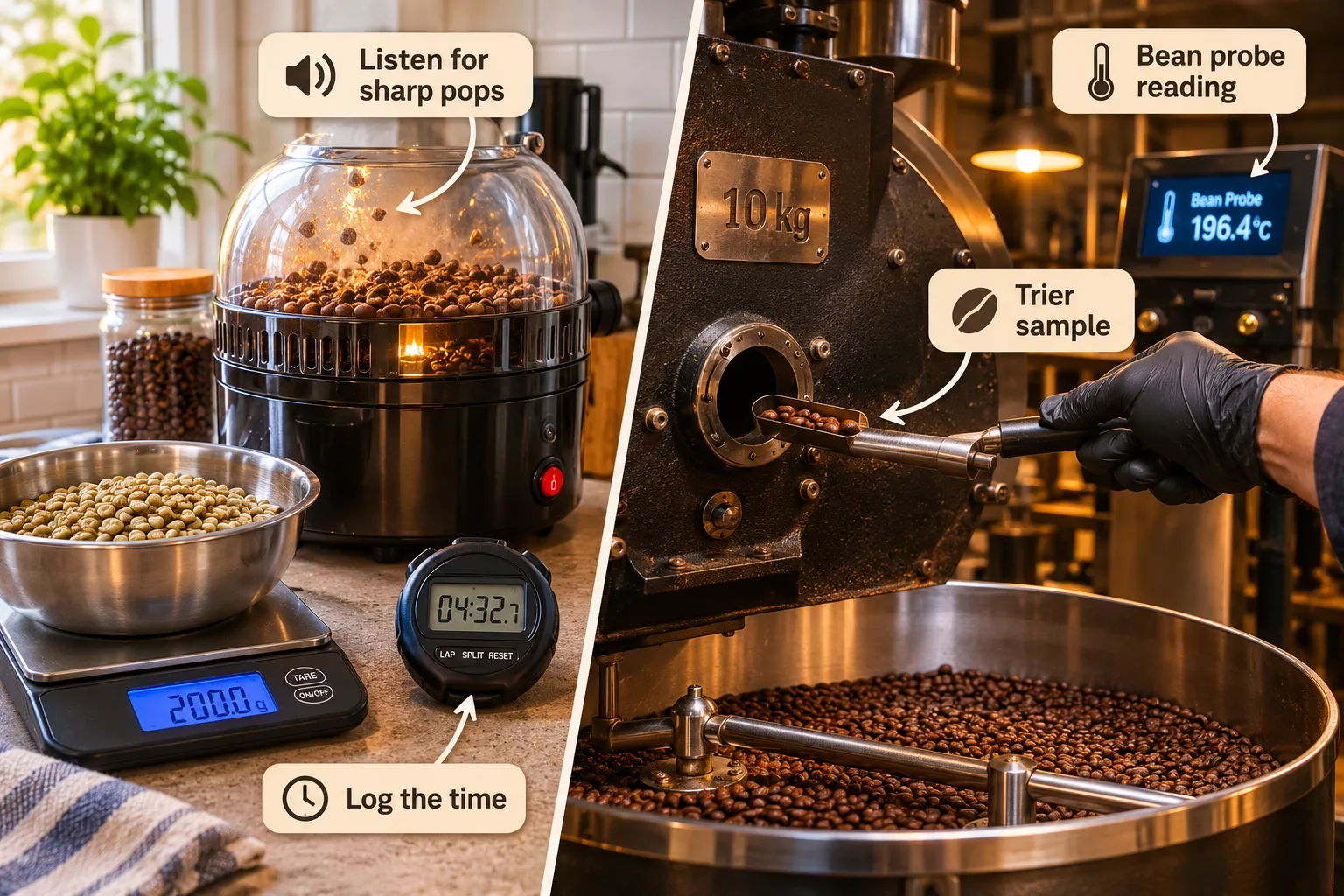
- Sound. Count the first distinct pop and mark the time. Convention is to log the first audible crack, not the rolling peak.
- Color. Pull the trier (the sampling spoon). Beans should be a medium cinnamon brown with the center cut still visibly lighter.
- Time. On most home drum roasters, first crack lands between 7 and 12 minutes into the batch, depending on charge temperature and batch size .
- Volume and surface. Beans swell and the wrinkled seam starts to open and flatten.
- Probe reading. Record it, but treat it as a machine-specific landmark rather than a universal number .
Decision rule: if two of the three primary signals (sound, color, time) agree, call it. If sound disagrees with color, trust color.
Why Can't I Hear the First Crack in My Home Roaster?
Usually it is machine noise, not a missing crack. Hot-air popcorn poppers and fluid-bed roasters run loud fans that mask the lower frequencies of the crack coffee pops. Small batch sizes also produce fewer beans cracking, so the event is quieter and more spread out.
Fixes that work:
- Increase batch size to the upper end of your roaster's rated capacity. More beans, more pops.
- Cut the ambient noise. No range hood, no music, no running water for those two minutes.
- Move closer and listen low. Crack frequencies carry poorly over fan whine.
- Use color as the backup and log temperature so the next roast has a reference point.
- Record the audio. Playing back a roast with headphones often reveals pops you missed live. This is the same principle behind automated detection: ROEST's L200 Plus uses a built-in microphone to distinguish cracking from drum noise, and Cropster's roast software predicts the the crack window roughly three minutes in advance so operators can set gas and airflow before it arrives.
Larger machines make unaided listening harder, not easier. Daily Coffee News reported on October 23, 2026 that Mill City Roasters shipped its first 20-kilogram M-Series roasters on October 9, with data logging and touchscreen controls as standard. More mass, more drum noise, more reason to cross-check sound against probe data and color.
Can You Get a Good Roast Without Hearing a Clear the crack?
Yes, if you substitute color and time for sound. Commercial sample roasters and many home setups are roasted successfully by color benchmarks alone. The UC Davis work reported by the Specialty Coffee Association found bean color values at first and second crack were nearly consistent across substantially different roast profiles and green coffees, which is exactly what makes color a workable stand-in.
The limitation: color is harder to judge by eye under kitchen lighting, and whole-bean color lags ground color. If you are serious about repeatability without a crack sensor, grind a small cooled sample and compare it against a printed roast color card each batch.
What Temperature Does the crack Happen At, and How Many Minutes In?
Bean temperature at the crack typically falls between 385 and 400F (about 196 to 205C), and most home batches reach it 7 to 12 minutes after the beans are charged into the drum. Both numbers are ranges, not settings.
The reason published figures disagree is mechanical. Coffearium's review places bean cracking broadly around 180 to 200C, while other technical and educational sources cite 195 to 205C . A probe measuring bean mass reads differently from one measuring environmental air temperature, and probe position, drum geometry, and calibration all shift the number . A 2026 Scientific Reports digital-twin study of coffee roasting modeled exactly these bean-to-air heat transfer differences, which is why a simulated or modeled temperature rarely matches the display on your machine .
Does Every Coffee Bean Crack at the Same Point?
No. Density, moisture content, processing method, and bean size all move the crack. High-grown, dense Ethiopian or Kenyan beans generally resist longer and crack later than a soft, low-grown bean. Natural-processed lots with higher residual sugar often crack with a slightly different character than washed lots of the same altitude.
Decaffeinated coffee is its own case. The decaffeination process alters bean structure and color before roasting, so roasters frequently report a muted or hard-to-hear the crack and have to lean on color and time instead.
Can Altitude or Humidity Affect When the crack Happens?
Yes, on both sides of the equation. Growing altitude changes bean density, which changes how long the bean resists pressure. Roasting altitude matters too: lower atmospheric pressure at elevation means water boils at a lower temperature, so steam forms slightly earlier inside the bean.
Ambient humidity and green coffee moisture content matter more than most home roasters expect. Green coffee stored through a humid summer picks up moisture, which lengthens the drying phase and pushes the crack later. The same bag in January, after dry indoor heating, may crack a full minute earlier at the same charge temperature. If your roast times drift across seasons without any equipment change, moisture is the usual suspect .
the crack vs Second Crack: What's the Real Difference?
the crack is pressure release; second crack is structural failure. The first is water and CO2 escaping through intact-but-ruptured cell walls. The second, near 435 to 450F, is the cellulose matrix breaking down, pushing oils to the bean surface and replacing origin character with carbon and smoke notes.
Roast level by crack: drop point and expected cup
| Roast level | Drop point | Approx. bean temp | Typical cup character |
|---|---|---|---|
| Cinnamon / very light | Start of the crack | ~385-390F | Sour, grassy, underdeveloped |
| City | End of the crack | ~395-405F | Bright acidity, origin-forward |
| City+ | 45-75s after the crack ends | ~410-420F | Balanced sweetness and acidity |
| Full City | Just before second crack | ~425-435F | Caramel, body, muted acidity |
| Vienna | Early second crack | ~437-445F | Bittersweet, faint surface oil |
| French / Italian | Mid to late second crack | ~450F+ | Smoky, oily, roast-dominant |
Temperatures are bean-probe approximations and shift with machine, probe placement, batch size and calibration. Use crack timing and bean color as the primary reference.
Practical takeaway for buyers rather than roasters: when a bag says "medium-dark," it is describing a drop point somewhere between full city and Vienna. If you prefer that profile, our guide to choosing a coffee roast level maps those labels to flavor, and brewing dark roast coffee covers the grind size and water temperature adjustments post-second-crack beans need.
Why Does the crack Coffee Timing Matter for Quality?
Because development time, the interval between the crack and the drop, is where sweetness, body, and acidity get balanced. Everything before the crack sets up the bean. Everything after decides what it tastes like.
The strongest evidence here comes from a multi-study investigation by Morten Münchow, Jesper Alstrup, Ida Steen, and Davide Giacalone, published in Beverages. The researchers held final roast color constant and varied the roast path. At the same color, differences in development time influenced sensory and chemical outcomes, while time to the crack had a comparatively smaller effect. The limitation worth stating: these were controlled roasts on specific equipment with trained sensory panels, so the result tells you which variable deserves attention, not a formula guaranteeing your cup improves.
The UC Davis color research reported by the Specialty Coffee Association supports the same practical conclusion from a different direction. If color at first and second crack is nearly consistent across profiles, then the useful variable you control is how long you stay between those two landmarks.
What this means at the roaster:
- Development time ratio (time after the crack divided by total roast time) commonly lands between 15 and 25 percent for filter roasts. Lower tends toward bright and thin. Higher tends toward sweet and heavy.
- Make heat changes early. Cropster's documentation cites Scott Rao's recommendation to avoid gas adjustments roughly 40 to 45 seconds before the crack, and airflow changes roughly two minutes before it. Late changes arrive during the exothermic phase, when the bean is least cooperative.
- Log it. One number per batch, every batch, builds a profile faster than any theory.
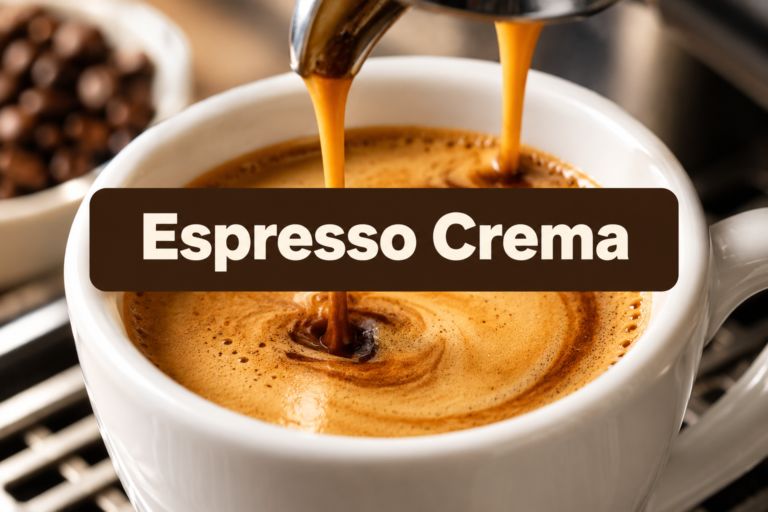
Roasting for espresso adds another layer, since the pressure of extraction punishes underdeveloped beans more harshly than a pour over does. Our notes on roasting coffee for espresso go deeper into that tradeoff.
Should I Stop the Roast Right at the crack? And Is the crack the Same as Light Roast?
No, and no. Dropping at the first pop produces a cinnamon roast that tastes sour, grassy, and papery, because the Maillard products have not had time to resolve into sweetness. A genuine light roast is dropped at or just after the end of the crack, not at its start.
This is the misconception worth correcting plainly: the crack is not a light roast, it is the gate a light roast walks through. Modern light roasts from specialty roasters still carry 30 to 90 seconds of development past the final pop. The sour, hay-flavored cup people blame on "light roast" is usually an underdeveloped roast, which is a different defect entirely. If bright, fruit-forward coffee has disappointed you before, the comparisons in our best light roast coffee roundup show what properly developed light roasting tastes like.
How Long After the crack Do I Need to Keep Roasting?
Between about 45 seconds and 3 minutes, depending on the roast level you want.
- City: drop as the crack finishes rolling, roughly 45 to 75 seconds after onset.
- City+ to Full City: 90 seconds to 2.5 minutes, watching for the surface to smooth out.
- Vienna and darker: continue until second crack begins, usually 3 to 4 minutes past the crack onset.
Common mistake: chasing a stopwatch number borrowed from someone else's roaster. A two-minute development on a 1-kilogram drum is not a two-minute development on a hot-air popper. Build your own numbers.
What Are the Common Mistakes People Make With the crack Timing?
The most frequent error is logging the wrong moment: marking the rolling peak of the crack instead of the first audible pop, which quietly inflates every development figure by 20 to 40 seconds.
Others worth checking against your own routine:
- Cranking heat during the crack. The reaction is already exothermic. Adding gas now risks scorching and baked flavors.
- Cutting heat to zero at the pop. Stalling the roast produces flat, bready coffee with no sweetness. The bean still needs energy.
- Comparing probe temperatures between machines. A target like "the crack at 200C" does not travel between roasters unless probe type, position, batch size, and calibration match .
- Ignoring green coffee moisture. Same bean, different season, different crack time.
- Roasting batches too small to hear. Under-filling a drum produces thin, scattered cracks and erratic heat transfer.
- Resting coffee badly after the roast. Coffee outgasses heavily for days after the crack ruptures the bean. Most roasts need 3 to 14 days of rest before they brew well, and roast date on the bag matters more than any other printed number.
- Judging a roast on day one. It will taste gassy and sharp. Wait.
FAQ

Conclusion: What This Means for Your Next Bag or Batch
If you roast at home, the single highest-value change is logging two numbers per batch: the time of the first audible pop, and the time you drop. That gives you development time, which the Beverages research by Münchow and colleagues identified as the variable with more sensory influence than the pre-crack timeline when final color is held constant. Change one thing at a time across ten batches and you will learn more than any profile chart can teach you.
If you buy rather than roast, the practical use of understanding the crack coffee is label fluency. "Medium roast" means a drop point a minute or two past the crack. "Dark roast" means somewhere inside second crack. Match that to your brew method and your preference instead of to the adjective on the bag, and check the roast date before anything else.
Next step: pick one bag you already enjoy, note its roast level, then compare it against a roast one step lighter using the same grind size, brew ratio, and water temperature. The difference you taste is development time, and it will tell you more about your palate than a hundred tasting notes on packaging. Better Coffee Starts With Better Answers.
Related reading: how to make coffee taste better and the best coffee grinder for every brew method and budget.