Chlorogenic Acid in Coffee: What Roasting Destroys
Quick Answer
Roasting destroys most of the chlorogenic acid in coffee, and the darker the roast, the less survives. A 2025 study in the International Journal of Food Science & Technology measured total chlorogenic acids falling from 77.58 mg/g in unroasted beans to 4.92 mg/g in an Italian roast, a drop of about 93.7% . Light roasts keep the most. Some of what breaks down turns into chlorogenic acid lactones, which taste bitter, so the chemistry you lose is also the flavor you gain.
Key Takeaways
- Green beans are the richest source. A 2026 systematic review in Trends in Sciences reported 12.50 to 160.10 mg/g total caffeoylquinic acids in Arabica green beans and 32.10 to 185.60 mg/g in Robusta .
- Processing can strip nearly all of it. The same review found reductions as high as 99% in Arabica and 56 to 92% in Robusta across roasting and brewing .
- Roast level is the dominant variable. Dark roasting commonly produces losses above 80 to 90% .
- Brewed numbers tell the same story. One analysis measured roughly 270.93 mg/L in light roast brew, 187.45 mg/L in medium, and 90.53 mg/L in dark .
- Arabica roast-level reductions have been reported at about 15.9% light, 57.6% medium, and 84.2% dark in a review published via PMC, with the caveat that origin, roast endpoint, and lab method all move the number .
- Antioxidant capacity does not vanish with the chlorogenic acid. Roasting builds melanoidins, the brown Maillard compounds, which carry their own antioxidant activity .
- Absorption is limited. Less than a third of ingested chlorogenic acids are absorbed in the small intestine, and intact 5-CQA is barely measurable in blood.
What is chlorogenic acid and why is it in coffee?
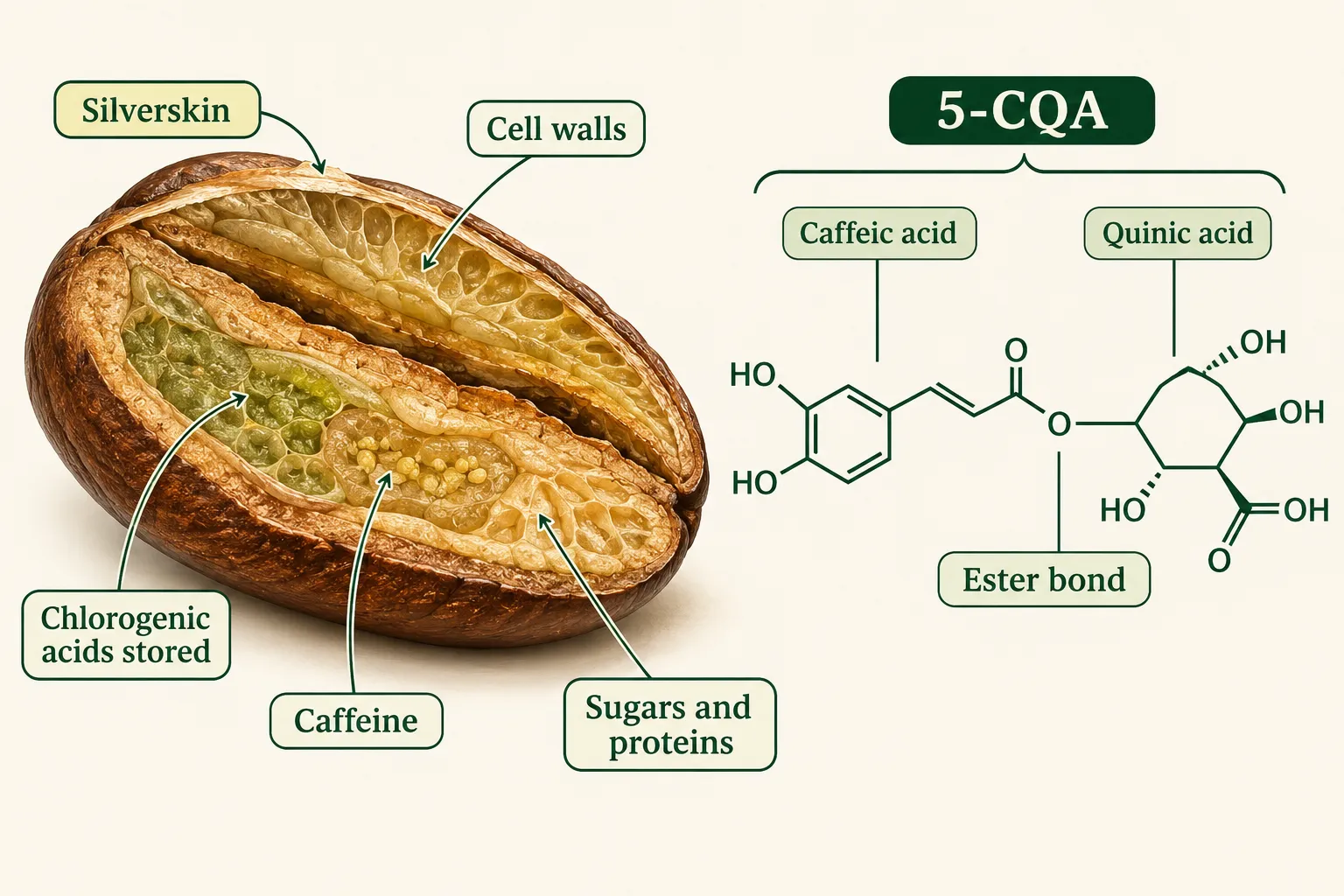
Chlorogenic acid is a family of plant polyphenols formed when caffeic acid bonds to quinic acid. The coffee plant makes them as part of its own defense chemistry, and they end up concentrated in the seed we roast. Green coffee is one of the most concentrated dietary sources on earth.
)
The term is slightly misleading. "Chlorogenic acid" is not one molecule but a group, usually dominated by the caffeoylquinic acids. The single most abundant isomer in coffee is 5-CQA, which is why most studies report it separately .
A few practical notes:
- Robusta carries more than Arabica. The 2026 Trends in Sciences review put Robusta green beans at 32.10 to 185.60 mg/g against Arabica's 12.50 to 160.10 mg/g . Robusta's higher polyphenol and caffeine load is part of why it tastes harsher. Read the full picture in our look at the drawbacks of Robusta coffee.
- They contribute to perceived acidity and astringency in the cup, especially in lightly roasted coffee.
- They are heat sensitive. That single fact drives everything else in this article.
The coffee plant did not produce chlorogenic acids for your health. It produced them for its own. We just happen to drink them.
Chlorogenic acid: what roasting destroys and what survives
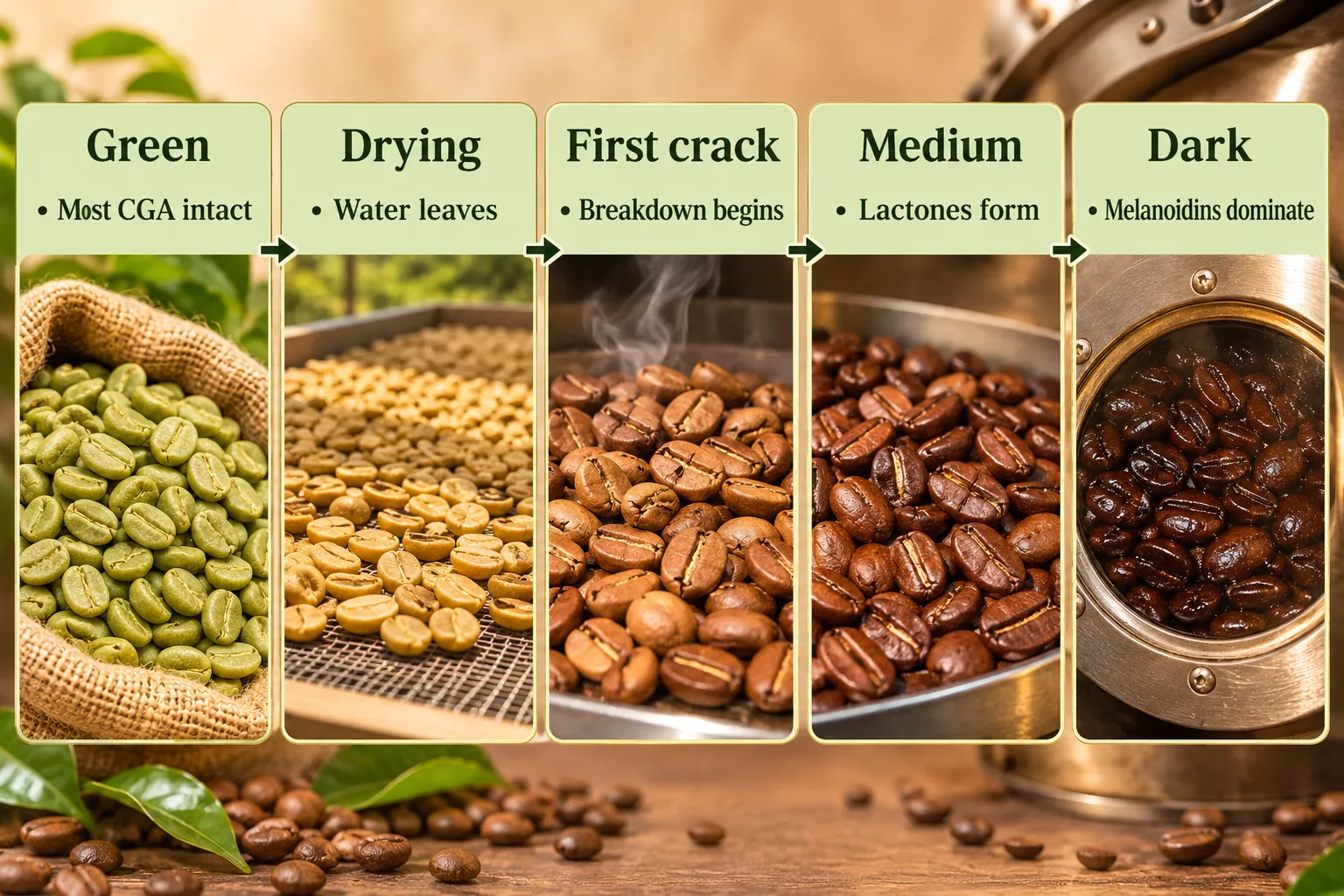
Roasting destroys chlorogenic acid through four overlapping reactions: isomerization, hydrolysis, pyrolysis, and conversion into chlorogenic acid lactones and smaller phenolic fragments . What survives depends almost entirely on how far past first crack the roaster went.
)
Here is the sequence in plain terms.
- Drying phase. Moisture leaves the bean. Chlorogenic acids are largely intact.
- Early browning. Maillard reactions begin. Some isomerization starts, shuffling the molecule into different forms without destroying it.
- First crack. Measurable degradation begins in earnest.
- Development. Hydrolysis splits chlorogenic acids into caffeic acid and quinic acid. Lactones form through dehydration of the quinic acid portion.
- Second crack and beyond. Pyrolysis takes over. Lactones themselves break down further into phenylindanes, which are harsher still.
The lactone step is where chemistry meets taste. Chlorogenic acid lactones are bitter. They peak somewhere around medium to medium-dark and then degrade into even more bitter products. That is why a medium-dark roast can taste more aggressively bitter than a very dark one, which tastes more of smoke and carbon.
Melanoidins tell the other half of the story. These large brown polymers form through Maillard reactions as the bean darkens, and they carry antioxidant activity of their own . A dark roast has lost most of its original coffee polyphenols and gained a different set of compounds. The antioxidant profile changed. It did not simply disappear.
The misconception this article corrects: plenty of articles claim dark roast coffee has "no antioxidants left." That is wrong. Dark roast has far less chlorogenic acid, and that part is well documented. It still carries melanoidins and retains measurable antioxidant capacity . Lower in one specific compound class is not the same as empty.
Does light roast coffee have more CGA than dark roast?
Yes, and the gap is large. Brewed measurements from one analysis found about 270.93 mg/L in light roast, 187.45 mg/L in medium roast, and 90.53 mg/L in dark roast, a decline of roughly two thirds from light to dark .
A 2026 review summarized approximate retention ranges as 70 to 90% for light, 50 to 70% for medium, and under 40% for dark . A separate Arabica review reported losses of about 15.9% light, 57.6% medium, and 84.2% dark . The percentages differ because the studies used different beans, different roast endpoints, and different assays. The direction never changes.
)
Light roast vs dark roast antioxidants, and what you taste
The flavor consequence is the part most people actually care about.
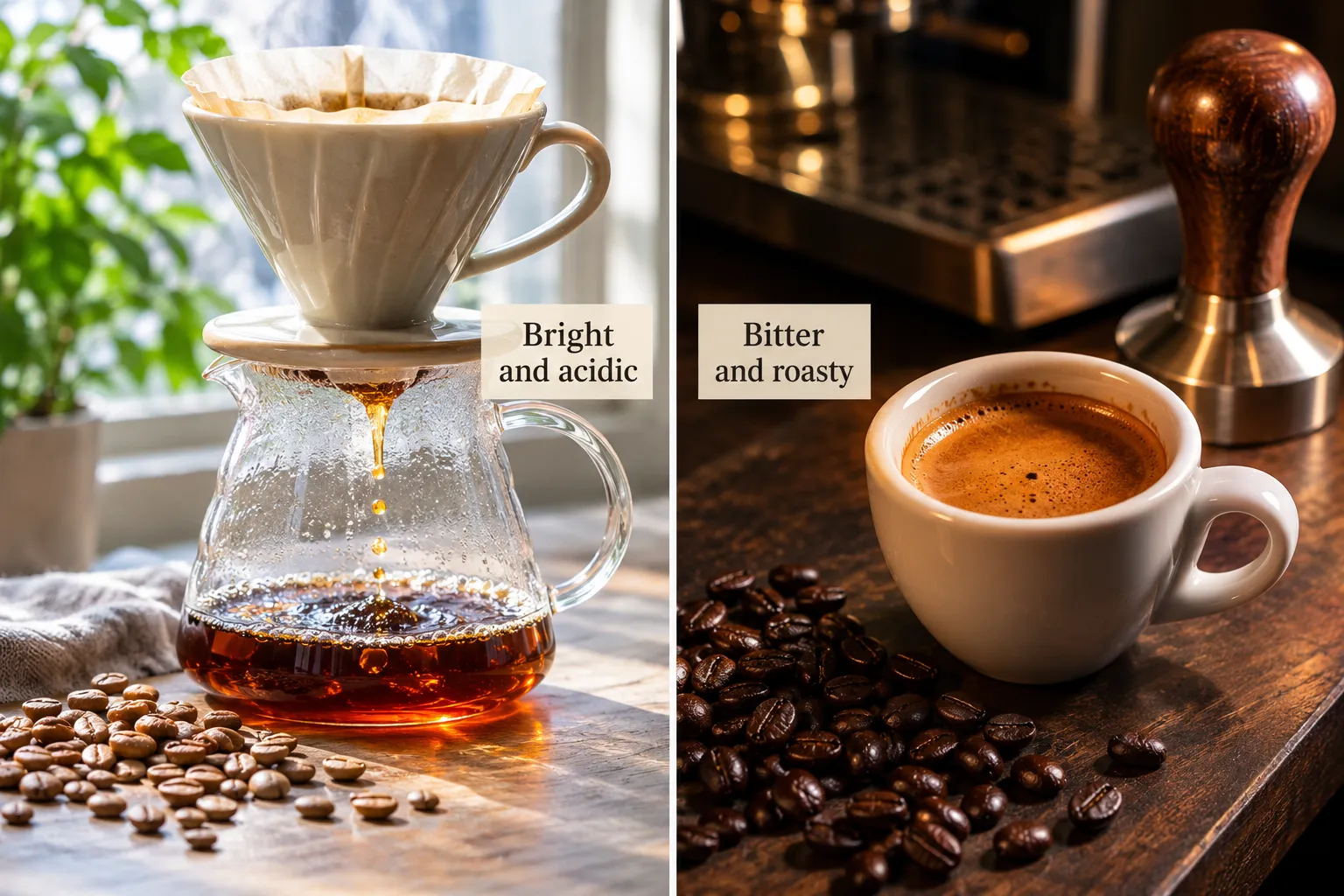
- Light roast: more CGA, more perceived acidity, more fruit and floral aroma from surviving volatile precursors. It can taste sour or grassy if underdeveloped or underextracted. Our light roast coffee picks cover beans built for this.
- Medium roast: the peak zone for CGA lactones. Balanced sweetness, caramel notes, moderate bitterness. See medium roast options for drip, pour over, and espresso.
- Dark roast: fewer coffee polyphenols of the chlorogenic type, more melanoidins, more roast-derived bitterness from phenylindanes and carbonized sugars. Often more body, less origin character. Compare dark roast choices here.
Decision rule: choose light roast if CGA content is your priority and you brew with a scale and a burr grinder. Choose medium if you want sweetness and forgiveness. Choose dark if body and low acidity matter more to you than coffee polyphenols. Our guide on how to choose a coffee roast walks through the trade-offs.
How much CGA gets destroyed during roasting, and at what temperature?
Across the published range, roasting and processing can remove anywhere from roughly 16% to 99% of the original CGA. The 2025 Italian roast measurement of 93.7% loss is a reasonable number for commercial dark roast .
On temperature: there is no single cutoff where CGA is destroyed. Degradation is continuous and depends on both heat and time. Bean temperature during roasting climbs through roughly 180°C to 230°C (356°F to 446°F), and meaningful breakdown accelerates once beans move past first crack, generally around 196°C to 205°C (385°F to 400°F) depending on the roaster and bean density. A long, slow roast at a lower peak temperature can destroy as much CGA as a fast hot one, because total thermal exposure is what counts.
Common mistake: assuming a roaster's "light" label guarantees high retention. Roast color is measured on scales like Agtron, and two bags labeled light can sit several points apart. Color alone also hides development time. If you want a specific comparison, our page on roasting coffee for espresso explains why espresso roasts tend to run darker and longer.
| Roast level | Approx. CGA retention | Dominant taste driver |
|---|---|---|
| Green (unroasted) | 100% baseline | Grassy, astringent, not drinkable as coffee |
| Light | 70 to 90% | Acidity, fruit, floral aroma |
| Medium | 50 to 70% | Caramel sweetness, lactone bitterness |
| Medium-dark | ~40 to 50% | Peak CGA lactones, cocoa |
| Dark / Italian | Under 40%, often ~6% | Phenylindanes, melanoidins, smoke |
Is CGA actually good for you?
CGA is an antioxidant compound, and that is a statement about chemical composition, not a medical outcome. Having more of it in your cup does not translate reliably into measurable effects in people.
Two findings keep this honest.
Absorption is low. A 2026 translational review reported that intact 5-CQA is rarely measurable in plasma at all, with peak concentrations of only 11 to 12 nanomolar across total CGA doses of 412, 635, and 795 µmol. Less than one third is absorbed in the small intestine. Most of the rest is metabolized by gut bacteria into smaller phenolic acids.
Outcome evidence is mixed. A 2026 systematic review and meta-analysis in Nutrition Research Reviews found the evidence did not support a clear cognition benefit specifically attributable to coffee-derived CGA, even though the wider literature contains some signals from CGA rich coffee.
So the fair position is this: CGA coffee is an interesting composition fact and a real driver of flavor. It is not a reason to claim coffee treats, cures, or prevents anything. Observational coffee studies find associations, and associations are not causation. If you are chasing an overall healthier cup, our page on the healthiest coffee to drink deals with the practical levers, like what you add to it.
Which coffees have the highest CGA?
Green coffee extract ranks highest, followed by light roast Robusta, then light roast Arabica. No mainstream retail brand publishes verified CGA numbers per bag, so treat any brand-specific claim with suspicion.
What actually predicts a higher CGA roast level in a bag you can buy:
- Species. Robusta green beans measured higher than Arabica in the 2026 review . Many blends include some Robusta without saying so.
- Roast color. Lighter is higher. This is the single most reliable signal available to a shopper.
- Roast date. Fresher beans are not higher in CGA, but they taste better, which matters more day to day. Check the roast date on the bag.
- Transparency. Single origin bags that list processing method and roast level give you more information than a generic "100% Arabica" label. If you want variety while you compare, a rotating subscription like Atlas Coffee Club sends different origins and roast levels to taste side by side.
Edge case: instant coffee is sometimes higher in CGA than expected, because manufacturers may use Robusta and because extraction is aggressive. That does not make it taste better.
Can you get CGA from other foods besides coffee?
Yes, though coffee is by far the biggest dietary contributor for most US adults. Other sources include apples, pears, plums, blueberries, artichokes, eggplant, potatoes, carrots, and yerba mate.
Quantities are much smaller per serving than a mug of light roast coffee. Prunes and apples carry a reasonable amount. Green coffee extract supplements carry the most by a wide margin, which is a separate question covered below.
The practical point: if you drink two cups of coffee a day, coffee is almost certainly your main source of CGAs regardless of what else you eat.
Does CGA survive brewing with hot water?
Mostly yes. CGAs are water soluble, and hot water extracts them efficiently. Brewing causes far less loss than roasting does, though the 2026 review counted brewing as part of the total processing chain that can reach 99% reduction in Arabica .
Variables that change how much ends up in your cup:
- Brew ratio. A stronger ratio puts more of everything in the cup, CGAs included. Our French press ratio guide covers the math.
- Grind size. Finer grind means more surface area and faster extraction.
- Water temperature. Hotter water extracts more. Brewing around 200°F is standard for pour over.
- Contact time. Longer steeping extracts more, which is one reason cold brew compensates for cool water with 12 to 20 hours of contact.
- Filtration. Paper filters remove diterpenes like cafestol, but CGAs pass through.
Cold brew is sometimes described as low in CGA. In practice, long immersion recovers a good deal, though cold water is less efficient per minute. The bigger factor is that cold brew is usually made with dark roast, which started with less.
Common mistake: underextracting a light roast and blaming the bean. Light roast beans are denser and need a finer grind or hotter water than dark roast at the same setting. A bloom of 30 to 45 seconds helps wet the bed evenly.
Is green unroasted coffee better for CGA, and does decaf still have it?
Green unroasted coffee contains the most CGA by a wide margin, but it does not brew into anything most people would want to drink. It tastes grassy, vegetal, and astringent. That is why the industry extracts from green beans rather than trying to drink them.
A 2026 international patent publication describes pulling high CGA material from broken green coffee beans using low temperature ultrasonic and enzymatic processing, then chromatography and spray drying, with the stated aim of a low caffeine, CGA-enriched extract. A Korean patent granted on May 21, 2026 covers a decaffeinated coffee bean extract containing CGA or trigonelline. The commercial direction is clear: if you want high CGA, you extract it from green coffee, not from a roasted bag.
Decaf keeps most of its CGA. Decaffeination targets caffeine, not polyphenols. Some loss occurs during solvent or water processing, and the Swiss Water style methods can wash out a share of water soluble compounds along the way. But decaf at a given roast level still carries CGAs in the same broad range as its caffeinated counterpart at that roast level. Roast level remains the bigger variable.
What are the side effects of too much CGA, and should you take supplements?
CGA from normal coffee drinking is not associated with specific toxicity. High dose green coffee extract supplements are a different product with a thinner safety record, and they are not a substitute for coffee in any meaningful sense.
Reported issues with concentrated green coffee extract in human trials have included gastrointestinal discomfort, headache, and effects linked to the caffeine content rather than the CGA itself. Some products also raise homocysteine in short term studies. Supplements in the US are regulated as food, not drugs, so label accuracy varies between brands. Anyone pregnant, taking medication, or managing a health condition should speak to a clinician before using concentrated extracts.
On dosing, the question "how much CGA do you need to see health benefits" has no settled answer. The 2026 Nutrition Research Reviews meta-analysis did not find a clear cognition benefit attributable to coffee-derived CGA. The 2026 translational review showed plasma levels in the low nanomolar range even at doses of 795 µmol. Published figures put a typical cup of coffee at roughly 100 to 400 mg of CGAs depending on preparation , and there is no established intake target above that.
The honest recommendation: drink coffee you enjoy, lean lighter if CGA matters to you, and skip the extract unless a clinician has a reason to suggest it.
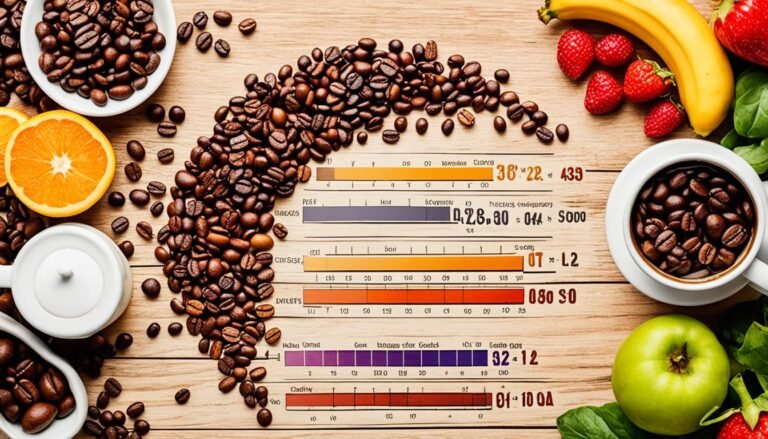
CGA retention by roast level
Approximate share of the green bean’s original CGAs remaining after roasting.
Midpoints of published ranges: green 100% baseline; light 70-90%; medium 50-70%; medium-dark ~45%; dark under 40%, with one Italian roast measured at 6.3% retention. Sources: Bioactive Compounds in Coffee review (PMC, 2026); International Journal of Food Science & Technology (2025). Ranges vary by origin, roast endpoint, and assay.
FAQ
Conclusion: what this means for your next bag
For a home brewer, the practical summary is short. If CGA matters to you, buy lighter. A light or light-medium roast retains roughly 70 to 90% of what the green bean started with, against under 40% for a dark roast . That is a composition difference you can act on at the shelf, without any claim that it will do anything to your health.
The flavor side is the more reliable payoff. Lighter roasts keep more acidity and origin character. Darker roasts trade CGA for melanoidins, body, and roast bitterness. Both are legitimate coffees. One is just a different chemical animal.
Your next step: buy one light roast and one dark roast single origin from the same roaster, brew both at the same brew ratio and water temperature, and taste them side by side on the same morning. You will learn more about CGA roast level in ten minutes than in another hour of reading. Start with our light roast picks and read the brewing method that matches your gear.
Better Coffee Starts With Better Answers.