Coffee Bloom: What the Bubbles Say About Your Beans
Quick Answer
A coffee bloom is the foam that rises when hot water first hits fresh grounds, caused mostly by carbon dioxide trapped inside the beans during roasting escaping all at once. A tall, dense, crackling dome usually means recently roasted coffee. A flat, silent bed usually means the beans have been degassing for months, or were ground long before you brewed. Standard practice is to pour about two to three grams of water per gram of coffee and wait 30 to 45 seconds .
Key Takeaways
- The Specialty Coffee Association, through scientific communicator Peter Giuliano, identifies bloom bubbles as CO2 released from the porous cell structure of roasted beans .
- Giuliano describes whole beans as reasonably fresh by a degassing standard for roughly three weeks after roasting, while ground coffee can lose much of its CO2 within about an hour of grinding .
- A 2026 evidence review by Coffearium reports freshly roasted beans may hold roughly 1 to 2 percent of their mass as trapped gas, and that as much as 75 percent of it can escape during and right after grinding .
- The same review found no consulted study that directly measured how bloom time or bloom water volume changes pour over extraction yield or flavor. The 30 second number is a convention, not a proven threshold .
- A 2020 study by Hargarten, Kuhn, and Briesen measured roughly 15 percent particle size growth in wet coffee grounds, mostly finished within four minutes. Some of the rising bed is swelling, not gas .
- The common bloom ratio is 2 to 3 grams of water per gram of coffee, so 30 to 45 grams for a 15 gram dose .
- Breville's Spiral Luxe Auto Pour Over, launched in late 2026 at $599.95 as of October 16, 2026, automates bloom timing and pause length for people who do not want to judge it by eye.
What exactly is coffee bloom, and why does it happen?
Coffee bloom is the rapid release of gas from wet coffee grounds in the first half minute of brewing. Roasting drives chemical reactions inside the bean that produce carbon dioxide, and that gas stays locked in the bean's porous cell walls until something sets it free. Hot water is very good at setting it free.

Here is the mechanism in plain terms:
- Roasting makes gas. Heat breaks down sugars and acids and produces CO2 inside the bean's cellular structure .
- Grinding opens the container. Cutting the bean into thousands of fragments exposes the trapped gas to air. Coffearium's 2026 review reports up to 75 percent of trapped gas can escape during and immediately after grinding in very fresh coffee .
- Water finishes the job. Hot water displaces the remaining gas, which pushes up through the bed as foam, lifting and cracking the surface .
Two things happen at the same time, and most brewing guides mention only one. Gas escapes, and the grounds themselves absorb water and swell. The 2020 Hargarten, Kuhn, and Briesen measurement of roughly 15 percent particle growth, largely complete within four minutes, means part of that rising bed is simply coffee getting bigger . The bubbles are the loud part of the story, not the whole story.
Why the bloom matters practically: CO2 is slightly acidic and physically pushes water away from the grounds. A bed full of escaping gas brews unevenly, because water follows the easiest path and skips the pockets still venting. Wetting everything first and pausing gives the gas a head start.
If this is your first serious pour over, our walkthrough of how to use the Bean Envy pour over coffee maker covers the equipment side.
Coffee bloom: what the bubbles say about bean freshness
A strong coffee bloom is a reasonable freshness signal, not a quality score. Fresh coffee generally produces a bigger bloom because more CO2 remains inside it . Stale coffee lies flat because the gas left weeks ago. That is the whole test.
What you can reasonably read from the bed:
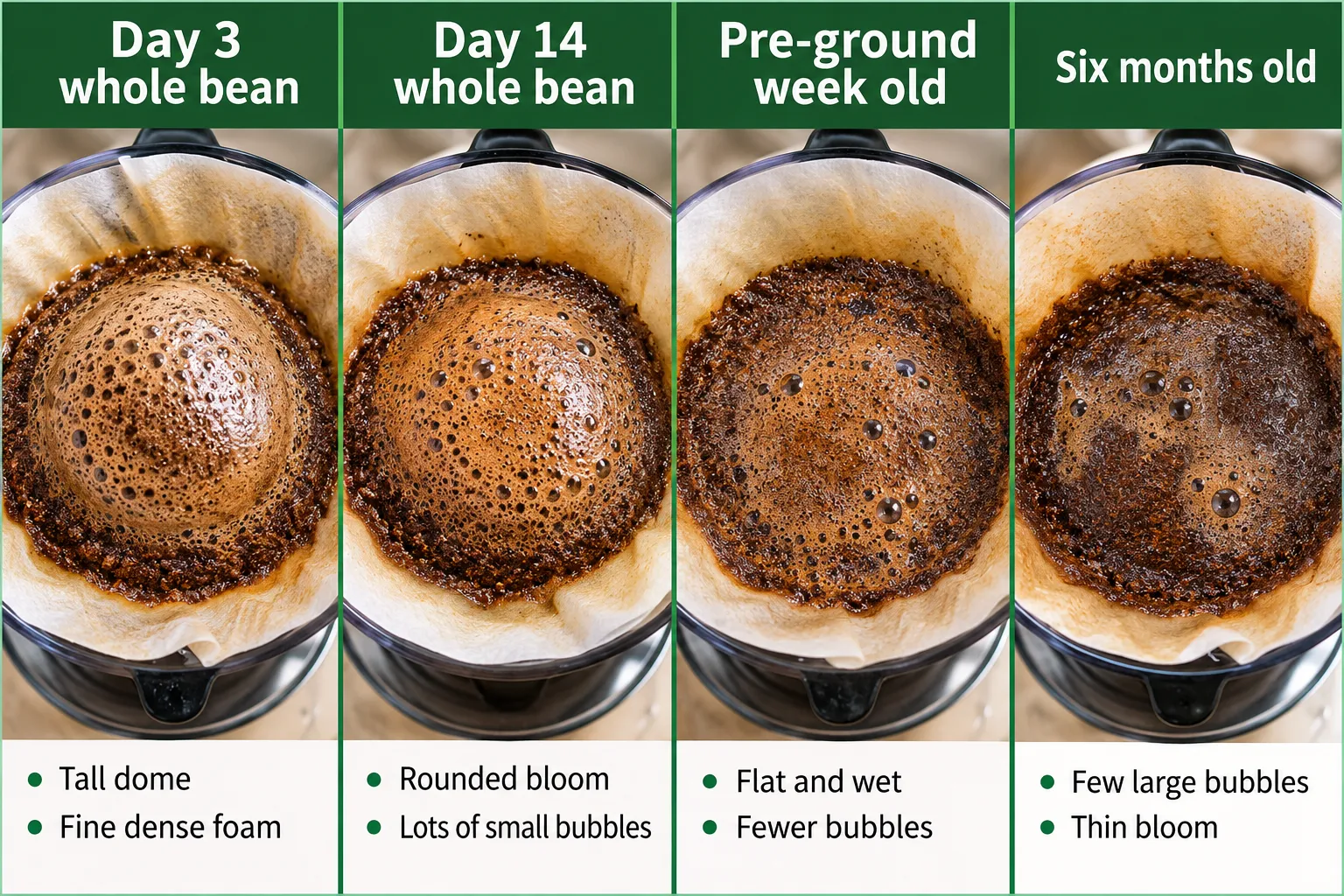
- Tall dome, fine dense foam, audible crackle. Recently roasted, probably within two to three weeks, ground moments before brewing.
- Modest lift, scattered medium bubbles. Three to six weeks post roast, or ground 15 minutes early. Still perfectly drinkable.
- Flat, wet, no movement. Months past roast date, or pre-ground coffee that degassed in the bag. The stale coffee test just came back positive.
What bigger bubbles versus smaller bubbles mean. Small, tightly packed bubbles that form a creamy crust usually indicate even wetting and finely distributed gas release, which is what you want. Large, sparse bubbles that pop quickly often mean water channeled through one area, or that coarse grounds are venting slowly from a few spots. Giant single bubbles bursting at the edge of the bed often point at a dry patch where water never reached. Swirl or stir the bloom and the problem usually disappears.
One honest limitation: bloom size tells you about gas content, not flavor. Robusta tends to hold more CO2 than arabica. Darker roasts hold more than lighter ones. A huge bloom from a scorched dark roast still tastes like a scorched dark roast. Treat the bubbles as a freshness instrument, and the cup as the verdict.
The misconception worth correcting
The widespread claim is that a 30 second coffee bloom is scientifically proven to improve extraction. Coffearium's 2026 review found no consulted study that directly measured how bloom duration or bloom water volume changes pour over extraction yield or flavor . The mechanism for degassing is well documented. The specific numbers are recipe convention passed between cafés and repeated online.
The bloom has two defensible jobs: wet the entire coffee bed, and let gas escape before the main pour. Everything past that is your recipe, not physics.
That does not make blooming pointless. It makes the timing flexible. If 25 seconds tastes better on your beans, 25 seconds is your answer.
How long should you let coffee bloom, and how much water should you use?
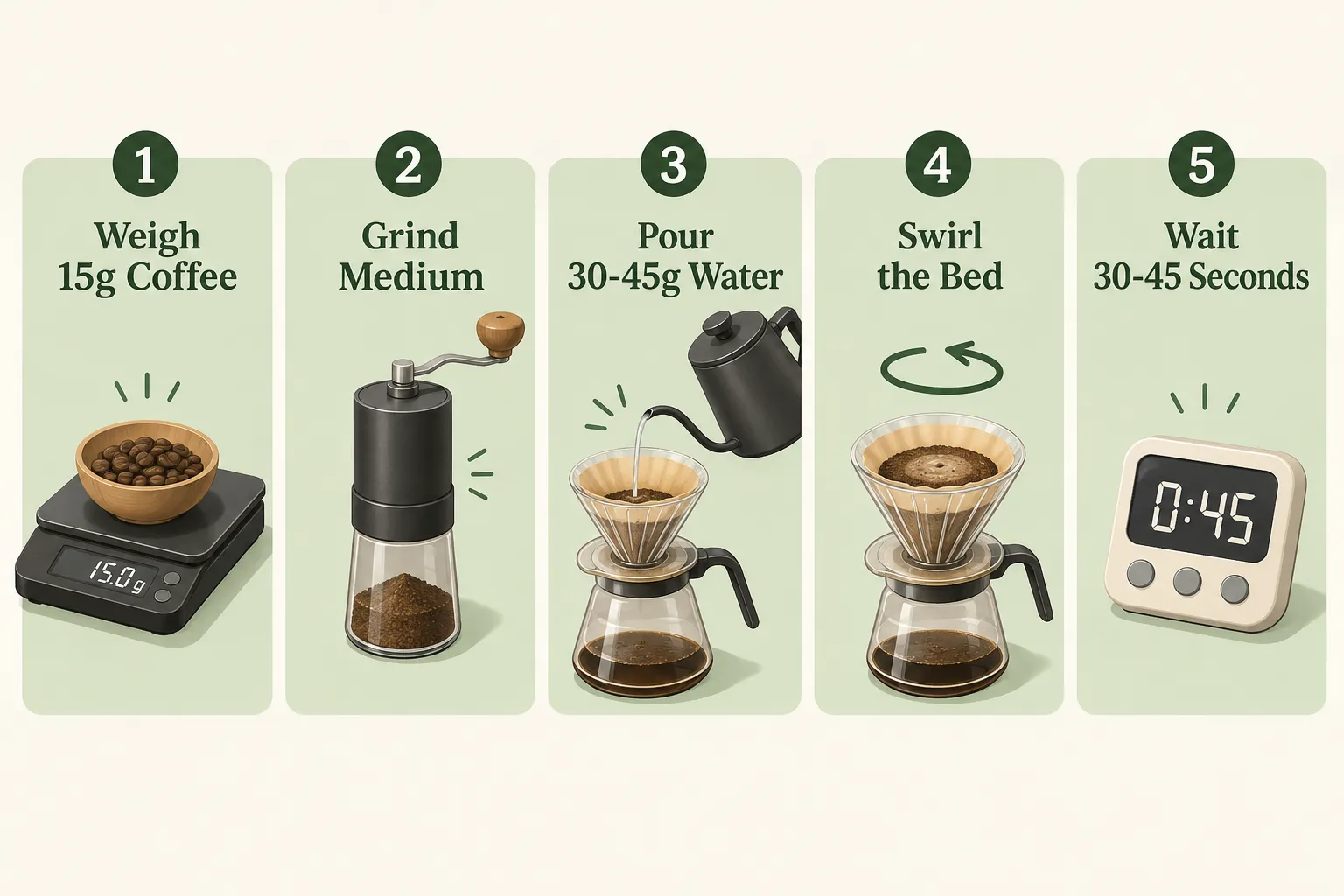
Use roughly 2 to 3 grams of water per gram of coffee and wait 30 to 45 seconds . For a 15 gram dose that is 30 to 45 grams of bloom water. For a 30 gram dose, 60 to 90 grams.
The bloom ratio has a floor and a ceiling. Too little water leaves dry pockets, which is the single most common pour over error. Too much water and coffee starts dripping into the carafe before the pause is over, which turns the bloom into just the first part of a normal pour. Enough to saturate, not enough to drain, is the target.
Practical adjustments:
- Very fresh beans, under 7 days off roast: go toward 3x water and 45 seconds. There is more gas to clear.
- Three to six weeks old: 2x water and 30 seconds is plenty.
- Dark roasts: they absorb water fast and vent hard. Add a few extra grams.
- Coarse grinds for a Chemex or large batch: stir or swirl gently rather than pouring more water.
Swirling matters more than most people expect. A short swirl of the dripper after the bloom pour settles the bed flat and wets corners the kettle missed. Many baristas now prefer it to stirring with a spoon, which can drive fines into the filter.
Water temperature should stay in the normal brewing range, around 195 to 205 F. Cooler water produces a visibly weaker bloom even with fresh beans, which is worth knowing before you blame the roaster.
Try the calculator below to get your bloom water in grams.
Bloom water calculator
Why does some coffee bloom more than others?
Bloom size depends on how much CO2 is still inside the beans, and four variables control that: days since roasting, roast level, grind timing, and storage. Origin and processing method play smaller supporting roles.
| Coffee condition | Expected bloom | What to do |
|---|---|---|
| Whole bean, 3 to 10 days off roast | Tall dome, dense crackling foam | 3x bloom water, 45 seconds |
| Whole bean, 2 to 4 weeks off roast | Steady lift, fine even bubbles | 2 to 2.5x water, 30 to 40 seconds |
| Dark roast, any recent date | Fast, dramatic, short lived | Extra few grams of water, swirl early |
| Light roast, dense beans | Slower, smaller, longer lasting | Finer grind, hotter water, 45 seconds |
| Supermarket pre-ground | Flat or barely visible | Skip the long pause, brew normally |
| Beans 4+ months, opened bag | None | Use for cold brew or replace |
Does coffee bloom work differently for light versus dark roasts?
Yes, and the difference is structural. Darker roasts are roasted longer, so they generate more CO2 and their cell walls are more fractured and porous. Water enters fast, gas leaves fast, and the bloom looks spectacular and collapses quickly. Light roasts are denser and less porous. They release gas more slowly, so the bloom is smaller and steadier even when the beans are only days old.
Decision rule: if you drink light roasts, do not judge freshness by bloom height alone. Compare your coffee to itself across weeks instead. A medium roast sits in the middle and gives the most readable bloom for a beginner.
Processing method contributes too. Natural processed coffees often read slightly differently in the cup than washed lots from the same region, and the outer layers of the coffee cherry are part of why. For bloom specifically, roast level and roast date dominate.
Why is there no bloom with my coffee, and can older beans be rescued?
No bloom almost always means the CO2 is gone. The three usual causes are an old roast date, pre-ground coffee, and water that is not hot enough. Grind size and brewer rarely cause a complete absence of bubbles.
Work through it in this order:
- Find the roast date. A "best by" date is not a roast date. If the bag only has a best by stamp 12 months out, assume the coffee is old.
- Check whether it was pre-ground. The SCA position is blunt: ground coffee can lose most of its CO2 within about an hour of grinding . Our comparison of whole bean versus ground coffee explains the tradeoff.
- Check your water temperature. Water straight off the boil then rested 30 seconds works. Water from a drip machine's warming phase often does not.
- Check storage. An opened bag folded over on the counter degasses fast. A proper airtight coffee storage container with a one-way valve slows the loss meaningfully.
Can you get a bloom from stale beans? Not really, and anyone selling you a trick is selling you a trick. The gas is gone, and nothing you do at the dripper puts it back. You can still brew stale coffee better:
- Grind one step finer to recover extraction lost to flat, tired grounds.
- Skip the long pause. Wet the bed, wait 10 seconds, start pouring.
- Raise water temperature to the top of the range, around 205 F.
- Lower the brew ratio slightly, using more coffee per gram of water, to rebuild body.
Freezing works going the other direction. Beans frozen airtight soon after roasting hold their gas, and many home brewers report a visible bloom from frozen beans months later. That is prevention, not repair.
What happens if you don't bloom, and can you over-bloom coffee?
Skipping the bloom with fresh coffee usually produces a thinner, slightly sour cup, because escaping gas blocks water from reaching parts of the bed and extraction comes out uneven . With stale coffee, skipping the bloom changes almost nothing, since there is no gas to interfere.
What goes wrong without a bloom:
- Dry pockets in the center or edges of the bed.
- Channeling, where water carves a fast path and over extracts one area while under extracting the rest.
- A faster total brew time than your recipe expects, giving weaker coffee.
Can you over-bloom? Yes, in two ways. If you pour too much bloom water, coffee starts dripping through and you have begun the brew without meaning to. If you pause far too long, say two or three minutes, the wet bed cools, the slurry temperature drops, and the remaining brew runs cooler than intended. That tends toward a flat, papery cup. Past roughly 60 seconds you are mostly losing heat, not gaining anything.
The practical window is 25 to 50 seconds. Beyond that, measure, taste, and decide for yourself. If you want the pause repeated identically every morning, that is one argument for an automated brewer. Breville's Spiral Luxe Auto Pour Over, released in late 2026 at $599.95 as of October 16, 2026, lets users set brew ratio from 1:10 to 1:20, water temperature, pause time, and the number of spiral pours, which makes the bloom reproducible without manual kettle skill. It is a premium price for consistency, and worth considering only if your current problem is repeatability rather than beans. Compare the models in our guide to choosing a coffee maker for your home.
Does the bloom actually change how your coffee tastes?
The mechanism supports it, and the direct evidence is thinner than most guides admit. Coffearium's 2026 review found no consulted study that directly measured bloom time or bloom water volume against pour over extraction yield or sensory outcome . What is well supported is that CO2 interferes with even wetting, and even wetting improves extraction consistency.
So the fair statement is this. Blooming reliably helps you saturate the bed. Even saturation reduces channeling. Reduced channeling gives a more even extraction, which most tasters prefer. That chain is plausible and widely practiced in cafés . The precise 30 second figure has not been isolated as the cause of a measured flavor change.
A useful home test, using the same beans, grinder, water, and ratio:
- Brew one cup with a 40 second bloom.
- Brew one with no bloom at all, pouring straight through.
- Taste both at the same temperature, about 10 minutes after brewing.
If you cannot tell them apart, your coffee is probably old enough that there was no gas to manage anyway. That result is information too.
Does coffee bloom matter for espresso and cold brew?
For espresso, no, not as a separate step. Pressurized brewing forces water through the puck in 25 to 30 seconds and there is no pause to give gas. Freshness still matters enormously for espresso, just expressed differently: very fresh beans, under about five days off roast, produce gassy shots that gush, taste sharp, and resist consistent timing. Most espresso drinkers find beans settle into a stable rhythm somewhere between 7 and 21 days post roast.
Signs you are seeing CO2 trouble in espresso rather than a grind problem:
- A thick, foamy crema that collapses into near nothing in 30 seconds.
- Shot times that move around by several seconds with no setting changes.
- Spritzy, carbonated sharpness on the tongue.
The fix is patience. Rest the beans a few more days. If you are still working out the differences between brewing styles, our breakdown of drip coffee versus espresso covers the extraction side.
For cold brew, blooming is largely irrelevant. Cold water releases CO2 slowly and the steep runs 12 to 24 hours, so any gas simply leaves over time. Some brewers pour a small amount of hot water over the grounds first to pre-wet them, which does help the grounds sink and hydrate evenly, but that is wetting, not blooming in the classic sense. Stale beans work acceptably in cold brew because the long contact time compensates for lost aromatics. Our beginners guide to cold brew coffee covers ratios and steep times.
FAQ

Conclusion: what this means for your morning
The bloom is the cheapest diagnostic tool in your kitchen. You do not need a refractometer to learn something useful about your beans. Pour 30 grams of water over 15 grams of fresh grounds, watch for 40 seconds, and the bed tells you roughly how long ago that coffee left the roaster. Flat bed, old coffee. Domed and crackling, you bought well.
Keep the limits in view. The 30 second convention is not a validated physical threshold , part of the rising bed is particle swelling rather than gas , and bloom height says nothing about whether you will enjoy the flavor. Use it for freshness, not for judging a roaster.
Your next step: check the roast date on the bag currently in your cupboard. If it is missing or more than eight weeks old, that explains more about your coffee than any brewing adjustment will. Start there, then read our guide to choosing the best coffee beans for home brewing. Better Coffee Starts With Better Answers.