Best Coffee Storage Container to Keep Beans Fresh Longer
Quick Answer
The best coffee storage container for most home drinkers is an opaque, airtight canister that blocks light, air, and moisture. For beans you plan to keep more than a week, the Fellow Atmos Vacuum Canister earns its price by pulling internal pressure down to roughly half an atmosphere, which cuts oxygen exposure by about half compared to a standard sealed jar. If you finish a bag within seven to ten days, a simple airtight coffee storage container under $20 works just as well.
Key Takeaways
- A good coffee storage container blocks light, limits air exchange, and holds a size close to your actual bean supply.
- Vacuum sealed coffee containers like the Fellow Atmos reduce oxygen exposure more than standard airtight jars, but the benefit matters most past the one-week mark.
- Coffee staleness comes from oxidation, moisture, and light, not from age alone.
- Glass shows off your beans but does nothing to block light unless it's tinted or kept in a cabinet.
- The fridge and freezer cause more harm than good for beans you'll finish within a month.
- Whole beans stored properly last two to four weeks at peak flavor; ground coffee fades in days.
- A one-way valve lets built-up carbon dioxide escape without letting outside air in, which matters for freshly roasted beans.
- Expensive containers earn their price through engineering you can verify, not through branding alone.
What Makes a Good Coffee Storage Container
A good coffee storage container does three jobs at once: it blocks light, slows air exchange, and fits the amount of coffee you actually buy. Miss any one of those and the coffee fades faster, regardless of how nice the container looks on the counter.
Coffee is a dried, roasted seed packed with volatile aromatic compounds. Those compounds are what give a fresh bag its smell of citrus, cocoa, or toasted nuts. Light breaks them down through a reaction called photo-oxidation. Air brings oxygen, which reacts with coffee oils and dulls flavor. Moisture invites mold and speeds staling. A best coffee storage container design solves all three problems, not just one.
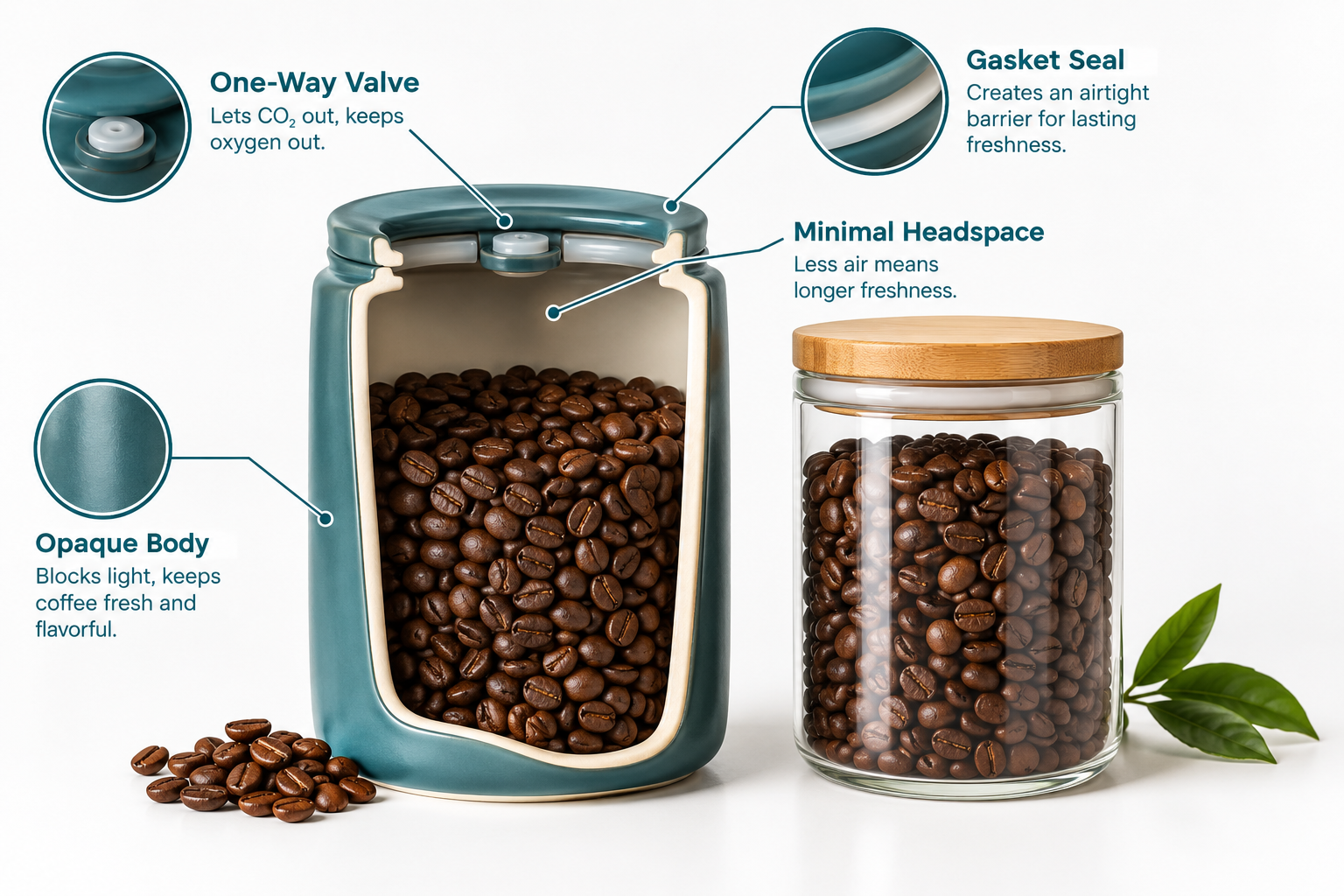
Look for these specifics before buying any coffee storage container airtight design:
- Opaque or dark material. Clear glass looks good on Instagram and does nothing for freshness unless stored in a dark cabinet.
- A real gasket seal, not just a snap-on plastic lid. Press the lid and listen for the seal, not just the click.
- A one-way valve or vacuum pump if you buy beans in bulk or subscribe to a roaster that ships every few weeks.
- A size that matches your habit. A container that's mostly empty air works against you (more on sizing below).
If you're still deciding which beans to buy before worrying about storage, our guide on how to choose the best coffee beans for home brewing is a useful place to start.
Best Coffee Storage Container Picks for Every Coffee Drinker
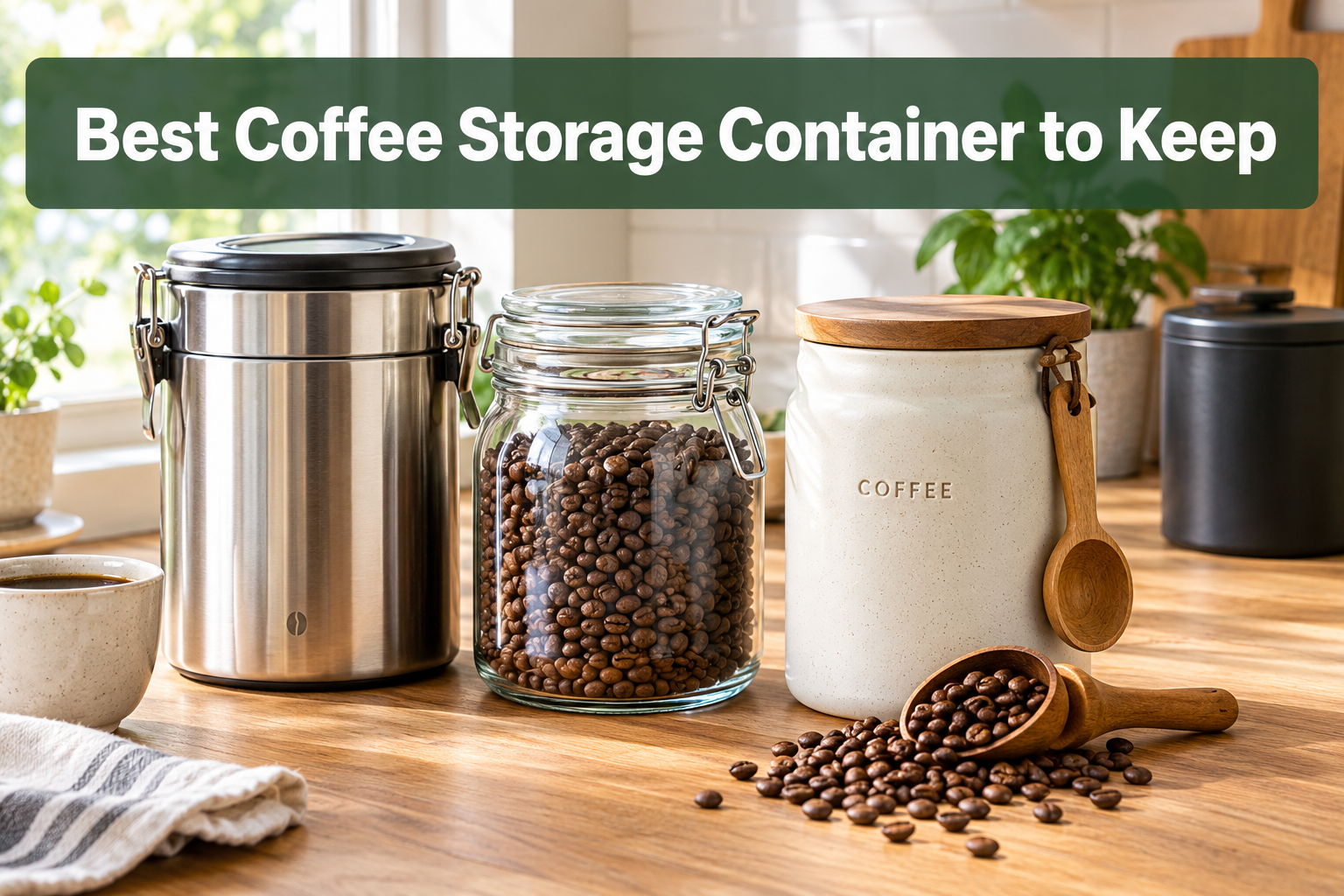
The best coffee storage container depends on how much coffee you keep on hand and how long it sits before you finish the bag. Below are picks for six common buyer types, based on published specs and documented reviews rather than in-house lab testing.
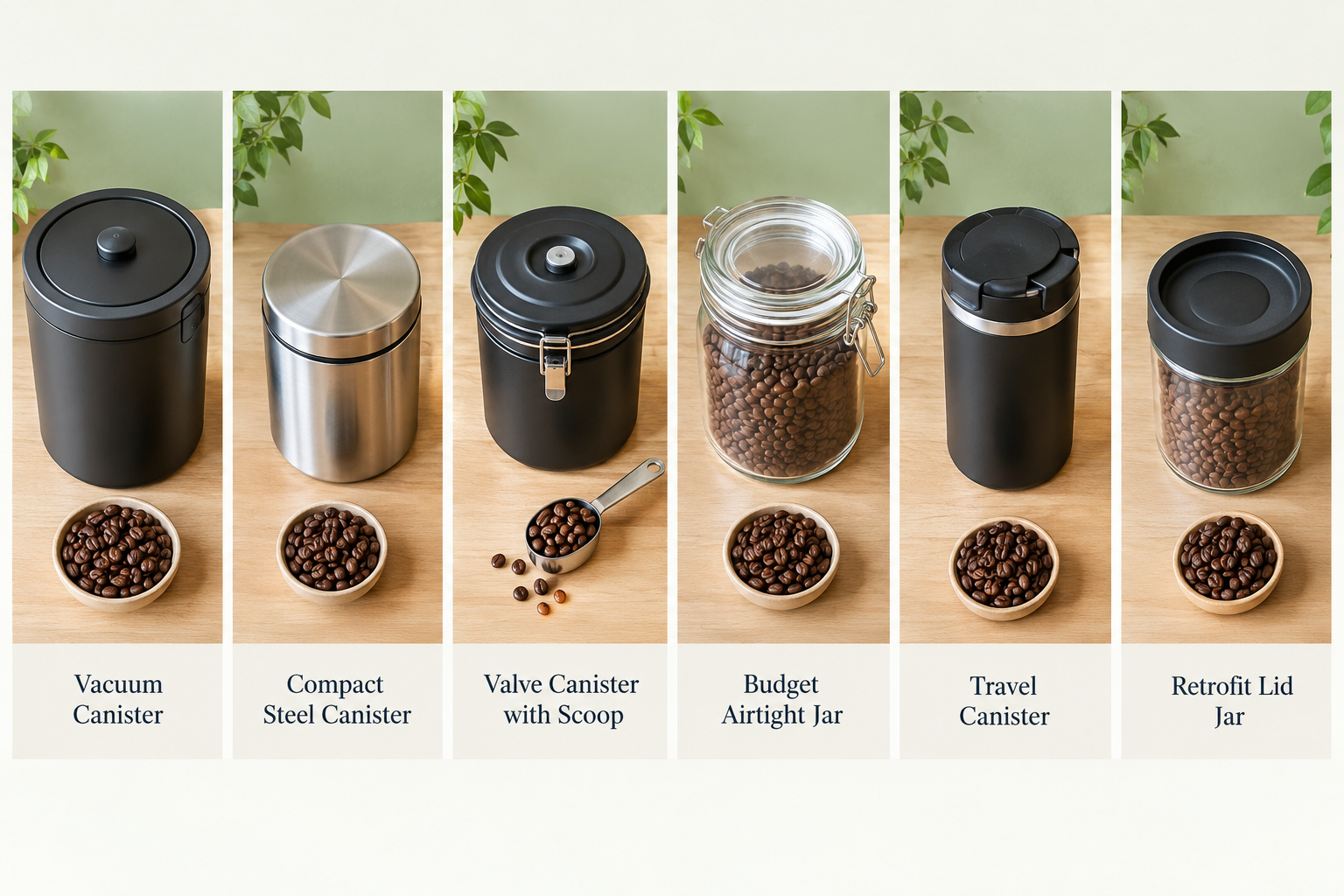
- Subscription drinker (beans for 2 to 4 weeks): Fellow Atmos Vacuum Canister. The electric version uses a USB-C rechargeable pump that automatically evacuates air and reseals when it senses air has gotten back in, which solves the common problem of forgetting to re-pump a manual seal. It comes in 0.4, 0.7, and 1.2 liter sizes, in steel or glass bodies.
- Budget buyer, spends coffee fast: an airtight jar under $20, like an OXO POP container. Simple, reliable, no batteries, and completely sufficient if you finish a bag within a week or two.
- Daily ground coffee user: Coffee Gator canister with a built-in scoop and one-way valve. A coffee canister with scoop setup removes the need for a separate spoon touching damp countertops, and the valve vents built-up gas from fresh grounds.
- Small kitchen, minimal counter space: Airscape coffee canister. Its inner disc drops down to press out air as you use beans, so the container shrinks its own headspace instead of sitting half empty.
- Travel, camping, or rough handling: Miir stainless canister. Dent-resistant steel body, no glass to crack in a duffel bag.
- Retrofit and ultra-budget: Friis lid. A silicone vacuum-seal lid that clips onto containers you already own, useful if you don't want to buy a whole new canister.
Comparison Table: Best Coffee Storage Container Options
| Container | Best for | Material | Seal type | Typical sizes |
|---|---|---|---|---|
| Fellow Atmos | Beans kept 2 to 4 weeks | Steel or glass | Electric or manual vacuum pump | 0.4L, 0.7L, 1.2L |
| Airscape | Small kitchens, daily use | Steel | Press-down inner disc, airtight | 4oz to 64oz |
| Coffee Gator | Ground coffee, daily grinders | Steel or glass | Gasket lid, one-way CO2 valve | 12oz to 22oz |
| OXO POP | Budget buyers, fast turnover | Plastic or steel | Push-button airtight seal | 1L to 4.4L |
| Miir | Travel, durability | Stainless steel | Gasket screw lid | 12oz to 16oz |
| Friis | Retrofitting existing jars | Silicone lid only | Manual vacuum pump lid | Fits standard mason jars |
Strengths and tradeoffs: The Fellow Atmos gives you the most documented oxygen reduction, but the electric pump adds a part that can fail, and Reddit user reports describe the vacuum fading after a few days or months when the filter clogs, especially with ground coffee. Airscape and Coffee Gator skip batteries entirely and are easier to clean. OXO POP and Friis cost less but rely on you finishing coffee quickly. Skip the Atmos if you drink ground coffee daily and finish a bag inside a week; the vacuum pump has less to work with and the filter clogs faster with fine particles.
For readers still choosing beans, see our buyers guide to choosing the right coffee beans for your recipes.
Why Does Coffee Go Stale and How Do You Prevent It
Coffee goes stale because oxygen reacts with coffee oils, aromatic compounds evaporate, and light breaks down flavor molecules. None of this happens instantly, but it's already running the moment beans leave the roaster.
Freshly roasted coffee also releases carbon dioxide for days after roasting, a process called degassing. That's why a bag of beans looks puffed up right after roasting and settles over the following week. A roast date stamped on the bag matters more than a "best by" date, because staling starts at roasting, not at purchase.
To slow the process:
- Buy whole beans, not pre-ground, whenever possible.
- Store in an opaque, airtight coffee storage container.
- Keep the container at room temperature, away from the stove and windows.
- Buy only what you'll drink in two to four weeks.
- Grind right before brewing.
Grind size and extraction both depend on fresh beans doing their job. If you want the deeper mechanics of extraction and grind, our advanced coffee storage and preservation guide covers it in more depth.
Airtight vs Vacuum Sealed Coffee Containers: Which Is Better
Vacuum sealed coffee containers reduce oxygen exposure more than standard airtight containers, but the difference only shows up clearly if you keep beans longer than about a week. For coffee finished within seven to ten days, a well-made airtight jar performs close enough that the vacuum feature won't be noticeable in the cup.
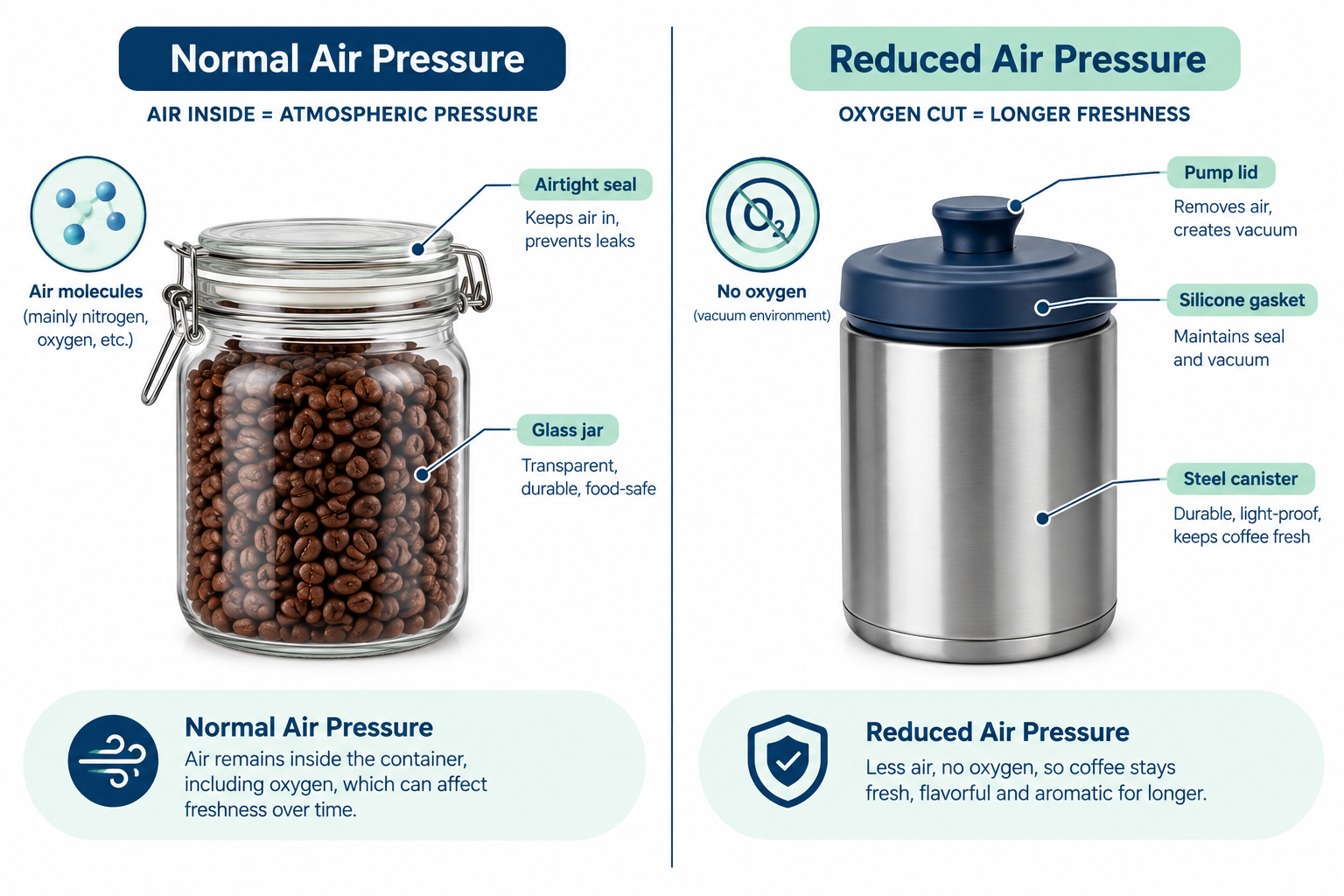
An airtight container blocks new air from entering after you close the lid. A vacuum sealed coffee container goes a step further by actively pulling existing air out. Fellow's own figures, cited across recent buying guides, put the Atmos vacuum level at roughly half an atmosphere, meaning it removes about half the oxygen a sealed jar would otherwise hold.
Decision rule: Choose vacuum if you buy beans in 12oz to 2lb batches and take three or more weeks to finish them. Choose plain airtight if you buy smaller bags or drink through coffee fast. The vacuum mechanism is also a moving part; some owners report the seal weakening after months of use, usually tied to a clogged filter, particularly when ground coffee dust gets into the pump. Cleaning the filter and switching to whole beans restores a stronger seal for most users.
Glass vs Plastic vs Stainless Steel Coffee Containers
Stainless steel and ceramic block light completely, glass blocks nothing unless tinted or stored in the dark, and food-grade plastic sits in the middle depending on thickness and additives. Material affects light protection and durability more than it affects the seal itself.
- Glass: Attractive, easy to clean, but useless against light unless it's amber, cobalt, or otherwise opaque, or kept inside a cabinet.
- Plastic: Lightweight and often the cheapest option. Can absorb odors over time and some cheaper plastics degrade with repeated washing.
- Stainless steel: Blocks all light, resists dents and cracks, and holds up well for travel. Slightly heavier and you can't see the fill level without opening the lid.
- Ceramic: Blocks light and holds temperature steadiness well, but it's breakable and heavier than steel.
Common mistake: buying a beautiful clear glass canister and setting it on an open counter under a window. It looks great in photos and lets in the exact thing that ages coffee fastest. If you love the look of glass, keep it inside a cabinet or choose a tinted version.
How Long Does Coffee Stay Fresh in Storage Containers
Whole roasted beans stored in a good airtight coffee storage container stay at peak flavor for roughly two to four weeks after the roast date, and ground coffee holds peak flavor for closer to one to two weeks once exposed to air. A vacuum sealed coffee container extends that window somewhat by slowing oxidation, but nothing stops staling entirely.
Coffee doesn't become unsafe to drink after these windows; it just tastes flatter, less aromatic, and sometimes slightly sour or papery. The flavor decline is gradual, which is exactly why many drinkers don't notice the loss until they brew a genuinely fresh bag side by side.
Quick example: a bag of medium roast beans opened on day one and kept in an Atmos canister might still show noticeable citrus or floral notes at day 20. The same beans in a loosely folded bag on the counter would likely taste duller by day seven.
Best Coffee Storage Containers Under $20
Several airtight coffee storage containers sell for under $20, and they're the right choice for anyone who finishes a bag of beans within a week or two. Look for a steel or ceramic body with a rubber gasket lid rather than a snap-fit plastic lid, since the gasket makes the biggest difference in that price range.
Brands like OXO POP and basic Coffee Gator jars regularly show up in this bracket, though prices shift with sales and retailer, so it's worth a quick check before buying. Check the current price on a couple of models before deciding, since a $5 difference sometimes buys a noticeably better gasket.
Decision rule: choose a budget container if you drink through a 12oz bag in under 10 days. Skip budget picks if you buy 2lb bags every few weeks; the freshness gap will show up in the cup by week three.
Can You Store Coffee in the Fridge or Freezer
Storing coffee in the fridge is not recommended for beans you'll finish within a month, because the fridge introduces moisture and odors that damage flavor faster than room temperature storage does. The freezer can work for long-term storage of beans you won't touch for several weeks, but only in a fully airtight, moisture-proof container, and only if you avoid repeated freeze-thaw cycles.
Here's why the fridge causes trouble: every time you open the container, cold coffee meets warm kitchen air, and moisture condenses onto the beans. That moisture speeds staling and can introduce off flavors from other foods stored nearby.
Edge case: if you've bought several bags at once during a sale and know you won't touch some of them for two months, portion those bags into small, fully sealed, labeled containers and freeze them untouched until the day you plan to use them. Thaw the whole portion once, use it, and don't refreeze.
What Size Coffee Container Do You Need
The right coffee container size matches your typical bag weight with minimal leftover air space, since too much empty headspace lets more oxygen sit against the beans. Most home drinkers do well with a container sized for 12oz to 16oz, matching a standard bag of specialty coffee.
- 12oz to 16oz bags: a 0.4L to 0.7L canister keeps headspace low.
- 2lb bulk bags: a 1.2L canister, or split the bag into two smaller containers to limit how much air touches unused beans.
- Households sharing one bag across multiple people: size up slightly, since the container gets opened more often.
Common mistake: buying one large container for every bag size. A half-full canister traps more air against the coffee than a container that's nearly full, which speeds up staling even with a good seal.
Common Mistakes When Storing Coffee Beans
The most common mistake in coffee storage is buying more beans than you can drink within a month and storing them somewhere convenient rather than somewhere dark, cool, and sealed. Convenience usually means a spot near the stove, a window, or inside the original bag with the top rolled loosely.
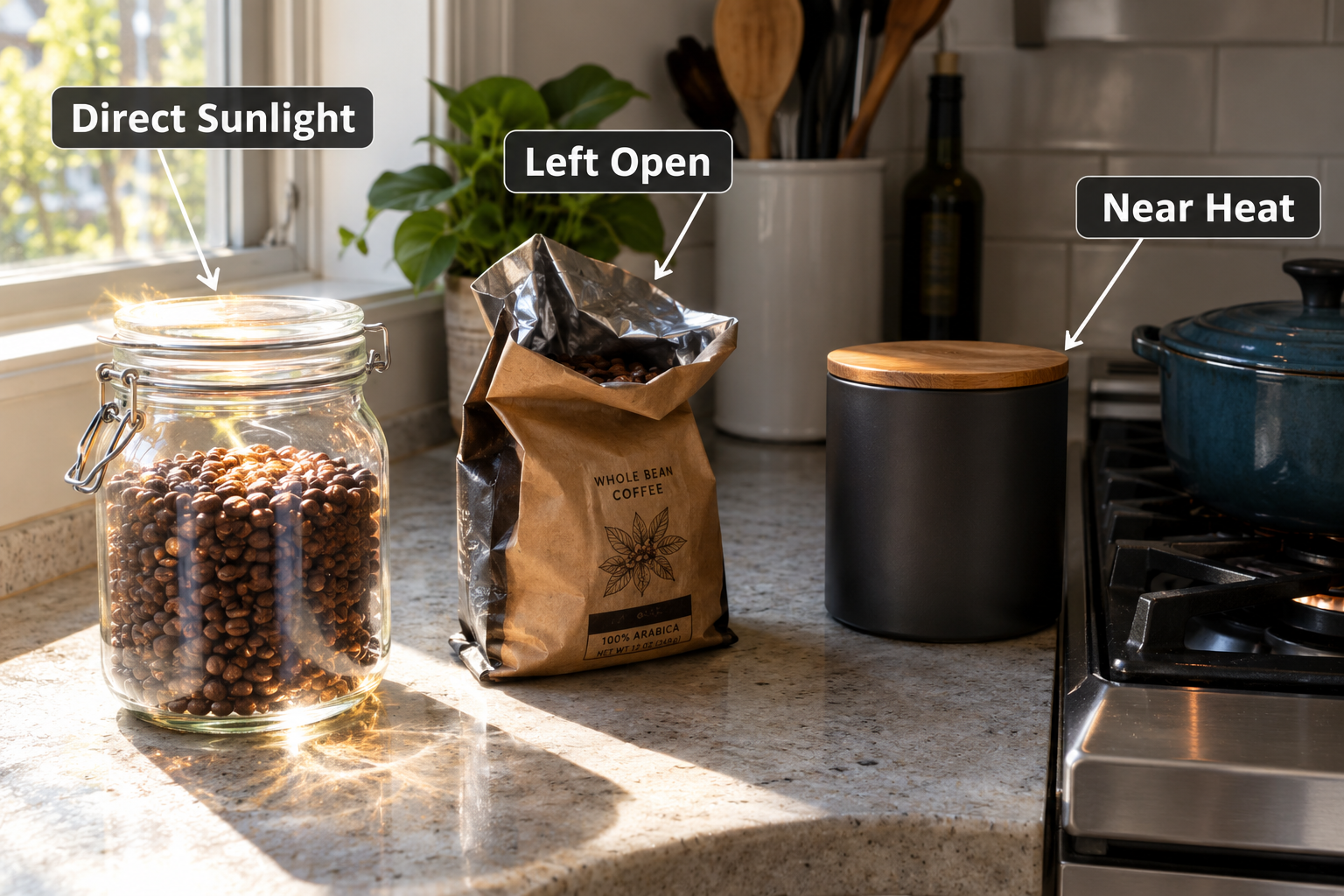
Other mistakes worth fixing:
- Leaving beans in a clear jar on display. Pretty, but light exposure adds up fast.
- Storing near the stove or oven. Heat speeds up every reaction that ages coffee.
- Grinding a whole bag at once "to save time." Ground coffee has far more surface area exposed to air, so it stales days faster than whole beans.
- Reusing a container without cleaning it. Old coffee oils go rancid and taint the next batch.
- Ignoring the roast date. A bag on sale because it's been sitting on a shelf for months is already partway to stale before you even open it.
Grind size matters here too. If you're dialing in a grinder for the first time, our top ways to grind coffee beans for a perfect brew walks through the basics.
Do Expensive Coffee Containers Actually Work Better
Yes, in specific and measurable ways, but only for people who keep beans longer than about a week. A vacuum sealed coffee container like the Fellow Atmos earns its higher price through a documented reduction in oxygen exposure, not through brand name alone.
The engineering that justifies the price includes a pump mechanism, a filter that needs occasional cleaning, and in the electric model, a rechargeable battery that automatically triggers re-sealing. That's real, verifiable added function. It's also a reason some owners report frustration: user reviews describe the vacuum weakening after repeated use if the filter isn't cleaned, especially with fine coffee grounds clogging the mechanism.
Decision rule: pay more for a vacuum canister if you genuinely keep beans past the one-week mark and are willing to clean the filter occasionally. Don't pay more if you're buying small bags and drinking through them fast, since a $15 airtight jar will taste nearly identical in that timeframe.
How to Know if Your Stored Coffee Has Gone Bad
Stored coffee has gone stale, not spoiled in a food-safety sense, when it smells flat or papery instead of aromatic, tastes dull or slightly sour, and no longer produces much bloom (the foamy rise when hot water first hits the grounds) during brewing. True spoilage, like mold, is rare in properly dried, sealed coffee but shows up as visible fuzz or a musty smell if moisture got in.
Quick checks:
- Smell test: fresh coffee smells sharp and specific (citrus, chocolate, nuts). Stale coffee smells muted or cardboard-like.
- Bloom test: pour hot water over grounds. Vigorous bubbling and rising means active gas, a sign of relative freshness. Little to no bloom suggests the beans have lost most of their carbon dioxide, a sign of age.
- Visual check: any fuzzy spots, discoloration, or clumping from moisture means toss it.
Stale coffee is still safe to drink. It just won't taste like much.
Whole Beans, Ground Coffee, Original Bags, and One-Way Valves
Best Coffee Storage Container for Whole Beans vs Ground
Whole beans need less protection than ground coffee because grinding multiplies surface area and speeds up oxidation, so the best coffee storage container for ground coffee usually needs a tighter seal and smaller size than one built for whole beans. If you have a choice, buy whole beans and grind just before brewing.
For ground coffee specifically, look for the best airtight container for ground coffee with a one-way valve and minimal headspace, since ground particles pack more surface area into the same volume and stale faster than intact beans.
Should You Store Coffee in the Original Bag or a New Container
Most specialty coffee bags already include a one-way valve and a foil-lined interior, which makes them a reasonably good short-term container on their own. Moving beans into a dedicated coffee storage container still helps if the bag's zip closure is weak, if you want to see remaining quantity at a glance, or if you're combining multiple bags.
Decision rule: keep beans in the original bag, rolled tightly and clipped, if you'll finish it within a week and the bag has a working valve. Transfer to a container if the bag lacks a good seal or you're storing beans for more than two weeks.
What Does a One Way Valve Do on a Coffee Storage Container
A one-way valve lets carbon dioxide escape from freshly roasted beans without letting outside air back in. This matters because beans continue releasing CO2 for days after roasting, and trapping all of that gas inside a fully sealed container can cause pressure buildup or a stale, flat taste from gas reabsorption.
Containers built for daily ground coffee use, like several Coffee Gator models, include this valve specifically because ground coffee off-gasses fast right after grinding.
FAQ
What is the single best coffee storage container for most people? An opaque, airtight canister sized close to your typical bag weight covers most needs. Add a vacuum feature like the Fellow Atmos only if you regularly keep beans longer than a week.
Do coffee storage containers with scoops actually help? A coffee canister with scoop design keeps a dedicated spoon inside the sealed environment, which means less exposure to moisture from hands or countertops and one less item to misplace.
Is stainless steel better than glass for storing coffee? Stainless steel blocks all light without needing extra storage tricks, while glass only works if it's tinted or kept in a dark cabinet.
Can I use a mason jar to store coffee? Yes, if it seals tightly and you keep it in a dark cupboard. A silicone lid like Friis can add a manual vacuum function to a jar you already own.
How often should I clean my coffee storage container? Wash it every time you switch to a different bag of beans, and dry it fully before adding new coffee, since leftover moisture and old oils speed up staling.
Does an expensive vacuum canister guarantee fresher coffee than a cheap airtight jar? No. It reduces oxygen exposure more effectively, based on published specs, but only shows a real advantage past about a week of storage, and it requires occasional filter cleaning to keep working.
Conclusion
Pick your best coffee storage container based on how long coffee actually sits in your kitchen, not on how good the canister looks next to the espresso machine. Fast drinkers who finish a bag in a week do fine with a $15 airtight jar. Subscription drinkers holding beans for two to four weeks get a measurable benefit from a vacuum sealed coffee container like the Fellow Atmos. Everyone benefits from buying whole beans, keeping the container dark and cool, and skipping the fridge unless you're freezing an unopened backup bag.
The single upgrade that helps every setup, expensive or cheap, is buying only what you'll drink soon and grinding right before brewing. Better coffee starts with better answers, and in this case, the answer is smaller bags and a tighter seal.
Keep Exploring Coffee Rank IQ
- Coffee Rank IQ home: reviews, brewing guides, and coffee science
- Best Light Roast Coffee for Bright, Fruity Cups
- Best Decaf K Cups That Taste Like Real Coffee
- Best Coffee Scale for Pour Over and Espresso…Timer Included
- Best Decaf Coffee That Still Tastes Like Coffee
References
- beanandburr.com/accessories/fellow-atmos-review
- www.triplebarcoffee.com/equipment/grinding/fellow-atmos-vacuum-canister-review
- www.thewaytocoffee.com/best-airtight-coffee-storage-containers
- www.amazon.com/Fellow-Canister-Storage-Integrated-Airtight/dp/B07PZ8KZ4G
- www.amazon.com/Fellow-Canister-Storage-Integrated-Airtight/dp/B082TYWNJQ
- www.amazon.com/Fellow-Canister-0-7liter-Integrated-Airtight/dp/B07NPMLLCZ
- print2webcorp.com/best-coffee-bean-storage-containers
- fellowproducts.com/blogs/learn/the-coffee-storage-container-with-highest-reviews
- www.amazon.com/Fellow-Canister-Storage-Integrated-Airtight/dp/B07PY4WXXV
- www.reddit.com/r/Coffee/comments/m26csb/fellow_atmos_coffee_canister_disappointment