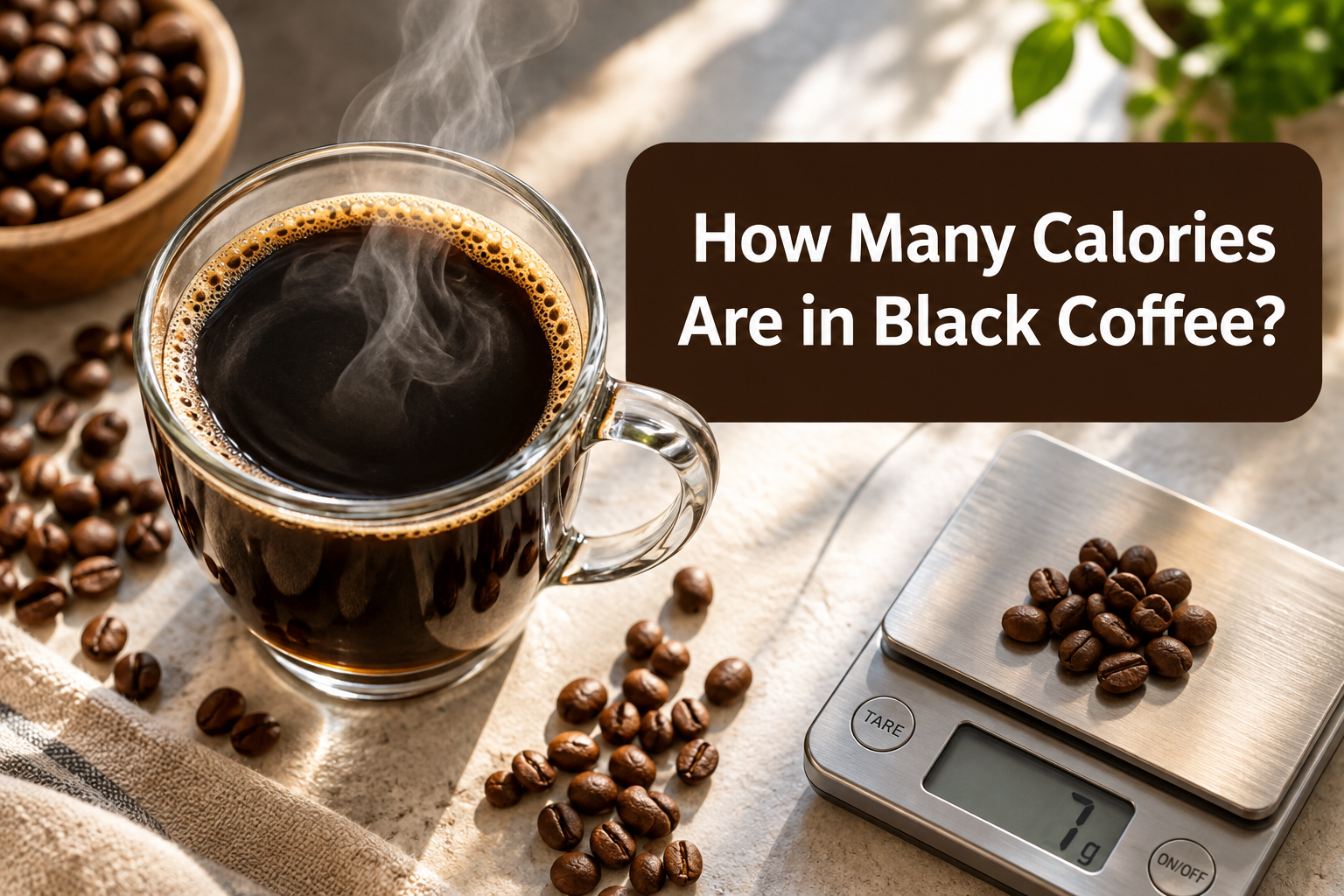
How Many Calories Are in Black Coffee? The Answer Changes Fast
Quick Answer
A plain 8-ounce cup of black coffee has about 2 calories, and most nutrition sources put the real range between 2 and 5 calories depending on brew strength and how the database rounds its numbers. That is the direct answer to how many calories are in black coffee, and it stays true whether you brew it hot, cold, or pull it as espresso, because those calories come from a trace of dissolved coffee solids rather than any fat, sugar, or protein.
Key Takeaways
- Black coffee calories sit around 2 to 5 kcal per 8-ounce cup across major nutrition references.
- Plain black coffee has 0 grams of fat, sugar, and carbohydrate, according to WebMD's nutrition data.
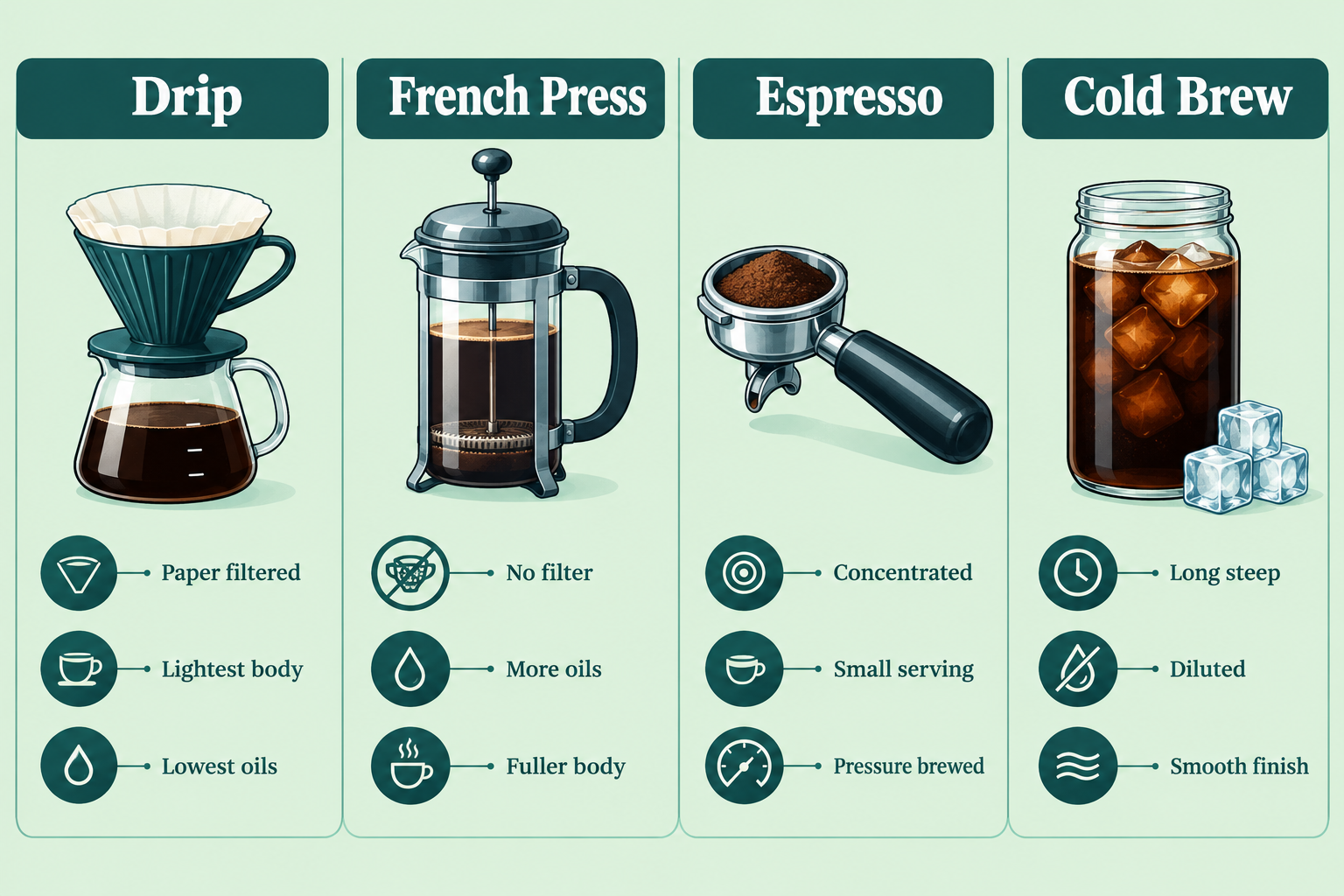
- Brew method changes the number only slightly. Espresso and French press run a bit higher per ounce than paper-filtered drip.
- Add-ins, not the coffee itself, are what push a cup toward 100 or 150 calories.
- Instant and fresh-ground black coffee land in the same 2 to 5 calorie range, because the calories come from dissolved solids, not the brewing tool.
- Black coffee is compatible with most fasting protocols because its calorie count is too low to trigger a meaningful insulin response for most people.
- Adding sugar, milk, or cream can turn a near-zero drink into a 100-plus calorie one in seconds.
What Is Black Coffee?
Black coffee is brewed coffee served with nothing added: no milk, no cream, no sugar, no syrup. It is just hot or cold water that has passed through or steeped with roasted, ground coffee beans, carrying with it caffeine, oils, and a small amount of dissolved solid matter.
That last detail, dissolved solid matter, is the whole story behind how many calories are in black coffee. Water itself has zero calories. Once it extracts flavor compounds from ground coffee, it picks up a tiny amount of energy-containing material along with the taste and aroma.
Black coffee covers a wide range of preparations: drip, pour over, French press, espresso, cold brew, and instant. All of them qualify as "black" as long as nothing is added after brewing. The complete beginners guide to pour over coffee is a useful place to start if you want to try a new method without changing your calorie count.
How Many Calories Are in Black Coffee?
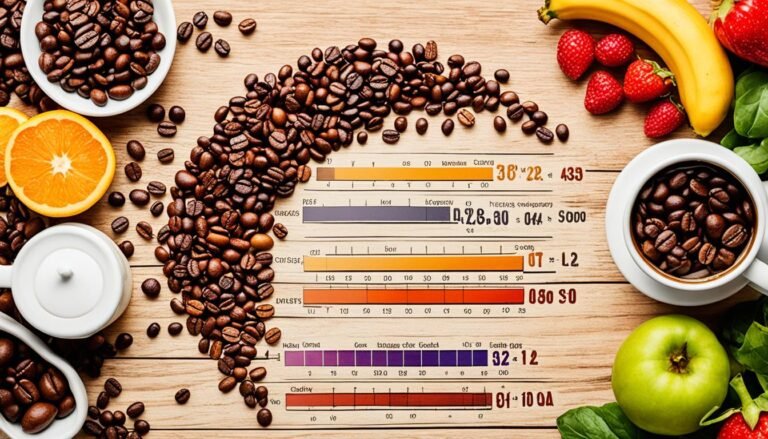
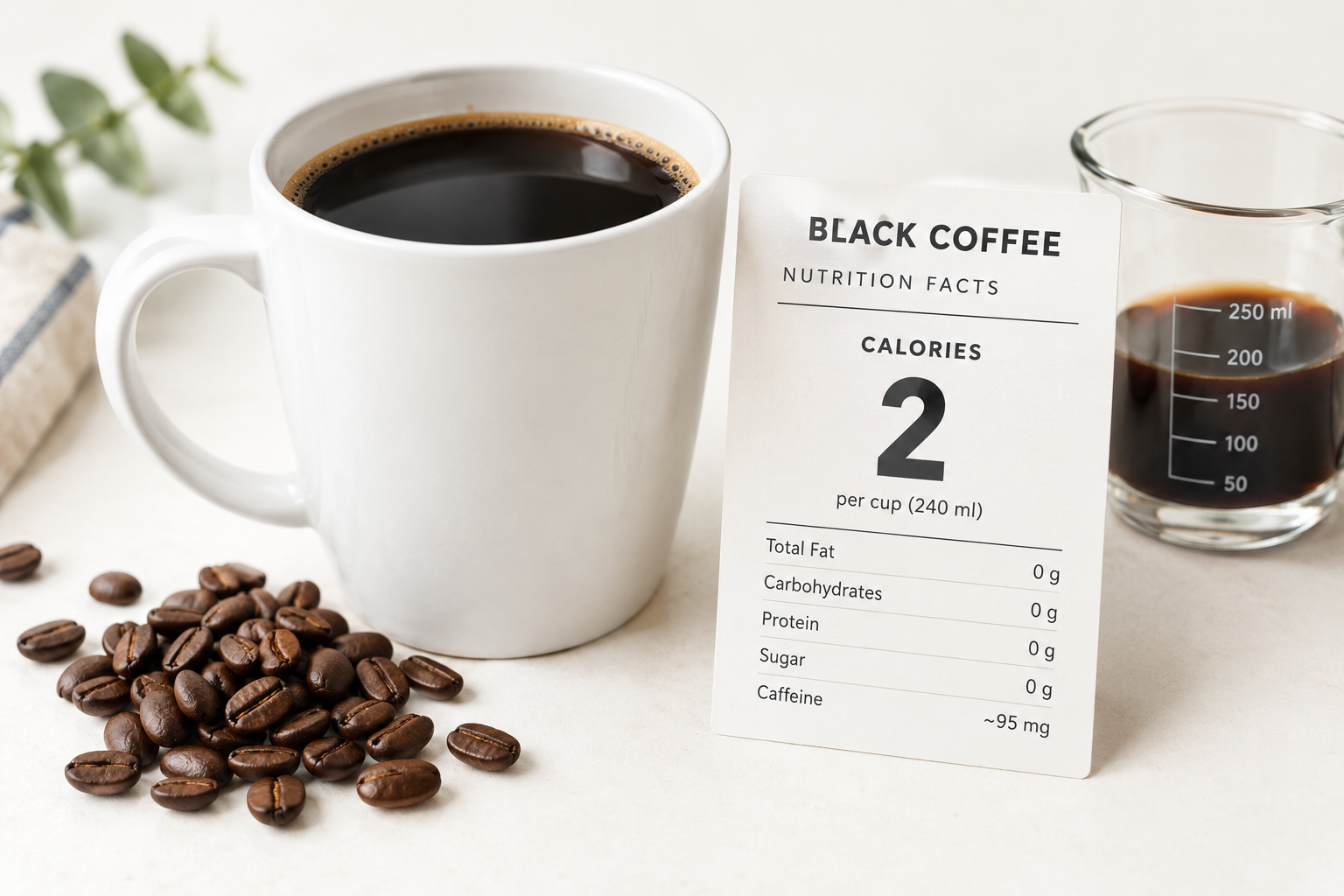
Black coffee has about 2 calories per 8-ounce cup, with most credible nutrition sources placing the real range between 2 and 5 calories depending on strength and rounding method. WebMD lists an 8-ounce serving of black coffee at 2 calories with 0 grams of fat, sugar, and carbohydrate. Healthline's coffee calorie table agrees, listing 2 calories for 8 ounces of black or iced black coffee.
Harvard's Nutrition Source describes a plain black cup of coffee as a very low-calorie drink, noting that 8 ounces contains just 2 calories. Coffee & Health, a science-focused industry resource, breaks it down even further: medium-strength black coffee runs about 1 to 2 kcal per 100 ml, which scales to roughly 2 to 5 kcal for a typical 200 to 250 ml cup.
So when someone asks how many calories are in black coffee, the honest answer is "almost none, and the small variation you see between apps is mostly rounding, not real metabolic difference." Redcliffe Labs and Apollo247, both updated in 2026, describe the same 8-ounce serving as landing in the 2 to 5 kcal window.
Black coffee nutrition facts at a glance:
- Calories: 2 to 5 kcal per 8 oz
- Fat: 0 g
- Sugar: 0 g
- Carbohydrate: 0 g
- Protein: trace, essentially 0 g
- Sodium: trace, generally under 5 mg
Is Black Coffee Actually Zero Calories?
No, black coffee is not literally zero calories, but it is close enough that most practical diet tracking treats it as free. A cup carries about 2 to 5 calories from dissolved coffee solids, a number so small it barely registers against a typical 2,000-calorie day.
Biology Insights puts it plainly: black coffee is "not technically zero calories, but close enough that it counts as calorie free by any practical standard". U.S. nutrition labeling rules also help explain the confusion. Foods and drinks under about 5 calories per serving are often legally rounded down to zero on a label, which is why some apps display "0" and others display "2" for the exact same cup.
Decision rule: if you are counting calories strictly for a medical reason, log black coffee at 2 to 5 calories rather than zero. If you are tracking loosely for general health, treating it as calorie-free will not meaningfully change your results.
Why Does Black Coffee Have Calories?
Black coffee has calories because hot or cold water pulls a small amount of dissolved coffee solids out of the grounds during brewing, along with oils, acids, and melanoidins created during roasting. Those dissolved solids carry a trace of energy, even though there is no fat, sugar, or protein in the traditional sense.
Coffee & Health notes that the macronutrient profile of black coffee is essentially absent: no meaningful fat, carbohydrate, or protein content, just a small quantity of extracted plant material. That is different from milk or sugar, which carry real, countable calories in gram amounts you can weigh on a kitchen scale.
This mechanism matters for one practical reason: how many calories are in black coffee depends almost entirely on how much coffee solid gets extracted, not on the water itself. Stronger extraction, more grounds, or longer contact time all pull slightly more dissolved solids into the cup, which is why brew method causes small shifts in the number.
Black Coffee vs Regular Coffee Calories
Plain black coffee and coffee with milk or sugar are nutritionally two different drinks, even though people call both "coffee." Black coffee without sugar or milk holds steady at 2 to 5 calories, while the same cup with common add-ins climbs fast.
Here is what actually drives the number up:
- Black coffee without sugar calories: 2 to 5 kcal per 8 oz, essentially unchanged from plain water plus dissolved solids.
- Black coffee with sugar calories: add about 16 calories per teaspoon of sugar, according to Biology Insights. Two teaspoons adds roughly 32 calories on top of the base 2 to 5.
- Black coffee with milk calories: 2 ounces of 2% milk adds about 30 calories, turning a near-free cup into a 32 to 35 calorie drink.
- How much calories in coffee with milk and sugar: stack both and a standard cup can land between 50 and 70 calories, still modest, but no longer close to zero.
- Cream instead of milk: 2 ounces of cream adds around 120 calories, which means "two sugars and a splash of cream" can push a single cup past 150 calories, closer to a light snack than a beverage.
The gap between black coffee calories and dressed-up coffee calories is the real story behind most people's daily intake. Plain espresso, drip, or pour over rarely causes a calorie problem. The flavored latte on the way to work usually does.
How Many Calories Are in Black Coffee With Different Brewing Methods?
Brewing method changes how many calories are in black coffee only within a narrow, single-digit range, because the underlying mechanism (dissolved solids) stays the same across methods. Filtration, contact time, and pressure shift the number slightly, but every common method still lands well under 20 calories for a normal serving.
Drink4Good's 2025 to 2026 breakdown gives a useful side-by-side view of a 12-ounce serving:
| Brew method | Serving size | Typical calories | Calorie range |
|---|---|---|---|
| Drip, paper filter | 12 oz | 3 | 2 to 5 |
| Drip, metal filter | 12 oz | 5 | 3 to 7 |
| Pour over | 12 oz | 3 | 2 to 5 |
| French press | 12 oz | 6 | 4 to 10 |
| AeroPress | 12 oz | 4 | 2 to 7 |
| Americano | 12 oz | 8 | 5 to 15 |
| Diluted cold brew | 12 oz | 6 | 3 to 10 |
Paper filters trap more of the oily compounds than metal filters, which is why paper-filtered drip and pour over sit at the low end. French press and metal-filter drip let more oil and fine sediment through, nudging the calorie count up a little, though still nowhere near what most people would call meaningful. If you want to compare setups directly, the advanced coffee brewing equipment buying guide walks through what each brewer actually does to the cup.
Black Coffee Calories: Cold Brew vs Hot
Cold brew and hot black coffee land in nearly the same calorie range, generally 2 to 10 calories per serving, because temperature does not change how many dissolved solids end up in the cup nearly as much as contact time and grind size do. Coffee-Bike's June 2026 explainer states that 250 ml of black coffee contains around 2 kcal regardless of hot or cold preparation.
Cold brew's long steep time (often 12 to 24 hours) can extract slightly more solid material than a quick hot brew, which is why some diluted cold brews land closer to 6 to 10 calories per 12 ounces rather than 2 to 5. Our advanced cold brew coffee methods guide and our how to make the best cold brew coffee guide cover the steep-time and ratio choices that affect strength, flavor, and this small calorie shift together.
Black Coffee Calories: Espresso vs Drip
Espresso carries more calories per ounce than drip coffee, but because a standard shot is so small, the total calories per serving stay close to drip. Cafely reports that a concentrated 8-ounce serving of straight espresso can reach around 20 calories, compared with 2 calories for an 8-ounce drip cup, but a typical 1-ounce espresso shot works out to roughly 2 calories once you account for the actual serving size.
That distinction matters if you are comparing an Americano (espresso plus hot water) to plain drip. Drink4Good lists Americanos at 5 to 15 calories for 12 ounces, a bit higher than paper-filtered drip's 2 to 5, because you are getting the concentrated espresso base diluted with water rather than a single, less concentrated extraction. If espresso is part of your routine, is espresso stronger than coffee? and is it better to drink espresso or coffee? cover the caffeine and flavor side of that comparison in more depth.
Black Coffee Calories: Instant vs Fresh Ground
Instant black coffee and fresh-ground black coffee carry roughly the same calorie count, because both rely on dissolved coffee solids rather than the brewing tool itself. Instant coffee is made from dried, pre-extracted coffee solids redissolved in hot water, so its calorie profile mirrors freshly brewed black coffee at about 2 to 5 calories per 8-ounce cup.
The practical difference between instant and fresh ground shows up in flavor and aroma, not calorie count. If you are choosing between the two for taste rather than calories, our guide to choosing the best ingredients for the top 10 coffee recipes has useful detail on how bean quality changes what ends up in the cup.
Black Coffee Calories Per Cup Size
Calories scale with volume in a fairly linear way: a 4-ounce cup runs about 1 to 2 calories, an 8-ounce cup runs about 2 to 5 calories, and a 16-ounce large mug or to-go cup runs about 4 to 10 calories, all still low compared with almost any other beverage. NutriScan's September 2026 update reports 2 kcal per 240 ml (about 8 oz) cup, consistent with this scaling pattern.
Quick rule of thumb: double the volume, and you roughly double the calorie count, but you are still doubling a number under 10.
Can You Drink Black Coffee While Fasting?
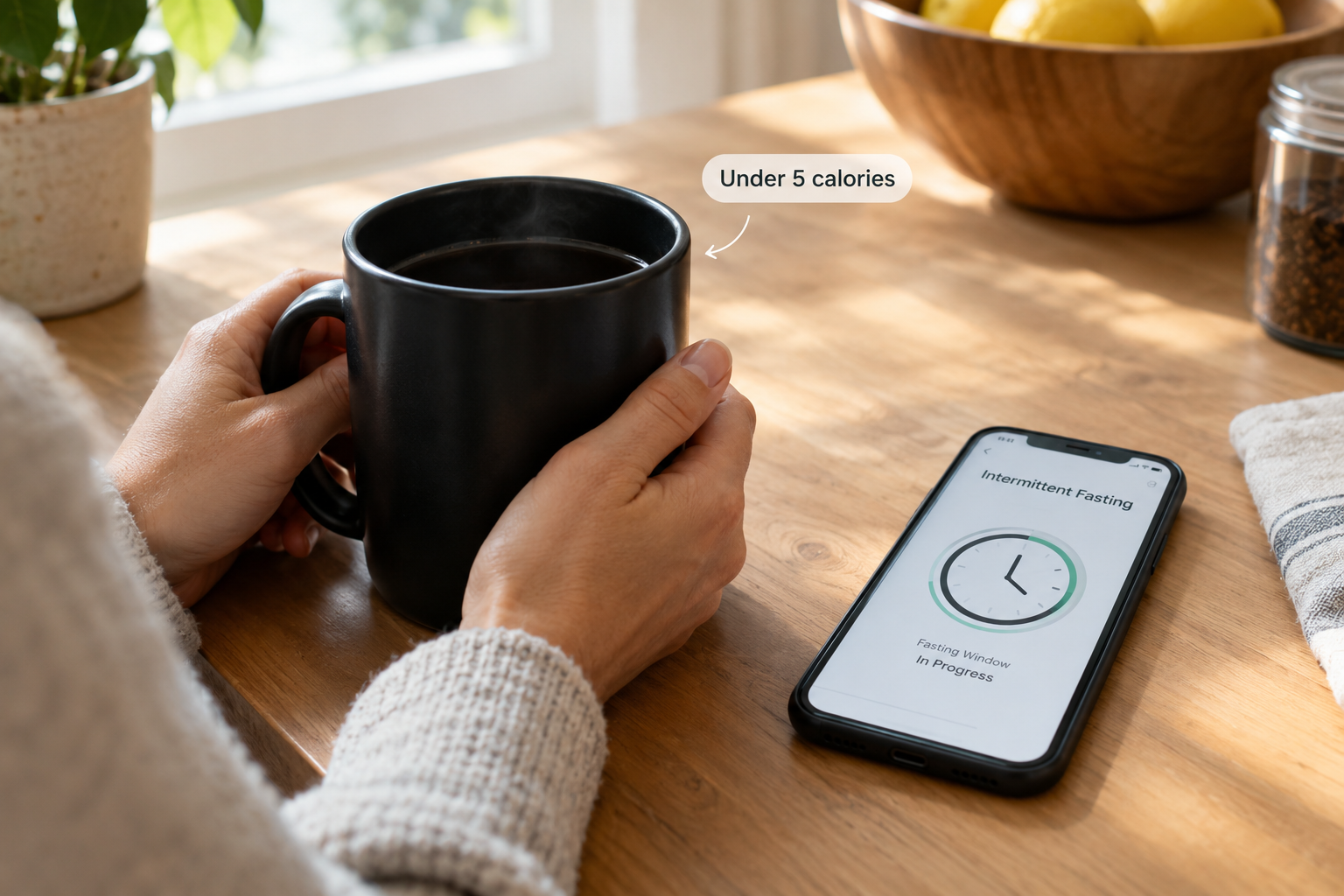
Yes, black coffee is compatible with most intermittent fasting protocols because its calorie count, 2 to 5 calories per 8-ounce cup, is too low to meaningfully break a fast for most people. Several 2026 nutrition guides tie black coffee's low calorie count directly to its use during fasting windows.
NutriScan notes that black coffee can boost metabolism by roughly 3 to 11%, largely due to caffeine's effect on the nervous system rather than any calorie contribution. That is a mechanism worth understanding: the reason black coffee fits a fasting plan is that its energy content rounds to almost nothing, not that coffee has some special fasting-friendly property beyond caffeine.
Does black coffee break a fast? For strict water-only or medical fasting protocols, technically yes, since 2 to 5 calories is still calories. For general intermittent fasting (16:8, 18:6, and similar), most practitioners and the guides cited above treat black coffee as fine, because the number is too small to trigger a significant metabolic response.
Common mistake: adding cream or sugar "just this once" during a fasting window. That single splash of cream can add 120 calories, which is enough to end a fast in a way plain black coffee never would.
How to Make Black Coffee Lower Calorie
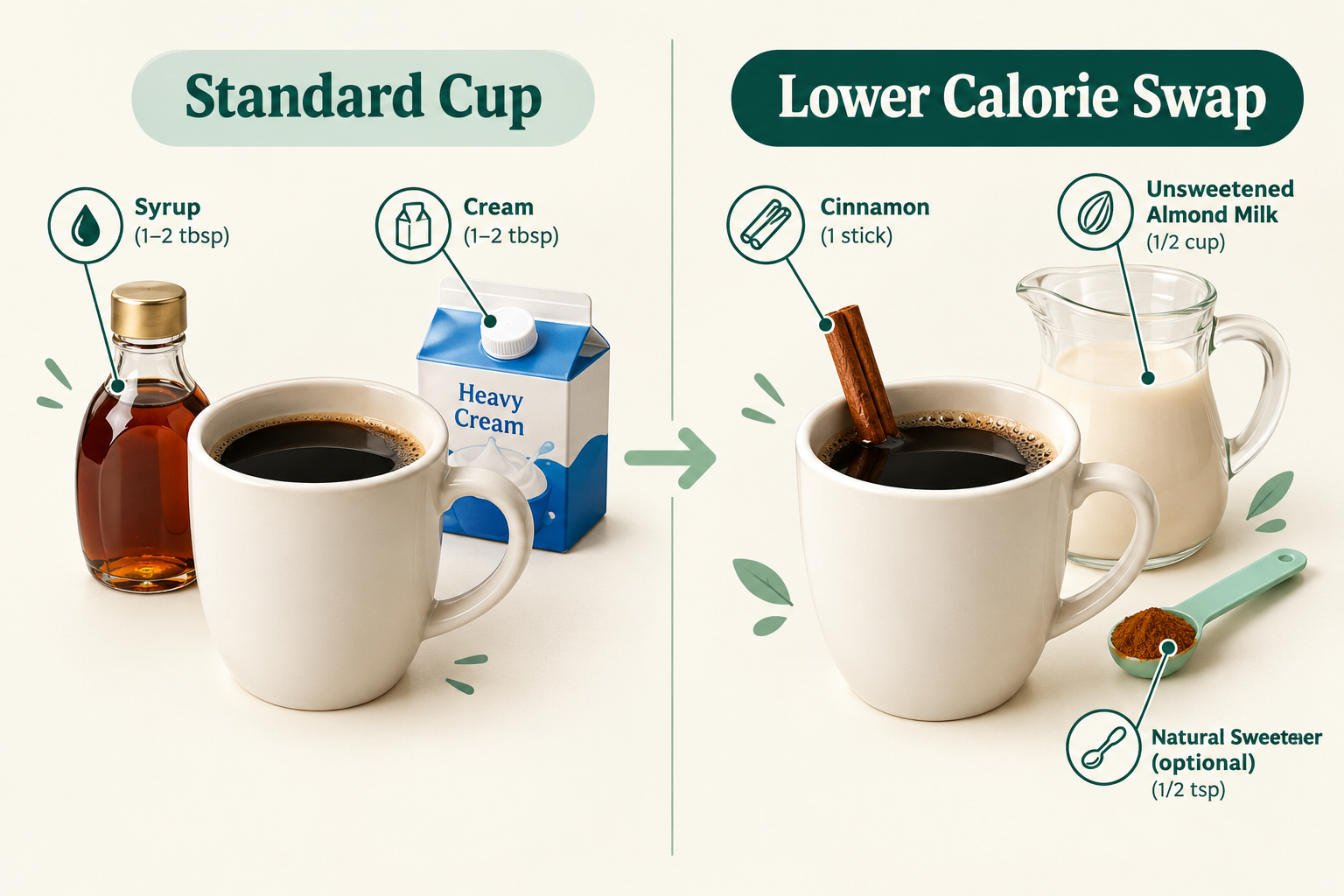
Black coffee is already close to calorie-free, so "lowering" it mostly means avoiding the additions that push the number up, rather than changing the brew itself. A few practical moves:
- Skip the syrup pump. Flavored syrups can add 20 to 50 calories per pump, far more than the coffee itself contributes.
- Swap cream for a splash of unsweetened plant milk. You still get some creaminess without the roughly 120 calories a 2-ounce pour of cream adds.
- Use cinnamon or vanilla extract instead of sugar. Both add flavor without meaningfully raising the calorie count.
- Brew with a paper filter if you use drip. Paper filtration traps more oil and sediment than metal, keeping the cup on the lower end of the 2 to 5 calorie range.
- Measure your grounds. A consistent brew ratio prevents over-extraction, which is one of the few brewing choices that actually shifts the calorie number, even slightly.
If you are working on your ratios and want a repeatable result, our guide covering best ways to perfect advanced coffee brewing is a good next stop.
Black Coffee Benefits Beyond the Calorie Count
Black coffee's real appeal is not its calorie count, which is already near zero, but what it does without adding sugar, fat, or extra calories to your day. WebMD highlights that black coffee's lack of sugar and fat makes it compatible with calorie-controlled and heart-healthy eating patterns, as long as you skip the high-calorie flavorings.
Some of the most commonly cited black coffee benefits in current nutrition writing include:
- Supporting alertness and focus through caffeine, without the calorie load of sweetened drinks.
- Fitting easily into calorie-controlled diets, since the base drink barely registers.
- Providing a modest, temporary boost to metabolic rate, in the 3 to 11% range reported by NutriScan, tied to caffeine rather than the coffee's calorie content.
- Working as a low-calorie alternative to soda, juice, or sweetened coffee drinks for people trying to cut daily sugar.
None of this changes the core fact at the center of this article: how many calories are in black coffee is a settled, boring, and genuinely good answer. The interesting part is what you add to it. For a broader look at where coffee fits into a healthy routine, see which coffee is best for health? and is it healthier to drink coffee or not?.
FAQ
How many calories are in black coffee? About 2 to 5 calories per 8-ounce cup, depending on brew strength and how the source rounds its numbers.
Does black coffee have any calories at all? Yes, a small amount, roughly 2 to 5 calories per 8-ounce cup, coming from dissolved coffee solids rather than fat, sugar, or protein.
How many calories are in black coffee with milk and sugar? Adding about 2 ounces of milk and a teaspoon of sugar can add roughly 45 to 50 calories on top of the base 2 to 5, based on estimates from Biology Insights for milk and sugar contributions.
Are espresso calories higher than drip coffee calories? Per ounce, yes, but per typical serving, they are close. An 8-ounce concentrated espresso serving can run around 20 calories, while a normal 1-ounce shot is closer to 2 calories, similar to an 8-ounce drip cup.
Can I drink black coffee on a low-calorie or fasting diet? Yes. Plain black coffee's 2 to 5 calorie range is low enough to fit almost any fasting or calorie-controlled plan, as long as you skip cream, sugar, and syrup.
Does the brewing method change how many calories are in black coffee? Slightly. Paper-filtered drip and pour over tend to sit at 2 to 5 calories per serving, while French press, metal-filter drip, and Americanos run a little higher, generally 5 to 15 calories, due to more oil and sediment passing into the cup.
Conclusion
Black coffee's calorie count is one of the few nutrition numbers that has stayed remarkably stable: about 2 to 5 calories per 8-ounce cup, no matter which recent source you check. The small variation you see between apps and articles comes from rounding and measurement precision, not from any real change in what is in your cup.
What actually changes fast is everything you add to it. A splash of cream, a pump of syrup, or two spoonfuls of sugar can turn a 2-calorie drink into a 100-plus calorie one before you finish stirring. If you want the benefits of coffee without the extra load, keep the mug plain, pick a brew method you enjoy, and save the milk and sugar decisions for when they actually matter to your day. Better coffee starts with better answers, and in this case, the answer is refreshingly simple.
Keep Exploring Coffee Rank IQ
- Coffee Rank IQ home: reviews, brewing guides, and coffee science
- Best Decaf Coffee That Still Tastes Like Coffee
- Drip Coffee vs Espresso: Caffeine, Flavor, and the Real Difference
- Used Coffee Grounds: Which Plants Love Them…and Which Don't
- Best Coffee Maker With Grinder: Fresh Grounds Without an Extra Gadget
References
- redcliffelabs.com/myhealth/food-and-nutrition/black-coffee-calories-health-benefits-weight-loss-and-nutrition-facts
- calceat.app/blog/calories-in-coffee
- www.webmd.com/diet/health-benefits-black-coffee
- nutriscan.app/calories-nutrition/black-coffee
- coffee-bike.com/en/about-us/news/blog/how-many-calories-does-your-coffee-contain
- cafely.com/blogs/info/calories-in-black-coffee
- drink4good.com/how-many-calories-are-in-12-oz-of-black-coffee
- www.apollo247.com/health-topics/general-medical-consultation/black-coffee-nutritional-information-and-effects
- www.healthline.com/nutrition/coffee-calories