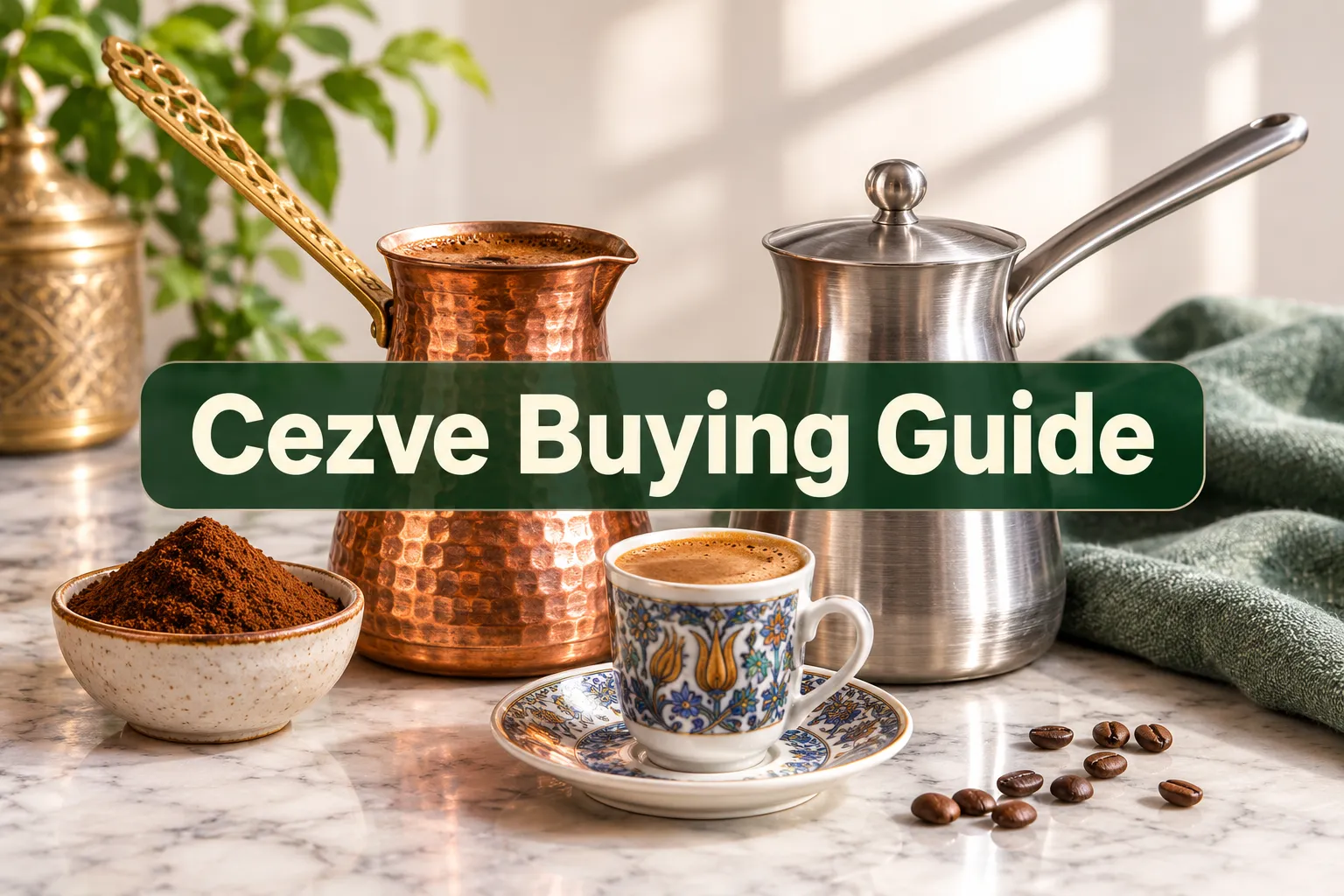
Turkish Coffee Pot Guide: Copper or Stainless Cezve
Quick Answer
Buy a copper turkish coffee pot if you want faster heat response and traditional foam control, and buy stainless if you own an induction hob or hate upkeep. Size matters more than metal: a cezve should be filled to roughly two thirds, so match the pot to the number of cups you actually brew. On Amazon, checked November 5, 2026, a handmade 1mm DEMMEX copper cezve listed at $43.99 (4.6 stars, 1,853 ratings) and a 24oz stainless model with a lid listed at $20.50. Both make excellent coffee when the heat is low and the pot comes off before a full boil.
Key Takeaways
- Copper for control, stainless for upkeep. Copper heats and cools quickly, which helps you lift the pot the second foam climbs the neck . Stainless skips lining wear and usually tolerates a dishwasher .
- Price check, November 5, 2026 (Amazon): DEMMEX 1mm handmade copper $43.99 (1,853 ratings), 24oz stainless with lid $20.50 (400+ bought per month), budget copper $17.99 (852 ratings).
- Induction kills traditional copper. Copper is nonmagnetic and will not heat on an induction cooktop. Stainless works only if the base is flat and magnetic, so test it with a fridge magnet .
- Unlined copper and coffee do not mix. The FDA Food Code 2026 prohibits unlined copper contacting foods below pH 6, and brewed coffee measures around pH 4.85 to 5.10. Buy tin-lined or stainless-lined only.
- Shape beats metal for foam. The wide base and narrow neck concentrate foam at the opening. A wide-mouth stainless pot will foam worse than a well-shaped stainless cezve.
- Target temperature is 88 to 92°C over 2.5 to 3 minutes, per the EU's 2025 traditional specialty specification for Turkish coffee. Full boiling flattens the foam and sharpens the flavor.
- Cezve and ibrik are the same pot in common usage. "Cezve" is the Turkish word, "ibrik" is more commonly used in English-language retail listings.
What is the difference between a copper cezve and stainless steel?
Copper conducts heat about 15 times faster than stainless steel, so a copper turkish coffee pot reacts the instant you move it off the flame. Stainless holds its heat longer, which is forgiving in a different way: it climbs slower and gives you a wider window before foam rises, but it also keeps cooking after you lift it.

That single difference drives almost every other tradeoff.
| Feature | Copper cezve | Stainless cezve |
|---|---|---|
| Heat response | Fast up, fast down. Best for pulling at the exact foam moment | Slower both directions, more thermal lag |
| Lining | Tin lining, wears over years and needs retinning | No lining to fail |
| Induction | Will not work (nonmagnetic) | Works only if base is flat and magnetic |
| Dishwasher | No, hand wash only | Usually yes |
| Typical Amazon price (Nov 5, 2026) | $17.99 to $43.99 | around $20.50 for 24oz with lid |
| Look | Hammered, engraved, gift-worthy | Plain, functional, kitchen-neutral |
)
The practical version: if your stove is gas or an electric coil and you like watching a pot, copper rewards attention. If you cook on induction, or the pot lives in a shared kitchen where somebody will eventually throw it in the dishwasher, stainless is the sane purchase.
Decision rule: choose stainless if more than one person in the house will wash it.
Turkish coffee pot buying guide: is copper or stainless steel better?
Neither metal makes better coffee by itself. Heat management and grind do. The pot's job is to let you control the climb and catch the foam, and both metals can do that in a properly shaped cezve .
Independent 2026 comparisons describe stainless as somewhat slower and less even in heat transfer, yet capable of comparable foam when used over low heat and removed promptly . Copper's advantage is timing. Turkish coffee can go from "rising nicely" to "all over the burner" in about four seconds, and copper's responsiveness buys you back some of that margin .
Five features we love in a good cezve
- A narrow neck with a flared pouring lip. The constriction traps rising foam near the opening instead of letting it spread and collapse. Payoff: thicker crema in the cup, less overflow.
- 1mm hammered copper body (as on the DEMMEX model, $43.99 on Amazon, checked November 5, 2026). Thicker walls spread heat more evenly across the base, so you get fewer scorched patches of grounds.
- A long, heat-isolated handle (brass or wood). You will lift this pot two or three times mid-brew. A short metal handle means a tea towel every single time.
- A tin lining you can actually see. Shine a light inside. A bright, continuous silver surface means the acidic brew never touches raw copper, which matters because the FDA Food Code 2026 still bars unlined copper from foods below pH 6, and coffee sits near pH 5.
- A flat, magnetic base on stainless models. This is the only thing that makes a stainless turkish coffee pot induction-ready. Material labels alone do not guarantee it .
What to watch out for
- Thin stamped copper. Budget pots around $17.99 often use thinner walls that develop hot spots. They work, they just scorch more easily on a strong burner.
- Pots sold by volume, not by servings. A "24oz" listing sounds generous and is actually too big for one Turkish cup.
- Decorative engraving over the lining seam. Beautiful outside, irrelevant inside. The lining is what you are buying.
- Lids. Mostly pointless for brewing. Turkish coffee is brewed open so you can watch the foam.
- Dishwasher damage on copper. Detergent dulls the exterior and can attack the tin. One cycle is usually enough to ruin the finish.
How do you actually use a turkish coffee pot?
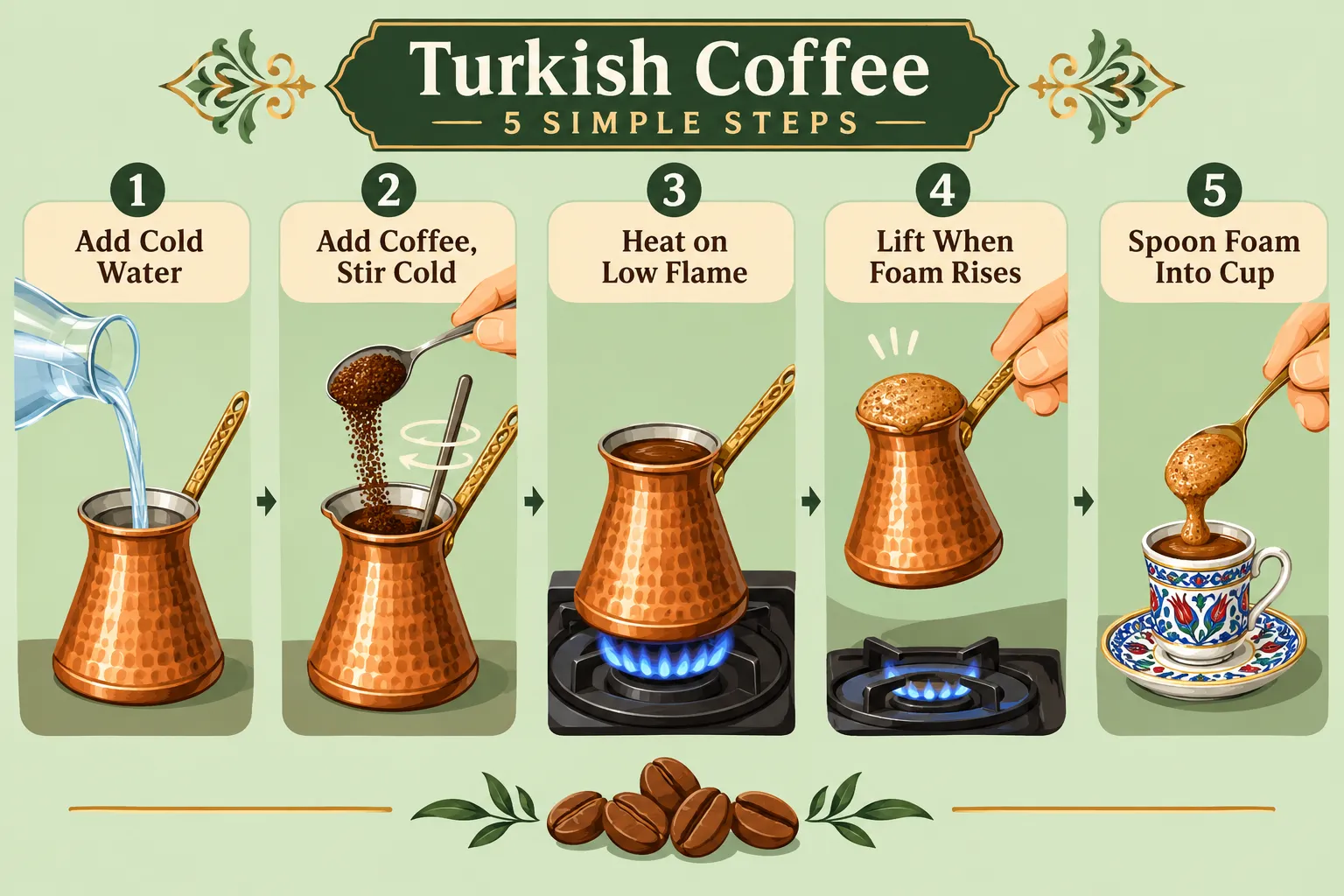
Grind the coffee to a flour-fine powder, mix it with cold water in the cezve before any heat, then cook it slowly over low heat without stirring until foam rises at the neck. Pull it off, pour, and serve with the grounds settling in the cup.
)
A 2023 peer-reviewed study on regional Turkish coffees used a clean working ratio: 8 g of coffee to 70 g of room-temperature water, cooked over medium heat for 2 to 2.5 minutes without stirring, then removed before boiling. The EU's 2025 traditional specialty specification puts the target at 88 to 92°C reached within 2.5 to 3 minutes, and states plainly that the coffee should not be fully boiled, because excess temperature produces off flavors and poor foam.
How to use a cezve, step by step
- Measure cold water into the demitasse cups you will serve in, then pour that water into the cezve. This is the oldest and most reliable way to size a batch.
- Add coffee at roughly 1 heaped teaspoon (7 to 8 g) per cup, plus sugar now if you want it. Turkish coffee is sweetened during brewing, never after.
- Stir once while cold until there are no dry clumps floating on top. Then put the spoon down for good.
- Set the pot over low heat. Low is not a suggestion. The slow climb is what builds the foam layer.
- Watch the neck. At around two minutes a ring of dark foam starts creeping up the inside wall.
- Lift the pot the moment the foam domes. Spoon a little foam into each cup first, return the pot to the heat for 10 to 15 seconds, then pour the rest slowly down the side of the cup.
- Let it rest 30 seconds so the grounds settle. Do not drink the last sip.
UNESCO's description of Turkish coffee culture, inscribed on the Representative List of the Intangible Cultural Heritage of Humanity in 2013, treats the cezve as part of the method itself: fine grind, cold water, slow brewing, foam. The pot is not just a container.
If your grinder cannot reach powder fineness, that is the first thing to fix. A quality hand grinder like the one covered in our VSSL JAVA manual hand grinder guide gets closer than most blade grinders ever will, though Turkish fineness pushes nearly every burr set to its limit.
What size cezve do I need for how many people?
Size the pot so a full batch fills it to about two thirds. A standard Turkish cup is roughly 60 to 70 ml, so a 2-cup cezve lands near 150 to 200 ml total capacity, a 4-cup near 300 to 350 ml, and a 6-cup near 450 to 500 ml.
An oversized pot is the most common reason home brews never foam properly. With too little liquid, the surface sits down in the wide part of the body where foam has room to spread and break instead of being funneled through the narrow neck. That geometry is documented in craft and cultural studies of the cezve shape, and it is why a 24oz pot brewing one cup will disappoint you every time.
Cezve size servings, practical version:
| Cezve capacity | Comfortable servings | Best for |
|---|---|---|
| 150 to 200 ml | 1 to 2 cups | Solo drinker, daily use |
| 250 to 350 ml | 3 to 4 cups | Couples, occasional guests |
| 450 to 500 ml | 5 to 6 cups | Hosting, family gatherings |
Common mistake: buying the 6-cup pot "for when people come over" and then brewing one cup in it 360 days a year. If you entertain, own two pots. A $20.50 stainless cezve as a second, larger pot costs less than a bag of good beans.
Can you use a turkish coffee pot on an electric stove or induction?
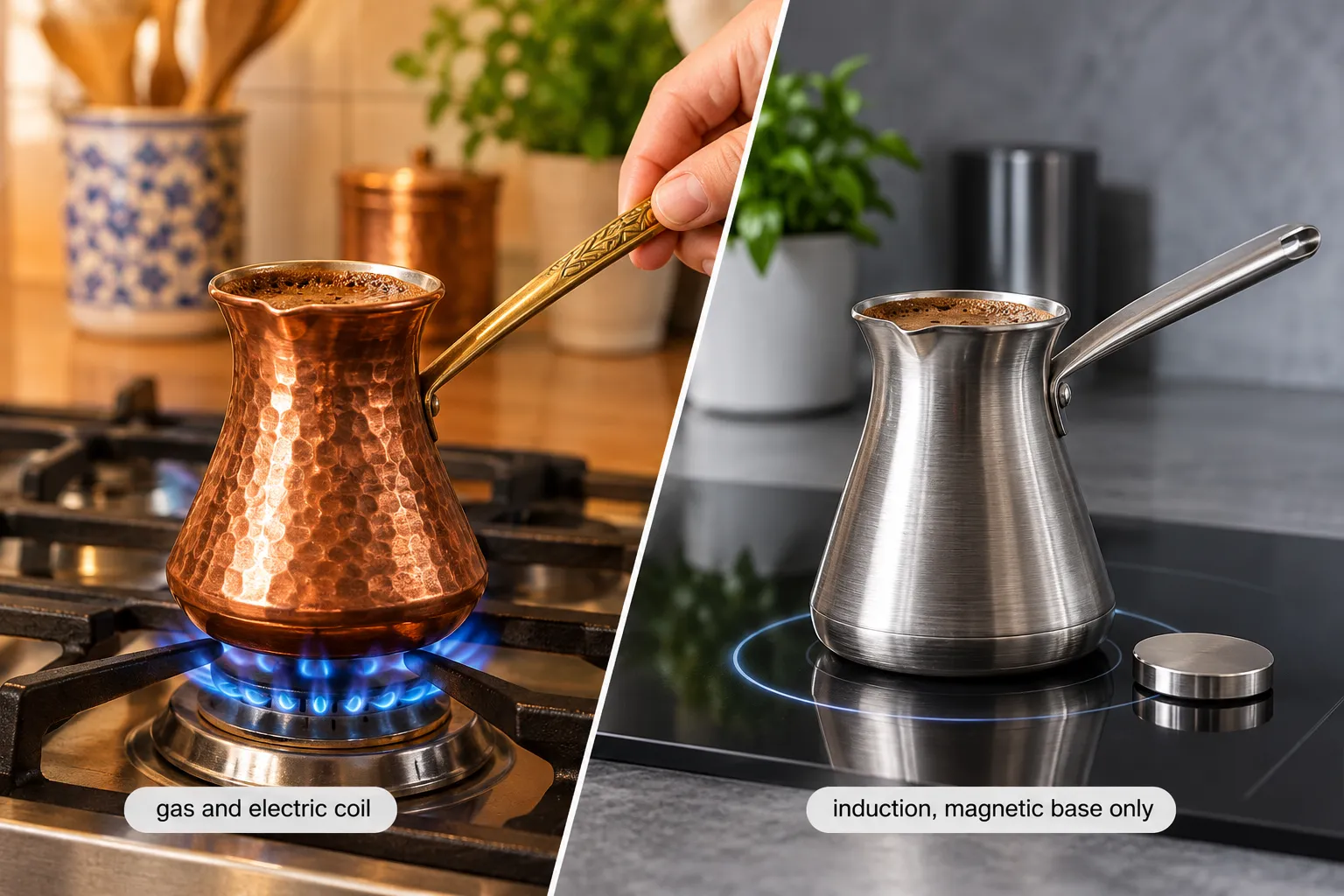
Yes on an electric coil or glass radiant element, no on induction with copper. Copper is nonmagnetic, so a traditional copper cezve will not heat on an induction cooktop at all . Stainless works on induction only when the model has a flat, magnetic base, and plenty of stainless cezves have rounded or narrow bottoms that never make proper contact .
Test before you buy: if the listing does not say "induction compatible," assume it is not.
Workarounds that actually work
- Induction interface disk. A steel plate that sits between hob and pot. It works, it adds thermal lag, and it partly erases copper's main advantage.
- A single gas burner. A portable butane burner costs less than many cezves and gives precise flame control.
- Low setting on an electric coil. Perfectly usable. The coil holds heat, so slide the pot off the element rather than just turning the dial down.
- A sand brewer. Heated sand beds give the gentlest, most even heat of all and are what many cafés in Istanbul use. Expensive and slow to heat for home use.
Edge case: glass-top electric stoves. A rounded copper base contacts a small area and will cook unevenly. Flat-bottomed pots do better here.
What is the difference between a cezve and an ibrik?
For buying purposes, none. "Cezve" is the Turkish term for the small long-handled brewing pot, and "ibrik" is the word that stuck in English-language retail, menus and marketplace listings . Strictly, the Turkish word ibrik refers to a lidded ewer or water jug, but search any shop today and both terms return the same product .
You will also see:
- Briki (Greek)
- Džezva (Bosnian and Serbian)
- Rakwa or dallah (Arabic-speaking regions, with different shapes)
- Turka (Russian and Central Asian)
Buy on shape and lining, not on the word in the title.
Do you really need a special pot, or can you make Turkish coffee in a regular saucepan?
You can make drinkable Turkish coffee in a small saucepan, and it will have noticeably less foam. The cezve's narrow neck concentrates rising foam at the opening, and a straight-sided saucepan lets it spread across a wide surface where it thins and collapses.
The smallest, tallest pot in your kitchen is the best substitute. A 1-cup butter warmer gets reasonably close. A 2-quart saucepan does not.
The other problem is pouring. Turkish coffee is poured in a slow, controlled stream so the grounds stay behind and the foam lands on top. A saucepan with no spout dumps. You will get grounds in the cup and a dissolved foam cap.
A cezve costs less than two café drinks. If you plan to brew this more than five times, the pot pays for itself in better foam alone.
For a complete walkthrough of ratio, grind and timing with whatever pot you own, see our essential guide to coffee brewing.
Why does my turkish coffee pot boil over, and what else goes wrong?
Overflow happens because the heat is too high and the pot is too full. Fill to two thirds maximum, use the lowest burner setting that still produces a climb, and stay at the stove for the final 60 seconds. Foam can go from a ring to a flood in under five seconds .
)
Common mistakes with Turkish coffee
- Stirring during the brew. Once heat is on, stirring breaks the foam cap you are trying to build. Stir cold, then stop.
- Grind too coarse. Turkish coffee needs powder fineness, finer than espresso. Coarse grounds will not suspend, so the cup tastes thin and the grounds never settle cleanly.
- Starting with hot water. The cold start gives the slow extraction curve that produces the foam. Hot water skips it.
- Letting it boil hard. Full boiling drives off the aromatics and flattens the foam, which is exactly what the EU's 2025 specification warns against.
- Pouring too fast. Grounds end up in the cup. Pour down the inner wall in a steady thin stream.
- Adding sugar after brewing. It collapses the foam. Add it with the grounds at the start.
- Old coffee. Roast date matters here as much as anywhere. Stale grounds produce weak, short-lived foam. Our guide on how to make coffee taste better covers the storage side.
Troubleshooting shortcut: no foam at all usually means grind too coarse or pot too big. Foam that appears then vanishes means heat too high.
How do you clean and maintain a copper turkish coffee pot?
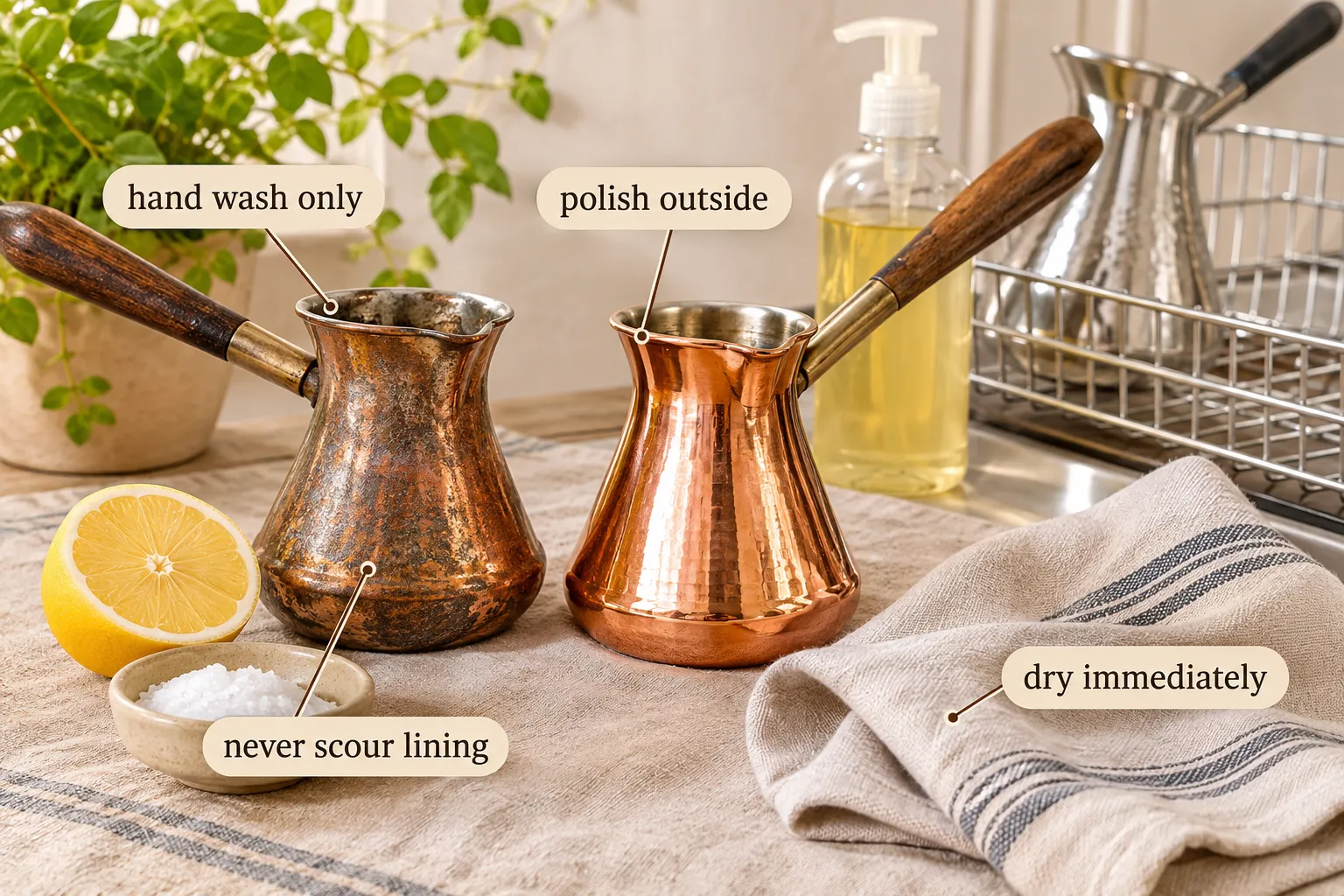
Hand wash a copper turkish coffee pot with warm water and mild soap, dry it immediately, and never use steel wool or abrasive powder inside. The tin lining is soft. Scrub it hard enough and you expose raw copper, which should not contact acidic coffee under FDA Food Code 2026 guidance.
Routine care:
- Rinse while still warm, before grounds dry into a crust.
- Soft sponge or cloth only, inside and out.
- Dry fully. Water spots on copper become tarnish within days.
- Store uncovered so moisture does not get trapped.
Exterior polish: half a lemon dipped in coarse salt, rubbed over the outside, rinsed and dried, restores the shine. Commercial copper polish works too. Keep all of it off the interior.
Retinning: heavy daily use will eventually thin the lining, typically over several years. Signs include dull copper-colored patches inside and a metallic taste. Specialist shops retin pots, though shipping often costs more than a replacement cezve at $17.99 to $43.99.
Stainless care: warm soapy water, soft sponge, or a dishwasher cycle on most models . A sprayed-on paste of baking soda and water lifts coffee staining. If you are already comfortable maintaining stainless brewing gear, our stainless steel Aeropress filter guide uses similar care logic.
Does the material really affect the taste of the coffee?
Material affects taste indirectly, through heat behavior, not through flavor transfer. A tin-lined copper pot and a stainless pot both present an inert surface to the brew. What changes is how evenly and how quickly the water heats, and that changes extraction.
Copper's even base reduces hot spots where grounds scorch, and scorched grounds taste bitter and ashy. Stainless, with slower and less even transfer, is more likely to overheat a patch of the base on a strong burner . On a low flame, that difference shrinks to near nothing .
Three things change the cup far more than the metal:
- Grind fineness. The single largest variable.
- Final temperature. The 88 to 92°C window from the EU 2025 specification.
- Coffee freshness and dose. 7 to 8 g per 60 to 70 ml cup is the reliable starting ratio.
Anyone chasing flavor improvements should sort those three out before spending another dollar on hardware.
Where should you buy a quality cezve, and how much should you spend?
Spend $20 to $45. That range covers both a 1mm handmade copper cezve and a solid stainless pot with a lid. Below $15 you tend to get thin walls and sloppy handle rivets. Above $60 you are paying for engraving and gift presentation, not better brewing.
Price check, Amazon, November 5, 2026
$43.99 · 4.6 stars · 1,853 ratings. The thicker-wall option, hammered exterior, long handle.
$20.50 · 400+ bought per month. Large capacity, dishwasher tolerant, best for households and gatherings.
$17.99 · 852 ratings. Thinner walls, works fine on low heat, good first pot or gift.
Arzum OKKA OK002B listed at $323.99 on Zoro, October 20, 2026. Newer OKKA Elite listings in 2026 cite 710 W, an 80-second quick mode, roughly four-minute slow brewing, high-boil detection, direct serving and self-cleaning.
Where to shop: Amazon for the fastest returns and visible review counts. Etsy for handmade and engraved copper from Turkish workshops, with longer shipping . Specialist coffee retailers for stainless models with verified induction bases . Budget marketplace listings exist at very low prices , though lining quality is hard to verify from a listing photo.
Affiliate disclosure: Coffee Rank IQ earns commission on some purchases made through links on this site. Prices listed were checked on the dates shown and change without notice.
Check the current price before buying. Copper pricing in particular moves with metal costs.
Should you buy copper or stainless, and who should skip both?
)
Buy the copper turkish coffee pot (DEMMEX 1mm, $43.99) if you cook on gas or an electric coil, you enjoy standing at the stove, you want the pot to look like something worth leaving out, and you are buying a gift. The thicker wall and faster response genuinely help with foam timing .
Buy the stainless cezve ($20.50, 24oz) if you own an induction hob with a magnetic-base model, you share a kitchen, you want dishwasher tolerance, or you brew for four or more people regularly .
Buy the $17.99 budget copper if you are testing whether Turkish coffee belongs in your routine at all. It works. Keep the flame low.
Skip the cezve entirely if you want push-button drinks. An automatic machine like the Arzum OKKA ($323.99, Zoro, October 20, 2026) handles brewing and serving without supervision, at roughly seven times the price of a good pot and with no control over the foam moment. People who want one-touch coffee are usually better served by a different category altogether, covered in our Zojirushi thermal carafe coffee maker guide.
Pros and cons
Copper cezve
- Fastest heat response, best foam timing
- Even base heat, fewer scorched grounds
- Handsome, gift-ready, traditional
- Will not work on induction
- Hand wash only, tarnishes, lining eventually wears
Stainless cezve
- Cheapest entry at around $20.50
- No lining to fail, dishwasher tolerant
- Induction capable with a flat magnetic base
- Slower, less even heat transfer
- Plain looking, and wide-mouth models foam poorly
Cezve size and dose calculator
Dose based on 8 g coffee per 70 g water (2023 regional Turkish coffee study). Pot capacity assumes a two-thirds fill.Coffee: ‘+dose+’ g, ground to flour fineness
Cezve capacity to buy: about ‘+pot+’ ml
Heat: low, reach 88 to 92°C in 2.5 to 3 minutes, lift before boiling.’; });
FAQ

Conclusion
Buy copper if you cook on gas and want the responsive heat control that makes foam timing easier, and buy stainless if you have induction, share a kitchen, or simply want a pot you can wash without thinking about it. The DEMMEX 1mm copper at $43.99 and the 24oz stainless at $20.50 (Amazon, November 5, 2026) both do the job well. Neither will save a coarse grind or a hard boil.
Next step: measure your usual serving into the cup you drink from, double the number if you share, and buy the pot that fills to two thirds at that volume. Then read the brewing method and keep the flame low for your first three attempts. Better Coffee Starts With Better Answers.