Bottomless Portafilter Sizes: 51, 54 or 58 mm?
Quick Answer
Your bottomless portafilter size is decided by your machine, not by preference: 51 mm for the DeLonghi Dedica family, 54 mm for Breville's Barista Express, Barista Pro, Barista Touch and Bambino, and 58 mm for Gaggia, E61 group machines and most commercial-style espresso makers . Diameter alone does not improve your espresso. What the naked design does is show you the underside of the puck so you can spot channeling, uneven tamping or a bad grind the moment it happens . Buy the size that locks into your group head, then spend your energy on puck prep.
Key Takeaways
- 51 mm is the DeLonghi Dedica and EC-series size. HiBREW listed a 51 mm bottomless model at $59 on October 21, 2026, with bundles at $79 to $98.
- 54 mm covers the Breville home lineup. Breville's own spec for the Bambino is a 54 mm portafilter with an 18 g ideal dose, and its Craft Collection 54 mm naked portafilter is listed at $99.95.
- 58 mm is the café standard and the size with the deepest accessory shelf. VST sells precision baskets in 7, 15, 18, 20, 22 and 25 g formats for 58 mm.
- Two 58 mm portafilters can still be incompatible. Gaggia 58 mm, E61 58 mm and Breville Dual Boiler 58 mm use different lug patterns .
- On Amazon, checked November 5, 2026, the Normcore 54 mm bottomless portafilter sat at $69.99 with 2,539 reviews and 1,000+ bought in the past month. A budget 54 mm alternative listed at $29.98.
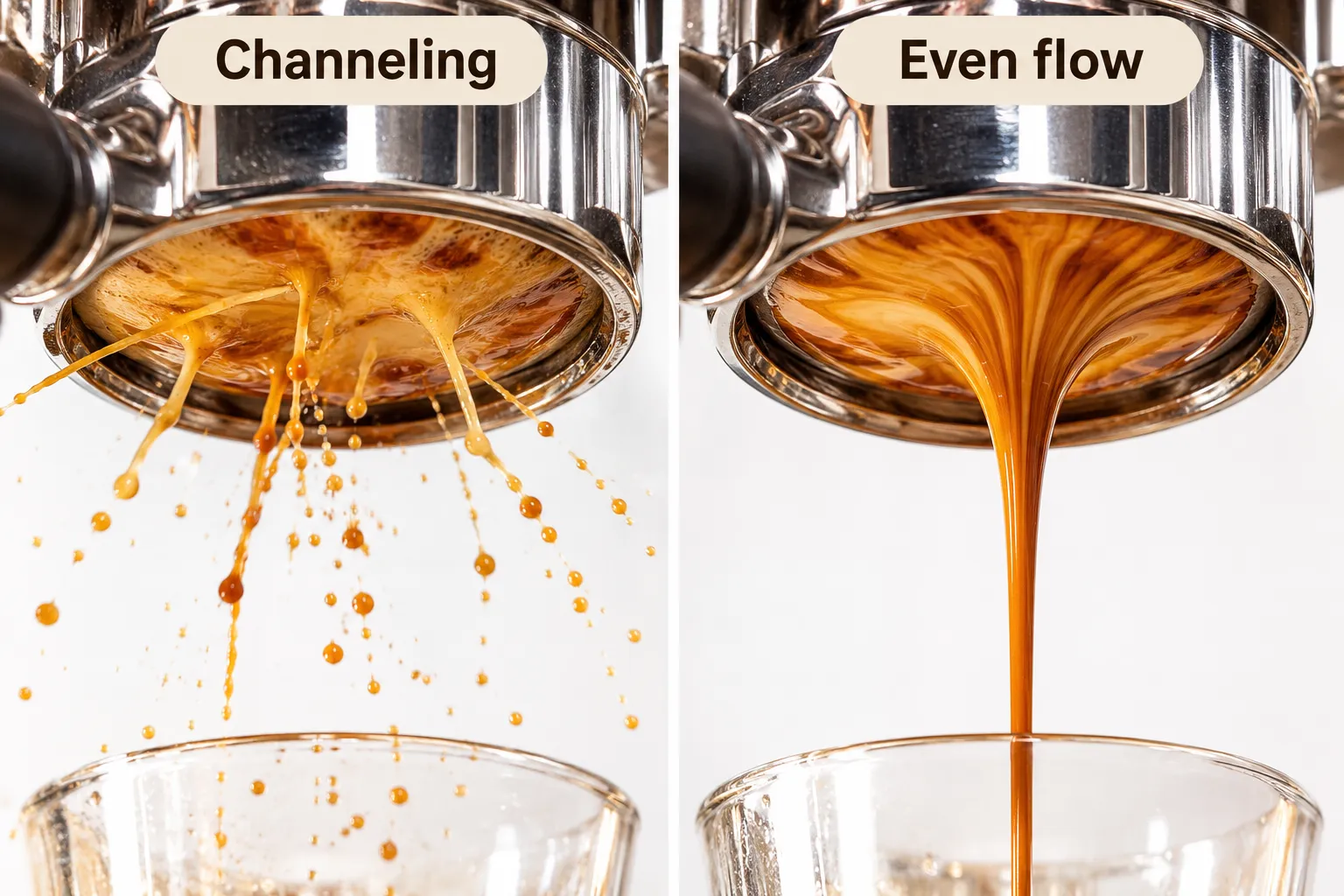
- A good shot through a naked portafilter forms even tiger striping that converges into one centered stream. Side squirts mean the puck failed, not the hardware.
- Yes, you can keep your original spouted portafilter and swap back for split shots or guests.
Bottomless portafilter sizes explained: 51, 54 or 58 mm?
The short version: pick the diameter your group head accepts, then check the lug pattern for your exact model. A bottomless portafilter (also called a naked portafilter) removes the spouts and the bottom plate, leaving the basket exposed so espresso pours straight out of the puck.
Here is what each size actually means in a home kitchen.
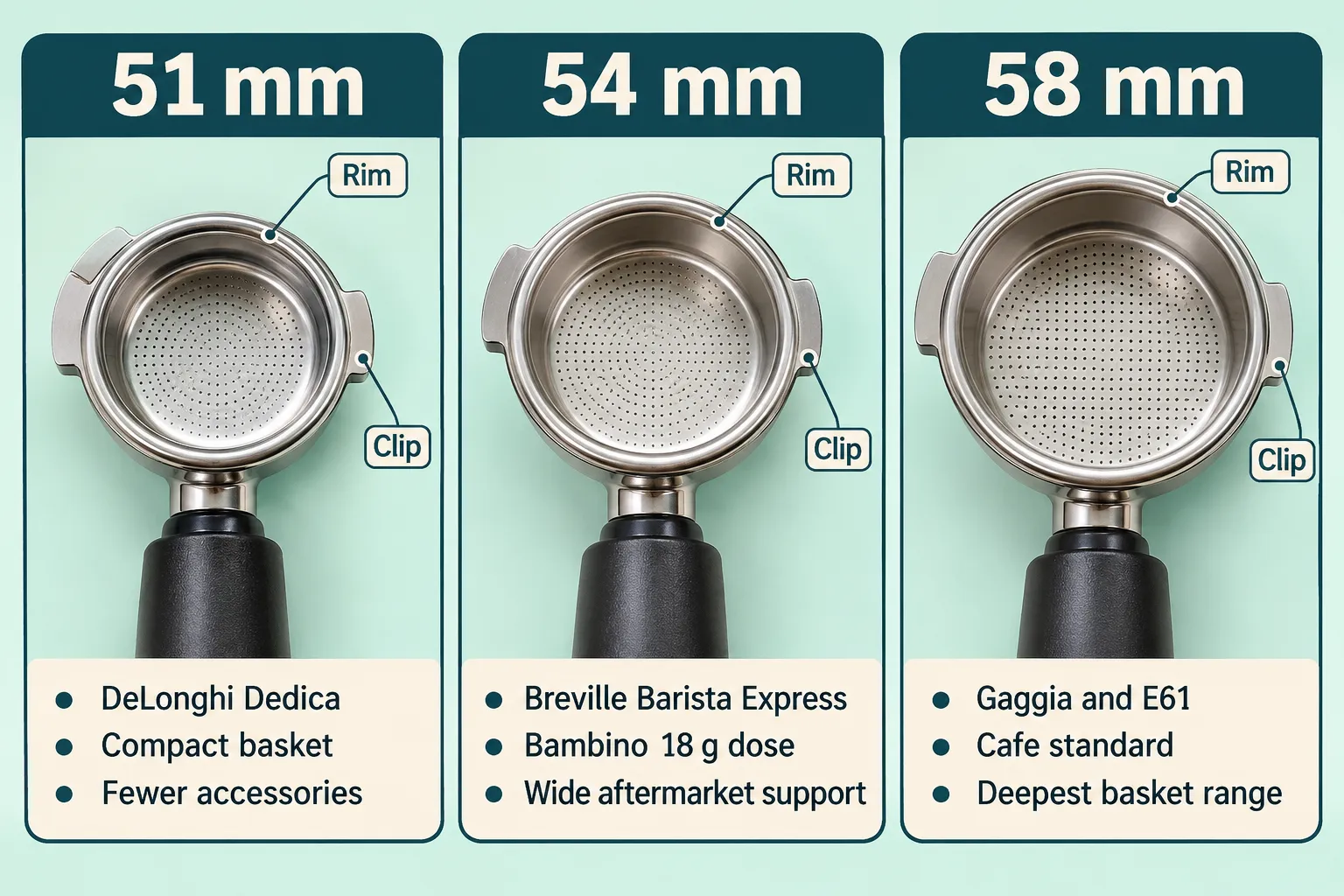
51 mm. The compact size, used most famously on the DeLonghi Dedica EC685 and EC885, plus several entry-level EC-series machines and some Chinese-made portable espresso makers . Baskets hold roughly 14 to 16 g of coffee. Smaller bed, less margin for error on distribution.
54 mm. Breville territory, and the most common size in the $300 to $900 home espresso bracket. Breville's documentation lists 54 mm single-wall baskets for the Barista Express, Barista Pro, Barista Touch, Bambino and Bambino Plus. Typical dose: 18 to 20 g.
58 mm. The commercial standard. Gaggia Classic, Rancilio Silvia, Lelit, Profitec, ECM, Rocket, and anything built around an E61 group all run 58 mm . Doses from 7 g to 25 g depending on basket.
The practical difference is bed geometry. A 58 mm basket spreads the same dose across a wider, shallower bed, which is more forgiving of a slightly uneven tamp. A 51 mm basket stacks the coffee deeper, so a tilted tamp creates a bigger density gradient. That said, the effect is small next to grind quality and distribution.
A correctly prepared 51 mm puck will beat a sloppy 58 mm puck every single morning.
Which portafilter size do I need for my espresso machine?
Match the brand and model, not the brand alone. Portafilter size by machine is the only reliable shortcut, and even then the lug pattern matters as much as the diameter.
| Machine family | Size | Notes |
|---|---|---|
| DeLonghi Dedica EC685 / EC885 | 51 mm | Pressurized basket stock; buy a non-pressurized basket with the naked handle |
| DeLonghi EC155 / EC260 | 51 mm | Plastic group on some units, check fit tolerance |
| Breville Bambino / Bambino Plus | 54 mm | Breville lists an 18 g ideal dose |
| Breville Barista Express / Pro / Touch | 54 mm | Breville sells 54 mm single-wall baskets directly |
| Breville Dual Boiler / Oracle | 58 mm | 58 mm, but lugs differ from E61 units |
| Gaggia Classic / Classic Pro | 58 mm | Gaggia-specific lug spacing |
| Rancilio Silvia | 58 mm | Silvia-pattern lugs |
| E61 machines (Lelit, Profitec, ECM, Rocket) | 58 mm | Largest accessory ecosystem |
| Flair, Cafelat Robot, most manual levers | n/a | Manual levers do not take portafilters |
Decision rule: if your machine is a Breville you bought for under $900, you almost certainly need a bottomless portafilter 54mm. If it has a chrome E61 group with a brew lever on the side, you need a bottomless portafilter 58mm. If it is a slim DeLonghi that fits in a 6 inch gap, you need 51 mm.
Common mistake: buying by diameter and ignoring the ears. Three different 58 mm handles can all refuse to lock on the same machine .
How do I know what size portafilter my machine uses?
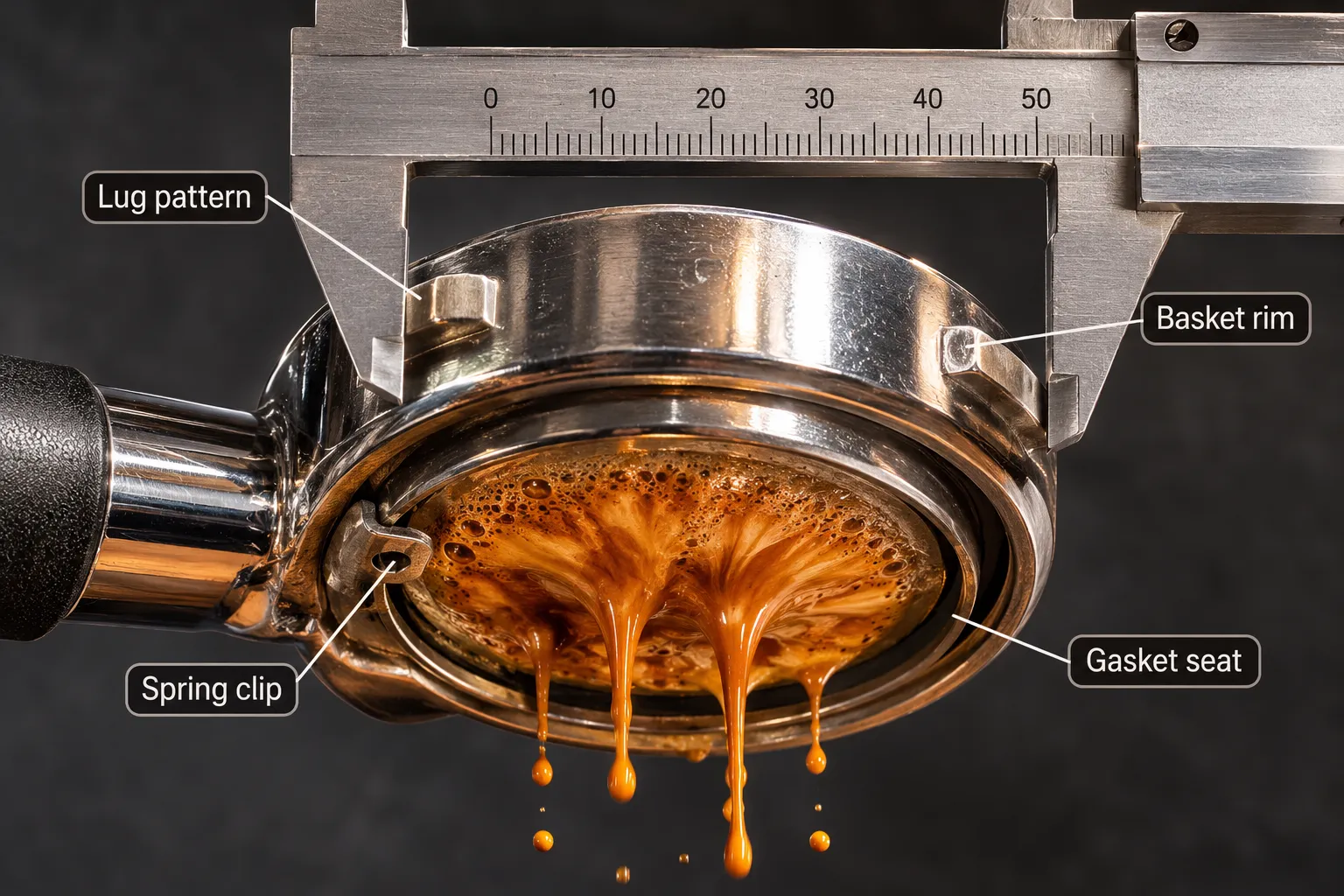
Measure the inside diameter of the basket rim with a caliper or a ruler, then confirm against your model number. Five minutes beats a return shipment.
Three ways to confirm, fastest first:
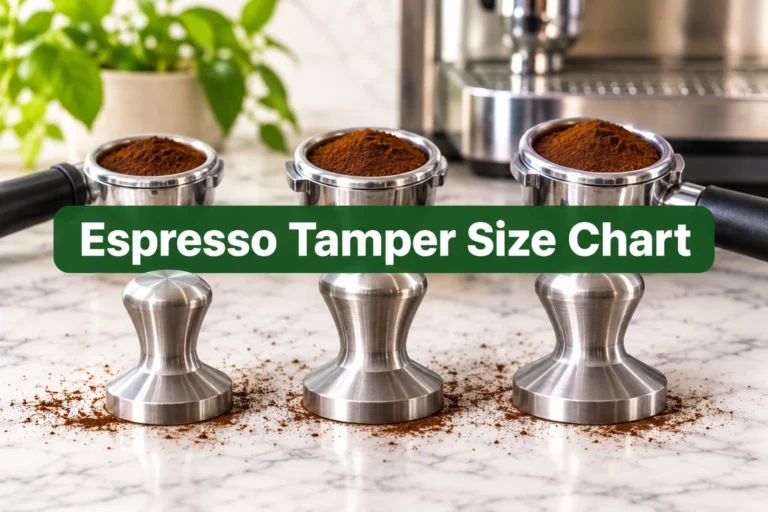
- Search your exact model number. "Barista Express BES870 portafilter size" is a better query than "Breville portafilter size." Several published portafilter size charts organize by model for this reason .
- Measure the basket. Pop the basket out of your existing portafilter and measure the widest inside diameter at the top rim. You will land close to 51, 54 or 58 mm. Round to the nearest standard size.
- Photograph the lugs. Count the ears and note their spacing, then compare to the product listing photos. Sellers who list by machine name rather than by millimeter alone are usually more reliable.
Edge case: a handful of machines use 49 mm or 53 mm baskets. Breville's own category explainer notes 49 mm as another home size alongside 54 mm, with 58 mm as the café standard. If your measurement lands around 49, stop and search specifically for that figure.
Why would I want a bottomless portafilter over a regular one?
Because it turns an invisible process into a visible one. Whole Latte Love describes the bottomless portafilter primarily as a diagnostic tool rather than something that improves espresso on its own. With the spouts gone, you watch extraction happen on the underside of the puck in real time.
What the naked view gives you:
- Espresso channeling shows up instantly. A thin jet shooting sideways means water found a crack and raced through it, under-extracting the rest of the bed.
- Uneven tamping is obvious. One side blonding early means your tamp was tilted.
- Blocked basket holes become visible. Dead spots in the flow pattern point to a basket that needs a soak.
- Less splitting, more crema. No spouts means no narrow channels for the stream to cling to, which some drinkers say gives a slightly thicker pour into the cup .
- Easier cleaning. Fewer cavities where old coffee oils hide.
The honest limitation: the device diagnoses. It does not fix. If you own a pressurized basket and a blade grinder, a bottomless portafilter will mostly show you a wall of foam and tell you nothing useful.
Can you use a bottomless portafilter on any espresso machine?
No. A bottomless portafilter works only on machines designed around a locking portafilter group head, and only when the diameter and lug pattern both match your specific model.
Incompatibility shows up in three ways:
- Wrong diameter. A 58 mm handle will not seat in a 54 mm group, and no adapter fixes that properly.
- Wrong lugs. Same diameter, different ear spacing or thickness. The handle either will not enter the group or will not rotate to a sealed position. 2026 buying guides repeatedly warn that "universal" labeling does not guarantee a correct lock .
- Pod and capsule machines. Nespresso, Keurig, Dolce Gusto and similar systems have no portafilter at all.
Decision rule: if a listing says "fits 58 mm machines" and never names your machine, treat it as a maybe. If it names your model, it is a buy.
Is 54 mm or 58 mm more common?
58 mm is more common across all espresso machines because it is the commercial standard, but 54 mm is extremely common in the US home market because Breville dominates that price bracket. Breville itself describes 58 mm as the café size, with 54 mm and 49 mm more typical at home.
What that means for shopping:
- 58 mm has the deepest accessory shelf. VST alone offers precision baskets at 7, 15, 18, 20, 22 and 25 g. Add puck screens, dispersion screens, distribution tools and a long list of tamper brands.
- 54 mm has caught up fast. Breville expanded its own Craft Collection in late October 2026 with a 54 mm naked portafilter at $99.95, and lists naked options in both 54 mm and 58 mm.
- 51 mm is the thinnest shelf. You can get a good portafilter and a decent basket. You will not get six precision basket weights.
Edge case worth knowing: on November 5, 2026, Porsche and La Marzocco announced a Linea Micra collection whose convertible 3-in-1 portafilter switches between single spout, double spout and bottomless. Convertible designs like that are still rare, but they point at where premium hardware is heading.
Why does my shot spray out the sides of my bottomless portafilter?
Because water is finding a low-resistance path through the puck and blasting out of one spot instead of flowing evenly. That is espresso channeling, and the naked view is doing its job by showing it to you.
A good extraction, per Whole Latte Love's description, develops even tiger striping across the basket that converges into a single centered stream. Spurting or localized blonding points to puck preparation.
Fix it in this order:
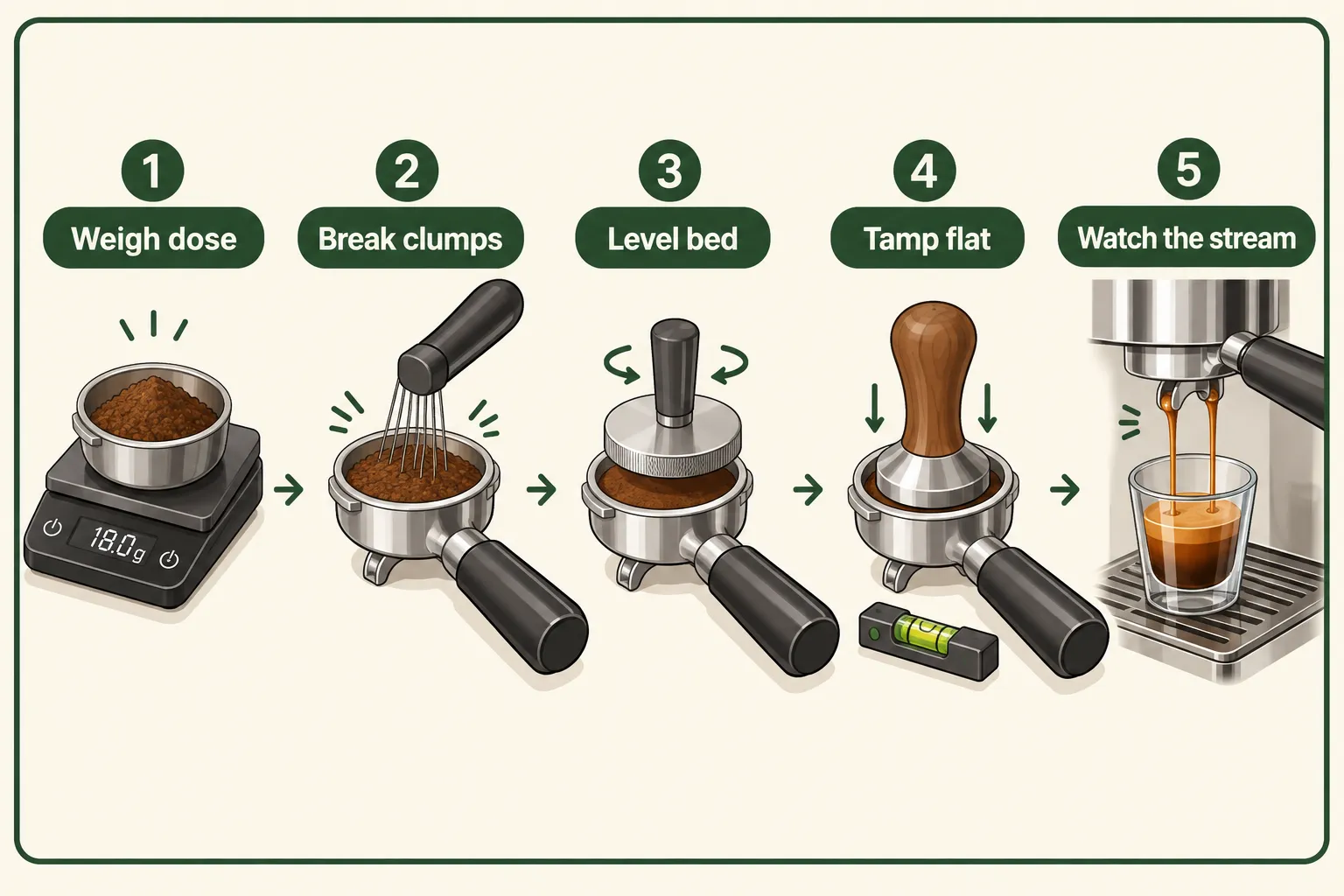
- Check your dose. Too much coffee leaves no headspace and the shower screen carves a crater. Too little lets the puck float. Start at Breville's 18 g for a 54 mm basket, 18 to 20 g for 58 mm, 14 to 16 g for 51 mm .
- Break up clumps. Grounds from a conical burr clump. A needle distribution tool (WDT) through the bed removes most channeling faults by itself.
- Level before you tamp. An uneven bed cannot be rescued by pressure.
- Tamp flat, not hard. Consistent and level beats 40 lb of force.
- Do not tap the portafilter after tamping. Tapping cracks the puck edge and builds a channel.
- Check the basket. Hold it to a light. Blocked holes make the flow pattern lopsided.
- Adjust grind last. Change one variable at a time.
Edge case: a worn group gasket or a badly fitting basket will leak around the rim no matter how good your prep is. If spray comes from the very edge every time, inspect the hardware.
What is the best bottomless portafilter size for beginners?
The best size for a beginner is whichever one fits their machine, and for most US buyers in the $300 to $800 range that is 54 mm. Breville's share of that bracket means a 54 mm bottomless portafilter is the default beginner answer, with excellent basket and tool support behind it.
If you are still choosing the machine and want the easiest learning curve:
- Choose 54 mm if you want one-touch convenience, a built-in grinder option, and a counter-friendly footprint. Breville's own documented dose (18 g for the Bambino) gives you a starting recipe on day one.
- Choose 58 mm if you expect to tinker, want precision baskets in six dose sizes, and plan to keep the machine for a decade.
- Choose 51 mm if space or budget decided the machine for you. It can pull good espresso, but you will buy fewer upgrades.
Common beginner mistake: installing a bottomless portafilter while still using a pressurized (dual wall) basket. Pressurized baskets create artificial crema and hide everything the naked design exists to reveal. Buy a non-pressurized basket at the same time.
How much does a bottomless portafilter cost in November 2026?
Expect $30 to $100 for the handle, plus $12 to $35 for a decent non-pressurized basket. Prices below were checked on the dates shown.
Normcore 54 mm the naked portafilter on Amazon, 2,539 reviews, 1,000+ bought in the past month. Checked November 5, 2026.
Budget 54 mm the naked portafilter on Amazon. Checked November 5, 2026.
Breville Craft Collection 54 mm naked portafilter, listed October 2026.
HiBREW 51 mm and 58 mm bottomless handles; bundles $79 to $98. Listed October 21, 2026.
Prices move. Check the current price before you order, and confirm the listing names your machine model.
Affiliate disclosure: Coffee Rank IQ earns commission on some product links. Prices and availability were checked on the dates listed and may change. Recommendations here are based on published manufacturer specifications and documented retail listings, not on hands-on testing of every model named.
Comparison table
| Option | Size | Price checked Nov 5, 2026 | Best for |
|---|---|---|---|
| Normcore the naked portafilter | 54 mm | $69.99 | Breville owners who want a proven, high-review option |
| Breville Craft Collection naked | 54 mm | $99.95 | Buyers who want guaranteed first-party fit and finish |
| Generic budget handle | 54 mm | $29.98 | Testing the idea before committing |
| HiBREW bottomless handle | 51 mm | $59 | Dedica and compact DeLonghi owners |
| HiBREW bottomless handle | 58 mm | $69 | Gaggia and E61 owners wanting a second handle |
Five features worth paying for
- Machine-named compatibility. A listing that says "fits Breville Barista Express BES870" rather than "58 mm universal" has done the lug homework for you. This single detail prevents most returns .
- Removable, non-pressurized basket included. Saves a second purchase and guarantees the basket seats correctly. Payoff: you can actually see the extraction instead of fake crema foam.
- Wood or heat-insulated handle. Walnut and resin handles stay cool through back-to-back shots. Payoff: no hot metal on your palm during a two-drink morning.
- Machined one-piece body with a smooth interior. Fewer seams means less retained coffee oil and a quicker rinse. Payoff: 10 seconds of cleanup instead of a brush session.
- Spring clip that holds the basket firmly. A loose clip drops the basket into the knock box with the puck. Payoff: fewer grounds on your floor and fewer dented baskets.
What to watch out for
- Lug mismatch. The single biggest return cause. Same millimeter, wrong ears .
- Mess during the learning phase. Your first ten shots may spray the counter. Pull them into a tall glass placed in the center of the drip tray.
- Pressurized basket confusion. A dual-wall basket in a naked handle gives you theater, not information.
- Thin budget handles. Very cheap units sometimes have rough casting inside the basket seat, which makes the basket sit at a slight angle.
- Lost split-shot capability. No spouts means no two-cup split.
- Hot handle on long sessions. Bare stainless handles heat up.
Pros and cons
Pros
- Shows espresso channeling and tamping faults in real time
- Easier to clean than a spouted handle
- Slightly thicker pour with no spout surfaces to strip crema
- Available in 51, 54 and 58 mm, usually under $70
- Forces better puck prep, which improves every shot afterward
Cons
- Diagnoses problems, does not solve them
- Makes a mess when the puck fails
- Cannot split a double into two cups
- Compatibility is model-specific, not diameter-specific
- Needs a non-pressurized basket to be useful at all
Who should buy one and who should skip it
Buy a the naked portafilter if:
- You own a Breville Barista Express, Pro, Touch or Bambino and your shots taste inconsistent. The 54 mm Normcore at $69.99 is the volume winner here on review count. A portafilter for Breville machines is the easiest size to shop for.
- You own a Gaggia Classic, Rancilio Silvia or an E61 machine and want access to VST precision baskets at 15, 18, 20 or 22 g.
- You just bought a burr grinder and want to see whether your new grind setting is actually improving the extraction.
Skip it if:
- Your machine only takes pressurized baskets and you have no plan to change that.
- You want one-touch drinks and have no interest in puck prep. A naked handle will only annoy you.
- You are buying a gift for someone whose machine model you cannot confirm. Buy beans, a scale, or a tamper instead.
Can you still use a regular portafilter if you buy bottomless?
Yes. Your original spouted portafilter keeps working, and most home baristas keep both. Use the naked handle for diagnosis and daily singles, and switch to spouts when you want two cups from one shot or when a guest is making coffee.
Keeping both also helps you isolate faults. If a shot tastes sour through both handles, the problem is your grind, dose or water temperature, not the hardware.
While you are improving extraction, the same attention to filtration matters for drip brewing too. Our guides to choosing flat bottom paper coffee filters and to using a GoldTone reusable basket coffee filter cover how filter choice changes the cup.
What are people getting wrong with the naked portafilters?
The most common error is expecting the hardware to improve the espresso. It does not. It reports.
Five mistakes worth avoiding:
- Treating a bad shot as a product defect. Sideways spray is almost always puck prep .
- Buying before fixing the grinder. A stepped blade or low-end burr grinder produces grounds too inconsistent to extract evenly at any portafilter size.
- Shopping by millimeter only. Confirm the model name.
- Overfilling the basket. No headspace, guaranteed channeling.
- Giving up after a week. The first dozen shots are the data, not the failure.
If you are rebuilding your whole brewing setup, the same precision thinking applies elsewhere. See our guide to stainless steel coffee filters for the AeroPress or the rundown on Technivorm flat bottom filters for drip.
Are the naked portafilters actually worth it?
For anyone grinding fresh coffee into a non-pressurized basket, yes. For $30 to $100 it is the cheapest feedback loop you can add to a home espresso setup, and the feedback is immediate and visual.
Worth it when:
- You grind fresh with a burr grinder
- You use a non-pressurized basket
- You care enough to adjust technique based on what you see
Not worth it when:
- Your machine is pressurized-only
- You want push-button drinks with zero fiddling
- You already pull consistent shots and dislike cleaning spray off the counter
FAQ

Conclusion
Buy the size your group head accepts: 51 mm for DeLonghi Dedica, 54 mm for the Breville home lineup, 58 mm for Gaggia, Rancilio and E61 machines. For most readers upgrading a $300 to $1,500 setup in 2026, that means 54 mm, and the Normcore 54 mm at $69.99 (Amazon, checked November 5, 2026) is the option with the longest review record behind it. The 58 mm ecosystem wins on basket variety, with VST offering six dose formats.
Your next step takes two minutes: find your machine's model number, confirm the diameter on a portafilter size chart, then check that the listing you are about to buy names your model and not just a millimeter figure. Order a non-pressurized basket at the same time. Then pull ten shots and watch the underside. Better Coffee Starts With Better Answers, and this is one of the few accessories that hands you the answer while the shot is still running.