Puck Screen: Better Espresso or Just a Cleaner Machine?
Quick Answer
A puck screen is a thin perforated metal disc you place on top of the coffee puck before locking in the portafilter. The benefit everyone agrees on is a cleaner shower screen and group head. The taste benefit is contested: retailer Clive Coffee measured roughly a 3 percentage point extraction-yield increase in its own 2025 experiment, while independent 2026 reviews from Burr & Basket and Proven Kitchen Tools reported no controlled evidence of better flavor . At $6.49 to $22.90, it is a cheap accessory with a reliable cleaning payoff and an uncertain flavor payoff.
Key Takeaways
- A Normcore 58.5 mm puck screen was listed on Amazon at $13.99 (1,173 reviews, 700+ bought in the past month, price checked November 5, 2026). A 0.2 mm ultra-thin 2-pack was $6.49 the same day.
- Thickness ranges from about 0.2 mm to 1.7 mm. Thinner screens protect espresso headspace, the gap between the puck and the shower screen .
- Clive Coffee's 2025 test on a La Marzocco Linea Mini (20 g in, 40 g out, 30 seconds) recorded an average extraction yield rise of about 3 percentage points, roughly a 20% relative increase . That was a retailer experiment, not peer-reviewed research.
- Burr & Basket and Proven Kitchen Tools (October 2026) both rated the cleanliness benefit as stronger than the taste evidence .
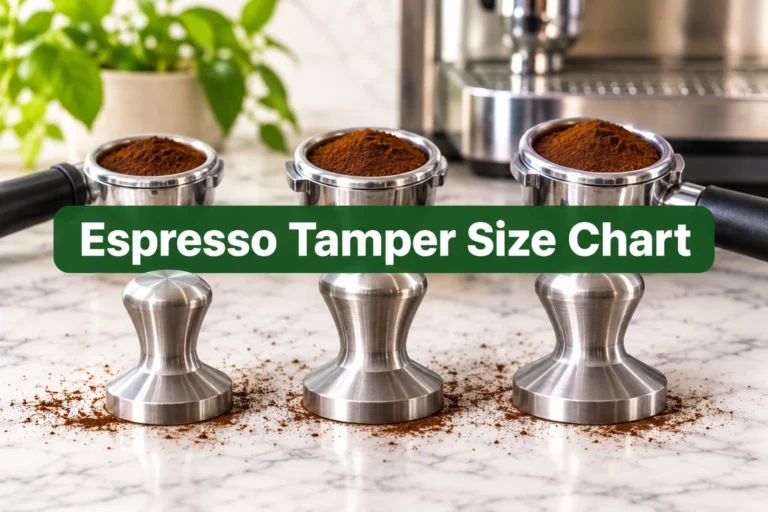
- Sizing matters more than brand: 51 mm, 53.3/54 mm (Breville and Sage), and 58/58.5 mm are the common fits. Wrong size means binding or grounds escaping around the edge .
- A screen cannot fix clumpy, unevenly distributed coffee. WDT, grind size, and a level tamp do that work .
- Best starter buy for most home machines: a 0.8 mm stainless screen around $12.99 to $13.99, replaced or deep cleaned every few weeks.
What is a puck screen and how does it work?
A puck screen is a round disc of perforated or mesh stainless steel, usually 50 to 58.5 mm across, that sits directly on the tamped coffee bed inside the portafilter basket. When you lock in and start the pump, pressurized water hits the screen first instead of striking bare coffee.
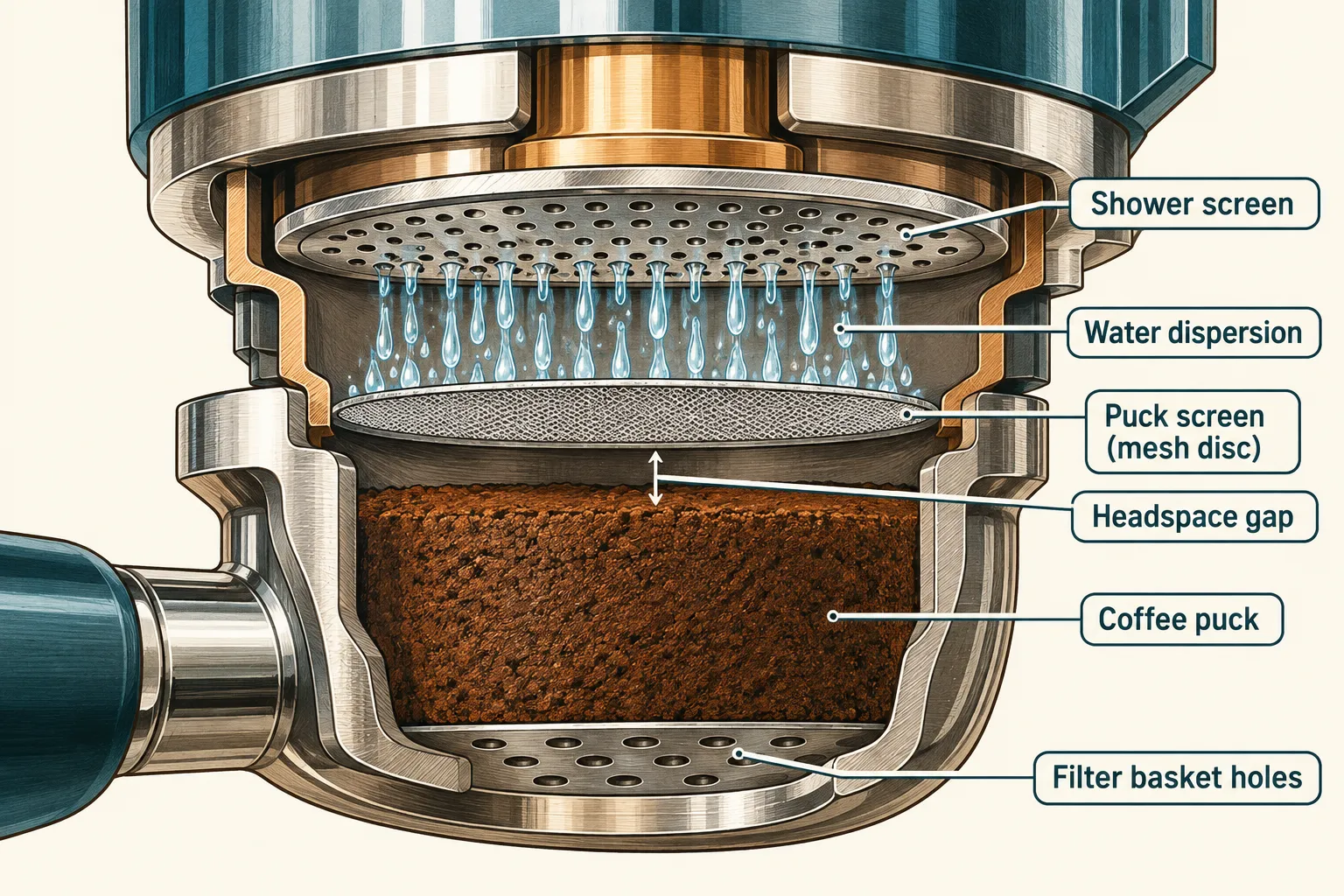
Two things happen mechanically.
It spreads the first contact of water. Clive Coffee's explanation is that the screen softens the initial blast of water and distributes it across the surface, which may reduce the weak paths that grow into channeling . Plausible, and consistent with how the device behaves, though not independently confirmed.
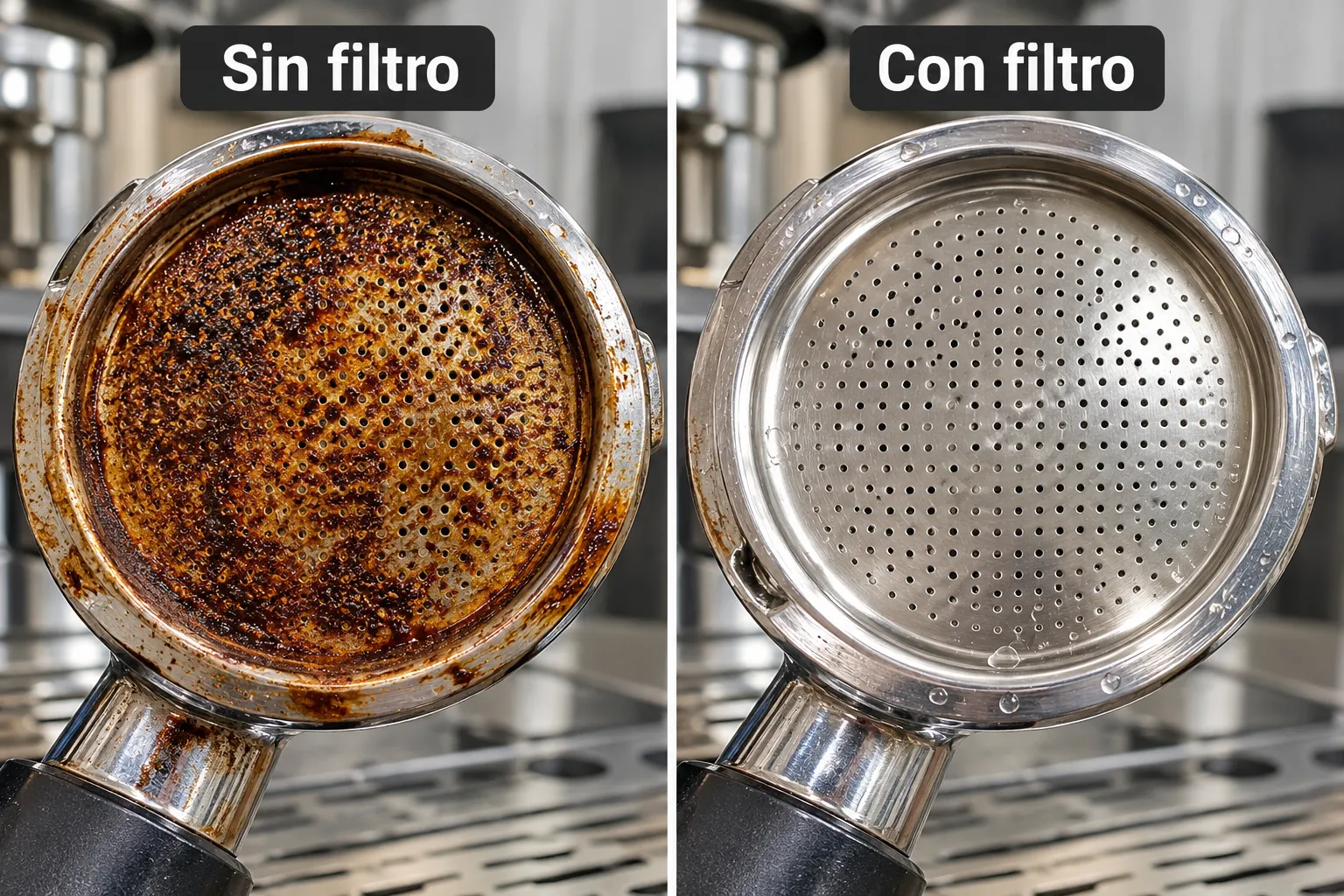
It keeps grounds off the shower screen. When the pump stops and pressure releases, wet grounds get pulled upward into the brew head. A screen catches most of them. That is the part nobody disputes, and it is why many people keep using one after they stop caring about the extraction claims .
)
Think of it as a lid on the coffee, not a filter through it. Water still passes freely. If you want a refresher on what happens below that lid, our explainer on espresso extraction and crema covers the mechanics.
Common mistake: believing the screen filters the espresso. It does not. Hole sizes are far too large to strain fines from the liquid.
Does a puck screen actually make better espresso?
Sometimes, in some setups, by a small margin. The best pro-screen number available comes from Clive Coffee's 2025 experiment on a La Marzocco Linea Mini using a 20 g in / 40 g out brew ratio and a 30-second target. Clive reported an average extraction yield increase of about 3 percentage points, which it described as roughly a 20% relative gain .
Hold that result at arm's length for three reasons. It came from a retailer that sells the product. It used one machine, one recipe, one grinder. And no independent lab has replicated it.
)
The 2026 editorial consensus is more cautious:
- Burr & Basket could not verify a controlled trial proving flavor improvement and rated the cleanliness benefit higher than the yield evidence .
- Proven Kitchen Tools called keeping grounds off the shower screen the "main, uncontroversial benefit" and flagged the absence of controlled taste evidence .
- Espresso Verdict reported that noticeable flavor gains are inconsistent and advised treating better taste as a possible bonus rather than the reason to buy .
Clive's own 2026 puck-prep comparison is more useful for buyers than its yield number. It placed WDT and the espresso puck screen among the largest contributors in its setup, while adding a leveler on top of both produced only a marginal further gain . If that holds in your kitchen, the ranking tells you where to spend attention: grinder first, distribution second, screen third.
A $14 disc that keeps your group head clean is a good purchase. A $14 disc sold as a flavor upgrade is a hopeful one.
Decision rule: if your shots already taste balanced and your puck prep is solid, expect cleaner hardware and little else. If your shots run fast and sour with visible spraying, fix grind size and distribution before buying anything.
Puck screen vs distributor vs paper filter: which one should you get?
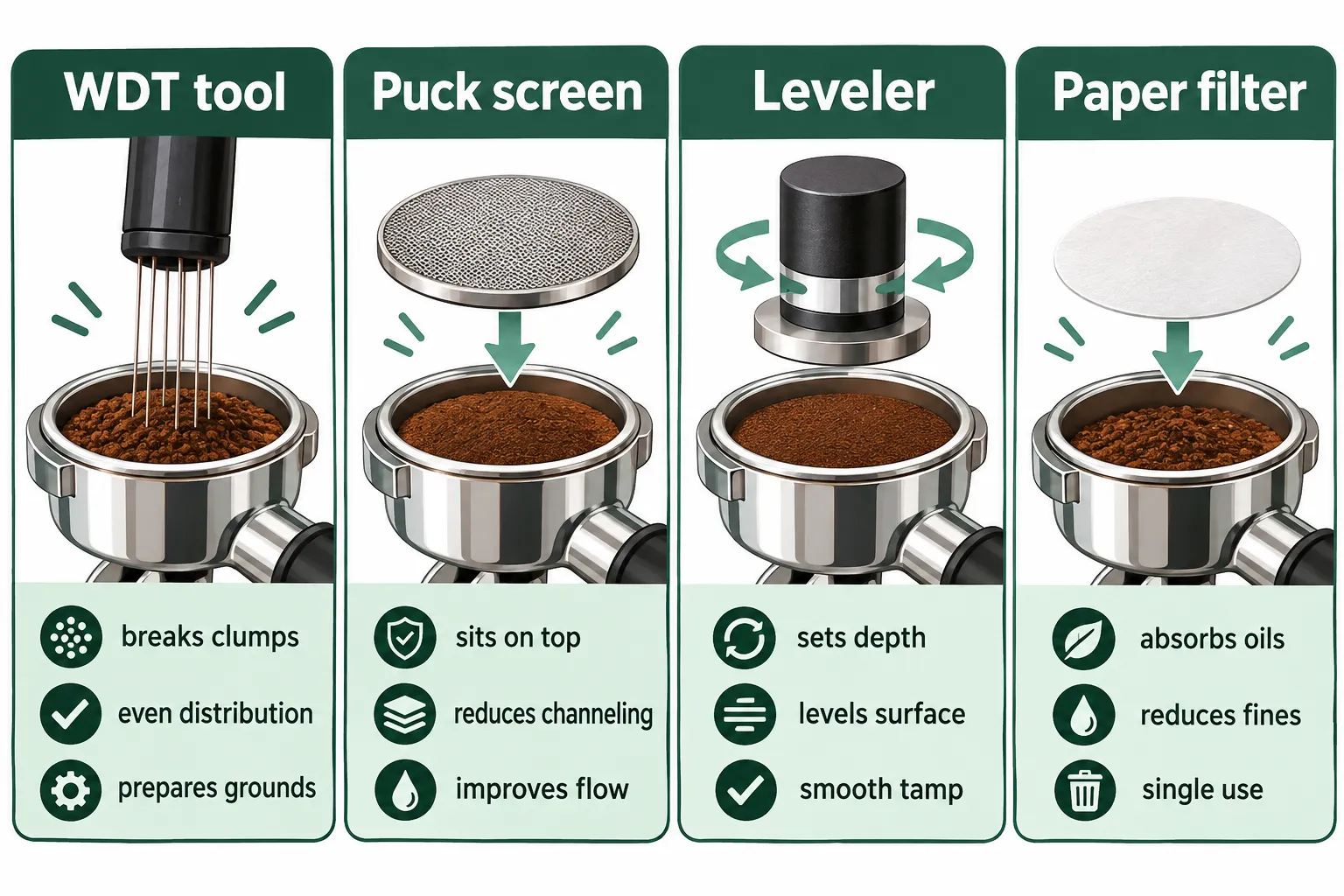
Buy the WDT tool first, then the puck screen, and skip the leveler unless you enjoy the ritual. These tools do different jobs and only one of them reaches inside the coffee bed.
- WDT tool (needle distributor): stirs the dry grounds to break clumps and even out density. Works inside the puck, where channeling actually starts. Highest value per dollar at roughly $10 to $25.
- Puck screen: sits on top. Spreads early water contact and catches grounds. Does nothing about clumps already in the bed .
- Leveler / palm distributor: flattens the surface and sets tamp depth. Clive's 2026 comparison found minimal added benefit after WDT and a screen .
- Paper filter: the puck screen vs paper filter question comes up constantly. Paper discs are single use, cost pennies each, and some drinkers report a cleaner cup. They also create ongoing cost and waste. A metal screen is reusable for months. Paper suits people chasing clarity in light roasts; metal suits people who want one less consumable.
)
Choose this way: clumpy grinder output, buy WDT. Messy group head, buy a screen. Both, buy both for under $40 total. For broader kit decisions, see our rundown of essential espresso equipment and maintenance.
How much does a good puck screen cost in November 2026?
Between $6.49 and $22.90 for mainstream options. This is one of the cheapest accessories in espresso, which is partly why the debate is so loud: the stakes are a sandwich.
Prices checked November 5, 2026 on Amazon, with additional listings reported by Burr & Basket in late October and early November 2026 .
| Model | Thickness | Price (checked Nov 5, 2026) | Best for |
|---|---|---|---|
| Normcore 58.5 mm stainless | 0.8 or 1.7 mm | $13.99 (1,173 reviews) | Most 58 mm home machines |
| Generic 0.2 mm ultra-thin 2-pack | 0.2 mm | $6.49 | Tight headspace, high-dose baskets |
| MHW-3BOMBER | 0.8 mm | About $12.99 | Balanced everyday pick |
| Normcore titanium-coated | 0.8 mm | About $18.99 | Staining resistance |
| IMS Big Bang Ultra Thin | 0.5 mm | About $22.90 | Thin build with premium finish |
Prices move. Check the current price before ordering, and confirm the diameter against your basket, not your portafilter.
Affiliate disclosure: Coffee Rank IQ earns commission on some product links. Recommendations are based on published specifications and documented reviews from the sources cited, not on hands-on lab testing by this publication.
Puck screen thickness: 0.2 mm vs 0.8 mm vs 1.7 mm
Thinner screens preserve espresso headspace; thicker screens hold their shape longer. The market moved thinner through 2026 for exactly that reason, with options now spanning roughly 0.5 mm to 1.7 mm in mainstream lineups and 0.2 mm in budget ultra-thin packs .
Headspace is the gap between the top of the tamped puck and the shower screen once the portafilter is locked in. Add a 1.7 mm disc to an 18 g dose in a shallow basket and you may be pressing the puck against the brew head before water arrives.
| Thickness | Upside | Downside | Who it suits |
|---|---|---|---|
| 0.2 mm | Almost no headspace cost, cheapest | Bends easily, can warp after weeks | High-dose baskets, 20 g+ |
| 0.5 to 0.8 mm | Holds flat, still thin | Slight headspace loss | Most buyers, most baskets |
| 1.7 mm | Stiff, long lasting, easy to handle | Noticeable headspace loss | Light doses, shallow pucks |
Edge case: if your puck already shows a shower screen imprint when you knock it out, you have no spare headspace. Go 0.2 to 0.5 mm, or drop your dose by half a gram.
Can you use a puck screen on any espresso machine?
Almost any machine with a removable portafilter basket, as long as you buy the right diameter. Capsule machines are the exception, since there is no puck to cover.
Compatibility has become a central selling point, with products now marketed for specific basket sizes :
- 51 mm: many entry-level Delonghi and similar units
- 53.3 / 54 mm: Breville and Sage machines, including the Barista Express
- 58 / 58.5 mm: commercial-style machines, including the Gaggia Classic Pro and the Nuova Simonelli Oscar II
Measure the inside diameter of your basket at the rim. A puck screen 58mm fits most 58 mm baskets, but some baskets run wider and take 58.5 mm comfortably. Too large and it binds against the basket wall or deforms on insertion. Too small and grounds slip past the edge, which defeats the cleaning benefit .
Skip it entirely if you run a Nespresso or similar pod machine. Our Nespresso Vertuo guide covers upkeep for that format instead. Super-automatics with sealed brew units also have nowhere to put one.
Why is my puck screen clogging up so fast?
Oils and fines block the mesh, and dark, oily roasts plus skipped rinsing accelerate it. A screen used twice a day with an oily espresso roast can feel sluggish within two or three weeks.
Causes, in order of how often they show up:
- Oily beans. Shiny, dark roasts leave residue fast. If you are using a dark espresso roast, expect shorter intervals between deep cleans.
- No rinse after shots. Thirty seconds under hot water removes most of what would otherwise set.
- Very fine mesh. Tighter hole patterns clog sooner than open perforations.
- Stale grounds drying on the surface. Leaving the screen in the portafilter overnight bakes residue on.
Symptom to watch for: shot time creeping up by 4 to 6 seconds with no grind change. Pull the screen, brew without it, and compare. If timing returns to normal, the screen is the restriction, not your grind.
Can a puck screen make espresso taste worse?
Yes, in two specific situations. A clogged screen restricts flow and can push a shot long and bitter. And a thick screen in a full basket can compress the puck before brewing, which changes resistance and sometimes produces an uneven pour.
A third possibility is simpler: you changed one variable and your recipe no longer matches. If you add a screen and your 28-second shot becomes 34 seconds, grind coarser by a notch and re-dial. That is not the screen ruining the coffee, that is the screen moving the target.
Taste complaints in forums also include a faint metallic note from cheap screens on their first few uses. Wash any new screen in hot water with a drop of detergent before the first shot.
If something tastes off and you cannot place it, our guide to espresso troubleshooting runs through the usual suspects in order.
Does a the screen help with channeling?
It may reduce channeling that begins at the puck surface, but it cannot address channeling caused by clumps or density differences inside the bed. Clive Coffee's stated mechanism is that spreading early water contact removes the weak entry points where channels start .
That logic only covers the top layer. If your grinder produces clumps and you tamp them in unevenly, water will still find the path of least resistance three millimeters down, where no screen reaches .
Practical order of operations for channeling:
- Check grind size and dial in with a scale and timer
- Use WDT to break clumps
- Tamp level, with consistent pressure
- Confirm your basket is clean and the dose fits
- Then add a the screen
Grinder quality sits underneath all of it. If your burrs are producing wildly inconsistent particles, no accessory saves the shot. Our best espresso grinder comparison explains what burr geometry actually changes in the cup.
How to clean and maintain a the screen
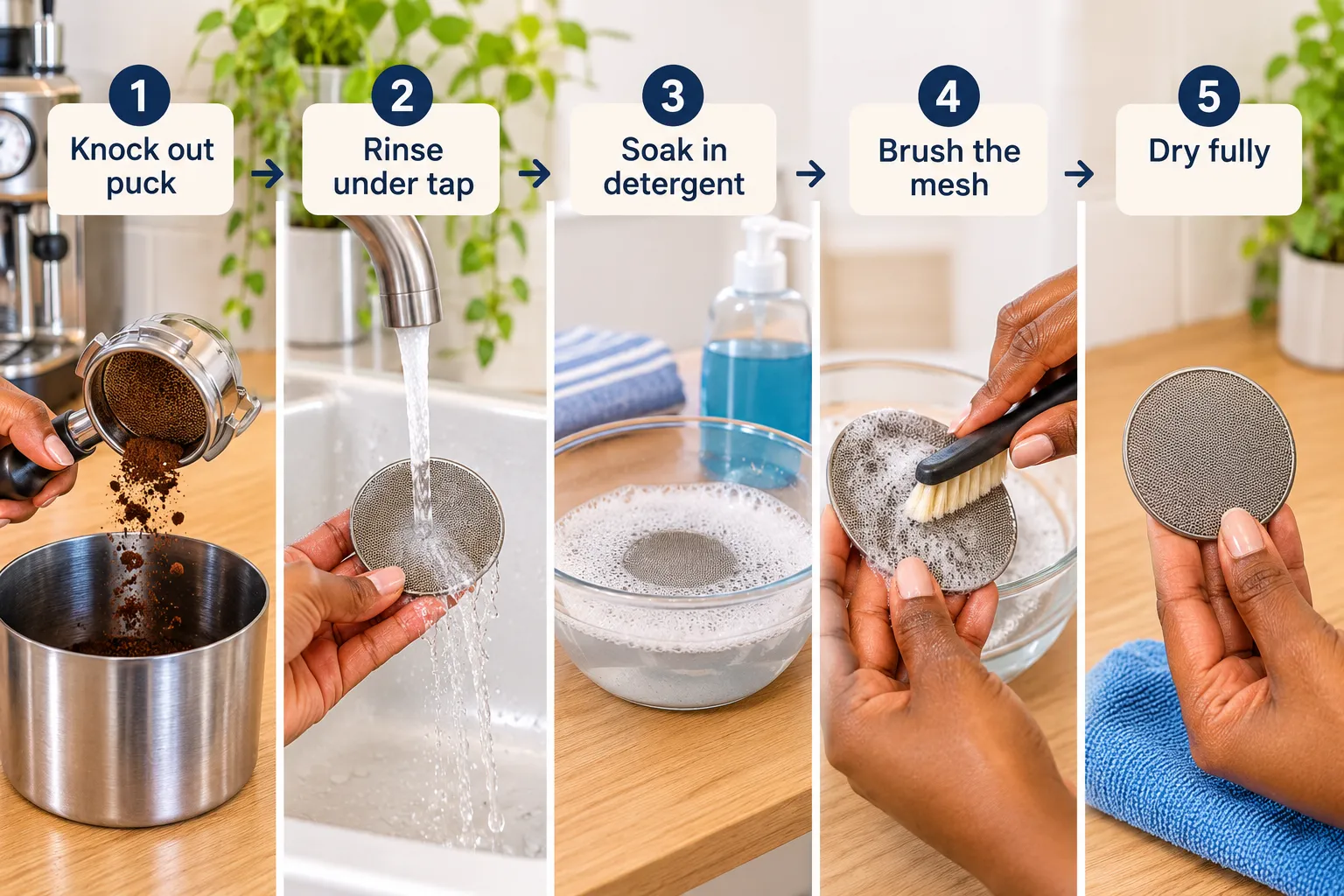
Rinse after every session, deep clean weekly, and replace when the mesh stays dark after soaking. Maintenance takes about two minutes a week and determines whether the screen helps or hinders.
)
Daily: knock out the puck, pull the screen, rinse under hot running water, wipe with a cloth, set it down to dry. Do not leave it sitting in a wet portafilter.
Weekly: soak for 20 to 30 minutes in hot water with espresso machine cleaner (the same powder you use for backflushing). Agitate, then brush gently with a soft brush. Rinse thoroughly.
Replace when: the mesh stays visibly dark after a soak, the disc is warped and no longer sits flat, or flow restriction returns within days of cleaning. At $6.49 to $13.99, replacement is cheaper than fighting a tired screen.
While you have cleaner out, do the group head too. Shower screen cleaning and a backflush on the same schedule keeps the whole path clean, and our notes on descaling your machine cover the water-side half of that routine.
Do beginners really need a the screen?
No. Beginners get more from a scale, a timer, fresh beans with a visible roast date, and a decent grinder. Buy the screen after those are sorted.
Proven Kitchen Tools framed it fairly in October 2026: a nice-to-have that keeps the machine cleaner, not a correction for poor puck preparation . That is the right expectation for someone six weeks into home espresso.
Buy a the screen if:
- You are tired of scrubbing coffee off the shower screen daily
- Your puck prep is already consistent and you want to test a small variable
- You want one fewer messy step in the morning routine
Skip it for now if:
- You do not own a scale
- Your grinder is a blade grinder or a low-end burr unit
- You are still getting gushers and sour shots
New to all this? Start with our picks for the best espresso machine for beginners, then add accessories once your baseline is stable.
the screen vs no the screen: what actually changes
| Outcome | With a screen | Without |
|---|---|---|
| Shower screen cleanliness | Clean for days, well documented | Grounds stuck after most shots |
| Extraction yield | Clive measured about +3 points on one machine | Baseline |
| Flavor improvement | Inconsistent across reviews | Baseline |
| Headspace | Reduced by 0.2 to 1.7 mm | Full |
| Maintenance | Rinse daily, deep clean weekly | Wipe group head after shots |
| Cost | $6.49 to $22.90 | $0 |
Pros and cons
Pros
- Reliable, documented cleanliness benefit for the shower screen and group head
- Cheap: $6.49 to $22.90 across mainstream options as of November 5, 2026
- Reusable for months with basic care
- Possible extraction gain reported by Clive Coffee's 2025 test
- Reduces how often you scrub the brew head
Cons
- No independent controlled evidence that it improves flavor
- Consumes espresso headspace, especially at 1.7 mm
- Clogs with oily roasts and needs regular cleaning
- Wrong diameter causes binding or escaped grounds
- Can lengthen shot time, forcing a re-dial
Common mistakes people make with the screens
- Buying by brand instead of by basket size. Measure first.
- Expecting it to fix channeling. It works above the puck only .
- Choosing 1.7 mm with an 20 g dose. Headspace disappears.
- Never cleaning it, then blaming the beans for slow, bitter shots.
- Not re-dialing after adding it. Shot time shifts, grind should follow.
- Stacking tools without testing. Clive found a leveler added little after WDT plus a screen . Add one thing at a time.
the screen thickness checker
Guidance only. Confirm diameter against your basket before buying.Who should buy one, and who should skip it
Buy the Normcore 58.5 mm stainless ($13.99, checked November 5, 2026) if you own a 58 mm machine, pull one to three shots a day, and want the shower screen cleaning chore to mostly disappear. It is the most reviewed mainstream option and the easiest to source.
Buy the 0.2 mm ultra-thin 2-pack ($6.49) if you dose heavy in a shallow basket and need to protect headspace. Accept that thin discs warp sooner and plan to swap the spare in.
Buy the IMS Big Bang Ultra Thin (about $22.90) if you want a 0.5 mm screen with a premium finish and you are already spending at that tier of gear .
Skip it if you brew with pods, run a super-automatic with a sealed brew unit, or have not yet bought a scale. Also skip if your main complaint is sour, fast shots, since grind size is the lever there. Our guide to the best espresso machine under $500 is a better starting point if the machine itself is the weak link.
FAQ

Conclusion
A the screen earns its $14 as a cleaning tool. The group head stays clean, the morning wipe-down shrinks, and your portafilter comes out tidier. That benefit is consistent across every 2026 review surveyed here .
The taste argument is weaker. One retailer measured a 3 percentage point extraction gain on one machine in 2025 , and independent reviewers could not confirm a flavor improvement under controlled conditions. Buy it for the clean shower screen and treat any sweetness gain as a bonus you did not pay for.
Next step: measure the inside diameter of your basket, then check how much headspace your current dose leaves. If the puck shows a shower screen imprint, order a 0.2 to 0.5 mm screen. If not, a 0.8 mm stainless disc at $12.99 to $13.99 is the straightforward pick. Compare the models, then spend the rest of your accessory budget on the grinder. Better Coffee Starts With Better Answers.