
Coffee Mug Warmer Guide: Real Temps and Auto Shutoff
Quick Answer
A coffee mug warmer holds coffee near drinking temperature, roughly 125°F to 145°F in most independent tests, and it does not reheat a cold cup. Plate warmers advertise settings from about 104°F up to 175°F, but the liquid inside your mug typically lands 20°F to 40°F below the plate setting because heat escapes from the open top. Auto shutoff ranges from 15 minutes of no-cup detection to four hours of runtime, and a timer is the single most useful safety feature on the spec sheet. Expect to pay $11 to $20 for a basic warming plate and $130 or more for a temperature-controlled smart mug.
Key Takeaways
- Wirecutter's testing filled nine warmers with boiling water and measured every 10 minutes for up to two hours; the Mr. Coffee plate held tea around 129°F, and the Nextmug held a similar temperature for roughly 90 minutes .
- WIRED testing of the COSORI warmer and mug set found it stayed within about 5°F of the selected setting, holding a full mug above 130°F at a 170°F setting .
- CNN Underscored tested 10 warmers and reported the IKAGO plate reached at least 130°F in just under 20 minutes, while several rivals needed about 30 minutes or never hit their set point .
- IKAGO's November 5, 2026 listing advertises 105°F to 175°F adjustable control, infrared cup detection, shutoff after 15 minutes without a cup, and shutoff after two hours of inactivity .
- The VOBAGA VOB-10 lists three settings (104°F, 131°F, 149°F), a documented four-hour auto shutoff, and runs at 120 volts and 20 watts .
- Amazon prices checked November 5, 2026: the top-selling warmer sat at $18.99 (4,031 reviews, 8,000+ bought in the past month) and the HouseGem warming plate at $10.99 (3,051 reviews).
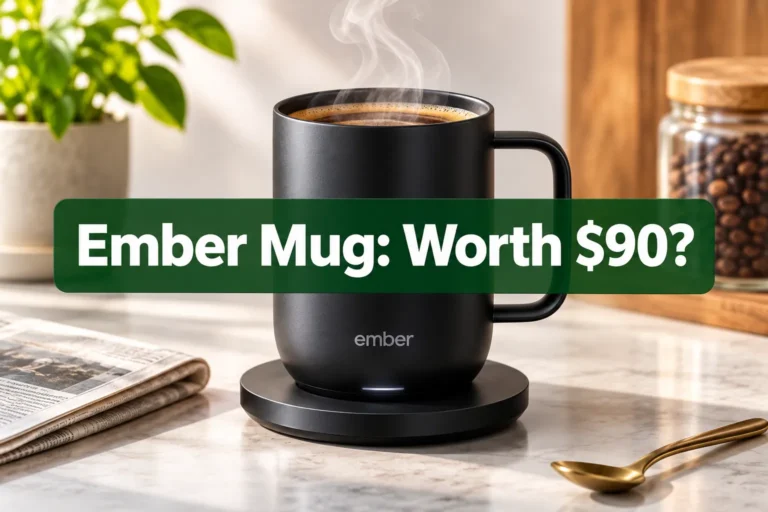
- Ember Mug 2 controls between 120°F and 145°F with roughly 90 minutes of battery on the 14 oz model, which is why the charging coaster matters at a desk .
What a coffee mug warmer actually does, and what it cannot do
A coffee mug warmer is a low-wattage heating plate (typically 15 to 25 watts) that slows the rate at which a hot drink cools. It maintains. It does not reheat. Pour 185°F coffee on one and the drink will still cool for the first stretch, settling into the warmer's holding range rather than climbing back up.
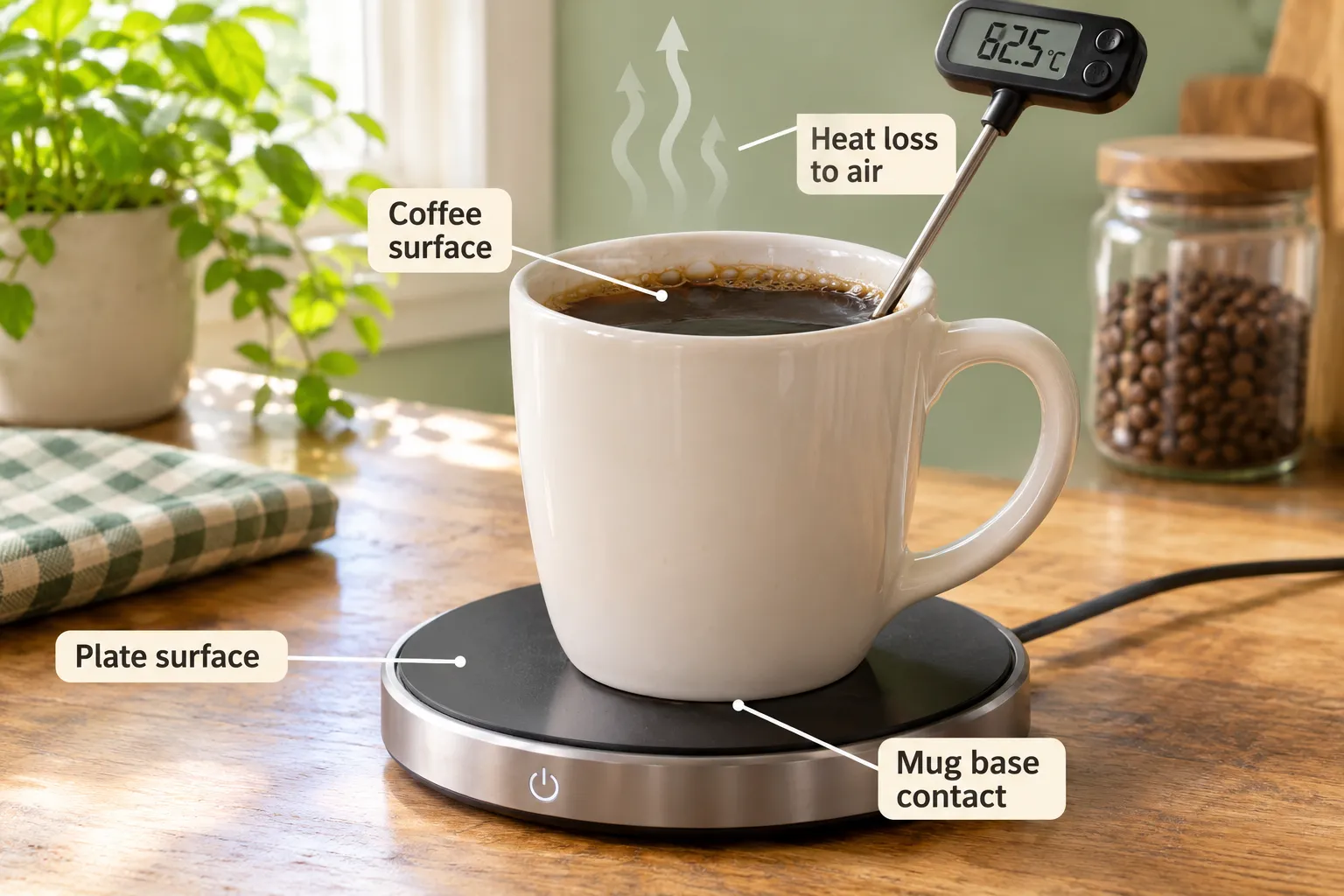
The physics are plain. Your mug loses heat in three directions: conduction into the desk, convection and evaporation off the open coffee surface, and radiation through the ceramic walls. A warming plate only fights the first one, and it only touches a two to three inch disc of mug base. The open top is where most of the heat leaves, which is why a lid changes the result more than another 20 watts ever will.
That is also why a warming plate behaves differently from the hot plate under a drip brewer. That plate sits under glass and keeps coffee near 175°F, which stews it. A desk mug warmer aims lower and treats the drink gently. If you brew with a thermal carafe setup like the Moccamaster, you already know the difference between holding heat and cooking coffee.
Coffee mug warmer temperatures: what the plate says versus what your coffee reaches
The number on the dial is a plate-surface target, not a beverage temperature. Independent testing suggests the drink usually sits well below it.
Two useful data points. WIRED's testing of the COSORI warmer and mug set found it tracked within about 5°F of the chosen setting, and at a 170°F setting a full mug stayed above 130°F . Wirecutter, which filled contenders with boiling water and logged temperatures at 10-minute intervals for up to two hours, reported the Mr. Coffee unit holding tea near 129°F . Both numbers cluster around the same place.
Where temperatures actually land
| Advertised plate setting | Typical sustained coffee temperature | What that feels like |
|---|---|---|
| 104°F (low) | Lukewarm, near body temperature | Pleasant for tea, flat for coffee |
| 131°F (medium) | Warm, drinkable immediately | The sweet spot for most drinkers |
| 149°F to 175°F (high) | 130°F to 145°F in a full mug | Hot enough to feel "fresh" |
Most people describe coffee as satisfying somewhere between 130°F and 145°F. That is the band a good coffee mug warmer defends.
A decision rule: if your plate offers three settings, start on the highest one with a full mug and a lid. Drop to medium only if the coffee tastes flat or papery after 40 minutes. Heat exaggerates bitterness in dark roasts, so a French roast held at 150°F for an hour will taste harsher than a medium single origin held at the same temperature.
Does a coffee mug warmer really keep coffee hot all day?
No. A mug warmer holds temperature well for one to three hours, and it preserves heat far better than flavor. Coffee continues to oxidize on a warmer plate, and most drinkers notice the taste turning dull and slightly woody after about 45 to 60 minutes.
Battery-powered smart mugs have a harder ceiling. The 14 oz Ember Mug 2 runs roughly 90 minutes off its battery before needing the charging coaster , and Wirecutter observed the Nextmug sustaining temperature for about 90 minutes . Corded plates have no battery limit, but they do have shutoff timers, which is the point of the next section.
A warmer buys you time, not freshness. It rescues the cup you forgot about. It will not make hour-four coffee taste like hour-one coffee.
Coffee mug warmer with auto shutoff: which timer is right?
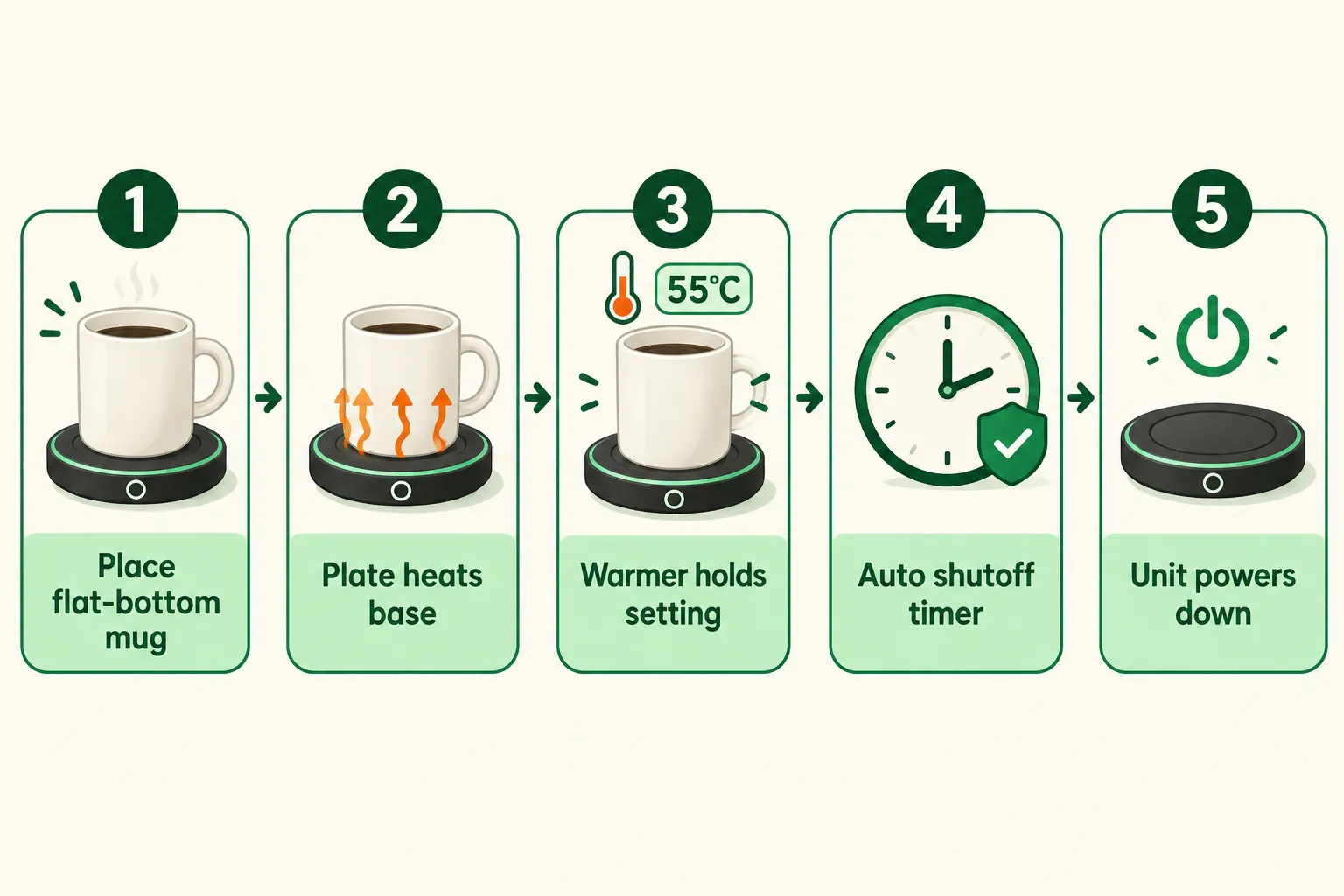
For most desk users, a four-hour auto shutoff with cup detection is the best combination. It outlasts a long meeting block but never leaves a plate hot overnight.
The two shutoff styles on the market:
- Fixed runtime timers. The unit powers down after a set period regardless of what sits on it. The VOBAGA VOB-10 documents a four-hour shutoff across its 104°F, 131°F, and 149°F settings .
- Sensor-based shutoff. Infrared or weight detection pauses heating when the mug is lifted. IKAGO's listing advertises infrared cup detection, pausing when the cup is removed, shutoff after 15 minutes without a cup, and shutoff after two hours of inactivity .
Choose by situation
- Home office, long sessions: four-hour timer.
- Shared or open-plan desk: sensor detection plus a two-hour cap.
- Households with kids or pets: the shortest shutoff you can live with, plus a cord you can route out of reach.
- Night-shift or very long sittings: a corded plate beats any battery mug.
The common mistake is assuming a shutoff exists. It often does not.
Do all mug warmers have auto shutoff, or just some?
Only some. Auto shutoff is a feature, not a standard, and plenty of inexpensive warming plates ship with nothing but an on/off switch and an indicator light.
The Norpro 5562 is a clear example: an 18-watt plate with a nonstick element, a 66-inch cord, an indicator light, and UL approval, but no documented adjustable temperature and no documented automatic shutoff in the specifications reviewed . It works. It simply stays on until you switch it off.
Before buying, search the product page for the words "auto shut" or "automatic power off." If the listing does not state a time in hours or minutes, assume there is no timer. A review mentioning the feature is not the same as a manufacturer specification.
Can a coffee mug warmer cause burns or overheat?
A corded 15 to 25 watt coffee mug warmer is low risk, but the plate surface can reach 150°F or more, which is hot enough to cause a contact burn and hot enough to scorch paper, laminate, or a wooden desk left in direct contact. Treat it like a small hot plate, because that is what it is.
No mug-warmer-specific federal recall was identified in the CPSC recall resources reviewed through November 6, 2026 . The agency's recent notices on rechargeable heating products have involved hand warmers, not mug warmers, but those notices matter for one reason: battery-powered heated mugs carry lithium-cell risks that a corded plate does not. If you want the lowest risk profile, a plug-in plate with a timer is the conservative pick.
Safe-use rules
- Keep the plate on a hard, heat-tolerant surface, never on paper stacks or a fabric desk mat.
- Unplug it at the end of the day even if it has a timer.
- Do not place a sealed travel lid on a mug and leave it heating unattended for hours.
- Never run the plate dry under an empty mug if it lacks cup detection.
- Check the cord for heat or discoloration every few months.
Will a coffee mug warmer damage ceramic or glass mugs?
Standard glazed ceramic, stoneware, porcelain, and borosilicate glass all tolerate mug warmer temperatures without damage. These plates hold under 180°F, far below the thermal stress point of ordinary dinnerware.
The real risks are narrower:
- Hand-thrown pottery with an unglazed foot ring can scuff the plate or heat unevenly.
- Thin soda-lime glass can crack from thermal shock if it goes from cold refrigerator to a hot plate. Let it come to room temperature first.
- Double-walled glass and vacuum-insulated steel will not transfer heat efficiently. The plate works; the coffee barely notices.
- Printed or decal-heavy mugs may show gradual wear on the base from repeated heating and wiping.
Travel cups fall in the same trap. A reusable KeepCup-style lid and body is built to resist heat loss, which means the warmer underneath has very little influence.
Can you use any size mug on a coffee warmer?
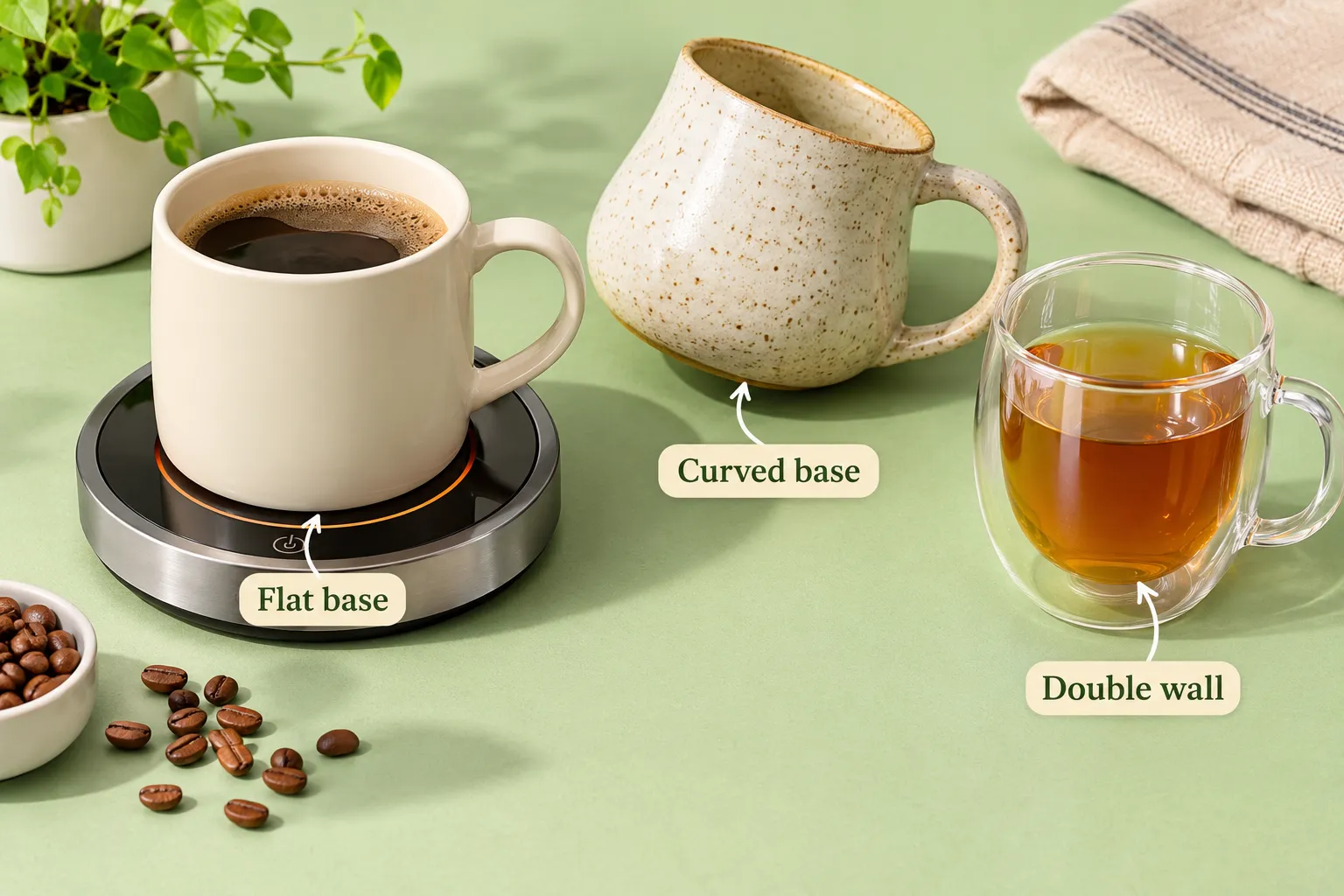
No. A flat-bottom mug of roughly 8 to 16 ounces, with a base diameter close to the plate diameter, is the requirement for a plate-style warmer. Rounded bases, oversized 20 oz mugs, and narrow espresso cups all perform poorly.
Three things decide performance:
- Contact area. Heat moves by conduction. A base that touches only at the rim transfers a fraction of the available heat.
- Volume. A 20 oz mug has more liquid and more exposed surface than a 20-watt plate can hold.
- Wall thickness. Thick stoneware absorbs heat from the plate before passing it to the coffee, so it takes longer to stabilize but then holds steadier.
This is the reason 2026 editorial testing has shifted toward matched systems. Sekin's August 14, 2026 comparison argues that an integrated mug-and-base pairing gives more predictable results than a universal plate, precisely because mug shape, material, and base contact dominate the outcome . The OHOM Ui 3 in that roundup pairs a supplied ceramic mug with an induction-style pad targeting about 130°F, a manufacturer figure rather than an independently measured beverage temperature .
Why does my coffee still get cold even with a warmer?
Four causes account for nearly every complaint, and three of them are free to fix.
- No lid. Evaporation off an open surface is the largest single heat loss. A simple silicone lid or even a saucer on top can hold several degrees.
- Wrong mug. A curved base, a double wall, or a 20 oz capacity will defeat a 20-watt plate.
- Too little coffee. A half-empty mug has a high surface-to-volume ratio and cools fast. Warmers hold full mugs better.
- Cold start. Warmers maintain. Pouring 120°F coffee onto a 131°F plate will not bring it back to 150°F.
Add a fifth if you work by a window. A draft across the mug surface strips heat quickly, and plates have no answer for moving air.
A quick test: fill your mug with freshly boiled water, set it on the warmer with a lid, and check it at 30 and 60 minutes with a kitchen thermometer. If it holds above 130°F, the warmer is fine and your coffee habits are the variable.
Coffee mug warmer vs thermos: which keeps coffee hotter?
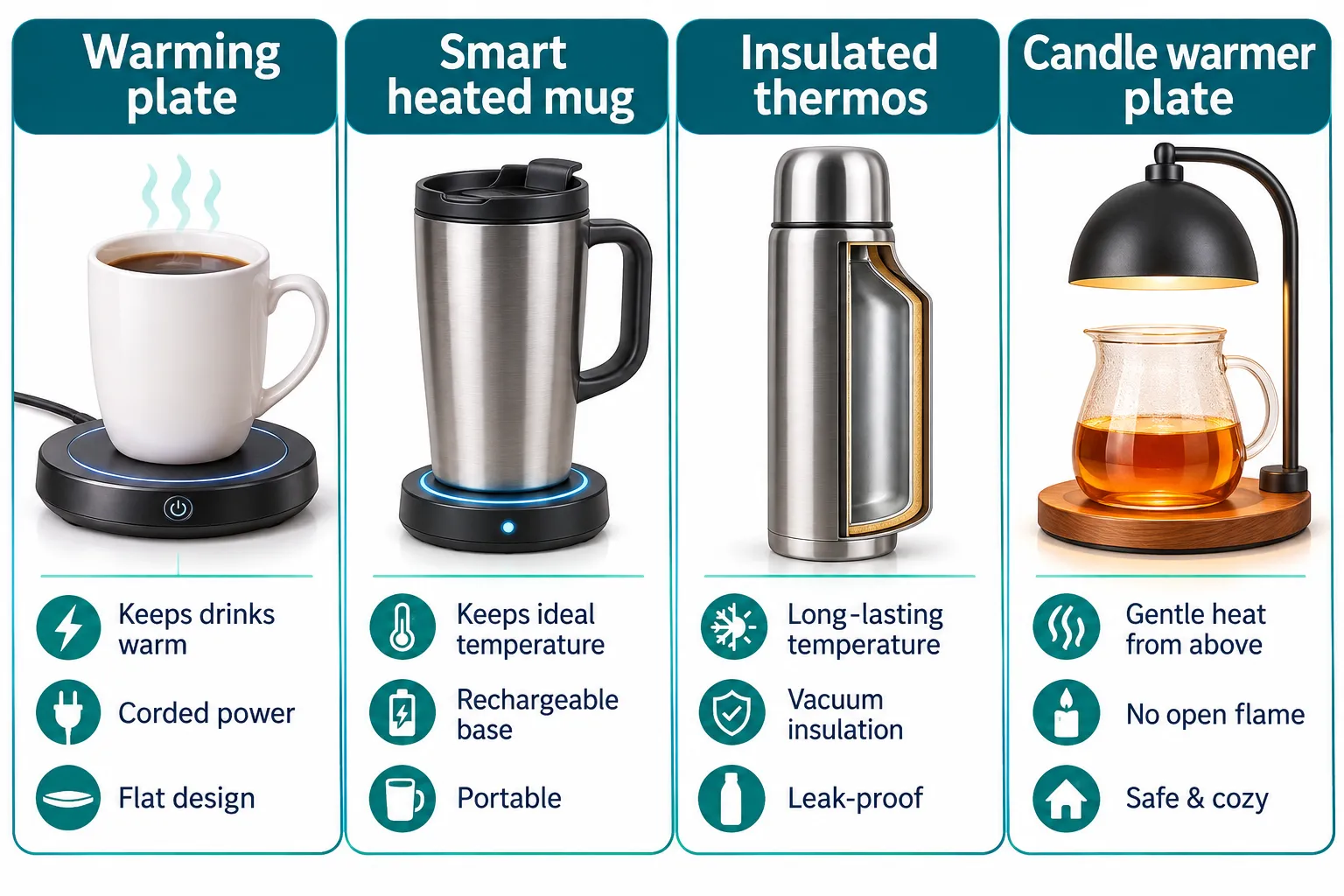
A good vacuum-insulated thermos keeps coffee hotter for longer, full stop. A quality flask can hold coffee above 140°F for six hours or more. No 20-watt desk plate competes with that.
The warmer wins on a different axis: you drink from an open mug. You smell the aroma. You sip without unscrewing anything. That matters more than most spec sheets admit, because aroma is where most of coffee's perceived flavor lives, and a sealed flask hides it.
| Option | Heat retention | Aroma and drinking experience | Typical price, checked Nov 5, 2026 |
|---|---|---|---|
| Warming plate | 1 to 4 hours, limited by timer | Open mug, full aroma | $11 to $25 |
| Smart heated mug | ~90 min on battery, unlimited on coaster | Open mug, precise control | $130 and up |
| Vacuum thermos | 6+ hours | Sealed, muted aroma | $25 to $50 |
Choose the thermos for a commute or a job site. Choose a coffee mug warmer for a desk. Many people own both and never regret it.
How much should you spend on a good coffee mug warmer?
Spend $15 to $25 for a solid plug-in plate with a timer, and only go past $100 if you want programmable degree-by-degree control. The budget tier is genuinely competent.
Amazon pricing checked November 5, 2026: the top-selling mug warmer listed at $18.99 with 4,031 reviews and 8,000+ units bought in the past month, while the HouseGem warming plate listed at $10.99 with 3,051 reviews and similar monthly volume. Prices change; check the current price before buying.
What the extra money actually buys:
- $11 to $15: one fixed temperature, on/off switch, often no shutoff timer.
- $18 to $30: two or three temperature settings, auto shutoff between two and four hours, sometimes cup detection.
- $45 to $80: matched mug-and-base systems with tighter temperature tracking.
- $130 and up: app-controlled heated mugs with 120°F to 145°F range and charging coasters .
Disclosure: Coffee Rank IQ earns affiliate commissions on some product links. Prices listed were checked on November 5, 2026 and will change.
Five features we love on a coffee mug warmer
- Infrared cup detection. IKAGO's listing advertises detection that pauses heating when the mug is lifted and shuts the unit down after 15 minutes with no cup . Practical payoff: the plate is not sitting hot while you are in a meeting.
- A documented four-hour auto shutoff. The VOBAGA VOB-10 states it plainly . Practical payoff: you can leave the house without mentally retracing whether you flipped the switch.
- Three real temperature steps. 104°F, 131°F, and 149°F cover tea, coffee, and "I like it hot" . Practical payoff: tea drinkers stop scalding delicate leaf infusions.
- A nonstick, wipeable plate surface. Drips are inevitable. Practical payoff: a sugar spill cleans off with a damp cloth instead of baking on.
- A long cord, 60 inches or more. The Norpro plate ships with a 66-inch cord . Practical payoff: the warmer sits where your hand reaches, not where the outlet dictates.
What to watch out for
Honest friction, because every one of these shows up in real use.
- No shutoff on cheap plates. Many sub-$15 units have a switch and nothing else .
- Advertised temperature is plate temperature. Your coffee will read lower, often by 20°F to 40°F.
- Flavor degradation. Holding coffee at 150°F accelerates staling. After an hour, most cups taste tired.
- Battery limits on smart mugs. Roughly 90 minutes untethered on the 14 oz Ember Mug 2 , so the coaster is not optional for desk work.
- Mug lottery. Your favorite curved-base mug may simply not work.
- Slow warm-up. CNN reported some warmers took around 30 minutes to reach temperature, or never reached their set point at all .
- No reheating. If your coffee went cold, the warmer will not save it.
Is a coffee mug warmer worth it, or just a gimmick?
For anyone who regularly rediscovers a cold half-mug on their desk, a $19 warming plate is one of the highest-value coffee purchases available. For people who finish a cup in 15 minutes, it is a gimmick.
Run this test for three days: note the temperature of your coffee when you take your last sip and how much you pour down the sink. If you are dumping a quarter of every cup, a coffee mug warmer pays for itself in wasted beans within a couple of months, especially if you buy single origin coffee worth paying attention to.
Comparison table: named the warmers and heated mugs
| Model | Temperature | Auto shutoff | Price (checked Nov 5, 2026) | Best for |
|---|---|---|---|---|
| Top-selling Amazon warmer plate | Multi-setting | Listed, verify on page | $18.99 | Most desk users |
| HouseGem warming plate | Basic plate heat | Check listing | $10.99 | Lowest-cost trial |
| VOBAGA VOB-10 | 104 / 131 / 149°F | 4 hours | Check the current price | Timer-first buyers |
| IKAGO warming plate | 105-175°F | 15 min no cup / 2 hr | Check the current price | Fast warm-up |
| Ember Mug 2 (14 oz) | 120-145°F app control | ~90 min battery | $130+ | Precision and gifting |
Who should buy one and who should skip it
Buy a plate warmer with a four-hour timer if you work at a desk, drink from an open ceramic mug, and take more than 30 minutes to finish a cup. The VOBAGA VOB-10 is the clearest pick here because the shutoff is documented rather than implied .
Buy a matched mug-and-base system if you want predictable results and dislike fiddling. Sekin's 2026 comparison names the OHOM Ui 3 as the best polished desk system, targeting about 130°F with a supplied ceramic mug .
Buy a smart heated mug if you want degree-level control or you are shopping for a gift. The Ember Mug 2 gives 120°F to 145°F with app control , and the Ember Mug 3 appeared as a #1 New Release in heated beverage warmers on November 4, 2026, which is a retail ranking signal rather than a performance test .
Skip all of them if you drink espresso, drink fast, commute with your coffee, or use a double-walled mug. Espresso drinkers are better served warming the cup itself; see our advanced espresso extraction and crema guide for why cup temperature matters at the moment of pulling the shot.
Pros and cons
Pros
- Cheap entry point, around $11 to $19 on Amazon as of November 5, 2026.
- Holds coffee in the 129°F to 145°F range in independent testing .
- Works with most ordinary flat-bottom ceramic mugs.
- Low wattage, typically 18 to 20 watts .
- Auto shutoff models remove the "did I leave it on" worry.
- Open mug keeps aroma available, unlike a sealed flask.
Cons
- Cannot reheat cold coffee.
- Flavor still degrades after roughly an hour.
- Plate temperature is not drink temperature.
- Many budget plates lack a documented shutoff .
- Incompatible with curved bases, double walls, and 20 oz mugs.
- Smart mugs cost 7x more than plates.
the warmer alternatives if you do not want to buy one
Free and near-free options that work:
- Use a lid or saucer. The cheapest heat retention upgrade there is.
- Preheat the mug with boiling water for 30 seconds before pouring. Thick ceramic then stops stealing heat from your coffee.
- Brew smaller. Two 6 oz pours beat one 12 oz pour that goes cold.
- Switch to a thermal carafe brewer, which holds the whole batch rather than one cup. Our Zojirushi Fresh Brew Plus thermal carafe buyer's guide covers that route.
- Use a candle warmer plate if you already own one for wax melts. It is a lower, less controlled heat and rarely has cup detection, so supervise it.
- Drink cold brew instead. Temperature stops being a problem. Start with our beginner's guide to cold brew coffee.
Common mistakes people make with a the warmer
- Expecting it to reheat. It maintains only.
- Buying without checking the shutoff specification.
- Using a 20 oz travel tumbler on a 20-watt plate.
- Leaving coffee on for three hours then blaming the beans for the stale taste.
- Setting the plate on a stack of paper.
- Skipping the lid, which is the biggest free gain available.
- Judging performance from the box temperature rather than measuring the coffee.
Estimate your coffee holding temperature
Estimate only, based on published test ranges from Wirecutter and WIRED-reported results. Measure with a kitchen thermometer for your own setup.
FAQ

Conclusion
A the warmer is a $19 fix for a real daily annoyance, provided you understand the deal: it holds coffee near 130°F to 145°F, it needs a flat-bottom mug, and it buys you time rather than freshness. The feature that actually matters on the spec sheet is not wattage or temperature range. It is the auto shutoff, and plenty of cheap plates do not have one.
Next step: measure before you buy. Put a thermometer in your usual mug and check the temperature at the moment you stop enjoying it. If that number is above 125°F, you want a warmer on a medium setting. If you are still drinking happily at 110°F, save the money and buy better beans instead. Better Coffee Starts With Better Answers, and in this case the answer starts with a thermometer.