Bialetti Moka Express Sizes: What Each One Really Yields
Quick Answer
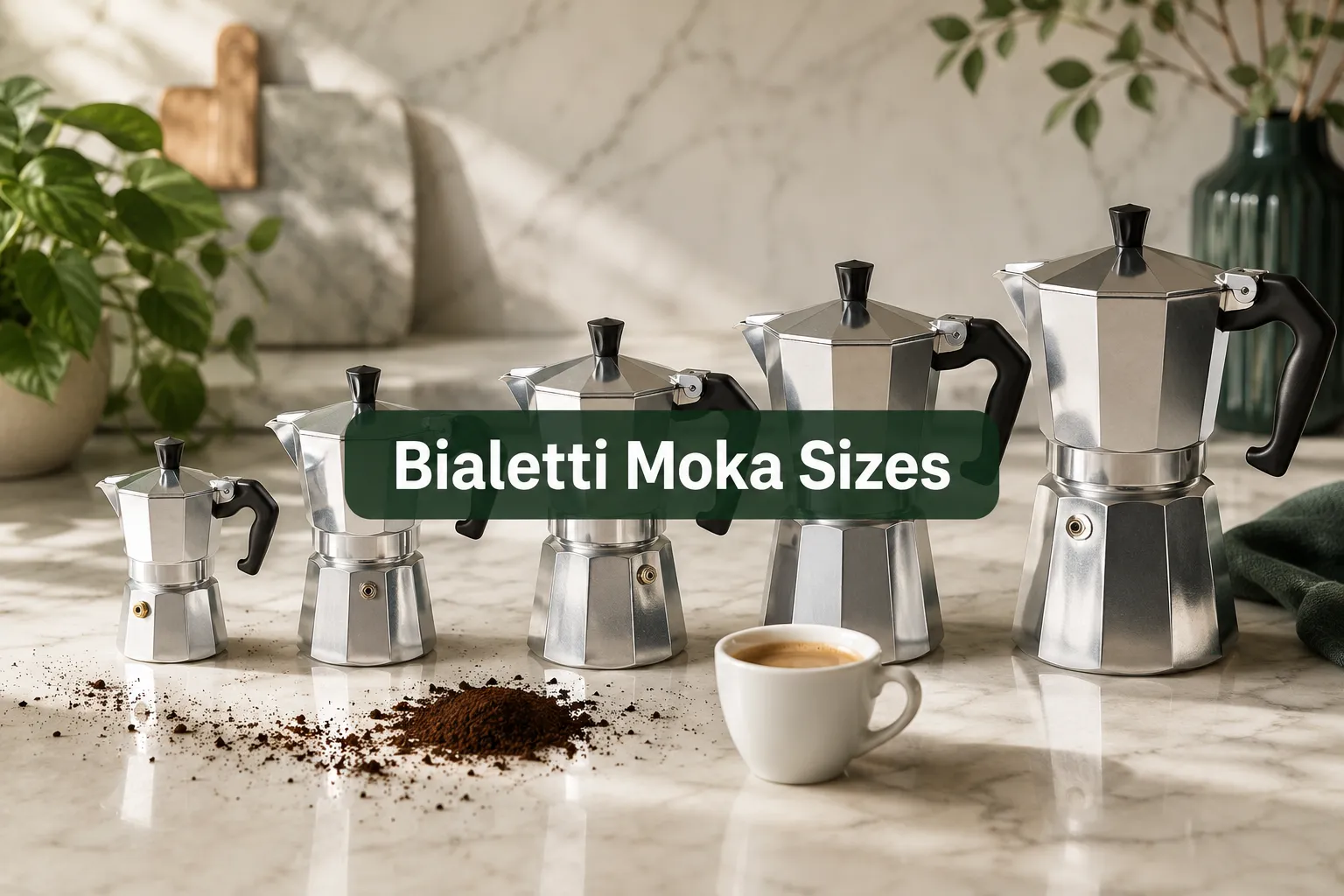
A Bialetti "cup" is an espresso cup, roughly 2 US fluid ounces, not an 8 oz mug. By Bialetti's own US size guide, the 1-cup yields about 2 oz, the 3-cup about 4.4 oz, the 6-cup about 9.1 oz, the 9-cup about 14.2 oz, and the 12-cup about 22 oz . So the 6-cup everyone buys makes roughly one large coffee or two modest ones. For one drinker, get the 3-cup. For two, get the 6-cup.
Key Takeaways
- One Bialetti cup ≈ 2 oz / 60 ml. Bialetti's US client support page states Moka sizes refer to espresso cups, not American coffee mugs .
- 3-cup yields about 4.4 oz (130 ml) . That is one concentrated coffee, or one solid cappuccino-sized drink after milk.
- 6-cup yields about 9.1 oz (250 to 270 ml) . Wirecutter's 2026-updated review notes real-world 6-cup output lands around 8 to 10 oz once the grounds absorb water.
- 9-cup yields about 14.2 oz, and the 12-cup about 22 oz . The 18-cup tops out near 27.3 oz.
- Amazon prices checked November 5, 2026: 6-cup $48.44 (4.6 stars, 51,170 ratings), 3-cup $39.98 (25,585 ratings). Bialetti's own US site listed the 3-cup at $49.99 on November 6, 2026.
- Brew it full. Bialetti's guidance warns that under-filling water or coffee changes pressure and hurts extraction . A 6-cup is not a flexible 3-cup.
- Brew time is 3 to 6 minutes on low-to-medium heat with a medium-fine grind .
Bialetti Moka Express sizes: what each one really yields
Here is the table that settles the argument. All capacities come from Bialetti's published US size guide , with the practical translation added.
| Model | Stated output | What that actually is | Realistic daily use |
|---|---|---|---|
| 1-cup | ~2 oz / 60 ml | One espresso-style shot | Travel, a single shot, novelty |
| 3-cup | ~4.4 oz / 130 ml | One strong coffee or two tiny Italian servings | One person, every morning |
| 6-cup | ~9.1 oz / 270 ml | One big mug topped with water, or two milk drinks | Two people, or one heavy drinker |
| 9-cup | ~14.2 oz / 410 ml | Two substantial coffees | Weekend brunch, three small cups |
| 12-cup | ~22 oz / 650 ml | Four to six servings | Family mornings, guests |
| 18-cup | ~27.3 oz | Batch brewing | Office, large gatherings |
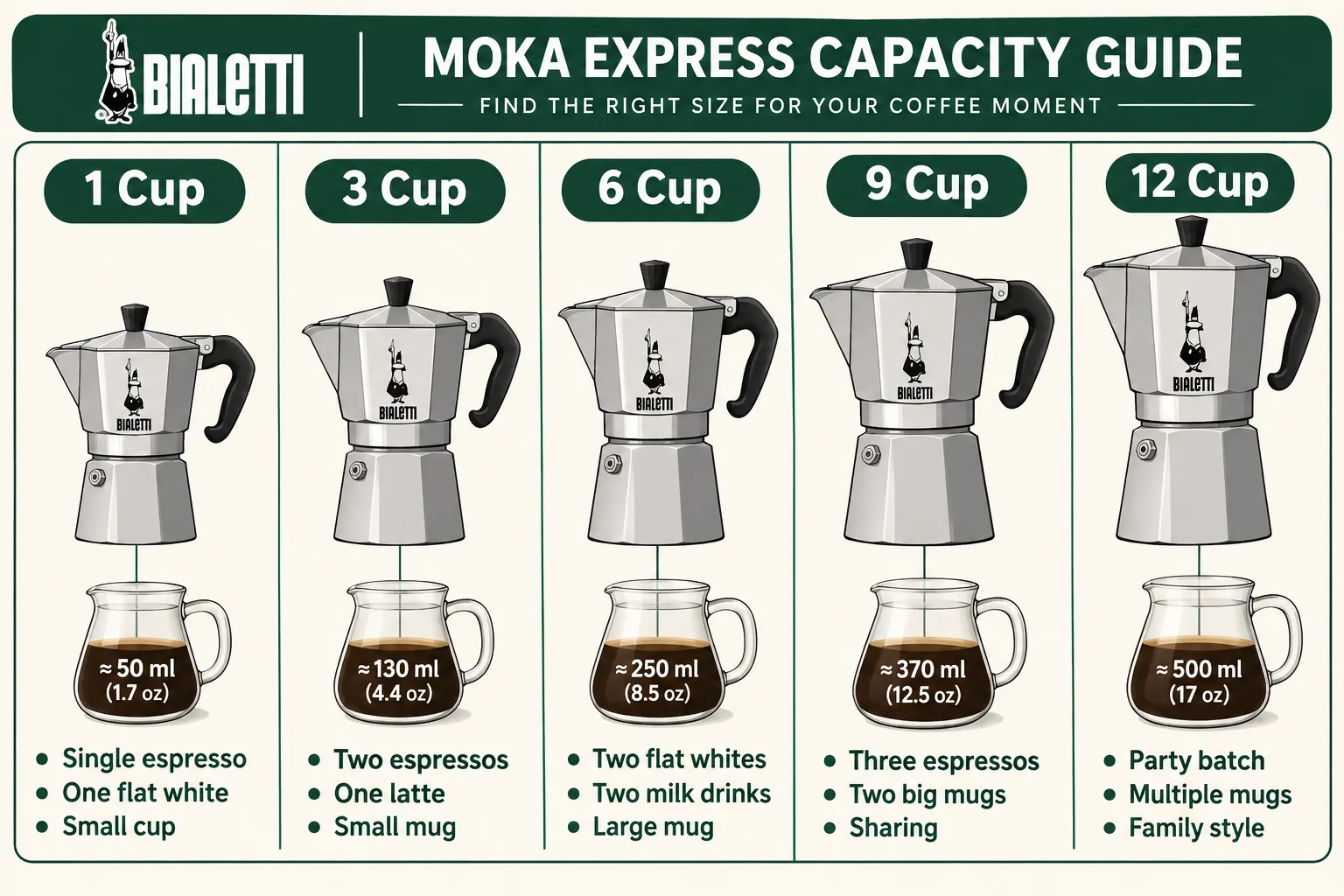
Notice the jump. A 6-cup is not double a 3-cup in usefulness, it is double in volume but roughly the same in drinks, because one American mug swallows the entire 3-cup output plus hot water. The size number tells you volume. Your habits tell you which volume you need.
A second detail that trips people up: stated capacity is water capacity, not finished coffee. Dry grounds soak up water and hold it. Wirecutter's review of the 6-cup, originally published in 2021 and updated for 2026, reported typical real yields of 8 to 10 oz depending on absorption. That is why your pot sometimes feels like it short-changed you.
What's the difference between Bialetti Moka Express sizes?
The only meaningful differences are boiler volume, filter basket diameter, and footprint. The pot is otherwise the same design: the same eight-sided cast aluminium body, the same safety valve, the same little man with the moustache.
What changes with size:
- Dose. A 3-cup basket takes roughly 15 to 17 g of ground coffee. A 6-cup takes around 25 to 30 g. A 12-cup can swallow 60 g or more. Budget your beans accordingly.
- Brew time. Bialetti specifies 3 to 6 minutes depending on pot size and heat . Bigger pots sit longer on the burner, which gives the coffee more time to pick up roasty, bitter notes if the heat is high.
- Burner match. A 1-cup or 3-cup on a wide gas ring will get flame licking up the sides and scorch the handle. A 12-cup on a small ring heats unevenly.
- Induction. The classic aluminium Moka Express is not induction compatible. Bialetti sells a separate steel "Induction" line and the Moka Finder tool can filter by hob type .
Decision rule: pick the size that matches your normal batch, not your biggest imaginable one. The pot runs best full.
Does Bialetti cup size mean espresso cups or regular cups?
Espresso cups. Bialetti's US client support page says so directly, and its published figures line up with roughly 2 oz per nominal cup . A 6-cup Bialetti Moka Express will not fill six American mugs. It fills one and a bit.
Why the confusion persists: the pot was designed in 1933 Italy, where a tazzina is a thimble of intense coffee you drink standing at a bar. Three of those is a morning. Three American mugs is 24 oz. The word travelled, the measurement did not.
If you drink your coffee black and small, the Italian maths works. If you drink a 12 oz latte, read every size number as "ounces, divided by two" and you will never be disappointed again. Moka coffee sits between drip and espresso in strength, which is exactly why diluting it works so well.
How many cups does a 3-cup Moka Express actually make?
About 4.4 oz, or 130 ml, of finished coffee . That is one small-to-medium coffee when you drink it straight, or one café-sized milk drink if you add 4 to 6 oz of steamed milk.
Practical translations for the 3-cup:
- Straight: two Italian-style demitasse servings, or one generous single.
- Americano style: add 4 oz hot water, get a 8.5 oz black coffee. See how the americano is actually built if you want the ratios right.
- Cortado or flat white: pour 2 oz of moka over 3 to 4 oz of warm milk. The cortado is the closest café match to a moka pot's output.
- Latte: possible, but thin. Step up to the 6-cup.
Common mistake: buying the 3-cup and then brewing it half full on slow mornings. Bialetti's own instructions warn against under-filling, because the water-to-headspace ratio drives the pressure that pushes brew through the grounds . Half a boiler gives you weak, sour coffee.
Why doesn't my Moka Express fill up all the way?
Because it was never going to. Stated capacity measures the water you pour into the boiler, and three things eat into that before it reaches the top chamber: the safety valve line caps your fill, the dry grounds absorb and retain water, and a small volume stays behind as steam and residue.
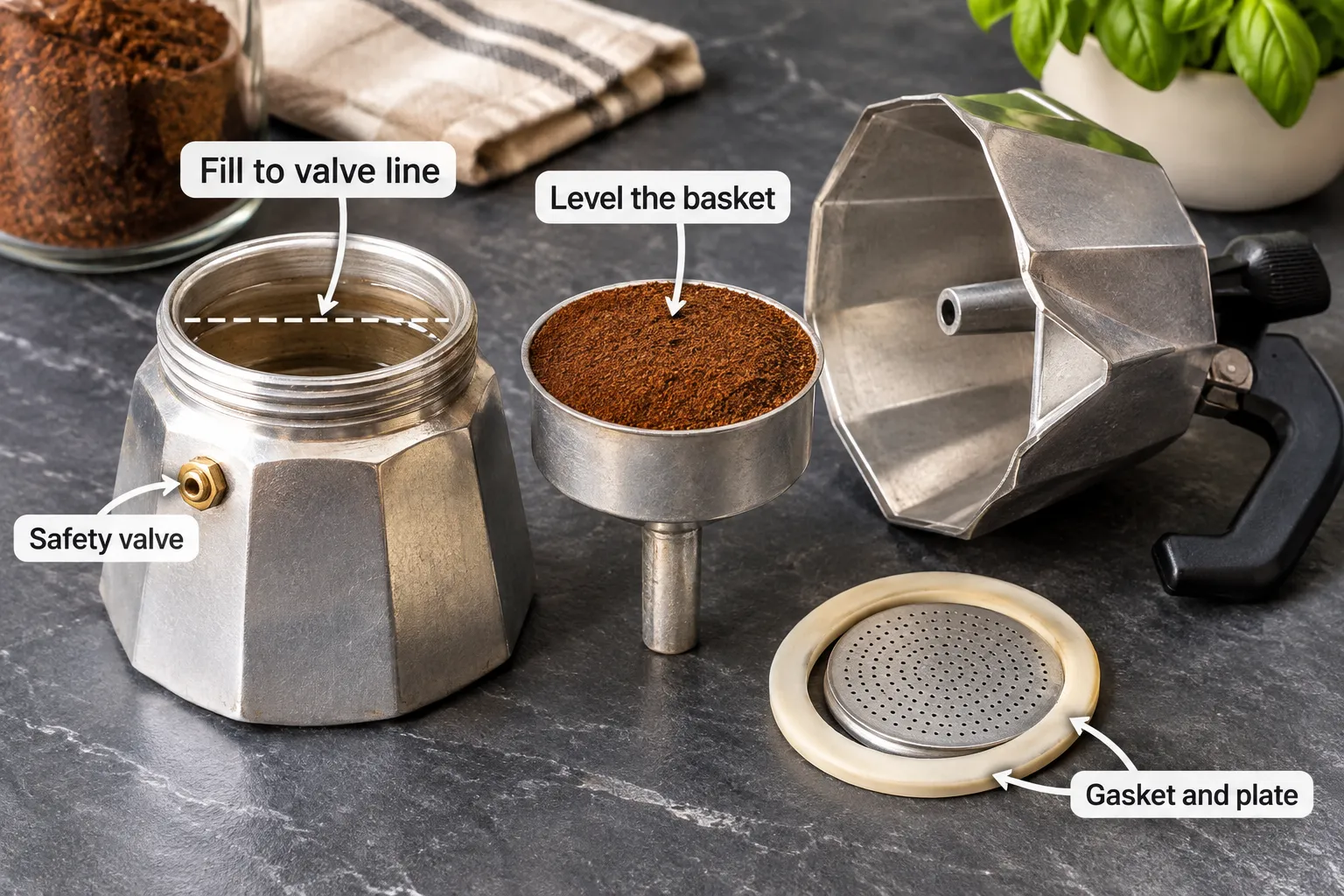
Fill water to just below the safety valve, never above it. That valve is a pressure release, and covering it with water removes your margin for error. Expect your 6-cup to hand back 8 to 10 oz rather than a theoretical 9.1.
Other reasons for a short pour:
- Heat too low. The pot stalls before it finishes. Medium heat, not a whisper.
- Grind too fine. Espresso-fine grounds choke the basket. Bialetti recommends medium-fine . A burr grinder set a couple of clicks coarser than espresso is the fix.
- Tired gasket. The rubber ring perishes after a year or two of daily use and leaks steam out of the seam. Replacements are a few dollars.
- Tamped grounds. Do not tamp. Level the grounds with a finger and leave them loose.
What size Moka Express should I get for one person?
The 3-cup. It makes 4.4 oz , brews in about four minutes, uses about 16 g of coffee per batch, and is the cheaper buy: $39.98 on Amazon as checked November 5, 2026, with 25,585 ratings.
Choose the 3-cup if you:
- Drink one coffee a morning, black or with a splash of milk
- Have a small burner or a camping stove
- Want to brew full every time, which is how the pot works best
Choose the 6-cup instead if you regularly drink a 12 oz americano or two cappuccinos before noon. A single person with a serious habit is a two-drink household in disguise.
Edge case: if you own only a wide gas ring with no simmer plate, the 3-cup can scorch. A cheap heat diffuser solves it for under $15.
How much coffee does the 6-cup Bialetti produce?
About 9.1 oz by Bialetti's published figure, and 8 to 10 oz in practice . It is the single most popular size, which is reflected in its review count: 51,170 Amazon ratings at 4.6 stars, with 3,000+ bought in the past month, checked November 5, 2026 at $48.44.
What 9 oz of moka coffee becomes:
- Two cappuccinos (about 4.5 oz of coffee each, topped with milk)
- One 14 oz americano with hot water added
- Three small Italian-style servings
- Two flat whites with room to spare
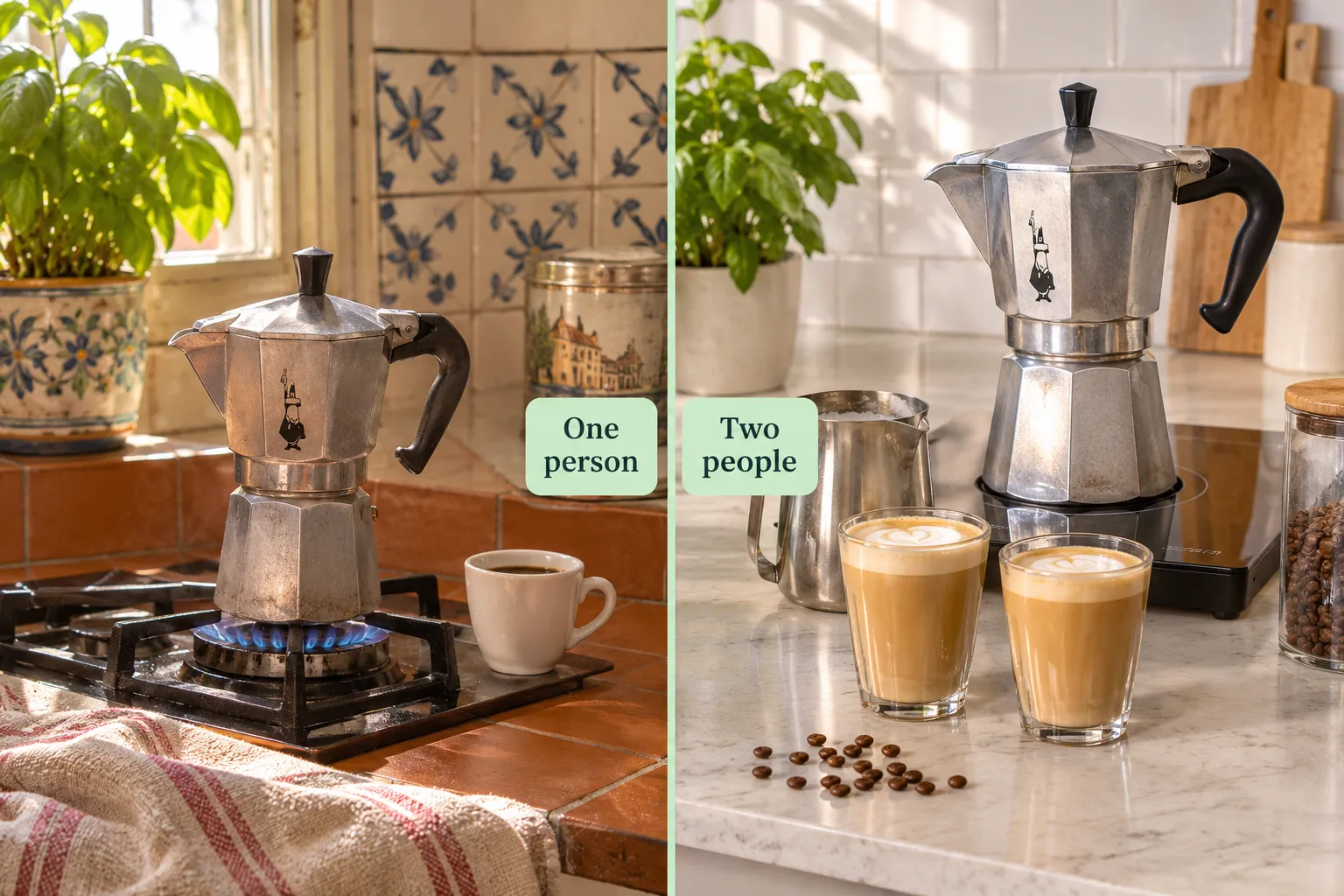
The 6-cup also happens to be the size most troubleshooting advice online assumes, which matters more than it sounds. Grind recommendations, dose figures, and timing notes almost all default to this pot.
Bialetti 3 cup vs 6 cup: which one wins for two people?
The 6-cup, clearly. Two people drinking milk-based coffee need roughly 8 to 9 oz of concentrate, which is precisely what the 6-cup delivers . Running the 3-cup twice costs you an extra four minutes and a second cool-down.
If your household is split, two drinkers but staggered schedules, owning the 3-cup and brewing twice is genuinely fine. Each brew is fresher. It just costs you time.
Is the 1-cup Bialetti worth buying?
For most buyers, no. At roughly 2 oz of output , the 1-cup Moka Express produces one espresso-sized serving and very little margin for error, since small boilers heat fast and overshoot easily.
It earns its place in three situations:
- Travel and camping. It is light, has no electronics, and works on any flame.
- A dedicated single-shot habit. If you drink one 2 oz coffee and nothing else, it is perfect.
- Gifting alongside a larger pot. It photographs beautifully and costs little.
Everyone else should start at the 3-cup. The extra 2.4 oz costs a few dollars and buys real flexibility.
Can you use regular ground coffee in a Moka Express?
Yes, but pre-ground supermarket drip coffee is usually a touch too coarse, and pre-ground espresso is usually too fine. Bialetti recommends a medium-fine grind for the Moka Express , which sits between the two.
Signs your grind is wrong:
- Too fine: the pot sputters, takes over six minutes, or stalls entirely. Coffee tastes harsh and ashy.
- Too coarse: brewing finishes in under two minutes with a thin, pale stream. Coffee tastes sour and weak.
Buy whole beans with a visible roast date and grind them yourself if you can. Medium and medium-dark roasts handle moka's heat well. If you are curious which beans end up in most bags, read our piece on the most consumed coffee bean varieties, and note that heavy robusta blends can turn harsh in a moka pot for the reasons covered in our robusta drawbacks guide.
Bialetti aluminum safety: what the documented position is
Bialetti's classic Moka Express body is cast aluminium, uncoated on the interior. Aluminium cookware is approved for food contact in the US and EU, and the pot has been in continuous production since 1933. Regulators have not issued a safety action against the aluminium moka pot itself.
Two things worth knowing, stated plainly:
- Acidic contact and scouring increase metal transfer in aluminium cookware generally. The practical response is the same as Bialetti's own care advice: rinse with hot water, skip the dishwasher, skip abrasive pads, and do not leave brewed coffee standing in the pot.
- A separate October 2026 recall involved Bialetti-branded ground coffee, not the pot. The Irish recall covered 250 g packs of Perfetto Moka Caramello, batch LC5 BD149T, best before May 29, 2027, after elevated ochratoxin A was found. That was a coffee batch issue, not a cookware issue, and the two get conflated in search results.
If aluminium still bothers you, Bialetti makes stainless steel versions in the Venus and Moka Induction lines, which are also the ones that work on induction hobs .
How does the Moka Express compare to a French press?
Different drinks entirely. The Moka Express makes a concentrated, espresso-style coffee under gentle steam pressure , suited to drinking small or diluting. A French press makes a full-immersion, full-volume cup at normal drinking strength.
| Bialetti Moka Express (6-cup) | French press (34 oz) | |
|---|---|---|
| Output | ~9 oz concentrate | ~30 oz drinking coffee |
| Strength | Espresso-style, intense | Standard brew strength |
| Grind | Medium-fine | Coarse |
| Time | 3 to 6 minutes | 4 minutes steep plus plunge |
| Best for | Cappuccino, americano, small strong cups | Big black mugs, serving a table |
| Price checked Nov 5, 2026 | $48.44 (Amazon, 6-cup) | Typically $25 to $90 |
If you want volume and body, a press wins. Our French press coffee ratio guide and the steeping time breakdown cover that method properly. If you want a base for milk drinks, the moka pot wins without argument.
What size Moka Express is best for families, and is the 9-cup too big?
For a household of three or four, the 9-cup (about 14.2 oz) or the 12-cup (about 22 oz) is the right call . The 9-cup is not too big for home use if you have three or more drinkers. It is too big if you are one person, because you will end up brewing it half full and ruining the extraction .
Quick sizing rule by household:
- 1 drinker, small cups: 3-cup
- 1 drinker, large milk drinks: 6-cup
- 2 drinkers: 6-cup
- 3 drinkers: 9-cup
- 4+ drinkers or weekend guests: 12-cup
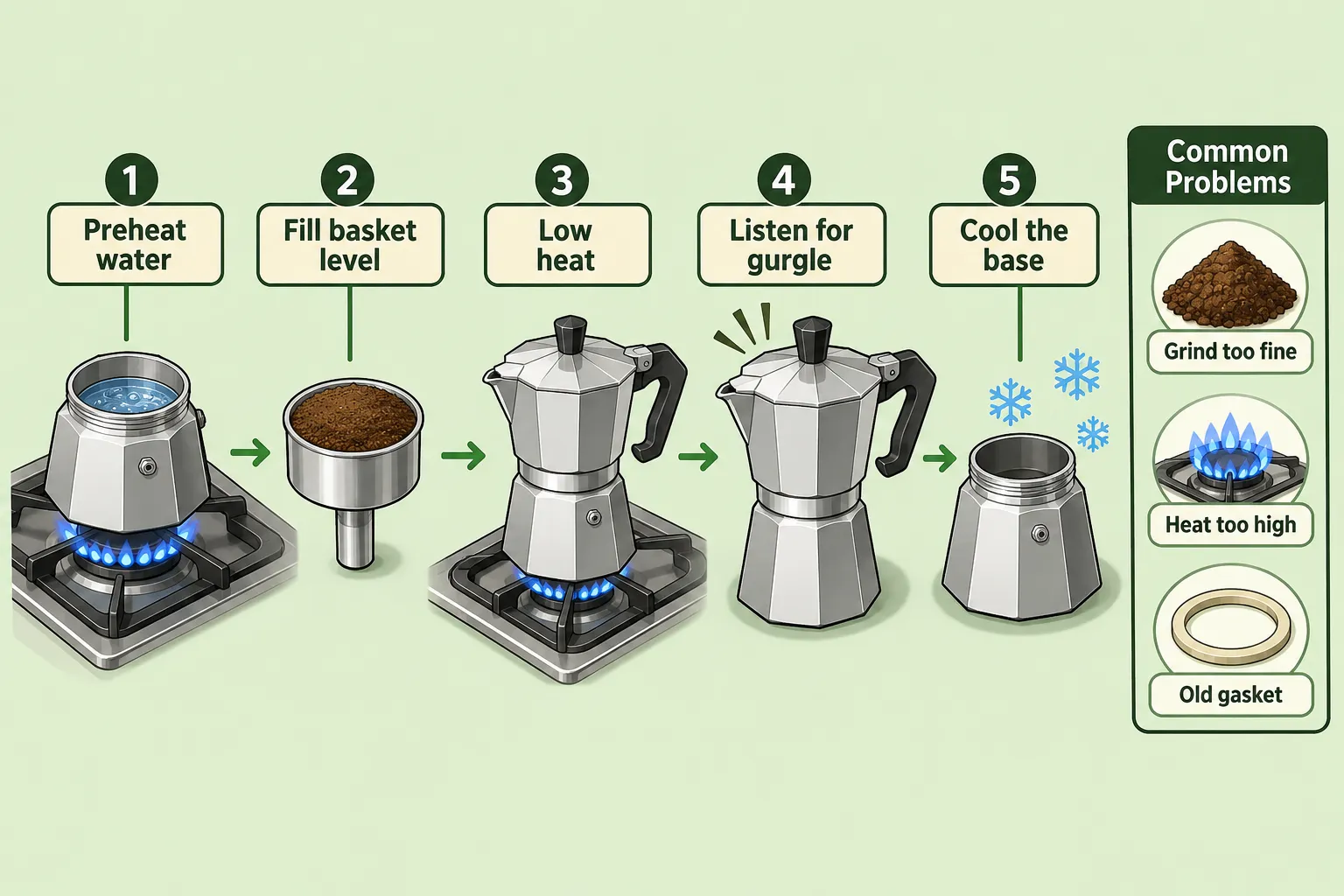
One honest caveat on the 12-cup and 18-cup: large moka pots spend longer on the heat, and the last portion of the brew can taste noticeably more bitter than the first. Pull the pot off the burner as soon as the gurgling starts and cool the base under a tap. That one habit does more for big-pot flavour than any grind adjustment.
What are the alternatives to the Bialetti Moka Express?
If a stovetop espresso maker is not quite what you want, four alternatives serve different needs.
1. Bialetti Venus or Moka Induction (stainless steel). Same brewing principle, induction compatible, easier to clean, usually $10 to $25 more. Use the Moka Finder to match hob type .
2. AeroPress. Faster, more forgiving, dishwasher-friendly plunger. Makes a concentrate you can dilute. Our AeroPress vs French press comparison covers the texture difference.
3. A real espresso machine. If pressure-brewed shots with crema matter to you, no moka pot substitutes. Budget $300 to $1,500 with a grinder. The moka pot is an excellent stepping stone to find out whether you actually want that.
4. Pour over. Cleaner, more delicate, and better for lighter single origin coffees. See French press vs pour over for how the body differs.
Bialetti itself has leaned into collaborations and collectible editions rather than new capacities, including The North Face and Dolce & Gabbana sets, plus regional designs like the Blu Mediterraneo 3-cup . The capacities underneath are the same ones in the table above.
.cg-mk{font-family:system-ui,-apple-system,”Segoe UI”,Roboto,sans-serif;background:#F5FAF8;color:#23372F;padding:18px;border-radius:10px;max-width:620px;margin:0 auto} .cg-mk h3{color:#14231D;margin:0 0 12px;font-size:19px} .cg-mk label{display:block;font-size:14px;font-weight:600;margin:10px 0 4px} .cg-mk input,.cg-mk select{width:100%;padding:9px;border:1px solid #61BDA1;border-radius:6px;font-size:15px;background:#fff;box-sizing:border-box} .cg-mk button{width:100%;margin-top:14px;padding:11px;background:#1F6B4A;color:#fff;border:0;border-radius:6px;font-size:15px;font-weight:700;cursor:pointer} .cg-mk button:hover{background:#145037} .cg-out{margin-top:14px;background:#E8F2EE;border-left:4px solid #1F6B4A;padding:13px;border-radius:6px;font-size:15px;display:none} .cg-out b{color:#14231D}Which Bialetti Moka Express size fits you?
=need){pick=p[i];break;}} document.getElementById(‘cgR’).style.display=’block’; document.getElementById(‘cgR’).innerHTML=’You need about ‘+need.toFixed(1)+’ oz of moka coffee per round. Closest match: the ‘+pick+’ Moka Express (~’+pick+’ oz output). Brew it full for best extraction. Capacities from Bialetti US size guide.’; }
Five features we love about the Moka Express
1. The eight-sided aluminium body. The facets spread heat around the boiler instead of concentrating it at one point, which is part of why the design has survived since 1933 with no real change.
2. The safety valve. A visible brass valve on the boiler that releases pressure if the basket clogs. It also doubles as your fill line, which removes guesswork.
3. A filter basket sized to a full dose. Because each size has a matched basket, filling it level gives you a repeatable brew ratio without a scale.
4. Replaceable gaskets and filter plates. Parts cost a few dollars and are widely stocked, which is why decade-old pots still work. Very few $50 coffee devices stay serviceable that long.
5. No electricity, no plastic in the brew path. It works on gas, electric coil, and camping stoves, and it packs flat for travel.
What to watch out for
- Not induction compatible. The classic aluminium model will not work on an induction hob. You need the steel Venus or Induction line .
- No dishwasher. Hot water and a soft cloth only. The dishwasher dulls and pits the aluminium.
- Gasket replacement. Plan on one every 12 to 24 months with daily use.
- Unforgiving on high heat. Blast it and you get bitter coffee and a too-hot handle.
- Size confusion at purchase. Over half the disappointed reviews come down to someone expecting six mugs .
- No crema. It brews at gentler pressure than a pump machine , so if you want a thick crema layer, you want an espresso machine.
Pros and cons
Pros
- Honest, repeatable concentrated coffee for well under $50
- Serviceable for years with cheap replacement parts
- Works without power, ideal for travel
- Six capacities from 2 oz to 27.3 oz
- 4.6 stars across 51,170 Amazon ratings for the 6-cup (checked Nov 5, 2026)
Cons
- Size naming misleads almost every first-time buyer
- Must be brewed full to extract properly
- Hand wash only, aluminium models not induction safe
- No crema and no true espresso pressure
- Bitter easily if heat or grind is off
Who should buy it, and who should skip it
Buy the 3-cup Bialetti Moka Express if you are one person who drinks one coffee a morning and wants café-strength concentrate for under $40. Winner for solo drinkers.
Buy the 6-cup Bialetti Moka Express if two of you drink milk-based coffee, or one of you drinks a big americano. It is the default for a reason. Winner for couples.
Buy the 9-cup or 12-cup if you have three or more drinkers and brew once for everyone.
Skip the Bialetti Moka Express if you want crema-topped shots, you only own an induction hob and will not buy the steel version, or you drink 20 oz of black coffee a day and would be happier with a good French press or a drip machine.
Affiliate disclosure: Coffee Rank IQ earns commission from qualifying purchases made through links on this site. Prices were checked on Amazon on November 5, 2026 and on Bialetti's US site on November 6, 2026, and change without notice. Check the current price before buying. This moka express review is based on published manufacturer specifications, Bialetti's official size guidance, and documented third-party reviews rather than in-house laboratory testing.
FAQ

Conclusion
The size chart is the whole decision. A Bialetti Moka Express counts in 2 oz espresso cups, so the 3-cup gives you 4.4 oz and the 6-cup gives you about 9.1 oz . Translate the number on the box into ounces and the right model becomes obvious in ten seconds.
Our verdict: 3-cup for one person at $39.98, 6-cup for two at $48.44 (Amazon, checked November 5, 2026). Buy the size you will fill every single morning, grind medium-fine, keep the heat low, and pull the pot off the burner the moment it gurgles.
Next step: measure the mug you actually drink from. If it holds more than 9 oz and you fill it daily, go straight to the 6-cup. Then compare the models and check the current price before you order.
Better Coffee Starts With Better Answers.