Cold Foam Maker Showdown: Wand, Cup or Frother Jug
Quick answer and key takeaways
A cold foam maker that costs under $25 will out-foam most $100+ machines on iced drinks, because cold foam needs speed and air, not heat. On Amazon (prices checked November 5, 2026), the Keurig SimpleCafe handheld frother sits at $22.49 with 2,239 reviews, a hands-free foam blender runs $24.99, and a 9oz cold foam maker cup is $14.99. For daily iced coffee, the hands-free blender cup wins. For the lowest price and the smallest drawer footprint, the handheld wand wins.
Key takeaways
- Best under $25 overall: the $24.99 hands-free foam blender. You press a button, walk away, and come back to a stiff foam cap.
- Best cheap pick: the $14.99 9oz cold foam maker cup, fine for one drink a day if you don't mind holding it.
- Best handheld: the Keurig SimpleCafe frother at $22.49, with 2,239 Amazon ratings and 8,000+ monthly purchases as of November 5, 2026.
- Premium benchmark: Nespresso's Aeroccino 4 at $129, with four programs including cold foam and a 120ml (4.06oz) maximum foam capacity.
- Texture specialist: the Nespresso NanoFoamer at $49, a rechargeable handheld built for fine microfoam rather than one-button convenience.
- Skim and 2% milk foam harder and hold longer than whole milk. Fat softens bubbles.
- Cold foam collapses fast. Expect roughly 5 to 15 minutes of a clean cap before it starts melting into the coffee.
Cold foam maker formats: wand, cup, or frother jug?
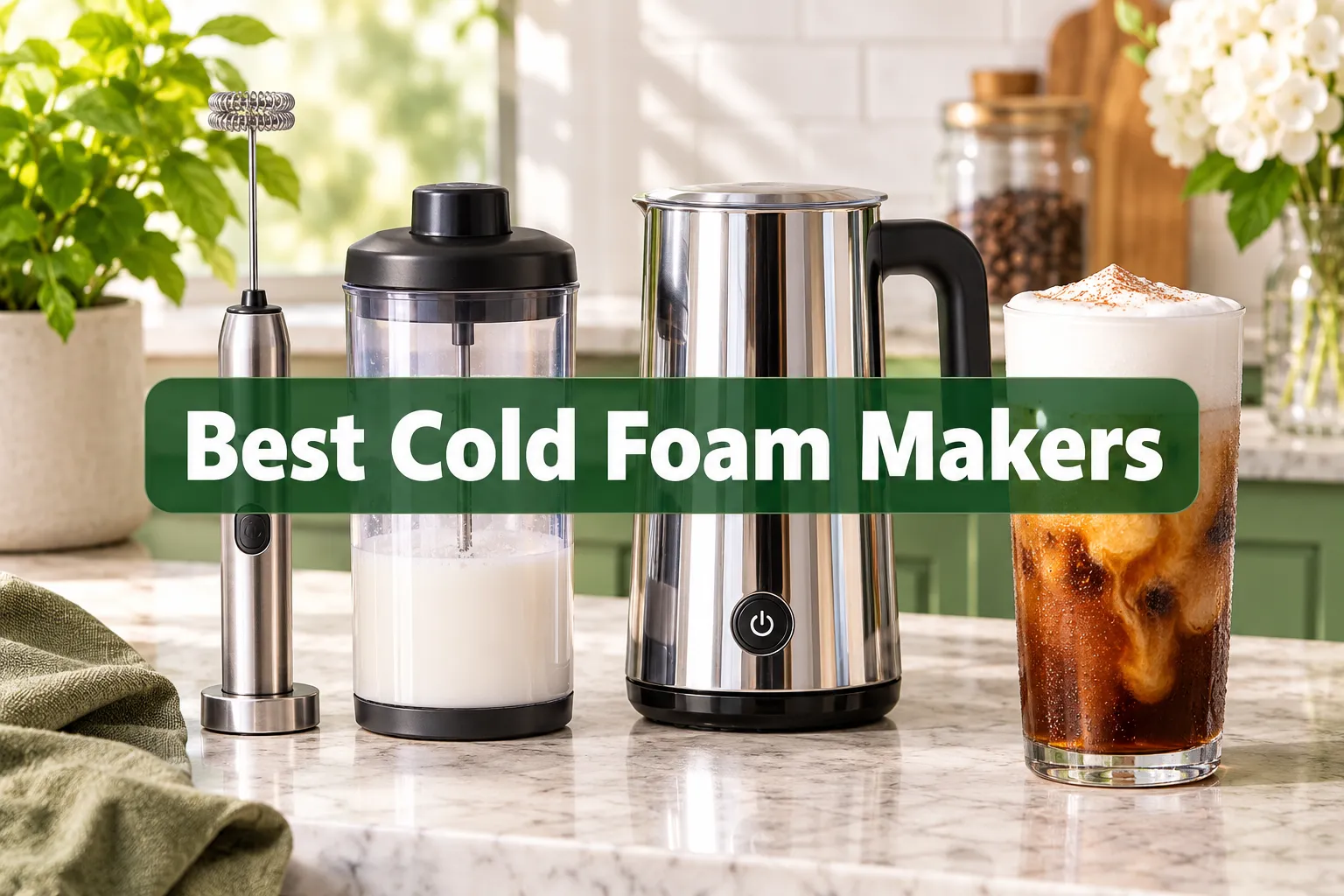
A cold foam maker is any device that whips cold milk into a thick, pourable foam without heating it. Three formats dominate the market: the handheld wand, the sealed blender cup, and the electric frother jug. They differ in how they introduce air, how much milk they handle, and how long cleanup takes.
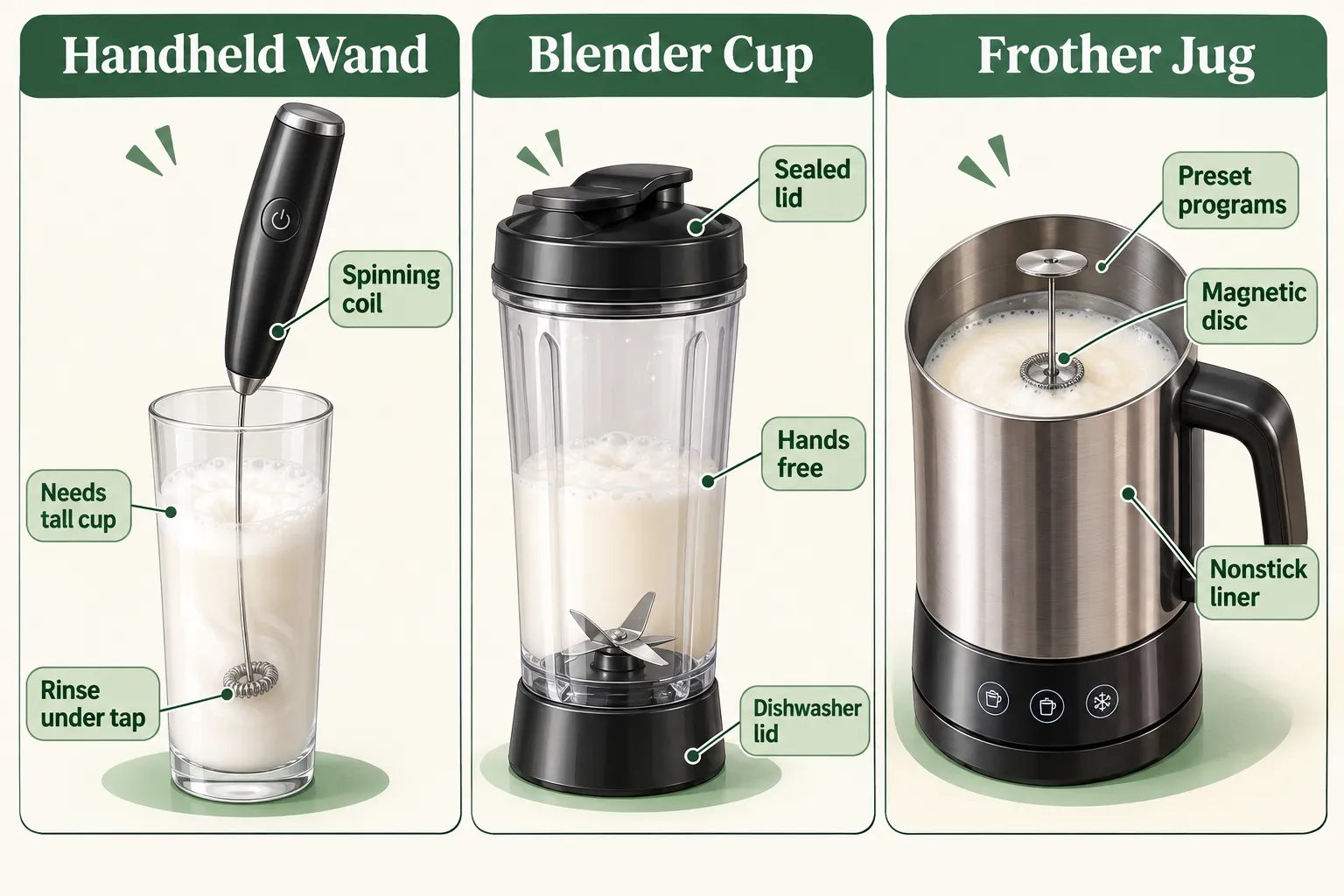
Here's the mechanical difference, because it explains everything else.
A handheld wand spins a small wire coil at high speed. It shears the milk and drags air in from the surface. You control the depth, the angle, and the time, which is why wands can make excellent foam and also terrible foam depending on who's holding them.
A blender cup seals milk inside a lidded vessel and spins a blade or paddle from the base. Because the container is closed, air gets folded in rather than splashed around. You press a button and let it run.
An electric frother jug heats, whisks, or both, usually with a magnetic disc at the bottom. The cold setting skips the heating element and runs the disc alone. Jugs are the most consistent and the most expensive, and they take up permanent counter space.
What's the difference between a cold foam wand and a frother jug?
The wand gives you control and costs under $25. The jug gives you repeatability and costs $50 to $129. A wand needs a tall narrow vessel, your hand, and 30 to 60 seconds of attention. A jug needs a power outlet and a button press.
Reviewers who compare formats land on a consistent trade-off: automatic jugs maximize consistency, handheld wands maximize price and portability, and fine-screen handheld devices such as the NanoFoamer maximize foam control . That's the whole category in one line.
The practical decision rule:
- Choose a wand if you make one or two drinks a day, your counter is full, and you're happy washing a whisk head under the tap.
- Choose a jug if two people want milk drinks back to back and you'd rather press a button than develop a technique.
- Choose a blender cup if your main drink is iced and you want hands-free foam without surrendering counter space to another appliance.
Which cold foam maker makes the thickest foam?
Sealed blender cups generally produce the stiffest cold foam, because the closed container keeps air folded into the milk instead of letting it escape off the surface. Fine-screen handhelds like the NanoFoamer produce the tightest, smallest-bubble foam, which pours more like café microfoam than like whipped topping.
There's a real distinction buyers miss. Thick is not the same as stable.
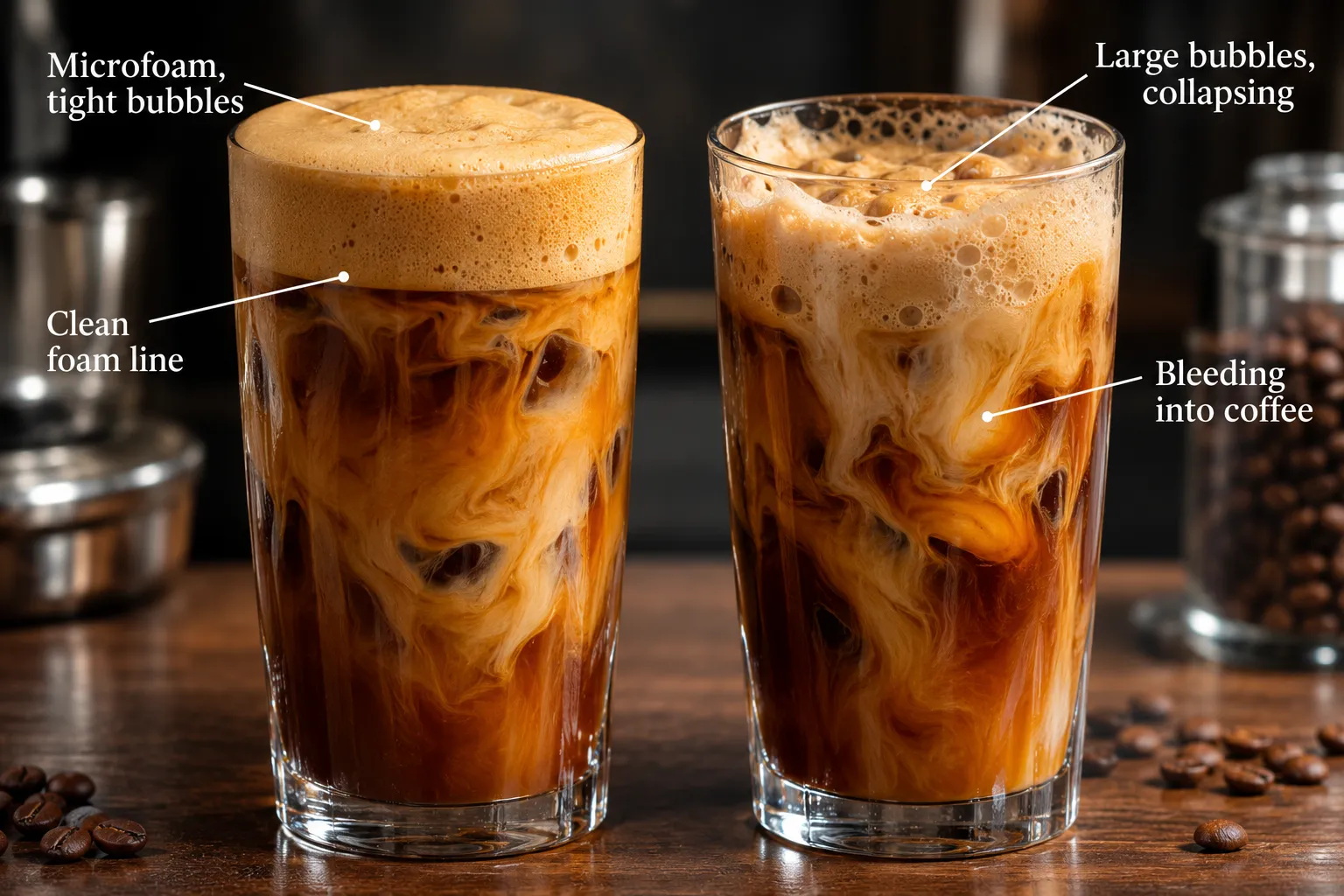
- Big airy foam sits high in the glass and collapses within a few minutes. Cheap whisks are good at this.
- Dense microfoam sits lower, looks glossy, and holds a clean line against the coffee for longer. It needs faster shear and a finer screen or blade.
Independent guides warn against treating every "cold foam" claim as equivalent, since some devices build a stable cap while ordinary whisks make larger bubbles that break down quickly . If a listing only says "frother," assume airy foam until a review says otherwise.
For the thickest result on a budget, the $24.99 hands-free foam blender does the job. For the best-looking result, the $49 NanoFoamer, which pushes milk through a fine screen for smaller bubbles.
Can you make cold foam with a regular milk frother?
Yes, most regular handheld milk frothers make cold foam, because the whisk doesn't care about temperature. Electric frother jugs are the exception: some only run a whisk cycle when the heater is active, so check for a dedicated cold setting before buying.
Food Network tested 12 milk frothers in December 2025 using whole, low-fat, and almond milk on both hot and cold settings, judging foam quantity, stability, run time, ease of use, and cleaning. Their best handheld was the Rösle Stainless Steel Dual Speed Frother at roughly $46. They also noted that the Nespresso Aeroccino 3 produces cold foam when you hold its control for three seconds, which is the kind of detail that never appears on the box.
So the honest answer on handheld frother vs electric: a $20 handheld will make cold foam today. A $129 jug will make the same cold foam more consistently, at four times the price, with a program you don't have to remember.
Does temperature matter when making cold foam?
Yes, and it matters more than most people expect. Cold milk straight from the fridge, around 38 to 40°F, builds a denser and longer-lasting foam than milk that has been sitting out. Warmer proteins give up their structure faster, so the bubbles merge and collapse.
Two quick habits that help:
- Pour the milk straight from the fridge. Don't measure it, leave it on the counter, then froth it ten minutes later.
- Chill the vessel. A glass jar from the fridge keeps the milk cold through 60 seconds of friction from the whisk.
A common mistake: adding syrup before frothing. Sugar syrups thin the mixture and weaken the foam. Froth first, then stir the sweetener into the coffee underneath.
How much should you spend on a cold foam maker?
Spend $15 to $25 unless you have a specific reason to spend more. The price jump from $25 to $129 buys consistency, presets, and dishwasher-safe parts, not noticeably better foam on an iced latte.
Here's the field as of November 5 and 6, 2026.
| Model | Format | Price (checked Nov 5 to 6, 2026) | Best for |
|---|---|---|---|
| Keurig SimpleCafe frother | Handheld wand | $22.49 (Amazon) | One drink a day, tiny kitchens |
| Hands-free foam blender | Sealed blender cup | $24.99 (Amazon) | Daily iced coffee, thickest budget foam |
| 9oz cold foam maker cup | Cup with whisk | $14.99 (Amazon) | Lowest cost entry, gift stocking filler |
| Nespresso NanoFoamer | Fine-screen handheld | $49 (Nespresso US) | Microfoam control, latte art practice |
| Nespresso Aeroccino 4 | Electric frother jug | $129 (Nespresso US) | Hot and cold presets, dishwasher cleanup |
The Aeroccino 4 runs four programs (cold foam, airy hot foam, dense hot foam, hot milk), takes about 80 seconds per cycle, holds a 120ml / 4.06oz maximum for foam and 240ml / 8.11oz for plain hot milk, and is dishwasher-safe. That's a real spec sheet, and it explains the price. It does not explain a better iced latte.
Five features we love on a budget cold foam maker
These are the features that change the daily experience, drawn from product specifications and published reviews rather than hands-on lab testing.
- A sealed lid (blender cup format). Milk stays inside, air stays folded in, and you aren't holding anything. The $24.99 blender cup is the only format here you can start and then ignore.
- A stainless double-coil whisk head. Two coils shear more milk per rotation than one wire loop. The payoff is a stiffer cap in 30 seconds instead of 60.
- USB-C recharging instead of AAA batteries. Battery-powered wands lose rotation speed as the cells drain, and weak rotation means weak foam. A rechargeable wand keeps a steady RPM through the cycle.
- A narrow, tall vessel included in the box. Foam depends on the whisk being submerged in a deep column of milk. The $14.99 9oz cold foam maker ships with the right-shaped cup, which saves you from improvising with a mug.
- Detachable whisk heads. Milk proteins dry into a film. A head that pops off rinses clean in seconds; a fixed one traps residue in the shaft.
What to watch out for before you buy
Some friction is real and worth knowing in advance.
- Splatter. Pull a running wand too close to the surface and milk goes on the backsplash. Start deep, then lift slowly.
- Battery wands fade. AAA models froth beautifully for two weeks, then mysteriously stop. The batteries are usually the culprit.
- Small capacity. Most cold foam makers handle 4 to 9oz. The Aeroccino 4 caps foam at 120ml / 4.06oz. That is one drink, not three.
- Charging and water don't mix. No regulatory change specific to cold foam devices showed up in November 2026 searches, so verify electrical certification, waterproofing claims, and the manufacturer's cleaning instructions yourself, especially on USB-rechargeable wands. Never submerge the motor housing.
- Blender cup bases are not dishwasher items. The lid usually is. The motor base never is.
- Noise. Sealed blender cups are louder than wands. At 6am in a studio apartment, that matters.
Why isn't my cold foam staying thick?
Cold foam collapses for four main reasons: the milk is too high in fat, the milk wasn't cold enough, you under-frothed it, or you added sugar before frothing. Fix those in order.
Troubleshooting, shortest fix first:
- Foam disappears in under two minutes. Switch to 2% or skim. Lower fat, stronger foam structure. Whole milk tastes richer but holds worse.
- Foam is bubbly rather than glossy. Froth longer, 45 to 60 seconds, and keep the whisk fully submerged for the first 20 seconds before lifting it near the surface.
- Foam sinks straight into the coffee. Your coffee may be too warm, or the foam is too thin. Pour over ice first, and pour slowly over the back of a spoon.
- Oat milk won't hold. Use a barista-edition oat milk. Standard oat milk lacks the added protein and stabilizers.
Cold foam is a structure, not a flavor. Protein holds the bubbles, fat softens them, and sugar dissolves them. Build the structure first, sweeten second.
How long does cold foam last after you make it?
Expect 5 to 15 minutes of a clean, distinct foam cap on an iced drink, depending on milk and device. Skim milk foam from a sealed blender cup holds at the long end. Whole milk foam from a hand whisk holds at the short end.
Foam made in advance and refrigerated loses most of its height within 20 to 30 minutes. Make it when you pour.
Do you actually need a cold foam maker, or can you DIY it?
You can DIY it. A sealed mason jar shaken hard for 45 seconds produces usable cold foam, and a hand whisk works if you're patient. The device buys you time and consistency, not magic. At $14.99 to $24.99, that trade is easy to justify if you make iced drinks more than twice a week.
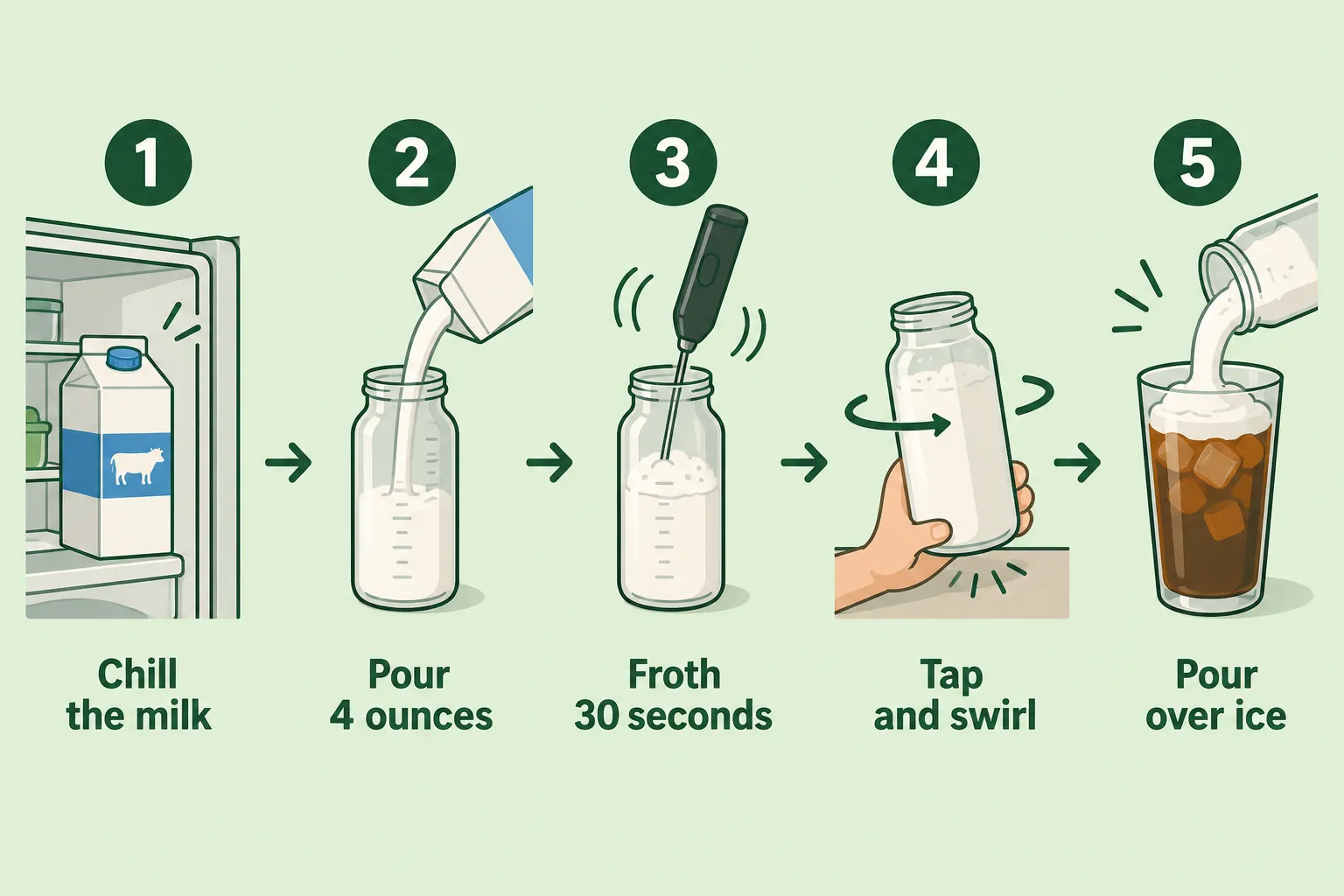
Three no-gear methods, ranked by result:
- Jar shake. Half-fill a mason jar with cold skim milk, seal, shake 45 seconds. Decent foam, zero cost.
- French press plunge. Pump the plunger 20 to 30 times. Produces the finest DIY microfoam of the three.
- Hand whisk in a narrow glass. Works, slowly, and your forearm will know about it.
Our step by step walkthrough for making cold foam at home without the Starbucks line covers ratios and sweet cream variations in detail.
Skip the purchase entirely if you drink your coffee black, or if you already own an espresso machine with a usable steam wand and only want hot milk.
Best cold foam maker for small spaces and easiest to clean
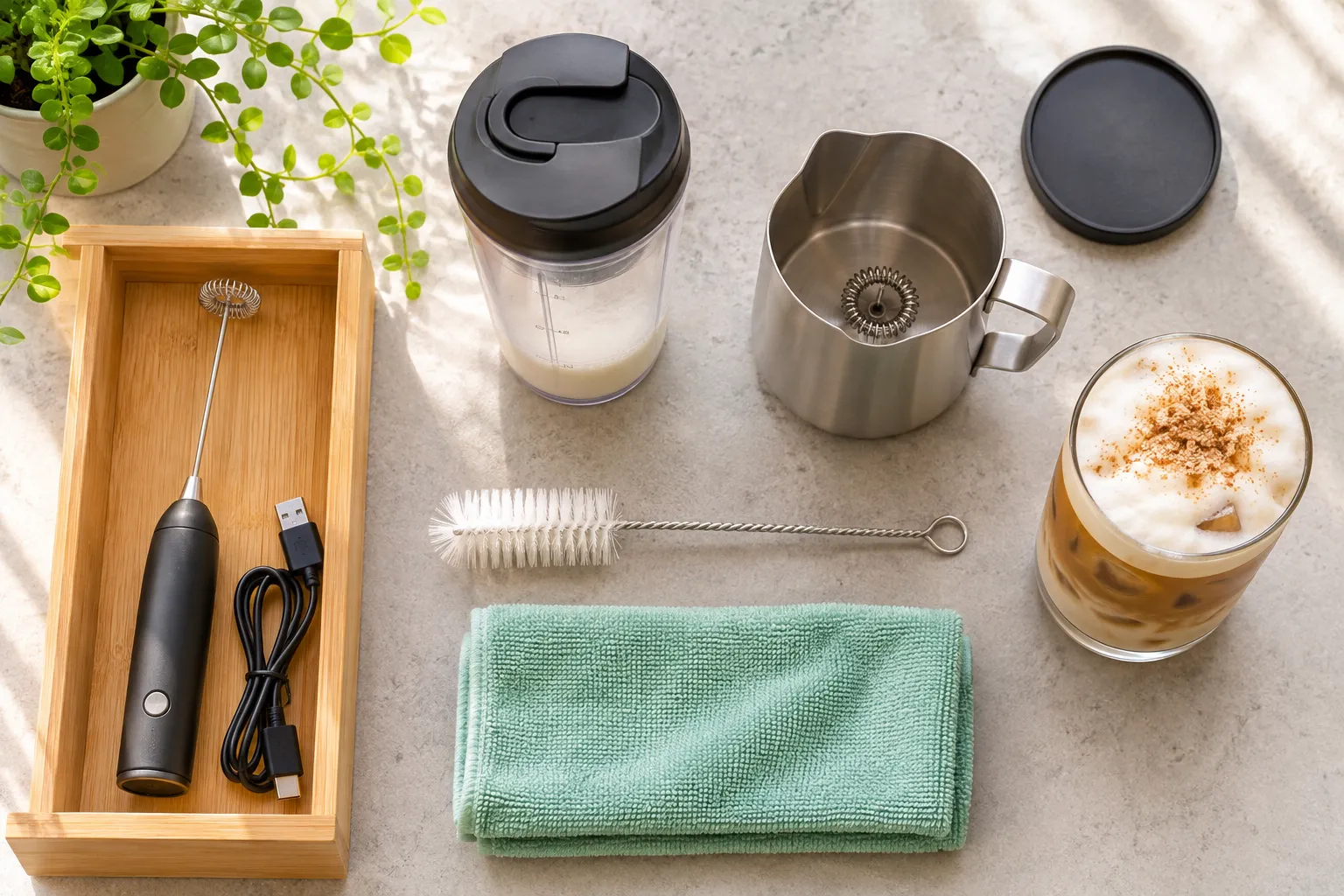
For small kitchens, the handheld wand wins on footprint: the Keurig SimpleCafe frother at $22.49 fits in a utensil drawer. For easiest cleaning, the sealed blender cup wins, since the lid and cup usually go in the dishwasher and the whisk is a flat disc rather than a coil.
A realistic cleaning routine by format:
| Format | Cleaning time | What goes in the dishwasher |
|---|---|---|
| Handheld wand | 10 seconds | Nothing. Spin in hot soapy water, rinse, dry. |
| Blender cup | 30 seconds | Lid and cup (check the manual). Never the base. |
| Frother jug | 60 seconds | Aeroccino 4 jug is dishwasher-safe; most budget jugs are hand-wash only. |
The common mistake: letting a jug sit with milk residue for an hour. Dried milk proteins bond to the nonstick coating, and scrubbing them off ruins the coating. Rinse immediately, every time.
Can you use any milk in a cold foam maker, and can it froth hot milk too?
Most milks froth cold, but they don't froth equally. Skim and 2% dairy give the firmest foam, whole milk gives a softer and richer one, and plant milks need a barista formulation with added protein to hold shape. For hot milk, a handheld wand works in a pre-heated mug, but only an electric jug heats the milk itself.
Milk ranking for cold foam, best structure first:
- Skim dairy: highest, stiffest foam. Thinnest flavor.
- 2% dairy: the practical sweet spot for iced lattes.
- Whole dairy: glossiest and richest, shortest hold time.
- Barista oat: very good, slightly sweet, works for most people.
- Standard oat, almond, rice: inconsistent, often collapses in under two minutes.
- Heavy cream (half and half blend): this is the Starbucks sweet cream approach. Blend 2 parts 2% milk to 1 part heavy cream, froth cold, pour.
On the hot question: a wand will froth milk you've already warmed, but it will not warm it. A jug like the Aeroccino 4 handles both, which is the main argument for its price if you want cappuccinos in winter and cold foam in July. Our roundup of the best milk frother options across formats goes deeper on dual-purpose models, and the Secura automatic electric milk frother guide covers jug operation in detail.
Cold foam maker vs Aeroccino 4: which one wins?
For cold foam only, the $24.99 blender cup wins on value by a wide margin. For a household that wants hot and cold milk drinks from one button, the $129 Aeroccino 4 wins on versatility and cleanup. The foam quality gap on an iced drink does not justify a $104 difference by itself.
A November 2026 specification-based comparison put the NanoFoamer PRO GEN-2 ahead for adjustable texture and latte-art practice, while favoring the Aeroccino 4 for preset programs and dishwasher cleanup. The comparison stated plainly that it was based on specifications, not hands-on durability or foam testing. Treat it as a feature guide, not a performance study.
Worth watching: De'Longhi announced a redesigned All-in-One Combination Coffee & Espresso Machine on October 27, 2026, with a retractable cold frother built specifically for iced drinks . Cold foam is migrating from a $20 accessory into integrated machines. If you're already weighing a $300 to $1,500 espresso setup, check whether cold frothing is included before buying a separate device. Our guide to choosing the right coffee maker for your home covers how to sequence those purchases.
Pros and cons by format
Handheld wand
- Pros: cheapest, smallest, 10-second cleanup, portable, works on hot or cold milk, great for travel.
- Cons: requires technique, splatters, battery models fade, you have to stand there.
Blender cup
- Pros: hands-free, thickest budget foam, consistent results, lid and cup usually dishwasher-safe.
- Cons: louder, more counter or cabinet space than a wand, motor base must stay dry.
Frother jug
- Pros: presets, hot and cold in one unit, largest capacity, most repeatable.
- Cons: $50 to $129, permanent counter space, 80-second cycles, overkill if you only drink iced.
Who should buy which cold foam maker
- The café escapee making one iced latte a day: the $24.99 hands-free blender. Press, pour, done. Pair it with the recipes in our iced latte at home guide.
- The small-kitchen renter: the Keurig SimpleCafe frother at $22.49. Drawer-sized, 2,239 Amazon ratings, and it doubles for hot drinks.
- The gift buyer under $20: the $14.99 9oz the frother cup. Low risk, immediately usable, comes with the right vessel.
- The texture obsessive: the $49 NanoFoamer, for fine microfoam and pour control.
- The two-drink household that wants hot and cold: the $129 Aeroccino 4.
- Skip it entirely if: you drink coffee black, or you own an espresso machine with a steam wand and don't make iced drinks.
Which the frother fits you?
Amazon and Nespresso prices checked November 5 to 6, 2026.‘;o.style.display=’block’;});
Common mistakes people make with the frothers
Most cold foam failures come down to five habits, and all five are free to fix.
- Using a wide mug. The whisk needs a deep, narrow column of milk. A wide mug spreads the milk too thin to catch air.
- Overfilling. Fill no more than one third of the vessel. Foam needs somewhere to expand.
- Sweetening first. Syrup before frothing thins the milk. Sweeten the coffee instead.
- Frothing warm milk for a cold drink. Pull the carton out last, not first.
- Letting the whisk sit dirty. Dried milk protein is the single biggest killer of cheap frothers.
One edge case: if you pour cold foam onto hot coffee, it will collapse almost instantly. Cold foam is built for cold coffee. For hot drinks, read the microfoam explanation in our flat white vs latte comparison.
FAQ

Conclusion
The verdict: buy the $24.99 hands-free foam blender if iced drinks are your daily habit, and the $22.49 Keurig SimpleCafe frother if drawer space and portability matter more than walking away mid-froth. The $14.99 cup is a legitimate way to find out whether you'll use one at all. Save the $129 jug for households that want hot cappuccinos and cold foam from the same button.
Next step: chill a carton of 2% milk overnight, froth four ounces for 45 seconds, and pour it over cold brew. Then read the cold brew ratio guide so the coffee underneath is as good as the foam on top. Better Coffee Starts With Better Answers.
Affiliate disclosure: Coffee Rank IQ earns commissions from qualifying purchases through retailer links. Prices were checked on Amazon and Nespresso on November 5 and 6, 2026, and change without notice. This comparison is based on published specifications, retailer listings, and documented third-party reviews, not on controlled hands-on testing by Coffee Rank IQ. Compare the models before you buy.