
Coffee Bar Cart: Check the Weight Limit First
Quick answer
A coffee bar cart should be rated for at least 100 lb total and 50 lb on the shelf holding your machine, because a Breville Barista Express weighs about 23 lb dry and a loaded home setup with grinder, water, mugs and beans commonly runs 60 to 80 lb . Most decorative bar carts sold as coffee stations are rated far lower, and some are listed at only 50 lb for the whole cart . Check the top-shelf rating, not just the headline capacity, and buy a cart with locking casters.
Key takeaways
- The Filano Rolling Coffee Bar is listed at 50 lb total capacity, while the LIKIMIO 57-inch Farmhouse Coffee Bar is listed at 175 lb . Same product category, more than triple the load difference.
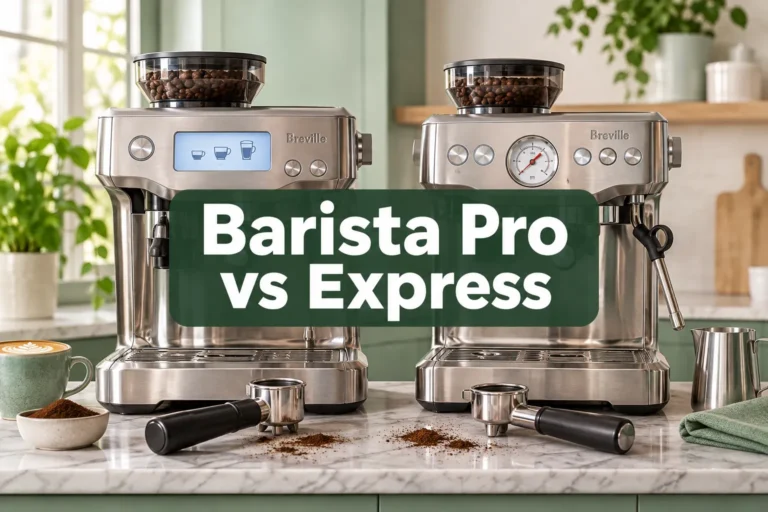
- A Breville Barista Express weighs roughly 23 lb and measures 15.9 x 13.1 x 12.4 inches, which is deeper than many narrow bar carts .
- A Gaggia Classic sits near 20 lb dry. Add a burr grinder at 5 to 15 lb and water, and you clear 40 lb fast .
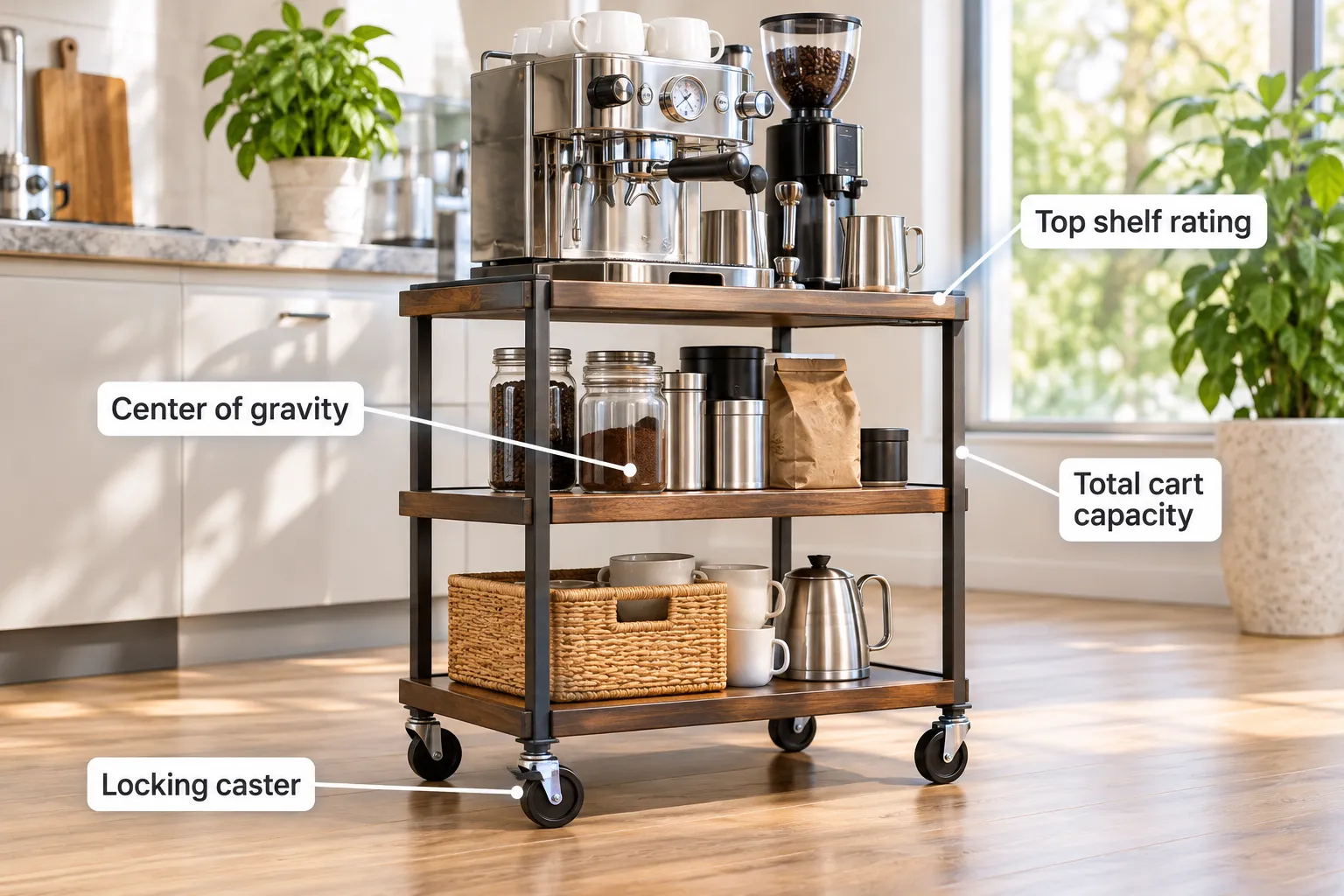
- Total capacity and per-shelf capacity are different numbers. A cart rated 150 lb overall can still have a top shelf rated for 30 to 50 lb .
- Amazon listings checked November 5, 2026: a 3-tier coffee station on wheels at $99.99 (456 reviews), a HOOBRO kitchen island with outlet at $119.99 (1,377 reviews), and a bare 3-tier rolling cart at $39.99.
- Commercial gear is out of scope for household carts. A Nuova Simonelli Appia II Compact two-group runs roughly 130 to 150 lb before water .
- Buy the cart after you pick the machine, not before.
What's the weight limit on a coffee bar cart?
Most household coffee bar carts fall between 50 lb and 210 lb total, and the number printed on the box is almost never the number that matters. Published 2026 comparisons list capacities from 50 lb total on lightweight carts up to 210 to 300 lb on heavier rolling furniture . The useful figure is what the top surface alone can carry, since that is where the espresso machine lands.
Three ratings appear on spec sheets, and manufacturers mix them freely:
| Rating type | What it means | Why it matters |
|---|---|---|
| Total capacity | Everything on the cart, all shelves combined | Good for rough screening only |
| Per-shelf capacity | One shelf in isolation | This is the number for your machine |
| Dynamic (rolling) capacity | Load it can carry while being moved | Often half the static rating |
A cart advertised at 175 lb total with roughly 50 lb per shelf, like the Amazon Basics 3-tier, is honest about the split . A cart that lists only a single big number and no per-shelf figure is usually hiding a thin top panel.
Decision rule: if the listing does not publish a per-shelf rating, assume the top shelf holds one third of the total and buy accordingly.
How much weight can a coffee cart actually hold in daily use?
Less than the label, because the label describes a static, evenly spread load on a level floor. Your espresso machine is a concentrated mass on four small rubber feet, usually pushed toward the back of the shelf where the plumbing sits.
Real-world factors that eat into the rating:
- Point loading. A 23 lb machine on four feet puts far more pressure per square inch than 23 lb of mugs spread across the shelf.
- Movement. Rolling a loaded coffee cart with wheels across a floor transition applies shock loads the static rating never covered.
- Tamping force. A manual tamp pushes down with real force. On a flimsy cart the whole thing flexes.
- Steam wand torque. Grabbing the portafilter and twisting puts lateral load on the frame.
Manufacturers rarely test for any of these. Espresso Parts advises calculating the fully loaded operating weight, meaning the machine, grinder, fresh water, waste water, cups, beans and tools together, before choosing a cart [as reported in coffee cart planning guidance].
Common mistake: buying a cart rated exactly at your measured load. Leave 30 percent of headroom.
How much does an espresso machine weigh for cart sizing?
Dry machine weights span roughly 7 lb for a capsule machine to 150 lb for a two-group commercial unit. Here are the figures that affect a home coffee bar cart decision.
| Machine | Approx. weight | Cart requirement |
|---|---|---|
| Nespresso Essenza Mini | Under 10 lb | Any cart, including a $39.99 3-tier |
| Gaggia Classic | ~20 lb | 50 lb top shelf, steel preferred |
| Breville Barista Express | ~23 lb | 50 lb top shelf, 16 in depth minimum |
| Rocket Boxer single group | ~102 lb | Not a cart. Counter or stand |
| Nuova Simonelli Appia II Compact 2-group | 130 to 150 lb | Purpose-built commercial cart only |
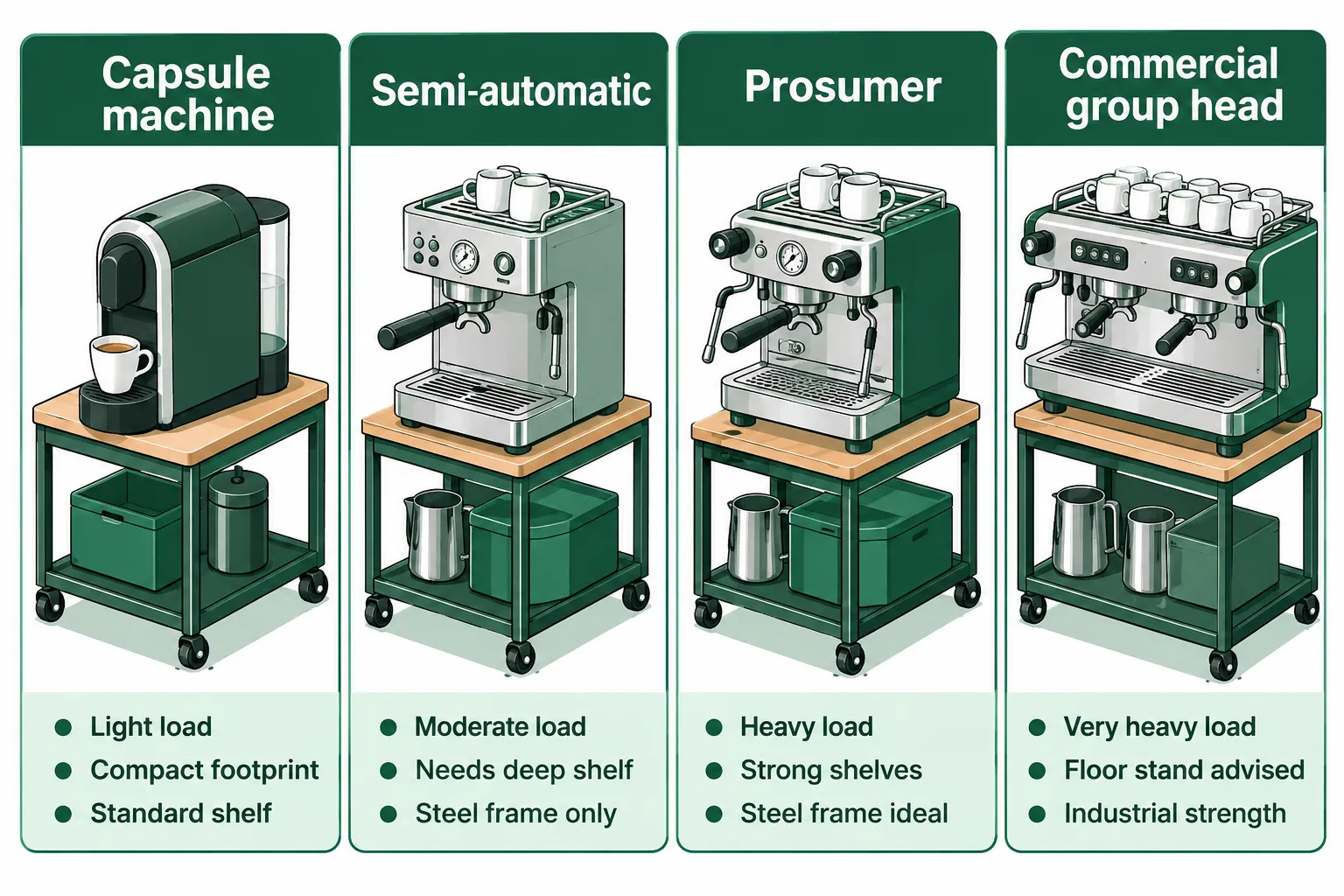
Add the extras. A burr grinder runs 5 to 15 lb, and the combined setup with water, beans, mugs and syrups commonly lands at 60 to 80 lb for a semi-automatic rig . If you are still choosing the grinder, our guide to the best coffee grinder for every brew method and budget lists weights and footprints alongside performance.
Water is the sneaky one. A 2-liter reservoir adds about 4.4 lb the moment you fill it, and a full 1.7-liter kettle adds roughly 3.7 lb.
Coffee bar cart vs regular kitchen cart: which holds more?
A regular kitchen cart almost always holds more, because it was designed as furniture rather than decor. Kitchen islands and butcher-block carts use thicker panels, four-sided frames and larger casters. Many decorative bar carts use a thin tray on a tubular frame, which looks elegant and flexes under 40 lb.
Where each one wins:
- Kitchen cart coffee bar: higher capacity, enclosed storage, often a butcher-block or solid-wood top. The HOOBRO kitchen island with a built-in outlet was listed at $119.99 on Amazon with 1,377 reviews as of November 5, 2026.
- Classic bar cart coffee station: better looking, lighter, easier to move, poor for anything above a pod machine or small drip brewer.
- Utility rolling cart: the $39.99 3-tier metal cart is the capacity bargain, with the cosmetics of a garage.
Choose the kitchen cart if your machine plus grinder exceeds 35 lb. Choose the bar cart if you are building a serving station for a Nespresso or capsule setup and want the room to look finished.
Why does my coffee cart feel unstable with equipment on it?
Instability usually comes from height, not weight. Putting a 23 lb machine on a 35-inch top shelf raises the center of gravity above the wheelbase, and any sideways nudge becomes a lever.
Four fixes, in order of effectiveness:
- Move the heaviest item to the bottom shelf. Grinder on the bottom, machine in the middle, mugs on top. It looks odd and it works.
- Lock all four casters. Two locking wheels is the industry default and it is not enough on tile.
- Check for a frame rattle. Tighten every bolt. Flat-pack carts loosen within three weeks of daily use.
- Add a rubber mat under the feet. It kills the slide during tamping.
Edge case: carts with X-brace rear panels resist racking far better than carts with open backs. If the listing photo shows a bare rectangle of tubing at the back, expect wobble.
How to know if a coffee bar cart will tip over
Run a simple geometry check before you buy. Measure the cart's wheelbase width, then compare it to the combined height of the cart plus your machine. If the loaded center of mass sits higher than about half the wheelbase width from the shelf edge, tipping risk climbs sharply.
Practical pre-purchase checklist:
- ✅ Wheelbase at least 16 inches wide
- ✅ Four locking casters, not two
- ✅ Published per-shelf rating
- ✅ Back panel, X-brace or cross-bar
- ✅ Top shelf depth of at least 16 inches for a Barista Express
- ✅ Weight of the empty cart above 20 lb (light carts tip easily)
In-store test: load the top shelf with whatever is heavy and nearby, then push the top edge sideways with two fingers. If the far wheels lift, walk away.
Best coffee cart for holding an espresso machine
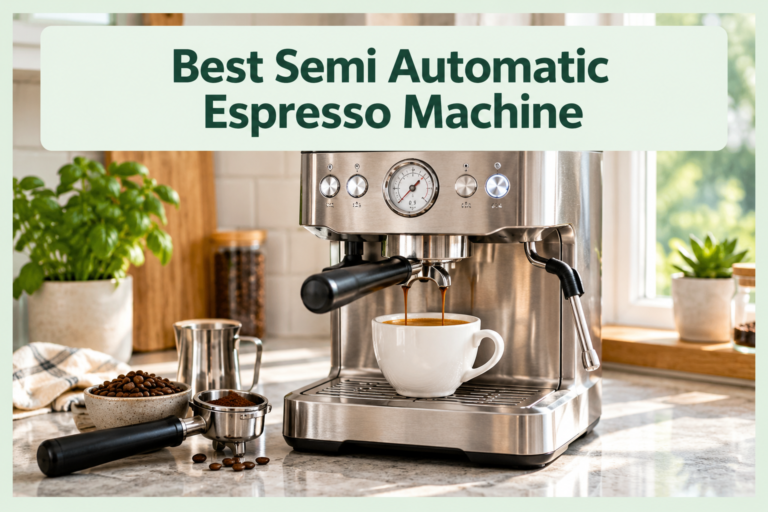
For a 20 to 25 lb semi-automatic like the Gaggia Classic or Breville Barista Express, a steel-framed cart rated at 175 lb total with a published 50 lb per-shelf figure is the sensible floor. The LIKIMIO 57-inch farmhouse coffee bar at 175 lb total is the kind of spec that clears this comfortably .
| Cart | Price (Nov 5, 2026) | Capacity | Best for |
|---|---|---|---|
| HOOBRO kitchen island with outlet | $119.99 | Heavy-duty wood frame | Breville, Gaggia, grinder |
| 3-tier coffee station on wheels | $99.99 | Mid-range steel | Drip maker plus grinder |
| Basic 3-tier rolling cart | $39.99 | ~50 lb per shelf class | Pod machine, mugs, storage |
Amazon prices and review counts checked November 5, 2026. Coffee Rank IQ earns affiliate commission on some links. Check the current price before buying, since cart listings change often.
Five features worth paying for
- Published per-shelf rating. Tells you the manufacturer tested the shelf, not just the frame.
- Built-in outlet strip. The HOOBRO model includes one, which removes the extension cord running across your floor.
- Four locking casters. Stops the cart drifting during a tamp.
- Solid wood or butcher-block top. Takes tamping force without flexing and survives water drips better than MDF.
- 16-inch or deeper top shelf. A Barista Express is 13.1 inches deep plus space behind for the tank .
What to watch out for
- MDF tops with a wood-look veneer. They swell at the edges once water gets in, usually within a year near a steam wand.
- Mesh shelves. Machine feet sink into the grid and the cart rocks.
- Two-wheel locking. Common on budget carts and a genuine annoyance.
- No back panel. Racking, wobble, mugs walking off the shelf.
- Cords that will not reach. Measure outlet distance before you commit to a wall.
Metal vs wood coffee cart: which is more durable?
Powder-coated steel wins on load and lifespan. Solid wood wins on stability and tamping feel. Particleboard and MDF lose on both.
- Steel: highest per-shelf ratings, resists water, can feel tinny and shows ring stains from wet portafilters.
- Solid wood or butcher block: heavier base weight lowers tipping risk, absorbs vibration, needs oiling and hates standing water.
- MDF or particleboard: cheapest, swells near moisture, fasteners strip out after a few relocations.
Decision rule: choose steel if the cart will be moved weekly. Choose solid wood if it stays in one spot and you tamp manually. Skip MDF entirely if the cart will live near a sink or a steam wand. After every build, a wipe-down routine matters more than the material, and our notes on advanced barista cleaning techniques translate well to a home station.
Can you put commercial equipment on a home coffee cart?
No. A two-group commercial machine weighs 130 to 150 lb and measures roughly 25 x 18 x 18 inches , which exceeds both the capacity and the depth of essentially every household cart. Commercial coffee carts are purpose-built with steel chassis, plumbed water, and dedicated electrical runs.
If you want commercial-style output at home, pick a prosumer single-group machine and put it on a counter or a dedicated stand rather than wheels. Machines in the 60 to 100 lb range, such as a Rocket Boxer at roughly 102 lb, need a surface rated well beyond the typical 50 lb shelf .
Lightweight coffee bar cart options that still work
A lightweight coffee bar cart is fine if your heaviest item is under 15 lb. That covers capsule machines, most pour over kits, a scale, a gooseneck kettle, and a cold brew pitcher.
What works on a slim cart:
- A Nespresso Essenza Mini and Aeroccino frother
- A V60 or Chemex setup with kettle and scale, covered in our pour over dripper guide
- A French press, grinder and mug rack
- A cold brew station, though a full 2-quart carafe adds about 4.5 lb
What does not work: any machine with a dual boiler, any grinder with a cast-iron base, and a water jug on the top shelf.
Coffee bar cart for small spaces: weight considerations
In a small kitchen, go narrow and tall only if the cart is heavy and braced, since a 12-inch-wide cart at 40 inches tall tips with very little provocation. A better small-space answer is a wide, low kitchen cart coffee bar, roughly 30 inches tall, which doubles as prep surface.
Three rules for tight spaces:
- Keep the machine below elbow height so you are pushing down over the wheelbase, not out past it.
- Measure the cabinet clearance above the cart. A top-fill water tank needs 6 to 8 inches of lift room.
- Place the cart against a wall, which removes one tipping direction entirely.
Good coffee cart ideas for apartments include mounting a shelf above the cart for mugs, which keeps the cart's own center of gravity low. Store beans in a sealed container rather than the bag, and our roundup of the best coffee storage container covers the sizes that fit a narrow shelf.
DIY coffee cart weight capacity: how to calculate it
Add the dry weight of every item, add the water, then add 30 percent. The total is the per-shelf rating you need.
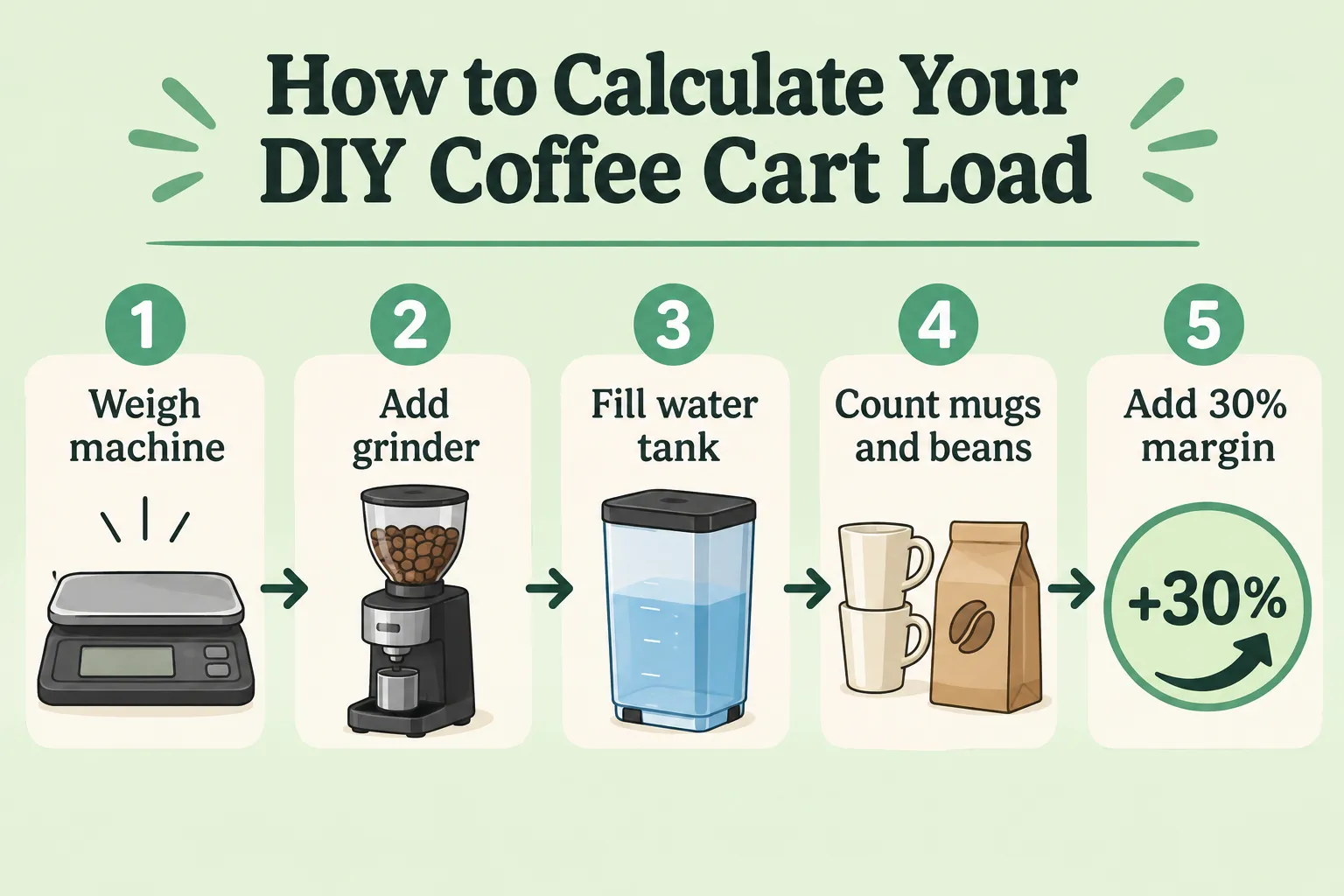
Worked example for a Breville Barista Express station:
| Item | Weight |
|---|---|
| Breville Barista Express | 23 lb |
| Separate burr grinder | 10 lb |
| Full 2 L water tank | 4.4 lb |
| 1 kg bag of beans | 2.2 lb |
| Six ceramic mugs | 6 lb |
| Scale, tamper, pitcher, cloths | 4 lb |
| Subtotal | 49.6 lb |
| With 30% margin | ~65 lb |
That number says a 50 lb shelf is marginal and a 175 lb cart with 50 lb shelves only works if you split the load across two levels. Put the machine and tamper on top. Put the grinder, beans and mugs below.
For a DIY build with a plywood top, 3/4-inch birch ply on a four-sided frame with a center support handles this range. Half-inch ply over a 24-inch unsupported span will sag.
Common mistakes people make setting up coffee carts
- Buying the cart first. Pick the machine, measure it, then shop.
- Reading total capacity as shelf capacity. The single most frequent error .
- Ignoring outlet reach. Most machine cords run 3 to 5 feet. A cart in the middle of a wall gap leaves a cord across a walkway.
- Overloading the top shelf for looks. Mugs on top, mass on the bottom.
- Forgetting water weight. A full tank plus a full kettle adds 8 lb that was not in your math.
- Skipping the drip tray mat. Water pooling on MDF ends the cart faster than any load.
- Running a grinder and machine on one cheap power strip. Check the amp draw before stacking appliances on a single circuit.
While you are planning placement, it is worth knowing which drink you will actually make most mornings. Our comparison of drip coffee vs espresso helps decide whether you need a 23 lb machine at all.
Pros and cons of a rolling coffee cart
Pros
- Frees counter space in a small kitchen
- Moves for cleaning behind and underneath
- Groups machine, grinder, beans and mugs in one workflow
- Cheap entry point, from $39.99 for a basic 3-tier
Cons
- Lower capacity than a fixed counter
- Wheels introduce movement during tamping
- Shelf depth often too shallow for prosumer machines
- Most published ratings are static, not rolling
Who should buy a coffee bar cart, and who should skip it
Buy the HOOBRO kitchen island ($119.99, checked Nov 5, 2026) if you own a Breville Barista Express or Gaggia Classic, need a built-in outlet, and have about 20 inches of floor width. It is the pick for the Café Escapee building a $300 to $1,500 setup.
Buy the $99.99 3-tier coffee station if your gear is a drip maker, grinder and mug collection under 40 lb total and you want the look finished.
Buy the $39.99 3-tier rolling cart if you run a capsule machine or a pour over kit and cosmetics are secondary.
Skip the cart entirely if your machine clears 60 lb, if you plan to plumb in a water line, or if your kitchen floor has a transition strip you would roll over daily. Counter or fixed cabinet instead.
FAQ

Conclusion
The weight limit is the spec that decides whether a coffee bar cart becomes a daily station or an expensive wobble. Match the per-shelf rating to your loaded weight plus 30 percent, lock all four wheels, and keep the heaviest object as low as the design allows. For a 20 to 25 lb machine, the $119.99 HOOBRO kitchen island with an outlet is the sensible buy. For a capsule or pour over setup, the $39.99 3-tier does the job without pretending otherwise.
Next step: weigh your machine, add 10 lb for the grinder and 8 lb for water, then shop only carts that publish a per-shelf number above that total. Better Coffee Starts With Better Answers, and this one starts with a bathroom scale.
.cg-el{font-family:system-ui,-apple-system,”Segoe UI”,Roboto,sans-serif;max-width:520px;margin:0 auto;background:#F5FAF8;border:1px solid #61BDA1;border-radius:10px;padding:18px;color:#23372F} .cg-el h3{margin:0 0 10px;color:#14231D;font-size:18px} .cg-el label{display:block;margin:8px 0 3px;font-size:14px} .cg-el select,.cg-el input{width:100%;padding:7px;border:1px solid #61BDA1;border-radius:6px;font-size:14px;background:#fff} .cg-out{margin-top:14px;background:#E8F2EE;border-left:4px solid #1F6B4A;padding:12px;border-radius:6px} .cg-big{font-size:26px;font-weight:700;color:#145037} .cg-note{font-size:13px;margin-top:6px}