Low Acid Coffee: What the Label Really Means
Quick Answer
"Low acid coffee" is a marketing descriptor, not a regulated category. No U.S. federal rule sets a pH, titratable acidity, or chlorogenic acid cutoff that a roasted coffee must hit before it can print those words on the bag. Most brewed coffee sits around pH 4.85 to 5.10, and brands selling low acid coffee typically publish numbers between roughly 5.1 and 6.0, measured in their own cups under their own conditions. Whether that difference matters to your stomach is a separate question, and the clinical evidence is thinner than the packaging suggests.
Key Takeaways
- No legal definition. FDA label rules require claims to be truthful and not misleading, but the available guidance does not set a pH threshold for coffee sold as low acid coffee. The FDA's 4.6 pH line applies to canned food safety, not consumer stomach comfort.
- Typical brewed coffee runs about pH 4.85 to 5.10. Lucy Jo's publishes approximately pH 5.6 for Mellow Belly Original, 6.02 for its Low Acid French Roast, 5.3 for Decaf Mellow Belly, and 5.1 for Timor (brand-reported, updated November 2, 2026).
- Puroast centers its 2026 marketing on pH 5.82, which it says was independently verified by UC Davis and North Carolina A&T. Treat it as a company claim unless you can read the protocol.
- pH is one measurement, not the whole story. Titratable acidity (how much acid there is) and perceived acidity (how bright it tastes) move independently of pH .
- Dark roast has the most direct physiological data behind it, from a small study of nine healthy volunteers, where dark roast contained 87 mg/L N-methylpyridinium versus 29 mg/L in medium roast and stimulated less gastric acid.
- A randomized, double-blind trial in 30 coffee-sensitive people found no meaningful symptom difference between a low-acid conduction-roasted coffee and conventional coffee (reported September 19, 2026).
- Price premium is modest at the grocery end. Amazon prices checked November 5, 2026: Folgers Simply Smooth $16.49, VitaCup Perfect Low Acid $14.99, Lucy Jo's Mellow Belly $17.39. Specialty names like Lifeboost run near $28.99 .
- If you have GERD, gastritis, or persistent reflux, talk to your doctor. Nothing here treats or prevents a medical condition.
Low acid coffee: what the label really means
On a bag, "low acid coffee" means the roaster believes its product produces a brewed cup with higher pH, lower total acid content, or a softer perceived acidity than ordinary coffee. It does not mean a government agency checked the number.
The FDA's food labeling framework requires that claims be truthful and not misleading. It does not publish a pH ceiling, a chlorogenic acid limit, or a required test method for roasted coffee sold under this description. That leaves each roaster to define the term, measure it however they choose, and publish whatever they publish.
Some brands do real work here. Lifeboost said on October 19, 2026 that it measures acidity in-house with an Apera PC9500 meter plus independent Light Labs testing, and, to its credit, acknowledged that pH describes hydrogen-ion activity in a prepared cup and does not predict any individual's gastric response. That caveat is more honest than most packaging.
Others print "low acid" with no published figure at all. The gap between those two approaches is the single most useful thing to check before you spend money.
A pH number tells you about the liquid in the cup. It does not tell you how your stomach will answer.
One thing worth separating: the 4.6 pH threshold you may run into belongs to the FDA's low-acid canned foods regulations, which exist to prevent botulism in sealed containers. It has nothing to do with heartburn, and nothing to do with coffee marketing.
What makes coffee acidic in the first place?
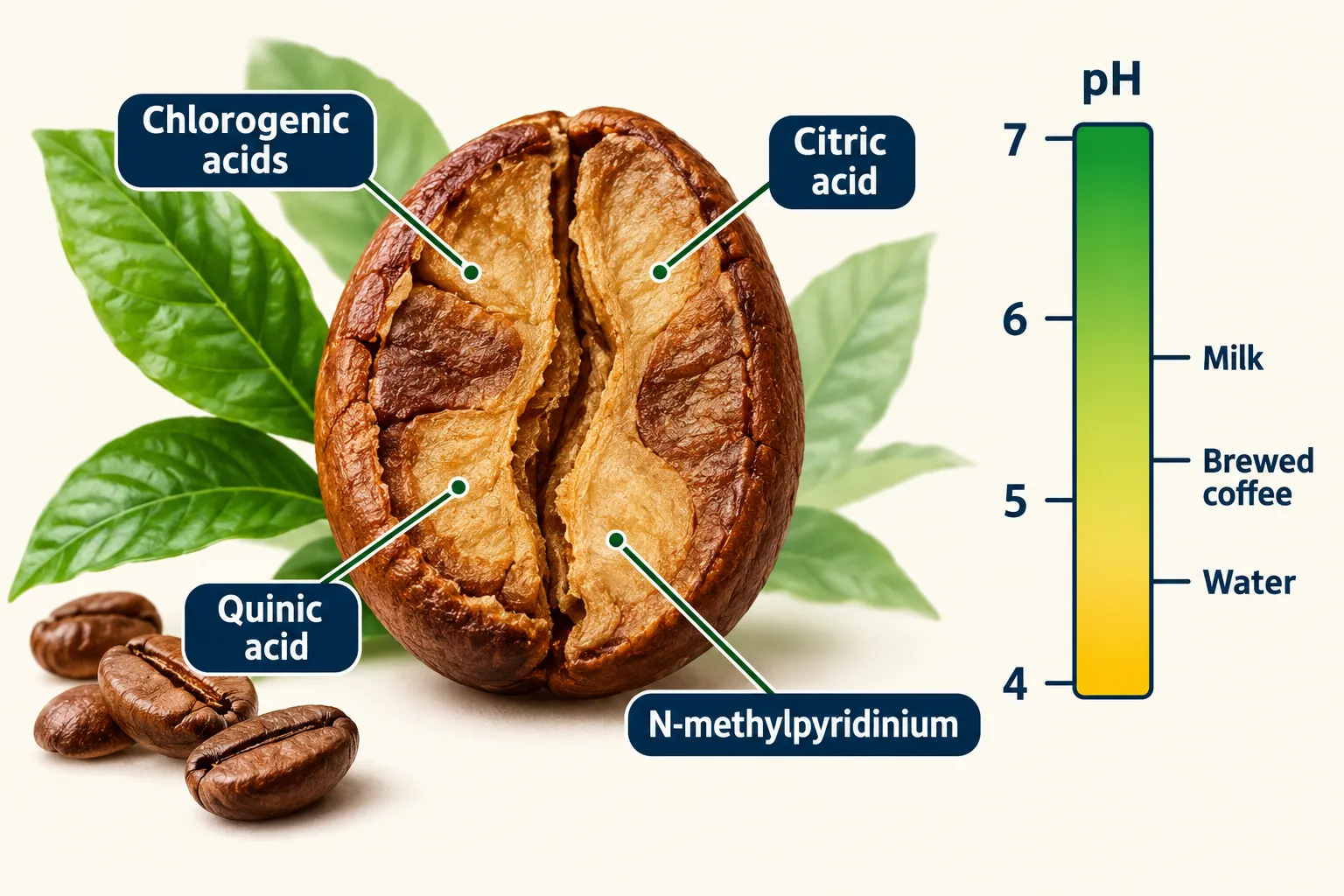
Coffee is naturally acidic because the bean contains organic acids, and roasting both destroys some and creates others. Brewed coffee is roughly as acidic as a banana or a can of soda, far milder than lemon juice.
The main contributors:
- Chlorogenic acids. Present in large amounts in green coffee. Roasting breaks them down progressively, and roasting data cited by Jayarr Coffee reports they fall to near-trace levels at the darkest roast tested .
- Quinic acid. Partly a breakdown product of chlorogenic acids. It increases with longer roasting and with coffee sitting on a hot plate, which is why stale diner coffee turns sharp and hollow.
- Citric, malic, and acetic acids. These are the bright, fruity, sometimes vinegary notes. A washed Kenyan tastes lively largely because of these.
- Growing conditions. High-altitude, slow-maturing arabica generally carries more of the pleasant fruit acids. Robusta carries less, which is one reason it shows up in blends built for a softer cup. We cover its other characteristics in our look at the drawbacks of robusta coffee.
- Processing method. Natural and honey processing can shift the acid profile and perceived sweetness.
Then there is the measurement problem. pH records hydrogen-ion activity. Titratable acidity records how much base it takes to neutralize the cup. Two coffees with nearly identical pH can hold different total acid loads, and a coffee can taste gentle without being dramatically higher in pH .
Common mistake: assuming sour taste equals high acid content. Sourness often comes from under-extraction. If your pour over tastes sharp and thin, grind finer or extend the brew time before you blame the beans.
How do they actually make coffee less acidic?
Roasters use four main routes: picking low-acid origins, roasting darker, treating the green beans with steam or slow heat, and changing the brew method. Each works through a different mechanism, and each costs you something.
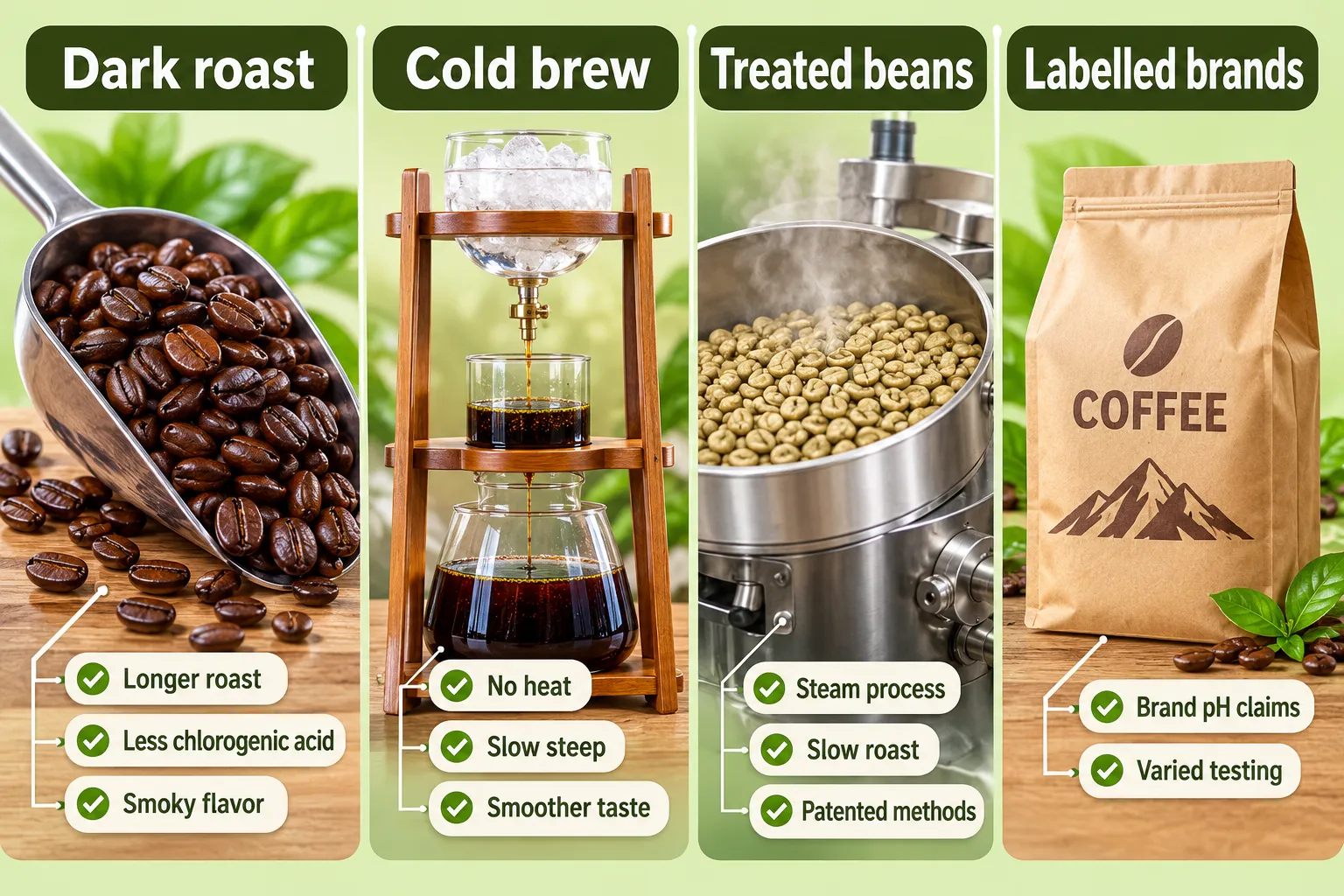
| Route | How it works | Tradeoff |
|---|---|---|
| Dark roast | Longer roasting breaks down chlorogenic acids and builds N-methylpyridinium | Smoke and bitterness replace origin character; quinic acid rises |
| Cold brew | No heat means slower extraction of some acidic and bitter compounds | 12 to 18 hours of waiting; pH often close to hot coffee |
| Treated or slow-roast beans | Steam treatment or patented slow roasting (Puroast reports a USPTO grant in April 2026) | Higher price; a patent proves a process, not a health outcome |
| Branded low acid blends | Origin selection plus roast profile, sold with published pH figures | Test conditions rarely disclosed; flavor often flattened |
Decision rule: if you want the cheapest honest attempt, buy a good dark roast and drink it fresh. If dark roast already disagrees with you, a steam-treated or slow-roasted product is the next thing to test.
Does dark roast coffee really have less acid?
Dark roast generally contains fewer chlorogenic acids than light roast, and it has the clearest physiological evidence behind the dark roast low acid idea. The evidence is real but small.
A review summarized by Evident describes a study of nine healthy volunteers in which dark roast stimulated less gastric acid secretion than medium roast. The dark roast measured 87 mg/L of N-methylpyridinium, a compound formed during roasting, compared with 29 mg/L in the medium roast, along with less chlorogenic acid.
Nine healthy people is a small sample. None of them had GERD, gastritis, or IBS. That study is a reasonable reason to try dark roast, not a reason to promise anything.
Two complications worth holding onto:
- Darker does not mean acid-free. Quinic acid rises with roast progression, and the coffee can taste sharp in a different way, especially after sitting on heat .
- Flavor cost is real. A French roast trades the fruit and florals for cocoa, char, and body. If you like that, it is not a loss. Our guide to Tully's Coffee French Roast walks through what a commercial dark roast actually delivers in the cup.
Is cold brew coffee lower in acid than hot coffee?
Cold brew is usually smoother tasting, but the measured pH of cold brew is often close to hot-brewed coffee from the same beans. Several published comparisons put both in the same broad band, and brewing variables move the number as much as temperature does .
What cold brew reliably changes is perception. Extracting at room temperature or below pulls fewer of the sharp, volatile acidic compounds and less bitterness, so the cup reads rounder and sweeter. People who report that cold brew acid feels gentler are usually describing taste, not a large pH shift.
Practical notes if you want to test it:
- Use a coarse grind, roughly 1 part coffee to 8 parts water by weight for concentrate.
- Steep 14 to 18 hours at room temperature, or up to 24 in the fridge.
- Dilute to taste, then compare it side by side against the same beans brewed hot.
Start with our walkthrough of beginner-friendly iced coffee methods if you have never run a batch.
Edge case: cold brew concentrate is strong. Drinking it under-diluted means more caffeine and more total acid per serving, which can undo whatever comfort the method gave you.
Does low acid coffee really help with acid reflux?
The honest answer is that evidence is mixed and leans unimpressive. A randomized, double-blind trial in 30 coffee-sensitive participants, reported September 19, 2026, found no meaningful difference in heartburn, regurgitation, or dyspepsia between a low-acid, conduction-roasted coffee and conventional coffee.
That matters because it tests the exact claim on the bag. If cup pH were the main driver of symptoms, a higher-pH coffee should have produced fewer. It did not, in that trial, at that size.
Clinical explanations suggest why. Coffee can relax the lower esophageal sphincter, the muscular valve between esophagus and stomach, and can stimulate gastric acid secretion. Decaffeinated coffee also stimulates acid secretion, and pure caffeine appears to have a smaller effect than coffee itself, per the Cleveland Clinic's discussion of coffee and acid reflux. In other words, the trigger may not be the coffee's own acidity at all.
Raising the pH of the cup does not change how the valve at the top of your stomach behaves.
What this means for you: low acid coffee may still feel better for some individual drinkers. Personal response varies and a 30-person trial cannot rule that out. But buy it as an experiment with your own body, not as a treatment. If you have diagnosed GERD, Barrett's esophagus, an ulcer, or you take acid-reducing medication, raise this with your doctor before changing your routine.
Low acid coffee vs regular coffee: is it better for your stomach?
For most healthy drinkers, there is no demonstrated digestive advantage to low acid coffee over regular coffee. For people who report discomfort from coffee, it is a reasonable, low-cost thing to try, with a fair chance it changes nothing.
Here is how the two compare on the things you can actually verify:
| Factor | Regular coffee | Low acid coffee |
|---|---|---|
| Typical brewed pH | about 4.85 to 5.10 | brand-reported 5.1 to 6.02 |
| Regulated standard | none | none |
| Published test protocol | rarely | occasionally, varies by brand |
| Flavor range | full, including bright and fruity | usually narrower, softer, often darker |
| Price (Amazon, Nov 5, 2026) | $10 to $18 for supermarket tiers | $14.99 to $28.99 |
| Clinical symptom evidence | n/a | one 30-person trial found no difference |
The phrase stomach friendly coffee carries no more legal weight than low acid. Treat both as descriptions of intent.
If your interest is broader than acidity, our piece on what the healthiest coffee to drink actually is covers filtration, additives, and what the research supports.
Who actually benefits from low acid coffee?
Four groups are most likely to notice a difference, and one group almost certainly will not.
Worth trying it:
- People who get a specific, repeatable burn after coffee and have already ruled out milk, sugar, and timing.
- Drinkers who simply dislike bright, sour cups and want chocolate and nut flavors instead. This is a taste preference, and the label delivers on it fairly often.
- Anyone drinking coffee on an empty stomach first thing. Food in the stomach changes the experience for many people.
- Sensitive drinkers who also want caffeine reduced. Decaf low acid coffee exists, including Lucy Jo's Decaf Mellow Belly at a reported pH 5.3. Note that decaf is not caffeine-free, as we explain in how much caffeine decaf coffee actually contains.
Probably not worth it: drinkers with no symptoms who enjoy a bright Ethiopian. You would be paying a premium to remove the part you like.
Best low acid coffee brands, where to buy, and what they cost
Low acid coffee brands range from supermarket staples at about $15 to specialty bags near $29. The cheapest tier is barely more expensive than ordinary coffee, which makes a one-bag trial cheap.
Amazon prices checked November 5, 2026:
- Folgers Simply Smooth, $16.49. 2,719 reviews, 5,000+ bought in the past month. Steam-processed, widely available, flavor reads mild and familiar.
- VitaCup Perfect Low Acid (organic), $14.99. 2,400 reviews. Organic single-origin positioning at the lowest price of the three.
- Lucy Jo's Mellow Belly, $17.39. 3,199 reviews. The brand publishes per-product pH figures, updated November 2, 2026, which puts it ahead of most competitors on transparency.
Two more worth knowing about. Puroast builds its 2026 messaging on pH 5.82 and says the figure was independently verified by UC Davis and North Carolina A&T, describing the coffee as five times less acidic than commercial coffee. Lifeboost sits near $28.99 and is one of the few brands to name its testing equipment .
The low-cost alternative nobody markets: a conventional dark roast. Comparison data lists Peet's Major Dickason's Blend between roughly $15.97 and $26.98 depending on listing and package size, prices reported October to November 2026 . That gets you reduced chlorogenic acids and a softer perceived edge without a specialty markup.
Affiliate disclosure: Coffee Rank IQ earns commission from some retail links. Prices above were checked on the dates listed and change without notice. This section is based on published product information and retailer listings, not hands-on tasting. Check the current price before ordering.
If freshness is your real problem, grinding at home fixes more than a label will. Compare the models in our guide to coffee makers with built-in grinders.
Can you make regular coffee less acidic yourself?
Yes, partly, and for free. Brewing variables move perceived acidity more than most shoppers expect, and several adjustments cost nothing.
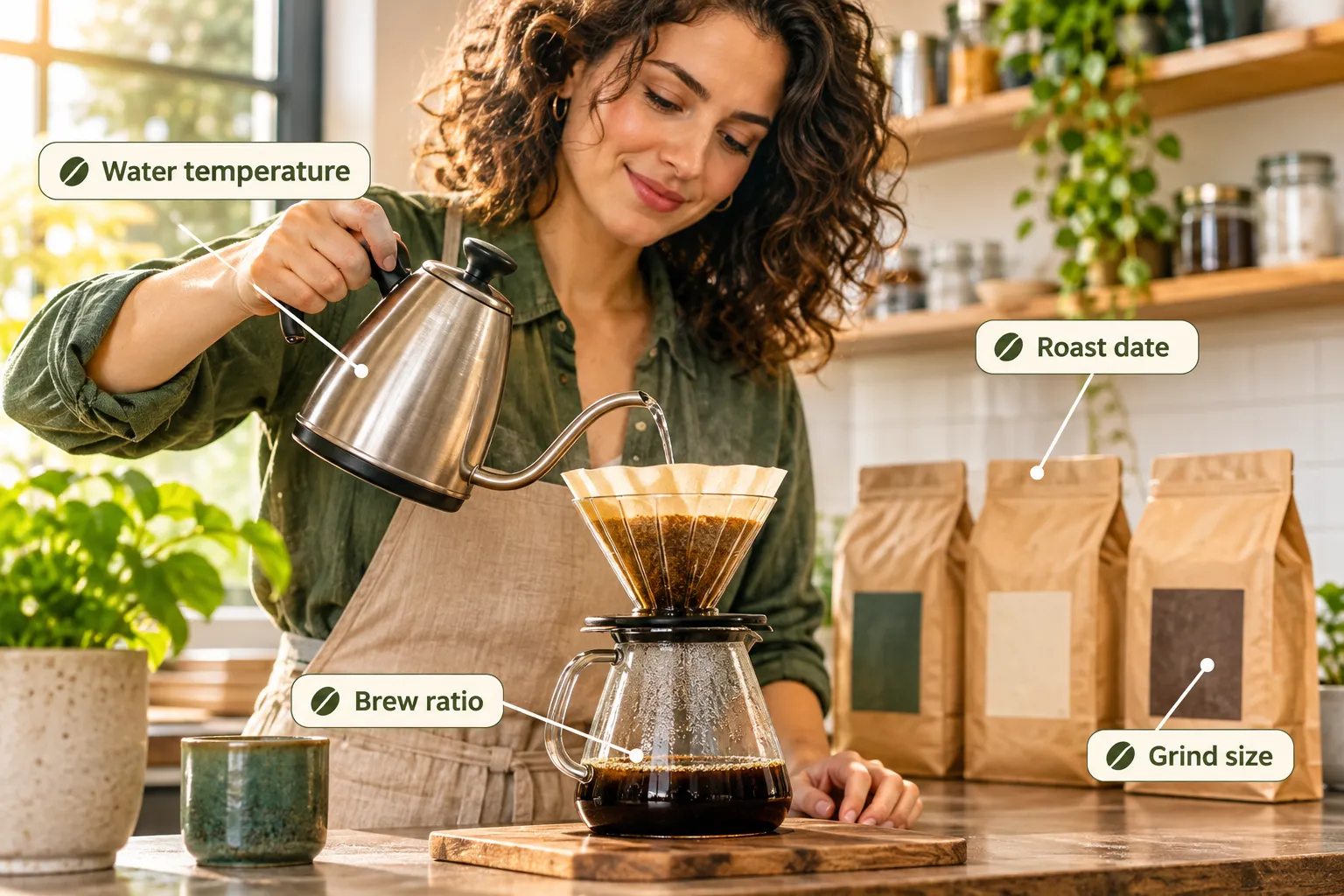
- Grind coarser and brew longer. Sour, sharp coffee is often under-extracted. Pull more out of the grounds and the sourness drops.
- Lower your water temperature. Try 195°F instead of 205°F. Less aggressive extraction of the sharp compounds.
- Use a paper filter. Paper traps oils and fine particles that contribute harshness. Our comparison of drip coffee versus pour over covers what filtration removes.
- Buy fresher. Check the roast date, not the best-by date. Stale coffee tastes flat and sour at once.
- Drop the brew ratio. A weaker cup contains less of everything, including acid.
- Skip the hot plate. Holding coffee at 180°F for an hour builds bitter, sharp compounds.
The pinch-of-salt and pinch-of-baking-soda tricks. A small amount of sodium bicarbonate will raise pH, because that is basic chemistry. It also strips sweetness and leaves a soapy, flat cup. Salt masks bitterness without changing acidity. Both are blunt instruments.
Can you add milk to low acid coffee to reduce acid more?
Milk raises the pH of the finished drink, because cow's milk sits near pH 6.7 and dilutes the coffee's acidity. A latte is measurably less acidic in the cup than the same espresso taken straight.
That does not automatically mean less discomfort. Dairy fat can slow stomach emptying, which bothers some reflux sufferers, and lactose intolerance produces its own symptoms that are easy to confuse with coffee sensitivity. Oat and soy drinks behave differently again.
If milk drinks are your thing anyway, our rundown of milk-based coffee drinks explains the ratios behind each one. A cortado and a flat white deliver very different coffee-to-milk proportions, and that proportion is what moves the pH.
Does low acid coffee taste worse than regular?
It usually tastes different, and whether that is worse depends on what you drink coffee for. Acidity in coffee is not a flaw. It is the brightness, the citrus, the structure that keeps a cup from reading as flat cocoa water.
Strip it out and you typically get:
- More body and roast-driven sweetness
- Cocoa, nut, and caramel character
- Less fruit, less floral, less distinct origin identity
- A rounder finish that suits milk well
People moving from flavored or supermarket coffee often prefer it immediately. People who learned coffee through a bright Ethiopian pour over tend to find it muted.
Quick test before you commit: buy one bag of a supermarket low acid blend and one bag of a good dark roast at a similar price. Brew both at the same ratio on the same morning. Note the roaster's listed tasting notes, then write down what you taste. If the dark roast does the same job for less money, that is your answer.
Is the low acid label just a marketing thing?
Sometimes. The label is unregulated, which means it carries exactly as much weight as the roaster's willingness to measure and publish.
Watch for these:
- No published pH anywhere on the site. A brand that tested its coffee usually says so.
- No brewing conditions given. Lucy Jo's publishes pH per product, but the page does not establish that every coffee was prepared at identical ratio, temperature, and extraction time. Without that, cross-brand comparison is shaky.
- Comparative claims without protocol. "Five times less acidic than commercial coffee" needs a named comparison coffee and a named method before it means much.
- Patents treated as proof of benefit. Puroast reports a USPTO grant for its slow-roast process in April 2026. A patent establishes intellectual property. It does not establish that the coffee is tolerated by sensitive drinkers.
- Health language that edges toward treatment. No coffee prevents or cures reflux. Any package implying otherwise is making a claim it cannot support.
- The 4.6 confusion. If a brand cites FDA's 4.6 threshold as a health benchmark, they have mixed up canned-food safety rules with consumer wellness.
FAQ
Conclusion
gentler beans means what the roaster decides it means. Some brands measure carefully with named equipment and publish the figures. Others print two words and charge more. The difference is visible in about thirty seconds of reading a product page.
Your next step, in order:
- Fix your brewing first. Check the roast date, grind coarser, drop water temperature to 195°F. This is free and it solves sourness more often than a new bag does.
- Try a dark roast. It has the most direct physiological data behind it, modest as that data is, and costs no premium.
- If that fails, buy one low acid bag under $18 and run it for two weeks against your usual coffee. Keep a short note of how you feel.
- If symptoms persist, see your doctor. Reflux has causes that no coffee bag addresses.
Better Coffee Starts With Better Answers, and in this case the answer is that the label is a starting hypothesis, not a result.