Breville Barista Express Impress Review: Worth the Lever?
Quick Answer
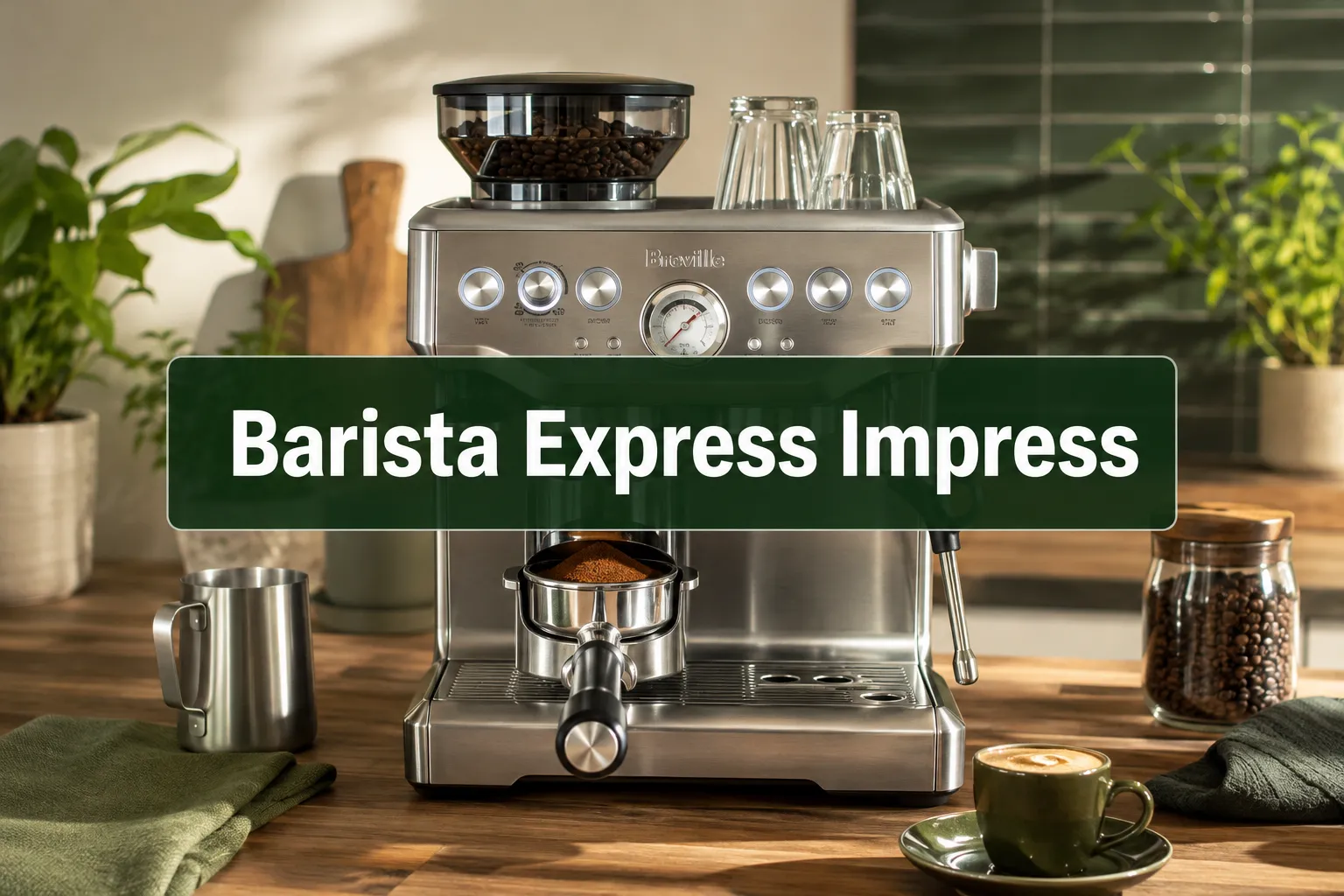
The breville barista express impress is worth the extra money for beginners who want consistent espresso without buying a scale, a distribution tool, and a tamping mat. Its lever doses and tamps the puck for you, which removes the two steps new users get wrong most often. Breville's US site listed it at $799.95 on October 22, 2026 , against $499.95 for the standard Barista Express . If you already own a quality tamper and a WDT tool, the lever buys you speed, not better espresso.
Key Takeaways
- Breville listed the Barista Express Impress (BES876) at $799.95 on its US site on October 22, 2026, in stock, with 25% off selected fresh beans bundled .
- Price tracking showed a recorded low of $649.95 and a high of $799.95 across checks between late July and early November 2026 . Waiting for a sale is reasonable.
- The standard Barista Express (BES870) sits at $499.95 on Breville's US site , roughly $300 less for the same thermocoil and a manual tamp.
- EspressoRadar rated the Impress 4.7 out of 5 in its June 13, 2026 review, arguing it raises the floor of your worst shots rather than the ceiling of your best .
- The grinder offers 25 grind settings and PID-controlled heating with 9-bar extraction, per Breville's own listing .
- Assisted tamping applies a consistent tamp, then a second lever pull levels the puck surface, which is the part most beginners botch with a hand tamper.
- Skip it if you already own a scale and a distribution tool. Buy it if the words "channeling" and "WDT" make you tired.
Affiliate disclosure: Coffee Rank IQ earns commission on some links at no extra cost to you. This review is based on published specifications, Breville's own documentation, and other reviewers' hands-on testing, not our own laboratory measurements. Prices were checked in early November 2026 and change often.
How does the impress lever function actually work?
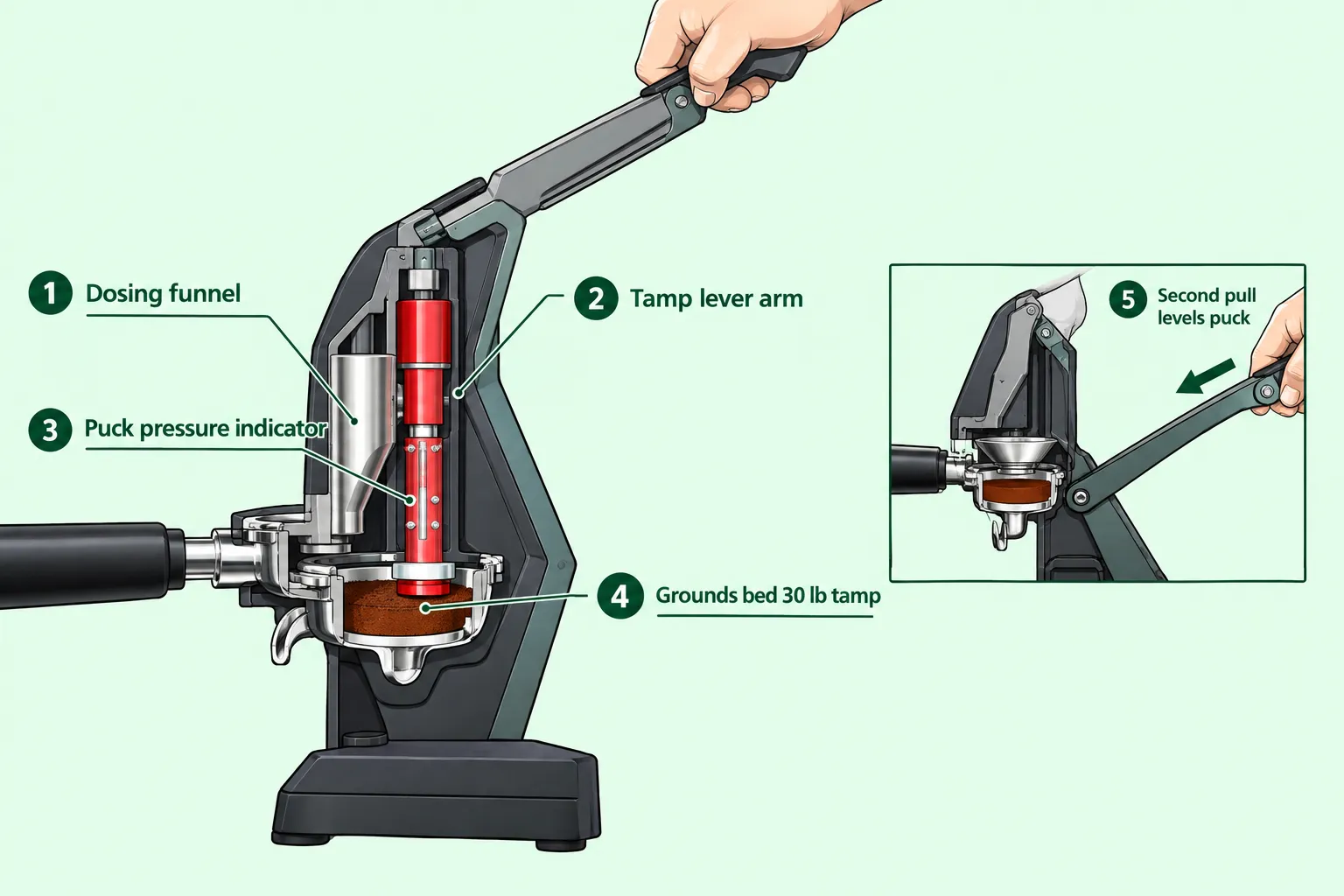
The lever doses a measured amount of grounds into the portafilter, then applies a consistent tamp without you pressing down on a counter. Pull it once to tamp. Pull it again to level the puck face.
Here is the sequence in practice:
- Lock the portafilter into the dosing funnel under the grinder.
- Press the grind button. Breville's "intelligent dosing" delivers a target dose based on your basket .
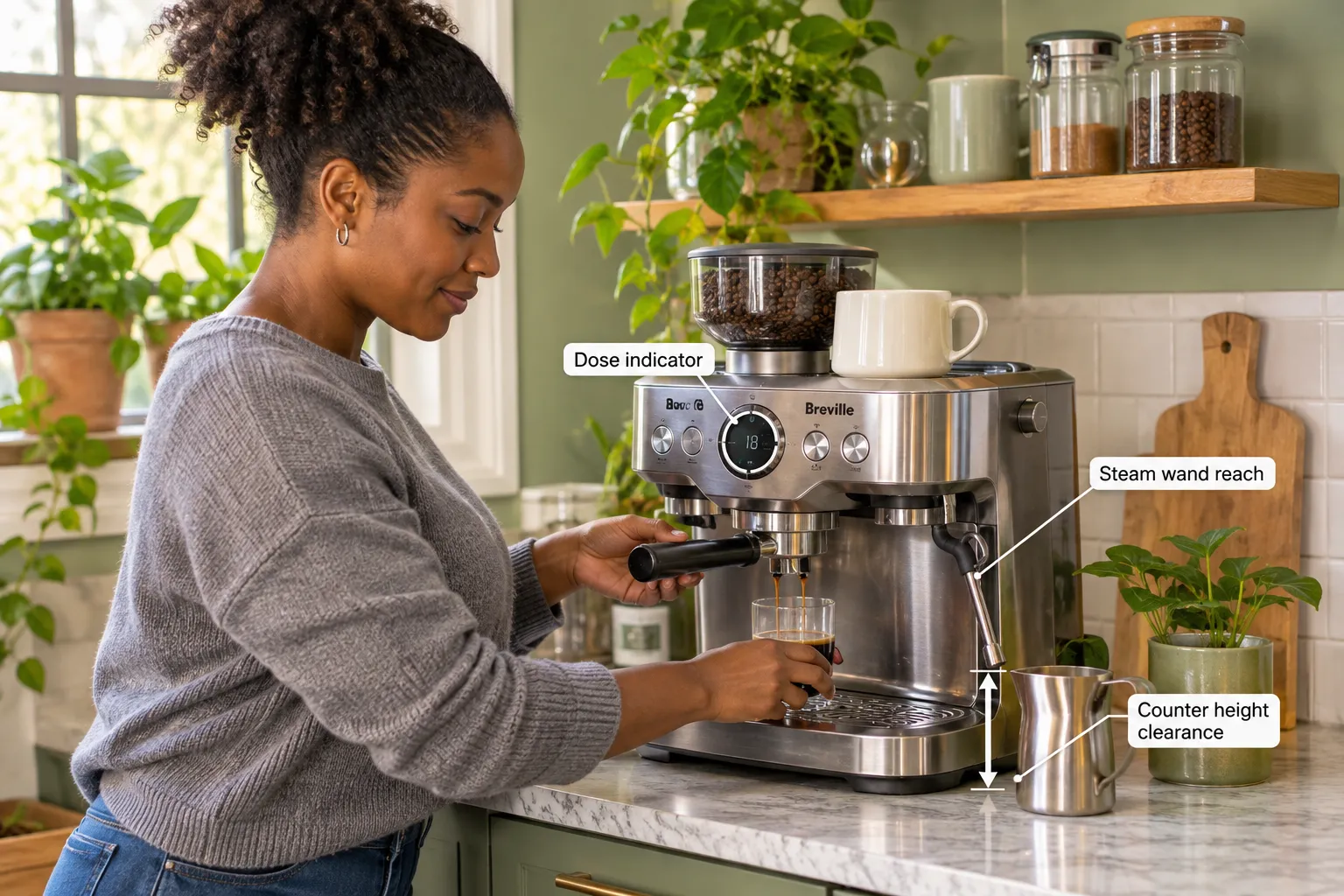
- Check the dose indicator. If you are under or over, the machine tells you to add or remove grounds in small increments.
- Pull the lever down. The machine applies a consistent tamping force, far more repeatable than a tired wrist at 6:40 a.m.
- Pull the lever a second time. A small rotation polishes and levels the puck surface, which is where channeling usually starts.
The payoff: a puck that looks the same on Tuesday as it did on Sunday. Espresso extraction is sensitive to how evenly water passes through the bed of coffee. An uneven or tilted puck lets water carve a path through the weak spot, pulling sour, thin shots. Consistent tamping removes one of the biggest variables beginners fight.
Common mistake: people still overfill. The dose indicator is not decoration. Ignore it and the puck swells against the shower screen, and you will spend your morning scrubbing grounds off the group head gasket.
Is the breville barista express impress worth the extra money?
The breville barista express impress is worth roughly $150 to $300 over the standard Barista Express if you are new to espresso and value consistency over tinkering. It is poor value if you already have tamping gear and a scale, because the espresso ceiling is the same machine underneath.
Both machines share the thermocoil heating system, PID temperature control, 9-bar extraction, and a conical burr grinder. What you pay for with the Impress is the dosing and tamping workflow, not a better brew group.
The money question depends on what you would otherwise spend:
| Item | Typical outlay | What it replaces on the Impress |
|---|---|---|
| Calibrated tamper | $30 to $70 | Lever tamp force |
| Distribution / WDT tool | $20 to $60 | Second lever pull leveling |
| Small espresso scale | $25 to $150 | Intelligent dosing indicator |
| Tamping mat and dosing funnel | $20 to $40 | Built in funnel |
Add those up and the gap narrows to something like $100 to $150, with the advantage that the Impress keeps your counter clear. That matters in an apartment kitchen more than spec sheets admit.
Decision rule: choose the Impress if your current espresso attempts are inconsistent. Choose the cheaper Barista Express if your shots are already fine and you just want a backup machine or a lower price.
What's the difference between the regular Barista Express and the Impress?
The core difference is dosing and tamping. The standard Barista Express grinds into the portafilter and hands you a tamper. The Impress grinds, measures, corrects, tamps, and levels using the lever.
| Model | US list price (Nov 2026) | Tamping | Grinder | Best for |
|---|---|---|---|---|
| Barista Express (BES870) | $499.95 | Manual, hand tamper | Conical burr, integrated | Hands-on learners, tight budgets |
| Barista Express Impress (BES876) | $799.95 | Assisted tamping lever, 2 pulls | Conical burr, 25 settings | Beginners who hate mess |
| Barista Pro (BES878) | Varies by retailer | Manual tamp | Faster heat up, more grind steps | Upgraders who want adjustability |
Serious Eats places the Impress among the most approachable Breville machines, noting the built-in grinder, automated dosing, and assisted tamping lever, while the standard Express keeps a more manual routine . Business Insider's March 2026 comparison called the Impress versus Pro choice close but leaned Pro for its better grinder and finer adjustment, while still calling the Impress the friendlier starting point because assisted tamping cuts guesswork .
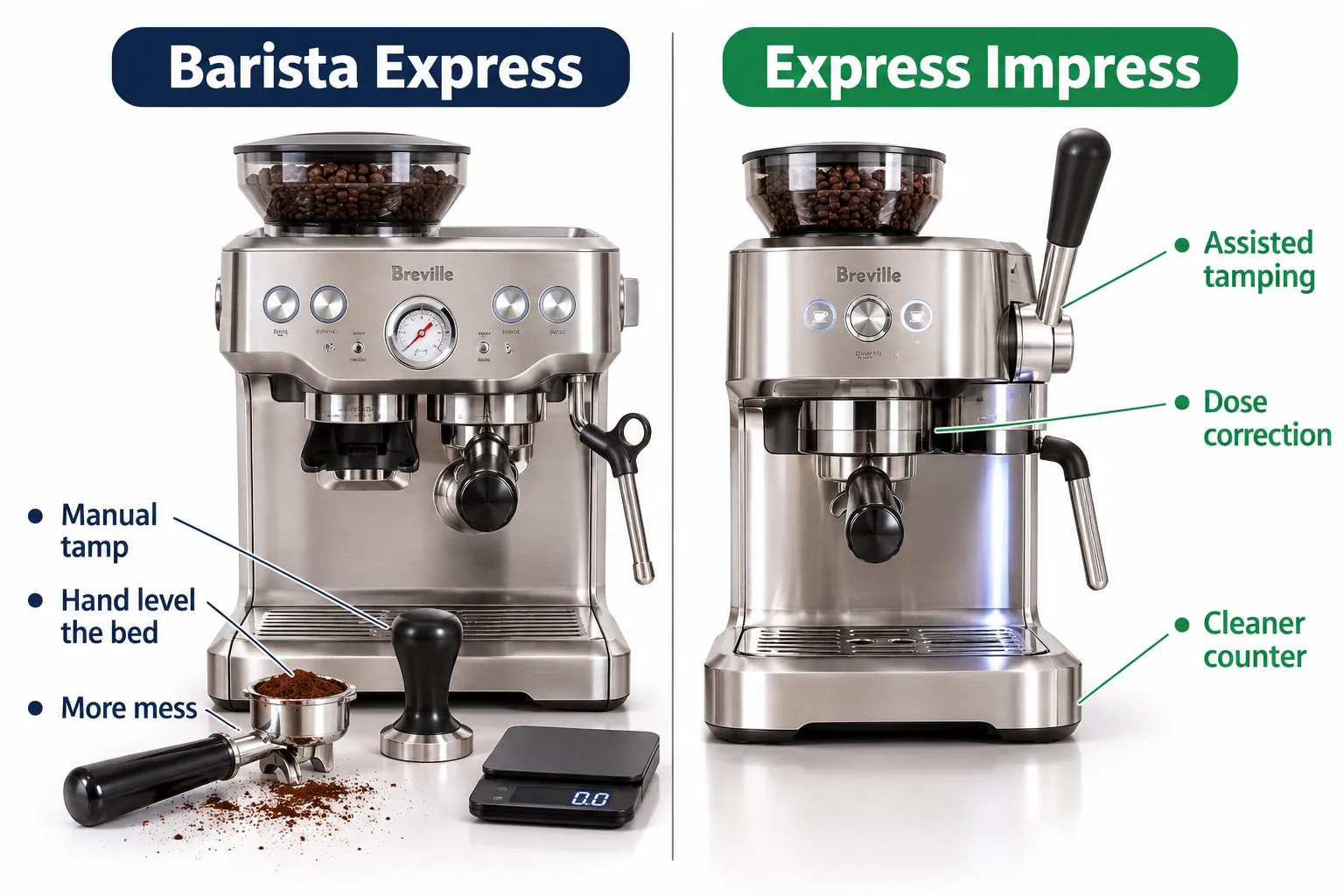
If you want to learn espresso as a craft, the manual tamp teaches you something. If you want a flat white before a 9 a.m. call, the lever is the better buy.
For the full workflow on the older model, read our complete guide to using the Breville Barista Express espresso machine.
How much does the breville barista express impress cost right now?
Breville's US site listed the breville barista express impress at $799.95 on October 22, 2026, in stock, with 25% off selected fresh beans for buyers . Deal trackers recorded a low of $649.95 across the preceding weeks, so the real street price is volatile .
Three sourced price points worth knowing:
$799.95 (US direct, Oct 22, 2026) Breville's own listing, full price, all finishes .
$649.95 (recorded low, 2026 sale periods) TechRadar reported the Impress dropping to its best price since Prime Day during a 2026 promotion, a $150 saving .
A$799 instead of A$869 (Nov 3, 2026) Breville Australia ran a temporary promotion bundled with 1 kg of coffee .
Practical advice: unless a specific finish is about to sell out, paying $799.95 the week before a known sale window is hard to justify. Breville's 2026 US Black Friday promotion was scheduled for November 27 to 29, with Cyber Monday on November 30. Set a price alert and check the current price before you commit.
Does it come with a built in grinder, and is it any good?
Yes. The Impress has an integrated conical burr grinder with 25 grind settings, feeding directly into the portafilter . It is competent for espresso and acceptable for a strong filter grind, but it is not a $400 standalone grinder.
What that means in the cup:
- 25 steps is enough for most medium roast espresso blends. You will find a workable setting.
- Light roasts are harder. Very light single origin coffee often wants a grind adjustment finer than the step between settings allows. Business Insider preferred the Barista Pro partly for its larger number of grind steps .
- Grind retention exists. Expect a small amount of stale grounds held in the chute. Purge a couple of grams after changing beans.
- Roast date matters more than you think. Coffee between 5 and 21 days off roast grinds and extracts more predictably than week-old supermarket bags.
Edge case: if you also brew pour over or cold brew, the grinder will handle it, but a dedicated burr grinder will give you a cleaner particle distribution for those methods.
Is the breville barista express impress good for beginners, and do you need experience?
It is one of the friendliest espresso machines sold at this price, and you do not need prior experience to pull a drinkable shot on day one. You will still need to learn grind size adjustment and milk steaming, because the machine does not do either for you.
What the Impress handles for you:
- Dose measurement and correction
- Tamp pressure
- Puck leveling
- Brew temperature via PID control
- 9-bar extraction pressure
What is still on you:
- Choosing grind size and adjusting when shots run too fast or too slow
- Steaming milk with the manual wand, which is a real skill
- Timing your shot and tasting the result
- Cleaning
WIRED's February 2023 review found that beginners could make good espresso quickly, but described the automation as training wheels that leave you less prepared for a fully manual machine . That is a fair criticism and a fair tradeoff. A later synthesis of expert reviews noted BBC Good Food gave it 5 out of 5 as its best assisted-manual machine, Serious Eats recommended it for beginners, and WIRED scored it 6 out of 10, warning the guided workflow gets confusing once users start customizing .
New to milk drinks? Our beginner's guide to barista quality espresso drinks covers the ratios, and the advanced latte techniques guide covers pouring once your microfoam improves.
Five features we love
1. The two-pull assisted tamping lever. The second pull levels the puck face. That is the part a beginner with a hand tamper almost never gets right, and it is the main reason shots start running evenly instead of spraying sideways.
2. Breville dose control with a live indicator. The machine shows whether you are under or over dose and lets you add grounds in small increments. It is a scale substitute that lives inside the machine, which is more useful than a scale you forget to use.
3. The dosing funnel. Grounds go into the basket, not onto the counter. Over a year of daily use this is the feature you will actually notice.
4. PID-controlled thermocoil heating at 9 bars. Breville's listing specifies PID temperature control and 9-bar extraction . Stable water temperature means your shot tastes the same at 7 a.m. and 7 p.m.
5. A steam wand that is genuinely manual. You keep control over milk texture. Many machines in this bracket automate steaming and produce flat, bubbly foam. Here you can learn proper microfoam.
What to watch out for
- Full price is steep. $799.95 when the same machine has traded at $649.95 during sales.
- The automation is opinionated. WIRED's criticism holds: when you try to deviate from the guided routine, the workflow gets fiddly .
- Thermocoil, not dual boiler. You brew, then steam. Back to back drinks for four people means waiting.
- Grind steps can feel coarse for light roasts.
- It takes real counter space. Measure the height to your upper cabinets before buying. The water tank and bean hopper both need vertical clearance.
- Skills transfer is limited. If your plan is to graduate to a manual lever machine, the Impress teaches you less than the standard Express does.
What are the most common problems people report?
The issues that come up most often with the Impress are grinder chute clogging with oily dark roasts, puck screens swelling when overdosed, weak steam pressure after mineral buildup, and user frustration with the dose indicator on very light or very dark beans.
Fixes, in order of how often they work:
- Clogged grinder chute: switch to a less oily roast, or remove the upper burr and brush the chute monthly. Oily dark roast beans cause most of this.
- Weak or sputtering steam: descale. Hard water scales up a thermocoil faster than people expect.
- Shots running fast and sour: grind finer, one step at a time. Give the grinder a few seconds to purge the old setting.
- Grounds all over the group head: you are overdosing. Trust the indicator.
- Leaking around the portafilter: check the group head gasket for old grounds, then wipe the rim before locking in.
No recall was found. A review of CPSC-related records through October 15, 2026 turned up no recall for the BES876. The Breville recall most often returned by searches is the unrelated 2015 Fast Slow Cooker pressure cooker recall. Check the CPSC database against your serial number anyway before buying used.
How much maintenance does this machine need?
Plan on two minutes daily, ten minutes weekly, and about thirty minutes every few months. Breville maintained an active BES876 troubleshooting page, cleaning guides, and product documentation as of October 2026, which is a decent signal that parts and support are not being wound down .
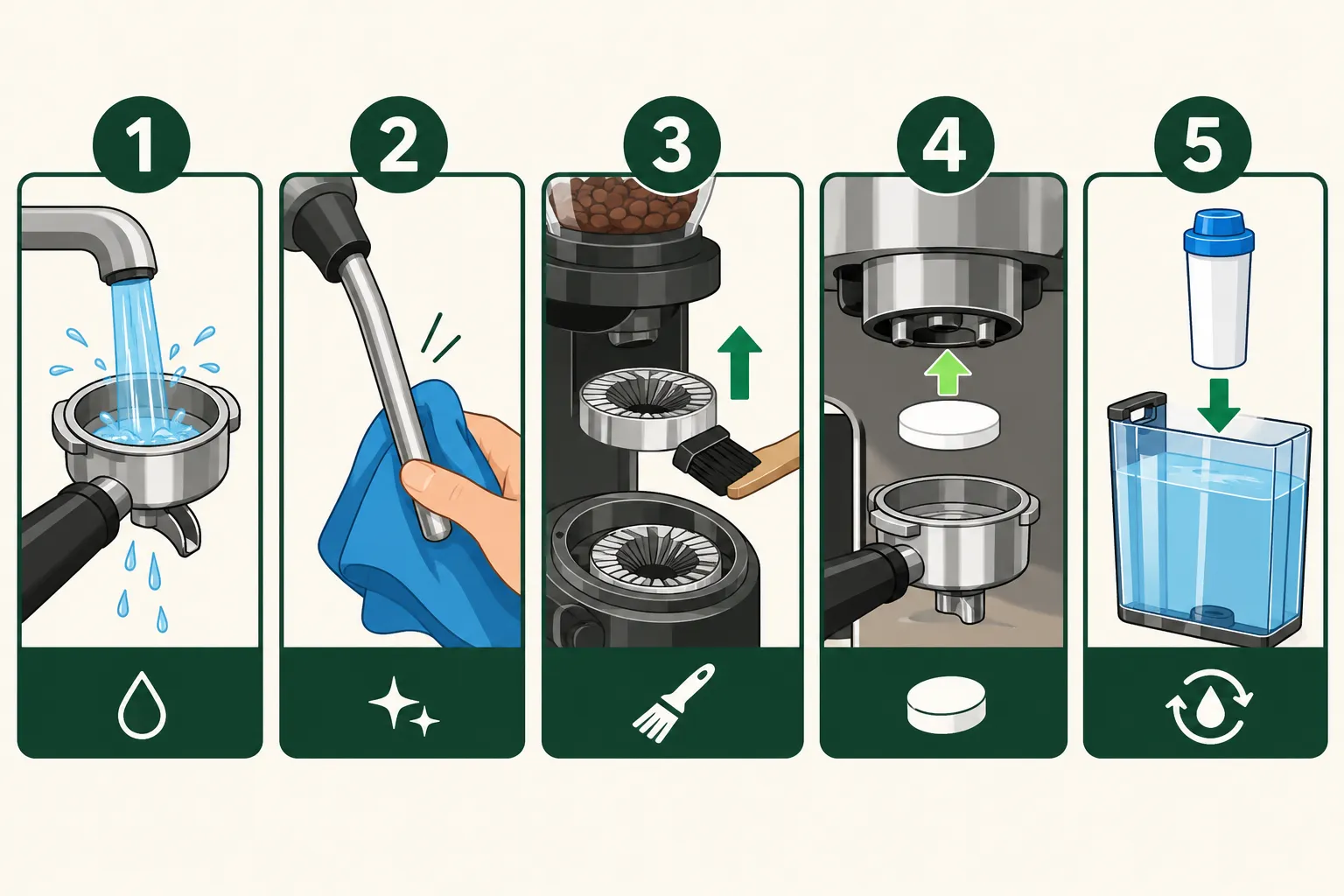
Daily: purge and wipe the steam wand immediately after every use. Knock out the puck. Rinse the basket.
Weekly: backflush with the blind disc and a cleaning tablet. Soak the portafilter and basket. Wipe the drip tray.
Monthly: brush the burrs and the grinder chute. Empty and rinse the bean hopper to clear oil residue.
Every 2 to 3 months: replace the water filter, more often with hard water.
Every 3 to 6 months: descale. The machine prompts you based on usage.
Water quality is the quietest factor in machine lifespan. Filtered water with moderate mineral content extracts well and slows scale. Our guide to advanced barista cleaning techniques covers the professional versions of these routines.
How long does the barista express impress typically last before issues?
With weekly backflushing and regular descaling, home machines in this class commonly run several years before a service part is needed. The components that fail first are predictable: the group head gasket, the steam wand o-ring, and the solenoid valve.
There is no published manufacturer lifespan figure for the BES876, and anyone quoting you an exact number of years is guessing. What is documented is that Breville keeps a product hub, troubleshooting page, and cleaning documentation live for the model , which usually means spares are obtainable.
Biggest lifespan killer: skipping descaling on hard water. Scale restricts the thermocoil, drops brew temperature, and strains the pump.
What are better alternatives if this is too expensive?
If $799.95 is too much, the standard Barista Express at $499.95 is the straightforward answer, and the money saved buys a good tamper and a distribution tool with change left over.
Other routes worth considering:
- Breville Bambino Plus plus a separate grinder. Faster heating, smaller footprint, and you choose the grinder. Total cost can land near the Impress but with a better grind.
- De'Longhi Dedica or La Specialista range. De'Longhi competes hard on price, and the La Specialista models include their own tamping assistance. Build quality and steam power generally trail Breville at comparable prices, though the entry cost is lower.
- Gaggia Classic Pro. A commercial-style 58 mm portafilter, metal body, and a machine people modify and repair for a decade. No grinder, no dose assistance, steeper learning curve, far better skill transfer. Choose this if you want a hobby.
- A manual route for under $100. A hand grinder and a good press or pour over setup. Not espresso, but excellent coffee. See our guide to choosing a French press if milk drinks are not your priority.
Decision rule: Impress for convenience, Gaggia Classic Pro for craft, standard Barista Express for budget, Bambino Plus plus grinder for upgrade potential.
Does the impress function make noticeably better espresso?
It makes more consistent espresso, which most home users experience as better espresso. The best shot an expert can pull on the Impress is roughly the best shot they could pull on the standard Barista Express, because the brew group and boiler are the same.
EspressoRadar's June 2026 review made exactly this argument, rating the machine 4.7 out of 5 and framing the benefit as a higher floor rather than a higher ceiling . For a beginner whose shots currently swing between 15 and 45 seconds, raising the floor is the whole point.
Quick example: two users, same beans, same grind. The experienced one with a quality tamper and WDT tool will match the Impress. The beginner tamping by hand will produce three good shots out of ten. On the Impress, that beginner gets perhaps eight.
Who should buy it and who should skip it
Buy the breville barista express impress if:
- You are buying your first real espresso machine and want milk drinks at home
- You hate mess and limited counter space
- You will not realistically weigh doses every morning
- You can get it near $649.95 rather than $799.95
- You are gift shopping for someone who loves café drinks but has never pulled a shot
Skip it if:
- You already own a scale, a calibrated tamper, and a WDT tool. Buy the $499.95 Barista Express instead.
- You want to learn espresso as a craft and move to a manual machine later. Gaggia Classic Pro.
- You need four milk drinks back to back. Look at a dual boiler.
- You mostly drink light roast single origin filter coffee. Spend the money on a grinder and a pour over setup.
Pros and cons
Pros
- Assisted tamping removes the single biggest beginner error
- Breville dose control with a live under/over indicator
- Integrated conical burr grinder, 25 settings
- PID temperature control and 9-bar extraction
- Dosing funnel keeps grounds off the counter
- Manual steam wand lets you learn proper microfoam
- Active manufacturer support documentation as of October 2026
Cons
- $799.95 full price is high for a single thermocoil machine
- Regularly discounted to $649.95, so timing matters
- WIRED scored it 6/10, citing confusing customization
- Limited skill transfer to manual machines
- Grind steps can be coarse for light roasts
- No simultaneous brew and steam
What mistakes do most people make when starting out?
The most common mistakes are using stale supermarket beans, ignoring the dose indicator, changing two variables at once, and giving up on milk steaming after three attempts.
- Stale coffee. Buy coffee with a roast date on the bag and use it within a month. No machine fixes six-month-old beans.
- Overdosing. The indicator exists for a reason.
- Changing grind and dose together. Change one variable, pull a shot, taste, then change the next.
- Not using a brew ratio. Aim for roughly 1:2, so 18 g in, 36 g out, in 25 to 30 seconds. Adjust grind to hit the time.
- Skipping the wand purge. Dried milk inside a steam wand is a maintenance problem and a hygiene one.
- Steaming too much milk. Fill the jug to just below the spout base.
For technique beyond the basics, our guide to advanced espresso shot techniques covers dialing in and diagnosing channeling.
Price and spec comparison
| Machine | Price checked Nov 2026 | Tamping | Grinder | Best buyer |
|---|---|---|---|---|
| Barista Express Impress (BES876) | $799.95 list, $649.95 low | Assisted lever, 2 pulls | Built in, 25 settings | First-time espresso buyer |
| Barista Express (BES870) | $499.95 | Manual tamper | Built in | Budget, hands-on learner |
| Barista Pro (BES878) | Varies by retailer | Manual tamper | More grind steps | Upgrader wanting control |
| Gaggia Classic Pro | Varies, typically under $500 | Manual, 58 mm | None included | Tinkerer, long-term repairs |
Prices checked against Breville US listings and deal tracking in early November 2026 . Verify before buying.
FAQ

Conclusion
The breville barista express impress earns its lever for one specific buyer: someone who wants reliable café drinks at home and has no interest in building a counter full of tamping gear. The espresso ceiling matches the cheaper Barista Express, but the floor is meaningfully higher, which is what most people actually feel in the cup on a Wednesday morning.
At $799.95 it is defensible. At $649.95 it is a straightforward recommendation. Experienced home baristas with a scale and a distribution tool should save $300 and buy the standard model.
Next step: set a price alert, check the current price on both the BES876 and BES870, and decide based on whether you will genuinely weigh doses every morning. Be honest about that one and the machine chooses itself. Then order fresh beans with a roast date and dial in with an 18 g dose, 36 g out, in about 28 seconds.
Better Coffee Starts With Better Answers.