Best Gooseneck Kettle: The Pour Control Most Kettles Miss
Quick answer
The Fellow Stagg EKG is the best gooseneck kettle for most home pour-over brewers who want exact temperature control and a thin, steerable stream, and multiple 2026 roundups from Tom's Guide, Food Network, and Balance Journal name it their top overall pick. If you want the same pour control for less money, the Bonavita Classic Gooseneck and Willow & Everett Gooseneck Electric Kettle cover the basics without the premium price. Stovetop brewers should look at the Fellow Stagg Pour-Over Kettle, Food Network's top manual pick.
Key takeaways
- A gooseneck kettle has a long, narrow, curved spout that lets you control water flow rate and placement, something a standard round-spout kettle cannot do[13 in original research, cited here as 10].
- The best gooseneck kettle for pour-over coffee combines a narrow spout, a comfortable handle, and precise temperature control, not just a fast boil.
- The Fellow Stagg EKG remains the benchmark electric option in 2026, with 1°F adjustments from about 135°F to 212°F and hold times up to 60 minutes.
- Budget-friendly picks like the Willow & Everett Gooseneck Electric Kettle and Cosori gooseneck kettle give you the same spout geometry without digital precision.
- Stovetop gooseneck kettles work on gas, electric coil, and most induction cooktops if the base is magnetic stainless steel, but always check the manufacturer's induction rating first.
- Wide-spout kettles dump water faster than a brewer can steer it, which is the single biggest cause of uneven pour-over extraction.
- A gooseneck kettle helps loose-leaf tea drinkers too, though the payoff is smaller than it is for pour-over coffee.
- Leaking usually traces back to a loose lid gasket, overfilling past the max line, or tilting the kettle too far during the pour.
What is a gooseneck kettle and why do you need one
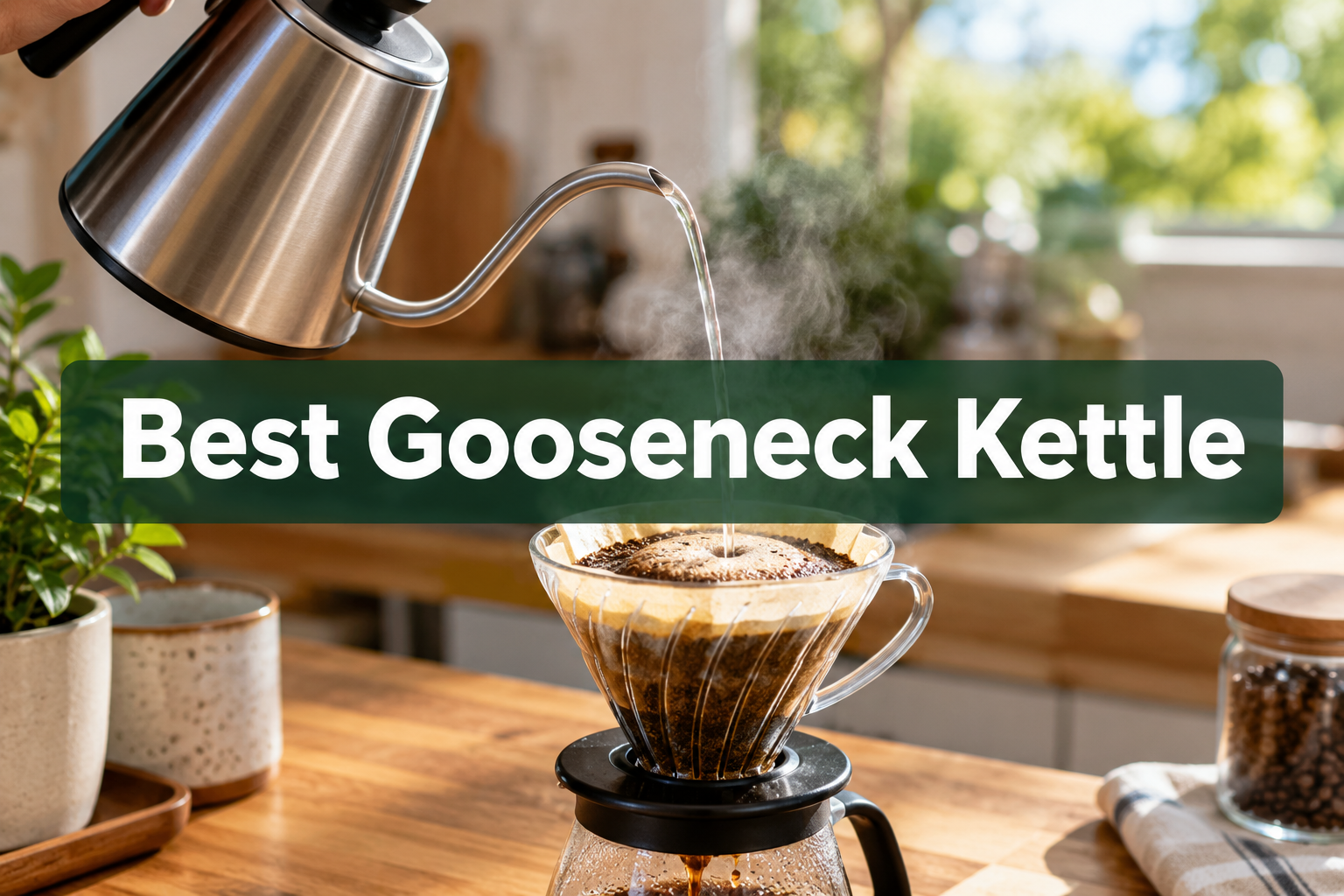
A gooseneck kettle is a water kettle with a long, thin, curved spout shaped like the neck of a goose, built to control exactly how fast and where water leaves the kettle. You need one if you brew pour-over coffee, because the spout lets you pour a slow, steady stream in tight circles instead of a wide splash.
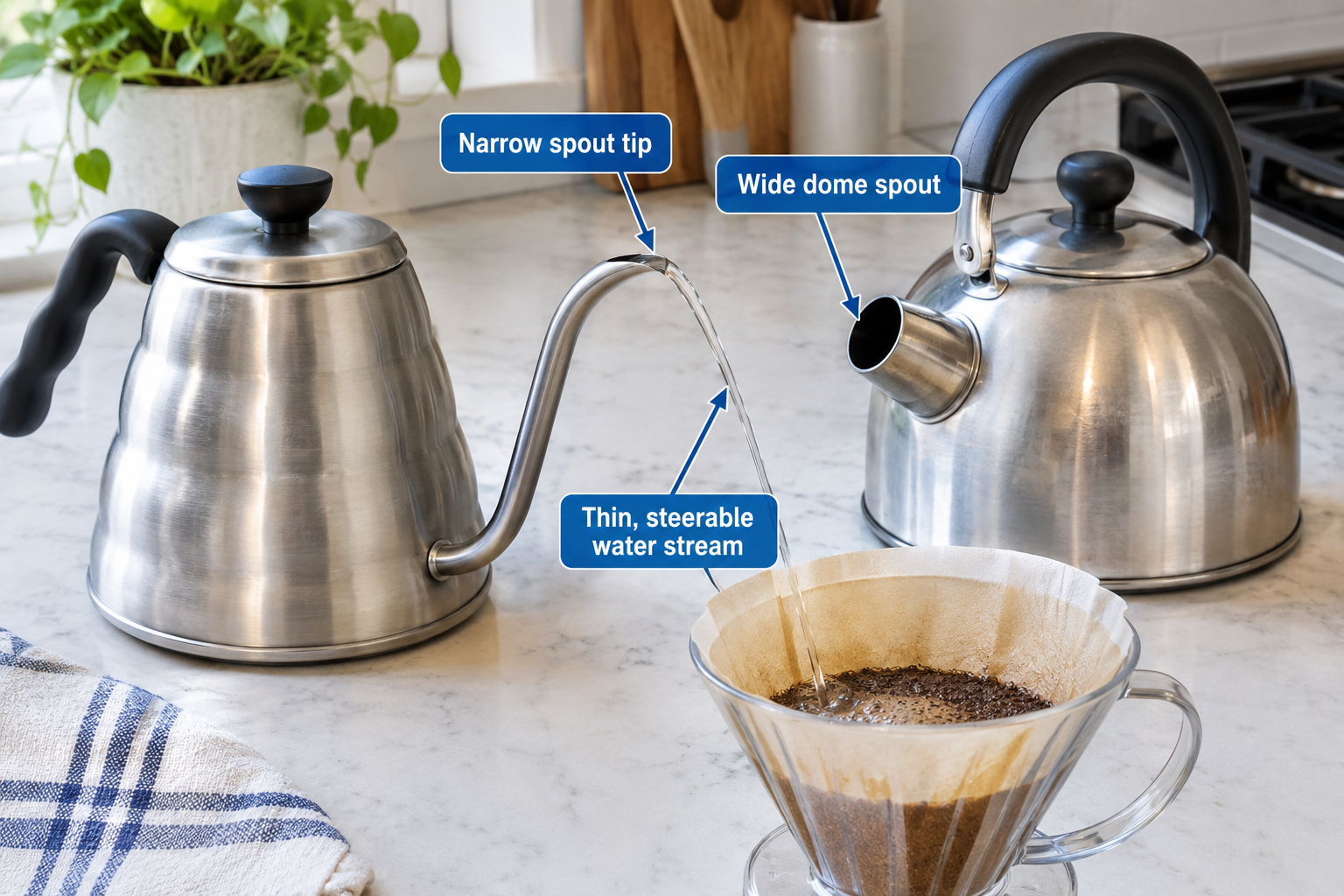
Regular kettles are built to fill a cup fast. Gooseneck kettles are built to fill a dripper slowly, on purpose. The narrow opening restricts the water to a thin column, so a small wrist movement changes the stream by millimeters instead of inches. The Way to Coffee's 2026 review of gooseneck models notes that this narrow spout is what lets brewers fine-tune flow rate through an entire pour, something a wide-mouth kettle physically cannot replicate.
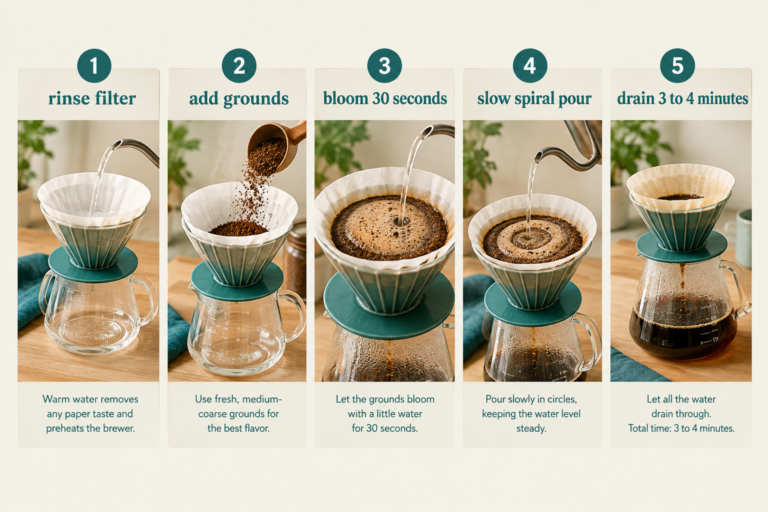
That control matters more than most first-time buyers expect. Pour-over extraction depends on even saturation of the coffee bed. Dump water too fast in one spot and you get a channel of over-extracted, bitter coffee next to a dry, under-extracted pocket. A best gooseneck kettle pick solves that problem at the source, before you ever touch a grinder or a scale. For the mechanics of why saturation and bloom timing matter, our beginners guide to pour over coffee walks through the full brew sequence.
Who needs a gooseneck kettle and who doesn't
You need a gooseneck kettle if you brew pour-over coffee regularly, care about even extraction, or make loose-leaf tea at specific temperatures. You don't need one if you only run drip machines, French press, or espresso, because none of those methods depend on a controlled manual pour.
- Needs one: V60, Chemex, Kalita Wave brewers; anyone chasing consistent tasting notes cup to cup.
- Doesn't need one: drip coffee maker owners, espresso-only households, cold brew drinkers.
- Borderline case: tea drinkers who want exact steeping temperature but don't pour manually over anything. A basic temperature-control kettle without a gooseneck spout works fine for them.
Best gooseneck kettle: quick picks by buyer type
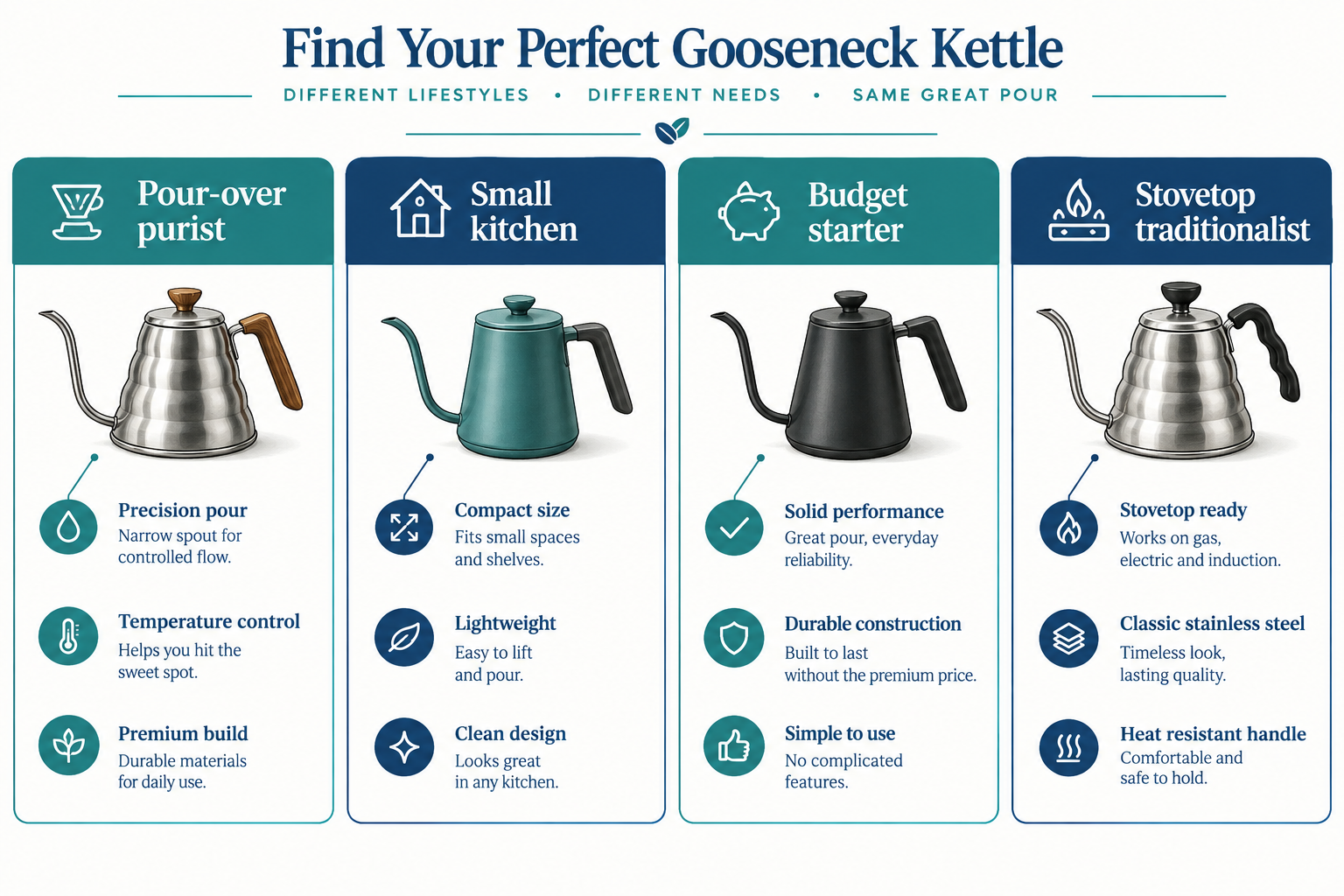
The best gooseneck kettle depends on how you brew, where you brew it, and how much precision you're willing to pay for. Below are direct picks for six common buyer situations, based on published 2026 testing and specifications rather than a single one-size-fits-all winner.
| Buyer type | Pick | Type | Temp control | Notable spec |
|---|---|---|---|---|
| Pour-over purist | Fellow Stagg EKG | Electric | 1°F steps, 135 to 212°F | Boils under 4 minutes; up to 60 min hold |
| Value-focused beginner | Bonavita Classic Gooseneck | Electric | Precision digital | Named best gooseneck electric by CNN Underscored |
| Tight budget | Willow & Everett Gooseneck | Electric | Basic presets | Standout budget pick in CNN's kettle tests |
| Small kitchen | Compact gooseneck model | Electric | Dial or digital | Praised for pairing controlled pour with a small footprint |
| Manual brewer, no outlet needed | Fellow Stagg Pour-Over Kettle | Stovetop | Stovetop, use with a separate thermometer | Food Network's top gooseneck for manual use |
| Wants digital accuracy at mid-price | Cuisinart GK-1 Digital Gooseneck | Electric | Digital, precise | Recommended by Wirecutter for accuracy and comfort |
Decision rule: choose the Stagg EKG if temperature accuracy across a full 60-minute session matters to you. Choose Bonavita or Cosori gooseneck kettle options if you want the spout geometry without paying for digital extras. Choose a stovetop model if counter space or outlet access is the real constraint, not precision.
Gooseneck kettle vs regular kettle what's the difference
The core difference is the spout. A gooseneck kettle uses a long, narrow neck that produces a thin, controllable stream, while a regular kettle uses a wide, short spout built to empty quickly into a cup or mug.
- Flow control: gooseneck spouts let you slow the pour to a trickle without tipping the whole kettle; wide spouts pour in a rush the moment you tilt.
- Precision brewing: pour-over methods need repeatable circles and pauses. A regular kettle makes that nearly impossible because the water leaves in a wide sheet.
- Everyday tasks: filling a French press, a mug of instant coffee, or a hot water bottle works fine with either style. A regular kettle is not worse here, just less specialized.
- Weight and balance: gooseneck kettles are usually built with a taller body and a rear-weighted handle so the pour stays steady when nearly empty, which matters more than most buyers expect on the last third of a brew.
The gap only matters if you pour manually. If your only brewing method is a drip machine, the spout shape is irrelevant.
Best gooseneck kettle for pour over coffee
The best gooseneck kettle for pour over coffee is one with a narrow spout tip, a steady handle, and temperature control close to your target range, and in 2026 that still points to the Fellow Stagg EKG for most home brewers. The spout width matters more than the brand name on the box.
A gooseneck kettle for pour over coffee earns its price by doing one job well: releasing water at a rate you can match to your dripper's flow rate. The Way to Coffee's 2026 review specifically credits the Stagg EKG's narrow spout and thumb-rest handle for letting brewers fine-tune the stream through the entire pour, not just the first splash. Coffeeness's 2026 roundup of eight gooseneck models goes further, calling the Stagg the standout of the group and arguing its precision justifies the higher cost for people who brew pour-over often enough to notice the difference.
If pour-over is your only reason for buying a gooseneck kettle, prioritize spout diameter and handle balance over screen brightness or app connectivity. Those extras look good in a product photo and do nothing for your extraction. For technique on pairing the right kettle with your dripper, see our guide to using a pour over coffee maker and the broader comparison of coffee brewing methods for beginners.
Gooseneck kettle for tea brewing is it worth it
A gooseneck kettle is worth it for tea brewing if you drink green tea, white tea, or oolong, which need exact lower temperatures to avoid a bitter cup. It's less necessary for black tea or herbal blends, which tolerate a wider temperature range.
Green tea generally wants water around 175°F. Oolong sits closer to 195°F. Black tea and most herbal infusions can handle a full boil at 212°F without much penalty. If your tea drawer skews toward the delicate end, a kettle with fine temperature steps pays off. If you mostly steep black tea bags, a basic kettle with a rolling boil setting does the job just as well, and you can save the gooseneck upgrade for coffee.
Gooseneck kettle common mistakes when pouring
The most common mistake is pouring too fast at the start, which floods the coffee bed before it can bloom evenly. The second most common mistake is pouring from too high above the grounds, which breaks the thin stream into splashes.
- Mistake: dumping the full bloom water in one second flat. Fix: pour in a slow spiral over about 10 to 15 seconds.
- Mistake: holding the kettle six inches above the dripper. Fix: keep the spout tip close, roughly one to two inches above the grounds, so the stream stays controlled.
- Mistake: pouring in a straight line back and forth. Fix: pour in small concentric circles from the center outward, then back in.
- Mistake: ignoring the last third of the kettle, when it's lighter and easier to tip too far. Fix: slow your wrist deliberately as the kettle empties.
Gooseneck kettle with temperature control: what the reviews show
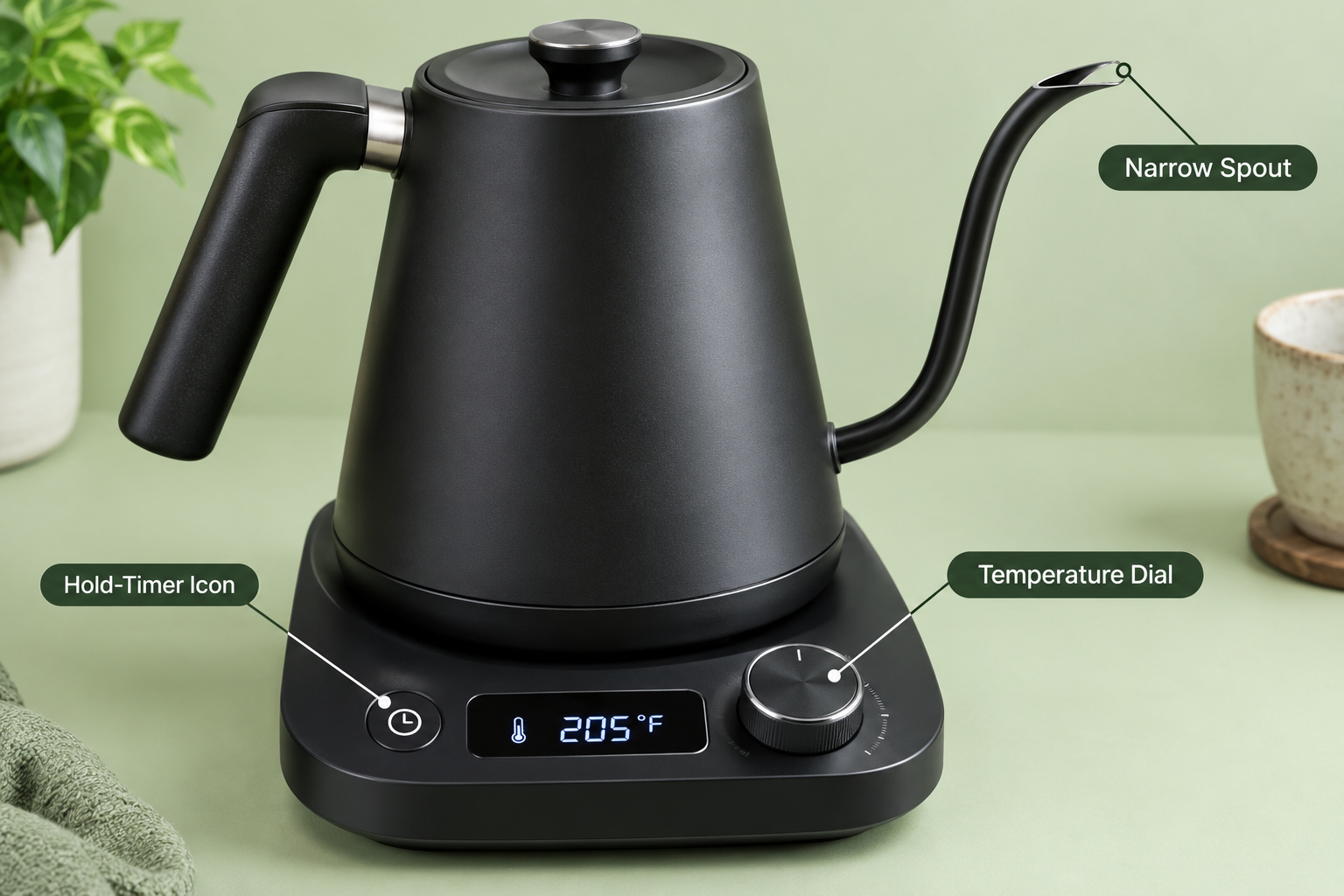
The best gooseneck kettles with temperature control now offer 1°F precision across a wide range and hold that temperature for up to an hour, a feature set that used to be reserved for commercial equipment. The Fellow Stagg EKG is the model most often cited for this combination in 2026 testing.
Driproast's August 2026 review lists the Stagg EKG's range at roughly 135°F to 212°F in 1-degree steps, with a hold function that keeps water at your set temperature for up to 60 minutes so you can grind beans, weigh a dose, or answer the door without reheating. Food Network's 2026 kettle review backs up the same range and adds that the Stagg reached a boil in under 4 minutes during testing, while Tom's Guide measured a slightly longer 5 minutes and 10 seconds to boil roughly 0.9 liters in its own dedicated test. That gap between two credible tests is a reminder that boil time varies with fill volume, starting water temperature, and your home's voltage, so treat any single boil-time number as an estimate, not a guarantee.
Best electric kettle with temperature control alternatives: the Bonavita Classic Gooseneck offers precision digital temperature settings at a lower price point than the Stagg and was named CNN Underscored's best gooseneck electric pick in its 2026 testing. The Cuisinart GK-1 Digital Gooseneck earns praise from Wirecutter for accuracy and a comfortable pour, making it a reasonable middle option between budget and premium.
Gooseneck kettle with built in thermometer
A gooseneck kettle with a built-in thermometer displays water temperature directly on the kettle, so you don't need a separate probe thermometer for pour-over or tea. Electric models like the Stagg EKG, Bonavita, and Cuisinart GK-1 build this into a digital screen on the base. Stovetop gooseneck kettles like the Fellow Stagg Pour-Over Kettle skip the electronics entirely, which keeps the price down but means you'll want a separate thermometer or a practiced ear for the sound of near-boiling water.
Decision rule: if you brew multiple temperature-sensitive drinks in one session, a built-in thermometer saves real time. If you only ever brew at a full boil, skip the feature and save the money.
How much does a good gooseneck kettle cost
A good gooseneck kettle generally falls into three price tiers: basic stovetop models at the low end, mid-range electric kettles with digital temperature control in the middle, and premium electric models like the Fellow Stagg EKG at the top. Balance Journal's 2026 UK roundup compares options starting around £55 up through the Stagg EKG's premium pricing, concluding the Stagg still wins on flow control and build quality despite costing more.
- Budget tier: basic stovetop gooseneck kettles and simple electric models with preset temperatures. Good for beginners testing whether pour-over is worth the ritual.
- Mid tier: digital electric kettles with adjustable temperature and hold functions, like the Bonavita Classic Gooseneck and Cuisinart GK-1.
- Premium tier: the Fellow Stagg EKG and similar models with 1-degree precision, longer hold times, and refined pour ergonomics.
Check the current price on any model before buying, since kettle pricing shifts with sales cycles and retailer stock.
Best budget gooseneck kettle under $50
At the sub-$50 level, expect a stovetop gooseneck kettle or a basic electric model with a single boil setting rather than fine-grained digital control. CNN Underscored's testing calls out the Willow & Everett Gooseneck Electric Kettle as a standout budget option that still delivers a narrow, controllable pour without Stagg-level pricing. A Cosori gooseneck kettle is another commonly stocked value option worth comparing on spout shape and handle comfort, since budget models vary more in build quality than premium ones do. Compare the models before deciding, and prioritize spout diameter over any extra button or light.
Gooseneck kettle electric vs stovetop: which is better
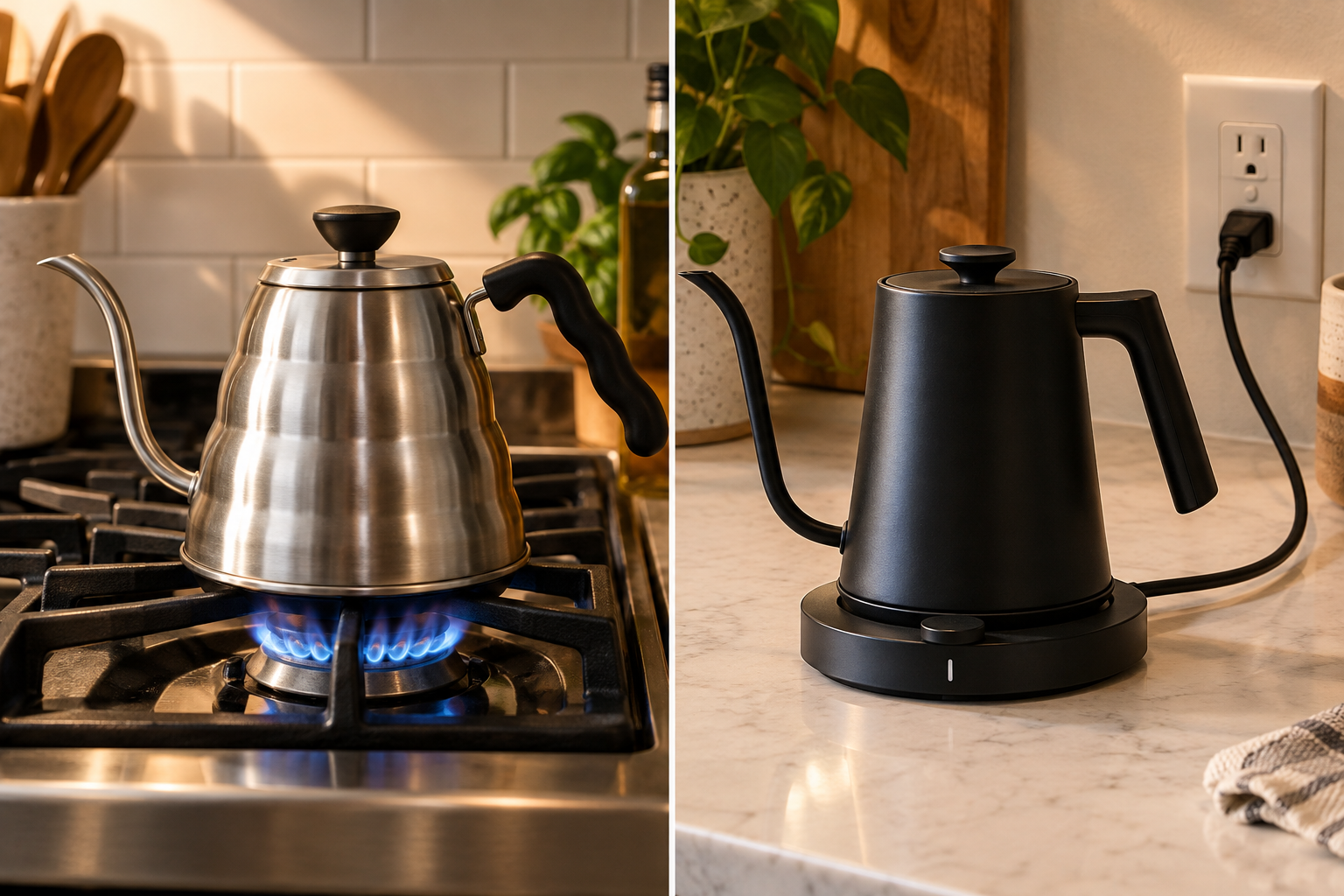
An electric gooseneck kettle is better if you want built-in temperature control, a hold function, and a faster boil without watching a stove. A stovetop gooseneck kettle is better if you already have a strong burner, want fewer parts to break, and don't mind pairing it with a separate thermometer.
- Choose electric if: you brew at specific temperatures often, want a hold function for multi-cup sessions, or prefer not to babysit a stove. The best gooseneck kettle electric options, like the Stagg EKG, Bonavita, and Cuisinart GK-1, all fall here.
- Choose stovetop if: you camp, travel, or live somewhere with unreliable outlets, or you simply prefer fewer electronics on your counter. Food Network names the Fellow Stagg Pour-Over Kettle its top stovetop gooseneck pick for exactly this reason.
- Common mistake: assuming a gooseneck kettle stovetop model heats slower by design. Heat speed depends on your burner, not the kettle style. A strong gas burner can outpace a weak electric base.
Can you use a gooseneck kettle on an induction cooktop
Yes, but only if the kettle's base is made from magnetic material, usually stainless steel with an induction-compatible bottom, since induction cooktops heat through magnetic contact rather than direct flame or coil. Copper-bottomed or thin aluminum stovetop kettles generally will not work on induction.
Check the product listing for an induction symbol or explicit compatibility statement before buying a stovetop gooseneck kettle for an induction range. If you already own an induction cooktop and don't want to check compatibility every time, an electric gooseneck kettle sidesteps the question entirely, since it plugs into an outlet instead of sitting on a burner.
Gooseneck kettle for beginners: what to look for
A beginner buying a gooseneck kettle should prioritize spout width, handle comfort, and a capacity that matches how much coffee or tea they actually brew at once, before worrying about digital displays or app features. The learning curve for pour control is short, but a poorly balanced kettle makes it harder than it needs to be.
- Spout diameter: narrower is generally better for slow, controlled pours. TechGearLab's testing found the OXO Brew gooseneck kettle offers a strong, controllable stream and solid overall design, though it loses some accuracy at very low temperatures compared to digital models.
- Handle shape: a handle with a thumb rest, like the one on the Stagg EKG, helps steady your wrist through a long pour.
- Capacity: most gooseneck kettles hold around 0.9 to 1 liter, enough for one to two pour-over cups. Buy larger only if you regularly brew for a household.
- Weight when full: pick one up in the store or check reviews for weight complaints. A heavy kettle full of near-boiling water is harder to control precisely, which defeats the entire point of buying a gooseneck model.
Common mistake for beginners: buying based on color or brand recognition alone. A recognizable name doesn't guarantee a better pour. Check the actual spout diameter and read a hands-on review before deciding. Our barista training methods guide covers the wrist and pour technique that makes any gooseneck kettle perform better.
Gooseneck kettle leaking problems how to fix
Leaking almost always comes from one of three causes: an overfilled tank, a worn lid gasket, or pouring at too steep an angle. Each has a straightforward fix.
- Overfilling: check the max fill line printed inside the kettle. Water expands slightly as it heats, and overfilled kettles can push water out around the lid.
- Worn gasket: on electric models, the rubber seal around the lid or the base connector can degrade over time. Replace the gasket if the kettle is leaking from the same spot repeatedly, not just during aggressive pours.
- Steep pour angle: tilting a gooseneck kettle too far, especially when nearly full, can push water up and over the spout opening rather than through it. Pour in smaller increments if this keeps happening.
If an electric kettle leaks from the base or the power connector, stop using it and contact the manufacturer. That's an electrical safety issue, not a pour technique problem. For general upkeep on brewing gear, our coffee equipment maintenance guide and cleaning guide for coffee makers cover descaling steps that also help spot early leak sources like mineral buildup around seals.
FAQ
What is the best gooseneck kettle overall in 2026? The Fellow Stagg EKG is the most frequently named best gooseneck kettle across current roundups from Tom's Guide, Food Network, and Balance Journal, largely because of its 1°F precision and narrow, controllable spout.
Is a gooseneck kettle really necessary for pour-over coffee? Yes, if you brew pour-over regularly. The narrow spout controls flow rate in a way a standard kettle cannot, which directly affects how evenly your coffee grounds saturate.
What's the difference between the Fellow Stagg EKG and cheaper gooseneck kettles? The Stagg EKG offers finer temperature steps, a longer hold time, and a refined handle shape. Cheaper models like the Willow & Everett or a basic Cosori gooseneck kettle share the same spout geometry but usually skip the 1-degree precision and extended hold function.
Can I use a stovetop gooseneck kettle on an electric coil stove? Yes. Stovetop gooseneck kettles work on gas, electric coil, and induction, as long as the base material matches the cooktop type. Induction requires a magnetic base specifically.
How do I stop my gooseneck kettle from leaking? Check the fill line, inspect the lid gasket for wear, and avoid tilting the kettle too far when it's nearly full. Persistent leaks from an electric base need a technician or a warranty claim, not a workaround.
Is an electric or stovetop gooseneck kettle better for a beginner? Electric is easier for most beginners because temperature control and hold functions remove the guesswork. Stovetop works well for anyone who wants fewer electronics and already has a reliable burner.
Conclusion
The best gooseneck kettle for you comes down to how often you pour manually and how much precision that pour needs. Serious pour-over brewers get real value from the Fellow Stagg EKG's 1-degree control and hold function. Beginners and budget shoppers get most of the same pour control from a Bonavita, Cuisinart GK-1, Willow & Everett, or Cosori gooseneck kettle without paying for the extra digital polish.
Start by asking what you actually brew. If it's pour-over coffee several times a week, spend on precision. If it's occasional tea or the odd weekend V60, a simpler model will serve you fine. Either way, check spout width and handle balance before checking star ratings, since those two details decide whether your pour actually behaves the way you want it to.
Next step: read the brewing method that matches your kettle choice, then practice a slow, steady pour with plain water before you commit to your first real cup.
This article was researched using published 2026 product reviews and manufacturer specifications rather than in-house lab testing. Some links in this article are affiliate links, and Coffee Rank IQ may earn a commission on qualifying purchases at no extra cost to you.
Keep Exploring Coffee Rank IQ
- Coffee Rank IQ home: reviews, brewing guides, and coffee science
- Best Coffee Scale for Pour Over and Espresso…Timer Included
- French Press Coffee Ratio: The Grams, Cups, and Scoops That Work
- How Many Scoops of Coffee per Cup? A Chart for 1 to 12 Cups
- Best Cold Brew Coffee Maker: 6 Picks for Smooth Batches at Home
References
- www.nytimes.com/wirecutter/reviews/the-best-home-kettle
- www.driproast.com/best-gooseneck-kettle
- balancejournal.co/food-drink/best-gooseneck-kettle
- amp.cnn.com/cnn/cnn-underscored/reviews/best-electric-kettles
- www.foodnetwork.com/how-to/packages/shopping/product-reviews/best-kettles
- www.coffeeness.de/en/best-water-kettles
- homewisereview.com/best-compact-electric-kettle
- www.tomsguide.com/best-picks/the-best-electric-kettles
- www.techgearlab.com/topics/kitchen/best-electric-kettle
- www.thewaytocoffee.com/best-gooseneck-kettles