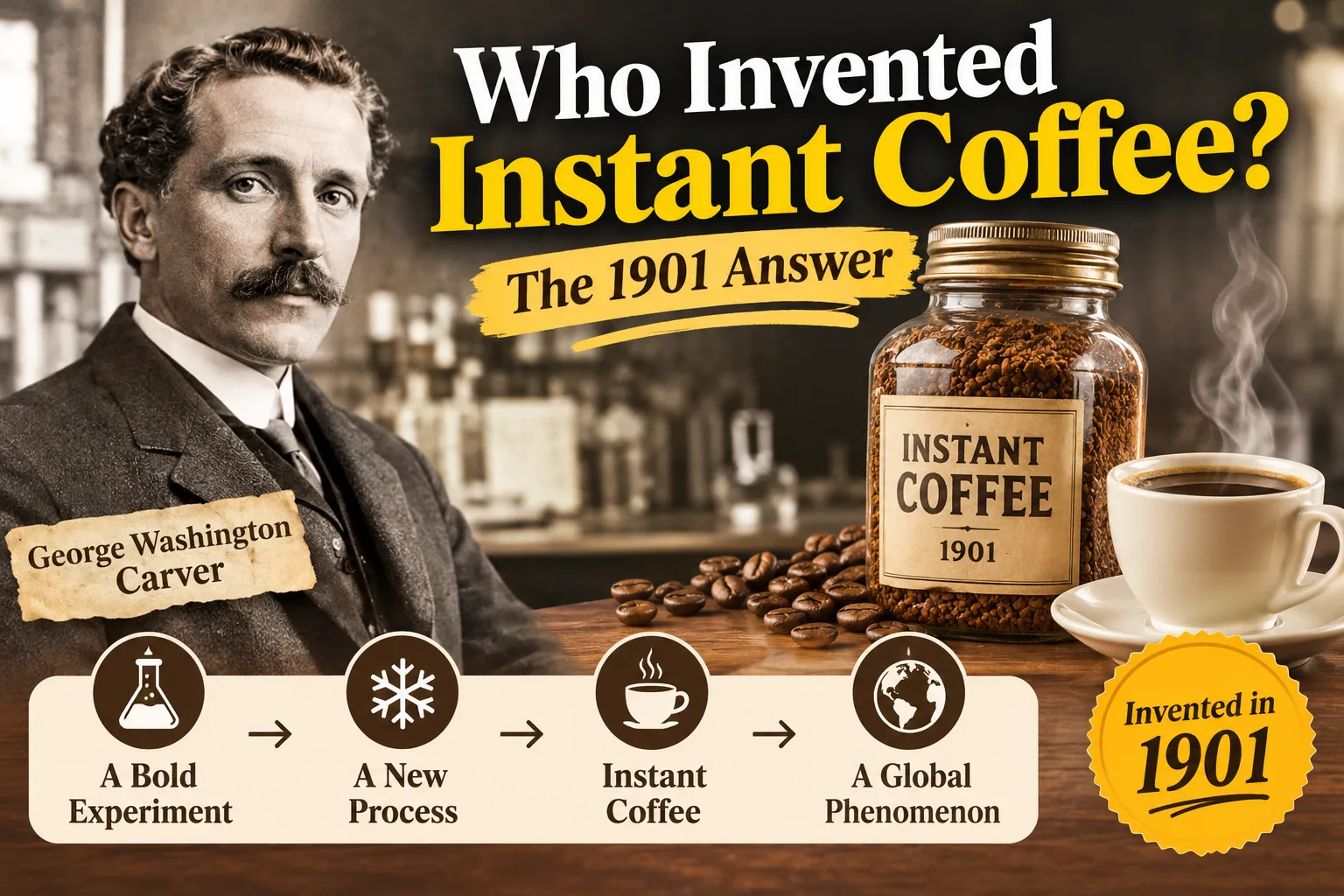
Who Invented Instant Coffee? The 1901 Answer
Who invented instant coffee: the one-sentence answer
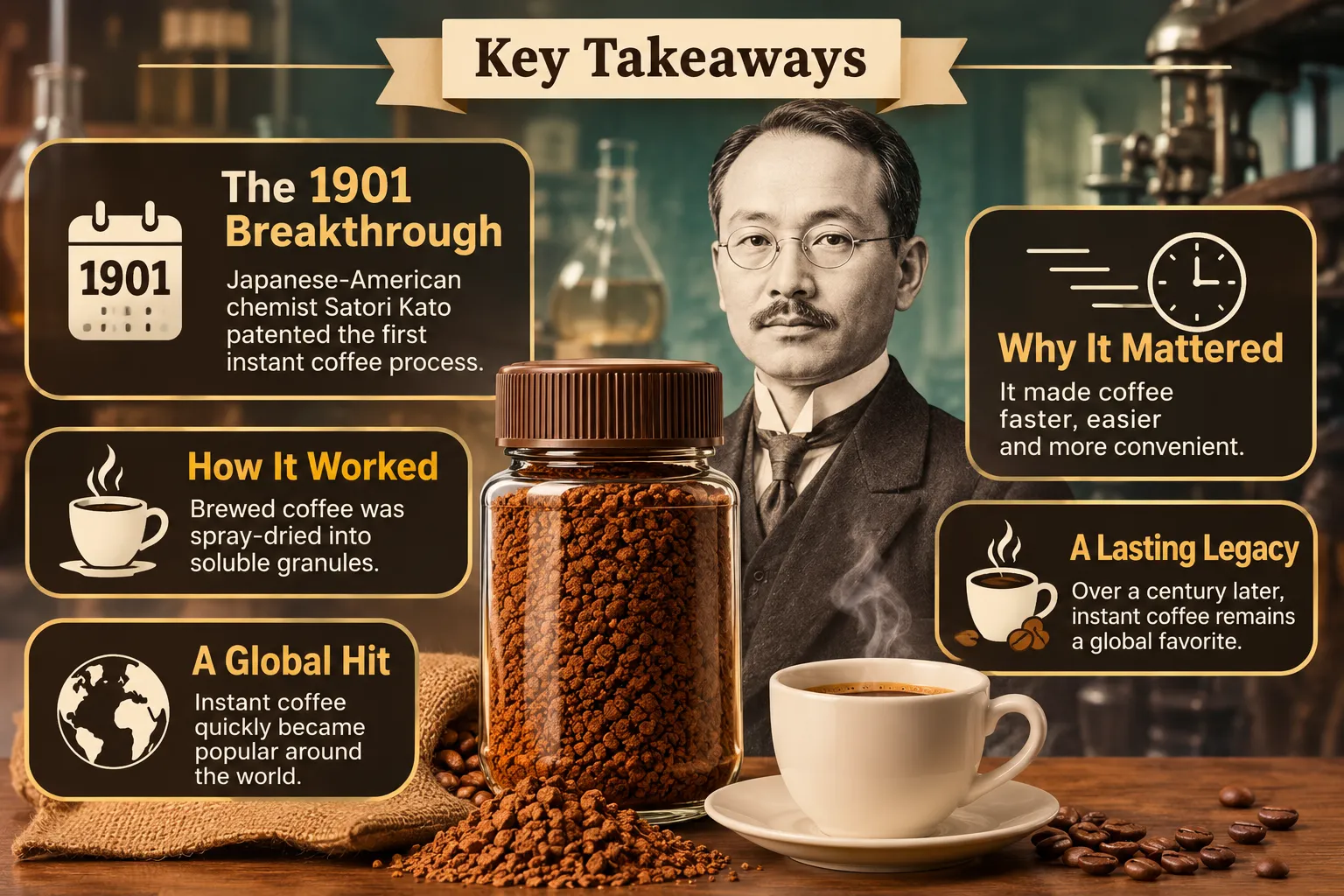
Ask who invented instant coffee and the honest reply is two names: New Zealand merchant David Strang, who filed a soluble coffee patent in Invercargill on January 28, 1890, and Japanese chemist Satori Kato, who filed the famous U.S. patent on April 17, 1901 and showed soluble coffee to American crowds at the Pan-American Exposition in Buffalo that same year .
Key takeaways
- David Strang, a coffee and spice merchant in Invercargill, New Zealand, was granted patent No. 3518 for "Strang's Patent Soluble Dry Coffee-powder." His product was advertised in July 1889 as being made instantly with boiling water.
- Satori Kato, a chemist working in Chicago, filed his U.S. application on April 17, 1901; U.S. Patent 735,777 was granted on August 11, 1903 .
- Kato's 1901 Buffalo demonstration is why American sources name him first, even though Strang's filing predates him by about eleven years .
- George Constant Louis Washington (no relation to the president, despite the sales advantage) began selling Red E Coffee around 1909 and founded his refining company in 1910. He commercialized it; he did not invent it .
- World War I rations put soluble coffee in American trenches and created a generation of habitual drinkers .
- Nescafé launched in 1938 after Nestlé worked on a Brazilian coffee surplus problem, and freeze drying reached instant coffee in the 1960s .
- Instant coffee is real coffee: brewed, then dried. The flavor gap comes from what the drying removes.
Who invented instant coffee
Who invented instant coffee depends on which question you are actually asking, so here are the three separate answers.
First documented soluble coffee: David Strang, Invercargill, New Zealand, patent application lodged January 28, 1890, New Zealand Patent No. 3518. His method dried a strong coffee infusion in hot air to leave a powder that dissolved in boiling water. Heritage New Zealand describes him as the first person to produce and sell instant coffee, and notes a July 1889 advertisement for the product.
First U.S. patent and the name most Americans learn: Satori Kato. His patent, "Coffee concentrate and process of making same," separated a fat-free water extract from the volatile coffee oils, concentrated the extract, recombined the oil, then dried the mixture . That extra step was a deliberate attempt to keep aroma in the jar, which is the exact problem instant coffee still fights in 2026.
First mass-market success: George Constant Louis Washington, a Belgian-born inventor living in New York. His Red E Coffee reached shops around 1909 and his company was established in 1910 . He solved manufacturing and distribution, not chemistry.
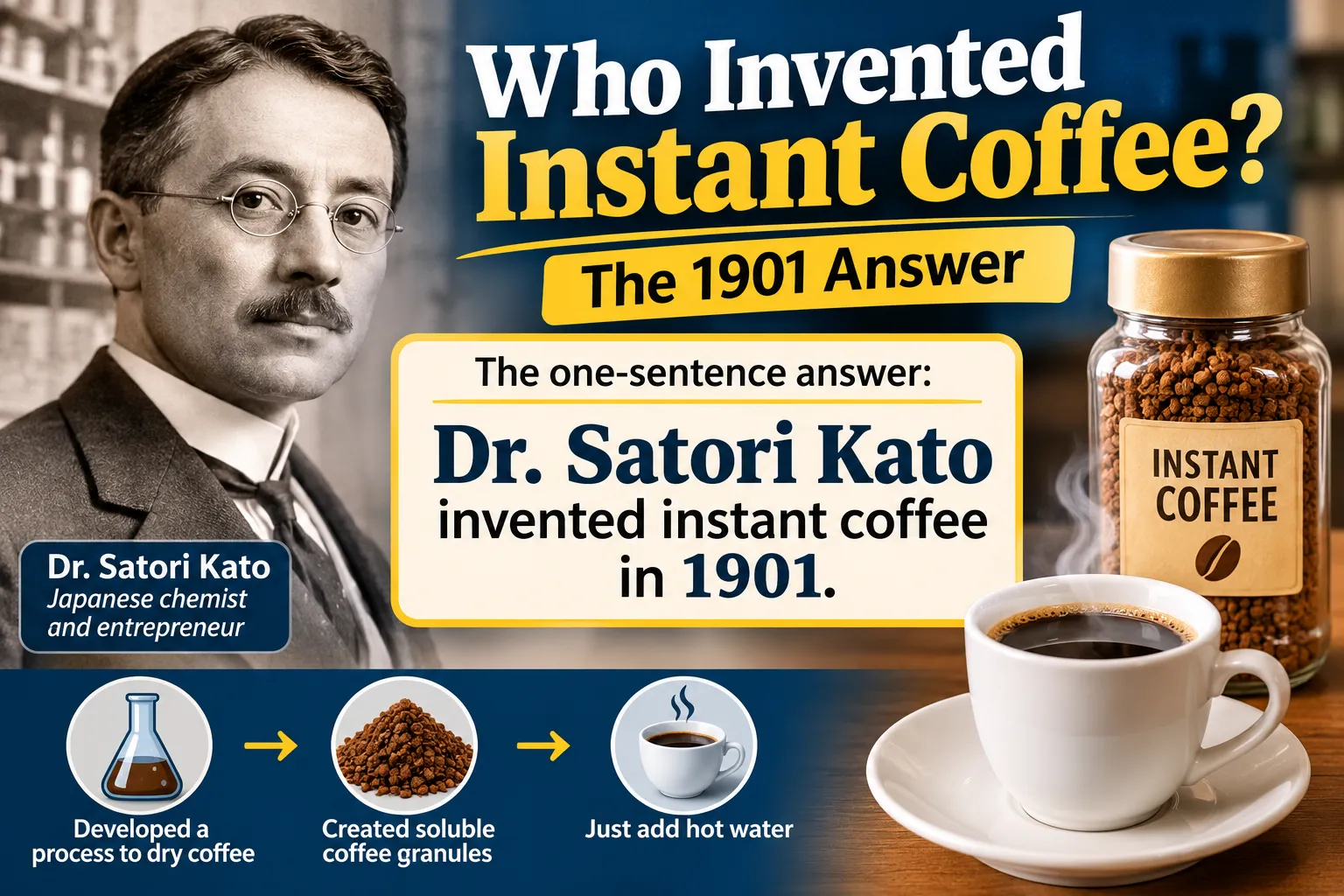
So: who invented instant coffee? Strang invented it, Kato patented and publicized it in the United States in 1901, and Washington sold it by the ton. Three different claims, three different men, one drink. If a quiz wants a single name, 1901 and Kato is the expected answer. If a historian is grading you, say Strang.
Instant coffee came from New Zealand first and then the United States, which surprises most people who assume Switzerland because of Nescafé.
A dated timeline of instant coffee history
The useful version of instant coffee history runs from a small-town grocery in the southern hemisphere to a Thai factory scheduled for 2028.
July 1889, Invercargill, New Zealand
Strang's Coffee is advertised as being made "instantly with boiling water." The business was a local coffee and spice merchant, not a laboratory.
January 28, 1890, Wellington
Strang lodges the application that becomes New Zealand Patent No. 3518. Hot air drying of a coffee infusion. Simple, effective, and almost entirely forgotten outside New Zealand for a century.
April 17, 1901, Chicago and Buffalo
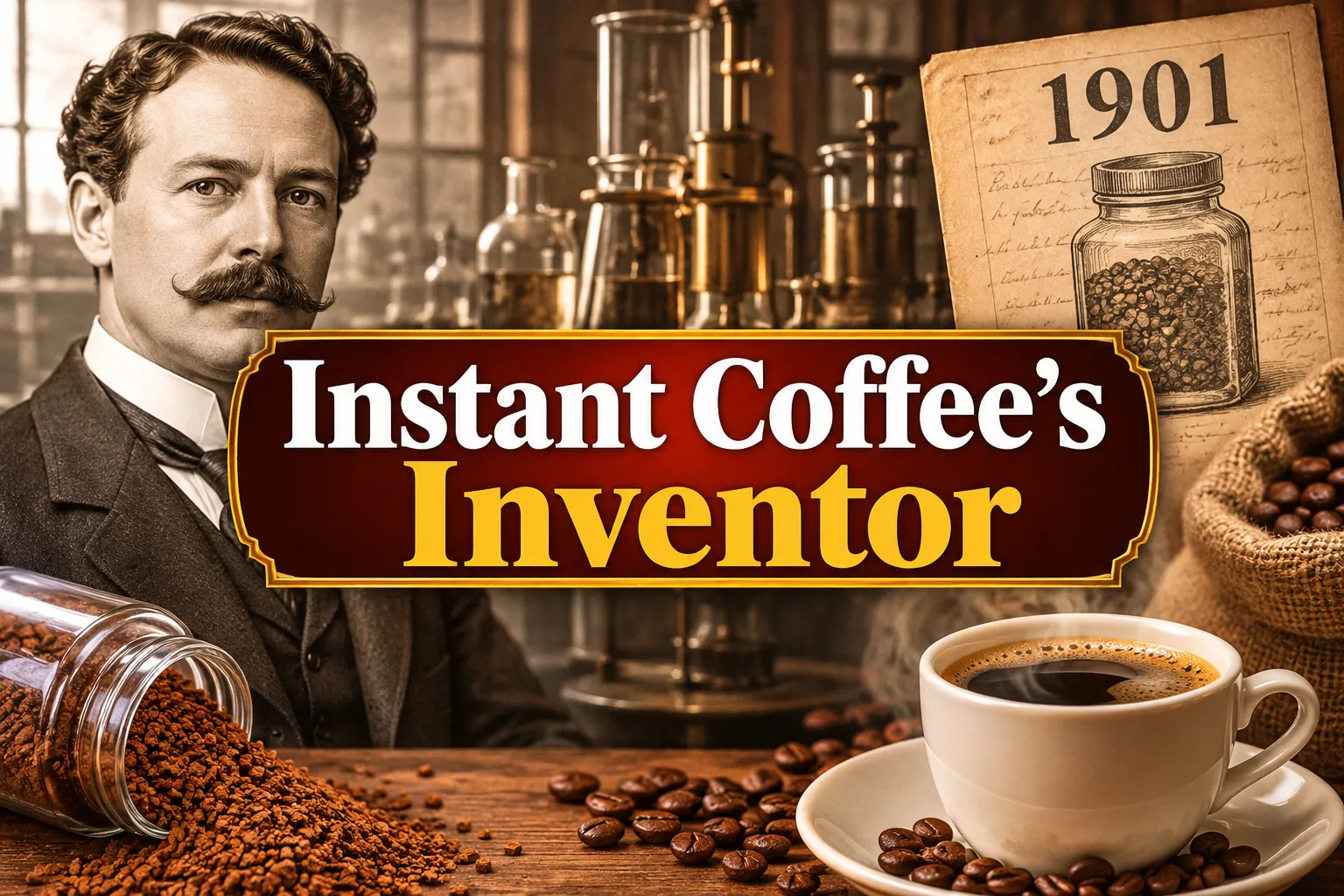
Satori Kato files his U.S. application and soluble coffee is presented to the public at the Pan-American Exposition in Buffalo, New York . Fairgoers drink coffee made from powder. The story sticks. Kato's patent is granted August 11, 1903 as U.S. 735,777 .
1909 to 1910, Brooklyn, New York
George Washington markets Red E Coffee and incorporates the George Washington Coffee Refining Company . This is the first instant coffee ordinary American households buy regularly.
1917 to 1918, the Western Front
The U.S. Army buys Washington's output for WWI coffee rations. Soldiers call it "a cup of George" . Supply cannot keep up with demand. Men who drank it in France kept drinking it at home.
April 1, 1938, Switzerland
Nescafé launches after Nestlé spends years on a process to preserve flavor in dried coffee, prompted in part by Brazilian surplus stocks . Nescafé history then merges with World War II: American rations again carried instant coffee worldwide.
1960s, United States and Europe
Freeze dried coffee invention moves from theory to shelves. Freezing the coffee extract and removing water under vacuum avoids the high heat that strips aroma, which is why freeze dried granules still cost more than powder .
October and November 2026
TAIK Health launches a functional instant coffee in Australia on October 15, 2026, and Blue Bottle Coffee announces a New Orleans craft instant blend on November 5, 2026. Specialty roasters now treat soluble coffee as a legitimate format rather than an embarrassment.
Documented record versus the legends
Three claims about instant coffee circulate widely. Two are documented. One is folklore dressed as fact.
| Claim | Status | What the record shows |
|---|---|---|
| Strang patented soluble coffee in 1890 | Documented | New Zealand Patent No. 3518, application January 28, 1890 |
| Kato demonstrated soluble coffee in 1901 | Documented | U.S. application April 17, 1901; patent 735,777 granted 1903 |
| Washington invented instant coffee | Legend | He commercialized it from 1909 to 1910; earlier patents exist |
| The president invented it | False | George Constant Louis Washington, a different man entirely |
| Instant coffee is a 1940s invention | False | It predates Nescafé by roughly half a century |
Strang invented it. Kato patented it in America. Washington sold it. Nescafé perfected the business model. Each of those sentences is true, and none of them is the whole story.
One more frequently repeated item deserves care: various 18th and 19th century British "coffee compounds" are sometimes called the first instant coffee. Those recipes exist, but none match the documented, patented, commercially sold powder that Strang produced. Separate the curiosity from the record.
Is instant coffee the same as regular coffee?
Yes, chemically it starts as the same thing. Instant coffee is brewed coffee that has had its water removed, so what remains in the jar is dried coffee extract, not a synthetic powder .
The difference shows up in aroma. Coffee's most attractive smells are volatile compounds, meaning they evaporate easily. Spray drying pushes concentrated extract through hot air, and a lot of aroma leaves with the steam. Freeze drying keeps more of it. Kato was already working on this problem in 1901 by pulling the coffee oils out before drying and adding them back afterward .
Practical rule: if you want instant that tastes closest to a brewed cup, buy freeze dried and check the roast date on the pack. Our guide to the best instant coffee worth drinking black explains which ones survive that test.
Instant also tends to lean on robusta beans, which are cheaper and higher in caffeine but harsher in flavor. The drawbacks of robusta coffee explain a good share of the bitterness people blame on the format itself.
Why does instant coffee taste different from fresh brewed?
Because the flavor you lose is the flavor you notice. Three things change between a pour over and a spoonful of granules.
- Aroma loss during drying. Heat drives off volatile compounds. Spray dried powder loses more than freeze dried granules.
- Bean choice. Mass-market instant uses a high proportion of robusta for cost and yield.
- No control over extraction. With pour over you set grind size, brew ratio, bloom and water temperature. With instant, the factory already decided.
What you can still control: water. Use fresh water just off the boil, around 200°F, and keep the brew ratio honest at roughly 2 g of granules to 200 ml. Over-dosing instant is the fastest route to a cup that tastes like ash. More fixes live in our notes on how to make coffee taste better.
Common mistake: pouring boiling water directly onto granules in a cold mug, then topping with cold milk. Warm the mug, dissolve the granules in a splash of hot water first, then fill.
Does instant coffee have less caffeine than regular coffee?
Usually yes, per cup. A typical serving of instant delivers less caffeine than a cup of drip brewed coffee, mainly because the serving uses less coffee solids . Robusta content pushes it back up in some brands.
For comparison, the Australian product TAIK Functional Instant Coffee launched on October 15, 2026 lists 140 mg of caffeine per serving, which sits comfortably in drip-coffee territory. So "instant means weak" is a generalization, not a rule. Read the label.
If you are counting scoops at home for brewed coffee instead, the scoops per cup chart gives you the dosing numbers.
Can you make instant coffee at home, and is instant coffee bad for you?
You can approximate it, and the health picture is unremarkable.
At home: brew a very strong batch of coffee, reduce it gently over low heat or in a low oven until it is syrupy, then dry the residue completely on a lined tray. A home freezer plus a vacuum setup gets closer to freeze dried texture, but most kitchens cannot match it. Expect a dull, flat result. Strang's hot air method works; his equipment was better than your oven.
Health: instant coffee is dried brewed coffee, so it carries the same caffeine, chlorogenic acids and antioxidants in different amounts. The most cited concern is acrylamide, a compound formed during roasting that appears at higher levels in some instant products. Dietary acrylamide exposure from coffee is low relative to other foods, and no human study has shown that normal coffee drinking causes harm through it. Treat association studies as association, not cause.
Shelf life: an unopened jar stays usable for a year or two. Once opened, moisture is the enemy. Keep the lid tight, use a dry spoon, and store it away from the stove. An airtight coffee storage container does the same job for granules that it does for beans.
Sourced facts and dates worth quoting
David Strang lodges the application for New Zealand Patent No. 3518, “Strang’s Patent Soluble Dry Coffee-powder.” The product was advertised in July 1889.
Satori Kato files his U.S. application; patent 735,777 is granted two years later. Soluble coffee is served at the Pan-American Exposition in Buffalo in 1901 .
George Constant Louis Washington establishes the George Washington Coffee Refining Company after launching Red E Coffee around 1909 .
Thailand’s Board of Investment approved a US$688 million Nestlé project for an AI-enabled soluble coffee factory with roughly 170,000 metric tonnes of annual capacity, scheduled to begin operations in Q4 2028.
Commission Delegated Regulation (EU) 2026/2102, adopted July 13, 2026, brings coffee extracts and concentrates under tariff heading 2101 11 00 into the deforestation rules, applying from December 30, 2027.
Who invented instant coffee? Compare the three claims
| Person | Date | Place | Claim |
|---|
Sources: NZ Patent 3518 record; U.S. Patent 735,777 (Kato); published histories of the George Washington Coffee Refining Company.
FAQ
Conclusion: from a Buffalo fairground to the jar in your cupboard
The line runs straight. Strang dried a coffee infusion in Invercargill in 1890. Kato refined the chemistry and handed cups to strangers in Buffalo in 1901. Washington industrialized it by 1910, two world wars made it normal, Nescafé made it global in 1938, and freeze drying in the 1960s finally gave it a defensible flavor. That is who invented instant coffee, and why the question has three right answers.
Next step: buy one freeze dried single origin instant and one supermarket spray dried jar, brew both at 2 g per 200 ml with water just off the boil, and taste them side by side. You will learn more about drying and aroma in five minutes than any article can teach. Then read our notes on why coffee tastes bitter to name what you are tasting. Better Coffee Starts With Better Answers.