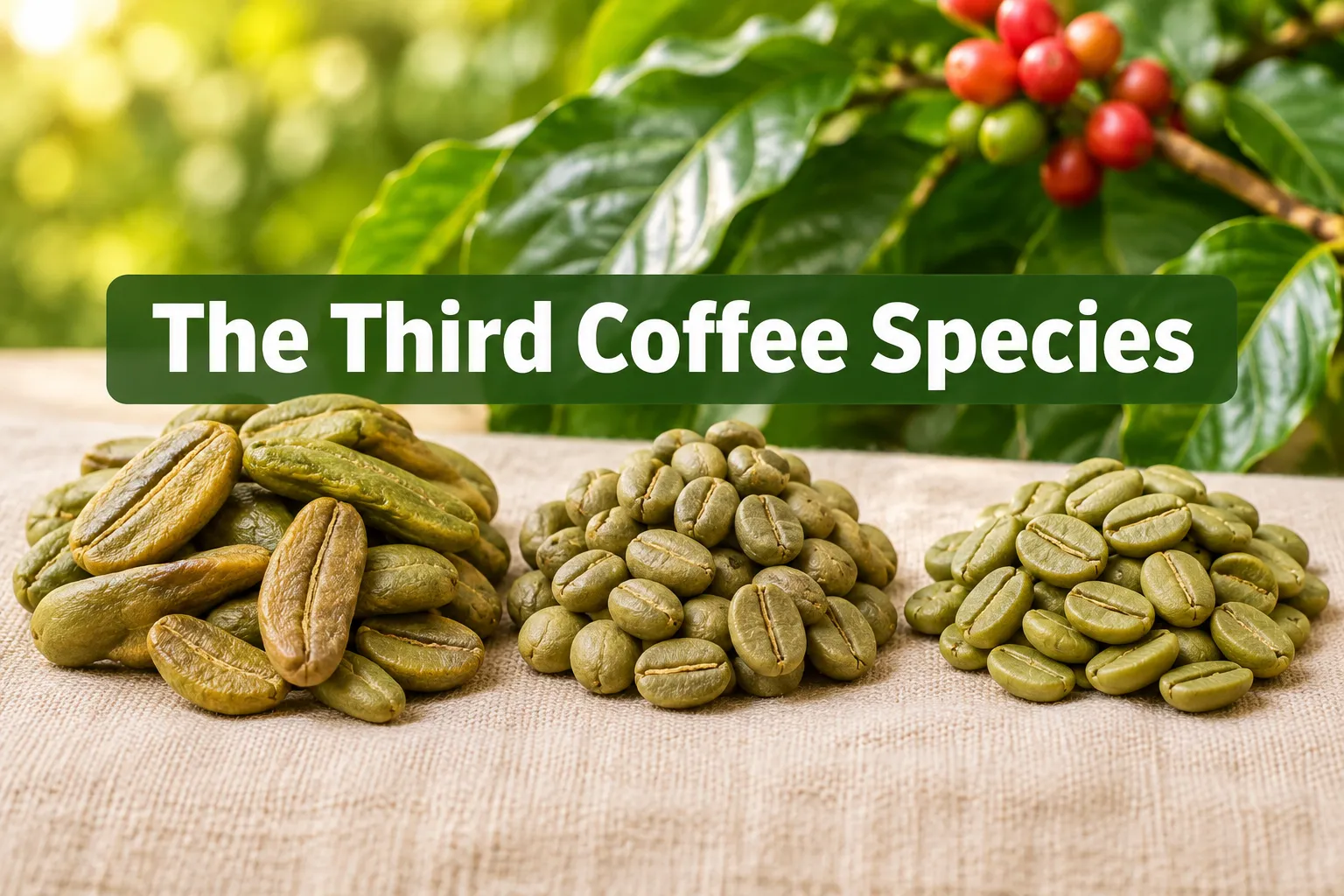
Liberica Coffee: The Third Species, Explained
Quick Answer
Liberica coffee is the third commercially grown coffee species, after arabica and robusta, and it accounts for a very small slice of world production. Its beans are visibly larger and often asymmetric, with a hooked crease. It grows mainly in the Philippines, where it is called barako, and in Malaysia and Indonesia. Published descriptions commonly report smoky, woody, and jackfruit-like notes, which is why reactions split hard between fascination and rejection.
Key Takeaways
- Liberica coffee is a distinct species, Coffea liberica, not a variety of arabica.
- A 2025 Nature Plants study led by Aaron P. Davis at Kew split what was called C. liberica into three species: C. liberica proper, C. dewevrei (Excelsa), and C. klainei, using 353 nuclear genes across 55 accessions .
- Kew's analysis places cultivated liberica mainly at roughly 10 to 500 meters elevation, with mean annual temperatures near 24 to 27°C and rainfall often 2,000 to 4,000 mm .
- In a 2026 survey of 100 coffee farmers in Lipa City, Batangas, 49% grew liberica, 30% robusta, 19% Excelsa, and 2% arabica. 95% used dry processing and 80% sold mainly to local markets .
- The Philippines produced 35,650 metric tons of green coffee in 2025, up 11.5% from 31,980 tons in 2024, and the Philippine Coffee Board warned output could fall below 30,000 tons in 2026 .
- ASEAN coffee bodies are prioritizing liberica as a heat-tolerant lowland option, though the Crop Trust stresses that natural tolerance does not prove commercial viability .
- Expect to pay a premium in the US, usually in the specialty range, because supply is thin and shipping volumes are small.
What is liberica coffee and where does it come from?
Liberica coffee comes from Coffea liberica, a species native to western and central Africa, around Liberia, Côte d'Ivoire, Cameroon, Gabon, and nearby forests. Colonial trade carried it to Southeast Asia in the late 1800s, where it took hold in the Philippines, Malaysia, and Indonesia. Today it is a lowland smallholder crop, not a plantation commodity.
The tree itself is the first surprise. Liberica grows tall, sometimes well past the height of a comfortable harvest ladder, with broad leathery leaves that look closer to a citrus tree than to the tidy arabica bushes in most origin photography. The cherries are large. The beans inside are the largest in commercial coffee, often lopsided, with a crease that curves instead of running straight.
Kew's 2025 work in Nature Plants put real numbers behind the species boundaries. The team analyzed 55 accessions using 353 nuclear genes, plus 2,240 exon-region SNPs for population structure, and found three separate monophyletic groups with bootstrap support of 100 for C. liberica, 100 for C. dewevrei, and 99 for C. klainei . Translation for the shopper: the bag labeled "Liberica/Excelsa" on a roaster's site is now describing two different species, not two names for one.
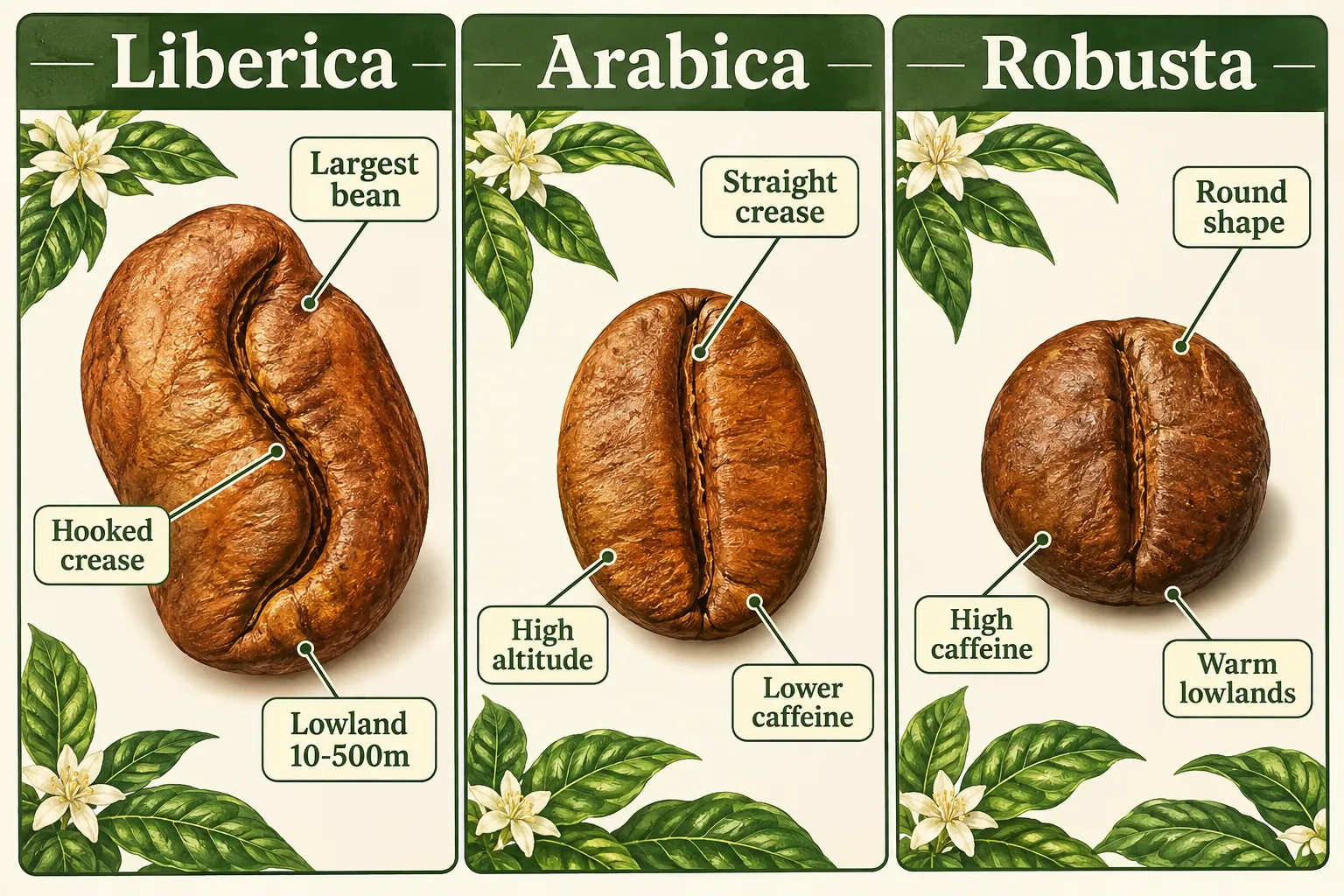
That same analysis described cultivated liberica's climate envelope: roughly 10 to 500 meters elevation, mean annual temperature around 24 to 27°C, rainfall commonly 2,000 to 4,000 mm. Wild populations averaged 24.6°C and about 2,215 mm of annual precipitation . Arabica wants cooler, higher ground. Robusta is the closer commercial neighbor.
Liberica coffee: the third coffee species, and why that label stuck
Liberica coffee earned the "third coffee species" title because arabica and robusta together supply almost all traded coffee, and liberica is the only other species with a continuous commercial history. Arabica dominates specialty. Robusta dominates instant and low-cost blends. Liberica sits under 2% of world production, so it rarely appears in global supply statistics at all.
The label is also historical. When coffee leaf rust tore through Southeast Asian arabica plantings in the 1800s, growers needed a replacement that could survive hot, low, wet ground. Liberica was planted as that answer in parts of the Philippines and the Malay Peninsula. Robusta later proved cheaper to grow and process at scale, and liberica stayed regional.
Worth separating documented history from the romantic version. The rust crisis and the subsequent planting shifts are well recorded. Stories about single heroic farms saving the species are usually folklore. What the records support is simpler: liberica survived because specific communities kept drinking it.
Liberica never lost a flavor contest. It lost a logistics contest.
The taxonomy update matters here too. Excelsa, long treated as a liberica variety, is now described as its own species, C. dewevrei . Some writers now talk about four species instead of three. Both framings can be correct depending on whether you mean commercial trade or botany.
How does liberica taste compared to arabica and robusta?
Published descriptions of liberica taste consistently report smoky, woody, and resinous character, with a distinct tropical fruit note often compared to jackfruit, and sometimes a floral or almost savory finish. Arabica is generally sweeter and more acidic. Robusta is typically heavier, more bitter, and grainier. Those are reported descriptors from roasters, researchers, and trade coverage, not a tasting panel result from this site.
The polarizing part is the aroma-to-flavor gap. Several trade reports describe liberica as smelling floral and fruity in the grinder, then tasting far more savory in the cup. Perfect Daily Grind's 2026 coverage of liberica processing discusses how post-harvest choices shift that profile, since the thick, fleshy cherry behaves differently from an arabica cherry during drying .
Here is the honest framing from inside the industry. Kenny Lee Wee Ting of Earthlings Coffee in Sarawak has argued that the goal is not to make liberica taste like arabica, but to understand and improve its own character . Judge a liberica by arabica scoring habits and it will lose. Judge it as its own thing and the smoke and jackfruit become features.
Choose liberica if you already like dark, earthy, low-acid coffees, or you drink a lot of dark roast and want something stranger. Skip it if your favorite cup is a washed Ethiopian with lemon-blossom acidity. They are not neighbors.
What does liberica coffee smell like?
Roasters and researchers commonly describe liberica's dry aroma as floral, woody, and fruit-forward, with jackfruit and sometimes an incense or tobacco edge. Brewed, the aroma usually reads smokier and nuttier. A common first reaction from people grinding liberica beans for the first time is that it does not smell like coffee at all, which is accurate and not a defect.
Liberica vs arabica and robusta: how do they actually compare?
Liberica has the largest bean, the lowest share of world production, and a flavor profile that sits apart from both common species. Caffeine content is generally reported as lower than robusta and roughly comparable to or slightly above arabica, though published figures vary by study and sample, so treat any single number with caution.
| Trait | Liberica | Arabica | Robusta |
|---|---|---|---|
| Bean size and shape | Largest; asymmetric, hooked crease | Medium oval; straight crease | Small, round; straight crease |
| Caffeine | Moderate; below robusta | Lowest of the three | Highest |
| Reported flavor | Smoky, woody, jackfruit, floral aroma | Sweet, acidic, fruit and chocolate | Bitter, grainy, heavy body |
| Growing elevation | ~10 to 500 m | Typically 900 to 2,000 m | Lowland to ~800 m |
| Share of world production | Under 2% | Majority share | Most of the remainder |
| Main growers | Philippines, Malaysia, Indonesia | Brazil, Colombia, Ethiopia | Vietnam, Brazil, Indonesia |
The liberica vs arabica comparison that actually matters at home is extraction behavior. Bigger, denser, often unevenly roasted beans grind differently. If you use a blade grinder, you will get a wide particle spread and a muddled cup. This is one of the few coffees where a burr grinder versus a blade grinder changes the result dramatically.
The barako story: why the Philippines and Malaysia kept liberica alive
Kapeng barako is the Philippine name for liberica coffee, strongly associated with Batangas and Cavite provinces, and it is the main reason the species still has a living drinking culture. Barako is traditionally brewed strong, often boiled or in a sock filter, and served sweet. Malaysia kept a parallel tradition through kopitiam-style coffee, where liberica beans are roasted with sugar or margarine and brewed very dark.
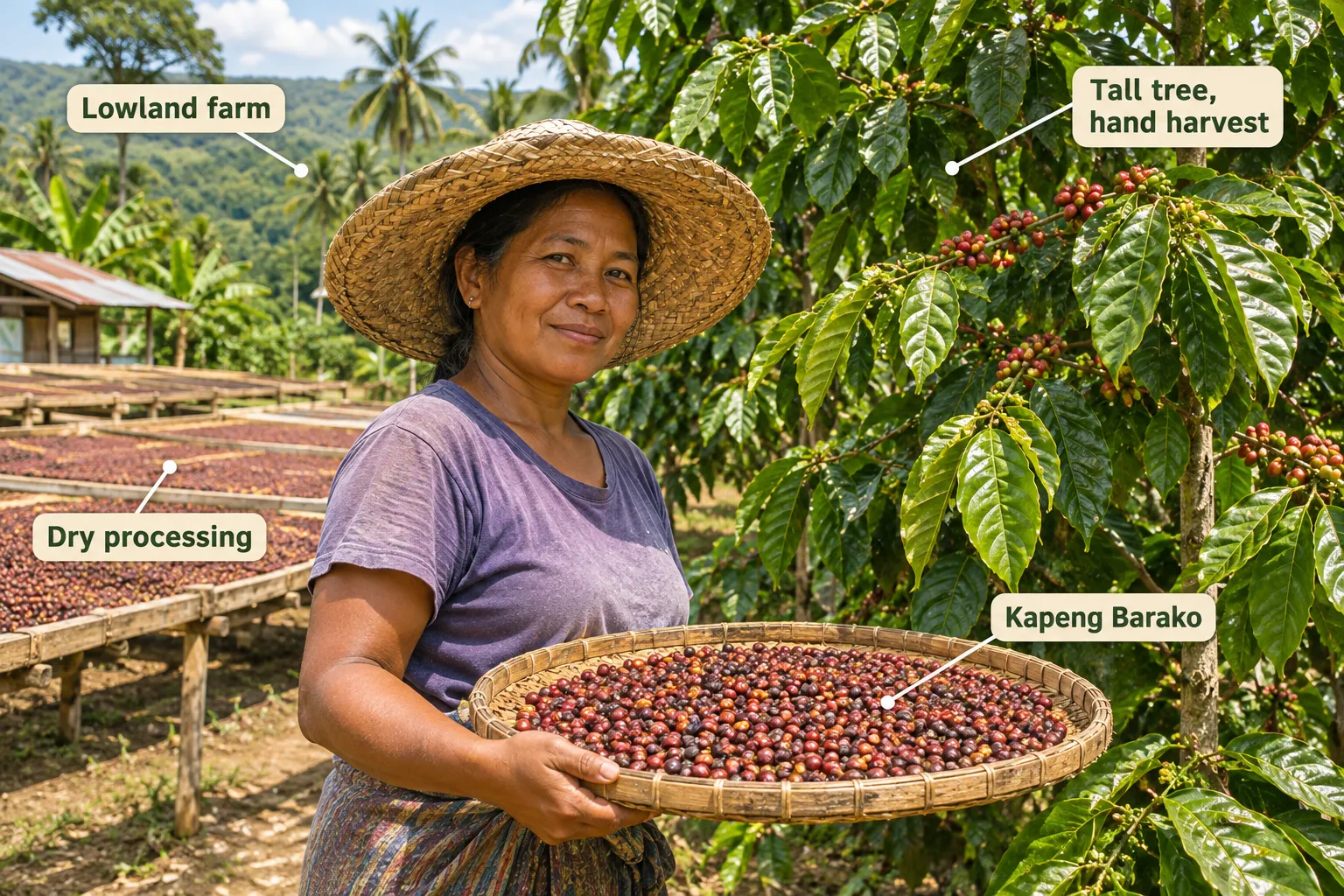
A 2026 study published in Frontiers in Environmental Economics surveyed 100 coffee farmers in Lipa City, Batangas, and interviewed industry stakeholders. Liberica was grown by 49% of respondents, robusta by 30%, Excelsa by 19%, and arabica by 2%. The farms were small: 41% worked 0.5 hectares or less and 48% worked 1 to 5 hectares. Ninety-one percent used traditional or natural farming, 95% used dry processing, and 80% sold primarily to local markets .
That last figure explains the US scarcity better than any supply-chain theory. Most liberica never leaves its home market because that is where the demand already is.
Philippine coffee overall is under pressure. BusinessWorld reported in October 2026, citing Philippine Coffee Board chair Pacita Juan, that national output could drop below 30,000 metric tons in 2026 on rising temperatures and El Niño effects, after producing 35,650 metric tons in 2025, an 11.5% rise over 31,980 tons in 2024 . Juan also said ASEAN coffee organizations were prioritizing liberica, then Excelsa and robusta, because these species grow at roughly 200 to 300 meters where arabica is increasingly heat-stressed .
Is liberica actually climate-proof?
No, and the researchers are unusually blunt about it. The Crop Trust's workshop at the International Coffee Convention in Trieste on November 2, 2026, discussed liberica alongside Stenophylla, Eugenioides, and Racemosa as candidates for resilience and quality differentiation, while stating that natural tolerance does not automatically prove commercial viability. Controlled trials, reliable identification, sensory evaluation, and farmer economics are all still required . Kew's authors likewise called for multilocation field trials before firm cultivation claims .
There is also breeding news worth watching carefully. Trade reporting in October 2026 described Kew-linked work on a liberica and Excelsa hybrid, Coffea × libex, examined across 113 accessions from three continents, reportedly combining higher yield than liberica, seed size closer to arabica, easier processing, and apparent inheritance of liberica's leaf-rust resistance . That is early-stage breeding evidence, not a product you can buy.
Is liberica coffee hard to find, and how much does it cost?
Yes, liberica coffee is genuinely scarce in the US. It is under 2% of global production, most of it is consumed domestically in producing countries, and only a handful of US roasters and importers carry it consistently. Expect specialty pricing, typically well above a supermarket arabica and often above a comparable single origin, because volumes are small and freight is inefficient.
Price moves with availability, so treat any specific figure you see online as a snapshot. Check the current price at the roaster rather than trusting an older blog number.
What to watch out for when buying:
- Mislabeled blends. Some bags marketed as liberica are liberica blended with robusta or arabica, with no ratio stated. Look for a percentage.
- Liberica and Excelsa confusion. Since the 2025 Kew revision, these are separate species . A bag that uses both names interchangeably is a sign the seller has not checked.
- No roast date. Scarce coffees sit in warehouses. A roast date is more informative than a "best by" stamp.
- Vague origin. "Southeast Asia" tells you nothing. Batangas, Cavite, Sarawak, or Johor tells you something.
- Novelty markup with no information. Rarity is not a tasting note. If the listing cannot describe the processing method, be skeptical.
Where to buy liberica coffee beans online in the US
Your realistic options are small specialty importers focused on Philippine or Malaysian coffee, direct-from-origin Philippine roasters that ship internationally, Asian grocery retailers carrying barako, and the occasional limited release from a US specialty roaster. Marketplace listings exist but often lack roast dates and species verification.
If you want a steadier path into unusual coffees generally, a rotating subscription is a reasonable on-ramp. Our comparison of coffee subscription services covers which ones actually surface uncommon lots versus which stick to crowd-pleasers.
What is the best way to brew liberica coffee?
Start with a French press or pour over at a slightly coarser grind than you would use for arabica, water at about 200°F, and a 1:16 brew ratio. Taste it black before you decide anything. Liberica's smoky, woody profile intensifies with over-extraction, so the common error is grinding too fine and brewing too long.

A practical starting method:
- Weigh 22 g of beans for 350 g of water. A scale removes most of the guesswork. See our coffee scale picks if you are still measuring by scoop.
- Grind coarse to medium-coarse on a burr grinder. Liberica beans are large and unevenly dense, so consistency matters more than usual.
- Heat water to 200°F. Boiling water pushes the woody notes toward ashy.
- Bloom with 50 g of water for 45 seconds. Dry-processed liberica often degasses vigorously.
- Finish the pour and aim for a total brew time of 3:00 to 3:30 on a pour over, or a 4-minute press.
Troubleshooting:
- Tastes ashy or burnt: grind coarser, drop water temperature by 5°F, shorten contact time.
- Tastes thin and vegetal: grind finer or raise the ratio to 1:15.
- Tastes fine but you want the fruit: try it as cold brew at 1:8 concentrate for 16 hours. Low-temperature extraction suppresses smoke and brings jackfruit forward. Our cold brew guide covers the ratio logic.
If you want to match the traditional barako experience instead, brew it very strong, then sweeten. That is how most of Batangas drinks it, and the sugar changes the perception of the woody notes entirely. For ratio fundamentals, read our pour over coffee ratio guide.
Is liberica good for espresso, and can you blend it?
Liberica can work in espresso, but as a blend component rather than a straight single origin for most palates. Its heavy body and low acidity produce thick, dark shots that can read as flat or rubbery on their own. At 10 to 25% of a blend, it adds body and a distinctive aromatic edge without taking over.
Practical notes for espresso machines:
- Dose slightly lower. Liberica's large, irregular particles can channel. Start 0.5 g under your normal dose and distribute carefully.
- Expect grinder adjustment. You will likely need a finer setting than your usual arabica, then a dial-back once you taste bitterness.
- Watch the crema. Dry-processed liberica often gives abundant, dark crema that looks great and tells you little.
Blending is the most common commercial use. Southeast Asian roasters routinely combine liberica with robusta for strength and arabica for sweetness. If you roast or blend at home, treat liberica as a seasoning, not a base. For context on how espresso differs from filter extraction in the first place, see drip coffee vs espresso.
Liberica brew ratio calculator
Starting points for liberica beans. Taste, then adjust one variable at a time.
‘+t+’
Grind: ‘+p+’
Target time: ‘+p+’‘;} m.onchange=go;d.oninput=go;go();})();
Why isn't liberica coffee more popular, and why do some people dislike it?
Liberica is uncommon for economic reasons first and flavor reasons second. The trees are tall and awkward to harvest, yields per hectare are lower than robusta, the thick cherry is harder to process, and the bean's irregular size complicates roasting and sorting. Add a flavor profile that scores poorly against arabica-based specialty standards and the commercial incentive disappears.
The dislike is real and worth taking seriously rather than explaining away. Common complaints:
- Smoke dominates. At darker roasts, the woody notes can read as ashtray.
- Low acidity. Drinkers trained on bright specialty coffee find it flat.
- Inconsistent quality. With 95% of surveyed Batangas farmers using dry processing on small plots , variability between lots is high.
- Aroma mismatch. The floral grinder smell sets an expectation the cup does not meet.
The counterargument from the specialty side is that liberica has been judged by a scoring system built around arabica . Processing research is beginning to address the quality variability directly . Whether that shifts US demand is an open question, not a prediction.
Is liberica coffee worth trying?
Yes, if you are curious and willing to brew it on its own terms. It is one of the few genuinely new flavor experiences available to a home brewer without changing anything about your equipment. Buy a small bag, brew it black on a pour over first, then try it sweetened like barako and as cold brew. You will know within three cups whether it is for you.
It is not worth buying as a daily driver replacement if you love bright, acidic coffee, and it is not worth paying a heavy novelty markup for a bag with no roast date or stated origin.
FAQ

Conclusion
liberica beans is the third coffee species in commercial terms, the largest bean in your cupboard if you find some, and the only widely available coffee that might not taste like coffee to you on first sip. That is the point of trying it.
Your next step: order one small bag with a visible roast date and a named origin, grind it coarse on a burr grinder, and brew 22 g to 350 g on a pour over at 200°F. Taste it black. Then brew the same beans as cold brew and compare. Two brews, one bag, and you will understand more about extraction and species difference than another article can teach you.
Better Coffee Starts With Better Answers.