Jamaican Blue Mountain Coffee: Real vs 10% Blends
A bag labeled "Blue Mountain Blend" can legally contain mostly coffee from somewhere else entirely. Real jamaican blue mountain coffee is a certified, trademark-protected coffee grown in a small defined zone of Jamaica's Blue Mountains, while a blend only needs a minimum share of that coffee by weight. Jamaica's regulator, JACRA, sets that floor at 30% for a product called a Jamaica Blue Mountain Blend. The widely repeated "10% blend" figure is not the Jamaican rule, and anything sold at that level is either labeled under a different jurisdiction's practice or is a marketing claim nobody has verified.
Key Takeaways
- 100% certified is the only version that tastes like the original. Everything else is a blend where most of the cup comes from undisclosed origins.
- JACRA's published floor for a "Jamaica Blue Mountain Blend" is 30% local Blue Mountain coffee by weight. The other 70% may be any permitted origin.
- The "10%" number circulating online is not a Jamaican regulation. Treat it as a marketplace claim, not a certification fact.
- Supply is tight. Dr. Norman Grant of Mavis Bank Coffee Factory said on October 26, 2026 that production fell to roughly 191,000 boxes, down from about 500,000 before Hurricane Beryl in 2024, against demand near 350,000 boxes.
- Price per pound for certified 100% is steep. US retail listings checked November 6, 2026 commonly sit between roughly $50 and $90 per pound depending on grade and roaster .
- Verify three things: the certification mark and licensed dealer, the named estate or factory, and the roast date. Barrel packaging alone proves nothing.
- If the price stings, Kona, Panama Geisha, and high-grown Guatemalan or Colombian lots deliver similar gentleness for less.
Jamaican Blue Mountain Coffee
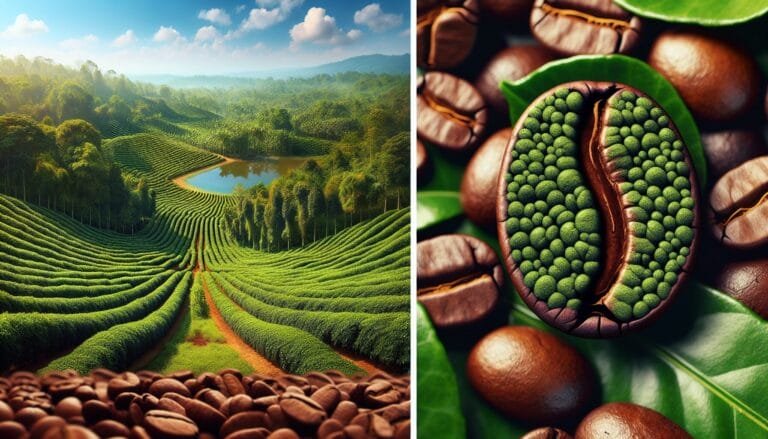
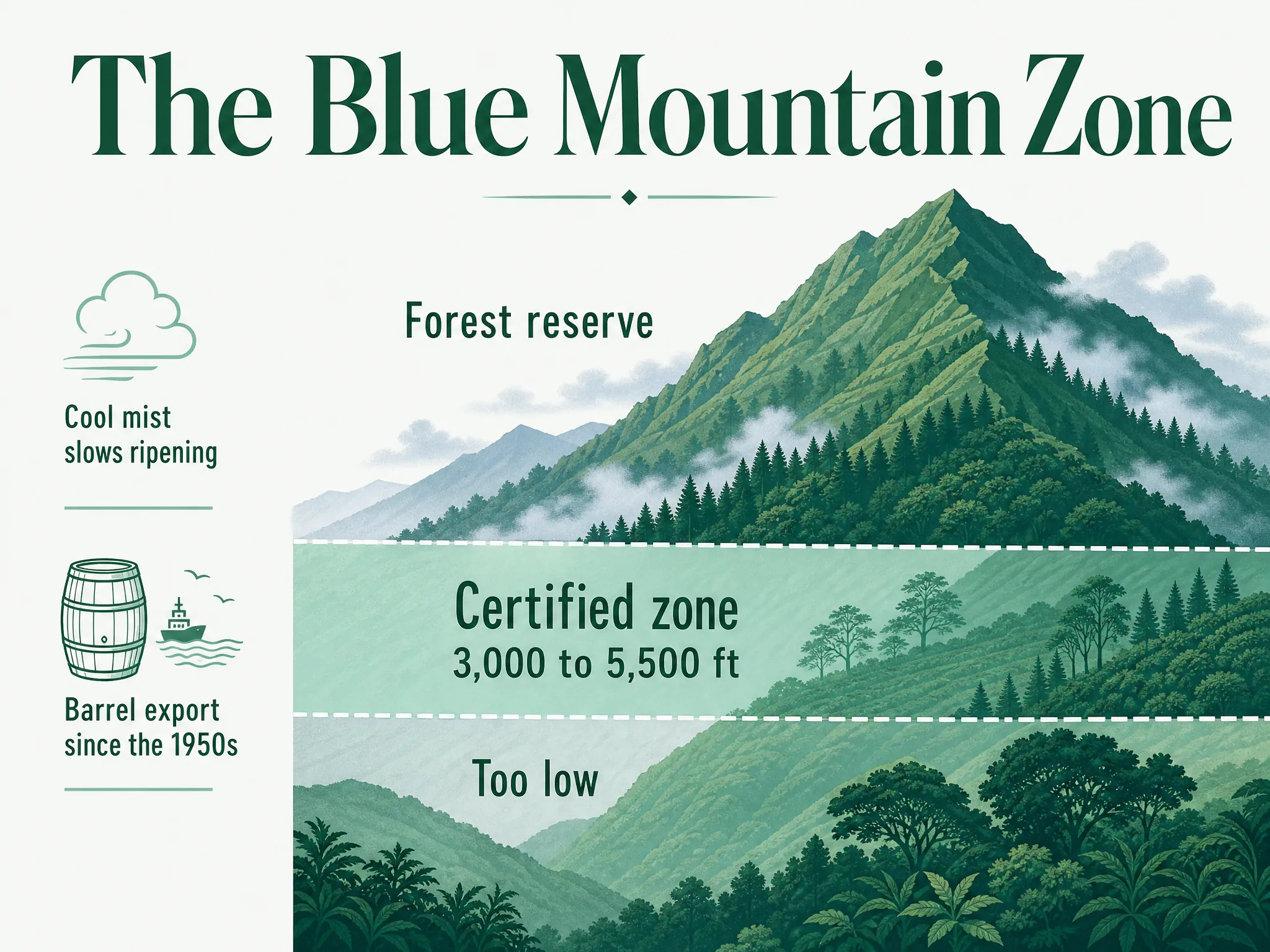
Jamaican blue mountain coffee is arabica grown in a legally defined zone of Jamaica's Blue Mountain range, processed and certified under rules administered by the Jamaica Agricultural Commodities Regulatory Authority (JACRA). The protected growing band runs roughly 3,000 to 5,500 feet above sea level across parishes including Portland, St. Andrew, St. Thomas, and St. Mary. Coffee from the same island grown below that band is sold as Jamaica High Mountain or Jamaica Supreme, not Blue Mountain.
Three things make the zone unusual. The mountains trap cloud cover, which cuts direct sun and slows cherry maturation. Cool nights at altitude extend the ripening window further. And the soil is volcanic and well drained, which coffee roots like.
Slow ripening generally produces denser beans with more developed sugars and lower perceived acidity. That is the agronomic explanation behind the flavor reputation, and it is the same mechanism behind other famous high-altitude coffees.
The name itself is property. Coffee Marks Limited, a JACRA-owned subsidiary, owns and manages the Jamaica Blue Mountain and Jamaican High Mountain Supreme trademarks. JACRA licenses dealers, processors, coffee works, nurseries, and anyone using those marks. So "Blue Mountain" on a bag is a legal claim, not a poetic one.
A protected name is only as useful as the paperwork behind it. Ask who licensed the bag you are holding.
Why is blue mountain coffee so expensive?
Because the supply is tiny, the terrain is punishing, nearly everything goes to Japan, and recent hurricanes gutted the harvest. Those four pressures stack.
Harvesting happens on slopes too steep for machinery, so every cherry is picked by hand, often in several passes as fruit ripens unevenly. Labor is the single largest cost line on most Blue Mountain farms.
Then the volume problem. On October 26, 2026, Dr. Norman Grant, managing director of Mavis Bank Coffee Factory, said Blue Mountain production had fallen to approximately 191,000 boxes, a 25-year low, compared with roughly 500,000 boxes before Hurricane Beryl in 2024. He attributed the drop to hurricanes Beryl and Melissa plus thin recovery support. In the same remarks he put demand at about 350,000 boxes of Blue Mountain and 28,000 boxes of High Mountain.
Demand running near double supply does two things to a premium coffee: it pushes the blue mountain coffee price up, and it hands counterfeiters a business model.
Export concentration tightens it further. JACRA has stated that roughly 70% of Jamaica's coffee goes to Japan. Grant also noted that Japanese buyers want more volume but resist price increases. What reaches US shelves is the remainder, and that remainder competes against the blend market for the same name.
Jamaica is pushing back on the production side. In September 2026, JACRA announced approximately J$35 million in support for around 4,000 Blue Mountain farmers, including 15,000 seedlings, 8,000 bags of fertilizer, 1,000 liters of herbicide, 500 kilograms of fungicide, 500 liters of insecticide, and plant stimulants. The stated targets were pests, harsh weather, and praedial larceny (crop theft). Replanted coffee trees take years to bear fruit, so that program will not move 2026 prices.
How does jamaica coffee certification work?
Jamaica coffee certification runs through JACRA, which licenses every link in the chain and controls use of the trademarks. A legitimate 100% product traces back to a licensed coffee works, a registered farm zone, and an authorized trademark user.
What JACRA actually regulates:
- Licensing of dealers, manufacturers, processors, coffee works, and nurseries.
- Trademark use, through Coffee Marks Limited, for Jamaica Blue Mountain and Jamaican High Mountain Supreme.
- Grading and export handling. In September 2026 JACRA promoted a new warehouse built around certification, storage, and export handling aligned with global standards.
- Blend composition rules, including the 30% minimum discussed below.
JACRA has also said it is building a blockchain-based traceability platform, with QR or bar codes on shipments so buyers can potentially identify the farmer, farm location, and supply-chain details. Kenrick Morgan of JACRA described it as a way to separate authentic Jamaican commodities from third-party knockoffs. Worth knowing the limit: the published announcement describes a rollout planned for later in 2026. It does not establish that universal consumer scanning was live as of November 6, 2026. If a bag has a scannable code today, scan it. If it does not, that alone is not proof of fraud yet.
What does a blue mountain coffee blend legally contain?
Under JACRA's published coffee materials, a product sold as a Jamaica Blue Mountain Blend must contain at least 30% local Blue Mountain coffee by weight. The remaining 70% may come from other origins, subject to licensing and recordkeeping.
A few consequences follow directly.
A properly licensed, accurately labeled 30% blue mountain coffee blend is a legal product. It is not counterfeit. It is also not equivalent to the 100% certified coffee, and should not be priced as if it were.
The 10% premise that gave this article its title is generally inaccurate for Jamaica. Current evidence points to 30% as the Jamaican floor for that specific name. The 10% figure appears tied to other regional labeling contexts or to informal seller claims, not to Jamaican rule. If a US bag advertises "10% Blue Mountain," you are looking at a seller's own disclosure, not a certification tier.
And a blend label that hides the percentage entirely is the real warning sign. Silence on composition usually means the number is not flattering.
Does the percentage of blue mountain actually matter?
Yes, but less than the brew does. At 30%, Blue Mountain beans are a minority of what hits your water, and they are usually blended with coffees of different density and roast behavior. That unevenness tends to flatten the exact qualities people pay for.
Decision rule: buy the blend only if the price reflects the blend. Roughly a third Blue Mountain should cost roughly a third of a 100% premium, not 80% of it.
How to tell if jamaican blue mountain coffee is real or fake
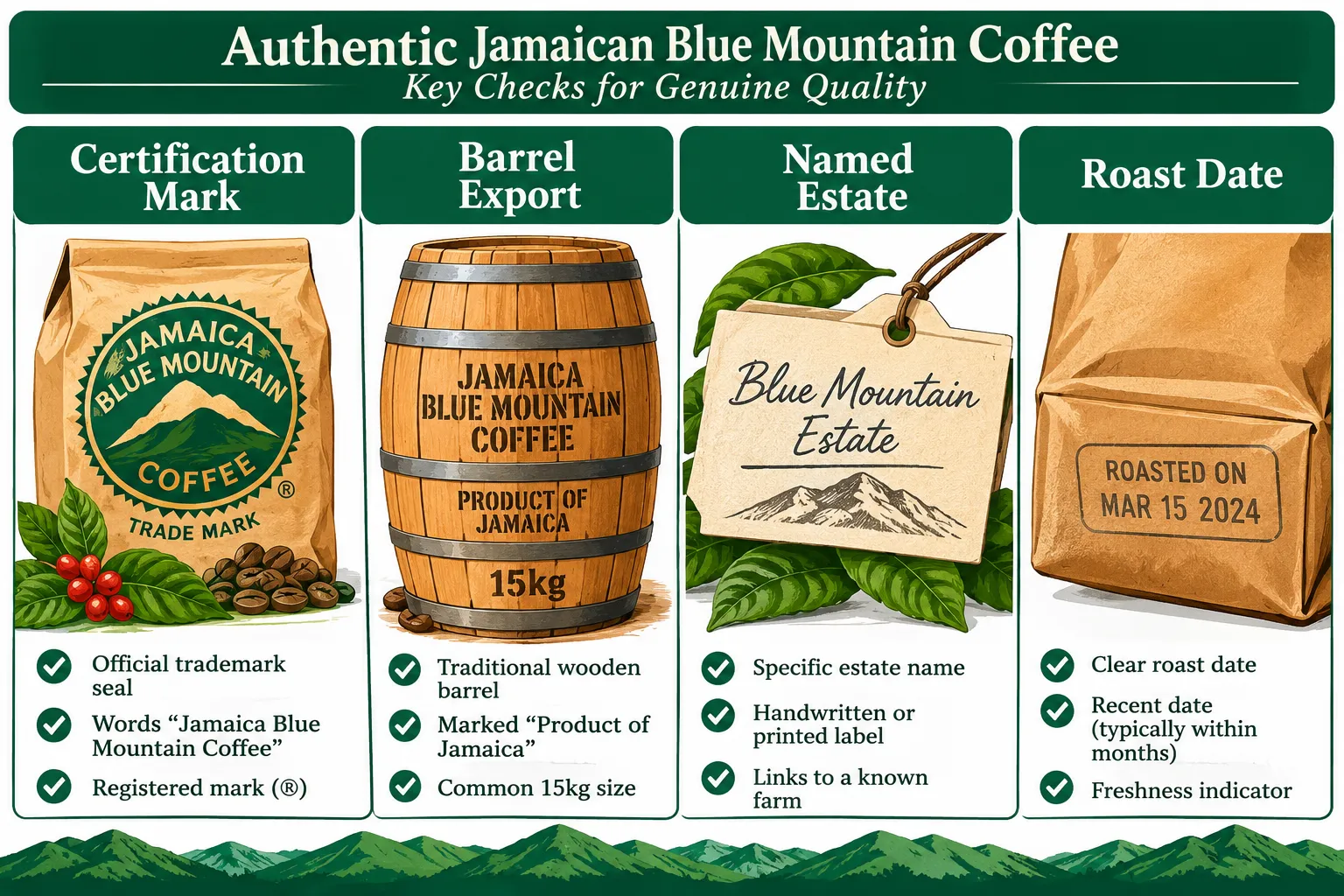
Check four things before you pay: the certification mark with a named licensed dealer, a named estate or coffee works, a roast date, and a price that makes agricultural sense. One of them alone proves little. All four together are hard to counterfeit casually.
Certification mark and licensee. Genuine 100% bags carry the Jamaica Blue Mountain trademark and reference a licensed processor or dealer. A seller who cannot name their Jamaican supplier is not a seller you need.
Barrel export, with a caveat. Blue Mountain has long been shipped in wooden barrels, commonly 15 kg and 30 kg, a tradition rooted in the Japanese trade. Barrels signal a real export channel. They are also easy to photograph for marketing. Treat the barrel as supporting evidence, never as proof.
Named estate or factory. Mavis Bank, Clifton Mount, Wallenford and similar names come with a traceable address. "Imported from the mountains of Jamaica" does not.
Roast date. A roast date within the last few weeks suggests a roaster handling real inventory. No roast date on a coffee costing more per pound than a steak dinner is a judgment call made for you.
Price sanity. Certified 100% at $18 a pound does not exist in 2026, not with production at 191,000 boxes. For context on what honest specialty pricing looks like across tiers, compare against a guide to the best medium roast coffee.
What does real jamaican blue mountain coffee taste like?
Roasters consistently describe it as mild, smooth, low in acidity, with a clean finish. Sellers list notes such as mild sweetness, nutty and chocolate tones, herbal hints, and a notable absence of bitterness . Those are roaster and retailer descriptions, not a documented tasting panel at Coffee Rank IQ.
The honest framing: Blue Mountain is famous for what it lacks. No harsh edges, no sour snap, no lingering bitterness. Drinkers who love bright Ethiopian florals sometimes find it underwhelming. Drinkers who want a gentle, balanced black coffee often find it close to ideal.
Grade affects the cup. JBM is graded by screen size and defect count, with Grade 1 at the top for standard beans and Peaberry sold separately . Higher grades mean larger, more uniform beans, which roast more evenly.
Can you tell the difference between 100% and a 10% or 30% blend?
Side by side, in the same brewer, at the same brew ratio, most attentive drinkers can. Blind and alone, many cannot.
What usually gives the blend away is the finish and the body. The 100% tends to stay smooth through the cooldown. Blends more often turn slightly dry or bitter as the cup drops below about 140°F, because the filler coffee is frequently a cheaper, harsher lot roasted darker to hide it.
Try this at home: brew both at the same 1:16 ratio, same grind size, same water temperature, and taste them at 30 minutes. Hot coffee hides a lot. Cooling coffee tells the truth.
How much does genuine blue mountain coffee cost, and where should you buy it?
Certified 100% jamaican blue mountain coffee in the US generally runs between roughly $50 and $90 per pound across specialty retailers checked on November 6, 2026 . Blends sell far lower, which is appropriate, and occasionally sell far higher than they should, which is the problem.
Buy from a roaster that names its Jamaican supplier, publishes a roast date, and states the percentage in plain numbers. Marketplace listings with no licensee named are where most disappointment lives.
| Option | Typical US price per lb (Nov 6, 2026) | What you get | Best for |
|---|---|---|---|
| 100% certified JBM, Grade 1 | ~$50 to $90 | Full certified lot, trademark, traceable works | Gift buying, one-time curiosity, low-acid drinkers |
| JBM Peaberry | Often above Grade 1 | Single round bean, sorted separately | Collectors and comparison tastings |
| 30% Blue Mountain blend | Highly variable, often $15 to $30 | Minority JBM plus undisclosed origins | Only if priced like a blend |
| “Blue Mountain style” (no %) | $10 to $20 | No certified content required | Skip |
| 100% Kona | ~$40 to $70 | Hawaiian single origin, similar smoothness | Closest profile substitute |
| High-grown Guatemala or Colombia | $18 to $28 | Fresh single origin, documented farm | Best everyday value |
Prices are retailer listing ranges observed in published shop pages, not a negotiated wholesale survey. They move with each harvest.
Blue Mountain vs Kona vs other premium coffees
Kona is the closest everyday comparison: another island-grown, volcanic-soil, hand-picked, protected-name coffee with a mild and smooth reputation and its own 10% blend problem in Hawaii. Panama Geisha costs more at auction but tastes nothing alike, leaning floral and tea-like rather than soft and nutty.
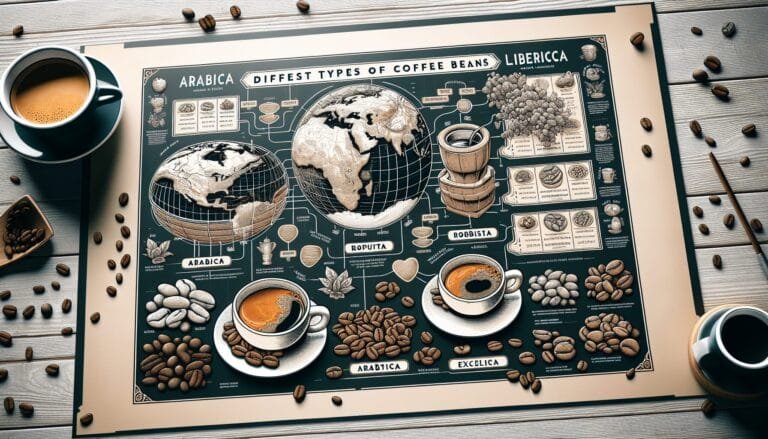
| Coffee | Protected name | Typical profile (as described by sellers) | Blend trap |
|---|---|---|---|
| Jamaica Blue Mountain | Yes, JACRA trademark | Mild, low acid, nutty, clean finish | 30% minimum blends |
| 100% Kona | Yes, Hawaii origin labeling | Smooth, medium body, sweet | Low-percentage Kona blends |
| Panama Geisha | Variety, not a place mark | Floral, jasmine, tea-like, bright | Mislabeled varieties |
| Ethiopian Yirgacheffe | Regional mark | Citrus, floral, high acidity | Regional mixing |
If you want more on how blending changes a cup's structure rather than just its label, the breakdown in mastering advanced coffee blending explains why components fight each other in the brewer.
What to watch out for when buying jamaican blue mountain coffee
Four scams account for most complaints, and all four are avoidable in under two minutes of checking.
- Blend priced like 100%. A 30% blend sold at $55 a pound. Legal label, indefensible price.
- Percentage omitted entirely. "Blue Mountain Blend" with no number anywhere on the bag or listing.
- "Blue Mountain style" or "Blue Mountain roast." These phrases dodge the trademark. They can contain zero Jamaican coffee.
- Unverified marketplace sellers. No licensee named, no roast date, stock photo of a barrel, suspiciously deep discount. With production at a 25-year low, nobody is clearing out genuine inventory cheap.
One more: pre-ground bags sitting on a shelf for months. Grinding multiplies the surface area exposed to oxygen, so staling accelerates. If you are spending this much, see why whole bean versus ground coffee matters more at the premium end, and store opened beans in an airtight container built for coffee.
Is jamaican blue mountain coffee worth the price?
For a gift, a tasting comparison, or a once-a-year indulgence, yes. As a daily driver at $60 or more per pound, most drinkers get better value from a fresh single origin at a quarter of the cost.
Choose the 100% certified if:
- You dislike acidity and want a soft, balanced black coffee.
- You are buying a gift where the name carries meaning.
- You want to taste a protected origin and judge it yourself.
Skip it if:
- You add milk and sugar. The subtleties disappear.
- You brew espresso exclusively. The gentle profile often reads as flat under pressure.
- You drink two pots a day. The arithmetic turns unpleasant fast.
What should you buy if jamaican blue mountain coffee is too expensive?
Pick a named-farm, high-altitude washed arabica with a recent roast date. Guatemalan Huehuetenango, Colombian Huila, and Costa Rican Tarrazú deliver a similar mild, clean, low-bitterness character for $18 to $28 per pound.
For a gentler path to finding one, a rotating subscription like Crema Co lets you sample several origins before committing to a bag.
How do you brew jamaican blue mountain coffee best?
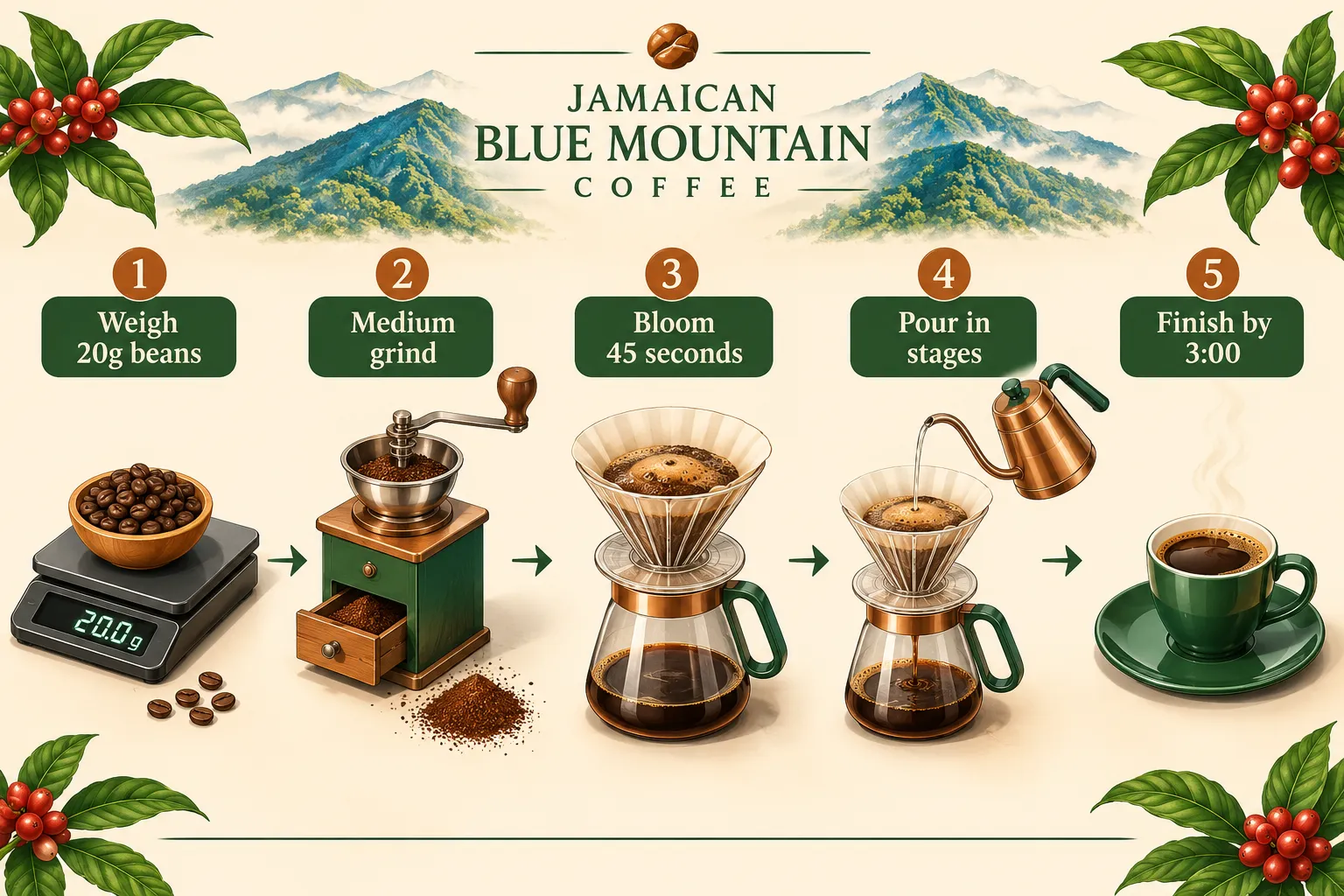
Pour over or drip, medium grind, water at 195°F to 200°F, and a 1:16 brew ratio. The goal is preserving sweetness and body without pulling out bitterness that this coffee does not naturally carry.
Method, step by step:
- Weigh 20 g of whole beans. Scale, not scoop. Blue Mountain beans are dense and a scoop misreads them.
- Grind medium on a burr grinder, roughly table salt texture. Burr grinders produce more even particles, which is the single biggest lever on extraction consistency. See the options in the best coffee grinder guide.
- Heat water to 195°F to 200°F. Slightly cooler than boiling. Full detail in the coffee brewing temperature guide.
- Bloom. Pour about 50 g of water, wait 45 seconds. The bed swells as trapped carbon dioxide escapes. That gas blocks water from reaching the grounds, so the bloom buys you an even extraction.
- Pour in two or three stages to 320 g total. Aim to finish dripping by 3:00 to 3:30.
Troubleshooting:
- Thin and sour? Grind finer or raise water temperature slightly. Under-extraction.
- Bitter and drying? Grind coarser or shorten the pour. Over-extraction.
- Flat and dull? Check the roast date. Beans past about four weeks from roast lose aromatics fast.
French press works too, and keeps more body, but the heavier mouthfeel can bury the clean finish roasters describe. If that is your brewer, stick to a coarse grind and the ratios in the French press coffee ratio guide.
Blend value check
Compare what a Blue Mountain blend costs against the certified 100% price you could pay instead.
As an Amazon Associate, Coffee Rank IQ earns from qualifying purchases.
FAQ
Conclusion
Buy 100% certified jamaican blue mountain coffee, or buy a named alternative and stop paying for the word. Blends at 30% are legal and sometimes pleasant, but the premium belongs to the certified lot, not to a label that borrows its reputation.
Three steps for your next purchase:
- Find the percentage on the bag. If no number appears, assume the lowest one and price it accordingly.
- Name the source. A licensed dealer, a coffee works, and a roast date within the last month.
- Brew it properly. Burr grinder, 1:16 ratio, 195°F to 200°F water, 45-second bloom. Great beans brewed carelessly taste like average beans.
If $65 a pound is not happening this month, pick a fresh high-altitude Guatemalan or Colombian single origin and spend the difference on a better grinder. That swap improves more cups than any origin name on a bag.
Better Coffee Starts With Better Answers.